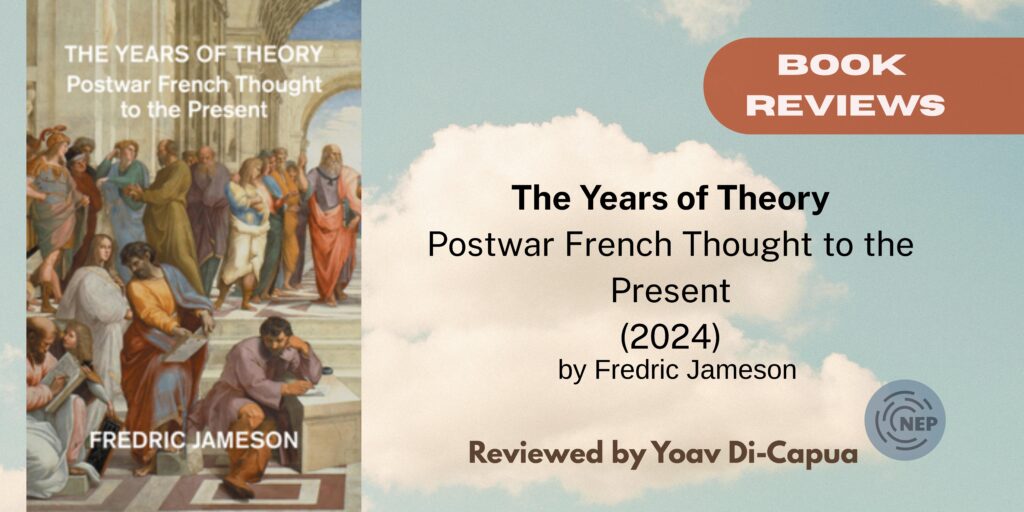
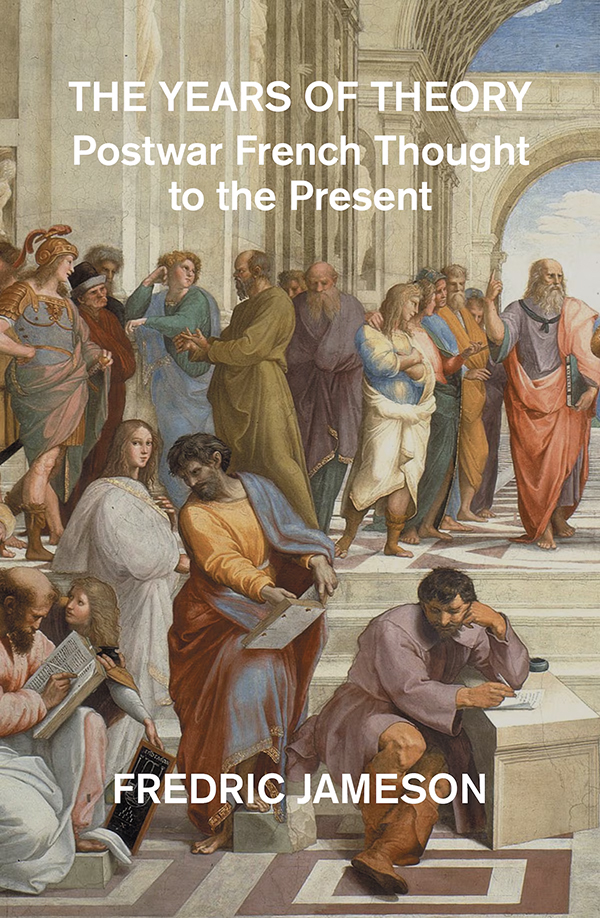
Fredric Jameson has a new book—his last. Published posthumously in 2024, only a few months after his passing, it offers an idiosyncratic philosophical journey through his own deeply personal engagement with French theory. Just as he has done since 1985 as a Professor at Duke University, in this work Jameson takes the time to reflect on what “theory” is trying to do—how, why, by whom, when, and where. The point of the book, he tells us, is to identify the “name and phone numbers” (115) of the makers and shakers of theory, rather than to explain what theory itself is. This is not, in other words, an introduction to French theory. Readers seeking such orientation would be better served by primers such as French Philosophy: A Very Short Introduction. And even then, the search may prove unsatisfying, for French theory resists definition. This resistance, as we shall shortly see, is structural. “Theory,” as it came to be known, is a subject that deftly avoids its own subjectivity, stubbornly eluding definition and self-reflection. Modular, open-ended, and often obscure, it faces outward, lending itself to use and reinvention across disciplines—from comparative literature and cultural studies to architecture, anthropology, gender studies, psychology, and beyond. Each field, indeed each thinker, forges a distinctive variant of Theory. Historians, too, have ours—but more on that later, as this is, first and foremost, Jameson’s experience with theory.
Born in Ohio in the midst of the Great Depression, Jameson attended a liberal arts college in Pennsylvania, where he pursued French studies. He graduated in 1954, just in time to immerse himself in the existentialist carnival sweeping Paris and much of Europe. Existentialism became the subject of his doctoral dissertation at Yale, that of his first book, and, more importantly, a lifelong passion through which he thinks about the world. In addition to his immersion in French thought, Jameson—like many intellectuals of the 1960s—was profoundly influenced by the Frankfurt School, pioneers of a Marxist critique that analyzed capitalism through cultural rather than strictly socio-economic lenses. The German School’s central concern was understanding why revolutions, which Marxist theory predicted, did not occur. This focus led them to prioritize cultural analysis over materialist concerns, inspiring subsequent generations of so-called “cultural critics”—a public persona and political role they effectively helped to invent. Jameson, for his part, embraced this role.
Fusing these two traditions—French and German—Jameson approached the cultural record holistically, viewing it as a vast, expansive field encompassing every sphere of human activity: politics, philosophy, art, literature, music, cinema, architecture, and psychology. By engaging all these spheres, he wrote about “everything,” as the interdisciplinary forebears of the Frankfurt School had envisioned. Progressing steadily, by the 1980s he was widely recognized as the leading Marxist literary and cultural critic in the United States. Observing what he called the slow de-Marxification of Europe, he shifted his focus to the phenomenon that had taken its place: postmodernism (or post-structuralism). Approaching it from the “outside,” he transformed postmodernism—despite its resistance—into a philosophical topic, in need of inquiry.
Approaching postmodernism critically, but without hostility and at times even sympathetically, he emerged as a preeminent critic of this new globalized form of culture, eventually publishing Postmodernism, or The Cultural Logic of Late Capitalism (1991). Thereafter, he followed postmodernism, engaging both its promise and exhaustion in our own neo-liberal times. To translate his stance to the world of art, one might contrast Edvard Munch’s turn-of-the-century modernist painting The Scream, which connotes existential anguish as a quintessential modern condition, and Andy Warhol’s 1970s silkscreens which blur the boundary between high and low culture, foreground reproduction, repetition and surface over depth, embrace irony and ambiguity, and de-center the artist as sole author. Jameson appears to have preferred the recognizable modern subject of Munch, an image hollow enough to project ourselves onto it.
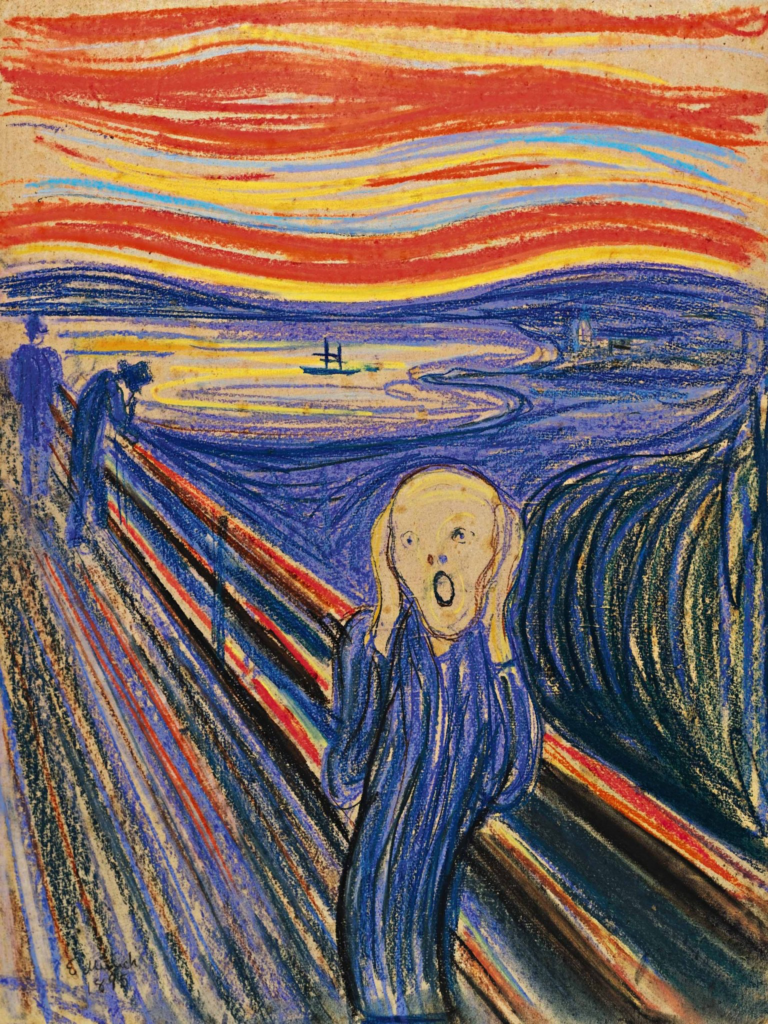
The Scream by Edvard Munch, ca. 1893.
But all of this is rather old news. In his latest book, a more relaxed Jameson circles back to the golden age of French theory—from its initiation with Sartre’s Being and Nothingness (1943), through the late-century experiments of postmodern thinkers such as Alain Badiou’s Being and Event (1988), and on to its American offshoots. For although postmodernism is French in origin, it is also an American tradition: from the late 1970s onward, the United States became the place where French theory found its most fervent reception and political applicability, perhaps even eclipsing its influence in its native country.
Indeed, it was in America that an amplified “theory” crystallized into a heavyweight academic category bearing the aura of exclusivity, elitism, and the promise of an esoteric path to hidden knowledge—what its practitioners often treat as “truth.” To partake in this secular theology—a characterization that critical thinkers vehemently reject—is to enter the worlds of its prophets and saints: Lévi-Strauss, Althusser, Barthes, Lacan, Derrida, Guattari, Deleuze, Kristeva, Foucault, Lyotard, Rancière, Baudrillard, and many others. You may never have read these iconic thinkers, yet if you have ever used terms like discourse, intervention, or narrative, you are already using their language. Also deploying the metaphor of theory as language, Jameson writes of how one “…learns Deleuzian, Derridean…” (96), and many other dialects with which to find truth in the world.
However, the theory-as-language metaphor has some obvious limitations, as, unlike language, the horizon of theory is always normative: concerned not simply with describing the world or explaining how things are, but more urgently with how they might or should be. That feature makes theory a highly political affair. Indeed, what binds the diverse strands of theory is the (Marxist) expectation that the writing and reading of theory will culminate in a revolt against the institutionalized order, or in its 1960s name, “the system.” Another way of understanding it is as a new addition, or an upgrade, to “counter-Enlightenment” thought; a tradition that is as old as the Enlightenment and whose icons are people like Friedrich Nietzsche and Martin Heidegger. With the anti-establishment message baked into its DNA, it is an irony that the only true revolution in which theory participates is that of transforming itself into what it came to destroy: a system. In Jameson’s wise words: “Theory was never supposed to turn into a system; it was supposed to destroy systems in some way and to exist as a kind of local enterprise.” (437-8).
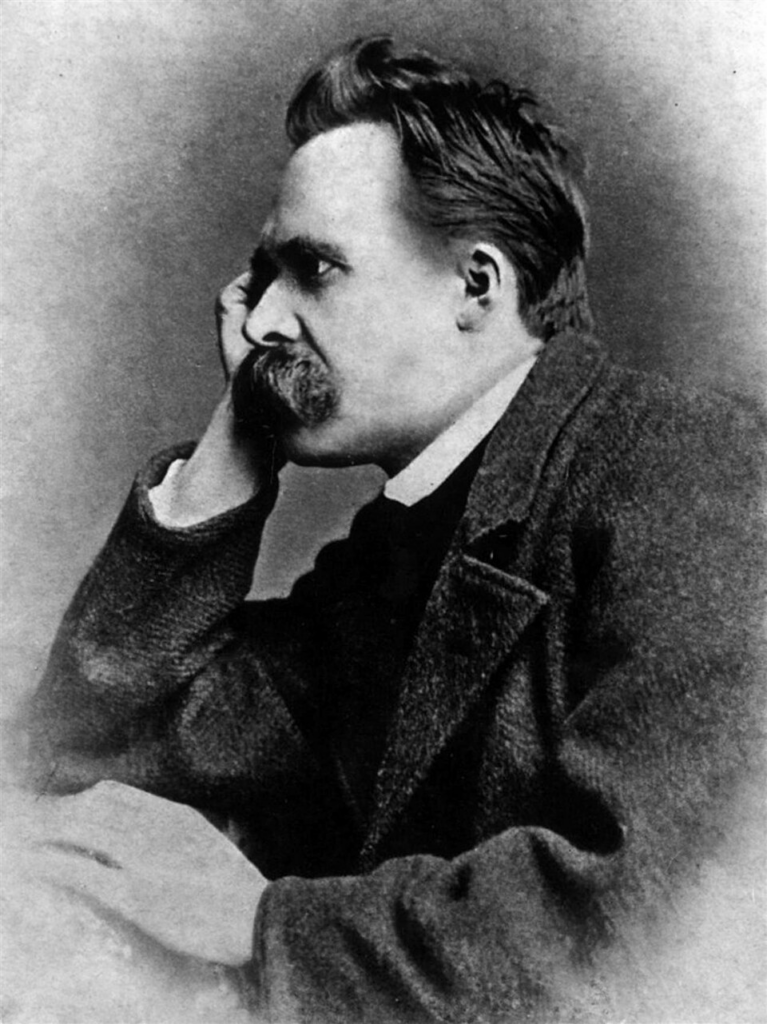
Friedrich Nietzsche by photographer Gustav Schultze, 1882. Source: Wikimedia Commons
Delivered as an online seminar in 2021—the Zoom year of Covid—the twenty-four lectures that make up this book arrive in a composed conversational prose. This is a deliberate stylistic choice, emphasizing the power of narrative and standing in sharp contrast to the often impenetrable and self-referential language of theory. It is, in itself, a political choice. Thematically, Jameson traces a linear progression through philosophy: from existentialism, structuralism, and semiotics to post-structuralisms and the bifurcated intensities of postmodernism. All of this unfolds against the backdrop of shifting ideological, social, and institutional contexts—the liberation of Paris, the politics of the French Communist Party, the Algerian War, May ’68, the rise of Maoism, the long socialist presidency of François Mitterrand (1981-1995), and the triumphant ascendancy of American-made neoliberalism globally.
Jameson engages each philosophical turn and twist on his own terms—autobiographically—which is why The Years of Theory is not an introduction to French theory but a meditation on it. He begins with the philosophical fountainhead of German phenomenology, which displaced an older tradition preoccupied with epistemological questions such as “How can we know that we know?” and “What guarantees the certainty of a scientific proof?” In their place, phenomenologists like Husserl and Heidegger shifted attention to the question of how we experience the world—that is, to the problem of being. With this shift, philosophy moved away from concepts of “essence” and “substance” toward a relational perspective, one that understands “…things of the world and the people of the world” (42), in other words, existence itself, as an interactive process.
Concerning that major shift toward existentialism, Jameson—like many others—credits Jean-Paul Sartre with translating phenomenology into a philosophy of freedom. Central to this is Sartre’s foundational theorization of otherness, a concept that has since become a mainstream feature of contemporary culture, especially in television and media. If you find yourself wondering about the current language of otherness—for example, the “objectifying look” or the “gaze” (le regard), which reduces a woman to an object of another’s desire and need, or what is now framed as “microaggression”—Jameson points you back to Sartre.
Sartre also endures in our lives through his coinage of the term commitment (engagement), by which he pioneered a new political model of intellectual activism—demanding that intellectuals not merely describe the world, as in socially detached scholarship, but actively work to transform it. This, too, resonates strongly today. Jameson, who matured intellectually in the world that existentialism had ushered in, remained permanently marked by Sartre’s insistence that individuals accept responsibility for their own freedom (“Freedom has to be your own act,” Jameson explains, 41). Yet although an enthusiastic follower, Jameson is also keenly aware of Sartre’s philosophical shortcomings: his failure to translate the philosophy of freedom into a universal ethics applicable across the globe; his reckless conceptualization of anti-colonial violence as a form of freedom; and—most painfully for Jameson—his inability to reconcile existentialism with Marxism.
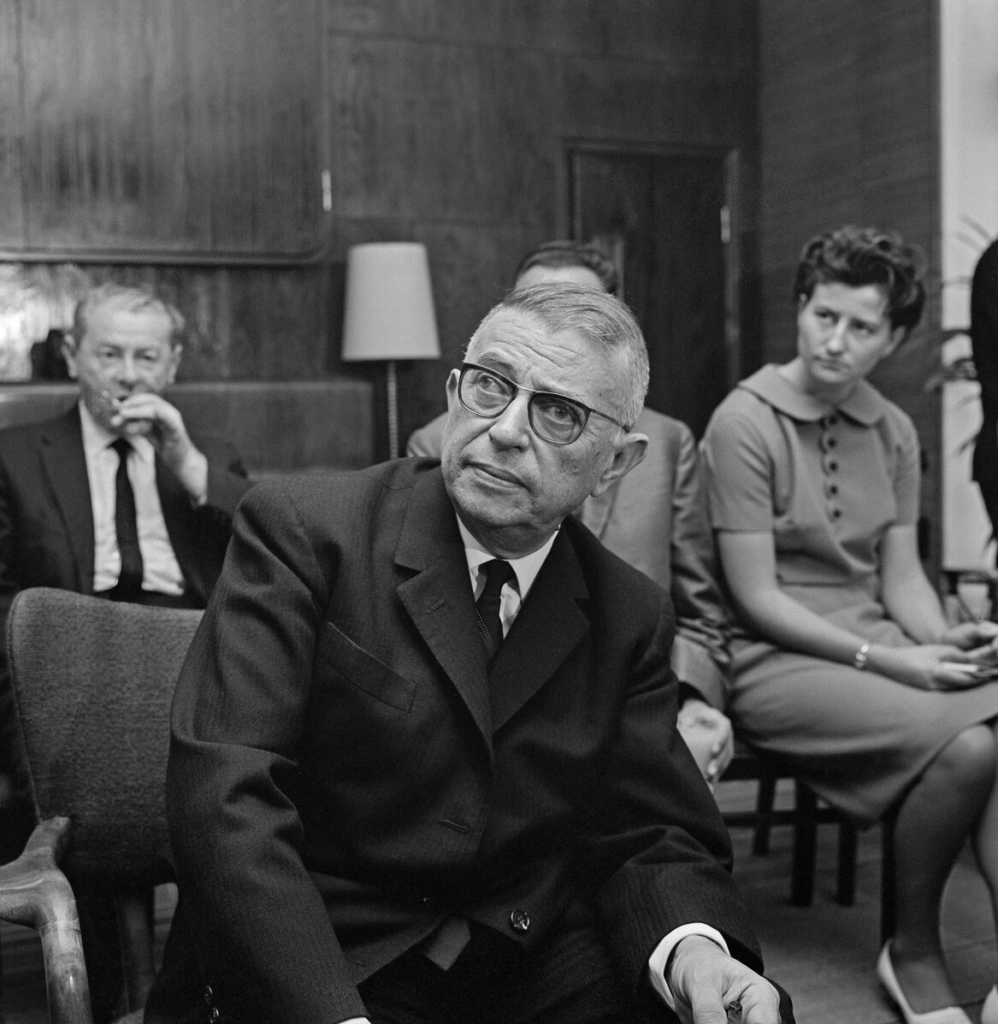
Jean-Paul Sartre, 1965. Source: Wikimedia Commons
Next, Jameson turns to structuralism, a movement that unfolded alongside existentialism but whose roots reach back to early twentieth-century studies of linguistic structures. “…in the structuralist period,” Jameson writes, “the major thought was that language produces us, that what we think of as our identity and our subjectivity is an effect of language” (251). From this perspective, anthropologists, historians, and literary critics built an entire conceptual universe of specialized jargon through which they sought to identify and analyze systems whose structures and rules were understood as binding, holistic, and universal, rather than culturally specific, decentralized, or random.
In their effort to map these structural grids, structuralists like anthropologist Claude Lévi-Strauss and literary critic Roland Barthes advanced ironclad assumptions: isolated subjects and words derive their meaning only through their function within a larger system, such as tribal patrimony, never on their own. In this view, a word signifies not in itself but by virtue of its difference from other words. Structuralist analysis thus emphasized how meaning is produced through a structure of binary oppositions such as modern vs. traditional, male vs. female, metropole vs. colony, or city vs. countryside. These oppositions were thought to underlie myths, texts, and cultural practices—and, most relevant here, the writing of history. In one of the many original moments in the book, Jameson reflects on how structuralists transformed problems into solutions, not by “solving” them, but by describing and exploring their structures and rules. This helps explain why, in those years, so many graduate seminars in history bore the title “Problems in Social History,” encouraging Ph.D. students to identify, articulate, and analyze the structure of the past.
As a system of interpretation that subordinated individual agency to overarching structures, structuralism had already reached its limits before the revolutionary moment of May ’68, when it became clear that individuals were lost within societies remarkably resilient to fundamental change. A piece of graffiti from the time mocking structural Marxist Louis Althusser—“Althu sert à rien” (“Althusser is worthless”)—captured the stasis that pushed a new generation to revisit an old question: Where does power come from, and how does it operate? This new focus on power signaled the arrival of post-structuralism—an imprecise umbrella term marking the postmodern liberation of theory from the constraints of organized, or rather structured, philosophy. In the 1970s, French thought staged a decisive break with the Cartesian model of the autonomous rational subject (“I think therefore I am”), which constituted the very basis of Enlightenment.
Where structuralism conceived of the world in terms of fixed systems and universal rules, post-structuralism emphasized instability, plurality, and the impossibility of establishing meaning in any absolute sense. Post-structuralist thinkers argued that structures were not fixed, timeless, and universal but contingent, unstable, and constantly shifting—therefore subject to ongoing interpretation and reinterpretation. Viewing meaning as never fully present and always deferred, Jacques Derrida coined the term différance to describe the process by which meaning emerges through an endless play of differences, never reaching a final ground or essence. This shift implied an abandonment of stable definitions or absolutes of any kind, inaugurating a form of relativism that resisted the very possibility of ontological grounding in the form of authoritative truth. As sociologist and philosopher Jean Baudrillard put it in his book Simulacra and Simulation (1981), signs in culture no longer refer to any reality at all. They only refer to other signs, as in Warhol’s work. This is the age of pure simulation, where the distinction between reality and representation collapses and with it the ability to tell truth from fiction. About that, Jameson is clear: “There is no truth, so all you getting is effects.” (140).
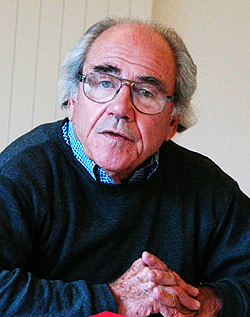
Jean Baudrillard in 2005. Source: Wikimedia Commons
Post-structuralists in particular challenged the supposed truth of binary oppositions, exposing them as instruments of vertical power that establish hierarchies of privilege—for instance, the white heterosexual man over his “others,” or civilization over the colonized “savage.” If you are following today’s culture wars, the language of privilege should sound familiar: its origins lie in this critique of binary opposition as the normative and seemingly objective order of things, as suggested by the title of Michel Foucault’s 1966 book The Order of Things: An Archaeology of the Human Sciences. Yet Foucault pushed the argument further, insisting that knowledge itself is conditioned by power relations that define what counts as truth, normality, or rationality. In doing so, he marked all forms of modern disciplinary knowledge as potentially oppressive.
Foucault, Roland Barthes, and others also began to treat texts, cultural practices, and institutions as socially constructed, shaped not by inherent essence but by discourse and social practices. A now-familiar claim within this line of thought is that “sex is a construction”: biological differences are not simply natural givens but are produced and sustained through cultural practices, including the assignment of roles, behaviors, and expectations to different bodies (male, female, or otherwise). This, too, strongly resonates with our current moment.
Taking yet another step, this perspective led post-structuralists to suggest that everything can be read—and unread—as a constructed text: not only literature, but also social practices (such as Independence Day), institutions (such as the archive), norms (such as objectivity), and, by implication, entire histories. Enshrining the autonomy of such texts, Roland Barthes famously proclaimed the “death of the author,” arguing, as in Warhol’s silkscreens, that meaning is not determined by an author’s intention but remains open to multiple readings. When Fredric Jameson and his colleagues co-founded the journal Social Text in 1979, they embraced the idea that texts lack any final, fixed meaning and instead exist within intertextual networks, where meanings are continually shaped and reshaped through other texts and contexts. Despite advancing a theoretical defense of narrative and storytelling as forms of criticism in his 1981 book The Political Unconscious, Jameson subscribed to a postmodern sensibility for much of the following decade. Eventually, however, he stepped off the train—while many of his colleagues remained aboard.
Since post-structuralists argued that any attempt to provide a complete, closed system of meaning is reductive, essentialist, functionalist, and thus both impossible and oppressive, they cultivated a deep suspicion of totalizing explanations—what François Lyotard famously called “grand narratives” in the style of books like The Making of The Modern World: From The Renaissance to the Present (1955). To expose their exploitative nature, post-structuralists developed a method of reading known as deconstruction, whose modus operandi was to identify the operation of binary oppositions within texts, along with instances of essentialism, functionalism, and reductionism—all of which function as agents of power concealed as normative order. Having taken American academia by storm in the early 1980s, the post-structuralist theoretical corpus as a whole, and deconstruction in particular, exerted enormous influence on the writing of history, forcing it to rethink its procedures, methods, norms, and utility. Forcing it to entertain anew an old question: What is History?
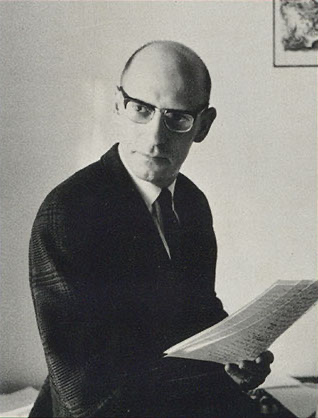
Michele Foucault in 1970. Source: Wikimedia Commons
I recently spoke with a middle-aged man who, after a long and highly successful career in business, had returned to his alma mater as a distinguished fellow. As an undergraduate in the late 1980s, he had majored in history at an Ivy League school, studying with some of the most prominent historians in the country. Three and a half decades later, he was eager to rekindle his passion for the past by taking history courses once again. Yet, to his surprise, he found the discipline almost unrecognizable: “We used to study the past as it happened. We were tested and quizzed relentlessly on the nuts and bolts of historical events and processes—the making of modern Germany, the Russian Revolution, the decline and fall of imperial China. But now it seems as if students already know the facts, and all they do in class is philosophize. Much of it is about the past as an experience—whatever that means. What happened?” “French theory happened,” I answered, but immediately added, “that it is not as bad as it looks.” It will take a book to explain what was lost and gained in the historical profession since the 1970s, and, not being a professional historian, Jameson sheds light only on some of these aspects, particularly about the utility of historical narrative.
However, if you return to read the grand historical narratives of the 1980s, especially histories of Africa, the Middle East, Asia, and possibly Latin America too, you will likely find them profoundly unsatisfactory for all the reasons that post-structuralists have listed. These histories were written largely with the source material of the European states which dominated, indeed colonized, much of these lands for centuries on end, thus structurally failing to account for the lived experiences of those who suffered under their rule. But even the national histories of Europe were lacking: entirely overlooking the history of women and working classes, to cite two glaring examples of how more than half of the nation’s population was not represented in the supposedly inclusive story of the nation. Consult the big histories of the Cold War and, until recently, you are not likely to understand how global and violent this war was, the exact opposite of what its name suggests. All of these were selective histories in need of serious revision.
The dissatisfaction with these canonical narratives was routinely treated as symptomatic of the many problems of professional history. Attacks and counter-attacks between historians and theoreticians animated the scholarly scene for some decades now, most recently in 2018 with the publication of the Theory Revolt Manifesto against academic history. On all sides, this is a substantial debate with some serious arguments and counter-arguments. At its very heart, however, lies the issue of narrative, its delegitimization on one hand, and the desire to have orienting grand narratives on the other. Today, many of our students are fluent in deconstructing texts, identifying how power flows through them, raising serious questions about why our national history “begins” at this particular date and not another (for instance, the 1619 Project, which seeks to unseat 1776 as the founding moment of the United States). That, however, is not to say that they actually “know” history, its facts and sequences in the sense that a student of the 1980s was expected to. Or that they can even, in the absence of a shared world of facts and sequences, think with it with some level of sophistication. Thus, by way of a criticism, many in the profession, students included, practice history as what Jameson himself calls “search and destroy missions” (437) of enemy texts and authors. That is highly unfortunate.
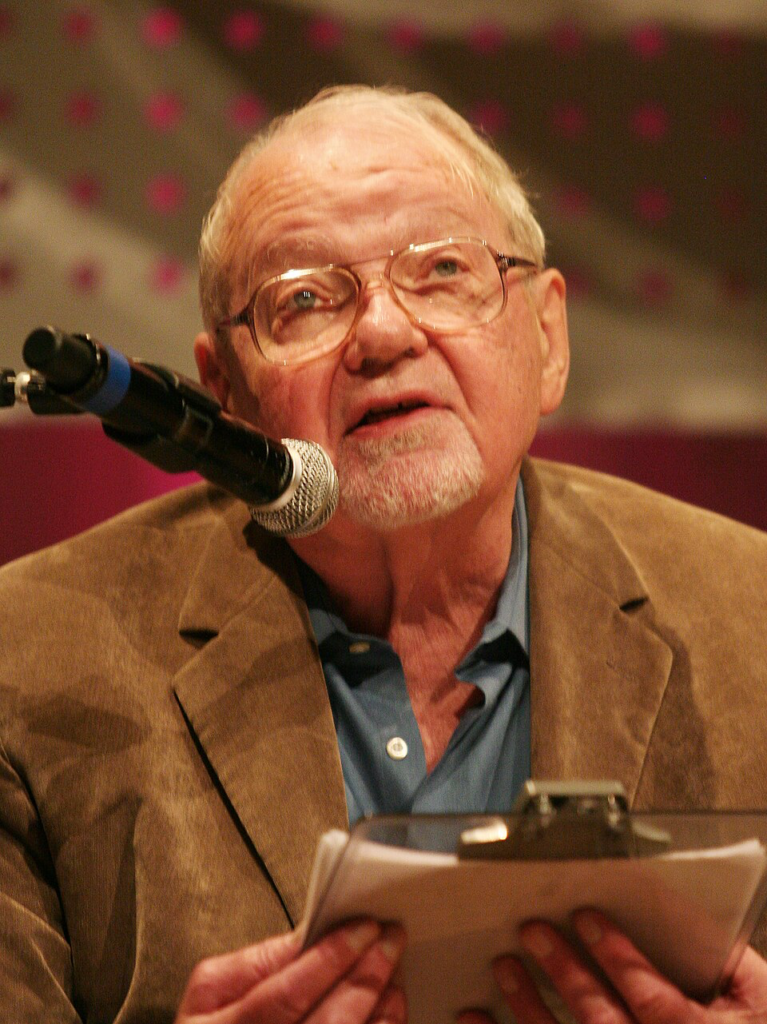
Fredric Jameson in 2004. Source: Wikimedia Commons
To move forward, we must reject the notion that theoretical engagement—assumed to be inherently progressive, emancipatory, and just—is incompatible with historical narrative, which is often presumed to be reactionary, oppressive, and exclusionary. Instead, we should harness the remarkable postmodern insights of the last few decades to imagine and write new narratives. If the integrity of political community is to be preserved, we need histories capable of incorporating postmodern critique without collapsing into post-Enlightenment cultural pessimism (“oppression is everywhere”) and without losing sight of the common good. Crafting such humanizing narratives, in academic scholarship, public history, school textbooks, and in film, too, is nothing less than an urgent cultural mission. Without them, we risk a slow descent into political tribalism and chauvinistic nationalism.
For this reason, despite his deep investment in criticism and Theory, Jameson, in this final book, offers several statements advocating a renewed engagement with narrative. Reflecting on the impossibility of representing Derrida, he writes: “I don’t see how you can write a good book about Derrida,” since, by design, there is no central work or masterpiece—only a method of reading and a theoretical attitude (252). In a more direct statement, Jameson insists that “…narrative is important, because it’s very hard to see how you can have any kind of history without a historical narrative. History is a historical narrative. It’s not the facts” (116). This, arguably, is one of the most important lessons we can draw from the life and work of such an intellectual giant.
Yoav Di-Capua teaches modern Arab intellectual history. He is the author of Gatekeepers of the Arab Past: Historians and History Writing in Twentieth-Century Egypt (2009) and No Exit: Arab Existentialism, Jean Paul Sartre and Decolonization (2018). He is currently completing a new history of the Global 60s in the Arab world. His work was supported by the National Endowment for the Humanities and the Alexander von Humboldt Foundation in Germany and the Simon Guggenheim Foundation.
The views and opinions expressed in this article or video are those of the individual author(s) or presenter(s) and do not necessarily reflect the policy or views of the editors at Not Even Past, the UT Department of History, the University of Texas at Austin, or the UT System Board of Regents. Not Even Past is an online public history magazine rather than a peer-reviewed academic journal. While we make efforts to ensure that factual information in articles was obtained from reliable sources, Not Even Past is not responsible for any errors or omissions.



_(cropped).jpg)
.svg)
