This article is part of the series: History beyond Academia
History is often considered a solitary and insular discipline. Popular conceptions of historians include people holed up in dusty archives, writing in academic jargon, and going on long tangents about a subject that only they care about. In other words, academic history is written by historians, for historians. While some of these stereotypes persist, the advent of new digital technologies has made it both easier and more necessary than ever to produce accessible and engaging historical scholarship for audiences at all levels of expertise. Additionally, digital technologies allow historians to communicate their research using different strategies, not solely relying on the written word to convey information. In this piece, I reflect on my work in digital history, examining the strategies and methods used by the projects I’ve helped develop to make history more accessible to public audiences. I hope that this will spark ideas among professional and casual historians alike in understanding the necessity of moving towards a more connected and welcoming field, and that digital tools and methodologies are one of the options in making this happen.
I came to the world of digital history through the “digital” side. I had spent my first undergraduate year as a computer science major, but after completing a summer internship as a software developer, I realized that I was missing the humanities in my life. While I wasn’t yet ready to commit to being a historian as a career, I sought out ways that I could involve myself with the History department on campus. Luckily, The Nonviolence Project, a project run by Dr. Mou Banerjee, centering undergraduate research on nonviolent people and protests, was hiring a web designer. This was the first of many digital history projects I would later join. Through this experience and the ones that followed, I learned many lessons not only about how digital methods help communicate history, but also how they enhance the discipline of history.

Woman using computer. Source: Wikimedia Commons
Learning Outside of Books
One of the key strengths of digital history is its ability to engage different types of learners. Not everyone learns and internalizes information through reading alone; for many, interactive or visual forms of presentation are more effective, bringing history into a digital landscape. Many digital history projects are exploring these new tactics for sharing history, since a website or other digital platform is more conducive to these alternate methods of learning than a typical published book. Three projects that I’ve worked on come to mind when I think about the wide variety of ways that history can be made interactive. These forms encourage a broader and more expansive understanding of the past, and demonstrate how historical stories can be communicated in the present.
The Nonviolence Project is such a platform, where student researchers write articles about the history of nonviolence while sharing more nonconventional forms of history. The home page has an interactive map with markers for the different articles hosted on the site. This map allows someone to visually see the regions where nonviolence has made a significant impact. Also highlighted on the website is a playlist that a student made containing “songs relevant to nonviolent protests and movements.” Songs often create a more immediate emotional connection to a subject than typical prose does, so including songs inspired by nonviolence is an innovative way to connect to a wider audience. These types of unconventional ways of sharing history and historical knowledge make the subject more intriguing for people who might be disinclined to simply read history.
More recently, I’ve worked with Virtual Angkor, a project based out of Monash University, Australia, that seeks to virtually model the Angkor Wat complex and its surrounding landscape during its thirteenth-century heyday. Along with a comprehensive model, the team creates “scenes” meant to visually and auditorily depict the setting. Each part of the scene is painstakingly modeled by hand and thus has a specific purpose for being included. By analyzing and investigating the scene, users, students, and the public alike can learn about what Angkor might have looked like and sounded like as the people living there would have experienced it. Once again, this method of conveying information is both more engaging and more approachable to a wider group of people than a typical book or article might be, allowing for an immersive way of “experiencing” history.

View of the central structure of Angkor Wat. Source: Wikimedia Commons
Currently, I am in the process of creating a history-based video game in collaboration with the University of Texas’s JapanLab and the History Games Initiative. In this game, the player acts as an Afrodescendant healer in the booming port environment of seventeenth-century Cartagena de Indias, exploring the city, interacting with clients, and trying to avoid the Inquisition, which demonized African ancestral forms of healing as witchcraft. This was my first experience leading a team on a digital scholarship project. At times, it was difficult to ensure that everyone was on the same page. Some students came to the team with a stronger historical understanding of the setting and occasionally assumed knowledge that the team needed to unpack together. Despite these challenges, it has been one of the most fulfilling projects I’ve had the opportunity to work on. This project also helped our team understand what it means to work on an interdisciplinary team, pulling on each member’s strengths and finishing with a complete video game. Conveying this important era of history as a video game will allow for more people to engage with it, and hopefully, it will spark further interest.
Accessible History
Beyond making history more engaging, digital history also leads the discipline to be more accessible in general. Since these projects are publicly accessible, often hosted on the web, more people can discover them outside of an institutional setting. Beyond this, communicating history online widens the audience to those who are unable to read more traditional histories in books. Generally, books are made to be consumed through reading, in one language, and can only be read after purchasing. While there are exceptions to this—such as access through audiobooks, translated volumes, and renting through a library—not every work of history will be available through the above ways. Digital access allows historical knowledge to be communicated auditorily through videos or a screen reader, web accessibility standards ensure that website content is available to people who might be disabled, the text can be translated (though imperfectly) through built-in browser functions, and are generally free to access on the Internet. Additionally, the language used in digital history is often more accessible, written for a public audience rather than academics, lowering the barrier of entry for anyone interested in the subject.
The Nonviolence Project comes to mind when thinking about accessible history. This project is somewhat unique in terms of historical research because it employs undergraduate students interested in writing their own original research, which is published on a public-facing platform. Part of my job duties was to edit these articles as they came in, not only for grammar but also for clarity. I learned how important it is to keep language accessible, especially when the audience is the public. Beyond this, I also used more traditional web development standards to ensure the site was accessible on the back end, including alt text in images and using headings in the proper order. Such edits make sure that the site is compatible with screen readers that the visually impaired use to navigate the site.
Another benefit of digital history compared to more traditional forms of communicating history is that it allows for different “levels” of communication. When reading a book or article, there is usually only one way to read it: from beginning to end. However, through digital history, the same project can offer different levels of engagement. At Virtual Angkor, lesson plans are divided into three different levels based on the amount of engagement offered at each one. The first level is what one would see embedded on the site: videos, a small amount of text, and a few questions asking the user to analyze the video. The user would get the big picture of what the module is trying to convey, but doesn’t necessarily have to dig deeper. The second level contains reading excerpts from books and articles about the topic written by historians, anthropologists, and other experts on the subject for further analysis and offers more in-depth comprehension and evaluation questions. Finally, the third and most in-depth level contains a full reading list, offering the most comprehensive view of the subject evaluated in the module. The user is able to choose their own path based on their own level of interest and their own comprehension skills of the subject at hand. In this way, more people can productively interact with the site. Users are in charge of how they want to learn, and the website meets them where they are at.
Digital History to Counter (Inaccurate) Pop History
Creating innovative, interactive, and accessible ways of telling history is especially important when there are other, less-than-accurate representations of that same period. The Colombian television show Siempre bruja is set during the same time period as the video game I worked to develop, but does not go into depth on how the Inquisition worked to target African and Indigenous healing practices and instead represented them as real-life magic. The television show is problematic for other reasons, including portraying the main character, Carmen, in a (seemingly consensual) romantic relationship with her enslaver, Cristóbal. Because audiences may be drawn to the show for its entertainment value while assuming it conveys historical insight, it is especially important to provide similarly accessible, but more accurate, ways of presenting this history.
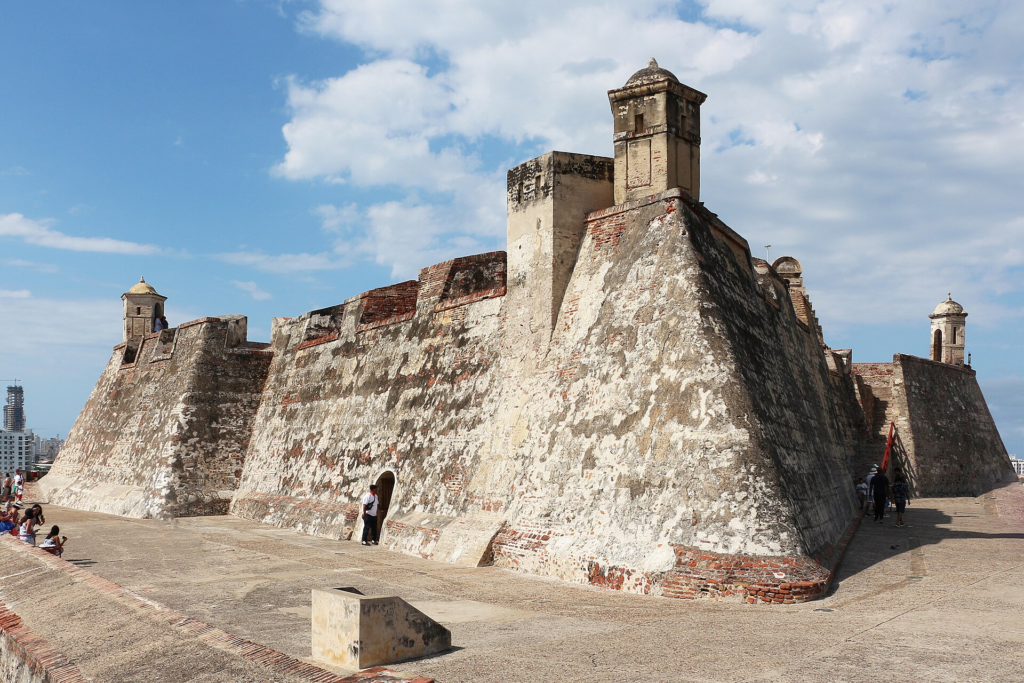
Castillo San Felipe de Barajas in Cartagena, Colombia. Source: Wikimedia Commons
While Siempre bruja was far from a pop culture phenomenon, it is likely some people’s only exposure to that period in history. For many years, historians have debated whether they have a responsibility to intervene when an inaccurate or harmful narrative becomes entrenched in society. While there are many different positions on this debate, a possible intervention in digital history can be to offer more accurate but still engaging historical narratives that the public can seek out in addition to written forms of history.
Conclusions
Taken together, these examples illustrate how digital history expands both scholarly practice and public engagement. Through seemingly endless techniques, a project can take any number of forms. Existing projects, such as The Nonviolence Project, Virtual Angkor, the JapanLab, and History Games Initiative, can all act as models for what the future of digital scholarship might look like; histories that allow learners to more deeply integrate themselves into the area and period which they represent. Some projects even go a step further—literally recreating the past for people in the present to explore and experience.
History is not only for academics—it is for everyone. No longer are historical narratives written by historians, for historians. Instead of alone in a dusty archive, a digital historian might be frequently found in front of a computer, putting the finishing touches on a publicly accessible website, designing a virtual model of an ancient city, or meeting with a team to create a more interactive way of communicating a subject.
Chloe Foor is a Phd student in History at the University of Texas at Austin. Her current project focuses on how physical spaces impacted gendered, racial, and religious identities in the New Kingdom of Granada in the seventeenth century, as well as how historical actors manipulated those identities to claim space for themselves. Currently, she is working with the JapanLab/History Games Initiative to develop a video game highlighting Cartagena Inquisition’s witchcraft trials during the early seventeenth century.
The views and opinions expressed in this article or video are those of the individual author(s) or presenter(s) and do not necessarily reflect the policy or views of the editors at Not Even Past, the UT Department of History, the University of Texas at Austin, or the UT System Board of Regents. Not Even Past is an online public history magazine rather than a peer-reviewed academic journal. While we make efforts to ensure that factual information in articles was obtained from reliable sources, Not Even Past is not responsible for any errors or omissions.