This article is part of the series: History Beyond Academia
Este artículo tiene una versión en español.
History is, above all, an effort to understand the past. Those of us who study it seek to reconstruct and interpret what happened, using methods that allow us to do so with care and rigor. We work with documents from the past—what historians call primary sources—which may be genuine, falsified, or somewhere in between. From these materials, and in dialogue with other researchers, we build interpretations that help us understand each era within its own context.
Often, we think of history as an individual pursuit among intellectuals. However, as the British historian Raphael Samuel noted, history is “a social form of knowledge, the work […] of a thousand different hands.”[1] This means that anyone—from a grandmother to a mail carrier—tells and evaluates historical events in their everyday lives, passing them down through oral or written traditions. History is not the monopoly of historians!
From the start, we conceived of the podcast as an opportunity to offer historical tools to a wider audience. In each episode, we present both objects—“things,” in this case—and distinguished researchers, with the goal of showing the many ways one can narrate and interpret a historical object, especially those from the colonial past and their implications in the present, whether the object is found in a museum, a church, or a private collection. This collaborative work has allowed us to build a shared vision of the colonial past—one we hope to enrich through dialogue with our listeners.
In this article, we reflect on the meaning of these historical objects and the ways researchers have revalued them—transferring their significance from the present to the past and vice versa—through a public medium such as a podcast.
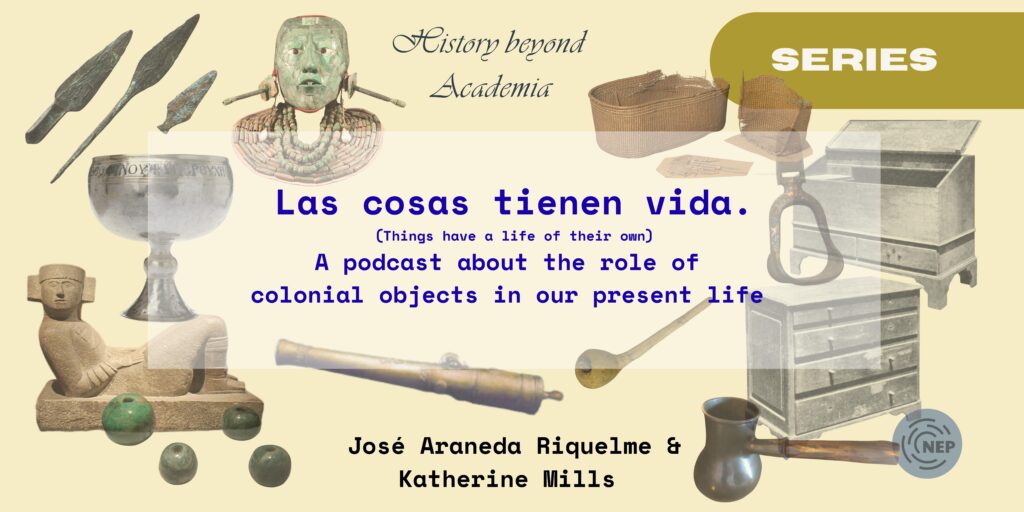
Podcast logo: Las cosas tienen vida.
The podcast Las cosas tienen vida (“Things Have a Life of Their Own”) first aired in April 2021 as a Public History project.[2] Its goal was to awaken interest among a broad Spanish-speaking audience in new methods of historical research through the study of cultural objects.
The idea took shape months earlier, during the coffee breaks that punctuated our long workdays at the Archivo de Indias in Seville. Among the piles of colonial documents, our conversations kept circling back to the same frustration: alack of spaces where we could share our research beyond academia. We wondered whether there was an engaging way to communicate our colleagues’ scientific advances to a general audience.
Who are these stories really for—the ones we devote so much effort and passion to? Could we build communities that value historical objects? How can we create spaces for researchers to share their work with non-specialists? Perhaps it was the effect of the pandemic—or simply a final burst of energy in our doctoral lives—but that’s how the idea to create something new was born.
At first glance, our podcast might resemble other projects that tell the history of the world or a nation through a series of objects.[3] But our purpose is different: we don’t aim to offer an identity-based or closed interpretation of a community and its time. Instead, we want to open up new ways of understanding history and its objects across the vast and diverse space that was the Iberian world in the early modern period.
We don’t tell the stories—we simply open the microphone. The storytellers are our guests, the researchers themselves. Each season, we invite ten to twelve specialists whose work covers different regions of the Iberian colonial world, showcasing the richness of perspectives and methods used to study the past. Each guest chooses an artifact and, from there, guides us through their own historical journey.
So far, the podcast includes more than one hundred episodes across nine seasons, featuring researchers from seventeen countries and disciplines as diverse as archaeology, engineering, history, and art history.
Our “radio cabinet of curiosities” follows no rigid selection criteria; instead, it moves freely within a creative kind of disorder that we love. From the beginning, we wanted to center each researcher’s choices, convinced that doing history is also a political act. This means accepting that we cannot control an object’s narrative or claim a single truth. Rather, we share our own questions and experiences through them.
Within that apparent chaos, we always seek a common thread: the relationship between people and their objects, both past and present. That connection is what ignites historians’ passion—a feeling that comes through in every conversation. In recent episodes, we have begun even asking our guests directly about why they chose their object, what drew their interest, and when they first encountered it.
By incorporating objects from the Ibero-American and even Ibero-Asian worlds, we’ve been able to cross national, physical, and intellectual borders. These crossings have been especially fruitful: for instance, Argentine historian Lucila Iglesias discusses a Chilean object—the Cristo de Mayo; Chilean researcher Laura Fahrenkrog colonial Paraguayan musical instruments; or Spanish scholar Marina Torres a Catholic priest’s cap from the Guangdong Provincial Museum in China.[4] In such cases, boundaries blur and give rise to new, exciting combinations. We thus break away from the national paradigm that still conditions us—the idea that a Chilean historian must study Chile’s history, or a Californian, California’s.
Over the past five years, we’ve learned almost everything—from how to conduct a good interview to how to survive final editing. Given the geographical diversity of our guests, we rely on technologies like Zoom to record episodes. Then, we carefully edit each one so that both the researcher and the object are presented in the best possible way, using tools like Audacity. Afterward, we manage social media and digital platforms to reach a wide audience. Each season, we tweak the format based on listener feedback and suggestions.
For example, at first we produced longer episodes—45 minutes to an hour—but listeners told us that was too long for their typical listening habits. Some even told us, laughing, that they listen to the podcast while doing yoga! Since then, we’ve aimed to keep episodes between 25 and 30 minutes. It wouldn’t be an exaggeration to say that behind each 25-minute episode there are over ten hours of work. Still, we continue this unpaid labor as an act of love—and as a political gesture toward the stories and research we share.
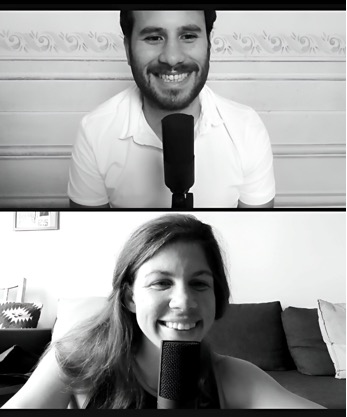
José y Kate during a recording session.
Throughout our nine seasons, we’ve built a virtual cabinet full of fascinating objects: from a lost cushion that resurfaced in the midst of a political dispute during the alférez mayor ceremony in Quito in 1573,[5] to more traditional artworks like a Cuzqueñan School painting of the Magdalene in Ecstasy, now part of the Thoma Collection in the U.S.[6]
Our decision to title each episode as ”un (a)”—for example, A jar or A painting by Velázquez (an upcoming episode in our new season)—is a deliberate stance against the dominance of canonical historiography. We’re not a podcast about canonical works. Instead, we give voice to objects without imposing a stylistic or historiographical framework upon them. By examining different kinds of things, we aim to show the importance of studying them holistically—as individual responses to the local and global dynamics that characterized Iberian globalization.[7]
But it’s not enough to show a variety of objects. In our podcast, we strive to delve deeply into each one, going beyond mere description. We explore its historical value, its purpose, the reality it represents, and the context in which it emerged. We ask what messages it conveys, what role it played in its time, and what it means today. We also reflect on how these objects are accessed today and complement each episode with books or articles on the topic—ideally written by the guest researcher themselves.
Of course, making history accessible doesn’t guarantee people will listen. Since the first episode, we’ve reached over 10,600 downloads, meaning that each episode was saved by a user on their device.[8] Listen counts vary widely depending on the object and its origin. For instance, the episode on South American Revolutionary leader Simon Bolívar’s sword has many more listens in Colombia than elsewhere.[9] Local communities are often especially receptive, both to the episodes and to the researchers’ own engagement—like in the episode about “a fragment of white clay” in Cajamarca, presented by Solsire Cusicanqui.[10]
Thanks to the RSA Grant for Public Engagement Project in Renaissance Studies, awarded by the Renaissance Society of America, we’ve recently expanded the project to other platforms by creating a website: www.lascosastienenvida.com.
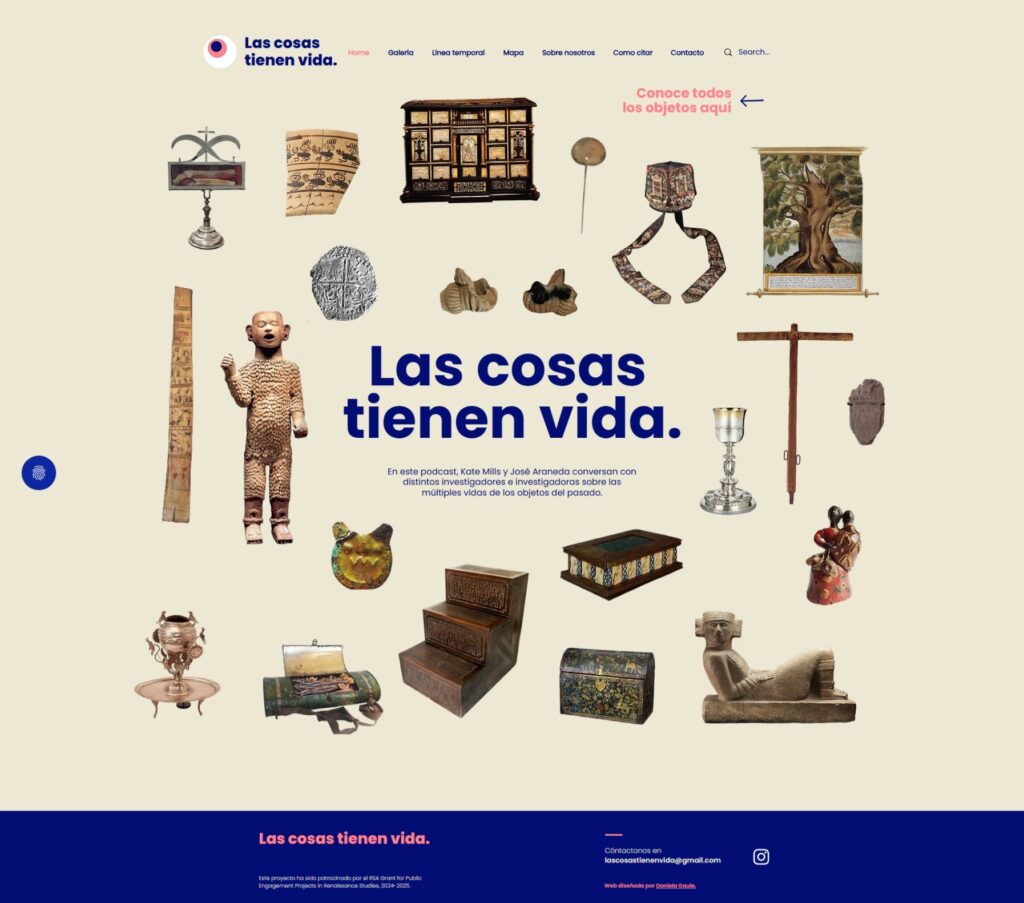
Las cosas tienen vida web page.
We began by uploading the most recent episodes, as older ones require image and copyright permissions. Our large archive of recordings will be gradually added. The website offers three different ways to visualize the objects, allowing listeners to make temporal, geographic, and visual connections among them. Clicking on any image opens an individual object page. For example, the page for the Inca staircase—the first object in season eight—shows the general layout: each page includes an image of the object, the podcast episode, its transcript in Spanish and English, and a brief biography and photo of the researcher.
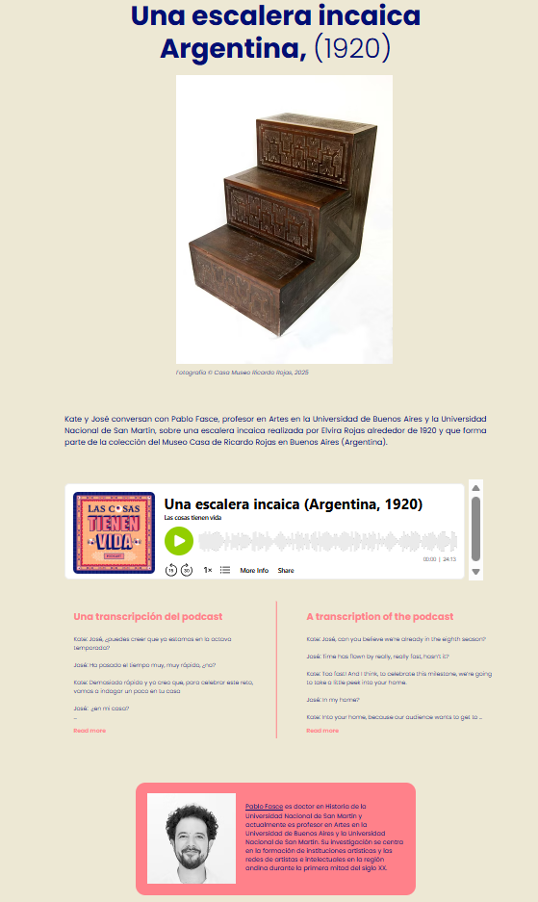
Template with an object and its interview.
The new website also serves as a valuable educational resource, both for secondary and university teaching. It offers students and teachers the opportunity to explore new objects, ask critical questions, and even develop future research projects. The platform encourages active learning, inviting historians, students, and the general public to explore the past with curiosity and rigor. More than a digital tool, it’s an interactive space where objects come to life and become accessible to a wide audience. Its goal is to serve as a bridge between history and community, promoting dialogue and participation around our shared past.
As a closing thought, we’d like to return to a question historian Marc Bloch immortalized more than seventy years ago: “Tell me, father, what’s the use of history?”.[11] Our answer today has been to create a podcast. In Las cosas tienen vida, we show that history not only illuminates the past but also connects cultures, geographies, and human experiences through the objects that surround us. Across nine seasons, we’ve explored that relationship between objects and history with researchers from different countries and disciplines, revealing multiple ways of understanding the world.
With our new website, we take that mission one step further—creating a space that links objects across time and space and serves as both an educational tool and a platform for sharing historical knowledge. We want history to keep engaging with communities, inspiring every listener, student, and researcher to find, in the objects of the past, their own answer to that eternal question: What is history for?
Kate (Katherine) Mills is a postdoctoral fellow at the Kunsthistorisches Institut in Florence. She holds a Ph.D. in Art History from Harvard University and an M.A. in the History of the Spanish Monarchy from the Universidad Autónoma de Madrid. Her current research examines the relationship between Andean natural disasters and the artists who contributed to the reconstruction of affected cities.
José Araneda Riquelme is a postdoctoral fellow in the MISGLOB Project, “Catholic missions and the global circulation of people and goods in the early modern period (1500–1800)”, at Roma Tre University. He holds a Ph.D. in Early Modern History from the Scuola Normale Superiore di Pisa and an M.A. in History from the Universidad Católica de Chile. His research explores the relationship between communication and the construction of the Spanish Empire during the seventeenth century.
The views and opinions expressed in this article or video are those of the individual author(s) or presenter(s) and do not necessarily reflect the policy or views of the editors at Not Even Past, the UT Department of History, the University of Texas at Austin, or the UT System Board of Regents. Not Even Past is an online public history magazine rather than a peer-reviewed academic journal. While we make efforts to ensure that factual information in articles was obtained from reliable sources, Not Even Past is not responsible for any errors or omissions.
[1] Raphael Samuel, Theatres of Memory: Past and Present in Contemporary Culture (London: Verso, 1994), 15.
[2] “Public history” is the practice of doing history with and for the public. It seeks to share historical research beyond the academic sphere, promoting civic participation in the interpretation and use of the past.
Thomas Cauvin, Public History: A Textbook of Practice, 2nd Edition (London: Routledge, 2022), p. 4.
[3] MacGregor, Neil. A History of the World in 100 Objects. New York: Penguin Books, 2013 y Lucena Giraldo, Manuel. 82 objetos que cuentan un país: Una historia de España. Madrid: Taurus, 2015.
[4] José Araneda Riquelme y Kate Mills, «Un gorro sacerdotal (China, s. XVIII). Con Marina Torres. Ep. 3×05 (12/04/2022)», Con Marina Torres. Ep. 3×05 (12/04/2022), Las cosas tienen vida, s. f.; José Araneda Riquelme y Kate Mills, «Un documento de unos músicos indígenas (Paraguay, s. XVIII)», Con Laura Fahrenkrog. Ep. 2×02 (31/08/2021), Las cosas tienen vida, s. f.; Araneda Riquelme y Mills, «Un gorro sacerdotal (China, s. XVIII). Con Marina Torres. Ep. 3×05 (12/04/2022)».
[5] José Araneda Riquelme y Kate Mills, «Un Cojín (Ecuador, 1573)», Con Laura Paz Escala. Ep. 5×05 (16/05/2023), Las cosas tienen vida, s. f.
[6] José Araneda Riquelme y Kate Mills, «Una Magdalena en éxtasis (Perú, s. XVIII)», Con Rosario Granados. Ep. 4×01 (13/09/2022), Las cosas tienen vida, s. f; José Araneda Riquelme y Kate Mills, «Un Velázquez (España, 1632)», Con Cécile Vincent-Cassy. Ep. 9×07 (13/01/2026), Las cosas tienen vida, s. f.
[7] Serge Gruzinski, Las cuatro partes del mundo: historia de una mundialización (México: Fondo de Cultura Económica, 2010).
[8] Datos derivados de las estadísticas privadas que nos entrega nuestra plataforma de podcast “Buzzsprout”.
[9] Por ejemplo, el episodio “Una espada de Simón Bolívar” (temporada 4, episodio 9) analiza la espada del líder revolucionario Simón Bolívar. El veinte por ciento del total de descargas de este episodio proviene de Colombia, en particular de la región de Bogotá, donde actualmente se encuentra la espada.
José Araneda Riquelme y Kate Mills, «Una espada de Simón Bolívar (Colombia, s. XIX)», Con Juliana Ramírez Herrera. Ep. 4×09 (08/10/2022), Las cosas tienen vida, s. f.
[10] José Araneda Riquelme y Kate Mills, «Un fragmento de cerámica blanca (Perú)», Con Solsire Cusicanqui. Ep. 3×10 (17/05/2022)., Las cosas tienen vida, s. f.
[11] Marc Bloch, Apología para la historia o el oficio de historiador [1949] (México: Fondo de Cultura Económica, 2001).