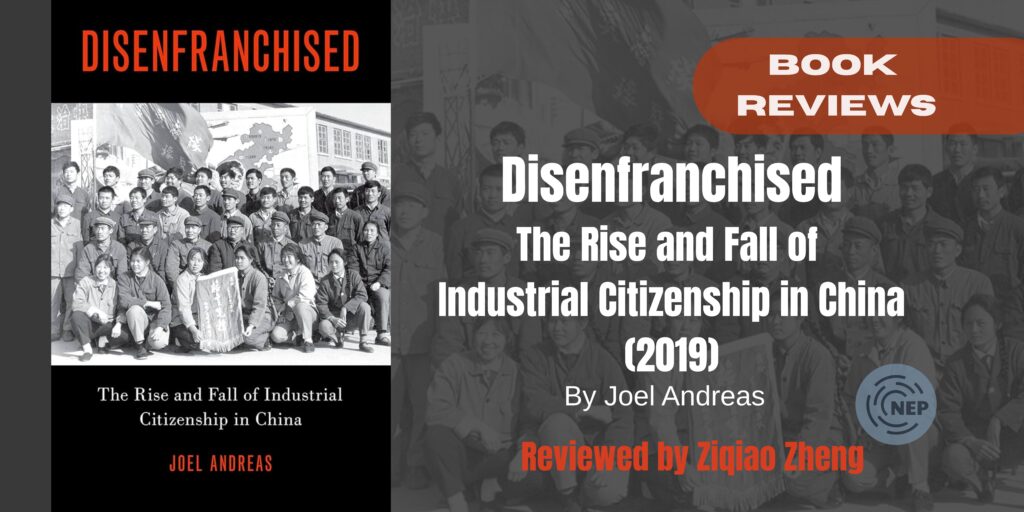
In Mao-era factories, workers were officially described as the “masters” of the workplace. With the support of the party-state, they participated in factory management through supervisory practices, while simultaneously embedding workers within Party-led systems of governance. In Disenfranchised: The Rise and Fall of Industrial Citizenship in China, Joel Andreas examines this tension, in which mechanisms of participation both motivated workers and constrained their actions. Andreas draws on interviews with 128 industrial enterprise employees to reconstruct the informal mechanisms of the workplace, showing that Mao-era patterns of factory governance were shaped through workers’ close identification with their workplaces and the binding of material interests to the workplace. Thereby extending Andrew Walder’s new traditionalist framework beyond treating shop-floor governance primarily as a cadre–worker dyad.
To make sense of this tension, Andreas adapts Guy Standing’s concept of “industrial citizenship,” which treats workers not merely as employees but as legitimate stakeholders entitled to material protection and governance participation. In Chapter 1, he builds on this idea by introducing two analytical dimensions–“workplace citizenship” and “autonomy in the workplace”–to examine how workers’ capacity for participation and claims-making within the factories shaped the practice of shop-floor democracy.
The remaining chapters are organized in chronological order. Chapter 2 examines the early years of the People’s Republic, showing the complex process through which the state incorporated workers into newly emerging structures of factory governance through institutional arrangements such as trade unions and workers’ congresses, which supported the takeover and transformation of capitalist industry and commerce. After a relatively peaceful socialist transformation of industry and commerce, the state established lifelong employment for workers in state-owned enterprises. These new enterprises, danwei, or work units, formed the central ground of working-class experiences: employment was tied to welfare provision and mechanisms of political supervision, thereby encompassing all aspects of daily life beyond production. Thus, workers should be identified and considered primarily as “danwei persons” rather than “social persons.”
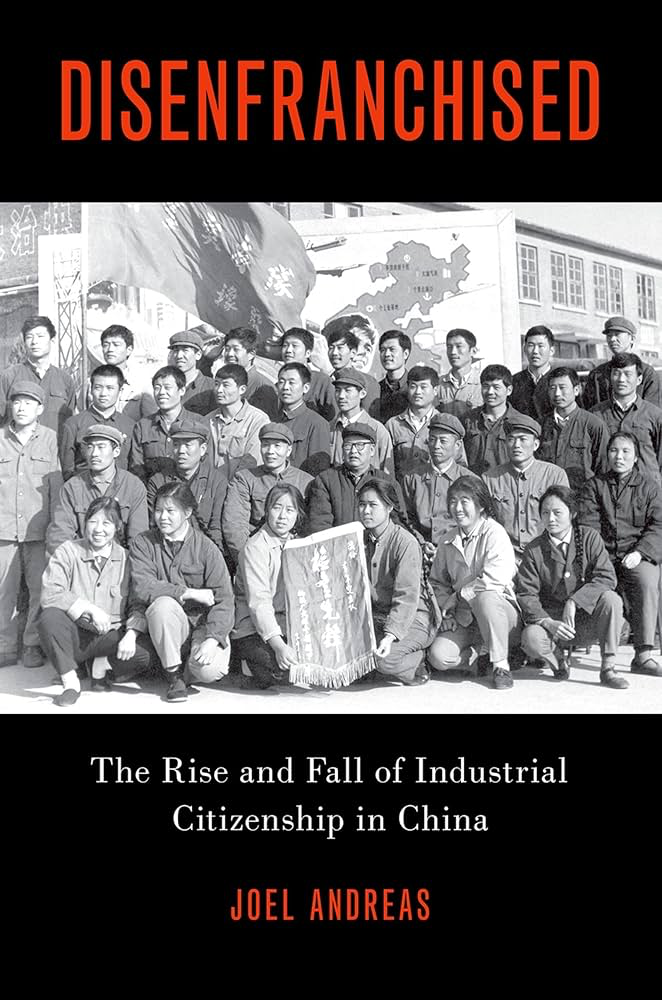
The title of Chapter 3, “Participatory Paternalism,” offers a concise description of the form of workplace democracy. As the author highlights, although institutions of democratic management were installed by the state, in practice, workers’ representatives were seldom able to challenge factory leadership; they functioned mainly to discipline capitalists and incumbent managers and to contain worker dissatisfaction. This finding corroborates the scope of workplace democracy in China delineated in Andreas’s Chapter 1 framework: workers’ attachment to the workplace sustained participation, while limited autonomy constrained meaningful negotiation.
In Chapters 4–6, Andreas discusses how leaders headed by Mao realized the limitations of the SWC in factory democracy and thus launched a series of political campaigns to promote workers’ participation in politics, factory decision-making, and supervision. Chapter 4 traces a series of top-down political campaigns that sought to advance democratic practice by mobilizing workers to openly criticize bureaucratism. These movements granted workers a limited supervisory voice, a trend that culminated in the “Big Democracy” movement of 1966 during the Cultural Revolution. Chapter 5 emphasizes that the Cultural Revolution profoundly reshaped the work-unit system, as workers acquired greater room for initiative and collective action, and a wave of worker movements directly challenged long-established patterns of factory authority.
In the post-Mao era, the “economism” upheld by the reform and opening-up fundamentally undermined the foundation of industrial democracy that had been established over the previous thirty years. Chapters 7 and 8 emphasize that Mao-style mass mobilization failed to establish a reproducible democratic supervisory system. Although Deng Xiaoping’s reforms primarily affected the economic sphere, each component sustaining democratic practice was successively damaged or dismantled in the course of market-oriented reform. As work unit communities were gradually steered toward profit maximization, economic hegemony marginalized workers’ voices. Workers ultimately lost their participatory citizenship in the workplace, leading to the establishment of a pure market despotism.
The brilliance of Andreas’s research on the rise and fall of industrial citizenship lies in employing an analytical framework to highlight the fragility of participatory democracy. In the passive revolution of the party-state’s market transition, the reorientation of the party-state’s will reduced participatory institutions to rubber stamp. Given the work-unit system’s lack of autonomy, workers’ political participation was progressively stripped away through the combined effects of marketization and party-state intervention. Participatory democracy under industrial citizenship produced neither regression nor progress, but rather a state of stagnation. The “Big Democracy” of the Cultural Revolution witnessed a multitude of political experiments, albeit many of them quickly vanished, leaving countless regrets. When worker groups autonomously initiate organizational modes and reshape their political subjectivity can this stagnation possibly be broken.
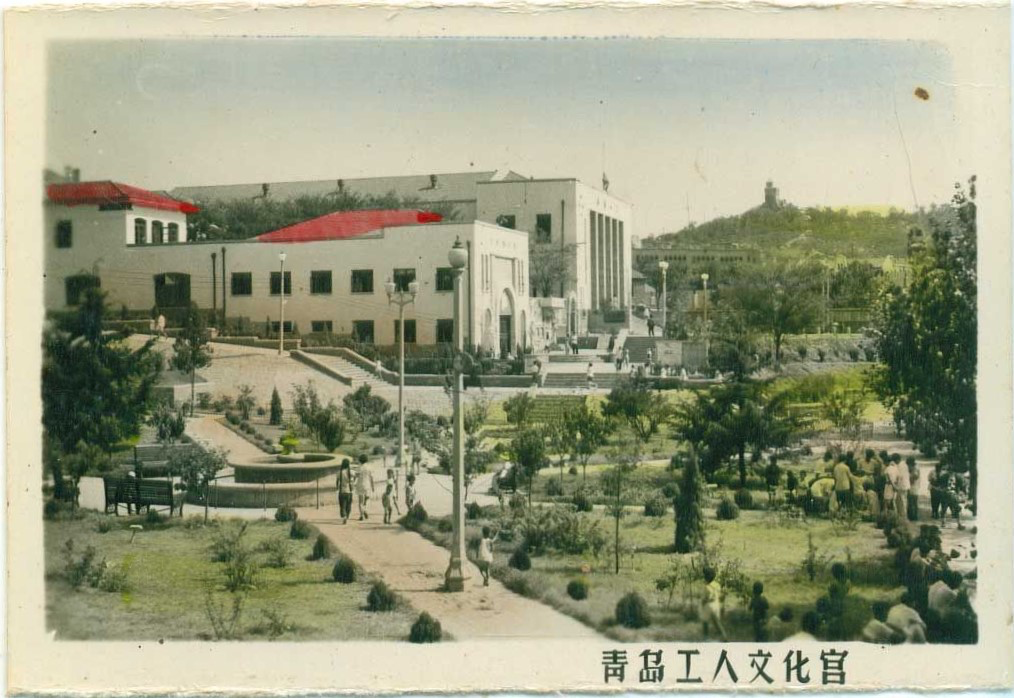
Qingdao Workers’ Cultural Palace, 1950s. Source: Wikimedia Commons

While the book’s broad scope—spanning from the Chinese socialist revolution to its integration into globalized development—is commendable, its vast temporal coverage results in a somewhat thin analysis of specific periods. Andreas’s analysis reflects a mechanistic perspective. Within his framework, Mao’s series of political experiments failed to curb bureaucracy because democratic power fundamentally relies on autonomy. Beyond citizenship, however, the other principle of politics is equality. In the profit-centered reform era, workers’ voices carried little weight when confronted with the economic and technical discourses of cadres, an imbalance that the Maoist educational revolution sought to eliminate and that points to an additional aim of those political experiments beyond Andreas’s focus. Consequently, his analysis does not fully examine how the intricate machinery of the production system continued to keep workers in a subordinate position.
Nevertheless, this milestone study is essential reading for any scholar of China. Its focus on the workplace as the central arena of socialist revolution offers a crucial lens for understanding PRC history and yields precious, cautionary, yet inspiring lessons for contemporary industrial democracy. Moreover, while Andreas extends Walder’s analysis, the book’s minor missteps remind us that if we obscure complexity and neglect to ask how democratic planning projects unraveled under internal tensions and external pressures, we forfeit the chance to turn emancipation’s potential into actuality.
Ziqiao Zheng graduated from the University of Sydney with a Bachelor of Arts in History. His postgraduate research in Environmental Science focused on climate–labour movements and democratic production in sustainable economies, leading to a deeper interest in the politics of production in 1960s China.
The views and opinions expressed in this article or video are those of the individual author(s) or presenter(s) and do not necessarily reflect the policy or views of the editors at Not Even Past, the UT Department of History, the University of Texas at Austin, or the UT System Board of Regents. Not Even Past is an online public history magazine rather than a peer-reviewed academic journal. While we make efforts to ensure that factual information in articles was obtained from reliable sources, Not Even Past is not responsible for any errors or omissions.
Related posts:
 Great Books on Women’s History: Asia
 Red China’s Green Revolution: Technological Innovation, Institutional Change, and Economic Development under the Commune by Joshua Eisenman (2018)
 Asian American Immigration: Read More
 Narcotic Culture: A History of Drugs in China, by Frank Dikötter, Lars Peter Laamann, and Zhou Xun (2004)