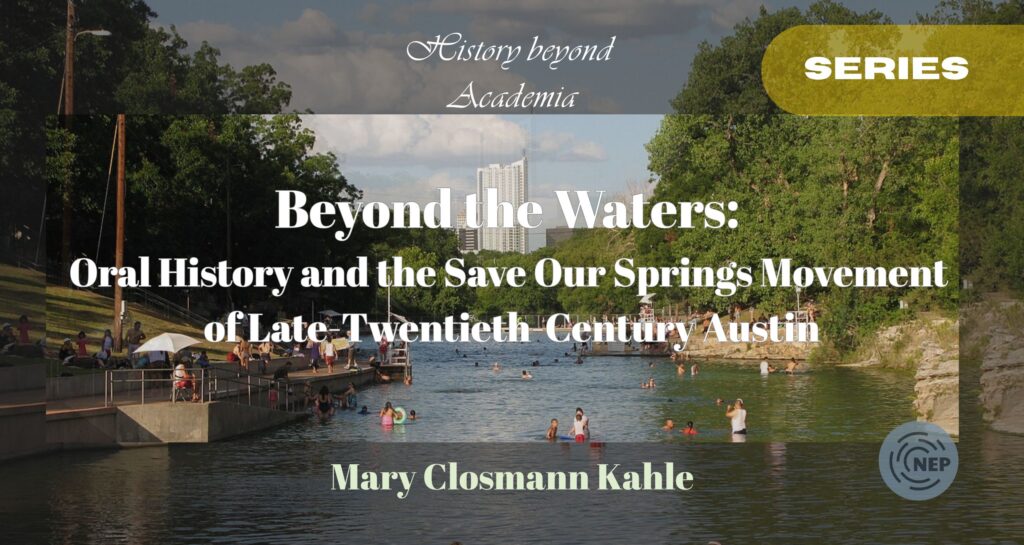
This article is part of the series: History Beyond Academia
On June 7, 1990, hundreds of Austin citizens spoke before the Austin City Council in opposition to a proposed 4,000-acre real estate development upstream of Barton Springs, an iconic spring-fed swimming pool in the heart of Austin. The development, spearheaded by flamboyant businessman Jim Bob Moffett, was to be on land over the Edwards Aquifer, a groundwater reservoir that is highly sensitive to pollution. Opponents of the project were deeply concerned about the potential impact of the development on water quality in the pool and the pool’s long-term health. The hearing ran into the following morning, and in a unanimous vote, the City Council rejected the development. The buildup to the hearing, the dramatic and unpredictable hearing itself, and the later adoption by the city of a stronger watershed ordinance (the SOS Ordinance) reflected the coalescence of local environmental groups and citizens into a movement known as Save Our Springs (SOS). The SOS Movement is now seen as a high point of activism in Austin’s history, a story that inspires both myth–it’s a classic David-and-Goliath story–and controversy.
To understand the importance of this moment, it’s critical to understand the place Barton Springs holds within Austin’s history. Barton Springs lies within Zilker Metropolitan Park, a 350-acre recreation hub that anchors the confluence of Lady Bird Lake and Barton Creek, two of the many creeks and waterways that add to the remarkable beauty of Central Texas. Just minutes from downtown Austin, Barton Springs traces its history from its role as a source of sustenance to Indigenous peoples, to its value as a site of commerce in the mid-1800s into the early 1900s, and to its final role as a recreation mecca. Like many recreation sites in the mid-1900s, Barton Springs was segregated until 1961, when activists and everyday people conducted “swim-ins” that led to its integration. Today, Barton Springs reflects both Austin’s diversity and its evolving identity as a countercultural bastion, a place where people of all backgrounds and ages can relax and enjoy its cooling waters throughout the year.
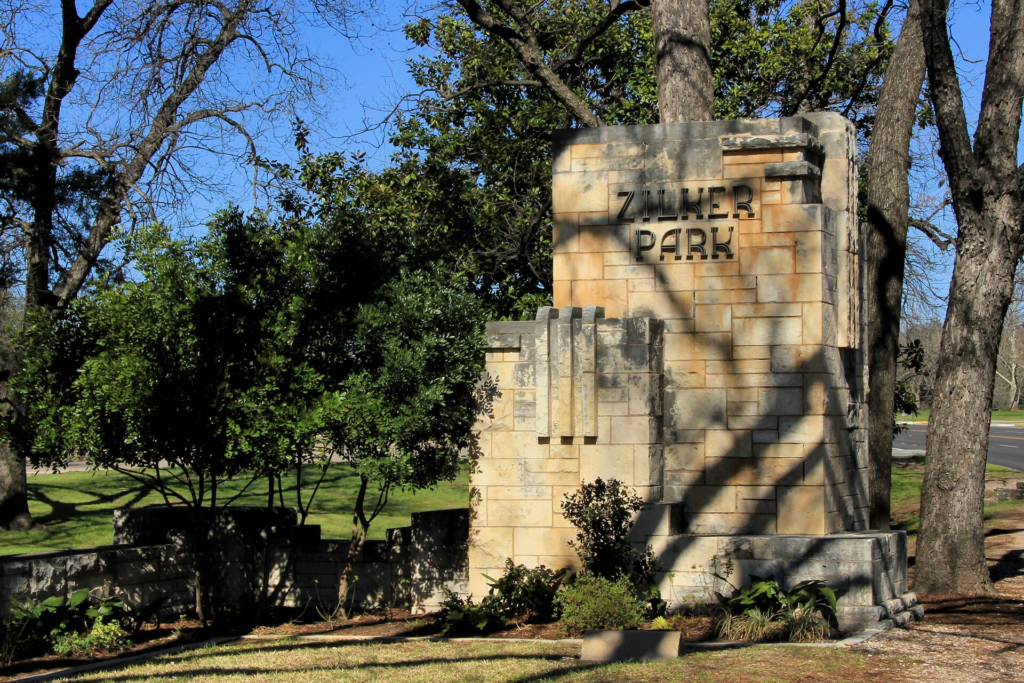
Zilker Park Entrance Portal, Austin. Source: Wikimedia Commons
Inspired by the SOS story, since 2019, I have been conducting oral history interviews with its participants, focusing on the period up to and including the 1990 hearing, the 1992 SOS Ordinance, and the years immediately afterwards. To date, I have completed audio interviews with forty people, recording the voices of everyone from environmentalists and their opponents to journalists and entertainers. My interest in Barton Springs began when I moved to Austin from Houston in 1986. A longtime recreational swimmer, I was used to chlorinated, lane-lined pools, and the cool, emerald waters of this legendary natural resource were a revelation.
The project began when I was earning my master’s in public history at Texas State University and took a fieldwork-focused oral history class in the fall of 2018. Two things happened: I discovered that I enjoyed interviewing, and I ran into a friend and key player in SOS, Brigid Shea, at a holiday party. I began talking with her about SOS and how I’d followed it when I was a young professional, and I asked whether anyone had ever captured the voices of the participants. She responded with her trademark enthusiasm, saying, “You should do it!”
This memory is important because it tells other stories about doing public history. Shea and I became friends through volunteering with the PTA at the high school our children attended. Tropes about PTA moms abound, but in this case, my relationship with Shea was key to my public history work because she was able to put me in touch with numerous SOS participants. As an oral history instructor at Texas State, I tell this story to my students to emphasize the importance of relationships in fostering historical inquiry.
A second aspect of this story is also important. I didn’t know then that Karen Kocher, a documentarian and now-retired instructor in the Radio-Television-Film department at the University of Texas at Austin, had been doing important work for some time on this same topic through her online Living Springs series. Her work includes interviews with several of the same people I was interviewing, which I didn’t discover until I was a year into my project. A central question for me became how I could differentiate my work from hers in ways that would contribute to the scholarship on Barton Springs. Eventually, Karen and I met to discuss our projects, and we have since forged a professional relationship in which we’ve shared interview material and supported each other’s work. I’ve come to see that my work differs from hers through our intended audiences, our interview style, and the points at which our lists of interviewees do differ.
I conducted my first interview in August 2019 with activist Shudde Fath, who was 103 at the time. In the course of the interview, several names arose that coincided with names I’d encountered in my research, and I began developing an interview list and working my way through it as I was earning my master’s. Although I didn’t earn class credit for my research, my affiliation with Texas State was key in their agreeing to archive my interview material and allowing me to use their interview consent form, both of which gave my project the imprimatur I needed to establish trust with my interviewees.

Aerial image of Barton Springs. Source: Wikimedia Commons
I examined the SOS Movement’s complexities through my master’s thesis, in which I focused on six interviews to discuss how SOS affected communities in Austin in varying ways. One of the most interesting discoveries involved the different ways that my interviewees defined “the environment.” Susana Almanza, who is Mexican American, stressed the importance of people, not just natural spaces and wildlife, within the environment.[1] Jeff Travillion, who is African American, touched on the role of the sustainable food community within discussions about the environment, further expanding the parameters of environmentalism.[2]
A controversial topic that my interviews uncovered was whether the SOS Ordinance spurred gentrification in East Austin, which historically has been home to Austin’s Mexican American and African American communities. The reasoning is that, because the ordinance restricted development over the watershed southwest of Austin, it has contributed to the supercharged development that has taken place in East Austin post-SOS. East Austin activist Daniel Llanes discussed this topic at length, the answer to which has yet to be fully resolved.[3]
My interviewees shared their strategies and motivations for supporting SOS. Shea spoke for many in her description of the all-night hearing as an inspiring “popular uprising.”[4] Llanes described connecting members of the activist group PODER (People Organized in Defense of Earth and Her Resources) with SOS leadership such that PODER supported SOS in exchange for assistance lobbying to rid East Austin of hazardous “tank farms” where several major oil companies stored fuel.[5] Shea’s husband, John Umphress, recalled the simple act of circulating pickle jars at live music venues to raise money for the cause.[6]

Kids enjoying Barton Springs. Source: Wikimedia Commons
Building upon my findings, I have showcased my research at conferences put on by the American Society for Environmental History and the Texas Oral History Association, and I plan to continue writing about it, incorporating the voices of all of my interviewees to flesh out the SOS story fully. The project is not yet live on the Internet, but at some point, I’d like to create a website to provide public access to the interviews. In the meantime, scholars wishing to access the materials can contact Texas State University Archives or me.
A typical workday on my SOS project involves going through my project planning documents and following up on interviews. I prioritize interviewees based on role in SOS, age, recommendations from others, or the simple fact that I’ve finally stumbled across their contact information after years of having them in my sights. Then I do outreach and finalize the interview, with a typical interview lasting about an hour and a half. The most labor-intensive part of my work is transcription, both the initial pass and the process of having my interviewees review their transcriptions.
Doing this work outside of an academic setting has posed several challenges and opportunities. The first challenge is that I do all of the work on my own time; given the substantial commitment required to conduct and transcribe the interviews, the pace can be slow, evidenced by the fact that I don’t have a dedicated website for the material. This bothers me because I feel an obligation to my interviewees to make their interviews widely accessible. In addition, I bear all the costs of my research, including the software subscription, transcription services I used for my early interviews, my audio recorder, and logistical expenses such as gas and parking. These factors place the option of doing audio-visual interviews that much more out of reach. That said, I have complete independence in choosing my interviewees, managing my schedule, and drafting interview questions, and this freedom has contributed to my confidence and creativity as an oral historian.

Environmental protest. Source: Wikimedia Commons
The pandemic also posed unique challenges and opportunities. I discovered that people had newfound flexibility in their schedules, and I was able to schedule interviews that had eluded me prior to the pandemic. I learned that online interviews can yield meaningful material despite the fact that they lack some of the personal rapport of in-person interviews. Platforms like Zoom also create recordings of meetings, so I had natural backup files to the recordings on my audio recorder, which I operated next to my laptop during interviews. Unfortunately, I didn’t appreciate the fact that my laptop speakers were blown during several online interviews, and those recordings, while yielding decent transcripts, suffer from poor audio quality. In addition, I had to learn to manage my dogs, ensuring that they were fed prior to interviews so that they wouldn’t interrupt me. I also held several interviews outdoors to allow for good airflow. One of these took place at a Starbucks along I-35; the sounds of interstate traffic, the umbrella over our table flapping in the wind, and a monster truck that parked next to us with an idling engine while the driver picked up his order are audible on the recording.
The surprising insights that my narrators have shared with me more than compensate for these challenges, such as the revelation that environmentalists and the development community held “peace talks” in the post-SOS heyday in which they hired a shaman to mediate.[7] It has also been fascinating to capture the point of view of members of the development community, whose portrayal of developer Jim Bob Moffett reflects a more complex take on his personality than what I obtained in interviews with environmentalists.[8]
My project on SOS has been fulfilling in more ways than I ever imagined when I embarked upon it. My experience conducting this project contributed to my being tapped to teach oral history at Texas State, a role I’ve thoroughly enjoyed. I get to share my successes and mistakes with my students, so they gain confidence in their ability to do oral history. I’ve also become a better historian. By interviewing a range of people both inside and outside of the activist circles that drove the SOS campaign’s historic victories, I’ve come to appreciate both the value of Austin’s identity as a “green, keep-it-weird” city and the need to interrogate that identity in new ways. Finally, I’ve made countless friends, including interviewees, fellow scholars, and the professional transcriber who assisted with my early interviews. Little did I imagine during that first dip in Barton Springs in 1986 that one day I’d have the opportunity to explore its history in this way. What a gift it has been.
Mary Closmann Kahle holds a degree in history from Stanford University and an M.B.A. from the University of Texas at Austin. She earned a master’s in public history from Texas State University, where she focused on oral history and historic preservation and completed an internship with Preservation Austin. She is a history steward with the Texas Historical Association, and served on the board of Preservation Austin and as the chair of the Austin History Center Association’s oral history committee (2022-2024).
[1] Susana Almanza, interview by author, Austin, TX, October 16, 2020, (Zoom).
[2] Jeff Travillion, interview by author, August 19, 2020, Austin, TX, (Zoom).
[3] Daniel Llanes, interview by author, Austin, TX, October 12, 2022.
[4] Brigid Shea, interview by author, Austin, TX, August 23, 2019.
[5] Llanes, interview by author.
[6] John Umphress, interview by author, Austin, TX, August 23, 2019.
[7] George Cofer, interview by author, Austin, TX, October 2, 2020, (Zoom)
[8] Beau Armstrong, interview by author, Austin, TX, December 10, 2019.
The views and opinions expressed in this article or video are those of the individual author(s) or presenter(s) and do not necessarily reflect the policy or views of the editors at Not Even Past, the UT Department of History, the University of Texas at Austin, or the UT System Board of Regents. Not Even Past is an online public history magazine rather than a peer-reviewed academic journal. While we make efforts to ensure that factual information in articles was obtained from reliable sources, Not Even Past is not responsible for any errors or omissions.




.jpg)