This article is part of the series: History Beyond Academia
Este artículo tiene una versión en español
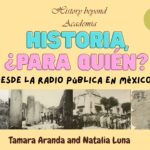
History, for whom? (Historia ¿para quién?) is the result of a conversation sustained over several years between young historians and a communicator interested in bringing historical reflection into everyday life. From the outset, the main question was how to translate complex topics—both historical and contemporary—into clear, accessible, and understandable content for very diverse audiences within Mexico’s public media.
After the coronavirus pandemic, opportunities emerged to bring the ideas born of those conversations down to earth. Thanks to the generosity and complicity of many colleagues, we were able to experiment with different formats and across various public media outlets, whose doors were opened to us by the National Institute of Historical Studies of the Mexican Revolutions (INEHRM).
In this sense, we consider Historia ¿para quién? to be the product of collaborative work among women dedicated to the social sciences and communication, including María Minero, Fernanda Nares, Guadalupe Muro, Ana Salinas, and Jehiely Hernández, from whom we have learned and with whom we have had the privilege of working.
It is also a project that emerges from the federal public administration, as it depends on funding from the Ministry of Culture through INEHRM, as well as on the production, technical support, and broadcasting of Radio Educación. This means that it responds to the right of access to culture and therefore its contents require institutional validation. It is worth noting that this has not limited the expression of ideas or the selection of topics; on the contrary, institutional backing has allowed us to connect with multiple specialists, converse with people responsible for little-known collections, and give visibility to independent projects that are doing a great deal to preserve and disseminate historical memory.
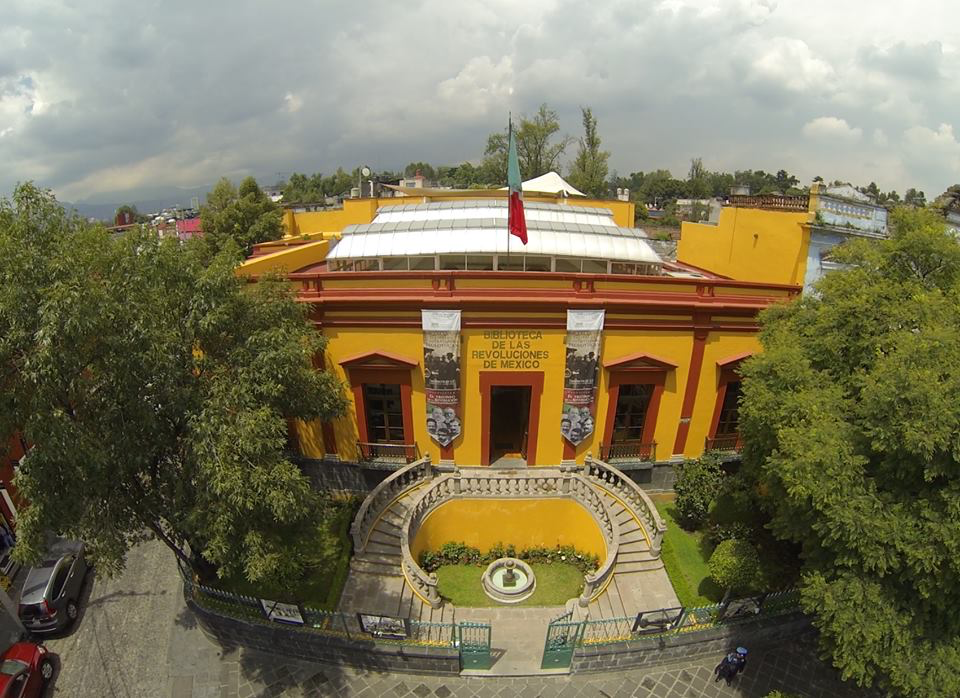
Instituto Nacional de Estudios Históricos de las Revoluciones de México. Source: Wikimedia Commons
The people responsible for bringing this project to life were the authors of this text: Natalia Luna and Tamara Aranda. Dr. Felipe Ávila, director of INEHRM, and M.A. Jimena Salgado, the institute’s director of outreach, placed their trust in us for this enormous and very important task. Holding fast to our initial premise, we decided to name the program Historia ¿para quién?, because the title encapsulates what matters most to us both: placing audiences—their interests and rights—at the center of the conversation. This was about democratizing historical knowledge to its fullest extent.
Then came the planning of the format. To meet our objectives, we opted for the specialized interview, though with a warm and approachable tone, and included a segment providing historical context and another based on audience polling, giving listeners a voice to express themselves on each topic. We also added a song inspired by the conversation and a round of rapid-fire questions to energize the interview and push specialists to “get to the point.”
The program is hosted by Tamara Aranda, a historian and researcher at INEHRM, and Natalia Luna, a communicator with more than a decade of experience in public media. In this project we found many points of convergence, ranging from personal interests—which are also political—to the need to explain and debate them through historical perspectives. Thanks to the collaboration and co-production between INEHRM and Radio Educación—a century-old broadcaster on the radio dial—a 55-minute space opened up for us to develop the program.
We asked ourselves what the current proposals were for communicating history and why there were so few spaces dedicated to historical dissemination using a more colloquial language, with a gender perspective, inclusive, and willing to step outside the margins of “History with a capital H” to let popular culture enter narratives about the past.
We were also interested in inviting young (and not-so-young) specialists whose projects, research, and knowledge transcend the walls of academia. We believe that the media—and public radio in particular—have an obligation to open spaces to disseminate knowledge and offer tools to audiences with very concrete rights: to understand, question, and better discern the reality around us. In the end, all of us are audiences.
The day-to-day work of Historia ¿para quién? is sustained by curiosity, wonder, and openness. Often we react to our own lives: to the people we meet, the topics we discover, the colloquia and conferences we attend. From there come the ideas that later become programs.

Promotional banner.
We have a list of topics to address and a series of sound resources to “dress” the program: short segments, street polls to hear what people know or think, songs that dialogue with the historical moment, and audience messages—essential for generating resonance and feedback. It is essential here to thank Juan Ramírez, responsible for sound design and reporting that enriches the program.
Any team member can propose a topic; we review possible specialist guests and, from there, collectively support the work. Tamara provides historical advising for each episode and conducts the research that then becomes a short segment. Natalia translates that work into a script designed for audiences, with trigger questions and resources specific to radio language. Both of us record the segment voices and host the program.
The team is completed by Alma Lilia Martínez as production assistant and Mario Ledesma as general producer, who oversee the final product and coordinate timing, recording studios, and articulation with the station’s social media.
For the dissemination of each program, we follow a basic rule: we cannot take anything for granted. Academic knowledge—and, in our case, historical knowledge—is not a common starting point for everyone. There will always be someone who does not share the same references, and it is precisely in the effort to break down topics to their apparent simplicity that the complexity of communicating to very diverse publics lies. Radio, the sound archive, and the digital platforms where the program is hosted are the tools with which we try to accompany that process.
Our initial audience is Radio Educación’s listeners on 96.5 FM. Although we do not have precise metrics, our fifteen years of experience collaborating there tell us that a good portion of our listeners have grown up alongside the station. It is a predominantly older audience that participates critically through calls and messages: they congratulate us, question us, tell us how the topics resonate, and what else they would like to hear.
At the same time, we have the mission of reaching younger audiences through the program’s repository on Spotify, where Historia ¿para quién? can be listened to on demand and circulate through other circuits, especially among students and people linked to historical research and the humanities.
Another core audience is INEHRM’s public, which spans a wide range of ages, genders, and geographic locations. As a national institute with more than 70 years of history, it has partnerships with institutions throughout the country, which makes it possible to decentralize history and take it beyond Mexico City and its metropolitan area. This also helps expand the thematic range and address histories that resonate in every corner of Mexico, connecting with local specialists and reaching audiences who call or write from across the Republic and even from other countries.
After more than half a year on the air, we believe our work has helped rethink some traditional notions of how history is viewed, beginning with dismantling the idea that history is only the past and, as such, distant and sacred. On Historia ¿para quién? we have critically reflected on events that seem far removed in time, but whose effects are observable today. Colonialism or Mexican Independence are examples of topics we have revisited with the help of experts who have shared their knowledge clearly with us and the audience.
We have also addressed painful topics in national and world history, from the Dirty War and Spanish exile to the Bosnian and Palestinian genocides. Through these programs we have touched sensitivities that appeal to the humanity of listeners, giving History with a capital H a human character that makes it close and open to questioning.
We analyze current problems through a historical lens to rethink our present and invite the listening community to imagine solutions. If feminists of the past were able to set aside their differences to fight together for citizenship rights, women struggling today can also generate more effective measures for access to justice; likewise, something must be done urgently, as citizens, if investigation files of people disappeared in the 1970s are piling up in prosecutors’ offices alongside those of the twenty-first century. Ignorance of history not only carries the risk of repetition, but also of non-repair and, worse still, the accumulation of grievances. In this sense, ignoring history condemns us to impunity and to perpetuating suffering.
After 30 programs, we can state with satisfaction that our objectives have been met, both communicatively and institutionally, as the project has become a platform for colleagues inside and outside academia, as well as within the institute itself, whose areas of expertise enrich our understanding of the present and deserve not only to be heard, but to be recognized.
For those of us who sign this text, the greatest challenges in carrying out the project were related to adapting language and communication strategies for a broad public. This is always difficult for those of us who come from academic spaces, because the habit of writing and speaking for peers weighs heavily. Fortunately, we managed to distance ourselves from tradition and think beyond the booth and the cubicle. We believe this is due to Natalia’s experience and sensitivity in public media and cultural and historical outreach projects, as well as Tamara’s lack of routine in academic exercises after having moved through such diverse worlds as public administration and human rights activism.

Public market in Mexico. Source: Wikimedia Commons
Forming a team composed of a historical researcher and a communicator forces us to maintain a dialogue outside strictly academic frameworks. This cross-pollination of knowledge has allowed us to rethink questions and ways of approaching knowledge, always keeping the social usefulness of history at the center. We often begin with the present moment as a trigger for constructing a historical understanding of our reality.
We also believe that the program’s positive results are due to the great team behind it, especially INEHRM and Radio Educación, where Juan Ramírez’s mastery has brought to air programs far more beautiful than we imagined. Juan, the magician who always makes us sound smarter and who, through his interviews, becomes the bridge between our ideas and what truly matters in the streets.
Together with our audiences, we explore how every element of our lives contains the possibility of being historicized and, in that sense, gains relevance in the passage from the individual to the collective. For the project, it has been fundamental to position ourselves there: in the street and its many voices, in the everyday as a space where history is woven daily and therefore deserves to be told.
In this sense, Historia ¿para quién? seeks to stop overlooking topics, characters, and events; to open space for doubt; and to engage in horizontal dialogue in order to critically reclaim what has always been ours.
In this process, history ceases to be merely knowledge about the past and becomes a public practice: a tool to name experiences, recognize inequalities, dispute common sense, and expand the repertoire of what is imaginable. When historical conversation circulates outside specialized spaces—without renouncing rigor, but assuming a commitment to intelligibility and listening—public life is strengthened: it becomes more capable of deliberating, remembering, and demanding.
Ultimately, the public value of this work appears in small scenes: a question that lingers after the radio is turned off, a family anecdote that suddenly connects with a collective process, a street that ceases to be a simple route and becomes a living archive. There, in that instant when the present becomes legible in the light of other eras—and the past reveals itself as something that still looks back at us—history recovers its power: not as a monument, but as a conversation.
Finally, if we celebrate this beloved project as a success, it is because of the messages left by our audiences. Through our contact channels, we know that our narrative has impacted the way listeners understand and relate to history. We therefore close this text with the last message we received on Radio Educación’s WhatsApp:
“…I think the great lesson I take away today, from the program of December 22, 2025, is that we human beings are a narration… and since the program is called Historia ¿para quién?, I think it would be important to ask who is building the [narration of] history, and I include myself—not because I am a historian, but because I am a citizen who wants to participate in building this country, which I truly hope will soon be a new country. In short, I think that today it is up to all of us to build the narration of our history.”
Tamara Aranda studied history at Uiversidad Nacional Autónoma de México (Facultad de Estudios Superiores Acatlán). She is currently a researcher at the Instituto Nacional de Estudios Históricos de las Revoluciones de México (INEHRM) and co-host of Historia, ¿para quién? on Radio Educación.
Natalia Luna is a communicator and radio host with over a decade of experience in public media. She co-hosts Historia, ¿para quién? on Radio Educación, where she works to translate historical research into accessible content for diverse audiences.
The views and opinions expressed in this article or video are those of the individual author(s) or presenter(s) and do not necessarily reflect the policy or views of the editors at Not Even Past, the UT Department of History, the University of Texas at Austin, or the UT System Board of Regents. Not Even Past is an online public history magazine rather than a peer-reviewed academic journal. While we make efforts to ensure that factual information in articles was obtained from reliable sources, Not Even Past is not responsible for any errors or omissions.