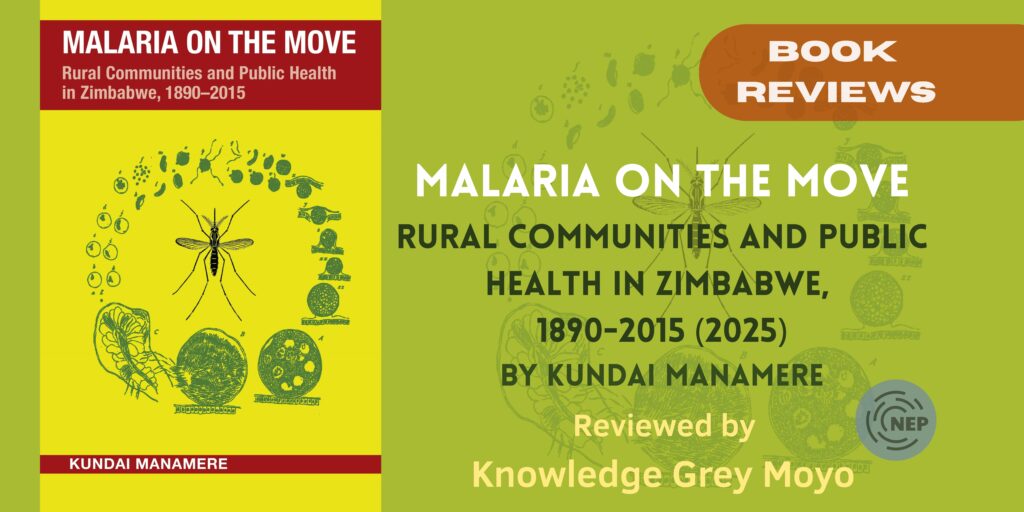
Kundai Manamere’s Malaria on the Move: Rural Communities and Public Health in Zimbabwe, 1890-2015 is an ambitious monograph that redefines and recenters Southern African medical history by foregrounding mobility as akey concept for understanding malaria’s history and circulation. Covering the period 1890 to 2015, Manamere argues that malaria control in Zimbabwe was deeply influenced by and intertwined with the political economy of settler colonialism, land displacement, border policies, and post–colonial realities of circular migration and resettlements. As such, human mobility was the mechanism of transmission itself. The parasite cannot travel unaided; it depends entirely on an infected human host’s bloodstream to carry it from one place to another, and every wave of forced displacement, labor migration, or circular movement between countryside and city was therefore a wave of parasite circulation. What the book ultimately argues is that the political and economic systems that kept people perpetually on the move — colonial land expropriation, migrant labor recruitment, war, and land reform were the most important engines of the epidemic.
Empirically, Manamere uses an array of sources, including public health files from the National Archives of Zimbabwe; WHO MAL Offset documents (1947-2000) from the World Health Organization archives; corporate records, such as the Triangle Sugar Estates environmental files; colonial and post-colonial newspapers; and oral histories. Manamere also draws on international archives, such as the Bodleian Library in the UK. The book features six chapters written in clear language, each focusing on a specific political and epidemiological period, from settler colonialism in the 1890s to 1930s to land reform and global health initiatives in 21st-century Zimbabwe. The first chapter places malaria control in Southern Rhodesia within the context of the political economy and racial logics of settler colonialism. This approach to control meant that public health efforts during this period aimed to protect the health of the white population and African workers while neglecting rural areas where most Africans resided. Using colonial medical archives, Manamere describes how colonial vector control and quinine distribution protected Europeans while spatially segregating Africans (p. 20). This led to a racialized view of epidemiology, with malaria seen as a rural disease.
Furthermore, Manamere explains how malaria control programs were used as a tool of occupation rather than a true humanitarian intervention. The book centers dichlorodiphenyltrichloroethane (DDT)— a synthetic insecticide applied through a technique called indoor residual spraying, where the chemical is painted or pumped onto the interior walls and ceilings of dwellings so that mosquitoes resting on those surfaces after a blood feed would absorb a lethal dose and die before they could transmit the parasite again. Malaria became an expression of how Africans mismanaged space, and as a means of enabling the establishment of European Settlers and the expansion of Estate agriculture and infrastructure. In this way, malaria management created the conditions for development. The book further highlights how these malaria public health efforts transformed the Southeastern Lowveld into a laboratory for vector eradication and the containment of Africans.
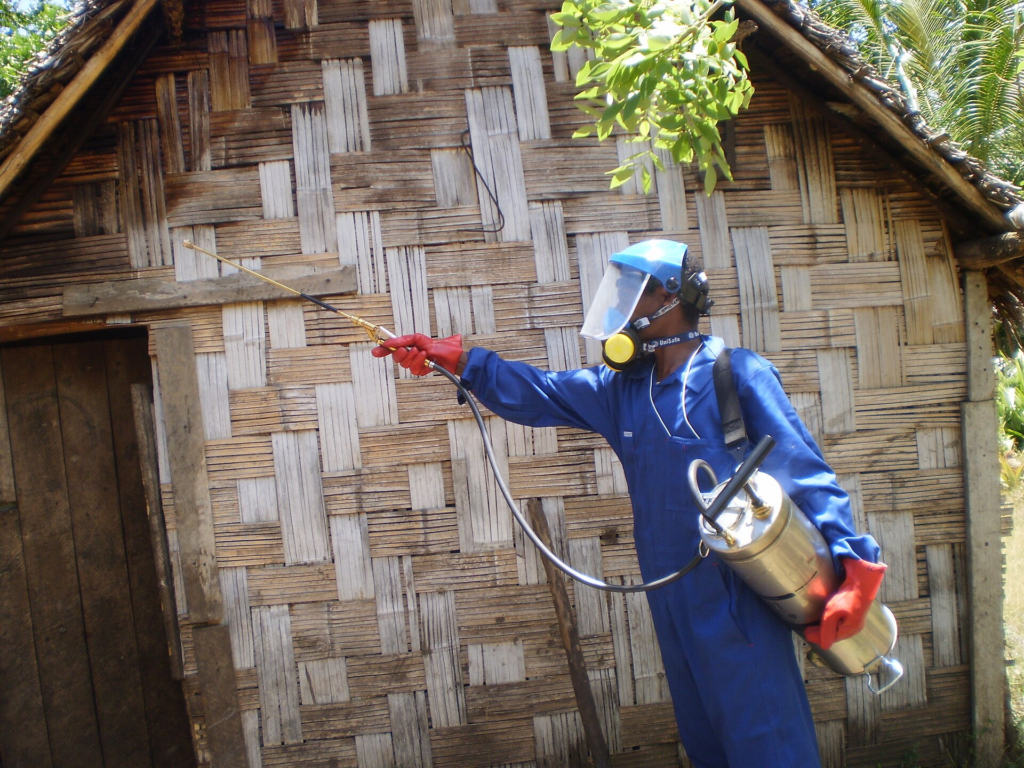
Spraying to prevent malaria. Source: Wikimedia Commons
.jpg)
The book further indicates that global health regimes have reproduced colonial hierarchies and that malaria programs advanced by international organizations were biased towards European towns, mines, and farms, and did not include Africans who were denied access to these interventions based on racialized assumptions of acquired immunity. Therefore, scientific authority concealed the extent to which political decisions regarding who, when, where, and how to protect were made. Scientists viewed malaria eradication as a global goal; however, aligning health interventions with extractive and settler interests in Zimbabwe widened disparities in malaria eradication efforts. The portrayal of science as neutral and universal is shown to have been embedded in a context where the economic benefits of racial capitalism prevailed.
More importantly, she deepens her analysis by unpacking the regional political economy of movement and examines how labor migration to South African mines transformed human mobility as carriers and conveyors of Plasmodium falciparum parasite (the parasite responsible for malaria transmission). Parasitized migrants moved between controlled and uncontrolled malaria zones (p. 66). The Plasmodium falciparum parasite enters the human bloodstream through a mosquito bite, multiplies inside red blood cells, ruptures them, and moves on. For as long as an infected person lives, the parasite travels with them—silent, often symptomless in those who have built a partial immunity through repeated infection, yet ready to ignite fever and death in anyone who has not. Consequently, the continued malaria outbreak is attributed to “circular migration” by seasonal workers and families, who brought infection back to their communities along social circuits of kinship and livelihood (p. 117). This conceptualization—treating circulation as both an economic strategy and a vector of epidemiological risk is among the book’s most original contributions. Manamere’s analysis shows that the failure of disease control could be attributed to a failure to reckon with the logic of everyday movement—a critique first made a couple of decades earlier by Ralph Prothero, whom Manamere references (p. 3). In that way, the book moves beyond biomedical reductionism and anthropological nuance into the historical geography of epidemiology as a decolonial method.
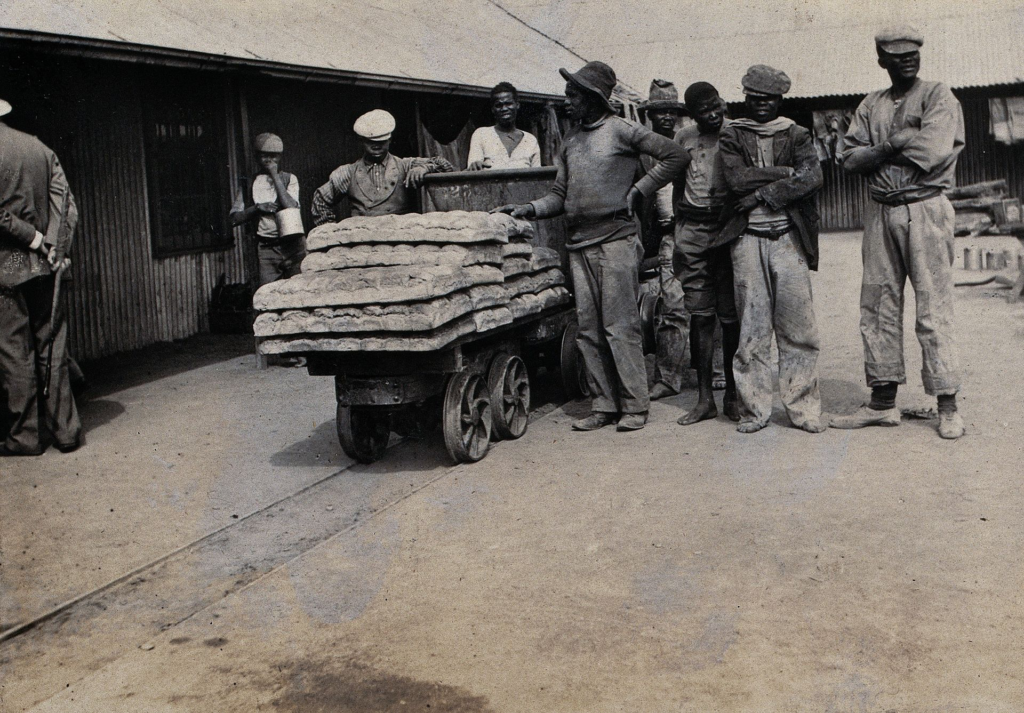
Bread carried on trollies for the South African mine’s workers. Source: Wikimedia Commons

When Zimbabwe achieved independence in 1980, the new government inherited what Manamere describes as “an island in a sea of hyperendemic malaria”—Triangle Sugar Estates, where decades of privatized control had been maintained, surrounded by a countryside ravaged by war of liberation in the 1960s- 1979, dislocation, and the abrupt cessation of all spraying programs (p. 165). The demobilization of fighters, the return of refugees from Mozambique, and the movement of formerly confined populations back to their homes created massive new waves of parasitized travel.
Meanwhile, malaria control remained prioritized in urban areas and economically advantageous regions, thereby reinforcing the spatial hierarchies established by colonial settlers. The rise of drug-resistant malaria and the occurrence of malarial outbreaks in urban locations that had previously been protected indicate the ineffectiveness of biomedical methods that did not consider patterns of migration and inequality. Furthermore, Manamere refutes the notion that communities should be blamed for failing to control malaria and asserts that, when examining the underlying causes of these failures, it becomes clear that they are rooted in the continued influence of colonial structures, namely the dispossession of land and the displacement of labor.
Manamere creates an excellent connection between the historical legacies of colonialism and the understanding of diseases and health in Southern Africa. The clarity of the book’s writing style, the extensive use of archival materials, and the innovative use of interdisciplinary methods are admirable. Manamere’s conceptualization of mobility integrates the disciplines of epidemiology, labor studies, and political medical geography into a model for interpreting the etiology of malaria in colonial and post-colonial Zimbabwe. However, one of the book’s limitations is that it is overwhelmingly centered on humans while neglecting parasites, mosquitoes, and blood as active participants in the analysis. Giving more agency to these nonhuman actors, especially the Plasmodium falciparum parasite, given its capacity to adapt to different environments, would have strengthened the book’s ecological argument and brought the book’s argument in line with recent scholarship on nonhuman actors.
Manamere’s book is an important contribution to scholarship on the history of medicine in Southern Africa, and Zimbabwe in particular. The study centers human mobility at the center of understanding the histories and circulation of diseases, showing that malaria’s persistence in Zimbabwe stems from structural inequalities rooted in the colonial era. By describing malaria as “a moving agent— biological, political, and moral” (p. 5), Manamereurges scholars and policymakers alike to rethink the geography of public health. The combination of rigorous archival work and innovative ideas ensures that Zimbabwe’s malaria story will be understood not as a tale of failure but of movement—an essential lesson for global health today, just as it was during the colonial period. This book is an excellent resource, and I recommend it for undergraduate and graduate courses in History of Medicine, Political Economy, African History, and African Studies.
Knowledge Grey Moyo is a Doctoral Candidate in the Department of History at The University of Texas at Austin. His research interests include History of Science, Technology and Medicine, Global Health, International Relations, and International Political Economy.
The views and opinions expressed in this article or video are those of the individual author(s) or presenter(s) and do not necessarily reflect the policy or views of the editors at Not Even Past, the UT Department of History, the University of Texas at Austin, or the UT System Board of Regents. Not Even Past is an online public history magazine rather than a peer-reviewed academic journal. While we make efforts to ensure that factual information in articles was obtained from reliable sources, Not Even Past is not responsible for any errors or omissions.
Related posts:
 Border Land, Border Water: A History of Construction on the U.S.-Mexico Divide by C.J. Alvarez (2019)
 The Lived Nile: Environment, Disease, and Material Colonial Economy in Egypt by Jennifer L. Derr (2019)
 Review of A Ritual Geology: Gold and Subterranean Knowledge in Savanna West Africa (2022) by Robyn d’Avignon
 Review of The Devil’s Cup: A History of the World According to Coffee by Stewart Lee Allen (1999)