• Features
  • Reviews
  • Teaching
  • Watch & Listen
  • About

The past is never dead. It's not even past

Not Even Past

On Flags, Monuments, and Historical Myths

July 6, 2015

Over the next few weeks, Not Even Past will offer readers historical sources, readings, and commentary on these events. Last week, Mark Sheaves collected past articles devoted to the history of slavery and its legacy in the US and provided us with an annotated list. Today we offer the historical analysis and commentary from journalists and historians primarily writing online. Follow us on Facebook and Twitter for more reading and news from the Task Force.

Slavery and its legacy in the USA

June 29, 2015

Not Even Past has published many feature articles, book and film reviews, and podcasts on slavery in the American South, brought together on this page. Approaching this topic from different angles, this body of work provides an overview of key issues important for anyone wanting to understand slavery and its lasting legacy.

The Curious Life of General Jackson’s Horse’s Hair

May 6, 2015

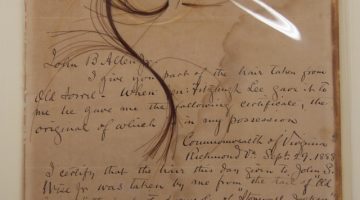
Old Sorrel hair

By Josh Urich The artifact below and the document that accompanies it are out of the ordinary: hair taken from General Thomas Jonathan “Stonewall” Jackson’s horse, Old Sorrel. The hair itself was plucked by General Fitzhugh Lee and given to John S. Wise, the son of former Virginia governor Henry S. Wise. John S. Wise […]

Conflict in the Confederacy: William Williston Heartsill’s diary

April 29, 2015

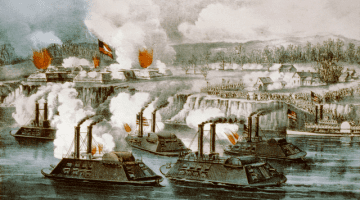
Print of the bombardment and capture of Fort Hindman, Arkansas Post, January 11th 1863. Via Wikipedia.

William Williston Heartsill volunteered to fight for the South before the Civil War even began. For the first two years of his service, he and his comrades from Harrison County, Texas served as a cavalryman on Texas’s western frontier.

The Professor and the Madman, by Simon Winchester (2005)

April 6, 2015

The nineteenth century in Britain was a time of grand figures, grand projects, and Imperial expansion. Imperialism was spreading the English language across the globe, yet there was still not a definitive guide to the language.

Reading Magnum: A Photo Archive Gets a New Life

April 1, 2015

Magnum Photos was formed in 1947, in the wake of the Second World War, by four photographers seeking to retain the rights to their images while working on projects that aligned with their own interests rather than solely responding to commissions from magazines and newspapers. Henri Cartier-Bresson, David “Chim” Seymour, George Rodger, and Robert Capa created a business model that fundamentally changed the practices of photojournalism

Personal Memoirs, by Ulysses S. Grant (2003)

February 16, 2015

April 2015 marks the sesquicentennial of the end of the U.S. Civil War. As we look back on that momentous event in U.S. history, we should take time to reconsider one of the war’s most important figures, Ulysses S. Grant. Most famous as a general, Grant’s life spans an important part of U.S. history. Moreover, Grant’s prose is clear and evocative, proving him to be a great writer,and the author of one of the finest examples of the military memoir.

Confederados: The Texans of Brazil

January 28, 2015

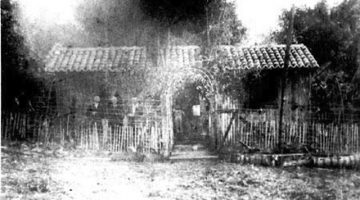
Black and white image of the house of the first Confederate family in Americana in Brazil

After the American Civil War ended in April 1865, white Southerners living in the defeated Confederacy faced an uncertain social, economic, and political future. Many, disappointed in the outcome of the conflict and fearful of vengeful reprisals from the victorious Union government, decided to leave the United States altogether and start afresh in a foreign land.

Past and Present in Modern China

December 3, 2014

It is no wonder that we cannot agree on China’s future; we cannot even agree on its past. In fact, how to interpret the past is a heavily disputed subject in China, because history has always been a tool to promote one’s political agenda at present. Huaiyin Li’s Reinventing Modern China and Zheng Wang’s Never Forget National Humiliation analyze the complex politics surrounding modern Chinese historiography.

After WWII: George Kennan’s “Long Telegram”

November 13, 2014

In February 1946, officials in Washington asked the U.S. embassy in Moscow why the Soviet government was failing to cooperate with American plans for the postwar international order. On the receiving end was George Kennan, a career foreign service officer who had risen to be the second-ranking American official in Moscow. Kennan replied with an extraordinary 5,300-word cable later dubbed the “long telegram.”

« Previous Page
Next Page »

Recent Posts

  • Cold War Chronicles
  • Primary Source: How Did Cary Coke Get Her Copy of Queen Catharine?
  • Tapancos and Tradition: Remembering the Dead in Northwestern Mexico
  • “How Did We Get Here” Panel 
  • Hidden Children and the Complexities of Jewish Identity  
NOT EVEN PAST is produced by

The Department of History

The University of Texas at Austin

We are supported by the College of Liberal Arts
And our Readers

Donate
Contact

All content © 2010-present NOT EVEN PAST and the authors, unless otherwise noted

Sign up to receive our MONTHLY NEWSLETTER

  • Features
  • Reviews
  • Teaching
  • Watch & Listen
  • About