Welcome to the History Carnival for May, 2012.
The past is never dead. It's not even past
Welcome to the History Carnival for May, 2012.

Based on lectures first delivered in Oxford in 1974, The Decline, Revival, and Fall of the British Empire, commands sustained attention today. In his sharp analysis of Britain’s declining world system, Gallagher offers both a novel explanation of empire’s “discontinuous decline” and a critique of contemporary decolonization theorists.

It is well-known that decades later he made witty statements about God: that He does not play dice; that God is crafty but not malicious. Einstein famously wrote: “Science without religion is lame, religion without science is blind.”
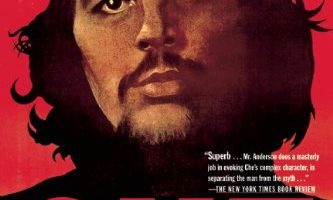
In July 1997, a Cuban-Argentine forensic team unearthed the skeletal remains of Comandante Ernesto “Che” Guevara in Vallegrande, Bolivia. Thirty years earlier, on October 9, 1967, CIA-trained Bolivian Special Forces agents had captured and executed the thirty-nine-year-old revolutionary before dumping his body in a shallow pit near a dirt runway.
Bruce J. Schulman in his 2001 work The Seventies: The Great Shift in American Culture, Society, and Politics surveys the history of an overlooked decade. Defining the “long 1970s” as the period between Richard Nixon’s entrance in the White House in 1969 and Ronald Reagan’s landslide reelection in 1984, Schulman counters popular conceptions that the decade was seemingly forgettable and unimportant.

From his childhood among the crumbling Spanish forts in West Florida to his experiences in the archives of Chavez’s Venezuela, Jesse Cromwell shares stories of adventure with Zach Doleshal culled from both his own life and the experiences of the Caribbean smugglers who form the subject of his dissertation.

If Digital History is “using new technologies to enhance research and teaching,” as the excellent website from the University of Houston puts it, then African American history is being well-served digitally. In honor of African American History month, I survey here one enormous and useful website that gives us all access to a very wide variety of materials.
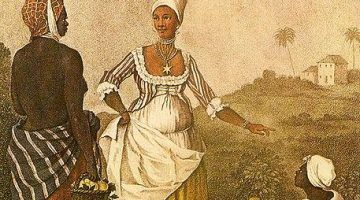
In the second installation of our new series, “Making History,” Zach Doleshal speaks with Jessica Wolcott Luther about her experience as a graduate student in history at the University of Texas at Austin. In the interview, Jessica shares stories about researching in seventeenth century archives (she’s been to eleven so far!), studying history using anthropological documents, and overcoming the frustration of knowing that she may never get the chance to find a direct source from a former enslaved person.
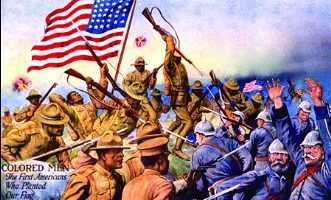
Moviegoers who recently flocked to cinemas around the country to take in George Lucas’ World War II aviation blockbuster, Red Tails, may be unaware of the long and checkered history of black servicemen in the American military in the decades before the ascendance of the now famous Tuskegee Airmen.
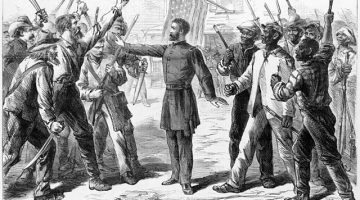
In March 1865, the U. S. Congress created the Freedmen’s Bureau for Refugees, Freedmen, and Abandoned Lands to ease the transition between slavery and freedom for 3.5 million newly liberated slaves. The bureau had three main functions—to distribute rations to Southerners who had been loyal to the Union during the Civil War, to establish public schools for black children and adults, and to oversee labor contracts between landowners and black workers.