• New
  • Features
  • Reviews
  • Texas
  • Teaching
  • Digital
  • Watch & Listen
  • Authors
  • About

The past is never dead. It's not even past

Not Even Past

Understanding History Through Video Games: Europa Universalis IV and Causation 

Banner of Understanding History Through Video Games: Europa Universalis IV and Causation by Chapman M. Hall.

The idea of using video games to teach history is nothing new. One of the oldest history video games, The Oregon Trail, was designed with this exact purpose in mind in 1971.[1] In the following decades, the popularity and technological sophistication of history video games–those with a historical theme or setting–have grown exponentially. The award-winning medieval action role-playing game Kingdom Come Deliverance II sold over five million copies in the first year after its release.[2] It is therefore natural that historians have started asking academic questions about history video games and how they influence younger generations’ understandings of history. However, the quantity of this research is still limited and there is a lot more to be explored and contributed. In my research project “Playing History: How Video Games Can Change The Way We Understand The Past” I sought to add to this growing field by pursuing two questions. How exactly do video games change how we think about history? What is unique about video games in how they communicate information? I surveyed and interviewed players of history video games and used Paradox Interactive’s acclaimed Europa Universalis IV as a case study to answer these questions. By analyzing the unique qualities of video games and Europa Universalis IV’s presentation of historical causation, this project demonstrated the potential of video games to communicate complex historical ideas to an audience already familiar with the medium. I will explore these conclusions here using the concepts of agency and replayability to show how Europa Universalis IV conveys knowledge of historical causation.

Video games are defined by their interactive nature. The player of a game actively influences and changes their experience through their actions, which is markedly different from how a viewer passively watches a film for example. This interactivity is best understood through the concept of agency, as defined by C. Thi Nguyen in his book Games: Agency as Art. Nguyen defines agency in the context of games as a set of temporary goals and actions available to pursue those goals, which the player takes up in order to play the game.[3] For example, when playing the video game Pong, I adopt the goal of scoring eleven points before my opponent, and to do so can move my paddle vertically to intercept the ball and bounce it at my opponent’s edge of the screen. This is not a goal I possess as I go about my daily life, nor do I use the limited action of vertically moving a paddle to achieve my normal goals, like making dinner. I take on the goals and available actions of the game to play it, and then dispose of them when I am finished. But while playing a game, these goals and allowed actions take precedence over any others we might have, allowing players to “submerge ourselves in the temporary agency of the game.”[4] This immersion means that video game players are not simply making mindless choices; they are firmly rooted in a game’s agency, which provides them a deep understanding of cause and effect.

 Video games also possess the virtue of replayability. While some games are more replayable than others, unlike a traditional novel or film which plays out exactly the same way every time, a video game can be played repeatedly with differing results. These differences could be whether the player wins or loses, a different narrative outcome to the game’s story, or simply a different pathway the player takes to get to the end of the game. This allows a game to communicate more than just an argument about why an event happened or if it would happen or not; a game can communicate how likely that event is to occur and what causes were most impactful by “modeling difficulty.”[5] How challenging it is to achieve the goals in a game’s agency and what sorts of tools and obstacles a player experiences create a complex picture of causation for the player to learn from.

These ideas of interactivity and replayability are key to understanding Europa Universalis IV, abbreviated as EUIV. It is a historical grand strategy game in which the player controls a country in a historical simulation from the 15thcentury to the 19th century. The game begins in a state that reflects historical reality at a chosen date and then develops into an alternate history simulation driven by the player’s decisions, the decisions of computer-controlled countries, and various historical events that are rigged to occur across a playthrough. The player controls all of their chosen country’s political, economic, military, diplomatic, and social policies, making them the country itself rather than any person. They take on what I call the “agency of the state,” which encompasses the goals the player adopts and the actions they take while controlling any country in the game.

Logo of Europa Universalis IV videogame

 Logo of the Europa Universalis IV videogame. Source: Wikimedia Commons

While EUIV is a resultingly very complicated game, it also has a high level of replayability. No two playthroughs of EUIVare alike, even if playing as the same country, because there are so many variables which can change the course of its simulated history. As a result, it is a video game that is especially well suited to teaching and exploring historical causation.

Historical change and cause and effect are intricate subjects. How historians grapple with questions of causation can be just as complex. Some prefer to attribute the course of history to the actions of influential individuals and key events, often in the form of “great man history,” while others look to large structural factors such as the environment or economic systems as the cause behind historical change. In practice, how historians approach cause and effect is a sliding scale that incorporates both approaches, and most current historians fall somewhere in the middle. In her book Thinking About History, Sarah Maza defines this mixed approach to causation as “productive chaos,” an approach that looks to analyze all sorts of factors, individual and structural, to determine how they contributed to historical change.[6]

Europa Universalis IV reflects this nuanced approach to cause and effect. The player, as an individual actor, has a great amount of influence on the course of the game. Their actions can affect not only their own country but the entire world of the simulation. The player’s decision to declare war against their neighbor could lead to the ruin of their entire country. Or their decision to invest massive amounts of funds into trade infrastructure could result in their country becoming the commercial center of the world. In a different playthrough, these actions might have different outcomes, but in each case, it is the player’s actions and decisions that are crucial to the simulation’s development. The player and their actions are a surrogate for individual-driven change.

Yet at the same time, the player’s agency of the state and their ability to influence the results of the game through it are limited. They are constrained by the structures put in place by the game, systems and large-scale factors which mirror structural forces behind historical change. For example, religion is a constant factor within EUIV. The population of each province, and therefore country, has a dominant religious faith, and this structure is an ever-present factor in the game. The player can convert their population to different religions, promote tolerance or intolerance towards minority faiths, and even engage in religious wars with other countries. But their actions are limited. They cannot, for example, force the population to become atheists. Even if the player chooses not to interact with religion, its influence will still affect their gameplay. Countries of different state religions have diplomatic penalties, a disgruntled minority population might revolt, and the Protestant Reformation will occur whether the players like it or not. While the player is a surrogate for individual factors behind change, the game itself can be seen as a surrogate for structural causes of change.

Another structural factor within the game that constrains the player’s individual agency is colonization. Whether the player takes part in colonization or not, it will still occur in the game world. They are able to influence how it occurs, by leading France to colonize Mexico before another country does, for example, but if they do not engage with that part of gameplay, the computer-controlled countries will still do so, and colonization will happen. This is because the structures of colonialism and incentives for that behavior are built into the game for the player and the computer. The game world is unable to escape the momentum of that systematic trend. The significant variability in how each playthrough develops is limited and guided by structural factors. To illustrate this, I ran two EUIV games with only computer-controlled countries until the year 1628. In the first game, the Americas were primarily dominated by England in Canada and what is now the eastern United States, Portugal in most of South America, and Spain with the Caribbean and the rest of the mainland Americas. The second game was almost entirely different. Spain controlled eastern North America while Portugal controlled the Caribbean, Central America, and the rest of North America besides northern Canada. France was the dominant force in South America, with other colonial empires possessing small pieces, and England held few territories at all. The shape colonization takes can differ, but it always occurs. This demonstrates how unique alternate historical realities are created in each playthrough. 

Man on computer playing Europa Universalis IV

           Man playing Europa Universalis IV. Created on Canva, Wikimedia Commons

This is exciting in an academic context because EUIV communicates that complex understanding to its players. By taking on the agency of the state and engaging interactively with decision-making in the game, players gain a nuanced understanding of cause and effect in history. Europa Universalis IV and history video game players in the University of Maine student body were surveyed for “Playing History,” and nine of those surveyed volunteered to participate in a semi-formal interview process to discuss their gaming experience. Interviewed and surveyed players demonstrated a complex understanding of historical causation. Many placed a great deal of importance on their own actions in determining the course of the simulation in a playthrough. These players also acknowledged that the mechanics of the game and the actions of computer-controlled countries played a significant role in their experience. Others explained that they felt the player had a roughly equivalent impact on the game as structural factors. One player even went as far as arguing that they are less important than structural factors and computer-controlled countries.[7] But all of these responses demonstrated an understanding that the causes behind simulated historical changes in the game were a mix of structural and individual ones.

 Players demonstrated this same sophisticated understanding of causation when asked questions about their understanding of history. Again, some players favored structural factors, some favored the impact of individuals, and some argued they were equal, but all acknowledged their inseparability. A common interpretation was that individuals are products of historical structures that they can steer or shape but not necessarily overturn. One interviewee expressed that individuals “surfed social forces.”[8] Another used history video games themselves to explain how they understood historical causation, arguing that the player’s actions are constantly impacted by a game’s systems, and they are also altering the state of those systems with their actions.[9] Across the board, interviewed players expressed a nuanced view of causes of historical change, both in Europa Universalis IV and real life. Through the immersive interactivity players engage with when adopting the game’s agency, EUIV communicates the complex historical idea of causation to its players. It is able to shape how we understand history.

This ability to communicate complex historical ideas to the player is an exciting power of video games. As historians continue to increasingly recognize video games as a media form to be taken seriously, this serves as one more reason to do so. There is a great deal more research to be done on the subject and recent works such as Tore Olsson’s Red Dead’s History, Jeremiah McCall’s Gaming the Past, and Alyssa Goldstein Sepinwall’s Slave Revolt on Screen are pointing the way. While “Playing History” revealed intriguing insights about history video games, it only scratched the surface. For one, the project’s sample size of surveyed and interviewed players was modest. More research on a larger scale would help us further understand how video games impact their player’s understanding of history. History video games also come in all shapes and sizes, from strategy games like EUIV to narrative games like the previously mentioned Kingdom Come Deliverance II. Further research into what historical ideas different types of games can explore and communicate is needed. History video games are a subject full of possibilities for public and academic history alike, and with the recent release of EUIV’s sequel Europa Universalis V, there is no better time than the present to study how we play the past.


Chapman “Chappy” Hall is a History PhD student at George Mason University and a Graduate Affiliate at the Roy Rosenzweig Center for History and New Media. His research interests are centered on French colonialism in the 18th and 19th centuries, history video games, and digital history.


[1] R. Philip Bouchard, “How I Managed to Design the Most Successful Educational Computer 

Game of All Time,” The Philipendium, June 29, 2017, https://medium.com/the-philipendium/how-i-managed-to-design-the-most-successful-educational-computer-game-of-all-time-4626ea09e184.

[2] “Five million Henrys are now adventuring in Bohemia!” Steam, Kingdom Come: Deliverance II, 

February 12, 2026, https://store.steampowered.com/news/app/1771300/view/530995512961141966?l=english. 

[3] C. Thi Nguyen, Games: Agency as Art (New York: Oxford University Press, 2020), 4-5.

[4] Nguyen, Games: Agency as Art, 10.

[5] Gonzalo Frasca, Mark J. P. Wolf, and Bernard Perron, “Simulation Versus Narrative Introduction to Ludology,” essay, in The Video Game Theory Reader, 1st ed. (New York, NY: Routledge, 2003), 228.

[6] Sarah C. Maza, Thinking about History (Chicago: The University of Chicago Press, 2017), 178.

[7] Chapman Hall, “Playing History: How Video Games Can Change The Way We Understand The Past,” Honors College, 2024, 83, https://digitalcommons.library.umaine.edu/honors/874.

[8] Hall, “Playing History,” 90.

[9] Hall, “Playing History,” 90-91.
Designing Historical Video Games

by Adam Clulow with Ashley Gelato, Michael Rader, Izellah Wang and Alex Aragon.

In early 2020, we set about recruiting students for an experiment: Could four History majors design a fully functional, historically accurate video game across the course of a single semester. The experiment was driven, first, by an awareness of the dramatic growth of the video games industry in recent years and, second, by a sense that History departments including our own needed to engage more closely with what has become a key conduit for students in our classes.

At current estimates, video games are a $120 billion industry and one that is growing rapidly every year.  For university students in particular, video games are pervasive.  According to surveys, more than 70% of college students play video games, even more watch gaming content streamed on a range of services and the overwhelming majority report some exposure to video games across multiple platforms.  At the same time, video games have become an increasingly important gateway for majors.  Many students who enter our classrooms come to History via historically-based games which proliferate across multiple platforms.

Historians can engage with video games in two basic ways. First, we can deploy them much as a film or a novel to interrogate popular understandings of particular topics, moments or figures. Second,  we can use them as a learning tool by asking students to design their own games.  This was our approach.  After an open call for applications followed by interviews, Julie Hardwick and I recruited four students, Ashley Gelato, Michael Rader, Izellah Wang and Alex Aragon, for a semester long Digital Humanities internship focused on game design, story-telling, programming, and history. 

The Game Design Team: Ashley Gelato, Michael Rader, Izellah Wang and Alex Aragon

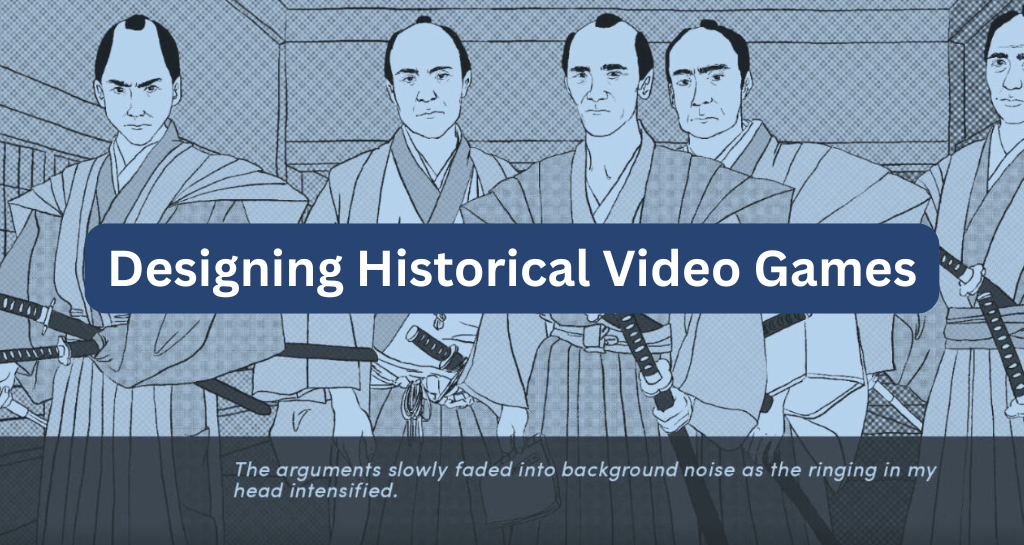
The task for the semester was to design a fully playable game that could be used in the classroom. The game was constrained by a set of guidelines.  First, it had to be built around a historical episode known variously as Chushingura, the 47 ronin or the Akō incident.  One of the most celebrated but also controversial episodes in Japanese history, the Akō incident took place between 1701 and 1703 and centered on an act of revenge carried out by a group of samurai against the perceived enemy of their dead master.  It laid bare the tensions between the myths and the realities of samurai life in this period, between legality and morality, and between the need for order and the desire for honor. 

Second, the Games Team had to develop a game with a clear educational payoff that could provide a window into the difficult life of a low-ranking samurai family in the eighteenth century.  To ensure stability, the Tokugawa regime that governed Japan worked to preserve and secure the samurai class while also stripping them of the right to use violence.  Placed on fixed stipends, many samurai and their families fell deeply into debt.   The game had to draw on and make connections to the most recent scholarship on the lived realities of the Tokugawa samurai, providing a series of teaching points that educators could use to design lesson plans around.  Third, the game had to be developed on zero budget, using only free, publicly available platforms and software without purchasing game assets. With these requirements in place, the Games Team was given total freedom to design the characters, the narrative and the game as a whole. As part of the internship, they worked closely with Ian Diaz, a UT graduate and experienced Games Designer.  

Promotional video for the Ako game

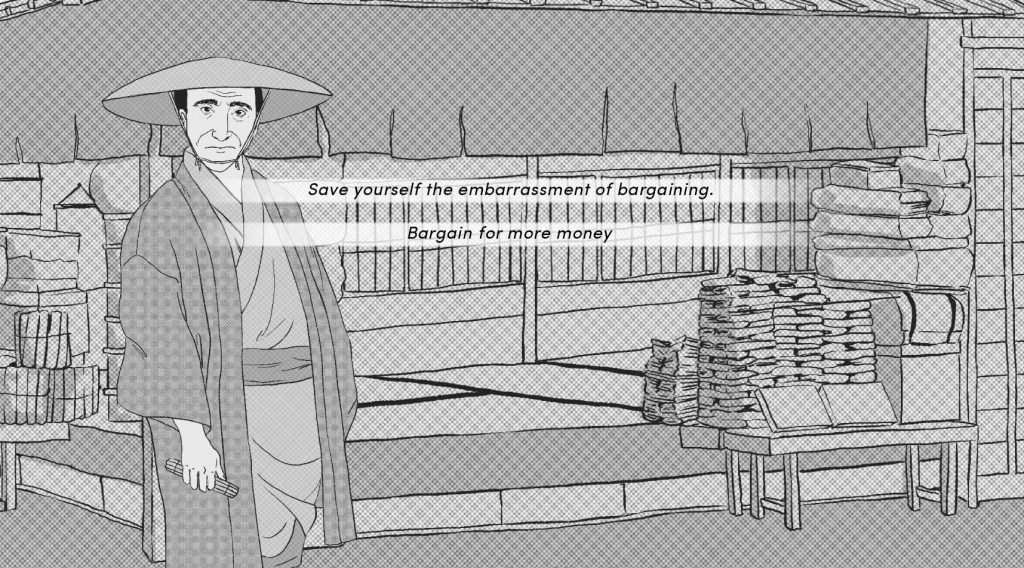
Video games take many forms.  Working within the confines of a single semester timeframe, the decision was made to develop a Visual Novel, a popular genre that is also highly flexible. Visual novels, which can broadly be characterized as Choose-Your-Own style adventure games, are typically presented in the first person with the player making a series of choices that govern subsequent actions.  They employ branching storylines that offer multiple paths through the narrative and for this reason players often replay them to experience the full range of different options. 

In designing a functional game, the Games Team faced four overlapping challenges: creating a believable central character, developing a branching storyline with consequential choices, writing compelling dialogue and producing realistic and historically grounded artwork. The most successful games push the player to invest emotionally in their character and the choices they make.  The first hurdle, therefore, was to create a believable character that could stand at the center of a first-person game.  The Akō game allows the player to view Tokugawa Japan through the eyes of young samurai, Kanpei Hashimoto. As Hashimoto, the player progresses through the major events of the Akō incident.  The game is divided into four chapters with each chapter designed to expose Hashimoto to new decisions and conflicts while exploring the realities of samurai life, the economic structures of early modern Japan, the role of women in society, the commercialization of religion, and the nature of samurai ideologies in an age of peace.

Second, the Games team worked to construct compelling narratives filled with choices that matter.  In total, the Akō game has five possible outcomes depending on the individual decisions players make.  These five outcomes represent unique branches of the story, but the player is also presented with numerous smaller decisions that open up additional pathways. 

Example of individual player decision

Third, the Games Team wrote thousands of words of dialog for use in the game.  Visual Novels contain some background information that is displayed at key junctures in the story, but the vast majority of interactions take place through dialog as the player engages with individual characters.   The scale of this dialog is magnified by the fact that it has to be written to accommodate multiple different pathways through the game.  For this project, the Games Team wrote over 30,000 words of dialog, a significant challenge that required extensive research in topics as diverse as agriculture, diet, currency, dress style, architecture and funeral ceremonies.

Comments from Ashley Gelato, a member of the Games Design Team

Finally, the Games Team made the decision to develop original artwork rather than using public domain images.  In its final form, the game has 4 chapters with 30 background images and 13 characters. Each of these 13 characters has multiple expressions, creating a total of around 50 individual “sprites” that display varying emotions and postures.  In order to ensure that the artwork was historically grounded, hundreds woodblock prints and other images were collected to serve as reference material.  Even the smallest of artistic decisions required extensive research. 

Over the semester, the Games team dedicated hundreds of hours to the task. The result was impressive: a deep learning experience and a fully functional game, Ako: A Test of Loyalty, that is linked to contemporary scholarship.  By the end of the semester in May 2020, the game was distributed to beta-testers who provided feedback.  In September 2020, it will be used for the first time in a university setting as an educational resource and then released on commercial platforms where it will be available for download at no charge. 

Screenshot of Ako: A Test of Loyalty

As an educator, it was remarkable to watch a group of students start from zero and build up an immersive historical experience over the course of a semester. Such experiments show how video games can be viewed as something more than just a distraction separated from the core study of history. Instead, used properly, video games can provide a highly effective vehicle for learning about the past. At UT, the experiment was so successful that it led directly to the creation of Epoch: History Games Initiative, which aims to develop a pipeline of historical games over the coming years.

You Might Also Like:

  • Digital Teaching: Mapping Networks Across Avant-Garde Magazines
  • Conspiracies, Fear, and the Dutch in Asia
  • Building a Virtual City for the Classroom: Angkor

Counterfactual History in a New Video Game

By Robert Whitaker

BioShock Infinite
Irrational Games

I have spent most of the last year applying for jobs, which means that I have spent most of the last year analyzing, constructing, rewriting, and generally just staring at my résumé. Writing a résumé is similar to creating a historical narrative – there is a protagonist (you), a cast of characters (employers and recommenders), a beginning, an end, a series of events in the middle, and a whole set of details that can be added or removed to suit particular audiences. Given the economy right now, there is pressure to make this narrative as broadly appealing as possible. Some career advisors have even encouraged me to engage in “creative truth-telling” to help me land a position. This practice, they tell me, isn’t lying, per se, but rather a gentle embellishment of the facts.

As an historian, however, this practice gives me the heebie jeebies. It reminds me too much of the push by some to make a selective reading of American history the standard for teaching the subject. American History, in many ways, represents the nation’s résumé. It is a catalog of achievements and events – some good, some regrettable – that are used to encourage citizens and outsiders to buy into the nation. As with my own personal narrative, the stakes for this résumé are high. There is the same pressure to embellish this history – both through addition and omission. But we must ask if it is really beneficial to avoid all the nasty bits when studying the past? When we consider our own personal failures, we often say that we learn from our mistakes. How can we learn from the nation’s mistakes if we remove them from our history? 

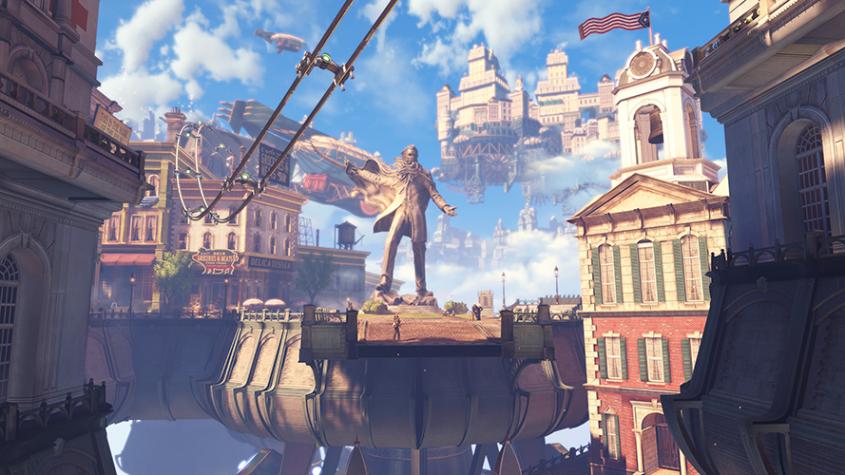
BioShock Infinite is a game that uses a counterfactual history of the United States to force players to consider some of these mistakes. Set in 1912, the game takes place in Columbia, a floating city hovering over the United States. You play as Booker DeWitt, a veteran of the 7th Cavalry Regiment and a former member of the Pinkerton Detective Agency, who is sent to Columbia to retrieve a girl named Elizabeth in order to absolve his debt.  Booker is racked by guilt for his participation in the Wounded Knee Massacre and for his role in putting down worker strikes as a Pinkerton agent. His personal remorse has driven him to drinking and gambling. Booker embodies several Progressive Era sensibilities, including the awareness of past wrongs, and the desire for redemption and reform.

In Columbia, however, Booker faces an unrepentant Gilded Age society led by firebrand preacher Zachary Comstock – a man who shares much of Booker’s personal history, but none of his remorse. Styling himself as a modern day Noah, Comstock sees Columbia as “another ark, for another time,” a place where he can preserve his vision of America while planning the destruction of “the Sodom below.” Comstock’s America is built upon a perverse worship of the Founding Fathers and rejection of the political and social developments in American society since the Civil War. Columbian society is committed to racial purity, religious zealotry, and unfettered capitalism, and promotes these philosophies through a set of distorted Sears Roebuck advertisements plastered around the city. Museums in the city present John Wilkes Booth as a hero and the Wounded Knee Massacre as a national triumph. The personal histories of DeWitt and Comstock reminds players not only of particular historical events, but also how the memories of those events can be perverted to attain political goals.

This sort of stylistic use of history is familiar territory for Irrational Games and its creative director, Ken Levine. The original BioShock, published in 2007, used Ayn Rand’s objectivist philosophy as the basis for a story set in the underwater city of Rapture. Levine’s BioShock games share many similarities in terms of plot and theme. Both games feature an antagonist bent on creating a utopian society based on warpedBioshock_infinite_screenshot_motorized_patriot notions of exceptionalism and capitalism. These antagonists are opposed in both instances by a group made up of dissatisfied, working class civilians, led by Frank Fontaine in BioShock and Daisy Fitzroy in Infinite. Thematically, the BioShock series grapples with the age old question of free will versus destiny, and stresses the potential role of the state in determining the answer.

Both BioShock games offer easy parallels with the present division between neoliberal capitalists and the Occupy Movement, yet these parallels become murky as both games progress. While the capitalist appears as the initial antagonist in both games, the player comes to learn that the opposition is capable of just as much destruction and violence. Levine’s message, then, is not a simple liberal critique of current politics, but rather a general warning about extremism in politics, whether that extremism comes from the left or the right. Writing as an historian of the 20th century, this is a warning that cannot be repeated too many times.

In addition to the plot and themes, BioShock Infinite encourages historicism through its music and gameplay. For reasons that become clear through the story, Infinite contains a jukebox musical score that features ragtime versions of popular twentieth-century hits, including songs by the Beach Boys, Creedence Clearwater Revival, Cyndi Lauper, Lead Belly, Soft Cell, and Tears for Fears. Additionally, Infinite’s gameplay often encourages the player to take on the role of historian. Major elements of the game’s narrative are left unexplained in cut scenes, but can be found by the player in voice recordings and kinetoscopes scattered throughout the city. These recordings and logs are not always easy to find, meaning that each player can come away with a different sense of the storyline depending on which, or how many, recordings they discovered. One of the game’s major side quests, then, is an oral history scavenger hunt.

ColumbiaThis sort of detailed work would be lost on most players without exciting gameplay to draw them in. Infinite, however, builds upon traditional first-person action in interesting ways. In particular, it takes advantage of the game’s setting in the clouds, allowing players to move around the environment using skylines and zeppelins. This freedom of movement gives the combat sequences a frenetic feel and prevents them from becoming predictable. Unfortunately, this novelty is diminished by the rote nature of the game’s violence. The current debate on graphic content in video games is all too applicable here. Infinite’s storyline, including the player’s interactions with their companion Elizabeth, are best experienced by the reader themselves. The plot is a bit more precocious than profound, but it is well paced, matching the action of the game.

The BioShock series has become something of a bellwether for the video game industry and the release of Infinite has led to several “state of the medium” pieces online (listed below). What, then, does BioShock Infinite indicate about the future course of video games? On the one hand, we see a familiar reliance on violence and the first-person perspective, but on the other hand, we see a game that engages with complex, historically laced themes. Certainly, Infinite presents these themes in an exaggerated manner, but the fact that the game deals with them at all is encouraging. This further maturation of video games can only be seen as a good thing, for historians and players alike.

Photo Credits:

Promotional Photos of Bioshock Infinite (Images courtesy of Irrational Games and 2K Games)

Images used under Fair Use Guidelines

If you’d like to read more about Bioshock Infinite:

Leigh Alexander writes that Infinite represents “a crucial moment in

canon,” but not one without flaws.

Giantbomb.com editor Alex Navarro collects and discusses the major threads of criticism that Infinite has encouraged in the gaming press.

Gamespot.com interview with Ken Levine on the development of Infinite and the current state of the video game industry.

“You have died of dysentery” – History According to Video Games

Right now millions of people worldwide are reliving the American Revolution through a new historical fiction. This fictionalized revolution, however, is not televised on PBS, nor is it directed by Steven Spielberg or written by Ken Follett. Instead, this version of the Revolution comes to us through a video game called Assassin’s Creed III. Developed and published by the French gaming company Ubisoft, Assassin’s Creed III follows the story of Connor Kenway, a half-English and half-Mohawk assassin battling the British and the Knights Templar (don’t worry, I’ll explain later) during the period of the US Revolution. From Connor’s perspective, players are able to interact with famous historical figures such as George Washington and Benjamin Franklin, and explore virtual recreations of colonial cities such as Boston, New York and Philadelphia. The game, released on October 30, has already met with critical acclaim from gaming journalists and it promises to become the most consumed and financially successful historical fiction, in any medium, this year.

image

The video game is a relatively new medium, but it has a long record of using history to tell stories like the one found in Assassin’s Creed. Given the mass popularity of video games and gaming culture, it seems appropriate that we begin to analyze the history portrayed in this medium in the same way we consider a historical novel or period film. Why and how is history used in video games? How has this use of history changed over time? How does the use of history in video games compare to the use of history in other media? Finally, are these uses of history merely a pretense for entertainment or do they offer a real opportunity to learn about the past?

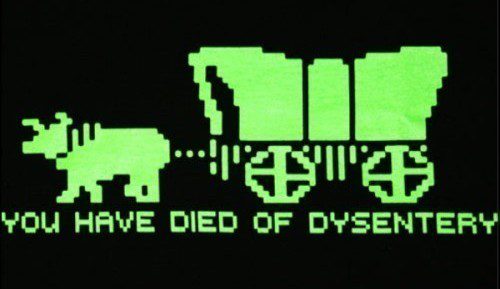
Early examples of history in video games came from titles designed explicitly for classroom use. Probably the best and most famous of these is The Oregon Trail. Developed by a group of teachers and released by the Minnesota Educational Company Consortium (MECC) in 1974, The Oregon Trail positions players as American settlers leading their families from Independence, Missouri to Oregon in 1848. While on the trail, players are required to manage their provisions as well as a number of impromptu crises, including broken wagon wheels, spoiled food, overworked oxen, and the sudden death of caravan members (usually from dysentery).Success is not guaranteed and the player’s expedition will end in failure without careful planning. Despite its rudimentary visuals and gameplay, The Oregon Trail gives players a rather accurate sense of the difficulty of transcontinental travel in the nineteenth century. It also provides players with something they cannot get from a book or film: an understanding of the past introduced through direct interaction. This interaction, however, is limited to the journey on the trail, and leaves the surrounding historical context (e.g. motivations for the journey, relations with Native Americans, etc.) up to the players, or their teacher, to fill in.

image

As The Oregon Trail and its imitators proliferated in classrooms during the 1980s and 90s, commercial games also began to adopt historical settings and topics. Early ventures in this genre included adaptations of historically themed board games, such as Axis and Allies, Diplomacy, and Risk, as well as digital versions of turn-based, tactical military games focused on the campaigns of the Second World War. These games were joined later by a large number of real-time strategy games (RTSs), including The Ancient Art of War, as well as games from the Total War and Age of Empires series. Like the vast majority of historical novels and films, these games focus on high politics and military history. Unlike these media, however, video games often range across long historical time periods and allow players to engage with a wide variety of subjects and events.

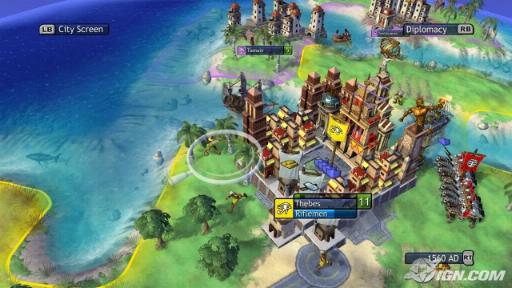
A key example of this type of work is the Civilization series, which debuted in 1991. Developed by the legendary Sid Meier, Civilization puts the player in charge of one of the world’s civilizations in 4000 B.C.E., with the objective of establishing and maintaining an empire until they reach either the game’s time limit (the game usually ends in the early 21st century) or one of several victory conditions (conquer all other civilizations by force, establish a colony on Alpha Centauri, be elected leader of the United Nations, or establish cultural hegemony). Players determine nearly every facet of their civilizations: agriculture, construction, demographics, diplomacy, economic policy, religion, and scientific research. The player’s civilization faces challenges from not only computer controlled competitors, but also from unhappy citizens and random natural disasters.

The Civilization series, in many respects, reflects a triumphalist, neoliberal conception of world history. Playable civilizations include crude stereotypes of current nation states, with many civilizations being completely out of place at the beginning of the game in 4000 B.C.E. For example, gamers can choose to play as the United States “civilization,” complete with an Abraham Lincoln avatar, dressed in a bearskin toga. Players often find that the game’s victory conditions are easier to achieve if they maintain a civilization that is democratic, culturally liberal, and secular. Play at all difficulty levels rewards aggressive foreign policy and the military conquest of neighboring civilizations is often a simpler path to victory than diplomatic or financial incentives. An aggressive foreign policy, however, can end in disaster if competing nations have nuclear weapons.

These problems aside, the Civilization series has much to recommend it from a historian’s perspective. It is the only history game that offers a global perspective on the past as well as an appreciation of contingency in history. The game does not follow the historical record – a player could successfully lead the Carthaginian Empire past Rome and begin the Industrial Revolution in Africa in the seventeenth century. Moreover, players can use a custom map or other modifications to create counterfactual situations in order to test variables. How different would European history be if the British Isles were connected to the continent? What if societies in the Americas had access to horses before contact with Europe? Civilization encourages players to consider the longue durée of cultural, economic, and ecological structures. And for players who seek a deeper knowledge of the game’s concepts, each edition of Civilization provides a “Civilopedia” with encyclopedia-size synopses of historical events and figures.

Though the Civilization series remains popular today, the most popular and profitable history video games of recent years come from the first-person shooter (FPS) genre. Beginning with 1992’s Wolfenstein 3D and continuing with the Call of Duty series in the 2000s, FPS games use the history of the Second World War as window dressing for what are essentially action movie simulators. Players take the role of a soldier from one of the Allied powers and shoot their way through levels filled with either German or Japanese enemy soldiers. These games make no effort to contextualize the player’s actions or to consider the moral implications of those actions. Moreover, the Second World War portrayed in these games remains firmly entrenched in the “Good War” narrative: Allied soldiers in these shooters are always heroic and righteous.

Other recent games, including the FPS series BioShock and the strategy series Command and Conquer: Red Alert, use history as the basis for adventures in counterfactuals. The first BioShock places the player in the city of Rapture, a submerged metropolis under the Atlantic Ocean built in the 1940s by a Howard Hughes-esque industrialist who hoped to create a utopian society based on Randian, or Objectivist philosophy (spoiler: it didn’t turn out so well). BioShock: Infinite, scheduled for release next year, is set in the floating city of Columbus in 1912, and will see the player engaging with Progressive Era ideas of American empire, eugenics, and exceptionalism.  Command and Conquer: Red Alert begins with Albert Einstein using time travel to murder Adolf Hitler in 1924 in order to prevent the Second World War. Unfortunately, this event creates a parallel timeline in which the Soviet Union embarks on world domination during the 1950s.

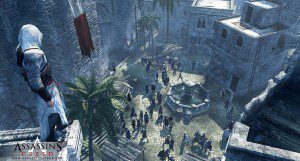
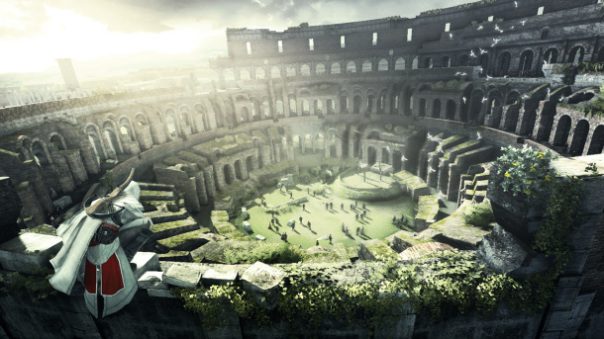
The Assassin’s Creed series, which debuted in 2007, also revels in counterfactual fantasies, but attempts to place these stories in realistic historical settings. In Assassin’s Creed, players take the role of Desmond Miles, a modern day bartender who is kidnapped by a shadowy multinational corporation called Abstergo Industries. Abstergo forces Desmond to use a virtual reality machine called the Animus, which allows the user to relive the lives of their ancestors using their DNA (hold on, it gets crazier). During the first game of the series, Desmond relives the life of his ancestor Altaïr ibn-La’Ahad, a Syrian assassin who lived during the third Crusade. The second installment of the series finds Desmond reliving the life of Ezio Auditore da Firenze, a fifteenth-century Italian assassin. Eventually, Desmond learns that Abstergo is the modern incarnation of the Knights Templar and that the organization is using Desmond’s ancestral memories to search for the “Pieces of Eden,” objects of immense supernatural power (think the Ark of the Covenant in Raiders of the Lost Ark). Famous historical figures make appearances throughout the series. Assassin’s Creed II, for instance, sees Leonardo Da Vinci, act as an early modern Q to the player’s James Bond, providing the protagonist with an assortment of gadgets, including his famous tank and flying machine models.

The story in Assassin’s Creed – the Illuminati meets Ancestry.com – has much in common with the conspiratorial history seen in the fiction of Dan Brown and Neal Stephenson. This fantastical story, however, is couched in a largely accurate and detailed historical setting. The first installment of the series, set in Palestine, features period recreations of Acre, Damascus, and Jerusalem. Assassin’s Creed II, set in Italy, provides recreations of Florence, Monteriggioni, Venice, and Rome.

image

This game also adds historical descriptions to the buildings players encounter (and climb) while playing, including St. Mark’s Basilica, Santa Maria del Fiore, Santa Croce, and the Ponte Vecchio. A direct sequel to Assassin’s Creed II, called Assassin’s Creed: Revelations, takes place in Istanbul and provides a similar level of detail. Developer Ubisoft’s effort at recreation also extends to the human characters who populate the game world. Careful attention is paid to clothing, demeanor, and language.  In pre-release coverage for the third game, creative director Alexander Hutchinson described the process of research and consulting that went into creating a Native American protagonist. Hutchison boasts of reading Wikipedia entries and watching documentaries, but his company also relies on a multinational group of professional historians and in-house researchers.

Of course, Ubisoft’s recreations are far from perfect and not always completely accurate. Yet their work demonstrates the potential for video games to provide consumers with history that is both interactive and instructive. To be sure, this history continues to focus on blood and guts, but a desire for different stories is emerging. For instance, Xav de Matos of Joystiq.com suggested last month that developers create a game focused on Harriet Tubman and the abolitionist movement. The recent growth in the popularity of video games has forced the industry and traditional gamers to begin to confront some of their biggest demons regarding racism, violence, and, most importantly, sexism. Ubisoft, for its part, published a portable game called Assassin’s Creed III: Liberation, which follows the life of a female African-French Assassin in eighteenth century New Orleans. If this trend continues, there is little doubt that new and different video game histories will emerge, and it will be exciting to see if those narratives lead to better opportunities for learning about the past.

The author would like to thank Dr. John Harney for his comments on an earlier draft of this essay.

You might also like:

Keith Stuart, “Assassin’s Creed and the Appropriation of History,” The Guardian

Here on Not Even Past: Joan Neuberger, “Telling Stories, Writing History: Novel Week on NEP.“

A free version of the original Civilization is available here

For ideas on using video games in the classroom, see Jeremiah McCall’s Gaming the Past: Using Video Games to Teach Secondary History (2011)

More by Bob Whitaker on gaming can be found on twitter @whitakeralmanac and his Playstation, Steam, and Xbox gamertag is hookem1883.

Images used under Fair Use Guidelines: See Wikipedia:Non-free content.

Recent Posts

  • Primary Source: On the Pleasures of Printers’ Ornaments
  • Review of Beyond States. Powers, Peoples and Global Order (2024).
  • Understanding History Through Video Games: Europa Universalis IV and Causation 
  • The Politics of Catastrophe: A Brief History of FEMA
  • Beyond the Archive: Digital Histories and New Perceptions of the Past
NOT EVEN PAST is produced by

The Department of History

The University of Texas at Austin

We are supported by the College of Liberal Arts
And our Readers

Donate
Contact

All content © 2010-present NOT EVEN PAST and the authors, unless otherwise noted

Sign up to receive our MONTHLY NEWSLETTER

  • New
  • Features
  • Reviews
  • Texas
  • Teaching
  • Digital
  • Watch & Listen
  • Authors
  • About