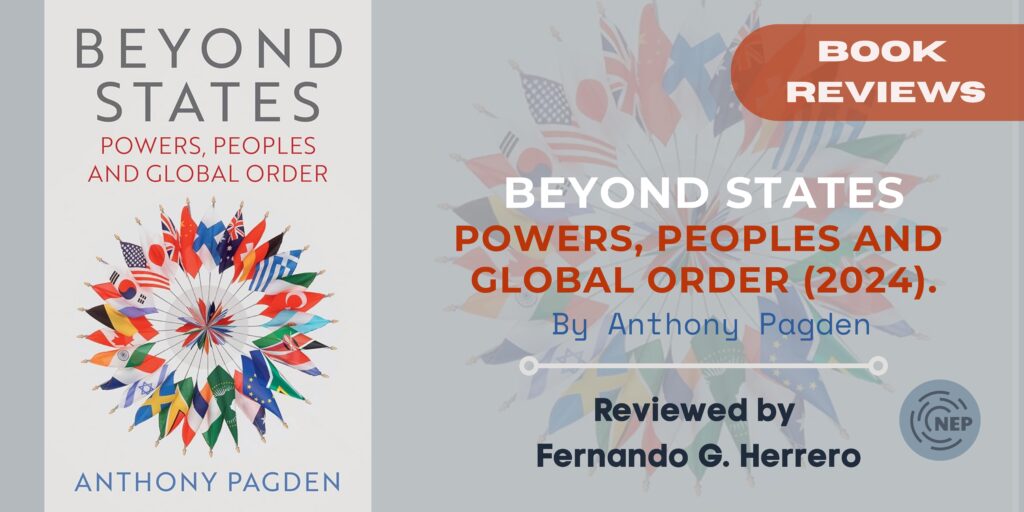
One serious historian shares the big dream of a one-world federation. Do we share the dream? Importantly, how do we evaluate this future-oriented invitation? What does that do for “history”? If the reputed English historian Anthony Pagden (UCLA)[1] does it, it must be legitimate. Beyond States: Powers, Peoples and Global Order is a slim, manageable, and erudite book of compact global history. As such, it is symptomatic of our times, for good and ill. The book is aimed at a general readership with interests in history and international relations. It remains firmly oriented toward Western perspectives, which continue to dominate the field. Europe is what matters to Pagden the most. This is the territory to study, defend, and love. Eurocentric at the core, with or without the professional home in the U.S. If you are someone who follows world events and seeks some needed historical background, this work is for you.
Readers will travel vast timespaces as a whole lot of “human” history is packed in these 285 pages. The adjective in quotes recurs in key moments. Compression must happen if we are to contemplate Cyrus the Great of Persia (6th century B.C.) and reach for the last Shah of Iran in 1967 in a few pages (119). Remember the grand gesture of Kubrick’s 2001: A Space Odyssey, from the fighting hominids and the throwing of a bone into the air to the shocking segue into the waltz of the spaceship of human civilization in a technological future. A planetary human civilization in outer space is the vision in the end.
This historicism is and must be thus a tight condensation of political vignettes and references, many of which are left begging for greater development. Do not lose the thread of the argument, which bets for a desired global federalism.
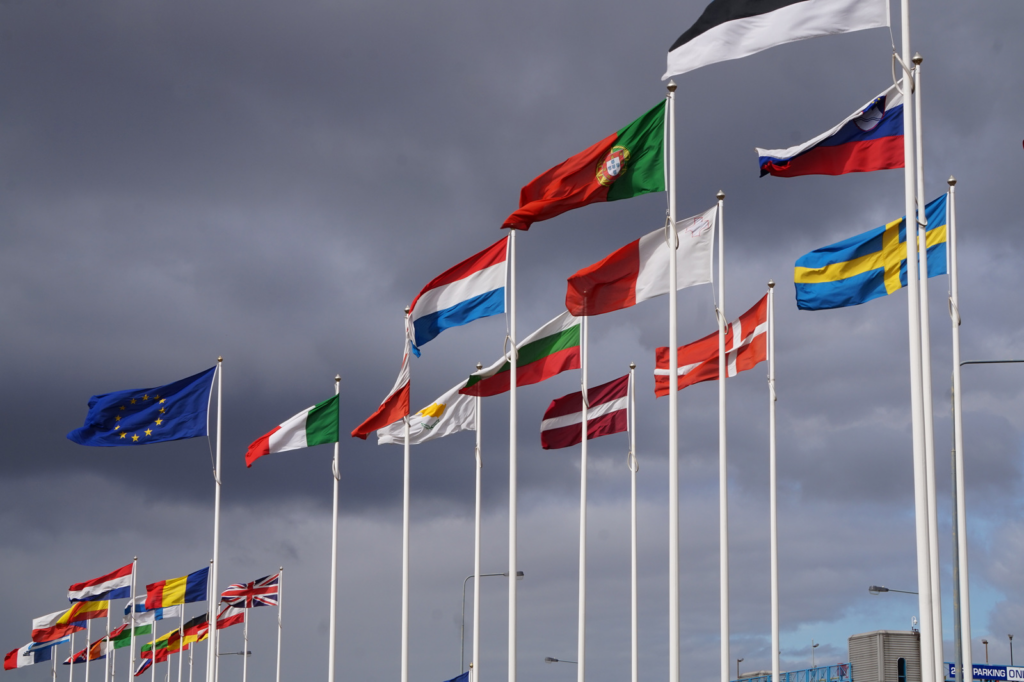
European Union flags on Castle Street, Hull. Source: Wikimedia Commons
Beyond States is thus this bold projection of a desire for a better future, which translates into the withering of the state (Engels, explicitly cited). The terminology is “humanistic” (post-structuralism is no serious consideration for Pagden, who does not contemplate the whole literature on post-modernism either). The nation(-state) does not hold either. There are no crocodile tears. Here, nationalism is a dull or obtuse parochialism, and the empires of the past were, in essence, imposition and coercion. “Modernity” is, sure thing, certain to leave them behind (there is no engagement with post/decoloniality either). Pagden’s proposal: history teaches us that a global federalism of big units emerges as “the most desirable alternative” (26). Is “global” another word for total, universal, indeed “world”? In any case, this federalism is no mega-State, no federal State either. It allows a high degree of cultural, political, and legal variations (225). It is not unity, but a union. It feeds off, unmistakably, from the lessons of the European Union and its principle of subsidiarity, but it is not exclusively Western anymore, although it has its prints and features. It is, or it should be, Pagden says, more inclusive and exercises “factual consensus.” How persuasive and seductive is this vision?
Pagden’s proposal is a “liberal” alternative to Carl Schmitt’s Large-Space Politics of a century ago (23, 35, 207, 225). Beyond States outlines four parts: the birth of the nation-states, from the national to the international, the order of the world, and a world federation. We leave empirical and archival conventions behind to pursue the teleological thesis of a global federation of federations. The prose is polite, non-belligerent, cautious, the apodictic is suspended, the hypothetical gains traction, and the Schmittian predilection for the political theological is here secularized. Yet, there is, in general, little institutional detail or historical development of each section. The declaration of faith of Beyond States: universal federalism is univocally proposed for the whole wide world to see and embrace with conviction.
As a respectable historian working within the English school of political thought, Pagden presents an enjoyable, readable, and professional account, supported by a wide range of references. You may, however, circumscribe the bibliography mostly within the white-male-European-and-Western names of the North Atlantic in the lingua franca. There is some French and a bit of German, and that’s about it (there is a telling reference to Italian in the end). No doubt, the pulsating heart of Beyond States is never far away from a European Union ideal. Pagden’s proposal is that the world will learn from it, make it its possession, and push it further. The European Union is the emotional and intellectual home of our English expatriate in Los Angeles. He will die faithful to it. Other parts of the world are add-ons, and he keeps the U.S. at a distance.
Working across thousands of years and at the scale of the global as a theoretical object, the book necessarily relies on rapid, schematic treatments rather than detailed or sustained engagements. Beyond States offers many fascinating vignettes, typically rendered in two or three pages, that would benefit from further development or reading elsewhere. Their compression, however, also produces a different effect, privileging suggestive, quick-pencil sketches over extended, multiperspectival accounts. I missed the clash of different interpretations provided by the different national, social or ethnic groups.

Tomb of Cyrus the Great. Source: Wikimedia Commons
Regarding empires, there is the inclusion of Cyrus the Great, Genghis Khan, the “human expansion” of the 15th century into America, the “first and second empires” (40-44), and much more. Regarding the nation, it is born (44ff), with Renan and Kant (there is a whole lot of Kant!); yet, the birth of such an entity, the nation, is not clear: is it Spain in 1469? Is it perhaps England in the 9th, 13th, and 17thcenturies? (50). The notion of nation conveys, he tells us, some kind of “union,” and this is the general run of the book. We are not meant to stop at the different stations; the train moves forward, and we are all moving, it appears, towards greater, irrepressible forms of human convergence. Such forms trump, so it is suggested, over fragmentations and divergences, also dissent. Before the 19th century, nations existed “in one way or another,” Pagden adds, but not so the conceptions of nation-state, or even nationalism. The modern nation will thus be the assemblage of “microunits” (51). Habermas speaks of “unity” (52) apropos the 19th century. “Union” is the preferred term for a better future. There is a lot of Habermas, always quoted approvingly (52, 158). The spirit of such social democracy is also here. Sympathetically reading Beyond States, your knickers will get occasionally tangled up too, but it is no major problem.
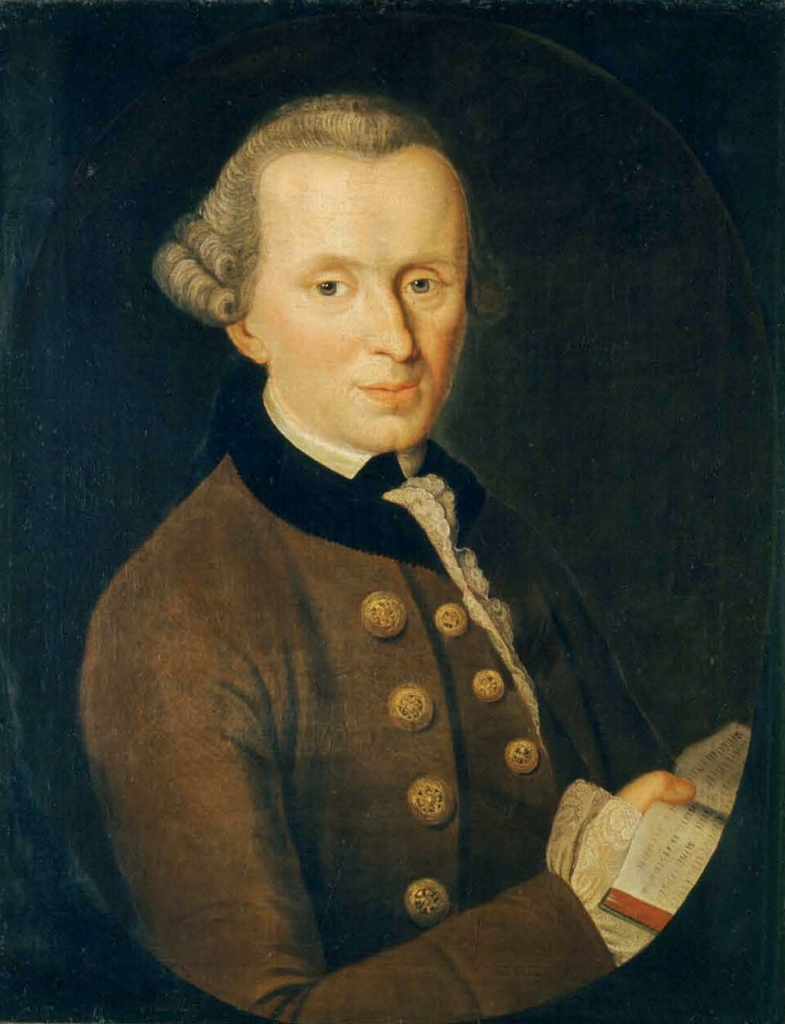
Portrait of Immanuel Kant by Johann Gottlieb Becker, 1768 Source: Wikimedia Commons
The notion of democracy is important, and it pops up from time to time. It is a “society without a father” (Hans Kelsen). There is a lot of the Austrian jurist Kelsen, proponent of a normative universalism, who is said to deliver a “happy world” (52, 72, 142-47, 220, 231). We see the ideal guard rails of Pagden in between such gentlemen (Kelsen and Habermas). Sovereignty yokes nation and state (references to Hobbes and Bodin are included, even the Labour-liberal politologist Harold Laski, quoted approvingly), but sovereignty is here not the totem and taboo that others take it to be. Beyond States traffics in the illusion of a future without limits or boundaries, and in the final invitation is something like “global governance.” We might want to say, against all evidence, a hypothetical “yes”, but what does that mean?
If sovereignty is not definite and does not hold court, the push and pull of the book are towards bigger and “open” time-spaces. Warring social groups will cohere into the singularity of “human.” Yet, Pagden is most at home in the European-sourced club of readers and interpreters, with the occasional “diversity” inclusion that does not signify a sustained dissidence or divergence. There is a telling inclusion of a seductive French cosmopolitanism (Russian expat Alexandre Kojève, 215-219). There are some Italian elements: Mazzini, the architect of Italian unification, is highlighted (57-60), Italian Prime Minister Georgia Meloni, however, puts a face to populism (187), which Pagden opposes. Citations come galore, sometimes circling the U.S. legacy of Woodrow Wilson, but the heart of our historian is not here. There are many citations, and the development of many of them could have grown into different trajectories, but this would have been another book. Beyond States is yet another push in the unequivocal universalist tradition of eminent political forms of Western origins.
The chapter on international law speaks of “values” (125) and of “liberal consensus” (125-26), coming out of secularized Christian justice, described as “good for the majority of humanity.” The notion of “human rights” is also a Western conception of political desirability. Cosmopolitanism “for many” (133) brings us close to “the moral vision of the universal” and, of course, the references are to Kant (134-38). Fear not: Pagden will follow none of the postcolonial critique apropos the anthropological racism of the enlightened Prussian philosopher. There are simply too many assumptions that require many more pages. There are not enough counter-narratives. The respected Finnish international-law scholar Martti Koskenniemi, cited explicitly, would resist such fast normative aspirations, situating them within the persistent conflicts and tragedies that Pagden tends to exclude from his future vision of global governance (126–27). There are references to the United Nations and the International Court of Justice. Yet, their contemporary dilemmas remain unexamined. Back to the future of the 1930s, the influential English economist John Maynard Keynes’s “optimistic vision” of a world of non-belligerent and competitive nation-states emerges (159). Most Westerners quoted are the steps of this stairway to the heaven of a global federation.
Beyond States is thus a public, professional exercise in the Europeanist faith. The faith affirms a globalizing federalism that is within reach or at least not far into the future. The Hegelian universalist state configuration will be left behind due to its overwhelming difference-erasing state-centrism (61). Yet its universalism is retrieved (118). Particularisms somehow survive: the dream is about positive, seemingly voluntary and non-coercive “union” and not enforced, uniform, negative “unity.” The push-and-pull is here towards collaboration and interdependence of bigger and bigger units rising above the limitations of this or that particularistic sovereignty. The agent or subject of this convergent history is not defined. Dante’s De Monarchia is “for many the supposed affinity of peoples of the whole planet” (219-20). Who is this “many”? What is that affinity? Democracy (dispatched as “collective self-government”) is added to the mix of the nation-state from time to time. Our current messy times require more bite and investigation. Is Pagden “guilty” by association? The good names are always –let us repeat–in the vicinity of the West. China is not democratic (69). Russia? You already know the answer. The varieties in the Global South, perhaps? We are assured that democracy is not exclusively Western; the Ochollo tribes in Ethiopia, the Zaporizhzhian Cossacks, the Igbo nation in Western Africa, and “perhaps many others, relatively small communities” (69), have been democratic. Bet your hat that our historian is not seeking sustained inspiration in those faraway societies.
Beyond States (2024) book cover.
Beyond States affirms an incredible linearity of global modernity, the one coming out of the French and American revolutions (71), coalescing around the moment of the Enlightenment, more European than American, and acquiring its “proper” qualities in the 19th and 20th centuries. This is the West that matters, the creator and exporter of all good things (73-5), with its contemporary NATO and EU articulations. The magic pill? The key factor? Commerce is the oldest and most sustained form of “contact” (76). The world is nothing if not interconnected. The terminology of the West overtakes that of Europe, with the French intellectual Auguste Comte (93-96), and the independent leader, Mustafa Kemal, “father of the Turks.” Where is America (from Alaska to Patagonia) in this Western expansionism? Beyond States runs a Europeanist counterpart to the contemporary U.S.-led West, currently under duress, which is not addressed.
This is, therefore, a self-styled “optimistic” ride if you want to take it. Injustices, slavery, racism, and man-woman inequality do, of course, happen; the refinement of these bad features in the West is “perhaps unknown in the rest of the world” (107-111). Scratch the eggshell: the West is the fons et origoof most things of value and some “refinement” of “less value.” As I read the text carefully, I keep wondering about the engine of this political machine and who gets to sit in the driver’s seat. The merchants? The business types? Self-assigned elites of the hegemonic countries? Do these preferences attenuate messy politics? There are also the politics of knowledge production and the geopolitical configurations of world partitions that still require reflection. Classes do not appear. Race plays no big part. Women are discriminated against. What else then? Beyond States constitutes a grandiose illusion, a kind of cosmic bird’s eye view of global history, of disembodied “humans” passing through the dark clouds and rain and thunder and reaching the warmth and nurture of a good sun. Climate change, theoretical West in the interregnum, internal tensions in the nations of this world, and crises in universities. Do not go far away from the U.S. ‘What else is ‘global history’ for?’, is the question that keeps Beyond States together. Or does it?
Yet, it is commerce that makes us “play the field,” nationally and internationally, and it is in the latter dimension where we “should” settle, Pagden asserts. From the 1st century to the 15th, the silk trade, Adam Smith’s enlightenment of the commercial society, communication, exchanges, ineluctable modality of modern society “to many” (85), who is this “many”? And there will be no more war or conquest. Carthage was the first commercial state, Pagden says (85). The most dynamic economic areas of the world today are omitted. The three dominant regions of the world are, however said to be the U.S., Europe, and China (229-232). Russia is not in the picture. No Asean, no Brics+, no Global South. Looking at the crystal ball, Pagden proposes amalgamations. It is a geopolitical nutshell. Things could go differently. Yet, our historians’ call is for the cultivation of sympathy, human sociability for the better care of our existence as a species (239-241). No technological prowess, no transhumanism, no AI, no Elon Musk or Peter Thiel here. The economy is not, per se, addressed. Capitalism is missing in action. We appear to be dealing with the dance of nominal entities and disembodied ideas.
Make no mistake: this is a liberal modality of “global history.” The Europe included here is that of the European Union, less so of NATO Europe, qua an ideal core of a Western compact (Brexit is a tragedy, 87; and Britain does not appear besides the sprinkling of a few Enlightenment figures). There are big silences in Beyond States, basically everything that upsets the thesis of greater convergences. Pagden’s core Europe is Franco-German filtered through the Anglo publishing prowess of Oxford and Cambridge. There are occasional admirative Italian touches. The “Hispanic” world makes a negligible contribution to the general vision, remarkable for our historian, who started his career under the guidance of John H. Elliott in the English context.
The author does not linger on the current problems or troubles of “Europe”; those of other units receive less attention. The portable volume does not, cannot linger in any detail of the political turmoil currently sweeping not only the West, but other parts of the world. Would ASEAN, BRICS+, G-20, USMCA, African Union be considered federations of the inspirational kind proposed by Pagden? No current political figures are mentioned, except for the populist Meloni. The Germany of Habermas does not show up. The U.S. of Trump is missing in action. The Latin America of Lula, idem. Is our historian too “optimistic”, too polite and euphemistic, too distant, too tactful? The “Hispanic” world occupies an uneven, marginal, and forgettable prelude to globalization, but the conventional term in quotes demands an update. Does China have anything to say? Russia? The Middle East? The Arab-Muslim world? Israel? The Jewish world? Africa? Never mind: a better “federalist” future looms in the future. Further conversations await with the esteemed historian in a dignified European club (Paris, London, Rome?), or perhaps in a cute taqueria in Los Angeles, with or without Chatham House rules.
Fernando G. Herrero is a Senior Research Fellow affiliated with the Instituto Iberoamericano of the University of Salamanca, Spain.
[1] See the two parts of my extensive conversation with Pagden, for greater context, also in Not Even Past.
The views and opinions expressed in this article or video are those of the individual author(s) or presenter(s) and do not necessarily reflect the policy or views of the editors at Not Even Past, the UT Department of History, the University of Texas at Austin, or the UT System Board of Regents. Not Even Past is an online public history magazine rather than a peer-reviewed academic journal. While we make efforts to ensure that factual information in articles was obtained from reliable sources, Not Even Past is not responsible for any errors or omissions.