
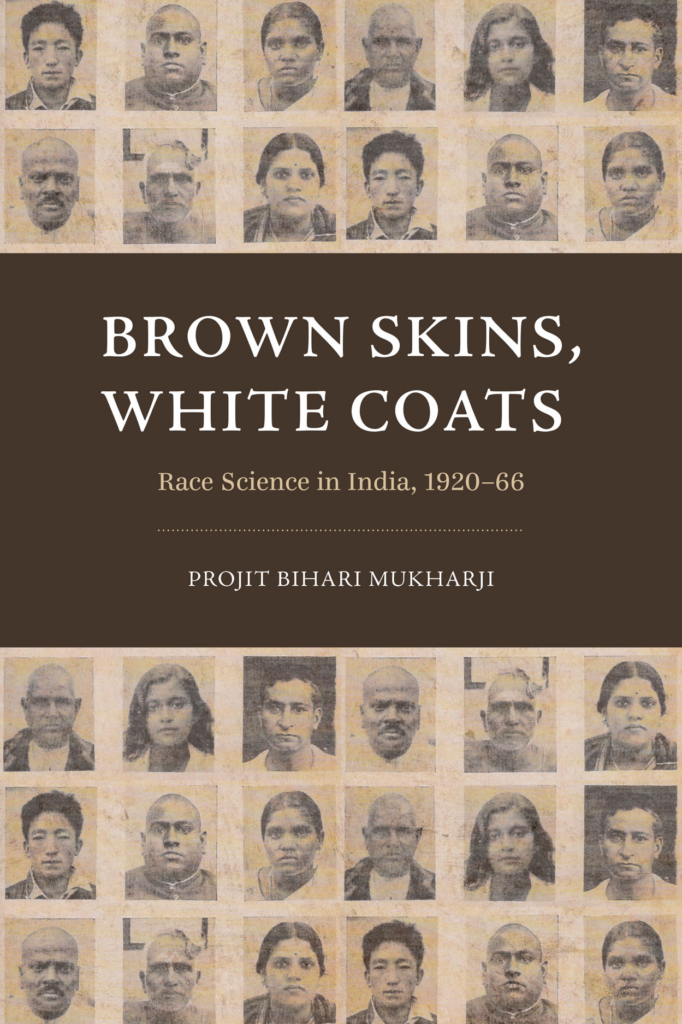
Projit Bihari Mukharji’s Brown Skins, White Coats: Race Science in India, 1920-66 adds an innovative account of India’s twentieth century to the historiography of race science. As the head of the Department of History at Ashoka University in Haryana, India, Mukharji engages with subaltern studies and decolonial writings of South Asian history. The title echoes psychiatrist and philosopher Frantz Fanon’s Black Skin, White Masks (1952), and Mukharji applies Fanon’s analysis to the Indian subcontinent in discussing science’s role in racial alienation, the process by which colonial medicine and science practitioners divorced themselves from the social and political realities of the people they studied and treated. Brown Skins, White Coats examines the twentieth-century field of seroanthropology–the study of blood testing to explain social phenomena–and shows how these scientific practices, publications, and discussions shaped the racial politics of India’s nationalist movement. Mukharji argues that the history of Indian nationalism is inseparable from the development of race science in the subcontinent, and that historians of race science elsewhere must account for the Indian case.
The book introduces a fascinating and effective method of storytelling beyond archival documents. Drawing from historian of slavery Saidiya Hartman’s method of Critical Fabulation, Mukharji constructs a fictional narrative based on the writings of twentieth-century Bengali novelist Hemendrakumar Ray. The narrative, consisting of eight letters exchanged between the novelist and another writer, includes the thoughts and conversations that non-scientists may have had about racial hierarchy in 1930s India. Through historical “overhearing” (p. 36), a linguistic practice that Mukharji identifies as distinctly Bengali, Brown Skins, White Coats combines classical Western historical methods with epistemologies local to the subject matter. The fabulations strengthen the book not only by articulating the presence of race science in social discourse, but also by demonstrating an analytical technique that reveals understandings of the archival material beyond purely literal interpretations.
Mukharji begins in 1919 with the world’s first seroanthropology publication, which claimed to establish a link between blood types and ethnicity. Primarily relying on scientific publications and commentaries from scientific peers, he then demonstrates the ubiquity of racial classifications among biologists and anthropologists across the subcontinent. Concurrently, the “rapid Indianization of the scientific services in South Asia” (p. 50) separated academic science, including seroanthropology, from its previous association with Europeanness. Seroanthropologists in British India later incorporated the principles of blood-based racial hierarchy into local ethnic, religious, and caste systems. Race science and hierarchy models fit well into the nationalist independence movements of the mid-century which identified scientific infrastructure as essential to nation building.
Mukharji next identifies multiple instances in which race science persisted after the Indian independence movement and discusses the concept of exogeneity, a framework that placed certain ethnic or religious populations as forever outsiders, in contrast to indigeneity. Many seroanthropological studies sought out culturally and genetically isolated communities as research subjects, including Jewish communities of South Asia. The studies of Jewish people fed into the nationalists’ assertion that Hindu people exclusively held the right to occupy and govern India, and Mukharji effectively shows how seroanthropologists contributed to the “emptying of the once-famed Jew Town of Cochin” (p.102). Mukharji then points to another example of racialized ideas of disease risk to the population of the subcontinent: sickle cell anemia. The historian notes that the social context of biochemistry in India in the 1950s differed significantly from the United States: “whereas the American molecularization of sickle cell disease had possessed a broad race-imploding aspect that disaggregated the presence of the gene from racial identities, in India molecularization seemed to reinforce racializing trends” (p.147). Molecularization–distilling the disease into differences in people’s molecular makeup–only exacerbated the racialization of sickle-cell disease in India. Skillfully tying in the racialization of caste and class in India, Mukharji shows how Indian scientists argued that certain populations posed a risk to the young nation based on the prevalence of genetic differences.
Having explained the theoretical work of seroanthropology, Mukharji next turns to material. Seroanthropology relied on blood, and researchers often used their own blood as control samples, a process called “self-calibration” (p. 172). In using their own bodies as references, Mukharji argues, researchers placed themselves as the material “reserve” (p. 173) of scientific knowledge in India. Additionally, through interrogating the selection of research subjects, Mukharji reveals the wide variance of study design, then the author identifies swaths of blood samples that were lost due to inadequate refrigeration, which further affected results. The analysis of blood and research materials grounds the book’s discussion in the daily reality of seroanthropology and convincingly illustrates the influence of physical circumstances on the scientists’ universal claims.

School of Tropical Medicine and Hygiene Institute, Calcutta. Source: Wikimedia Commons

Mukharji rounds out his exemplary work of subaltern history of science with an account of refusals. In congruence with recent calls to decolonize the history academy, Mukharji classifies refusal not as mere resistance to science, but rather as distinct actions that Indian communities performed based on their own understandings of blood. By casting refusals as different practices in parallel to seroanthropology, this analysis rebukes claims that resistance was anti-scientific and offers an excellent framework for scholars to explore varying degrees of engagement in the history of science. The book concludes with four texts from mid-century Indian scholars articulating views for the future of their country, each incorporating eugenics and other race science into their vision of India’s past and future. This final chapter and conclusion exemplify the prevalence of race science in India after WWII, but it is difficult to discern the degree to which the lectures and scientific publications influenced public thought about race and science. Mukharji concedes the possible disconnect between his scientific subjects and the greater Indian public in the conclusion, stating “Whether their seroanthropological stories actually translated into government policies or not is doubtful, but they certainly received the funds and the benediction of the state to tell their snapshotted biohistories” (p. 216). Nevertheless, the archival information Mukharji presents effectively proves that race science was widespread on the subcontinent and aligned with the nationalist project of twentieth-century India, from the colonial period through the first decades of independence.
Brown Skins, White Coats is a triumph of decolonial history. Projit Bihari Mukharji shows how historians of science can draw on the epistemologies and techniques local to their historical subjects to bolster their argumentation. Any historian, especially one searching for an example of decolonial academic writing, would benefit greatly from reading this book, regardless of their interest in seroanthropology.
Ben Schneider is an MD/PhD student currently completing a PhD in the Department of History at UCLA. He studies the history of public and private hospital expansion in twentieth-century Los Angeles and is interested in the relationships between health policy, urban policy, and health activism.
The views and opinions expressed in this article or video are those of the individual author(s) or presenter(s) and do not necessarily reflect the policy or views of the editors at Not Even Past, the UT Department of History, the University of Texas at Austin, or the UT System Board of Regents. Not Even Past is an online public history magazine rather than a peer-reviewed academic journal. While we make efforts to ensure that factual information in articles was obtained from reliable sources, Not Even Past is not responsible for any errors or omissions.
Related posts:
 Prejudice and Pride: School Histories of the Freedom Struggle in India and Pakistan by Krishna Kumar (2001)
 Wavell: the Viceroy’s Journal by Archibald Percival Wavell, ed. Penderel Moon (1973)
 Freedom at Midnight by Dominique Lapierre and Larry Collins (1975)
 Gandhi: Prisoner of Hope by Judith M. Brown (1989)