A Ferro e Fuoco: La Guerra Civile Europea, 1914-1945 by Enzo Traverso (2008)

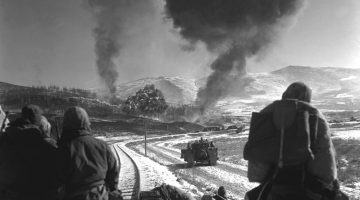
The period from 1914-1945 has sometimes been called a "European Civil War," but that concept has rarely been put to a systematic examination. Fortunately, Italian historian Enzo Traverso's recent work A Ferro e Fuoco, which can be loosely translated as Put to the Sword, offers some intriguing proposals for understanding the period as a continental civil war.
The Prisoner of Events in Vietnam

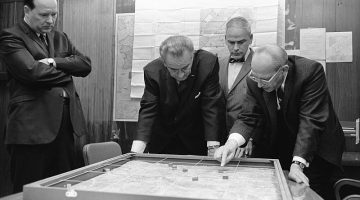
In the months following his resounding electoral triumph over Barry Goldwater in November 1964, President Lyndon Baines Johnson made momentous decisions to escalate U.S. military involvement in Vietnam. Most consequentially, he ordered the bombing of North Vietnam: first retaliatory strikes following a National Liberation Front attack on the U.S.
Episode 20: Reconstruction
Counterfactual History in a New Video Game
CIA Study: “Consequences to the US of Communist Domination of Mainland Southeast Asia,” October 13, 1950
Por Ahora: The Legacy of Hugo Chávez Frías

Chávez was an outsized, divisive, and complicated figure who aroused passions on both left and right throughout his fourteen years in power. To his supporters, Chávez was a symbol of Latin American independence and revolution.To his detractors, he was a “strongman” and a “dictator,” an enemy of free enterprise and democracy who consolidated political power in his Bolivarian Revolution and repressed his opposition.
Digital History: A Primer (Part 1)

Internet technology is starting to have a profound influence on the ways we do history. Historians have found new places to write history, new ways to make sources available, and some historians have mastered the digital technology to create new kinds of data and new kinds of sources for asking new kinds of questions about the past.
The Many Histories of South Austin: The Old Sneed Mansion

You wouldn’t think much of the limestone walls hanging on for dear life as you walked along Bluff Springs to get to the grocery store or the bus stop. Not least because they are set back about thirty feet from the road and concealed by trees. I first heard something about the walls and the Sneed mansion they once supported while walking along the Onion Creek greenbelt in South Austin.