• Features
  • Reviews
  • Teaching
  • Watch & Listen
  • About

The past is never dead. It's not even past

Not Even Past

Primary Source: How Did Cary Coke Get Her Copy of Queen Catharine?

This and other articles in Primary Source: History from the Ransom Center Stacks represent an ongoing partnership between Not Even Past and the Harry Ransom Center, a world-renowned humanities research library and museum at The University of Texas at Austin. Visit the Center’s website to learn more about its collections and get involved.

Mary Pix’s Queen Catharine; or, the Ruines of Love (1698) was not a smash hit. Very few of her plays were. While a handful enjoyed revivals on the stage throughout the 1690s and 1700s, none of her playbooks received a second run in print. That said, after Aphra Behn and Susanna Centlivre, Mary Pix was the most prolific woman playwright of the English Restoration.1 No fewer than twelve of her plays were produced between 1696 and 1706.2 And like many playwrights, regardless of gender, Pix used print to court aristocratic interest and, ideally, patronage. The copy of Queen Catharine at the Ransom Center may be the very one that Pix presented to the book’s dedicatee, Cary Coke. 
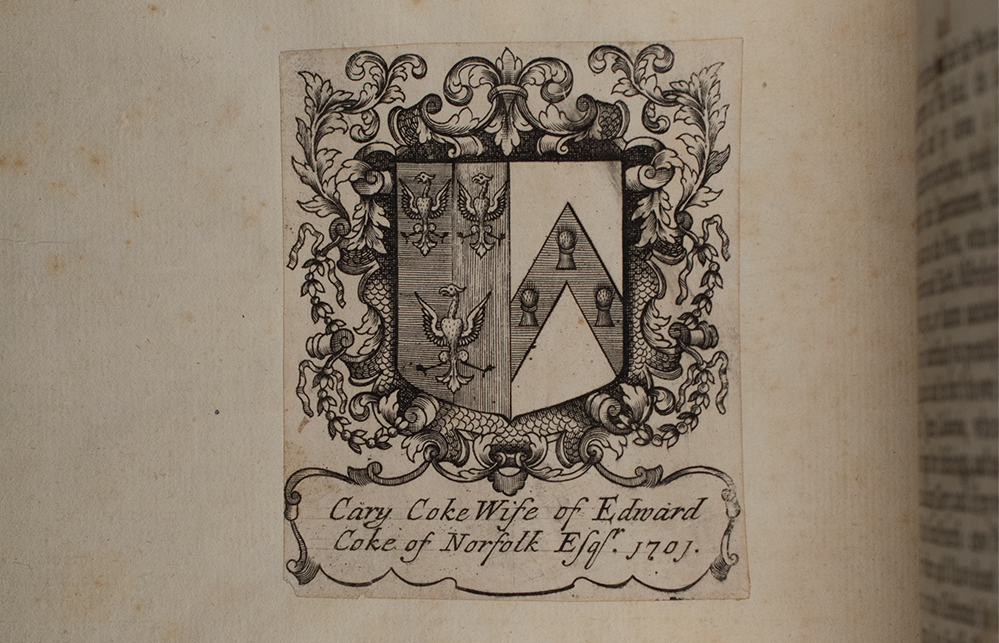
Bookplate of Cary Coke from Mary Pix, Queen Catharine; or, the Ruines of Love
Bookplate of Cary Coke from Mary Pix, Queen Catharine; or, the Ruines of Love (London: William Turner and Richard Basset, 1698). Harry Ransom Center, Ak P689 698q.

Part of the George A. Aitken Collection, which came to the Ransom Center in 1921, this copy of Queen Catharine is, from the outside, typical of the playbooks that went through the hands of nineteenth- and early-twentieth-century book collectors. It has been rebound in red leather and features marbled endpapers. Oddly, though, the volume’s only bookplate before arriving at the University of Texas appears not at the very front but on a leaf inserted after the playbook’s title-page. On the back—the verso—of that leaf, the plate reads, “Cary Coke Wife of Edward Coke, Esq. 1701.” The fact that it comes after the endpapers is not in and of itself unusual: book collectors in the early eighteenth century understood, perhaps better than modern ones, the impermanence of book bindings, and often glued their plates to the blank versos of title-pages. A bookplate following a title-page, however, is odd.  A little more than 300 of the Cokes’ playbooks are now at Oxford University’s Bodleian Library, and none include a plate in this position. Of the 30 total volumes in which they have been bound together, 24 include either Edward or Cary’s plate. In 22 of them, it appears on the verso the first play’s title-page.3 So, the question becomes: why is Cary Coke’s bookplate on an extra leaf in this copy of Queen Catharine? And what can this tell us about the history of this playbook before it arrived at the University of Texas?
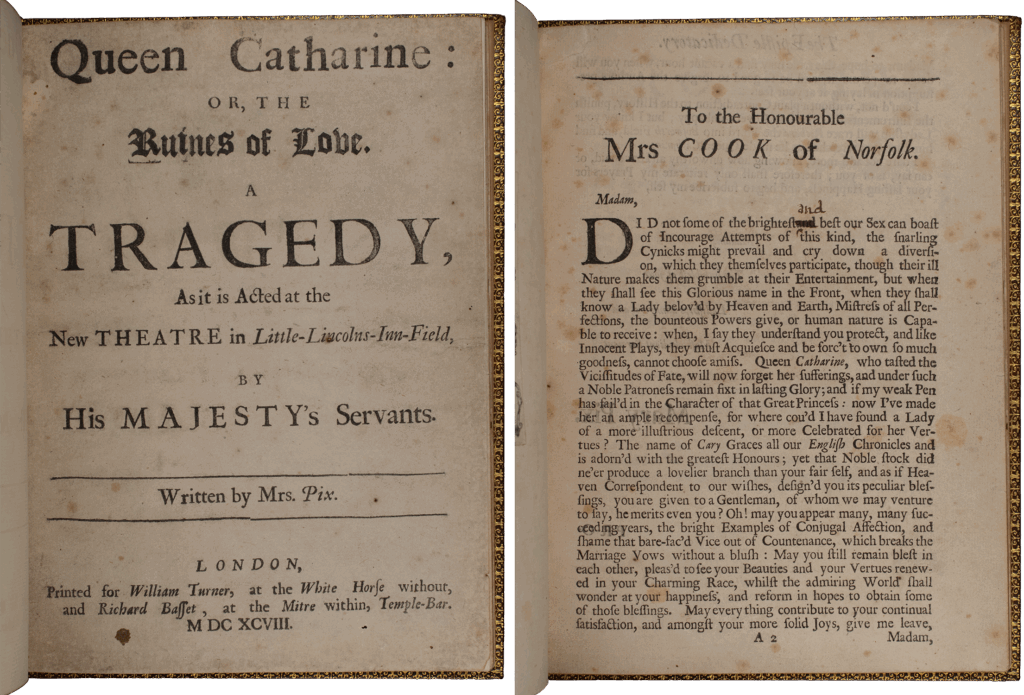
Title-page and sig. A2r with handwritten correction from Mary Pix, Queen Catharine; or, the Ruines of Love
Title-page and sig. A2r with handwritten correction from Mary Pix, Queen Catharine; or, the Ruines of Love (London: William Turner and Richard Basset, 1698). Harry Ransom Center, Ak P689 698q.

One clue may lie in a single handwritten correction. On the first page of the dedication to Coke, there is a typesetting error. What should be “brightest and”—“Did not some of the brightest and best of our Sex can boast of incourage attempts of this kind…”—lacks a space between the two words, appearing as “brightestand.”4 In the Center’s copy of Queen Catharine, someone has attended to this error, crossing out “and” and rewriting the word above in an early hand that roughly mimics the font. Given the bookplate, the emendation may have been made by Pix herself before she presented the book to Cary Coke. Or maybe it was made by Coke upon receiving the playbook from Pix. If a presentation copy, the playbook may have been kept separate from the bound playbooks, which include another copy of the Queen Catharine edition. (The volume including that copy bears Edward Coke’s bookplate, not Cary’s.) It isn’t hard to imagine that Cary Coke would want a special, personal copy of a play dedicated to her to remain apart from the larger, household collection of plays. It also isn’t difficult to imagine Pix taking a moment to correct a typesetting error in her dedication before sending or presenting the copy to the dedicatee. Of course, though, we can probably never know for sure.

There is also the matter of Aitken himself. That a Pix play found a home in Aitken’s collection at all is appropriate, given his wide-ranging interest in English books and a scholarly interest in the literature of Queen Anne’s reign in particular.5 However, few records indicating when and from where Aitken purchased his books survive. Aitken’s association with notorious book-forger and thief Thomas J. Wise (a few examples of their personal correspondence do survive in the Aitken collection) complicates matters further. Wise’s determination to create fine copies of early playbooks for his own collection (in)famously drove him to steal leaves out of copies at the British Museum (now the British Library).6 He also went so far as to forge entire editions of nineteenth-century books that did not exist, relying on his otherwise sterling reputation as a bibliophile to pass said forgeries off as legitimate.7 Since a working connection is known to exist between Aitken and Wise, and given Aitken’s relative lack of auction records or other bills of sale, it may be necessary to approach the Aitken collection with some degree of caution. But should Aitken and, by extension, the Ransom Center’s Queen Catharine be found “guilty by association” with Wise? 

Arguably no. Although the bookplate placement is curious, the playbook leaves themselves show no signs of having been manipulated by Wise or his binder. And Wise, fortunately, is not known to have forged provenance in this way. Aitken, too, clearly had many sources for his books apart from Wise. How the Cary Coke’s copy of Queen Catharine left the rest of the playbook collection at her home, Holkham Hall, is unclear, but it appears that it did in fact end up here in Austin, Texas, offering a window—even if a clouded one—into the relationship between two influential literary women.

Rachel Spencer is a PhD candidate in the Department of English at UT Austin. Her research focuses on 16th- and 17th-century drama, book history, performance studies and theater history, and feminist theory.

1 The “Restoration” is the period after 1660 when Charles returned to England as King Charles II. Having been closed since 1642, London’s theaters also reopened that year.

2 There are still some questions as to whether Pix may have produced thirteen plays, but the scholarly consensus tends to consider Zelmane no longer part of her canon. See: Annette Kramer, “Mary Pix’s Nebulous Relationship to Zelmane,” Notes and Queries 41, no. 2 (1994): 186-87.

3 Due to the condition of two volumes, Holk. d.4 and Holk. d.15, I did not personally confirm the location of the bookplates, but SOLO, the Bodleian’s library database, claims both volumes bear Edward Coke’s bookplate.

4 Harry Ransom Center, Ak P689 698q

5 “Aitken, George Atherton, 1860-1917,” The Online Books Page

6 David Foxon, Thomas Wise and the Pre-Restoration Drama: A Study in Theft and Sophistication (London, The Bibliographical Society, 1959).

7 The forgeries were first revealed in John Carter and Graham Pollard, An Enquiry into the Nature of Certain Nineteenth-Century Pamphlets (London: Constable and Company, 1934).

Primary Source: The Chopped-Up Second Life of a Coverdale Bible

Kōan Brink, "The Chopped-Up Second Life of a Coverdale Bible," part of Primary Source: History from the Ransom Center Stacks

This and other articles in Primary Source: History from the Ransom Center Stacks represent an ongoing partnership between Not Even Past and the Harry Ransom Center, a world-renowned humanities research library and museum at The University of Texas at Austin. Visit the Center’s website to learn more about its collections and get involved.

Today, when a book is outdated or simply no longer wanted, it heads to a secondhand bookstore, a friend, or sometimes, a dumpster. In the early modern period, however, the leaves of unwanted books frequently became ripe candidates for recycling. (A leaf is what you turn in a codex-form book; each has two sides—two pages.) These leaves, determined to be “waste,” were used in the construction of new bookbindings.1 Such waste frequently turns up in the Harry Ransom Center’s collection. A third edition of Robert Burton’s The Anatomy of Melancholy (1628), for example, is bound with printed waste from the Apocrypha in unidentified small-format edition of the King James Bible translation. In another instance, a Book of Common Prayer (1549) utilizes parts of a thirteenth-century manuscript as pastedowns, glued to the inside of the book’s front and back covers.2 In some cases, waste is the only material evidence of a text that survives today, and thus serves as a mechanism of preservation. As Adam Smyth writes, “Often, an institution’s response to printed waste—to remove or maintain? to catalog or ignore?—is a useful indicator of the waste text’s cultural standing at that moment.”3

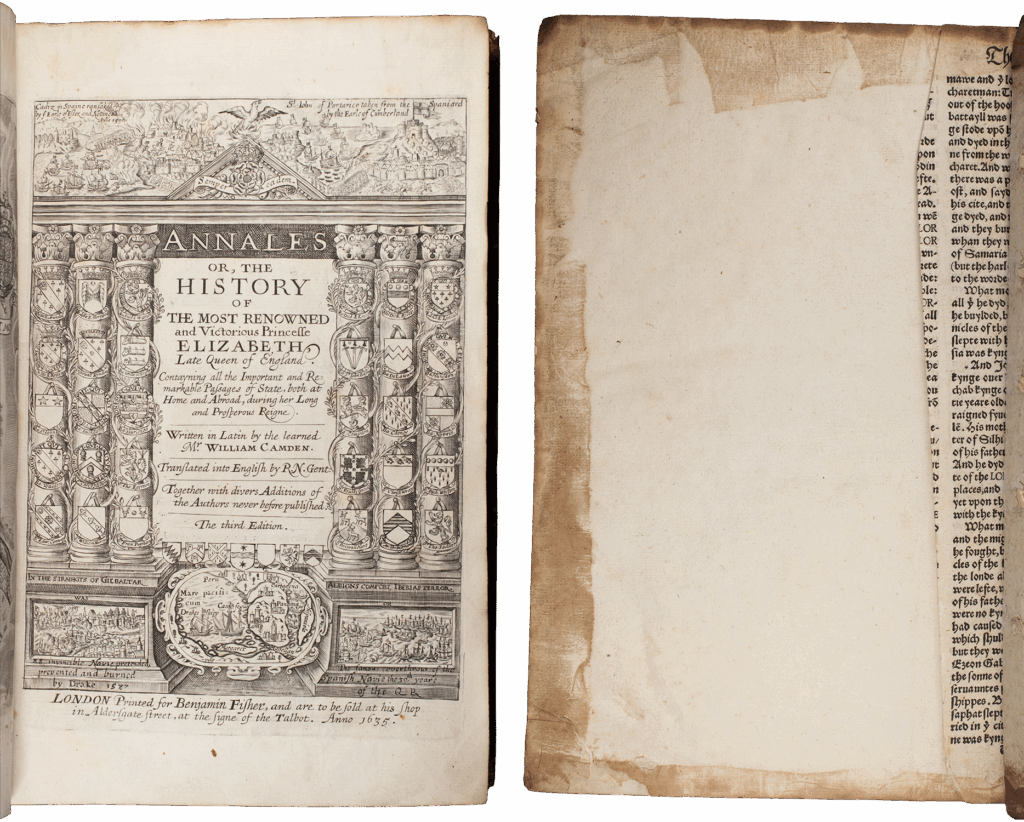
Title-page and rear endleaf, showing Coverdale waste, from William Camden, Annals, or, The history of the most renovvned and victorious princesse Elizabeth, late Queen of England (London: Benjamin Fisher, 1635). Harry Ransom Center, uncataloged acquisition.

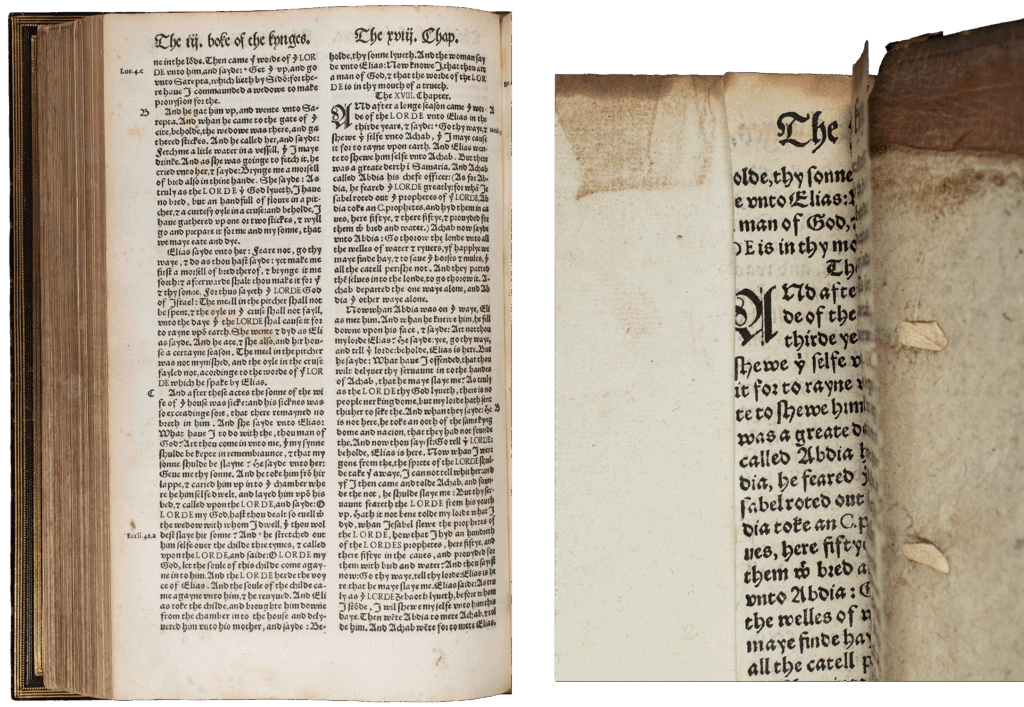
The Ransom Center recently acquired an early history of Queen Elizabeth I, a third printing of the Annales by William Camden (1635). The Center did not have a copy of this exact edition, so the volume helpfully filled a gap, but it was primarily attractive because it uses scraps from a Coverdale Bible (1535)—the first full bible printed in the English language—as binding waste, parts of leaves from III Kings (I Kings in most Protestant bibles). While the Center has long held copies of the landmark book, one receives a particular history of the early modern English bible from the fragments; preserved in the Camden, they become a kind of sedimentary record from a century earlier. Around 1635, an old Coverdale could apparently just be seen as waste. Today, though, any part of a copy would be attractive to collectors. In 1973, a Coverdale Bible missing 24 leaves sold for $50,000; today this translates to roughly $353,000 (there are no known complete copies).4 At the time of writing, AbeBooks lists another copy for a cool $1.5 million, describing the book as “the finest known copy in private hands.”5 There’s also a healthy market for individual leaves. In 2022, one Coverdale leaf sold for $780. To compare, a complete 1635 Camden usually sells for around $1,000.6

Biblia The Bible (Cologne?: E. Cervicornus and J. Soter?, 1535), sig. ll2v, and detail of rear endleaf, showing Coverdale waste, from William Camden, Annals, or, The history of the most renovvned and victorious princesse Elizabeth, late Queen of England (London: Benjamin Fisher, 1635). Harry Ransom Center, uncataloged acquisition.

Given the religiosity of early modern England, it might seem sacrilegious that someone would slice up a sacred text like the bible. The re-use of religious texts in new books, though, has a long history.7 And when it comes to bibles in particular, it is important to remember that the sixteenth and seventeenth centuries were an era of consistent and very public changes in what the “correct” bible should be. One that was popular and expensive in 1535 did not necessarily retain its value in 1635. Even in its own century, the Coverdale quickly gave way to the new-and-improved Matthew, Taverner, Great, Geneva, and Bishops’ Bible translations.8 In 1611, the King James became the official version in parishes and quickly found its way into households across England. This was the case in 1635, when the third edition of Annales was published. Despite Queen Elizabeth I’s famous statement that, “There is only one Christ, Jesus, one faith. All else is a dispute over trifles,”9 bible translations could be hotly contested, depending on which monarch was on the throne and which factions had influence. Religious and bibliographic turmoil often go hand in hand.10 The fact that a Coverdale was used as part of a binding speaks, perhaps more than anything else, to the ubiquity of outmoded bibles by 1635. The fragments in the Camden almost certainly came from a copy of the book that had circulated—and probably sustained significant damage—and not from unbound sheets that had been languishing in a warehouse for 100 years. This damaged-yet-durable quality of early modern bible leaves made them ideal for strengthening new books. 

The third edition of Annales was published only seven years before the English Civil War began in 1642, during a period when tensions within English Protestantism were growing. Given the morphing religious and political climate, it is tempting to read the relationship between biblical waste and its host text in a poetic or reciprocal manner, to say that the two texts—by their mere physical proximity—must be in conversation with one another, whether synergistically or antagonistically. As Smyth writes, “Waste thus complicates or thickens the historicism of the text, since to read waste is to be aware of multiple temporalities.”11 III Kings is about Davidic succession. At one point, David’s attendants try and find a virgin to look after him; Queen Elizabeth was commonly known as the “Virgin Queen.” III Kings is also a history and depicts Solomon building up a navy; Queen Elizabeth crucially expanded Britain’s naval and thus colonial power. Stories such as these appear frequently in the Bible, however, and there is zero reason to think that the binder intended a meaningful juxtaposition, especially given that the Coverdale components are scraps with incomplete sentences. Nonetheless, the two texts’ proximity can serve as a snapshot of English culture at the moment they came together. Camden’s retrospective history of Elizabeth offered nostalgia in a period of increasing turmoil under Charles I, and the Coverdale Bible was not in popular use. Both were facts around 1635.

So, when did a first-edition Coverdale make the transition from plausible binding support to collector’s item? “Protestant revivalism from the 1780s, followed by Catholic renewal from the 1830s, combined to give a new religious aesthetic to Christian practice in Britain,” one where objects such as bibles become renewed sites of devotional sentimentality.12 The British and Foreign Bible Society had been founded in 1804 to ensure that every household was able to procure a bible.13 On the one hand, this meant that bibles became more commonplace. On the other, more attention to English bibles in general made some editions special, helping turn them into monuments of the English Reformation. Even collectors more focused on literature, such as the American banker Carl H. Pforzheimer (1879-1957), came to see bibles as essential to a high-quality collection. The Ransom Center acquired its second 1535 Coverdale when Pforzheimer’s pre-1701 English books and manuscripts arrived in 1986. With the Camden, part of a third has joined the collection.

Kōan Brink is the Graduate Research Assistant for Early Book and Manuscripts at the Harry Ransom Center and a doctoral student in the Department of English at UT Austin. Their research focuses on early modern England— particularly poetry—religious texts, bibliography, and the history of the book. 


1 Adam Smyth, “Printed Waste: ‘Tatters Allegoricall’,” in Material Texts in Early Modern England (Cambridge: Cambridge University Press, 2018), 137. 

2 Harry Ransom Center, PR 2223 A1 1628 and -q- BX 5145 A2 1549c.

3 Smyth, 152.

4 Measuring Worth, accessed September 28, 2025, https://measuringworth.com.

5 “Fine Hardcover (1535) 1st Edition | Crawford Sterling Rare Books and Manuscripts,” AbeBooks, accessed September 28, 2025.

6 “Rare Book Transaction History Search Results,” Rare Book Hub, accessed October 10, 2025. (Access requires subscription.)

7 Anna Reynolds, “‘Such Dispersive Scattredness’: Early Modern Encounters with Binding Waste,” Journal of the Northern Renaissance 8 (2017).

8 John N. King and Aaron T. Pratt, “The Materiality of English Printed Bibles from the Tyndale New Testament to the King James Bible,” in The King James Bible after 400 Years (Cambridge: Cambridge University Press, 2013), 74.

9 “Elizabeth I,” Newberry Library, accessed September 24, 2025.

10 Reynolds. 

11 Smyth, 153.

12 Mary Heimann, “Victorian Piety and the Revival of Material Religion in Britain,” Orca: Online Research at Cardiff, accessed October 11, 2025.

13 Ibid.

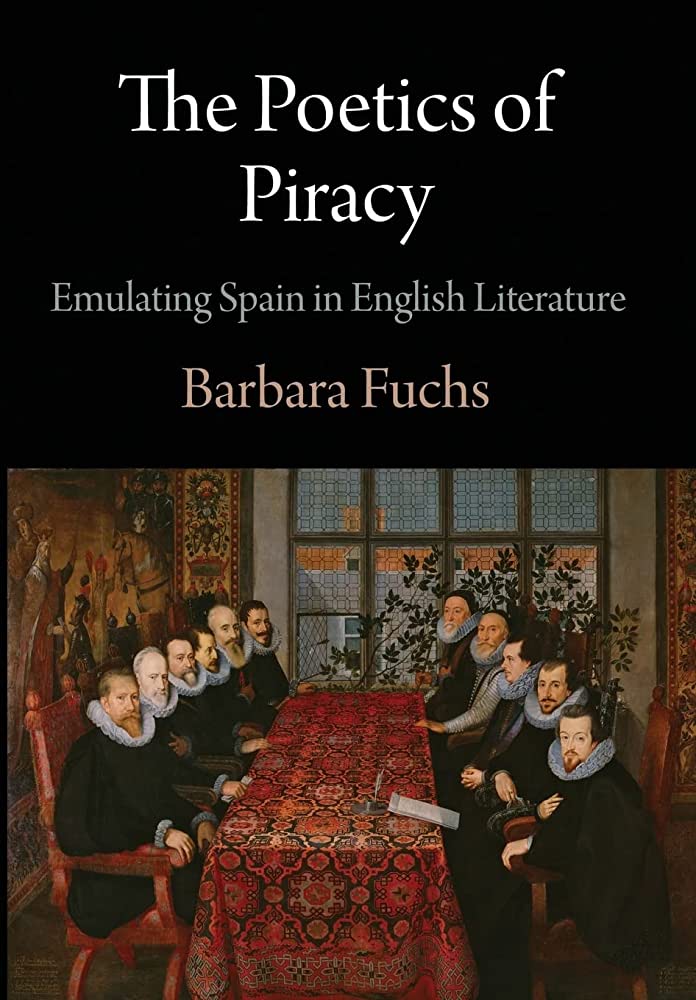
The Poetics of Piracy: Emulating Spain in English Literature, by Barbara Fuchs (2013)

By Christopher Heaney

There are few characters more English than William Shakespeare’s Falstaff, yet there he is, alone onstage in part two of Henry IV, praising his favorite drink: Spanish wine, the “good sherris sack” that “ascends [him] into the brain” and gives him bibulous valor. It’s one of Falstaff’s funnier monologues, but still touching, infused with his realization that his young friend Prince Hal no longer seems to love him. If so, Falstaff muses, then at least their time drinking sherry from Jerez together was well spent.

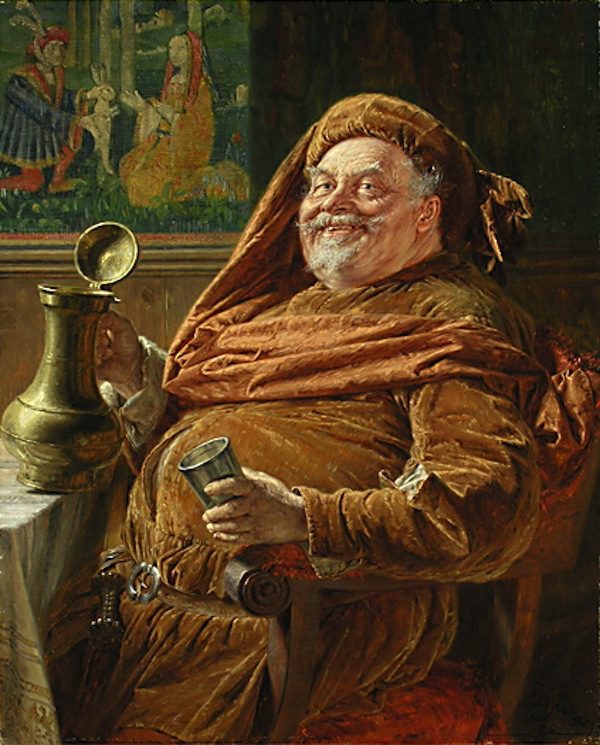
Eduard von Grützner: Falstaff mit großer Weinkanne und Becher {Falstaff with big wine jar and cup} (1896). Image via Wikimedia commons
Eduard von Grützner: Falstaff mit großer Weinkanne und Becher {Falstaff with big wine jar and cup} (1896).

Hereof comes it that Prince Harry is valiant; for

the cold blood he did naturally inherit of his

father, he hath, like lean, sterile and bare land,

manured, husbanded and tilled with excellent

endeavour of drinking good and good store of fertile

sherris, that he is become very hot and valiant. If

I had a thousand sons, the first humane principle I

would teach them should be, to forswear thin

potations and to addict themselves to sack. [Henry IV, Part Two, Act 4, Scene 3]


To addict one’s self to sack. An appropriate pun, perhaps intentional. “Sack” as both noun and verb: “sack,” another name for sherry, popular in Shakespeare’s England after the privateer Sir Francis Drake “sacked” 2,900 butts of the drink from the shipyards of Cádiz in 1587 (or so the story goes). Falstaff never labels the wine explicitly as from Spain, but it remains the “fertile” drink that redeemed the “cold blood” and “lean, sterile and bare” lands—England, perhaps—that Harry inherited from his father. Now “hot and valiant,” Harry is ready for Henry V. (“We few, we happy few, we band of brothers.”) Stolen, drunk, and stripped of its Spanish origins, wine from Jerez is sent back in time to become sherry, a medieval fount of Elizabethan identity and someday staple of English fruitcakes, funerals, and vicars’ sideboards.

John Cawse: Falstaff and the recruits from Henry IV, Part II, (1818)

Barbara Fuchs doesn’t land on the Falstaff example in her excellent The Poetics of Piracy: Emulating Spain in English Literature, but it is part of the process she so attentively explores. During the English Renaissance, she argues, early modern Spain’s extraordinarily rich literary production—“chivalric, sentimental, and maurophile romance, as well as picaresque, pastoral and novella”—was appropriated, de-nationalized, and then hidden by England’s emerging national canon of literature.

Coming off the world-changing century that began with the conquest of Granada and accelerated through Columbus’s exploration of the New World, imperial Spain remained the puissant—nay, poderoso—geo-political power to beat, which the English attempted through literary emulation, Fuchs argues. For Shakespeare and contemporaries on page and stage like Ben Jonson, Francis Beaumont, John Fletcher, and Thomas Middleton, “the Spanish vein” ran rich and deep, “even as the political situation between the two nations deteriorated in the wake of the Reformation and imperial rivalries.”\

Fuchs makes her case by juxtaposing texts on Spain and translated Spanish sources to argue that in the period under study—from the late sixteenth century to the 1620s and beyond—English writers celebrated the act of piracy, literary and literal, as a means to steal from the Spanish Golden Age and transform it into something new. By looking at translators in the late sixteenth century, she suggests that England was self-conscious of its “relative poverty of English letters,” and sought to enrich its own imperial ambitions through the translation of Spanish geographies, manuals for navigation, military treatises, and, epics and romances. The Chilean epic La Araucana was translated as a “how-to” guide for conquering Indians and Irishman, but still more influential was Miguel de Cervantes’s Don Quijote, which Fuchs shows was freely available and popular in England from the year of its publication in 1605. She explores how Beaumont’s The Knight of the Burning Pestle turned Quijote’s romance into a parody of London’s merchant class, piracy, and syphilis. During the failed negotiations of the Spanish Match between Prince Charles and the infanta Maria Anna, Fuchs proves just how often English writers continued to plunder Cervantes and Spain’s vibrant theater, turning “Spanish plots” into racist stereotypes of suspicious “plotting Spaniards.”

Why has it taken so long for scholars to recognize Spain’s obvious influence on English literature—and, one might add, the arc of its empire, in general? Why is it so revolutionary to suggest, as Fuchs argues, that “English literature was deeply transnational” at its founding moment? Fuchs suggests that the disavowal of Spain was itself the move England used to distinguish its literature from that of “the world,” and complicit in that erasure are critics and scholars of literary history who fetishize “‘English’ genius.” To make the point, she takes on the holy grail of Spanish-English literary relations— Shakespeare and John Fletcher’s lost play, Cardenio, inspired by one of Don Quijote’s stories-within-a-story. Just as Don Quijote is the oft-dropped asterisk to England’s claim to have invented the novel, Cardenio, when it is periodically reconstructed, is celebrated as a lost work of Shakespeare, minimizing the Cervantes connection, or taking it as an opportunity to fetishize folkloric, tarantella-dancing Spain, source of English sunburns. All this despite the fact that those reproductions have no Shakespeare-penned script to work from, only a possible eighteenth-century rewrite whose gaps are filled in with Cervantes instead.

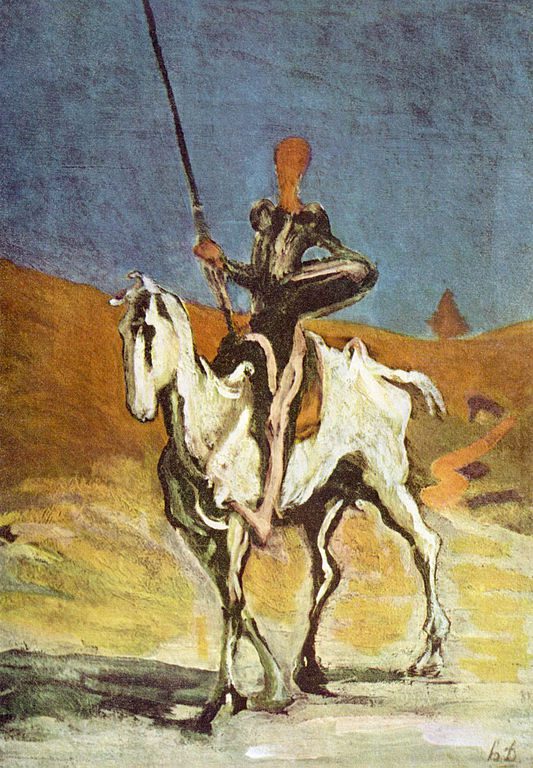
Honoré Daumier, Don Quichotte und Sancho Pansa {Don Quijote and Sancho Panza} (Circa 1868)

Fuchs works the Cardenio–Quijote question to yield a final twist worthy of Jorge Luis Borges. Fellow literary scholar Stephen Greenblatt recently received a Mellon Foundation grant to fund re-productions of Cardenio as “a lost play of Shakespeare’s” throughout the world. Fuchs draws from Greenblatt’s correspondence with Jesús Eguía Armenteros, the beleagured writer who took on the project in Spain, in which the Harvard scholar suggested that the Spanish writer “take the basic source material, the story in Cervantes, and our version of Cardenio and transform it to fit the concerns and the theatrical conventions of Spanish culture and society.” Eguía Armenteros instead began his play with a conversation between ‘The Author” and a character named “Harvard Professor Stephen Greenblatt.” “But I don’t know what the ‘theatrical conventions of Spanish culture and society’ are,” the Author complains.

Who does? But as The Poetics of Piracy shows, they are alive, well, and still intoxicate Falstaff’s heirs.

Barbara Fuchs, The Poetics of Piracy: Emulating Spain in English Literature, (University of Pennsylvania Press, 2013)


You may also like:

Bradley Dixon, Facing North From Inca Country: Entanglement, Hybridity, and Rewriting Atlantic History

Jorge Esguerra-Cañizares discusses his book Puritan Conquistadors: Iberianizing the Atlantic, 1550-170 (Stanford University Press, 2006) on Not Even Past.

Renata Keller discusses Empires of the Atlantic World: Britain and Spain in the Americas, 1492-1830 (Yale University Press, 2007) by J.H. Elliott

Christina Marie Villarreal recommends Visible Empire: Botanical Expeditions and Visual Culture in the Hispanic Enlightenment (University of Chicago Press, 2012) by Daniela Bleichmar


bugburnt


Images via Wikimedia commons

Recent Posts

  • Cold War Chronicles
  • Primary Source: How Did Cary Coke Get Her Copy of Queen Catharine?
  • Tapancos and Tradition: Remembering the Dead in Northwestern Mexico
  • “How Did We Get Here” Panel 
  • Hidden Children and the Complexities of Jewish Identity  
NOT EVEN PAST is produced by

The Department of History

The University of Texas at Austin

We are supported by the College of Liberal Arts
And our Readers

Donate
Contact

All content © 2010-present NOT EVEN PAST and the authors, unless otherwise noted

Sign up to receive our MONTHLY NEWSLETTER

  • Features
  • Reviews
  • Teaching
  • Watch & Listen
  • About