• New
  • Features
  • Reviews
  • Texas
  • Teaching
  • Digital
  • Watch & Listen
  • Authors
  • About

The past is never dead. It's not even past

Not Even Past

Primary Source: On the Pleasures of Printers’ Ornaments

Primary Source: History from the Ransom Center Stacks / On the Pleasures of Printers' Ornaments / Molly Yarn

This and other articles in Primary Source: History from the Ransom Center Stacks represent an ongoing partnership between Not Even Past and the Harry Ransom Center, a world-renowned humanities research library and museum at The University of Texas at Austin. Visit the Center’s website to learn more about its collections and get involved.

To my fellow researchers: if you are lucky enough to find yourself at the Harry Ransom Center (HRC), you should definitely consult with Dr. Aaron T. Pratt, the Carl and Lily Pforzheimer Curator of Early Books and Manuscripts, who is immensely knowledgeable and helpful. But be warned: Pratt is a bibliographical púca in a knit cap, leading you off your planned route into research parts unknown.

The will-o-the-wisp I followed came in the guise of The Historie of the Civill Warres of France, translated by William Aylesbury and Charles Cotterell, and printed by Ruth Raworth in 1647-8. When I sent Pratt an image of a typographical ornament in Civill Warres, I was certainly not expecting him to point out that the HRC’s copy of the book appeared to have different ornaments than the digitized copy on Early English Books Online (EEBO).1 The next thing I knew, one copy of Civill Warres multiplied into four—three newly acquired—and I had well and truly wandered off the garden path into madness.
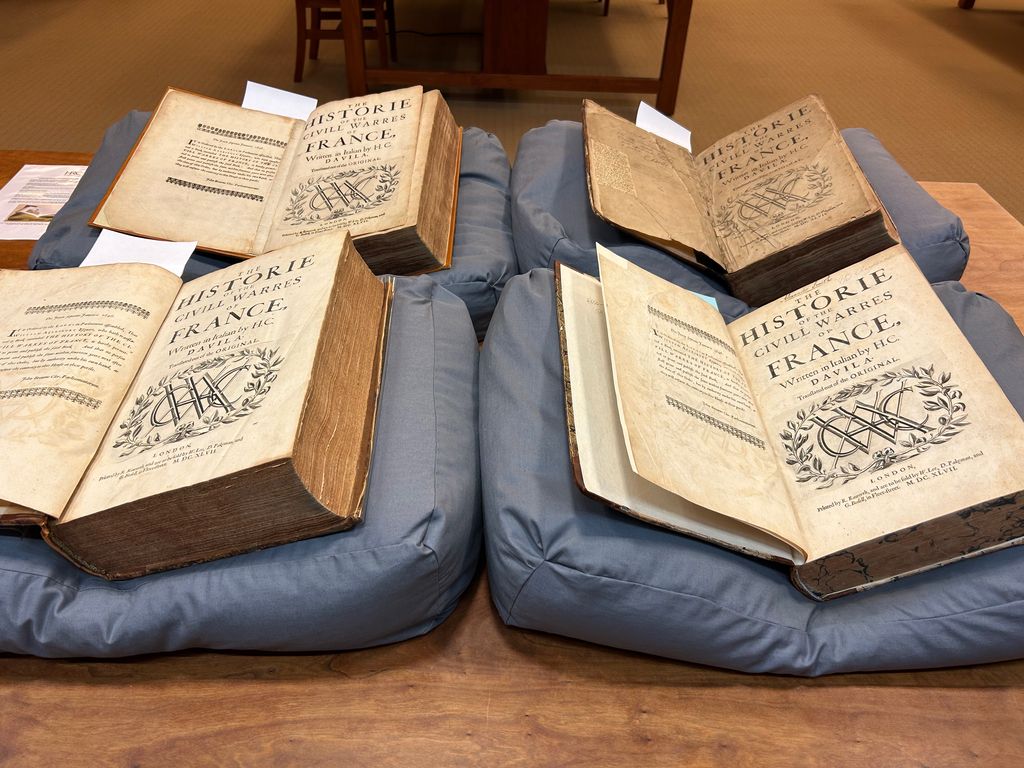
The Ransom Center's four copies of The Historie of the Civill Warres of France open on a table.

We determined that there were two versions of Civill Warres, which I refer to here as Versions A and B, with nearly identical title pages dated 1647-8. If this was a popular pamphlet, successively printed editions wouldn’t be strange, but Civill Warres is a massive folio. In fact, Raworth and Aylesbury planned to print only the first five chapters (around 102 sheets in folio) initially, to see if the demand warranted the financial investment necessary to print the other ten chapters (268 sheets) for a total of 1,478 pages, not including preliminaries—the perfect light beach read.2

Given the book’s size, it could have taken a single printing house, working at standard speed, between 12-24 months to complete, depending on the number of employees and printing presses. So, the basic question is this: given the enormity of the task, were both versions of Civill Warres printed by the Raworth house c. 1647-8? Or, was vB printed later, with false imprint dates on title pages deliberately set to match vA? Whenever the printing took place, were any other printing houses involved in the work? And what might asking these questions illuminate for scholars more broadly?

Rather than offer any straightforward answers to questions I am still debating, here is one strand of evidence that provides a potentially meaningful contribution. These books abound with bibliographical weirdness, such as running-title issues and stop-press corrections, all complicated by the sophistications of owners and booksellers; but the printers’ ornaments and ornamental capitals were what first caught our eyes, and since I was (originally) at the HRC to develop an ornament catalogue, it seems only right to start there. The ornaments in vB had always struck me as strange, since many of them do not appear in any other books from this printing house, either during the Raworths’ tenure or those of subsequent owners. During its first decade (1638-1648), the Raworth house compositors drew from a limited stock of ornaments repeatedly, so new ornaments always raise a flag. Did they buy them? If so, new or used? Borrow them from another house? Could sections containing unfamiliar ornaments have been printed by a different house? Publishers regularly divided printing jobs, particularly for large books, between multiple printers. Civill Warres has never been identified as a collaboratively printed book. Revising that narrative would change our understanding of an important woman printer’s career and business practices, and of the book trade networks at work during the critical period leading up to the regicide and establishment of the Commonwealth.

When C. William Miller catalogued the ornament stock of Ruth Raworth’s second husband, Thomas Newcombe, who became the house’s nominal owner after their marriage in 1648, he assessed the Raworths’ stock as “a good-sized one,” with “a wide variety of decorative initials and many large, generally attractive ornaments.”3 He admits, however, to examining far fewer Raworth publications, being primarily interested in ornaments used by Newcombe. Having now seen the majority of the books printed in the Raworth house, either in person or digital facsimile, I would characterize the Raworth stock somewhat differently. During John and Ruth Raworth’s tenures, although there are several ornaments and smaller decorative initials used repeatedly, there are a number of large decorative initials, and a few ornaments, used in a single book, never to appear again. A number of possible explanations exist. The appearance of an unfamiliar ornament could indicate shared printing between two or more houses, but some of the one-off ornaments are found in books too short for shared printing to be considered necessary. Alternatively, although they might have owned these ornaments, not all ornaments were physically suited to any publications—the decorative initials or large headpieces used for a large folio like Civill Warres would not be appropriate in size for smaller quarto or octavo books or pamphlets, which comprised the majority of the Raworth-produced books from 1638 until 1648. Ornaments broke, particularly old ones—something purchased second-hand, as they often were, might break after the run of a single book. 

As other bibliographers have pointed out, many English printing houses had similar, if not nearly identical, ornaments, which hinders efforts to identify the printers of a given book based on ornaments alone. Even extremely common ornaments can often be distinguished through careful examination, however, and more elaborately decorated texts like Civill Warres frequently contain more unusual, recognizable ornaments, headpieces, and decorative initials. Here are three ornaments from vB that I have located in books by other printing houses. Following the movement of these ornaments could help to pin down when and by whom vB was printed.
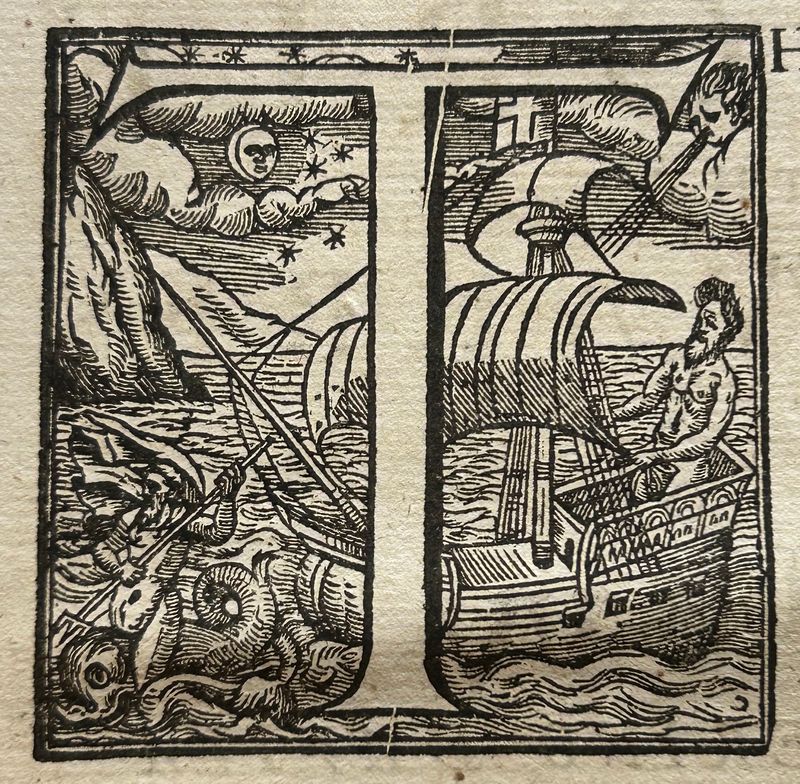
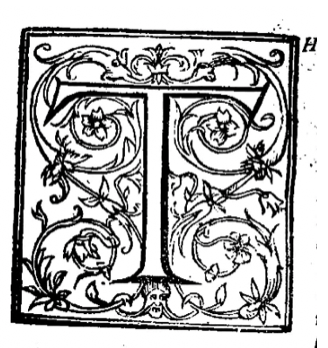
“Aeneas T” on p. 2 of vB. 

The imagery on this ornamental capital “T” reminded me of The Aeneid, so the label has persisted in my notes. There were at least three cuts of this ornament circulating during the 1630s and 1640s. 

I have found Cut 1, the version in vB, in four other books so far. From left to right, they are:

  1. A Collection of Sundrie Statutes… printed in 1632 by Miles Flesher, John Haviland, and Robert Young
  2. Thomas Adams, Commentary…upon the second epistle, printed in 1633 by Richard Badger
  3. Walter Balcanquhall (for Charles I), A large declaration concerning the late tumults in Scotland, from their first originals, printed in 1639 by Robert Young
  4. Lancelot Andrewes, XCVI Sermons, printed in 1641 by Richard Badger
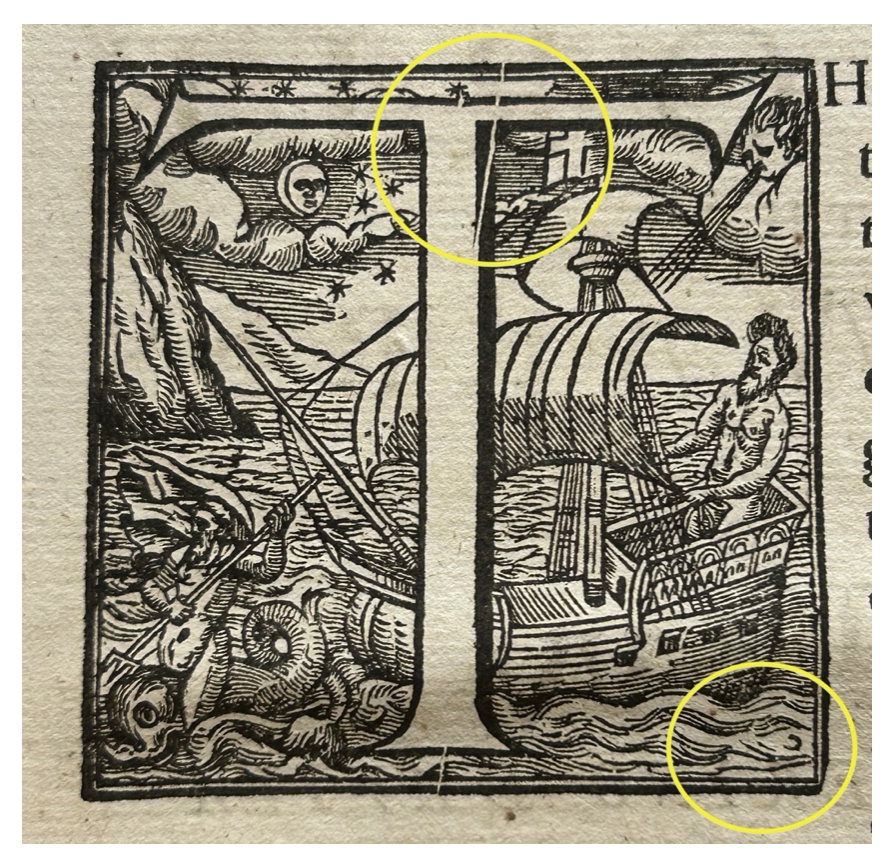
Below, I’ve circled some of the distinctive identifiers of Cut 1, particularly the crack across the top bar of the “T” itself and the backwards “c” in the corner. Although EEBO microfilms are less than ideal for this kind of work, these features are clear enough to be seen even in grainy black and white.
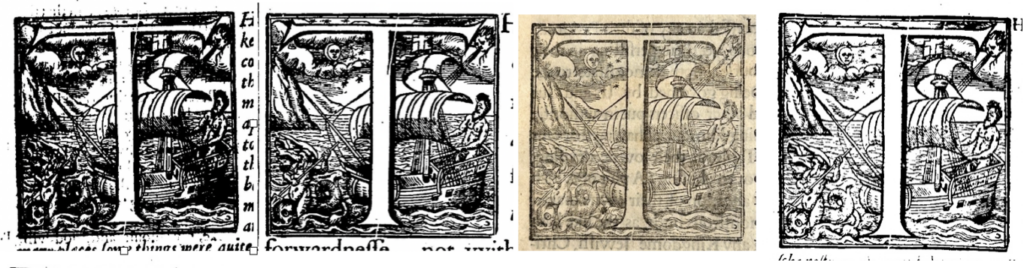
Cut 2 (left below) can be found in two books printed by Richard Badger: Michael Jermin’s Paraphrasticall Meditations (1638) and Lancelot Andrewes’ XCVI Sermons (1641), which actually uses Cuts 1 and 2 as well as a factotum of the same design. Cut 3 (right below) is seen from The Historie of the Council of Trent, printed in 1640 by Robert Young and John Raworth, where it appears in a section printed by the Young house. 
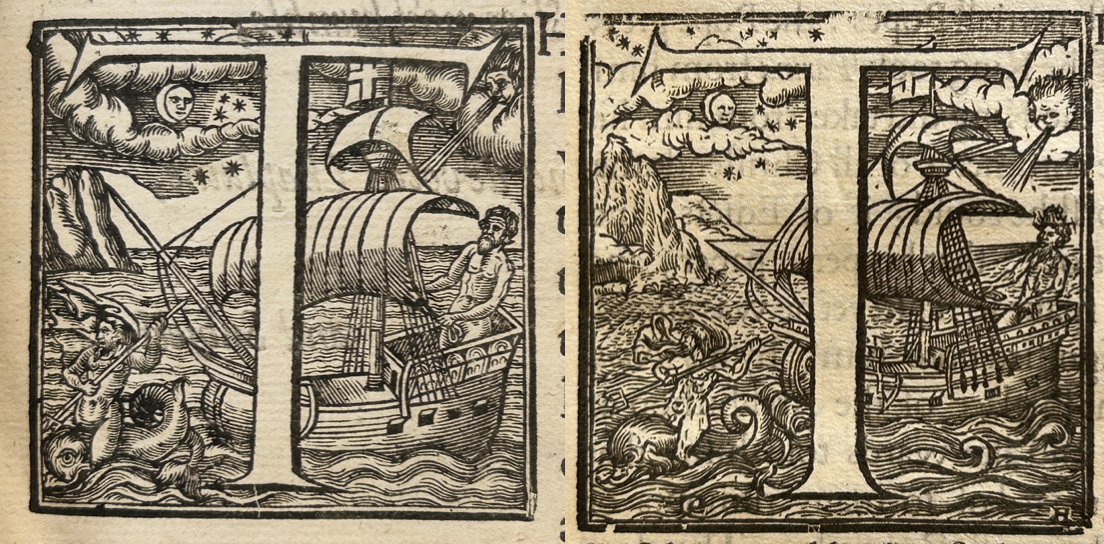
Comparing the three cuts side by side, there are clear differences not only in specific details (the placement of the stars, the corner initials) but in overall style. These variations occurred when the craftsman making a new ornament copied an existing design without worrying too much about the exact details.

Whereas vA begins each chapter with the same, fairly generic headpiece, Part 1 of vB has two distinctive ornaments on the first pages of chapters 2-5, one of which is the globe headpiece.4
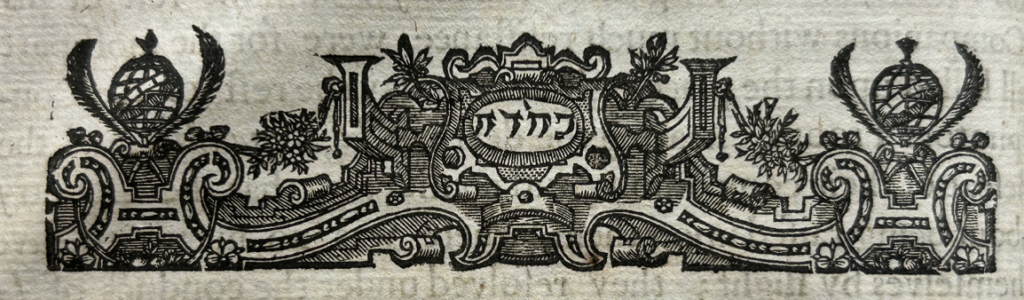
“Globe Headpiece” on pg. 52, 110, and 305 of vB.

The globe headpiece appears in two books printed by the Young house (active 1625-1653), owned first by Robert Young, then his son James. Recall that the Youngs also printed books containing Cuts 1 and 3 of the “Aeneas T.” The globe headpiece appears in:

1. Du Bartas His Divine Weekes and Workes, printed by Robert Young for William Hope in 1641.
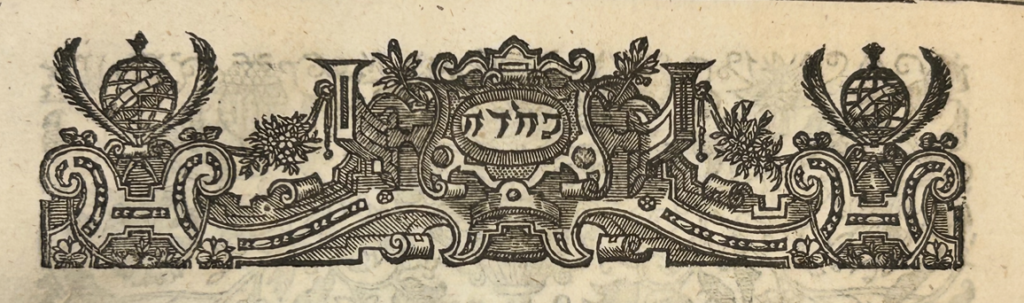
2. Henry and William Lawes, Choice Psalmes Put into Musick, For Three Voices, printed by James Young for Humphrey Moseley and Richard Wodenoth in 1648.
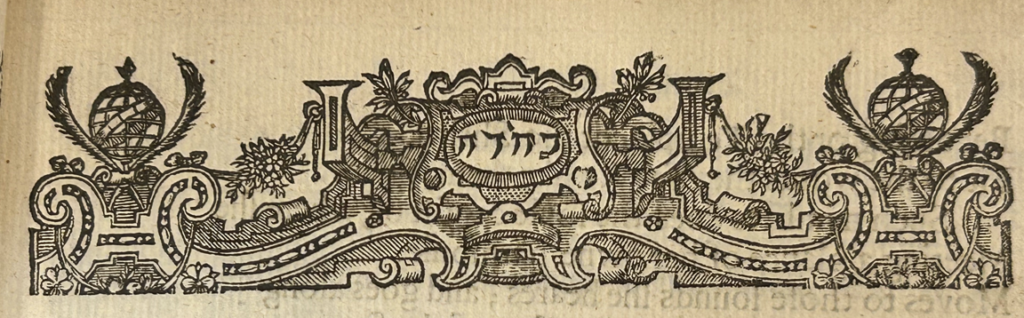
This does appear to be the same cut of the ornament—note in particular in all three examples the shape of the upper right quadrant of the left globe, a possible break in the hatching under the right globe, and the direction of the hatching throughout.
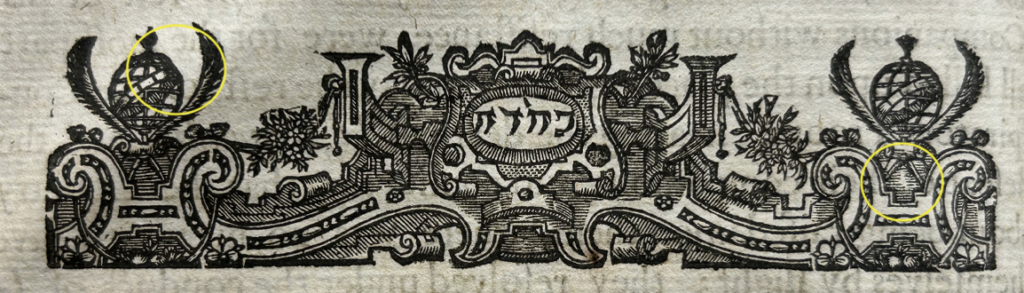
The appearance in the Lawes book is particularly provocative as it was published in 1648, the same year that part of Civill Warres was ostensibly printed. 
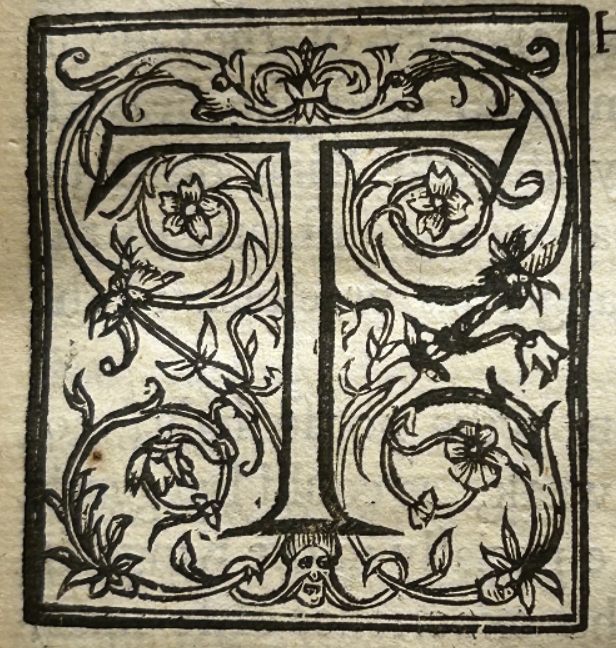
“Swirly T” on pg. 411 of vB.

The last ornament is another decorative “T,” which I call, creatively, the “swirly T.” I have found this ornament in one pre-1648 book: the 1629 edition of Lancelot Andrewes’ XCVI sermons, printed by George Miller for Richard Badger. Note the matching break along the bottom in both books, approximately 19 mm from the right corner.
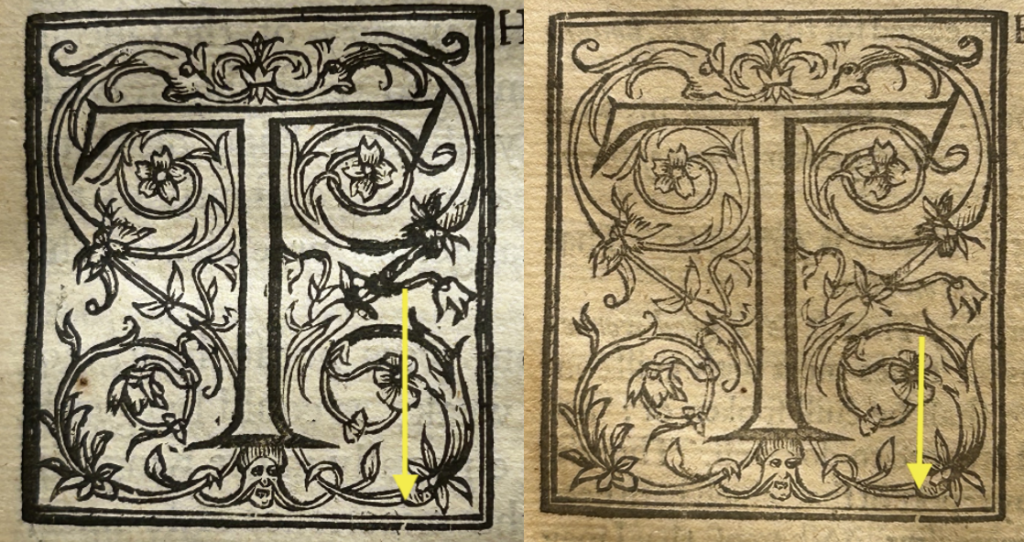
The 1629 Sermons was the final large publication of Miller and Badger’s four-year partnership, after which Badger struck out on his own. I haven’t located this “T” in any other Miller or Badger books yet, but it is possible that Badger retained some ornaments when the partnership dissolved. 

When considering these three ornaments as a cluster, a compelling pattern emerges. Prior to Civill Warres, the “Aeneas T” appeared in books printed, in chronological order, by the Flesher-Haviland-Young consortium, by Richard Badger, by Robert Young, and by Badger again. The globe headpiece was used by Robert Young in 1641, then by his son James in 1648. George Miller and Richard Badger used the “swirly T” in 1629. Two names stand out in that list—Young and Badger.

So, where were these three ornaments in 1647-8? Both the Badger and Young printing houses held royal warrants in the 1630s and 40s—Robert Young was the king’s printer for Scotland, while Richard Badger was Prince Charles’ printer.5 The two houses published multiple publications together in 1640, mostly related to the king’s position on the Bishops’ Wars in Scotland. Richard Badger died in 1641. His eldest son, Thomas, had already established a printing house, so Richard left his printing materials to his youngest son, Richard Badger II. By 1647, both Thomas and Richard II appear to have died; Thomas’s widow, Frances, ran their business from 1646 until 1648, when she married former Badger apprentice Richard Constable. The fate of Richard II’s printing materials are murky—in 1645, a Mrs. Badger was given permission to print “those sheets of the Psalter she used to print.”6 This could have been Richard II’s widow, although I have found no record of his marriage. I’m inclined to think it was Richard I’s widow, Alice Badger, who lived until 1655; however, as I haven’t found other evidence that she continued printing, I can’t say for sure if she still owned the Badger ornaments in 1647-8.

The final bit of evidence, however, suggests that Young ended up in possession of some of the Badger ornaments. James Young inherited his father’s printing house c. 1643 and operated it for five years. Then, in June of 1648, James Young sold his titles to William Dugard, the headmaster of the Merchant Taylor School and a newly licensed master printer.7 James Young’s two apprentices were turned over to Dugard on the same day that he informed the company of the purchase. According to Leona Rostenberg, Dugard also acquired Young’s printing equipment, a claim borne out by typographical evidence.8 Dugard used the globe headpiece in Pharmacopoeia Londinensis in 1650, and at least twice more in the following years.9 And in 1655, the “swirly T” appeared in Dugard’s new printing of The Countess of Pembroke’s Arcadia.
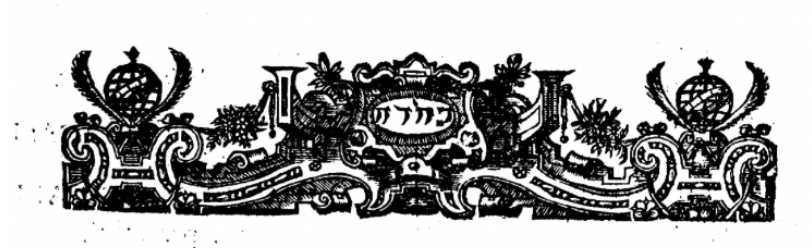
So, what does this tell us about the production of Civill Warres? First, it is unlikely that these three ornaments ever belonged to the Raworth house, leaving borrowing ornaments or splitting the work with another house as the most viable scenarios. The Raworths had shared a printing job with the Youngs before, the 1640 edition of Sarpi’s The Historie of the Councel of Trent, in which the Young house employed Cut 3 of the “Aeneas T.” When asked to print Civill Warres, a folio of similar size and scale to the 1640 Sarpi, it might have been natural to seek assistance from the house they had worked with on the earlier project. If vB was printed c. 1647-8, Young might have either lent the ornaments to the Raworth house or printed sections of vB himself; however, if the ornaments changed hands in early 1648 along with the titles and apprentices, William Dugard could have been involved in producing vB instead. If vB was actually printed sometime after 1649, the ornaments were either used or lent by William Dugard.10

Combined, the two versions of Civill Warres used around thirty unique ornaments, each offering potential insights into this book’s story. These must of course be read alongside the evidence of the type itself, the paper, variations in the text, copy-specific details, and historical context. When it comes women like Ruth Raworth, whose lives are underrepresented in traditional archives, developing a better understanding of even a single book can contribute materially to piecing together their stories.

Molly Yarn is a book historian, theatre practitioner, and independent scholar, as well as a freelance indexer and editor. Her first book, Shakespeare’s ‘Lady Editors’: A New History of the Shakespearean Text, was published by Cambridge University Press in 2021/2. She is currently writing a book on women printers in London during the English civil wars and interregnum. This project has been awarded fellowships from the Newberry, Beinecke, and Houghton Libraries, the Harry Ransom Center, the Bibliographic Society (UK) and the Bibliographical Society of America. She holds a PhD from the University of Cambridge.


1 The EEBO copy is held at Yale’s Beinecke Library. The Boston Public Library has also digitized a copy, available on Internet Archive.

2 In Civill Warres, the sections are referred to as books rather than chapters, but that’s just too many uses of the word “book” in an already complicated work of book history.

3 C. William Miller, ‘Thomas Newcomb: A Restoration Printer’s Ornament Stock’, Studies in Bibliography, 3 (1950), pp. 155–70 (p. 156).

4 I have not located an exact match for the other header, which I call the skull header, although George Miller (with Richard Badger) was using some with a similar style in the 1620s and 30s. See, for example, Lancelot Andrewes, XCVI Sermons, 1629.

5 For more on the Badgers, see Peter McCullough, ‘Making Dead Men Speak: Laudianism, Print, and the Works of Lancelot Andrewes, 1626-1642’, The Historical Journal, 41.2 (1998), pp. 401–24, doi:10.1017/S0018246X9800781X; Peter McCullough, ‘Print, Publication, and Religious Politics in Caroline England’, The Historical Journal, 51.2 (2008), pp. 285–313, doi:10.1017/S0018246X08006729.

6 Court Book C, f.221.

7 W. R. Meyer, ‘Dugard, William (1606–1662), schoolmaster and printer’, Oxford Dictionary of National Biography (Oxford University Press, October 2009), doi:10.1093/ref:odnb/8182.

8 Leona Rostenberg, ‘William Dugard, Pedagogue and Printer to the Commonwealth’, The Papers of the Bibliographical Society of America, 52.3 (1958), pp. 179–204 (pp. 186–87).

9 In A short plea for the common-wealth in this monstrous and shaking juncture (1651) and Dialling Performed Instrumentally (1652).

10 Although James Young continued to print until his death c. 1653, the Young books after 1648 contain very few ornaments.


NEP’S Archive Chronicles: El Archivo General de la Nación (AGN, Ciudad de México): Procesos afectivos, paisajes urbanos y la escritura de la historia

Cartel de El Archivo General de la Nación (AGN, Ciudad de México): Procesos afectivos, paisajes urbanos y la escritura de la historia

NEP’S Archive Chronicles explora el papel que desempeñan los archivos en la investigación histórica, ofreciendo una visión del proceso de realización del trabajo archivístico y de investigación. Cada entrega ofrecerá una perspectiva única de los tesoros y retos que los investigadores encuentran en los archivos de todo el mundo. NEP’s Archive Chronicles pretende ser tanto una guía práctica como un espacio de reflexión, en el que se expongan las experiencias de los colaboradores con la investigación archivística.

Note: Click here to access English version
Nota: Haz click aquí para acceder a la versión en inglés

Es un lugar común empezar por decir que estaba leyendo La atracción de archivo de Arlette Farge el primer día que fui a hacer investigación al Archivo General de la Nación (AGN) en la Ciudad de México, pero es verdad. No lo hice a propósito, llevaba tiempo queriendo leer el texto y acababa de comprar un ejemplar usado cuando empecé a investigar sobre la historia del Archivo General de México a lo largo del siglo XIX.

Esto ocurrió hace tres años, pero lo recuerdo claramente. Tiendo a olvidar las cosas, pero allí donde falla mi memoria social, mi memoria bibliográfica es casi impecable. Puedo recordar todos los libros que he leído. Sé cómo es la portada, qué tamaño tiene el libro, y dónde y cuándo lo leí. Recuerdo cómo se siente un libro dentro de mí, y puedo reconstruir lo que dice o por qué es importante. Sobre el clásico de Farge, recuerdo que el libro es romántico, que ella narra cómo recorría los pasillos de los Archivos Judiciales de París buscando mujeres en las fuentes, reflexionando sobre la afectividad del espacio, y recuerdo que lo estaba leyendo ese día. 

Era pleno verano, un día sombrío y lluvioso en la ciudad. También estábamos en plena pandemia de COVID. Por lo tanto, el AGN estaba abierto, pero su horario de atención al público era restringido, así como el material que podían consultar los investigadores. Había agendado una cita una semana antes para asistir y ver si realmente podía encontrar algo. Nunca había oído hablar de la colección que buscaba, pero estaba segura de que existía. Un archivo debe tener una colección sobre sus operaciones institucionales internas, ¿no?

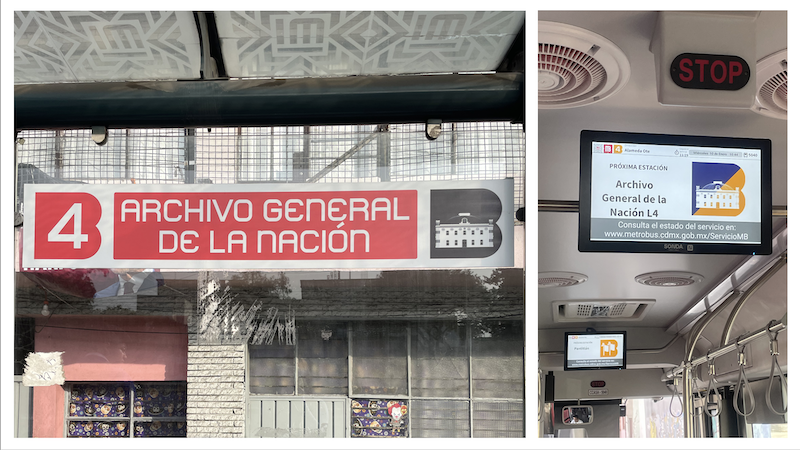
Salí temprano de casa, me subí en el metro y eventualmente llegué a San Lázaro, en el centro-este de la ciudad. La estación de metro debe su nombre a la antigua terminal ferroviaria del mismo nombre, que solía ser parte importante del sistema ferroviario interoceánico en la ruta México-Puebla-Veracruz. San Lázaro siempre es caótico. No sólo hay dos líneas distintas de metro tienen parada ahí, pero el espacio también se comparte con la Terminal de Autobuses de Pasajeros de Oriente, la TAPO, haciéndola una de las estaciones más concurridas de la ciudad, con más de 44.000 usuarios que la cruzan al día. Me costó trabajo encontrar dónde abordar la línea 5 del Metrobus, pero eventualmente lo logré. Una parada después, llegué a la estación Archivo General de la Nación.1

Imágenes de la estación de metrobús de Ciudad de México para NEP's Archive Chronicles
Fotografías tomadas por la autora.

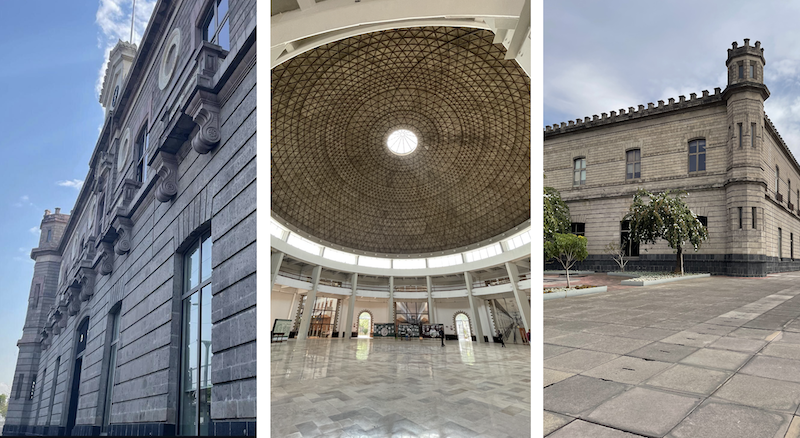
El AGN se encuentra actualmente ubicado en el Palacio de Lecumberri. Inaugurado originalmente en 1900 por el presidente Porfirio Díaz, este edificio fue diseñado como una moderna penitenciaría panóptica, propósito con el cual cumplió hasta 1972, cuando fue clausurado debido a una serie de irregularidades, corrupción y falta de espacio para sostener el creciente número de reclusos. Una vez cerrado y abandonado, estalló un debate en la prensa mexicana sobre su destino. Su demolición privaría a los antiguos reclusos como a las familias de las víctimas de un importante lugar de memoria. Además, quienes se oponían a su demolición subrayaron la importancia de conservar el edificio como un lugar crucial para estudiar y comprender la historia de la arquitectura disciplinaria durante en México en el siglo XX. Pero ¿qué hacer con él?

En los medios de comunicación estalló un debate sobre los posibles usos del edificio. La polémica de «los historiadores», representados por Edmundo O’Gorman, Eduardo Blanquel, Jorge Alberto Manrique y el arquitecto Flavio Salamanca, fue decisiva para que Lecumberri pasara de ser una cárcel a un archivo. El argumento principal de los historiadores se centró sobre todo en la cuestión del espacio, conscientes de que una de las características fundamentales de los archivos es que nunca dejan de crecer. En ese momento, el AGN, originalmente alojado en el Palacio Nacional desde su inauguración en 1823, hacía tiempo que se había quedado sin espacio y sus fondos se encontraban dispersos por diversos lugares de la ciudad, como el Palacio Nacional, el Templo de Guadalupe en Tacubaya o la Casa Amarilla, la Ciudadela y el antiguo Palacio de Comunicaciones, hoy Museo Nacional de Arte (MUNAL).2 La descentralización perjudicaba las funciones de la institución y ponía en riesgo el acceso de los usuarios.

Tres imágenes del palacio de Lecumberri: estructura exterior, cúpula interior, edificio exterior para NEP's Archive Chronicles
Fotografías tomadas por la autora.

Consciente de sus necesidades presentes y futuras, el personal de la institución había estado buscando soluciones para este problema. José Ignacio Rubio Mañé, que fue director de la institución entre 1960 y 1977, incluso llegó a viajar por el mundo a través de un programa financiado por el gobierno en busca de inspiración en otros archivos para mejorar el que él supervisaba. Pero el proyecto de remodelación quedó truncado antes de concluirse.

Y ahora, la solución estaba ahí: Lecumberri. El edificio ya era propiedad del gobierno, estaba abandonado y salvarlo garantizaría su funcionamiento como lugar rememoración y estudio. Como elemento adicional y fortuito, este palacio se había construido para garantizar las prácticas de vigilancia, un componente muy necesario para los archivos. Estos otorgan una gran prioridad a la vigilancia porque almacenan documentos sensibles y únicos que sirven de fuentes primarias para los relatos históricos de una comunidad determinada en el tiempo. Su robo o deterioro puede tener repercusiones sociales, materiales e incluso emocionales.

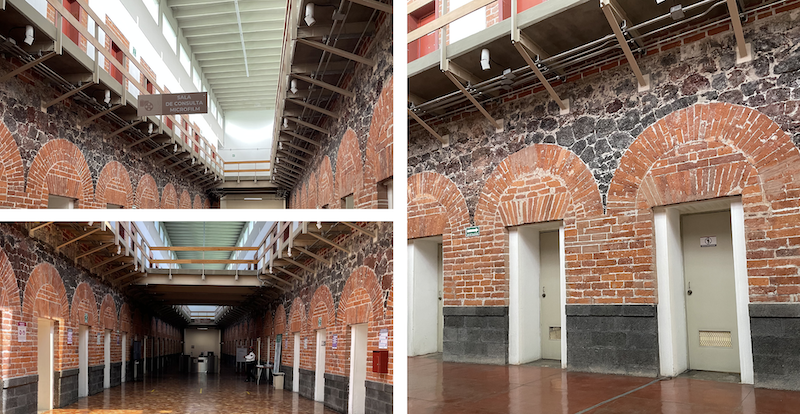
En 1977 se aprobó la transformación de Lecumberri en la nueva sede del AGN, que se trasladó en 1982 bajo la dirección de Alejandra Moreno Toscano. Las antiguas celdas de la prisión se convirtieron en bóvedas para el almacenamiento de documentos, y las largas galerías de cada uno de los 5 brazos de la prisión se transformaron en salas de lectura y oficinas. Aunque poética, la falta de control técnico sobre el clima y las plagas que los archivistas podían tener sobre los documentos dentro de las bóvedas impulsó la construcción del Anexo Técnico. Inaugurado en 2018, el Anexo es una instalación de almacenamiento de documentos moderna y tecnológica que aumentó masivamente el espacio de almacenamiento y modernizó los sistemas. Las celdas sirven ahora de oficinas para el personal, y algunos de los largos pasillos se han acondicionado para un proyecto de digitalización masiva. En el exterior, el gran edificio blanco y cuadrado contrasta con el palacio decimonónico situado a su lado. Dos estrategias e innovaciones tecnológicas diferentes para un mismo fin.

Tres imágenes de bloques de celdas y espacio de almacenamiento de documentos. Actualmente son oficinas para NEP's Archive Chronicles
Fotografías tomadas por la autora.

A mi llegada, me recibieron dos agentes de policía. Como en muchos archivos de todo el mundo, tuve que dejar mi mochila, papel, plumas, agua y cualquier alimento en los casilleros y registrarme con un documento de identidad oficial y registrar el número de serie de mi equipo de trabajo (computadora y tablet). Una vez registrada, tomé mi computadora, teléfono, guantes y mascarilla, y me dirigí a la Centro de Referencias, una parada obligatoria antes de entrar en las salas de consulta. No sabía dónde encontrar el archivo institucional, así que hablé con los archivistas. Mi primera conversación con la mujer de recepción -llamémosla M.- fue más o menos así:

“Buenos días”.

            “Buenos días”.

            “¿En qué puedo ayudarle?”

            “Estoy buscando… Estoy buscando el archivo del Archivo”.

            “¿Disculpa?”

            “Sí. Busco el archivo del Archivo”.

No puedo evitar reírme al recordar la cara de M. ante mi extravagante solicitud. Le expliqué que yo era historiadora, que estaba investigando la historia del Archivo General y que buscaba el archivo interno de operaciones del AGN.

            “Tiene que haber uno, ¿no?”.

            “Ay, no sé la verdad, no he oído hablar de él. Pero ¿por qué no pruebas en el buscador general a ver qué encuentras?”.

Me senté frente a una computadora y escribí lo primero que se me ocurrió: «archivo». Pero al teclear una palabra que forma parte del nombre de toda la institución, el sistema transcribió toda la base de datos en la sección de resultados del programa, y lo colapsó. Pasé las siguientes semanas en Centro de Referencias analizando ArchiDoc, el gigantesco sistema de búsqueda del AGN, intentando averiguar cómo encontrar esta colección de la que nadie en el había oído hablar. Hasta que un día, a primera hora de la mañana, se acercó M. para decirme que había visto una colección en el perfil de administrador de ArchiDoc. Se llamaba Archivo Histórico Institucional (AHI) y figuraba en la sección del siglo XIX.

¡Eureka! Resulta que no había visto esta colección en ningún lado porque los documentos estaban todavía siendo catalogados y procesados, y no estaba disponible aún para su consulta3. Se me puso la piel chinita de la emoción. Lo recuerdo claramente. Estos documentos constituyen la historia del Archivo a través del papeleo burocrático de la administración de la misma institución. De hecho, esto era exactamente lo que yo buscaba: el archivo del archivo. Y significaba que mi investigación doctoral era posible.

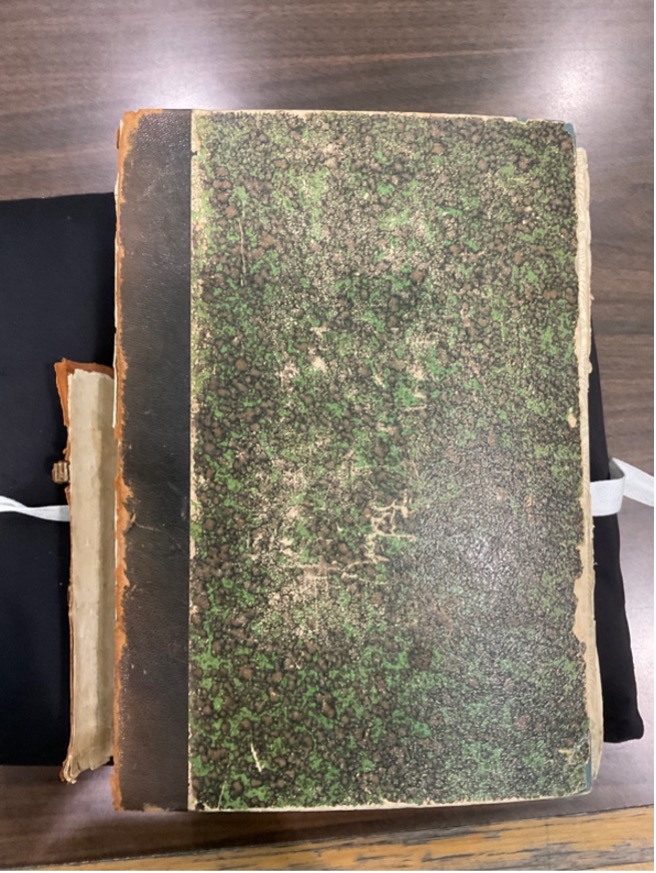
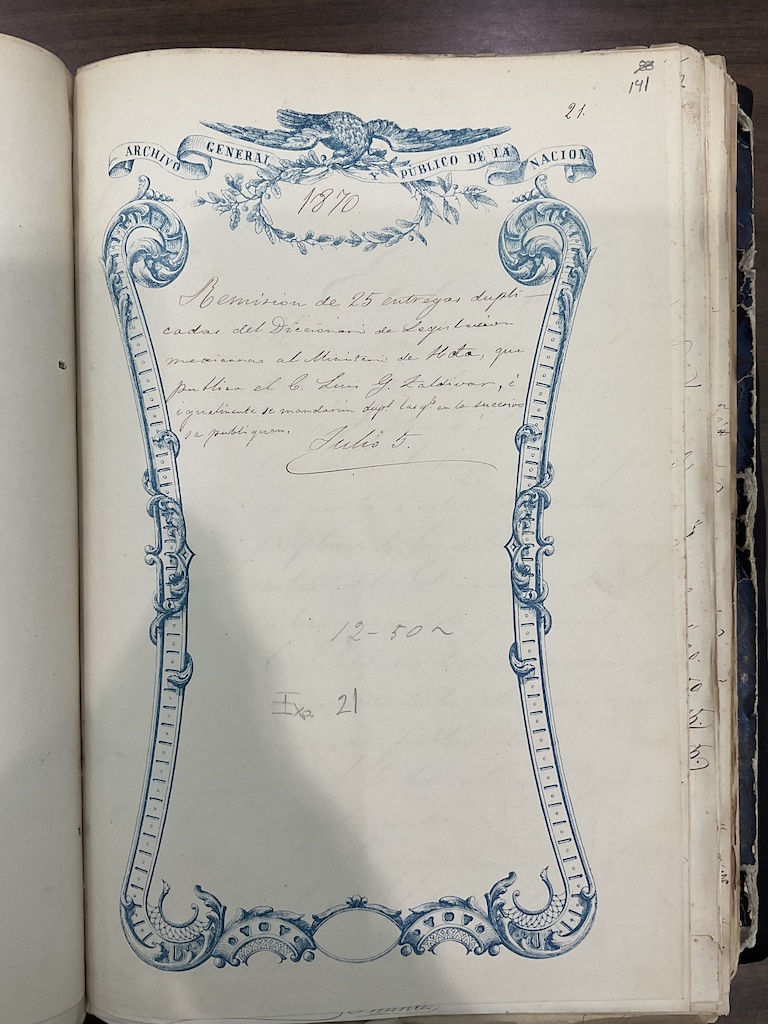
El Archivo Histórico Institucional tiene dos tipos de formatos documentales: volúmenes y cajas que contienen expedientes guardados en carpetas amarillas sin ácido. Los volúmenes están encuadernados en piel y tienen unas dimensiones aproximadas de 40 cm x 25 cm, con un número de páginas que oscila entre 250 y 450 por volumen. Consta de 295 volúmenes que van de 1825 a 1944, abarcando 119 años de historia administrativa archivística. La colección muestra un aumento significativo de volúmenes a lo largo del tiempo con un patrón de crecimiento sostenido a lo largo del tiempo. Su contenido es ecléctico y abarca informes, remisiones, recibos, notas, instrucciones y solicitudes de información, entre otros. En estos documentos podemos encontrar los mundos sociales, económicos, políticos, materiales e incluso afectivos que han sido parte esencial de la mecánica interna de la institución y de los materiales que ella resguarda.

Imagen del volumen encuadernado en cuero
Fotografía tomadas por la autora.
Imagen de papel con membrete de AGN
Fotografía tomadas por la autora.

No pude examinar los documentos físicos ese año y tuve que esperar hasta el verano siguiente para hacerlo, tras conseguir autorización previa de la administración del Archivo. Poco después, la historiadora y archivista Linda Arnold tuvo la amabilidad de compartir con nosotros la hoja Excel de toda la colección, lo que me permitió procesar y comprender más profundamente la colección antes acceder a los documentos.

En cuanto pude, regresé a la Ciudad de México y me dirigí directamente al AGN para analizar la colección física. Para ese momento ya sabía de qué elementos se componía el AHI, y por fin había llegado el momento de leerlo. Desde entonces he pasado cientos de horas en la Sala de Lectura «A» del AGN leyendo los documentos y tomándoles fotos para mi investigación.

En estos años, he paseado los extraños caminos de Lecumberri y he llevado a mis seres queridos a las visitas guiadas que ofrece la propia institución. También me he hecho amiga de algunos de los archivistas que trabajan ahí y he conocido a historiadores que admiro haciendo investigación. Mi investigación también me ha llevado a otros archivos de México y del mundo, donde he estado buscando evidencia que lo represente como parte de una red global de emergentes tecnologías de la información en el siglo XIX.

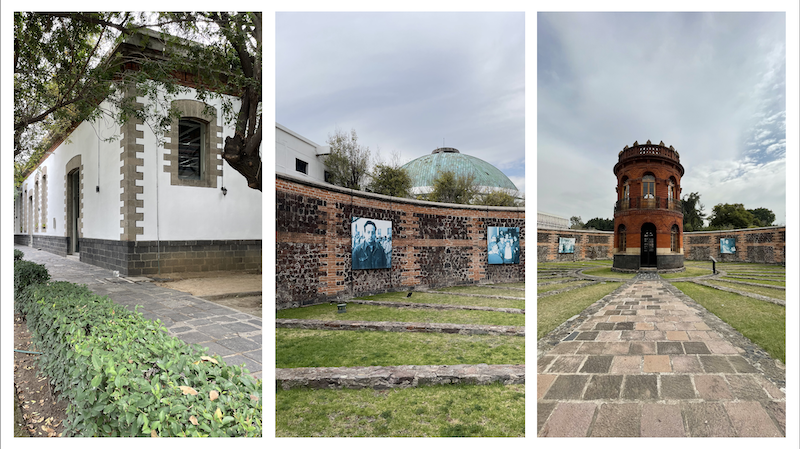
Tres imágenes de los exteriores de Lecumberri: edificio, cúpula desde el exterior, torre para NEP's Archive Chronicles
Fotografías tomadas por la autora.

Ya empecé a escribir la tesis y espero que esté lista en los próximos años. Pero escribir esta historia no ha sido del todo fácil. Los archivos son entidades por naturaleza fragmentadas y están constituidos por silencios y ausencias más que por lo que han logrado custodiar.4 Como objeto de tasación, botín de guerra o resultado de la volátil e imprevisible fragmentación de los fondos, la información documental que sobrevive en la actualidad no es más que un minúsculo fragmento de lo que se ha producido alguna vez. Esto plantea algunas preguntas fundamentales: ¿Por qué no se ha analizado en detalle la historia de los archivos? ¿Qué nos dice esto hoy? ¿Qué tipo de historias podemos recuperar analizando en detalle los archivos institucionales de las instituciones archviísticas?

Es precisamente la naturaleza fragmentada del AGN lo que me ha impulsado a explorar formas más experimentales de escribir sobre sus historias, llevándome a abordar sus complejidades a través de la escritura creativa, especialmente a través del ensayo. Porque al reflexionar sobre las condiciones en las que se archivó la historia, nos hacemos una idea de cómo se vivió y experimentó ésta, generando oportunidades para reinterpretar la formación de la identidad nacional y el pasado de formas nuevas y previamente inexploradas.

Camila Ordorica es candidata doctoral en Historia Latinoamericana por la Universidad de Texas en Austin, donde estudia la historia del Archivo General de México durante el largo siglo XIX (1790-1910). Su investigación dialoga con la archivística y la historia cultural, social y material, y explora cómo los archivos se escriben en la historia y su papel dentro de ella. La pasión de Camila por los estudios archivísticos tiene sus raíces en su formación como archivista. Camila ha trabajado en los Acervos Históricos de la Universidad Iberoamericana y en los archivos de Sine-Comunarr. Además, ha colaborado con la ENES-Morelia de la UNAM, el Instituto de Estudios Críticos ’17 y la Federación Internacional de Historia Pública en estudios y prácticas archivísticas y humanidades digitales.

Los puntos de vista y opiniones expresados en este artículo o vídeo son los de su(s) autor(es) o presentador(es) y no reflejan necesariamente la política o los puntos de vista de los editores de Not Even Past, el Departamento de Historia de la Universidad de Texas, la Universidad de Texas en Austin o la Junta de Regentes del Sistema de la Universidad de Texas. Not Even Past es una revista de historia pública en línea y no una revista académica revisada por pares. Aunque nos esforzamos por garantizar que la información de los artículos procede de fuentes fidedignas, Not Even Past no se hace responsable de errores u omisiones.


  1. Desde entonces he descubierto que la mejor ruta en transporte público es ir a la estación del metro Bellas Artes y tomar el Metrobús 4 directo al AGN. Suele haber más tráfico, pero el trayecto es más bonito. Con el aire fresco de la mañana, se puede contemplar todo el centro histórico, con sus edificios torcidos y su bulliciosa actividad. ↩︎
  2. Pereyra, Carlos, et al. Historia, ¿para qué? 1st ed. (México: Siglo Veintiuno, 1980) ↩︎
  3. El IHA aún no se ha abierto oficialmente a consulta, pero tengo entendido que se presentará oficialmente al público antes de finales de año. ↩︎
  4. Ver: Jacques Derrida, Archive Fever. A Freudian Impression, (The University of Chicago Press, 1996); Michelle Caswell, Archiving the Unspeakable: Silence, Memory, and the Photographic Record in Cambodia, (University of Wisconsin Press, 2014); Verne Harris, Ghosts of Archive: Deconstructive Intersectionality and Praxis, (Routledge, 2021); Michel-Rolph Trouillot, Silencing the Past. Power and the Production of History, (Bacon Press, 1995) ↩︎

Recent Posts

  • Primary Source: On the Pleasures of Printers’ Ornaments
  • Review of Beyond States. Powers, Peoples and Global Order (2024).
  • Understanding History Through Video Games: Europa Universalis IV and Causation 
  • The Politics of Catastrophe: A Brief History of FEMA
  • Beyond the Archive: Digital Histories and New Perceptions of the Past
NOT EVEN PAST is produced by

The Department of History

The University of Texas at Austin

We are supported by the College of Liberal Arts
And our Readers

Donate
Contact

All content © 2010-present NOT EVEN PAST and the authors, unless otherwise noted

Sign up to receive our MONTHLY NEWSLETTER

  • New
  • Features
  • Reviews
  • Texas
  • Teaching
  • Digital
  • Watch & Listen
  • Authors
  • About