• New
  • Features
  • Reviews
  • Texas
  • Teaching
  • Digital
  • Watch & Listen
  • Authors
  • About

The past is never dead. It's not even past

Not Even Past

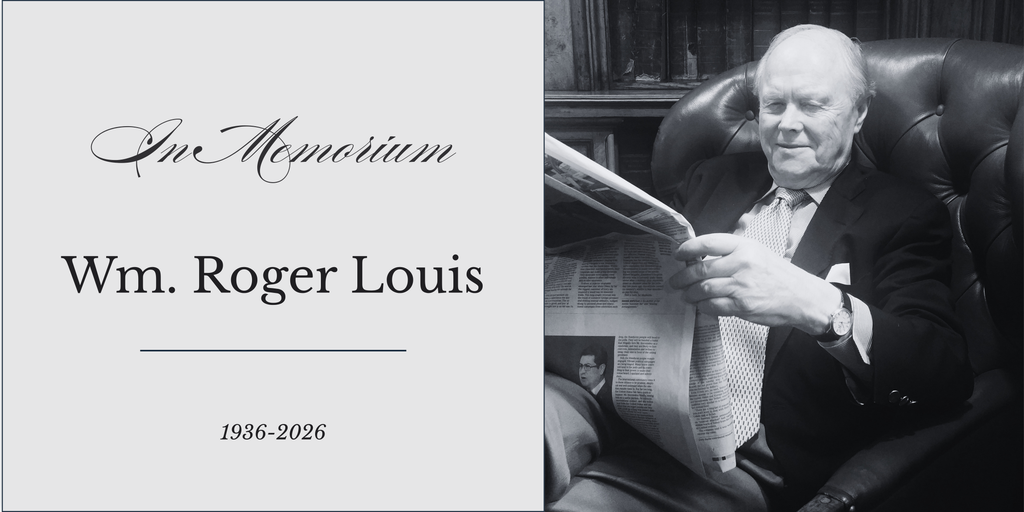
A Tribute to Wm. Roger Louis

A memorial service for Wm. Roger Louis will be held on Wednesday, November 4, 2026, at 12:00 p.m. at Weed Corley Fish Funeral Homes and Cremation Services – North, located at 5416 Parkcrest Drive, Austin, TX 78731.

By Justin Roberts


Wm. Roger Louis was a colossal figure in the study of the British Empire, especially in the study of later British imperialism in Africa, Asia, and the Middle East. The British journalist and author Geoffrey Wheatcroft went so far as to compare Professor Louis’ study of the British Empire with Edward Gibbon’s canonical work on the Roman Empire. “If Gibbon has a successor,” Wheatcroft said, “it must be Wm. Roger Louis, who has become after a lifetime’s study the greatest and truly incomparable historian of the decline and fall of the British Empire.” Only a small handful of scholars in the field in the past century could credibly be called his equal in energy, presence, or impact. Paul Kennedy, the Richardson Dilworth Professor Emeritus of History and Global Affairs at Yale, put it simply, “There was really nothing quite like him.”

Roger was born in Detroit in 1936, but he grew up in Oklahoma in the 1930s and 1940s. He said in an interview with The Historian in 2000 that he learned the “importance of work, thrift and family” from his parents. His parents made sure that he and his sister were well educated. “Neither of us ever doubted that we were going to college.” He enjoyed literature, devoured books from the local Carnegie library, and played the French horn. He also enjoyed handball, swimming, and gymnastics. He attended church where he had his “first lessons in public speaking” from a charismatic preacher. He later claimed that “Whenever people ask me about my philosophy of life, I repeat the words President Roosevelt once told a reporter: ‘I am a Christian and a Democrat. What more does one need in life?” He continued to use this line throughout his life. He developed a deep “commitment to civil rights” while he was working in various jobs at the YMCA and realized how segregated Oklahoma was. When Roger became president of Sigma Alpha Epsilon at the University of Oklahoma, he tried to pave the way for desegregation in the fraternity.
The YMCA also gave Professor Louis his first opportunity to travel outside of Oklahoma. He “learned that there was much more to the world than he had seen in Oklahoma.” He spent time in Freiburg, Germany, and at the Sorbonne in Paris. He learned to speak French and German. He even hitchhiked through the eastern Mediterranean to keep seeing the world. He completed his BA at the University of Oklahoma and then went on to complete his MA at Harvard and his D.Phil. at Oxford, where he was supervised by AJP Taylor. He also worked with Margery Perham and John “Jack” Gallagher. Roger credited Professor Taylor, a renowned stylist, with having “immensely improved my writing.” Professor Taylor taught him to keep his paragraphs short and to limit his discursive footnotes. Professor Taylor also encouraged Roger to write while researching rather than separating these stages. Professor Louis finished his doctorate in two years and taught at Yale from 1962 through 1970 before moving as a full professor to the University of Texas at Austin, where he became the Kerr Chair in English History and Culture in 1985.

Professor Louis was the author or editor of more than thirty books from 1963 through 2025. In fact, it is difficult to determine the precise number of his final scholarly contributions. By 2000, he had published “over fifty articles” and he soon stopped counting all his books and articles on his curriculum vitae. The last version of his CV from 2012 described his total as simply “some thirty books.” By 1967, Roger, who was then an associate professor at Yale, had already published two books. In 1966 alone, he published articles in three of the most prominent journals in his field: American Historical Review, English Historical Review and Journal of Modern History. Professor Louis was just 31 years old, but he had already established himself, Kennedy claims, “as the single most important scholar on the later time of the British Empire.” Roger never slowed down. He said that he “routinely” worked “ten-hour days most days of the week” and that his wife Dagmar “never let me forget that I spent most days at the PRO” [Public Record Office] in London during their honeymoon. He visited the archives in London every single summer for decades and scoured other archives around the world.
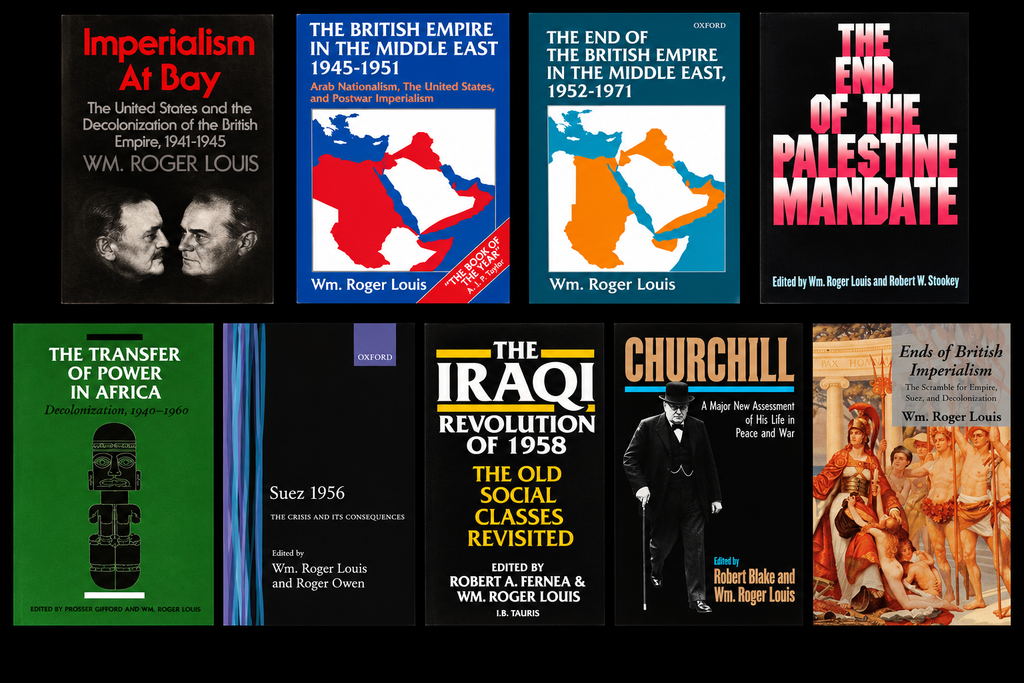
A collection of Wm. Roger Louis’ published works

Judith Coffin, his colleague in History for many years at the Forty Acres, said that in terms of “boundless energy,” Professor Louis was “in a league of his own.” David Leal, a professor in Government, says that Professor Louis usually broke up his long days of work with an hour-long stroll around the campus at lunch time. He continued to work after retirement. His last book—The End of the British Empire in the Middle East, 1952-1971—was published with Oxford University Press in June of 2025. It was the second part of a two-part project that he began more than four decades ago on the British Empire in the Middle East. John Darwin, an emeritus professor at Oxford, has described the second book as “a monument of historical scholarship” that offers clear proof of Professor Louis’ “astonishing mastery of the archival record.” 

One could argue that the most significant project in Professor Louis’ career was the five-volume Oxford History of the British Empire. He served as the editor-in-chief, shepherding the enormous project through to completion. The five volumes were published in 1998 and 1999. When I was a graduate student in the early 2000s, these volumes were required reading. It remains the definitive collection on the British Empire. Far from simply celebrating the British Empire, Professor Louis ensured that the volumes were intentionally inclusive and nuanced in perspective. In his interview in The Historian in 2000, Professor Louis noted that “several prominent British historians complained about an American being the editor-in-chief” of the project because they worried that “the work would be biased against the British.” Professor Louis wanted to ensure that these definitive volumes on the Empire included complicated and multifaceted perspectives.

Professor Louis described his vision of this project as a “new history of the British Empire” with a “less ideological approach” that told that history “not just from the standpoint of the British, but from those who had been on the receiving end of British imperialism.” He also tried to ensure that the volumes were “less Anglocentric” than traditional histories of the Empire and that they included “the significance the British Empire has had for the Scots, Irish, and Welsh.” He intentionally recruited “junior as well as senior scholars.” It was a successful and generative endeavor. Professor Darwin observed that “The energy and determination with which he drove through the whole series from conception to publication have become legendary.” Queen Elizabeth II named him Commander of the British Empire in 1999 for his role as editor.
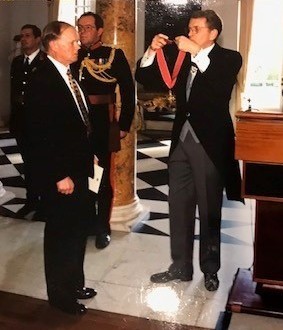
Roger Louis receiving his appointment as Commander of the Order of the British Empire (CBE).

A scholar who has produced as much as Professor Louis and spent as much time in the archives as he did could be expected to devote a little less time to his teaching. Somehow Professor Louis had the energy to be both a prolific researcher and an engaging teacher. He said he learned at Yale that “good teaching and writing go hand in hand” and his advice for younger historians was that “teaching and doing research complement each other” because “you can certainly learn from students in ways that benefit your research, while your historical research can emphatically help you to become a better teacher.”

In fact, Professor Louis’ teaching record clearly shows that he was a remarkable educator for thousands of undergraduate and graduate students since he began in 1970 at the Forty Acres. For more than a half century at UT Austin, he taught students about the British Empire and Commonwealth but also about comparative European colonialism, offering his broad and expansive view of the nature of empires. Professor Coffin recalled that “Every semester,” she would “recommend Roger’s courses to students, telling them it will teach them to read, write, speak, and think” and that it “will prepare them for graduate school in any field.” According to Professor Coffin, Professor Louis had strikingly consistent and high scores in his course evaluations. He was given the President’s Award for Outstanding Teaching in 1992, and he was named a Distinguished Teaching Professor in 1998. He was voted Professor of the Year by the students at the University of Texas in 2009.
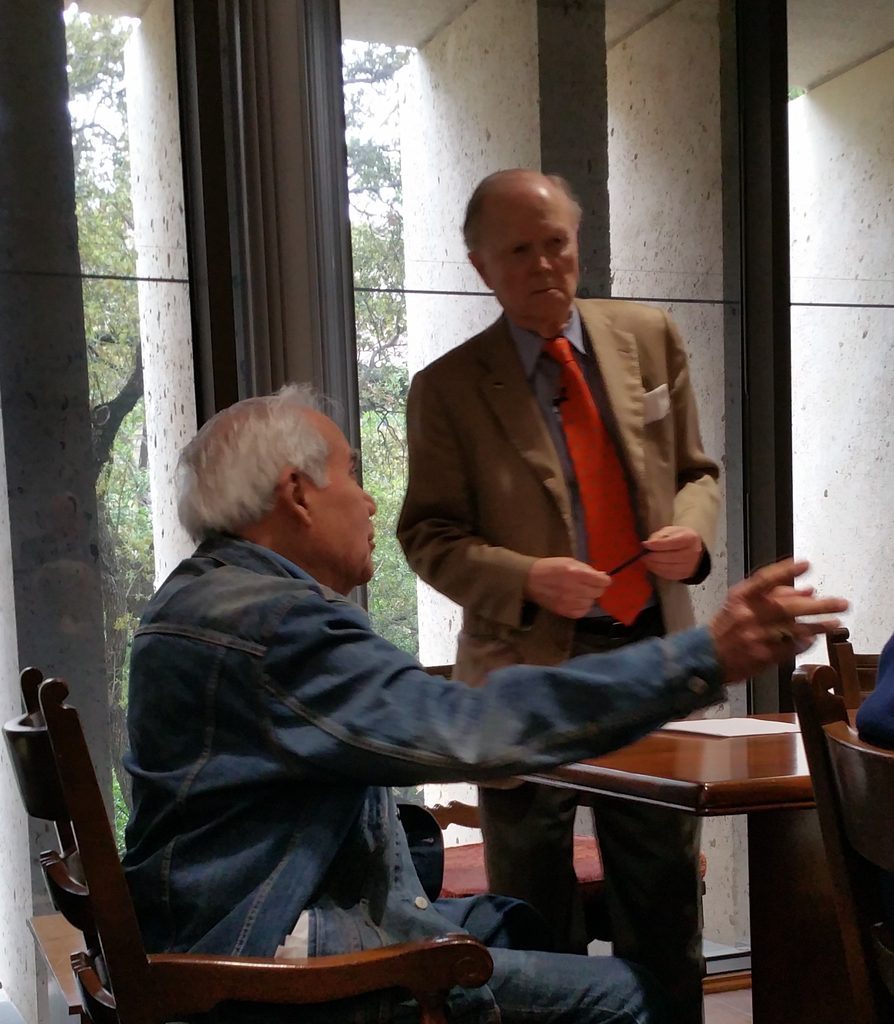
Professor Louis was equally devoted to more extensive supervision of both honors students and graduate students. According to Professor Coffin, he almost never turned away an honors student and as an honors thesis supervisor, he was “willing to read many drafts but firm enough that students do their best work for him.” Bryan Glass, who finished his dissertation under Professor Louis’ supervision, said that “No matter how demanding his schedule, he always made time for me as a graduate student.” According to Professor Glass, Professor Louis’ “combination of generosity, exacting standards, encouragement, and quiet leadership remains one of the most important influences on my own approach to mentoring students and building scholarly communities.” Professor Louis was awarded the Distinguished Graduate Teaching Award in 1984 and the Outstanding Graduate Teaching Award in 1998.

Professor Louis’ energy, vision, and intellect were recognized far beyond Austin. He was awarded the American Historical Association’s George Louis Beer Prize and the Benson Medal of the Royal Society of Literature. He was also awarded a senior fellowship at the National Endowment for the Humanities and a Guggenheim fellowship. He was appointed to the Kluge Chair at the Library of Congress in Washington. He helped organize a decolonization seminar in Washington for many years. In 2001, he became the president of the American Historical Association and the founding director of the American Historical Association’s National History Center. He was also appointed to the US State Department Historical Advisory Committee in 2003, from which he resigned as chair in protest in 2009.  

From 1975 through 2022, Professor Louis drew together scholars and people from diverse backgrounds into a passionate and energetic community in Austin focused on the study of Britain and its empire. These sessions became renowned across the campus as a Friday afternoon gathering spot for sharing ideas over a glass of sherry. Professor Louis believed that his beloved British Studies seminar succeeded in “breaking down some of the boundaries that divide departments from each other” and that it “also fostered good relations with people in the Austin community.” He encouraged younger faculty, graduate students, and undergraduates to attend to help keep his community thriving and filled with new voices, and he instituted a regular Friday lunch that, according to David Leal, “introduced the Oxford High Table spirit to campus.” Professor Louis claimed that some community members “loyally attended these Friday sessions for many years.” Professor Louis relished the “intellectual climate” in Austin and especially in “the British studies program where people of different ages, disciplines, and backgrounds discuss anything and everything.” Stephen Ennis, the current director of the Harry Ransom Center, believed that Professor Louis brought the seminar style that was at the heart of his British Studies program from Oxford to Austin and that “for the rest of his life, he was committed to the seminar method of teaching: a table, an invited speaker, and an engaged and informed conversation about history and ideas.”
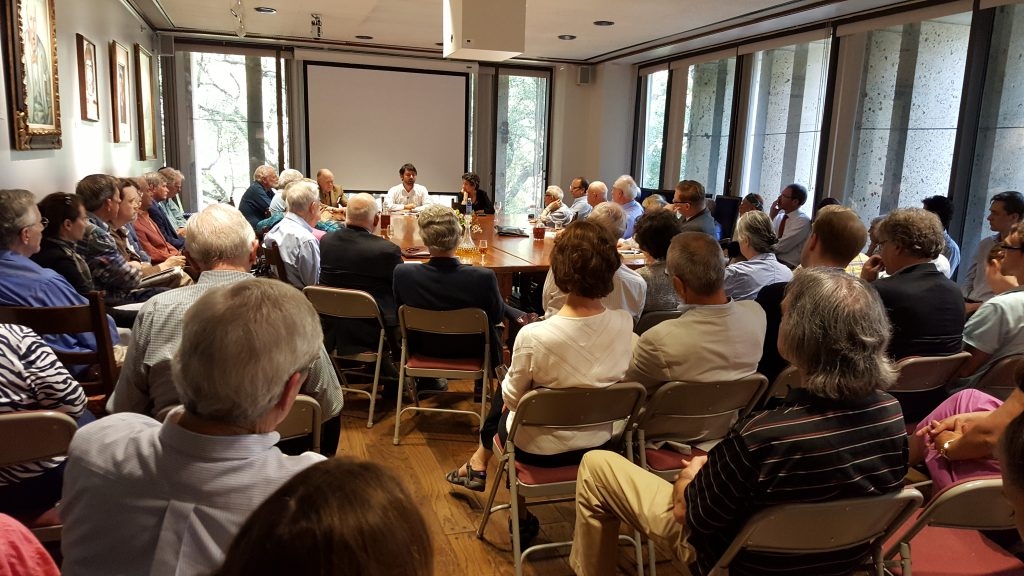
“The Tom Lea Crowd” | British Studies Program seminar event image courtesy of Dr. David L. Leal, Professor of Government, UT Austin.  Dr. Louis is seated at the front of the table to the left of the speaker.

I arrived in Austin in January of 2026 to begin as the director of Professor Louis’ British Studies program. I soon met Professor Louis and some of the still devoted members of his community. I was struck by the influence he had on so many people. His name continues to echo across the university. Professor Louis had cultivated the ability to get along with almost anyone. Professor Kennedy noted that this was always one of Professor Louis’ great talents. He “was simultaneously friendly with that crusty old Oxford Conservative Max Beloff AND with the idiosyncratic radical AJP Taylor; how could anyone get the approval of both?”

Since I arrived, I have encountered dozens of people who testified to the impact Professor Louis and his British Studies program had on them over the more than half a century in which he was a fixture in Austin. They included students, professors, and members of the larger Austin community. Some of these devotees told me they had regularly attended his weekly British Studies seminars on Fridays in the Harry Ransom Center for decades. They spoke of Professor Louis’ passion for meeting people, for reading, and for combing the archives. These devotees continued to meet for the Friday lunch to discuss what they were reading, bringing an eclectic range of interests to the table. Despite his age, Professor Louis continued to attend some of these lunches, where a passionate discussion of books was always at the core of the conversation. Professor Louis believed that asking someone what they were reading was the best way to get to know them and to start a conversation. I had the pleasure of attending Professor Louis’ ninetieth birthday celebration on May 8, 2026, at Tarry House. The room was filled with people who respected and adored Professor Louis. Once again, I had the chance to appreciate the vibrant community he has created. Several speakers rose to offer their appreciation.

“British Studies never stops,” is the line I have heard several times since I started in Austin, meaning that Professor Louis held the seminars at all times, rain or shine. He described the British Empire as “one of the great phenomena of modern world history.” He remained passionate about spreading a deep and abiding interest in this phenomenon and facilitating discussion of it. Professor Louis is no longer with us, but we must honor his memory by maintaining and building his British Studies community in Austin; we must do our best to ensure that British Studies never stops.
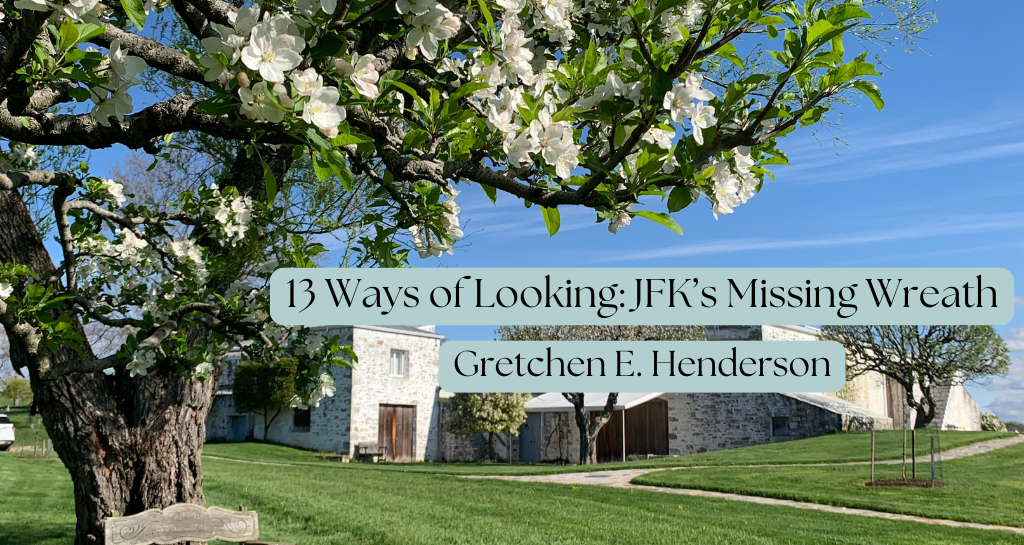
13 Ways of Looking: JFK’s Missing Wreath

Banner for 13 Ways of Looking: JFK’s Missing Wreath

Over sixty years ago, in November 1963, President John F. Kennedy took a fateful trip to Texas. It would be the last of his life. The trip had four planned stops: San Antonio, Houston, Dallas, with a final planned fundraiser dinner in Austin. In the days after his shocking assassination, JFK was buried at Arlington National Cemetery. Four years later in 1967, he was reinterred in his final resting place, marked by the Eternal Flame at the official presidential gravesite. The evolving design of the gravesite at Arlington had been publicized after his initial burial. However, behind the scenes, plans developed for an encircling memorial artwork. This missing wreath has remained undisclosed for decades.

With the Oak Spring Garden Foundation, I revealed the story of “The Missing Wreath: On JFK’s Grave & Mrs. Mellon’s Maquette” in an article published this fall in Ploughshares (the full text can be read here). Told as a detective narrative, it is woven like the structure of a wreath, exploring the planning, creation, and eventual disappearance of the artwork over time.

A short version of the story goes like this: 

After JFK’s assassination and his initial interment in Arlington National Cemetery in November 1963, an architectural firm owned by John (Jack) Warnecke was commissioned to design the formal gravesite. Detailed research reports were created in conjunction with consultations by prominent family, scholars, architects, art critics, and clergy, along with a public exhibit of design plans at the National Gallery of Art and coverage in major news outlets. First Lady Jacqueline Kennedy wanted the gravesite to be publicly accessible yet personal and intimate as befitted a family grave. In 1964, she designated her close confidant, Rachel “Bunny” Lambert Mellon—who had designed JFK’s beloved White House Rose Garden—to represent Jackie’s wishes in the grave design.

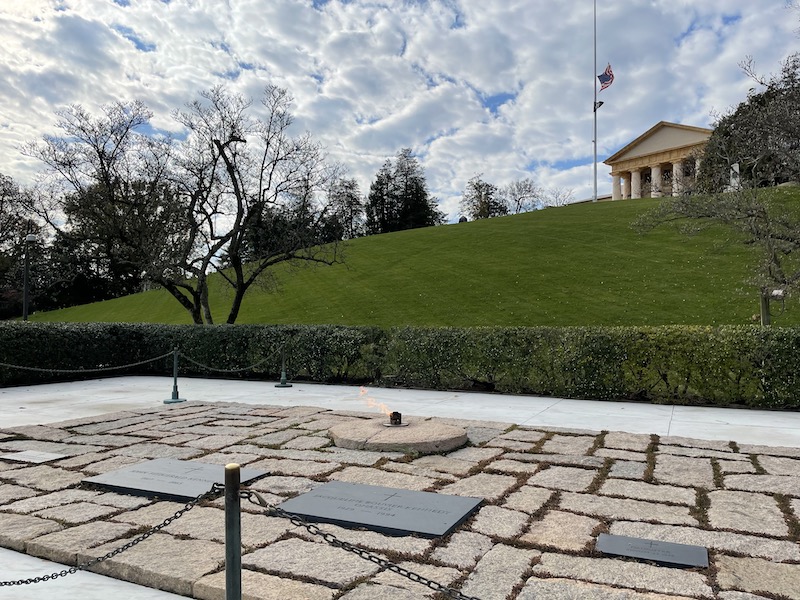
Arligton cementary JFK memorial.
President John F. Kennedy Gravesite, Arlington National Cemetery, Arlington, VA. Photo by author, November 2021.

With her sophisticated landscaping eye, Bunny softened Warnecke’s design around the Eternal Flame. As the final reinterment approached in 1967, she also worked behind the scenes on a secret memorial sculpture with another close confidant: the French-born Tiffany jewelry designer, Jean Schlumberger.

Bunny Mellon and Jean Schlumberger took as inspiration a wreath of military hats around the Eternal Flame that had been laid by JFK’s funerary Honor Guard in an impromptu gesture at his initial interment. Robert “Bobby” Kennedy, JFK’s brother, had been so moved by the gesture that he said the hats should remain around the grave until they “crumble to dust.” By 1969, the memorial wreath had been secretly made by French-born sculptor Louis Féron. Yet due to series of events and issues that delayed installation, the sculpture went missing by the early 1970s and was essentially lost to time—until it was rediscovered earlier this year.

Through the diligent sleuthing of Elinor Crane and Nancy Collins at the Oak Spring Garden Foundation (the Mellon’s former estate outside Upperville, VA), and with thanks to the memory of a stonemason named Tommy Reed, who had worked for essentially a half-century at Oak Spring, the lost artwork was finally found after a multi-year search. It was found disassembled in packing crates in an offsite storage facility at the John F. Kennedy Presidential Library and Museum.

Originally written when the artwork was still missing, the story of “The Missing Wreath” aimed to inspire a search for the lost sculpture. In the process of writing, the search to me became a meditation on who and what gets lost and found in retellings of history. As I wrote in the longer article:

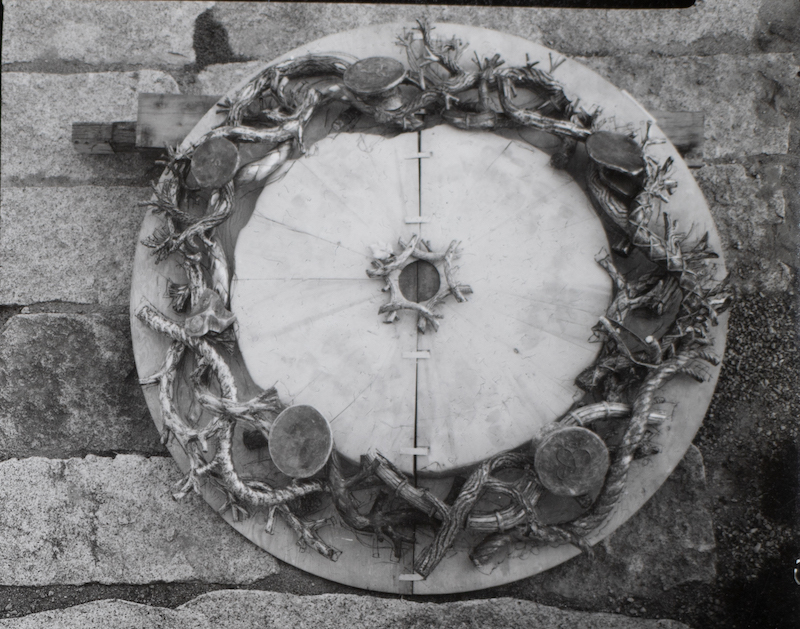
Original memorial wreath, JFK’s Missing Wreath
Cast and assembled memorial wreath for JFK’s gravesite, unknown location and date, photographer unknown. Photo acquired in 2021 by OSGF from an eBay sale of unidentified photos of “War Art Work” by Louis Féron (from the 2018 estate sale of Louis Féron and Leslie Snow). Courtesy of Oak Spring Garden Foundation.

“Historical artifacts never exist in a vacuum, and inanimate objects have lives and even afterlives. Public and private events color retellings; an artwork can be curated dozens of ways, even to the point of disappearing behind variations of accounts. The aura around the memorial wreath’s absence makes it almost more powerful than if it were present. When public celebrity is involved, when privacy is fiercely guarded, when privilege can determine what is noticed or neglected or even erased, stories can constellate between private records and the public imagination … Histories can get lost between lines and behind headlines—just as a crumbling stone maquette in a rural cemetery can lie for decades without notice.”

In the two years since “The Missing Wreath” was finished and accepted for publication by Ploughshares, additional puzzle pieces have emerged from different corners of the country, aiding in the search for the artwork’s final resting place. A brief coda notes the memorial’s rediscovery, highlighting its journey from lost to found, while leaving room for future historians.

As I reflect back on this remarkable story, what remains of interest to me are different ways to see the memorial wreath. Any history is always incomplete, as acts of remembering grow spaces for future storytellers to fill more gaps. With a nod to Wallace Stevens’ poem “13 Ways of Looking at a Blackbird,” I offer here some frameworks for interpreting and re-interpreting the wreath:

1. Histories of Art and Design: JFK’s memorial wreath was co-created by the American gardener and philanthropist Rachel “Bunny” Lambert Mellon, French-born jewelry designer Jean Schlumberger, and French-born sculptor Louis Féron. When lines between artist, craftsman, and commissioner blur, who is credited as the creator of an artwork? How do historical traditions and cultural systems influence this valuation and reevaluation where art and design meet?

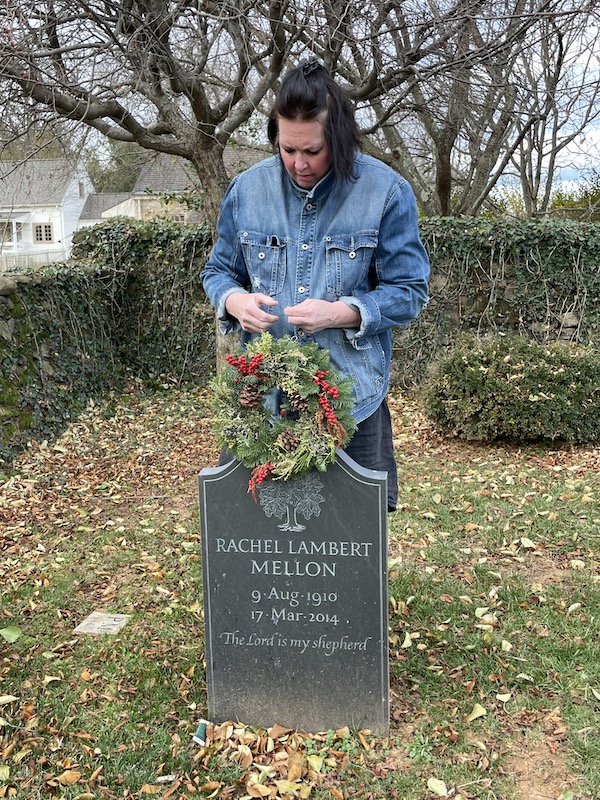
Nancy Collins hanging holiday wreath on headstone of Rachel “Bunny” Lambert Mellon
Nancy Collins hanging holiday wreath on headstone of Rachel “Bunny” Lambert Mellon, in Trinity Episcopal Church Cemetery, Upperville, VA. Photo by author, December 2021.

2. Histories of Labor: In addition to the co-creators in name, JFK’s memorial wreath owes much to contributions by highly skilled tradesmen including stonemasons, gardeners, servicemen, foundry workers, and more. The story of the missing wreath surfaced at the Oak Spring Garden Foundation (the former estate of Paul and Bunny Mellon in Virginia), thanks largely to a stonemason, who originally worked on a stone maquette in the early 1970s in the Oak Spring cemetery, where the sculpture briefly weathered. Since many people played a role in this memorial, how are such layers of labor credited?

3. Histories of Memorials: Plans for JFK’s Gravesite included commissioned reports in the 1960s by interdisciplinary critics and experts who considered distinctions among graves, memorials, and monuments in shaping the design. This was complemented by public-facing exhibits and family engagements with the process. Whether a national or personal memorial, how do incorporated elements do more than reflect a singular era to stand the test of time? Since the memorial wreath was not installed on JFK’s grave, how does its rediscovery offer a different reading of the same object in a different historical context?

4. Histories of Cemeteries: Multiple cemeteries in Virginia help to illuminate the story of the missing wreath: Arlington National Cemetery (where JFK is buried), Oak Spring’s Fletcher Cemetery (where the stone maquette was constructed based on JFK’s grave), Trinity Episcopal Church Cemetery (where the Mellons are buried), not to neglect other marked graves, along with unmarked cemeteries in neighboring mountains (largely interring free Black communities). Cemeteries balance preservation of memories with residual presence of physical bodies, cycles of life and death, shaped by beliefs about afterlives rooted in culture and ecology. JFK’s Gravesite sits in a national cemetery; he is one of only two presidents buried at Arlington. How do considerations of burial and commemoration reflect not only the person who died but also the values of the living?

5. Histories of Gardens: Bunny Mellon designed JFK’s White House Rose Garden during the president’s life, his Gravesite at Arlington after his death, and later the bayside grounds in Boston for his Presidential Library and Museum. After her death, the Mellon estate at Oak Spring transitioned from a private estate into a “garden foundation” to cross-pollinate the humanities, arts and sciences. One of its responsibilities includes stewarding the property’s cemetery, which caught the attention of Elinor Crane. Crane began asking questions about the crumbling stone maquette and enlisted Nancy Collins, the Foundation’s archivist, to help her search. Histories of gardens and cemeteries overlap. As landscapes change over time, how do attentions to plants help to support living histories and reparative futures, including attending to climate change?

6. Histories of Materials: JFK’s grave is composed of engraved slate headstones around a large round stone sourced from New England, in a sea of wavy pink granite, surrounded by specimen trees and other signature plantings. The design of the memorial wreath symbolically interweaves materials from bamboo to rope, driftwood to military hats, which inspired the wreath after JFK’s Honor Guard laid their hats in that shape at his initial interment. His memorial artwork was cast at a metal foundry and brought outside for a brief time to weather on an oyster shell stone maquette at Oak Spring. Considering both natural and manmade resources, how does materiality contribute to this story of the memorial wreath?

7. Histories of Ecology: After her multi-year search for the missing memorial wreath, Elinor Crane finally witnessed the artwork in early 2024 disassembled and crated at the JFK Presidential Library and Museum in Boston. On one of the disassembled pieces, she spied an unexpected detail: some bird droppings which she surmised came from Oak Spring when the memorial had been laid to rest for a short time on the outdoor stone maquette in the cemetery in the early 1970s. Since Oak Spring has transitioned from a private estate to a garden foundation to focus on cross-pollinating research, would it be possible to test and trace those droppings to identify the avian species? What foods might that bird have eaten, and does its kin still migrate through this ecosystem? This detail may seem insignificant but reveals the living world that surrounds such memorials.

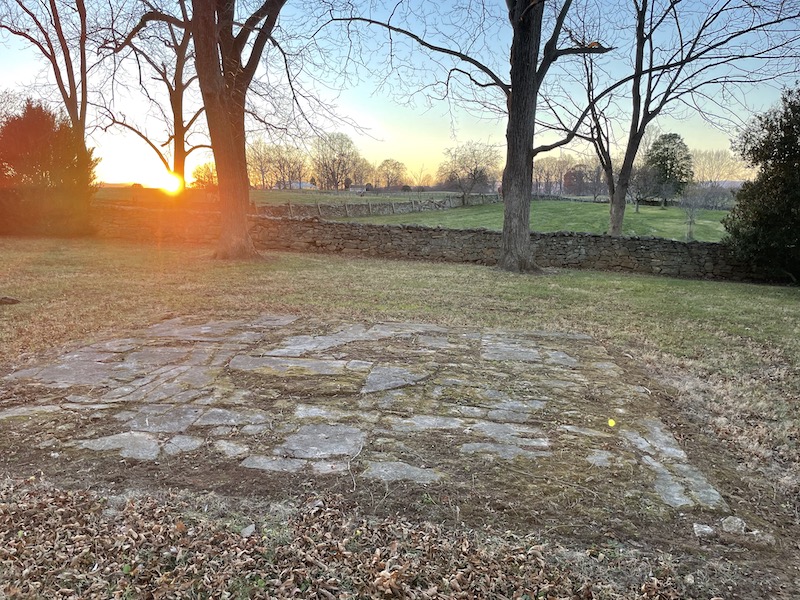
Stone maquette related to JFK gravesite in Fletcher Cemetery at Oak Spring Garden Foundation
Stone maquette related to JFK gravesite in Fletcher Cemetery at Oak Spring Garden Foundation, Upperville, VA. Photo by author, November 2021.

8. Histories of Lands (Ancestral, Colonized, Enslaved, Emancipated, Legislated): Established in 1864, Arlington National Cemetery is relatively young. It occupies land once owned by Robert E. Lee, which was requisitioned during the Civil War as a national burial ground. On the heels of the Emancipation Proclamation, part of the land was designated Freedman’s Village to support free Black women and men escaping enslavement. In centuries before colonization, the intersecting waterways of the Potomac and Chesapeake region served as homeland for hundreds of Indigenous communities. How are these ancestral lands recognized and represented in national and regional cemeteries, and who else may be buried in marked and unmarked graves in and beyond this region?

9. Histories of Witnesses: Most of JFK’s contemporaries have died, but after the memorial wreath was found in 2024, Elinor Crane and Nancy Collins learned that an important member of JFK’s funeral Honor Guard still lives. James L. Felder was only the tenth Black American to serve with the Honor Guard (with the other nine preceding him by only months), and he wrote an account of his experience, I Buried John F. Kennedy (1994). When the Oak Spring Garden Foundation gathered experts for a private meeting in September 2024 to share news of the lost-and-found memorial, Felder spoke about his experience and also shared his personal album of JFK’s funeral, made for him personally by First Lady Jacqueline Kennedy. Attendees also received a copy of Felder’s book with an advanced copy of “The Missing Wreath.” His album was reproduced for an exhibition on the memorial wreath that will run at the Oak Spring Garden Foundation from October 2024 into 2025. “The Untold Story of a Lost Memorial” exhibition invites attendees to share their own intersecting memories.

10. Histories of Libraries & Museums: Many museums and libraries figure in this story, including the Oak Spring Garden Library, Museums of Fine Arts in Virginia and Boston, the JFK Presidential Library and Museum, and others. Collections are never complete by themselves. Primary research often requires years for researchers to piece together a story. Large collections  may take years to process, catalogue, and create finding aids to make items accessible. Versions of cataloguing can leave items relatively invisible. Conservation and preservation of a single item may take months or longer. Events like a global pandemic can separate curators from collections. Scholarly trends may neglect aspects of objects that hide in plain sight. Historical events influence why items were collected in the first place, leaving gaps in historical records. Collaborations help to reconnect parts that have been disassembled over time. How do related histories influence the lost-and-found memorial wreath and other aspects that may be missing from this story?

11. Histories of Speculative Futures: If the memorial wreath been installed after JFK’s reinterment, what would its reception have been in the era of the late 1960s or early 1970s? Would it have distracted from the timeless simplicity of the Eternal Flame, and what other unrealized memorial plans for the president’s grave lie buried in other archives? Now that the memorial wreath has been found, what are its possible futures, from its current resting place disassembled in Boston to an anticipated exhibition reassembled in Virginia, or otherwise? Why does the specter of JFK’s unrealized presidency continue to haunt our current moment, including vulnerabilities around civil rights and other social concerns that remain pressing issues? Beyond surmising what the world might have been if JFK had survived, would it be more helpful to consider: What descendants have we become, and what kind of ancestors do we wish to be?

12. Symbolic Histories: Many symbols are woven into JFK’s memorial wreath—military hats, ropes, driftwood, a leaf, and more—not to neglect the symbol of the wreath itself. Why have the symbol of wreaths played such an important role over time? What does the choice of a memorial in the shape of a wreath resembling a crown of thorns offer to this larger encircling story? Now that over a half-century has passed since the memorial wreath was created, what symbols still carry resonance or not, depending on the eye (and age and background) of the beholder? Beyond the memorial wreath, how might the living symbol of the Eternal Flame illuminate a path forward, among other eternal flames that have existed across centuries and cultures?

13. Public Histories and Public Memories: For many, the memory of that day remains remarkably vivid. If you were alive in 1963, consider what do you remember? If you weren’t alive then, ask someone who was to share generational knowledge—not only about JFK but also about their daily lives. How do generations connect to learn about the arc of evolving and intersecting histories? What other questions arise? What knowledges emerge by sharing these stories? As I wrote:

“Even as this story tells the arc of an artwork that went missing, it is as much if not more a story of those who co-created a memorial and who cared to go searching for an artifact that got lost, about the ephemeral or privileged materiality of human lives, how cultural collections are acquired and stewarded in ways that evolve, laying groundwork for future researchers and historical understandings.” ~ GEH, “The Missing Wreath”

These are 13 ways of looking at JFK’s lost-and-found memorial wreath, offering more questions than answers. There are surely more. But these questions provide a starting point to look again at this traumatic and critical moment in modern American history, as we work to imagine and co-create possible futures.  

Gretchen Ernster Henderson is a Senior Lecturer at the University of Texas at Austin and writes across environmental arts, cultural histories, and integrative sciences. Her publications, exhibitions, and performances include five books, arts media, and opera libretti. She previously served as Associate Director for Research at the Harry Ransom Center at UT-Austin and Co-Director of a National Endowment for the Humanities Institute on Museums: Humanities in the Public Sphere at Georgetown University with UC-Santa Cruz.

The views and opinions expressed in this article or video are those of the individual author(s) or presenter(s) and do not necessarily reflect the policy or views of the editors at Not Even Past, the UT Department of History, the University of Texas at Austin, or the UT System Board of Regents. Not Even Past is an online public history magazine rather than a peer-reviewed academic journal. While we make efforts to ensure that factual information in articles was obtained from reliable sources, Not Even Past is not responsible for any errors or omissions.


Banner picture: Oak Spring Garden Library, Oak Spring Garden Foundation, Upperville, VA. Photo by author, April 2021.

The Curious History of Lincoln’s Birth Cabin

The monument at Abraham Lincoln Birthplace National Historical Park (via Wikimedia Commons)

by Jesse Ritner

School children across the United States learn that Abraham Lincoln was born in a log cabin. For seven weeks this past summer I worked at the Abraham Lincoln Birthplace National Historical Park in Hodgenville, Kentucky, where that cabin (as legend has it) is encased in a stone monument.  Imposingly large when viewed from the bottom of its 56 steps, the monument is almost claustrophobic inside. Designed by John Russel Pope, the early twentieth-century’s titan of neo-classical monuments and government buildings, the monument only has one room, about the size of a large living-room.  The entire log cabin fits inside, reinforcing the difference between the monument built in Lincoln’s honor and his humble origins.  The Grecian inspired edifice was built between 1909 and 1911, atop the knoll where legend (and some deeds with Thomas Lincoln’s name) lead us to believe Abraham Lincoln was born.  The now largely forgotten monument was once national news.  Over 100,000 Americans donated money to build the publicly funded temple.  The cornerstone was laid by none other than President Theodore Roosevelt and, two years later, it was dedicated by President William Howard Taft, himself a member of the Lincoln Farm Association, which led the fundraising effort.

The intended lesson of the Lincoln Birthplace Memorial is clear.  Those who begin in rags, can rise to riches.  Those men who save the nation will, for their services, have their less than impressive childhood homes enshrined in granite and neo-classical architecture, thereby tying them for eternity to the everlasting fight for freedom and democracy that can be traced all the way from ancient Athens to today’s rolling hills of Kentucky.  Yet, the monument and the cabin inside teach us much more than an overwrought story about the American dream; instead, it serves as a piece of history in of itself.

The cabin inside the monument’s granite walls never housed the Lincoln family.  It was constructed in 1895 by entrepreneur Alfred Dennett and his agent, James Bigham, from logs found in a log cabin near the sinking spring where records suggest Lincoln was born.  In 1897, the fabricated cabin was toured around the country, where it was matched with another ersatz birthplace cabin – that of none other than Confederate President Jefferson Davis.  As the caravan of cabins continued around the United States, it finally landed on Coney Island.  There, due to poor organization while shipping, parts of each cabin became mixed so they were simply joined together creating a single Lincoln-Davis Birthplace Cabin. According to James W. Loewen, author of Lies across America, when this cabin, now combining logs from the separate counterfeit cabins of the enemies of the Civil War, was sent back to Kentucky in 1906, it was represented as Lincoln’s “original” birthplace cabin. While the National Park Service does acknowledge that the cabin is not the original, but instead is “symbolic” (the quotation marks are theirs, not mine), it is largely silent on the actual origins of the cabin.

The symbolic cabin enshrined in the monument at the Abraham Lincoln Birthplace National Historical Park (via Wikimedia Commons)

In today’s conversations about Confederate statues, few are discussing the relationship between Confederate and Union memorials dating from the early twentieth century, both of which quite consciously use matching metaphors to affect their viewers.  In Kentucky, monuments such as Lincoln’s birthplace offer insight into the way historical narratives created by turn of the century endeavors in public history by both Union and Confederate supporters are often intertwined, despite the heated rhetoric and violence that results from these supposedly competing historical narratives today.

The Park Service’s silence calls to question why we need the monument in the first place and why we, as taxpayers, should support its preservation.  As a remembrance of President Lincoln, the monument and park are markedly outdated.  Far removed from population centers, the monument is largely forgotten.  On the other hand, the story of the cabin now enshrined in its “Temple of Fame,” as Theodore Roosevelt dubbed the granite structure, gives real insight into the way Americans, both Confederate sympathizers and Union patriots, collectively built historical narratives about the Civil War in the late nineteenth century.  Both Presidents Davis and Lincoln were born in Kentucky and, at the turn of the century, their rags to riches stories were not seen as inherently independent of each other, but were instead part of a single American narrative that both Southerners and Northerners could claim as their birthright.

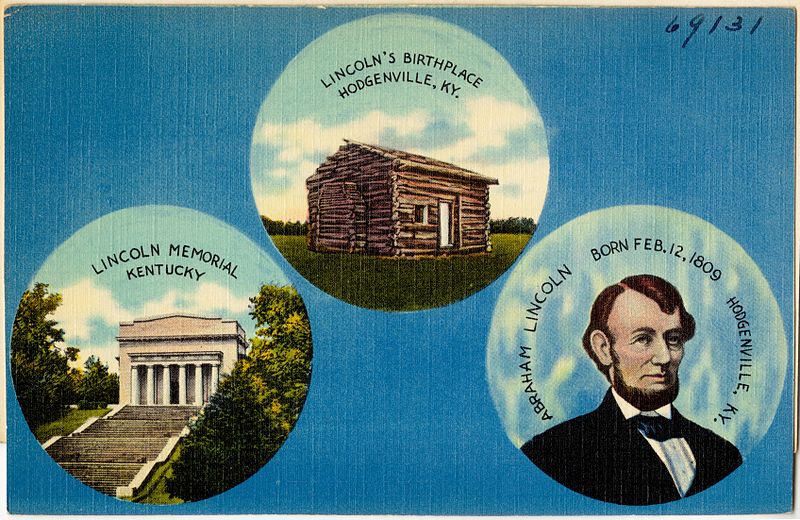
A postcard of Lincoln’s Birthplace Memorial, ca. 1930-1945 (via Boston Public Library)

The cabin today, with no mention of the monument’s convoluted history, ignores the partially fabricated histories that brought both to power, and brought these Kentucky brothers symbolically back together, even after a long, violent, and devastating war.  But, the monument, despite the faults inherent in its creation, also holds valuable potential as a piece of public history that can truly engage with the way in which historical narratives are created and why monuments are built, rather than simply reinforcing centuries old attempts at public education and nation building.  It suggests historical precedents to the Republican Party simultaneously claiming heritage as the party of Lincoln, while supporting the maintenance of Confederate monuments and minimizing or even erasing the history of slavery and its role in the bloody Civil War.  And it shows that in towns like Hodgenville, where Confederate flags fly freely next to memorials to Lincoln, the apparent conflict in historical memory is not new, but is part of a conscious narrative built in the immediate aftermath of the Civil War and continuing today.

The current dialog revolving around Confederate memorials is far more complicated than many analyses acknowledge. Considering the current unrest regarding Civil War monuments, it is necessary for us to examine the influence of all sides on the historical narratives they choose to create.  Remedying the wrongs that statues of people such as Jefferson Davis and Robert E. Lee represent is harder than simply taking prominent statues down.  As a nation we must reassess the way we have remembered the entire history of the Civil War and we must reexamine the ways past generations remembered as well, regardless of whether the historical figures in question are currently viewed as villains or heroes.

You may also like:

A Historian views Spielberg’s Lincoln (2012), by Nicholas Roland
Watch: panel discussion of confederate statues at the University of Texas
Charley Binkow on the Lincoln Archives Digital Project

Recent Posts

  • A Tribute to Wm. Roger Louis
  • Patterns, Assumptions, and Suspicions: A Review of Chile in their Hearts, by John Dinges
  • Rethinking the Samurai at the British Museum: A Conversation with Curator Rosina Buckland
  • Review of The Most Awful Responsibility: Truman and the Secret Struggle for Control of the Atomic Age (2025)
  • Meg Lauren’s Songs from the Archive
NOT EVEN PAST is produced by

The Department of History

The University of Texas at Austin

We are supported by the College of Liberal Arts
And our Readers

Donate
Contact

All content © 2010-present NOT EVEN PAST and the authors, unless otherwise noted

Sign up to receive our MONTHLY NEWSLETTER

  • New
  • Features
  • Reviews
  • Texas
  • Teaching
  • Digital
  • Watch & Listen
  • Authors
  • About