Throughout U.S. history, Black Americans have been victims of a range of violent and coercive systems, including slavery, segregation, and state-sanctioned violence, leaving enduring strains on the nation’s past and present. Among the most overt and brutal manifestations of this history was lynching, which made racial domination visible through public acts of terror. Emerging in the early nineteenth century, lynching in the United States functioned as widespread extrajudicial violence, most often carried out by White mobs against Black Americans and other marginalized groups[SH1] .[1] These killings typically involved an accused individual being seized by a mob and publicly executed, often after prolonged torture that included burning, cutting, drowning, or shooting. Victims were frequently left hanging in public spaces as a warning to others.[2]Such acts were routinely justified under the language of “social justice” and rarely resulted in legal consequences for perpetrators.[3]
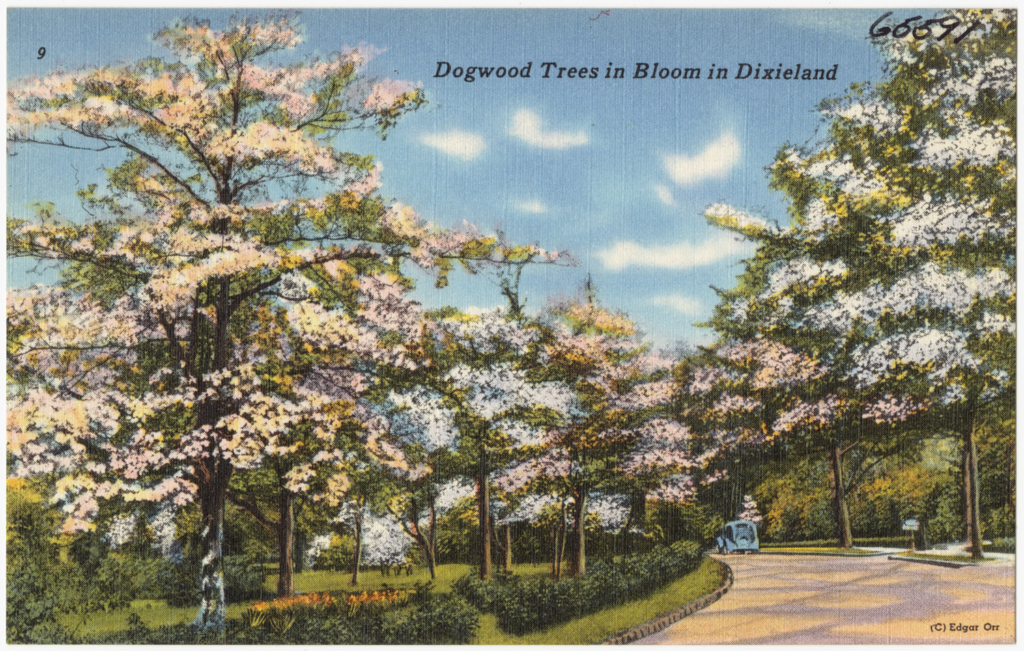
Dogwood trees in bloom in Dixieland, postcard. Ca. 1930
Crucially, lynching was not only enacted as violence but also staged, documented, and circulated. Many of these events were photographed, with images reproduced as postcards and distributed among White communities, extending the spectacle beyond the immediate site of the killing and embedding it within a broader visual culture of racial domination.[4]
Since the mid-nineteenth century, photography has played a significant role in shaping popular culture and historical memory through the use of violent imagery. [SH2] During the American Civil War, photographs of battlefields and soldiers’ daily lives were widely produced to document the conflict. Yet Black soldiers, who also fought in large numbers, appear only rarely in this visual record. Instead, Black people were more often depicted as civilians attached to the military or as refugees, a pattern that reinforced racial hierarchies by presenting Black subjects in subordinate or dependent roles relative to their White counterparts.[5]
Postcards, known as “Patriotic Covers”, started appearing at the end of the Civil War era in 1865, with portraits of White patriots to commemorate and honor them for their service and sacrifice.[6] To most people during the late nineteenth century, postcards were a modern form of visual communiqué mainly marketed to White audiences as pictographic collectibles of important places, events, and individuals. By 1908, 677 million postcards were mailed, increasing to nearly one billion in 1913.[7] Picture postcards became a popular visual communication medium in the United States and are often used as a tactile method to commemorate leisure outings and activities.[8]
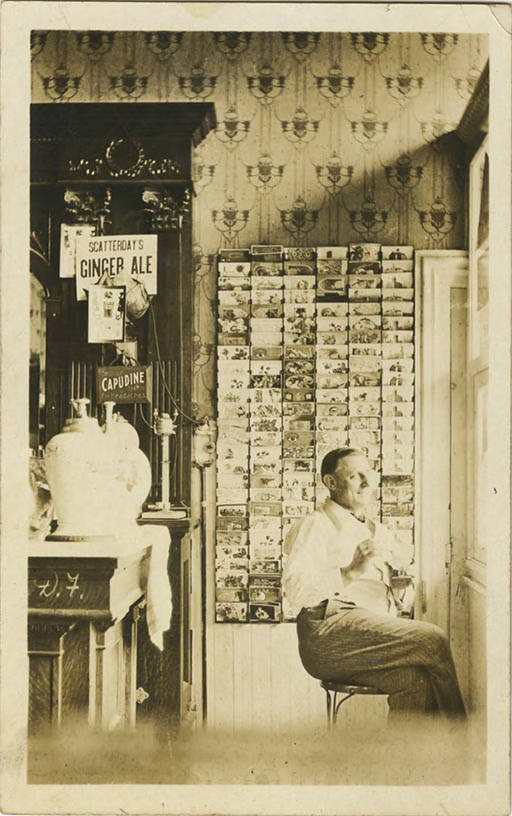
Papa Jony, Farmers City, IL sitting in a store, which sold postcards. Source: Wikimedia Commons
Purchasing and collecting postcards became a way to signal taste and social identity, with the style and quality of the images reflected in the postcards people possessed, mailed, and exchanged with others.[9]Within this broader visual culture, racialized imagery also circulated widely. Some postcards depicted Black figures deliberately darkened with ink and positioned alongside White subjects, reinforcing racial hierarchy and representations of Black inferiority.
Therefore, postcards produced and disseminated racist stereotypes, particularly through images of Black children depicted as primates or ape-like figures in degrading and stylized poses, such as eating watermelon, sitting on the ground, or walking barefoot in cotton fields.[10] Consequently, since the 1860s, lynchings also started being photographed across the country, especially in the South. These visual depictions of racial violence were widely reproduced and sold on the streets and local shops, primarily to White southerners from Texas, Louisiana, Mississippi, Alabama, and Georgia.[11] These states, where most lynchings happened, sold postcards for an average of ten cents each, which would later be sent throughout the country to relatives who shared the same racist views.[12] The dissemination of these postcards conveyed the message of the superiority of White individuals in the picture, who often posed in front of the camera with a grin of satisfaction.[13] These expressions not only asserted White superiority and power but also framed Black suffering as an expected outcome for those accused of defying the dominant group, regardless of guilt.
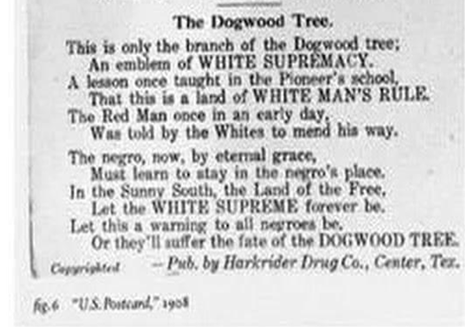
The Dogwood Tree, 1908. Credit: Without Sanctuary
In Sabine County, Texas, in 1905, the lynching of Will Manuel, Cleve Williams, Moses Spellman, Will Johnson, Jerry Evans, and a male whose last name was [SH3] identified as Williams was preserved in postcard form (See Figure above) and remains one of the few surviving examples to include pro-lynching poetry. Such postcards often featured explicit language that endorsed and reinforced White supremacy, whether through printed text or handwritten annotations. Not only did these postcards show the contemporary mindset of that time, but they also influenced future generations and their connotations of non-white people, as families often saved these postcards as memorabilia. Indeed, the writer’s supposed sense of righteousness and objectivity present in their words are material proof of their views and attitudes toward minorities and their support for a White supremacist America and the perpetual subjugation of Black people.
Public understanding of lynching remains uneven, and discussions of this history are often avoided or marginalized within broader narratives of the nation’s past.[14] Many White Americans have the perception that extremist racist behavior in society is an issue of the past and that the nation is long past violent and racially driven crimes and behaviors.[15] However, the legacy of lynching, and particularly its visual documentation, has influenced public policy and social attitudes, with lasting consequences for Black communities. Public lynchings continued until the mid-twentieth century, and so did the dissemination of postcards and photographs through the mail, even after the outlawing of their mailing in 1908.[16] Presently, lynching postcards and physical souvenirs of the deceased, such as clothing items, locks of hair, and bones, can be found in family albums, attic trunks, online sales, thrift stores, pawn shops, and flea markets, with some selling for up to thousands of dollars. Therefore, this indicates that objects considered to be lynching memorabilia were frequently hidden among family possessions or discarded as a means of avoiding the law or, in contemporary times, out in society, ready for acquisition by those who actively seek the items out.[17]
While the historical contexts differ, scholars note that visual documentation of racialized violence continues to shape public perception today. Similarly, lynching photographs have given way to “othering” of Black Americans in the US by the general population and the police force. The brutality shown in those postcards can still be seen today in the proliferation of images featuring police violence against Black people. Historically, many police forces have been “official” perpetrators of violence against African Americans in the South. In some cases, law enforcement agencies carry out a brutal and lengthy legacy of maintaining peace through state-sanctioned coercion and fearmongering among the minority population because of preconceived, racist, and stereotypical notions that are woven into the threads of American society.[18] For example, in contemporary conversations around police body cams, the proliferation of images of police violence against Black people is evident. The evidence can tell us that this Black person is doing nothing and is not a threat, yet they are handcuffed, or worse, their lives are taken from them.[19]
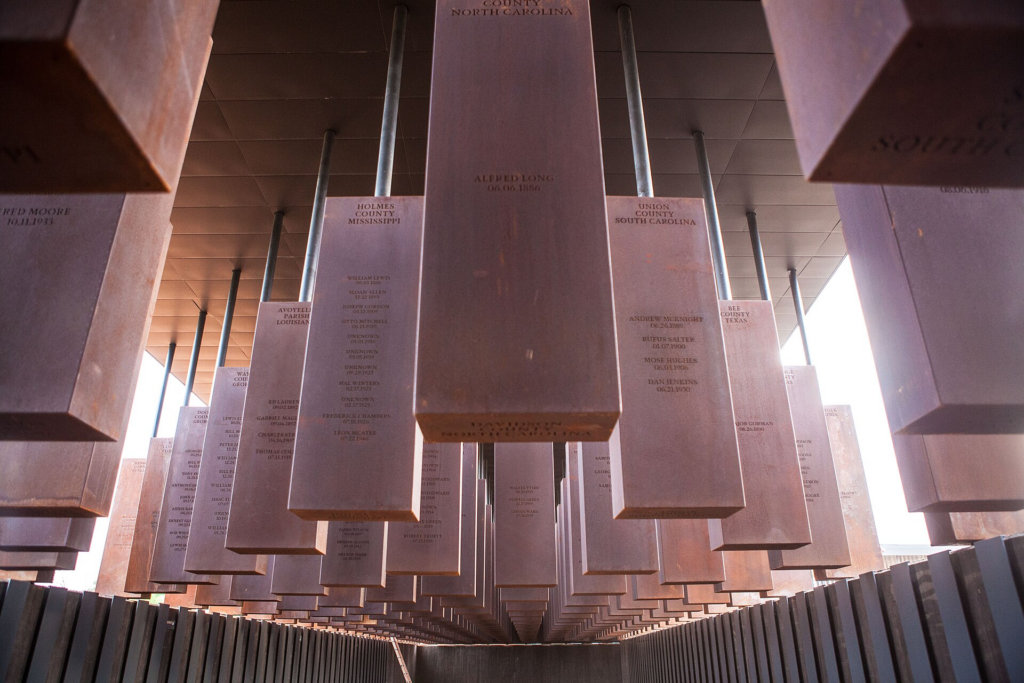
Memorial Corridor at The National Memorial for Peace and Justice. Source: Wikimedia Commons
The photographs act, still to this day, as a moment frozen in time where lynching victims were suffering at the hands of the White mob and are a permanent display of power, race, and White supremacy. Indeed, lynching photographs today stand as tokens of the most sensationalistic aspects of lynching: photographers selling torture and death through pictures and postcards for profit and spectators who bought them, sent them to friends and family, and preserved them for generations. Nevertheless, at the turn of the last century, they served as “proof” of something more; the shots photographers chose to take, develop, and sell, and how senders chose to present themselves through writing, ultimately came to visually substantiate the ideologies of White supremacy and White solidarity that both justified and incited lynching.[20] These images have allowed racist individuals throughout time to rationalize or obscure the brutality of lynching by reframing it as social justice or civic duty. In this sense, lynching photography not only documented racial terror but also functioned as a tool of denial—reinforcing the shared narratives and symbols of the past that both celebrated White dominance and concealed the depth of Black suffering. Regardless of the era, whether it involves a lynching postcard or the killing of a Black individual at the hands of the police, visual evidence of outright violence against the Black community struggles to raise awareness of the structural problem in a society that has long been accustomed to the inequalities and subjugation of Black Americans. Treating and understanding lynching photography as historically rooted yet still active in shaping the present enables us to recognize its enduring influence on the way race is perceived. Confronting these images, therefore, is not only about acknowledging a dark past but also about addressing the ongoing structures of racism they helped create, to prevent their repetition in new forms.
Alejandro Soto Camacho is a Ph.D. student in sociology at The University of Texas at Austin. He earned his BA in Sociology and Anthropology with a minor in Forensic Science from North Carolina State University. Currently, his research interests are in historical and environmental sociology.
Rasul A. Mowatt is the Department Head of Parks, Recreation, and Tourism Management in the College of Natural Resources and Affiliate Professor in the Department of Sociology and Anthropology at North Carolina State University. His interests and concerns are strongly centered on critiquing society for issues that are most prevalent in impacting quality of life.
Full article link: https://www.proquest.com/openview/240faeda045d4a5bb108212017cc5541/1?pq-origsite=gscholar&cbl=5531555
References:
Brown, Kimberly J. 2024. “The Absence of Black Soldiers in Civil War Photos Speaks Volumes.” The MIT Press Reader, June 19. https://thereader.mitpress.mit.edu/theabsence-of-Black-soldiers-in-civil-war-photos-speaks-volumes/.
Haydel, Nia Woods. 2007. “Without Sanctuary: Lynching Photography in America, a Case Study of a Higher Education Partnership for Social Justice Education.” PhD diss., Georgia State University. ProQuest (3301005). https://www.proquest.com/dissertationstheses/without-sanctuary-lynching-photography-america/docview/304843783/se-2.
Jordan, Meghan Lynn. 2017. “Lynching Photographs and Their Aftermath: The Overlay of the Gaze.” PhD diss., The University of Arizona. ProQuest (10622868). https://www.proquest.com/dissertations-theses/lynching-photographs-theiraftermath-overlay-gaze/docview/1966211490/se-2.
Mowatt, Rasul A. 2012. “Lynching as Leisure.” American Behavioral Scientist 56 (10): 1361– 1387. https://doi.org/10.1177/0002764212454429
Natividad, Ivan. 2022. “Confronting America’s Traumatic History of Lynching.” Berkeley News, June 16. https://news.berkeley.edu/2022/06/16/confronting-americastraumatic-history-of-lynching
O’Neill, Aaron. 2024. “Lynchings by State and Race in the U.S. 1882–1968.” Statista, February 2. https://www.statista.com/statistics/1175147/lynching-by-race-state-and-race/.
Raiford, Leigh Renee. 2003. “‘Imprisoned in a Luminous Glare’: History, Memory, and the Photography of Twentieth-Century African American Social Movements.” PhD diss., Yale University. Pro Quest (3084356). https://www.proquest.com/dissertationstheses/imprisoned-luminous-glare-history-memory/docview/305285177/se-2.
Scott, T. A. 2015. “‘Don’t Fail to See This’: Race, Leisure, and the Transformation of Lynching in Texas.” PhD diss., The University of Chicago (3725551). https://www.proquest.com/dissertations-theses/dont-fail-see-this-race-leisuretransformation/docview/1734444871/se-2.
Staff, Frank. 1966. The Picture Postcard and Its Origins. Frederick A. Praeger.
Stewart, Amy R. 2014. “Witnessing Horror: Psychoanalysis and the Abject Horror of Lynching Photography.” Psychoanalysis, Culture & Society 19 (4): 413–434. https://doi.org/10.1057/pcs.2014.40.
Tucker, Linda. 2005. “Not Without Sanctuary: Teaching About Lynching.” Transformations: The Journal of Inclusive Scholarship and Pedagogy 16 (1): 52–69. http://www.jstor.org/stable/10.5325/trajincschped.16.2.0070
Wood, Amy Louise. 2005. “Lynching Photography and the Visual Reproduction of White Supremacy.” American Nineteenth Century History 6 (3): 373–399. https://doi.org/10.1080/14664650500381090.
[1] Haydel 2007; Jordan 2017
[2] Haydel 2007; Jordan 2017; Mowatt 2012.
[3] Haydel 2007; Jordan 2017; Mowatt 2012.
[4] Raiford 2003; Stewart 2014.
[5] Brown 2024.
[6] Brown 2024.
[7] Scott 2015.
[8] Scott 2015
[9] Staff 1966.
[10] Scott 2015.
[11] O’Neill 2024; Scott 2015
[12] O’Neill 2024; Scott 2015
[13] Mowatt 2012.
[14] Jordan 2017; Tucker 2005
[15] Jordan 2017; Haydel 2007
[16] Scott 2015
[17] Jordan 2017
[18] Raiford 2003
[19] Natividad 2022.
[20] Wood 2005.
The views and opinions expressed in this article or video are those of the individual author(s) or presenter(s) and do not necessarily reflect the policy or views of the editors at Not Even Past, the UT Department of History, the University of Texas at Austin, or the UT System Board of Regents. Not Even Past is an online public history magazine rather than a peer-reviewed academic journal. While we make efforts to ensure that factual information in articles was obtained from reliable sources, Not Even Past is not responsible for any errors or omissions.




.jpg)
