• Features
  • Reviews
  • Teaching
  • Watch & Listen
  • About

The past is never dead. It's not even past

Not Even Past

The Dead Hand: The Untold Story of the Cold War Arms Race and Its Dangerous Legacy by David E. Hoffman (2009)

by Jonathan Hunt

On September 26, 1983, satellites notified a Soviet watch station south of Moscow of inbound U.S. missiles. Stanislav Petrov, the officer on duty, had ten minutes to determine whether to launch a counterattack. Mercifully, he chose to report the incident as a false alarm. His conscious disregard for standing protocol likely saved tens of millions of lives.

The Dead Hand Cover

The Dead Hand, David Hoffman’s gripping history of the Cold War’s final years, teems with such hair-raising details. He uses eyewitness interviews and newly declassified papers to recapture the context in which Soviet Premier Mikhail Gorbachev and U.S. President Ronald Reagan tried to halt the runaway U.S.-Soviet arms race. His exposure of the dark underbelly of the Soviet military-industrial complex is especially disturbing. The book’s title comes from a computer network, “a real-world doomsday machine,” built in the 1980s to retaliate in the event the Soviet leadership was killed by a U.S. preemptive strike. Meanwhile, secret facilities in the vast Soviet hinterlands churned out vats of such lethal bacteria and viruses as anthrax, Ebola, West Nile virus, smallpox, and plague. Soviet geneticists even tried to formulate a strain of super-plague fully resistant to antibiotics.

The focus of the book, however, is the evolving relationship between Gorbachev and Reagan. Despite their differences, these men shared an abhorrence of nuclear weapons. At the momentous 1986 summit in Reykjavik, Iceland, they conducted impromptu face-to-face negotiations to hammer out an agreement abolishing all nuclear weapons by 2000. Only Reagan’s commitment to building an anti-ballistic missile system blocked the agreement. Critics dismissively dubbed the Strategic Defense Initiative (SDI) “Star Wars” because it resembled science fiction more than scientific fact. They warned that even if feasible, SDI threatened to amplify the arms race. Ironically, though, Reagan’s dedication to SDI and his administration’s negotiation of a treaty eliminating all intermediate-range ballistic missiles stemmed from the same root—Reagan’s dream of ridding the world of nuclear weapons.
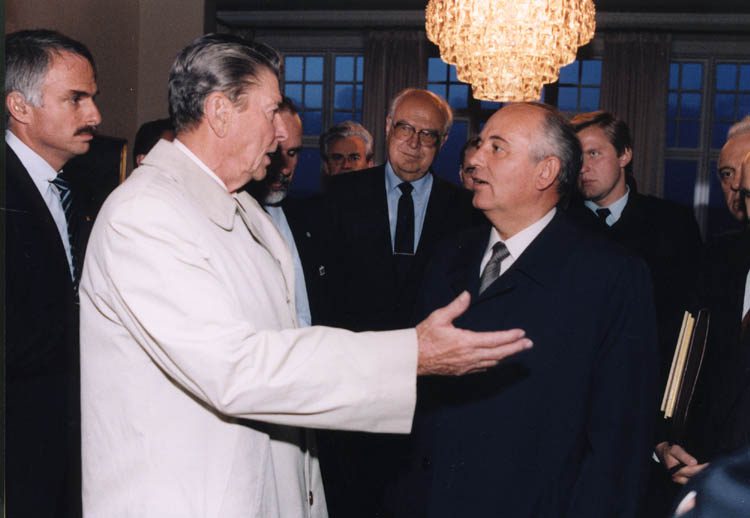
Ronald Reagan speaks to Mikhail Gorbachev
U.S. President Ronald Reagan and Soviet General Secretary Mikhail Gorbachev bid one another farewell at the close of the 1986 Reykjavik summit. (Source: Ronald Reagan Presidential Library)

Ultimately, Reagan and Gorbachev’s efforts to transcend the Cold War were overtaken by events in Eastern Europe. Hoffman presents the nuclear meltdown at Chernobyl as the turning point. After the environmental disaster, Gorbachev made glasnost, a push for government transparency, a cornerstone of his domestic agenda along with perestroika, the restructuring of the Soviet economic and political system. The states of Eastern Europe and the Soviet Union were too moribund, however, to cope with the rising expectations set off by Gorbachev’s reforms. By 1991, communist Europe had disintegrated. The U.S. had the foresight to help post-Soviet societies eliminate their nuclear inheritance. More than twenty years after the Berlin Wall’s fall, however, the foul inventions of Soviet germ warriors are still hidden and the U.S. and Russia still account for 95 percent of the world’s nuclear weapons. Without continued efforts at disarmament and disclosure, Hoffman suggests these genocidal weapons will remain the Cold War’s deadly legacy.

Further reading:

The Reykjavik File: Previously Secret Documents from U.S. and Soviet Archives on the 1986 Reagan-Gorbachev Summit (via the National Security Archive of George Washington University).

The Cold War International History Project

The Cold War Museum: 1980s

The Age of Reagan: A History, by Sean Wilentz (2008)

by Dolph Briscoe IV

Historians often define political periods in the United States according to the dominant president of the era. Arthur M. Schlesinger, Jr., most famously wrote of an Age of Jackson, and other scholars have proposed Ages of Jefferson, Lincoln, and Franklin D. Roosevelt. Sean Wilentz adds another chapter to this genre, labeling the last quarter of the twentieth century after Ronald Reagan, with his book The Age of Reagan: A History, 1974-2008. From the 1974 Watergate scandal until 2008 when Barack Obama was elected to the presidency, the U.S. witnessed the triumph of political conservatism. Ronald Reagan harnessed conservative angst to win the White House, pursued conservative polices as president both domestically and internationally, and left a legacy his conservative political successors attempted to continue, with mixed results.

41tW9b7OIMLThe Age of Reagan provides a valuable overview of recent U.S. political history. During the 1970s both major political parties experienced internal divisions. Conservative Republicans criticized Nixon, Gerald Ford, and Henry Kissinger’s pursuit of détente with the Soviet Union as dangerously weak foreign policy. Liberal Democrats railed against Jimmy Carter’s ineffective leadership in solving the nation’s economic and social problems. Americans turned away from moderates in both parties and looked to conservatism when they elected Ronald Reagan president in 1980. Reagan succeeded in entrenching conservatism within the federal government, particularly with his judicial appointees and expansion of presidential power.

Yet the author correctly debunks much of the mythology surrounding Reagan, noting that his administration often pursued pragmatic policies, unable or unwilling to roll back much of the liberal reform of past years, and also encountered many setbacks, most notably with the Iran-Contra scandal.

The Age of Reagan goes on to describe the triumphs and travails of Reagan’s presidential successors. George H. W. Bush, less conservative than his predecessor, encountered difficulties in appealing to both the moderate and right-wing factions of his party. Bill Clinton, a self-described New Democrat, governed as a centrist following Republican capture of Congress in the 1994 elections, recognizing this as a requirement in a conservative age. Wilentz concludes with a brief overview of George W. Bush’s tumultuous presidency. During these years conservatism may already have been running on borrowed time, butevents of the Bush years, such as the controversial election of 2000, the disastrous Iraq War, the miserable response to Hurricane Katrina, and the dramatic collapse of the economy ultimately sounded the death knell for the Age of Reagan, as Americans rejected conservatism in favor of Barack Obama’s call for political change. Sean Wilentz’s The Age of Reagan is a fascinating narrative of recent U.S. history, and will prove engaging reading, especially in the aftermath of the 2010 elections.

Time will tell if the Age of Reagan truly is over. The emergence of right-wing groups such as the Tea Party and the continued popularity of demagogic figures like Rush Limbaugh and Glenn Beck suggest that the conservative movement will not exit quietly into the night. The current president and his supporters would have to convince Americans of the superiority of their policies, no small task. Their success or failure will determine whether the United States has entered a new period, perhaps an Age of Obama, or returns to the Age of Reagan.

« Previous Page

Recent Posts

  • What is MACRI? Meet the Organization Showcasing Mexican American Civil Rights History in San Antonio and Beyond 
  • Primary Source: An Expressionist Art Dealer’s Legacy in Books
  • AVAnnotate:  A Research and Teaching Tool for Creating Digital Exhibits and Editions with Audiovisual Recordings
  • A Shogun’s Tale: How William Adams Became the West’s Favorite Samurai
  • Review of Puerto Rican Chicago: Schooling the City 1940-1977 (2022).
NOT EVEN PAST is produced by

The Department of History

The University of Texas at Austin

We are supported by the College of Liberal Arts
And our Readers

Donate
Contact

All content © 2010-present NOT EVEN PAST and the authors, unless otherwise noted

Sign up to receive our MONTHLY NEWSLETTER

  • Features
  • Reviews
  • Teaching
  • Watch & Listen
  • About