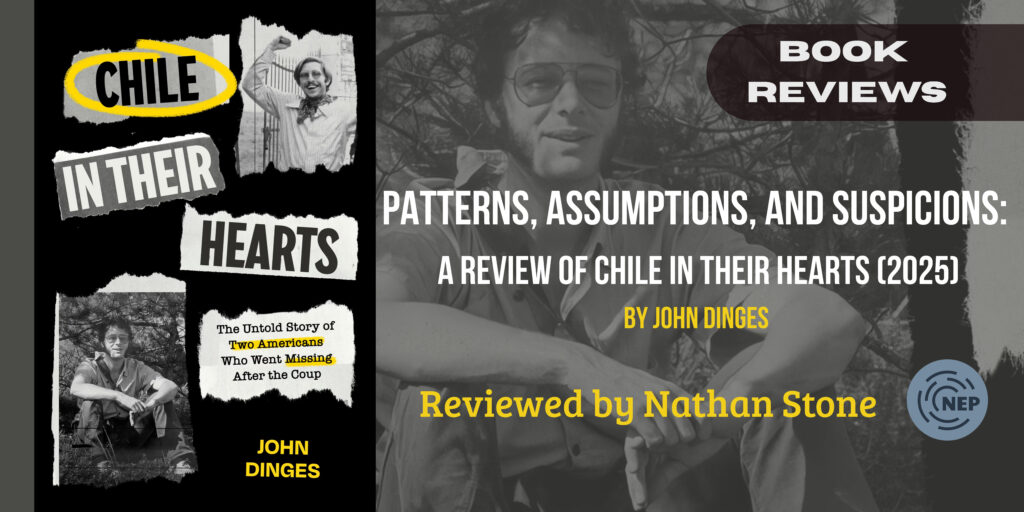
“…the Embassy investigation consisted almost exclusively of asking questions of Chilean officials. That might have been a reasonable approach in some countries, but it made little sense when the government that was being asked for help was in the midst of a campaign of mass killing and likely to be the guilty party.”[1]
After the disappearance and execution of Charles Horman and Frank Teruggi, US citizens, in the wake of Chile’s brutal coup d’etat in 1973, reasonable suspicions led journalists, activists, and family members to conclude that these two young men had been selected for detention and execution with the complicity and participation of US diplomats and CIA operatives. They were in Chile to witness the social experiment under democratically elected Socialist President Salvador Allende. One Chilean military intelligence source even offered eyewitness confirmation of that suspicion. Thomas Hauser published a plausible version of events, entitled The Execution of Charles Horman, in 1978. Human rights activists and naïve students like myself, on our way to witness the still-dangerous Chilean dictatorship under General Augusto Pinochet, devoured it with passion and growing commitment. Internationally acclaimed film director Costa-Gavras turned Hauser’s account into the suspense-filled 1982 blockbuster, Missing, starring Cissy Spacek, John Shea, and Jack Lemmon.[2] That cinematic phenomenon transformed a signature repressive strategy of the Pinochet regime—secretive extrajudicial abduction, torture, and execution—into an internationally recognizable atrocity with diplomatic repercussions.
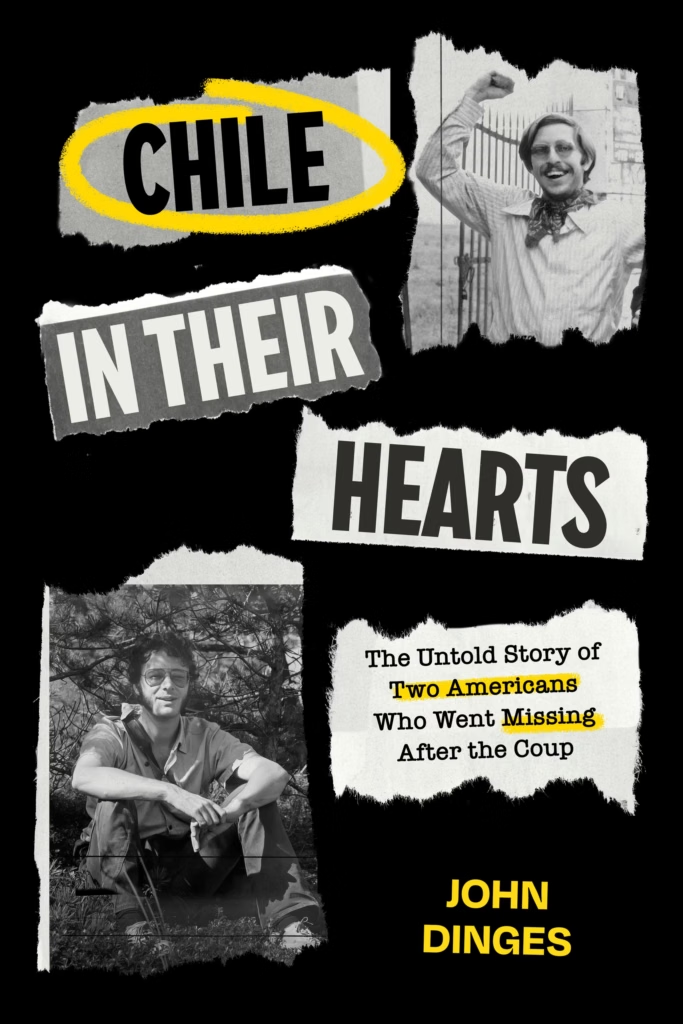
But in his new book Chile in Their Hearts: The Untold Story of Two Americans Who Went Missing After the Coup, renowned investigative journalist John Dinges, no stranger to human rights issues, has uncovered an uncomfortable glitch in the narrative. It made cinematic sense that US officials would select Horman, the man who seemed to know too much about US participation in the coup, for summary execution. But the dissenting Chilean military intelligence official, Rafael González, who claimed in 1976 to have witnessed a crucial meeting in 1973, recanted his testimony in 2001.[3] The author develops the legal complexity of the case in abundant detail. Suffice it to say that, as a dissenter seeking asylum in the Italian embassy, Colonel González needed to show clearly why he and his family could not safely remain in Chile. As Chilean courts addressed human rights abuses in 2001, that same eyewitness account of CIA presence at the meeting that determined Horman’s fate would have made González liable as an accomplice in Horman’s execution and temporary disappearance. González changed his story, and no other evidence ever surfaced to confirm the earlier version.
Oddly, as the dramatic lynchpin of Missing dissolves into a haze of pseudo-historical myth, the house of cards does not collapse. There are still reasons why the Pinochet regime killed Horman and Teruggi, and there are reasons why the US Consulate and the US Embassy in Chile failed to seriously investigate the murders. With attention to reliable documentation, Dinges makes the case that this specific failure to protect American citizens abroad, a top priority for any diplomatic team, reveals something far darker than the devious real-life spy thriller that human rights watchers have assimilated into our worldview over the last five decades. Dinges reveals the inner workings of an international system at odds with itself. As such, human rights watchers can no longer consider these executions exceptional, some devious plot for which some deviant individual should have to answer. We must understand it as the predictable outcome of a deeply rooted pattern of conflicting objectives and contradictory orders.
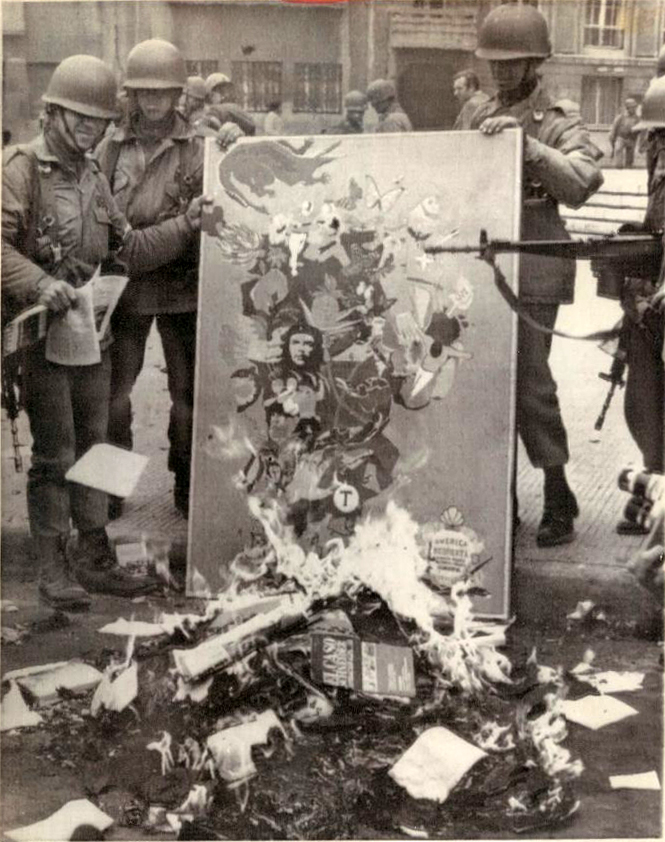
Chilean soldiers burn Marxist literature following the 1973 coup. CIA Freedom of Information Act release. Source: Wikimedia Commons
In the oppositional tradition of Neil Sheehan’s Bright Shining Lie (1988), about the Vietnam War, Dinges shows how the US diplomatic team in Chile found itself forced into a series of impossible choices that tended to maximize injustice and collateral damage. Sheehan relates the experience of John Paul Vann, a patriotic service member turned civilian contractor, who came to understand why the Pentagon refused to accept honest reports of how American military strategy on the ground in Vietnam only served to strengthen the cause of the Viet Cong. Military intelligence officers obeyed orders by changing reports, by confirming that the US was in fact winning a war of attrition, thus promoting massacres of innocent civilians that would amplify the body count, which had become the official scoreboard, stateside.[4]
The Chilean coup occurred in the same Cold War context, when many assumed that marching into hell for heavenly causes was not a fool’s errand, but a moral obligation. To stop the global enemy of truth and the American way, the cost would include extrajudicial murders and hurtful lies. The Embassy and the Consulate in Chile had orders from Kissinger’s State Department to support the military regime. Therefore, when General Pinochet’s Ministry of Foreign Relations reported first that Chilean officials knew nothing about the missing Americans, and then that they had most likely become the victims of leftists posing as Chilean military to discredit the regime, the US diplomats accepted that as the official version without rebuttal.[5] Absurd as it seemed, they reported that story back to the State Department and to the Horman and Teruggi families.
“The Embassy posture during the Nixon and Ford administrations, sympathetic to the junta, was that it could not be known who killed Horman and Teruggi because the junta, the most obvious suspect, said their people did not do it.”[6]
No hard evidence links any rogue CIA agents to the selection of Horman and Teruggi for execution. But in the context of military rule, their murders obeyed a standard pattern. Soldiers encouraged patriotic Chileans to denounce their neighbors and acquaintances for having the wrong friends, for singing the wrong songs, or for wearing their hair in the wrong way.[7] It happened to thousands of Chileans, too. As late as 1980, the Ministry of the Interior revoked my residence because they had “received reports” that I “had the wrong friends.”
Dictatorships make no distinction between dissent and outright terrorism. Secret police agents opened all of my mail and stole the address book off my desk. I suspect that they did not murder me because the Horman-Teruggi case had already caused a stir. But Dinges’ research shows that the Horman-Teruggi case fits a recognizable pattern. The pattern itself led to countless cases of torture and disappearance in Chile, Argentina, Brazil, and Uruguay over the next decade. Two deaths are a tragedy, but ten thousand deaths are just a statistic. We can count that as one more bright shining lie. Moreover, the number of disappearances in South America is far more than ten thousand.
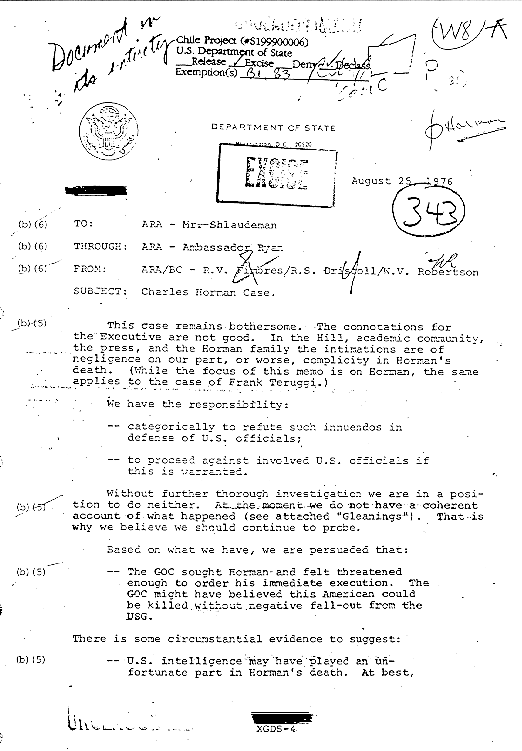
CIA declassified documents about Charles Horman “Missing” Case, Santiago, Chile, 1976. Source: Wikimedia Commons
The top secret CIA report, “Restless Youth,” that Director Richard Helms presented to President Johnson in 1968, did show a deep concern for the elusive connections between rebellious university students and young intellectuals worldwide. Helms even encouraged surveillance of Americans with suspicious connections.[8] Dinges makes no mention of that report, but he does point out that, even if the FBI or the CIA kept files on people like Horman and Teruggi—they obviously qualified as what the Agency would have called “fellow travelers”—no evidence exists for any shared information on Horman or Teruggi. And yet, the assumptions behind “Restless Youth” might account, at least in part, for a diplomatic culture that allowed officials to conclude that most dead activists had it coming, that there was no need to sully relations with the military regime by insisting on accountability for wrongful death. In Dinges’ account, the cover-up is the story, and it is bad enough.[9] And he does point out that diplomatic impunity for the Chilean dictatorship in those early days might have contributed to the dictator’s order to murder Orlando Letelier with a car bomb on a Washington street in 1976, a case that he has reported extensively in his previous work, The Condor Years (2004).[10]
The wave of extrajudicial abduction, torture, and disappearance that started in Chile would engulf the Southern Cone over the next fifteen years. In his previous work, Dinges points out that Chilean officials did, in fact, receive training in the strategies of “counterinsurgency” from US military intelligence operatives.[11] Moreover, even if no hands-on contact between CIA operatives and the Horman-Teruggi executions ever occurred, historian Greg Grandin has documented the formulation and implementation of disappearance as a repressive strategy in Guatemala, under the guidance of CIA operative John Longan, in 1966.[12] The whole point of a proxy war was to get others to do the dirty work in secret, so that leaders could proudly wave the flag and get reelected. Might we safely assume that disappearance as a repressive strategy did not spontaneously generate itself at the Chilean military academy in Santiago, independent of Washington’s Cold Warriors? Probably so, but the central issue of this book is that assumptions, even if probable, weaken the arguments of dissenters. And Dinges has uncovered here an ample trove of dissenters, within the Chilean military and the US diplomatic corps, who refused to go along with the lies, often at great risk to themselves and their families.[13]
Two inaccuracies stood out to me. Horman and especially Teruggi had connections with members of MIR, Chile’s only movement of any size that openly supported armed revolution during the Allende years. One Mirista who lived in Teruggi’s house in Ñuñoa was Fernando Alarcón. Dinges calls him a self-styled “professional revolutionary.”[14] Actually, MIR had an official rank of “professionalized” revolutionaries, chosen to give up their jobs and families and stay available to follow orders. MIR even robbed banks to support them. The other issue is that Dinges calls MIR’s bank robberies violent, but MIR survivor Andrés Pascal remembers how the Secretary General, Miguel Enríquez, prepared the bank robbers for their performances, saying that no one should actually get hurt and nothing should get broken. “We are not terrorists,” he would say, “we are revolutionaries.”[15] CIA reports attribute random acts of violence to MIR in declassified documents, but a fringe group of crazies called VOP actually committed those, and MIR denounced them for it.[16]
The other inaccuracies involve the Catholic Church. Dinges reports that liberation theology and “the preferential option for the poor” came out of the Second Vatican Council in 1965.[17] In fact, one of the documents of the Council, Gaudium et spes, validated the Church’s interest and participation in the material well-being of humanity at large. It was the Latin American Bishops’ Council that formulated the preferential option for the poor. That happened in two meetings, the first in Medellín (1968), and the second in Puebla de los Ángeles (1979). At those regional councils, local bishops validated the grassroots methods of liberation theology and embraced the continent’s poor as their own.
Neither of these inaccuracies has any bearing on the validity and importance of this book, however. This is no time to give in to public secrets, legal fictions, and official stories that ignore obvious facts. In the current climate, when internet memes and conspiracy theories can win elections and start wars, the call for evidence-based truth rings out as urgent and necessary.
Dinges’s most enlightening proposals come in the epilogue, where he lists the unexplored leads that could reveal not only a more detailed account of what really happened, but also how and why. The first of these would be an interview with Michael Townley, a young American who was also an operative for Chile’s secret police, the DINA. Convicted for the assassination of Orlando Letelier in Washington, and currently living under a secret identity in the witness protection program, Townley offered diplomatic officials a tip on the Teruggi murder as early as October of 1973. He might know details that have not become part of the public record. Other unexplored leads include Chilean military sources and dissenters who helped recover the bodies in 1973. Several of these went into exile and survived. There were also agents from an FBI field office in Buenos Aires who knew something about the case. Finally, Dinges proposes the formulation of a Truth Commission with subpoena power, modeled on Latin American examples. “Only such an authoritative commission can overcome the persistent lack of credibility U.S. agencies have earned by their past obfuscations.”[18]
Driven by passion and meticulous attention to depth and detail, this book stands out as one of the best on my shelf. I highly recommend Chile in Their Hearts for scholars of Chile, diplomats, and international lawyers. Most of all, it is a must-read for those who hold a passionate commitment to the truth. I personally share Dinges’ closing sentiment: “…Chile was a great love, and what happened there was a great wound in our hearts.”[19]
[1] John Dinges, Chile in their Hearts: The Untold Story of two Americans who went Missing after the Coup. (Oakland, University of California Press, 2025), 208.
[2] Thomas Hauser, The Execution of Charles Horman. (NY, Harcourt, 1978); Costa-Gavras, Missing, (Polygram, Universal, 1982).
[3] Dinges, Chile in their Hearts, 143-154.
[4] Niel Sheehan, A Bright Shining Lie, John Paul Vann and America in Vietnam. (NY, Random House, 1988).
[5] See Dinges, Chile in their Hearts, 200, 203. The circular shootout among leftists would become its own recurring pattern for the military regime, most notable in the case remembered as Los 119, or Operación Colombo. That story is as patently absurd as the one about terrorists who have an uncanny habit of dropping their passports and ID cards as they commit their crimes.
[6] Dinges, Chile in their Hearts, 206.
[7] Dinges, Chile in their Hearts, 155-166.
[8] CIA Report, “Restless Youth,” September 1968, declassified June 15, 2018. LBJ Library, NSF, Intelligence File, Box 3, Folder 16, document 4c; and Memorandum, CIA Director Helms to the President, September 4, 1968; declassified October 10, 1979. In Lyndon Baines Johnson Presidential Library, National Security File, Intelligence File, Box 3, Folder 16, doc 4b.
[9] All of the Horman family’s documentation of their ordeal sits in a long row of boxes at the Benson library.
[10] Dinges, Chile in their Hearts, 183, 204. See also, John Dinges, The Condor Years: How Pinochet and his Allies brought Terrorism to Three Continents. (NY, The New Press, 2004).
[11] Dinges, The Condor Years. (2004), 68-71.
[12] Greg Grandin,The last Colonial Massacre: Latin America in the Cold War (Chicago: University of Chicago Press, 2004), 17.
[13] Dinges, Chile in their Hearts, 167-178.
[14] Dinges, Chile in their Hearts, 42.
[15] Andrés Pascal Allende, El MIR Chileno: Una experiencia revolucionaria (Argentina, Editorial Cucaña, 2003), 39.
[16] See Report, “The Leftist Revolutionary Movement,” U.S. State Department, Bureau of Intelligence and Research (INR), Chile Project, #S199900030, December 7, 1970, 2.
[17] Dinges, Chile in their Hearts, 25.
[18] Dinges, Chile in their Hearts, 208-215, 217.
[19] Dinges, Chile in their Hearts, 218.
Nathan Stone is a historian of Latin America and a regular contributor to Not Even Past. He lived and worked in Chile, Uruguay, and Brazil for more than thirty years, and his writing focuses on Chile, dictatorship, revolution, memory, and the Cold War.
The views and opinions expressed in this article or video are those of the individual author(s) or presenter(s) and do not necessarily reflect the policy or views of the editors at Not Even Past, the UT Department of History, the University of Texas at Austin, or the UT System Board of Regents. Not Even Past is an online public history magazine rather than a peer-reviewed academic journal. While we make efforts to ensure that factual information in articles was obtained from reliable sources, Not Even Past is not responsible for any errors or omissions.