This article is part of the series: History beyond Academia
Ostrich egg models, Dr Pepper bottles, and toothbrushes preserved in soda. What do these artifacts have in common? At the Dr Pepper Museum, these objects collectively tell a story about the past that otherwise might go unnoticed. Located in the historic downtown of Waco, Texas, in the 1906 Artesian Manufacturing and Bottling Company building, known as the “Home of Dr Pepper,” the museum has welcomed over 3 million visitors since opening in 1991. Much more than a repository for soda memorabilia, it is an active site of historical practice, demonstrating that museums are not peripheral to the discipline of history, but spaces where historians produce knowledge through preservation, ethical decision-making, and public engagement.
Graduate training in history often centers on life inside the halls of academia—publishing, teaching, and archival research—but this can obscure other sites where history is actively produced and imparted to the public. At the Dr Pepper Museum, history is not only written but stewarded. Senior Collections Manager Rachael Nadeau Johnson reflects, “We are but a speed bump in the life of these artifacts,” underscoring a central principle of museum work: historians are temporary caretakers of objects that will outlast them. Museums remain among the most trusted public sources of information, placing a significant responsibility on curators and collections staff to ensure that what they present and display is accurate, well-sourced, and meaningful.
This responsibility is especially pressing in a moment shaped by digital misinformation. Nadeau Johnson highlights the challenges posed by AI-generated inaccuracies as well as enthusiast and collector communities that can circulate well-meaning but false information. Thus, today’s museum professionals increasingly act as teachers and correctives. They spend their time verifying claims, tracing sources, and presenting evidence-based narratives. The work of preservation is not only about maintaining objects but also safeguarding historical knowledge itself.
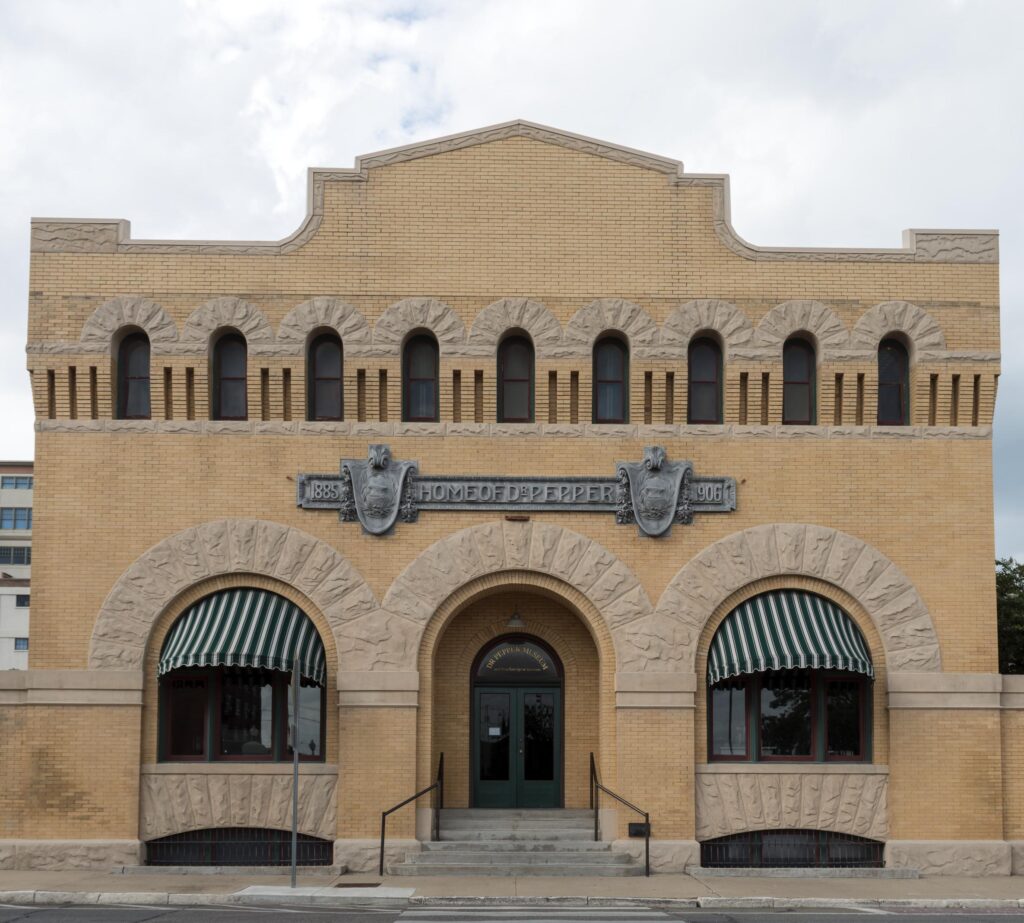
The Dr Pepper Museum in Waco, Texas, housed in the 1906 Artesian Manufacturing and Bottling Company building. Photograph by Carol M. Highsmith. Source: Library of Congress, Prints and Photographs Division, Carol M. Highsmith Archive.
Much of this work begins behind the scenes, before the museum opens each day. The curatorial staff catalog and track new donations, maintain exhibits, and correspond with donors and executives to ensure the displays reflect the history of Dr Pepper in an engaging and accurate manner. Contrary to popular assumption, only a small fraction, between 5 and 10 percent, of a museum’s collection is on display at any given time. The rest of the objects require ongoing care: cataloging, condition tracking, and research. Central to this process is provenance, the documented history of an object from its creation or rediscovery to the present. Maintaining these provenances is both essential and resource-intensive, requiring time, funding, staffing, and institutional support that are often in short supply. Yet, the work of nonprofit staff like Nadeau Johnson and Assistant Registrar Zach Loflin transforms a curious artifact into a piece of historical evidence.
Selection for exhibition involves many layers of decision-making. Objects are not chosen simply because they are rare or visually striking, but because they can support meaningful interpretation. Provenance informs which stories can be told, while physical condition determines whether an item can be safely displayed. Light exposure, the artifact’s quality, and material fragility all shape curatorial choices, as does Dr Pepper’s broader commitment to “people-first” narratives that connect objects to visitors’ lived experiences. Loflin explains, “There are a lot of ethical considerations in museum work, from how we engage with the public, to how we preserve our artifacts, and how we tell these stories.” These decisions are guided by professional judgment and rigorous training, and also by institutional codes of ethics that inform how museums acquire, interpret, and present collections for public consumption.
If preservation and selection form the foundation of museum work, interpretation brings it into the public arena. One of the primary challenges of public history is translating information into formats that are both accessible and engaging. Exhibit text is written at a sixth grade reading level and must communicate meaning within a few seconds. Developing text that is approachable for a variety of visitors requires delicate layering and balance. At Dr Pepper, staff deal with the fact that language itself constrains ongoing efforts to include multiple language translations for exhibits. Idioms, humor, and wordplay that work well in a specific context do not always translate, and curators must balance clarity with nuance in every aspect of their work.
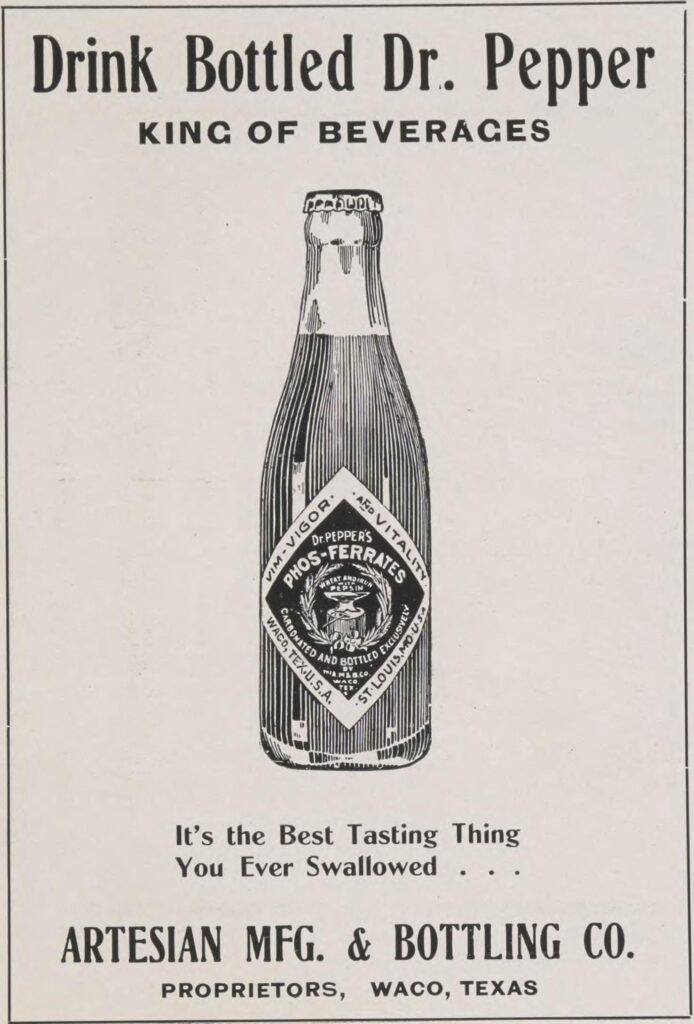
Ad in The Horned Frog (1906), Waco, TX, Public domain, via Wikimedia Commons
Despite these constraints, the impact of public history is immediate and visible. Both Nadeau Johnson and Loflin describe the rewards of interacting with the public daily and seeing visitors engage with exhibits they created. Loflin notes, pointing to the sheer volume of visitors, “We get a very diverse spread of people coming to the museum, all ages, backgrounds, international visitors—seeing the sheer amount of interest in the history is rewarding in itself.” For Nadeau Johnson, some of the most meaningful moments come from walking through the galleries and speaking to visitors about the history she helped shape. Hearing someone have an “Aha!” moment when viewing an exhibit, “It does not get old. Being able to create those teachable moments and watching people learning in real time,” is at the core of the curatorial staff’s mission. These interactions underscore the unique and valuable position museums occupy, operating at a scale that academic work often struggles to reach: brief but meaningful moments of individual connection.
This scale also introduces challenges. Visitors often misunderstand how collections function or how donated and acquired materials are incorporated. In reality, acquisitions involve careful evaluation, and not all items can—or should—be accepted. At the same time, museums face persistent structural constraints. Funding—“everyone’s favorite F-word,” Loflin jokes—shapes how institutions can preserve, research, and display materials. Limited staffing and resources further complicate the work, particularly as collections and visits continue to grow.
While the work is complicated, challenging, and often behind the scenes, the practice of curation is both an art and a source of joy to those who undertake it. By selecting objects for display, Loflin and Nadeau Johnson shape the stories that are told and curate unique and exciting exhibits. One of the most interesting artifacts at the museum is an ostrich egg model of the Old Corner Drugstore where Dr Pepper was created in 1885 by pharmacist Charles Alderton. The egg sits on a brass pedestal and is textured and painted to look like a red brick wall. The top half has been cut and shingled to look like a roof, and the interior opens through double doors and windows to reveal a miniature drugstore fountain with a cash register, seating, and a drink dispenser made from a small bird egg. Decorated with the slogan “Drink DP the year round” and gold ric-rac trim, this artifact displays the love and care that Texans and Dr Pepper drinkers worldwide hold for this classic beverage.
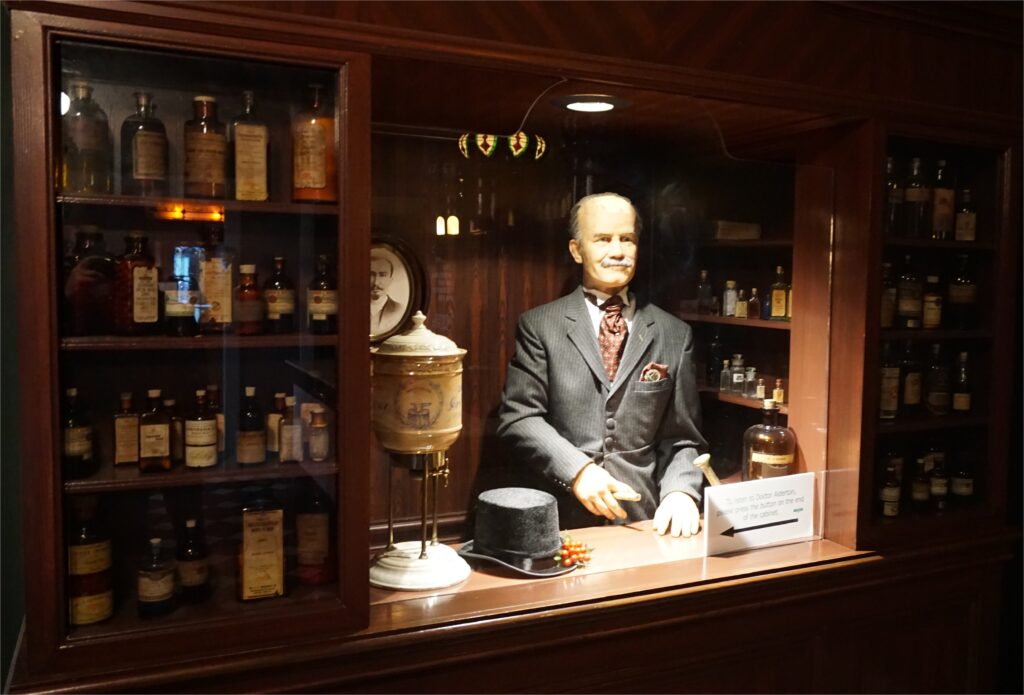
Replica of Morrison’s Old Corner Drug Store at the Dr Pepper Museum in Waco, where Charles Alderton first created Dr Pepper in 1885. Photograph by Michael Barera. Source: Wikimedia Commons
Despite the challenges of curation, museums remain an essential site of historical practice, where history is tangible, ethical, and intellectually demanding. As both Nadeau Johnson and Loflin note, public historians are the temporary caretakers of the past. The artifacts they steward will endure beyond any single career, but their decisions regarding what to preserve, how to interpret, and what to share shape how that past is understood. Museums, in this sense, are not places where history is simply displayed, but continually made, maintained, and entrusted to the public.
Further viewing: Rachael Nadeau Johnson appears in two episodes of the History Channel’s The Food That Built America: “Soda Rising: The Birth of Pop” and “Citrus Soda Stars.”
Danielle Sanchez is a doctoral student in the Department of History at the University of Texas at Austin. She earned her B.A. in History with a minor in Religion from Baylor University in the spring of 2021, and started in the Ph.D. program at UT Austin in the fall of 2021. She earned her M.A. in History in December of 2023, and is currently writing her dissertation research on the Texas Rangers in the early 1900s. Her research interests include race and American politics, religious-based oppression and violence, Texas and Southern history, the Texas Rangers, and anti-Mexican and anti-Black violence.
Author of banner picture: Larry D. Moore Wikimedia Commons
The views and opinions expressed in this article or video are those of the individual author(s) or presenter(s) and do not necessarily reflect the policy or views of the editors at Not Even Past, the UT Department of History, the University of Texas at Austin, or the UT System Board of Regents. Not Even Past is an online public history magazine rather than a peer-reviewed academic journal. While we make efforts to ensure that factual information in articles was obtained from reliable sources, Not Even Past is not responsible for any errors or omissions.