This and other articles in Primary Source: History from the Ransom Center Stacks represent an ongoing partnership between Not Even Past and the Harry Ransom Center, a world-renowned humanities research library and museum at The University of Texas at Austin. Visit the Center’s website to learn more about its collections and get involved.
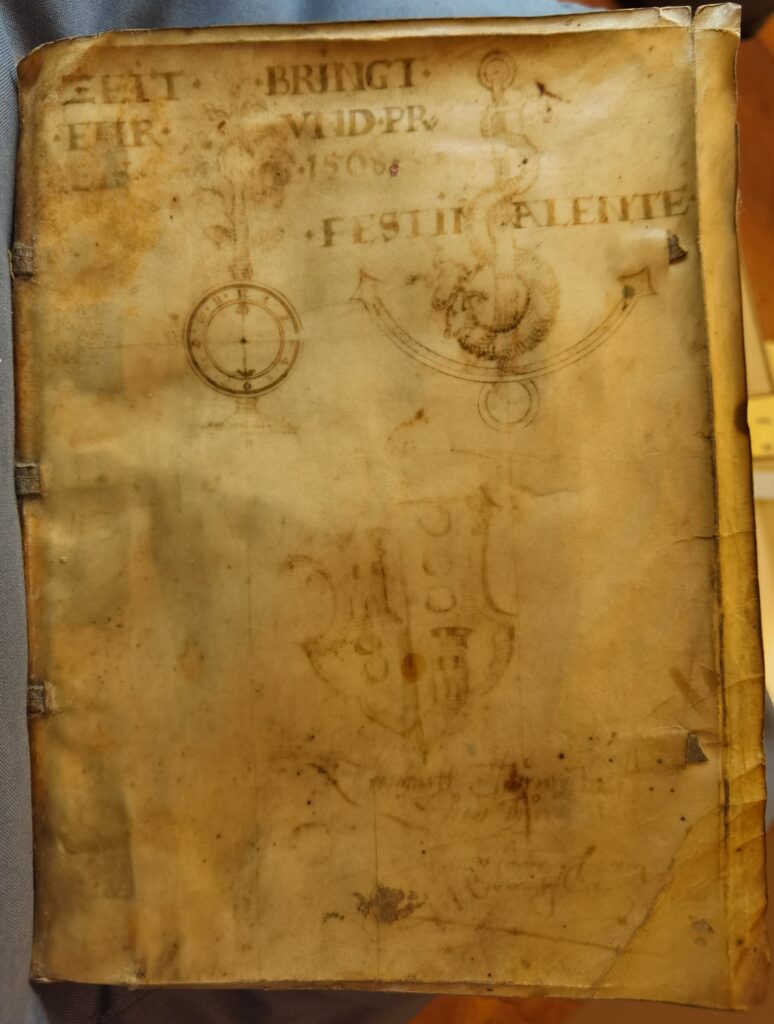
The Harry Ransom Center holds a sammelband of three works of Paracelsus that include (1) Von der Bergsucht oder Bergkranckheiten drey Bücher, or Three Books on Mountain Sickness or Mountain Diseases, (2) Modus Pharmacandi, or Methods of Administering Medicine, and (3) Von den Kranckheyten so die vernunfft berauben, or On the Diseases that Rob One of Reason. The first and third editions were published in 1567, with the first being published in Dillingen, Germany, by Sebald Mayer and the latter published in Basel by Adam von Bodenstein; the second was published in 1562 in Cologne by Jaspar Gennep. The editions were likely bound together very soon after the 1567 publications, as evidenced by the writing on the binding that records the date 1568. The front cover contains a signature and drawings by Leonhard Thurneysser (also spelled Leonhart Thurneisser) in ink, indicating that he was likely the first—or one of the first—owners of this volume, as well as annotations written by Thurneysser and one other unknown individual. The book presents fascinating entry points into the biography of Leonhard Thurneysser and the late-sixteenth century reception of Paracelsus.
The alchemist, physician, and early proponent of Paracelsian teachings was born in Basel in 1531, and as a youth apprenticed with Dr. Johann Huber in Basel, a metallurgist as well as physician and alchemist who purportedly owned books that provided Thurneysser’s early exposure and access to the ideas of Paracelsus. By 1548, Thurneysser began extensive travels that continued throughout the next decade, at times working as a goldsmith, soldier, and engraver. In 1558, in Constance (Konstanz), Germany, he married his second wife and then moved to Tarenz, Austria, and established a mine. This mine became successful enough to attract the attention of the Archduke Ferdinand I of Austria, who sent Thurneysser out on travels through Europe and Asia for further study and training in metallurgy. Thurneysser began to write and publish his own works with his Archidoxa in 1569, an astrological work written in verse, which he published with the services of printer Johan Ossenbruge in Muenster. His book Pison (1572), which discussed the minerals of the Spree River, attracted the attention of the Elector of Brandenburg, Johann Georg. After prescriptions from Thurneysser healed the Electress Sabina’s ailments, Thurneysser was appointed the couple’s personal physician and given the Grey Monastery in Berlin as a residence. In the Grey Monastery, Thurneysser founded his own printing press to publish and disseminate his own writings, which often incorporated many different languages and scripts.1 Following his appointment as personal physician to the Elector, Thurneysser’s published works all pointedly identify himself as, “Leonhart Thurneisser zum Thurn Churfürstlichen Brandenburgischen bestalten leibs Medicum,” stating that he was, “appointed personal physician to the Elector of Brandenburg.” Of the Harry Ransom Center’s (HRC) Thurneysser books, only the 1572 Pison lacks this statement as it was published before he entered the employ of the Elector.
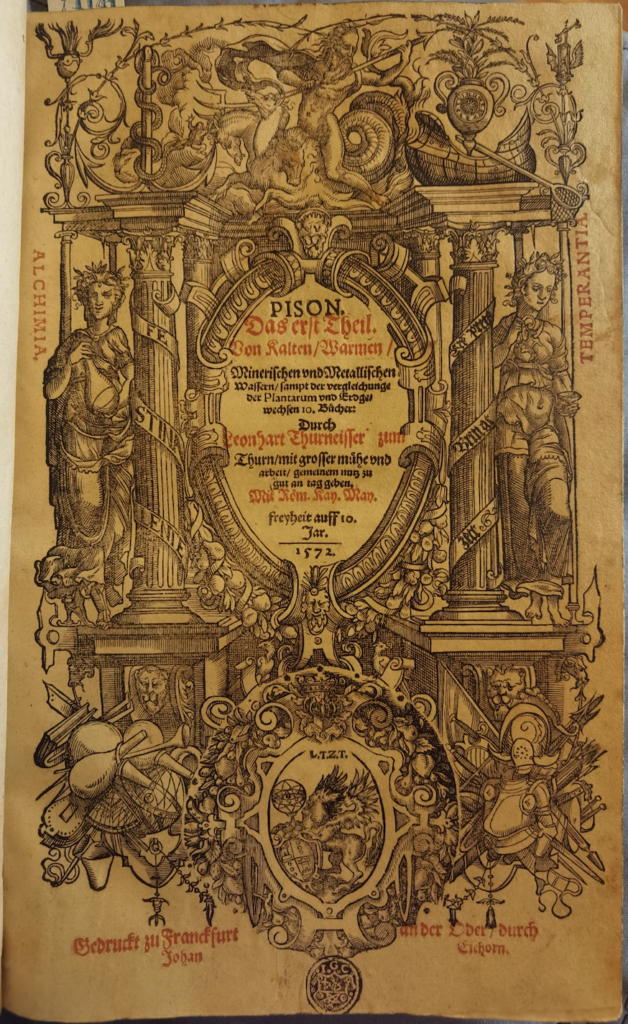
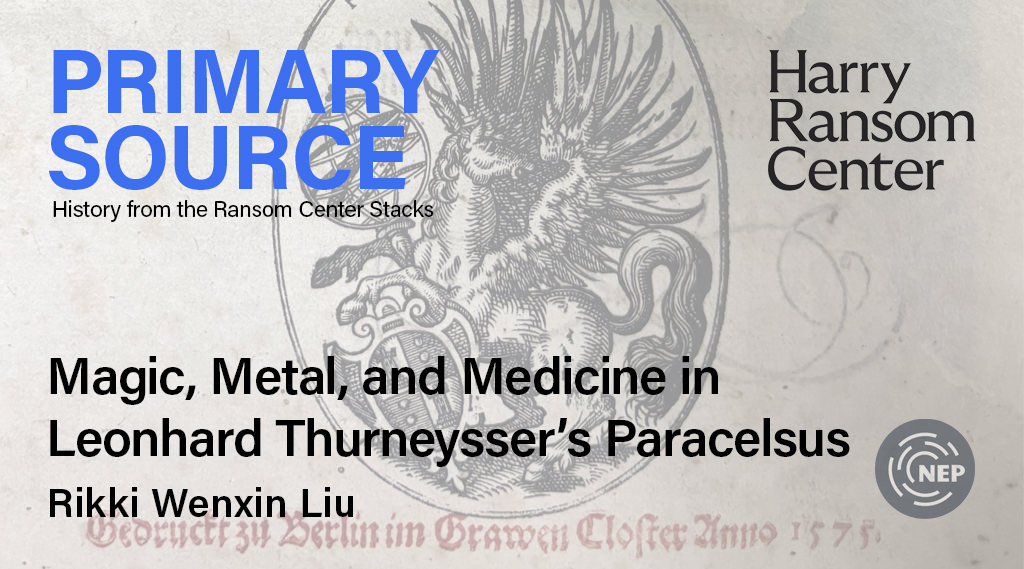
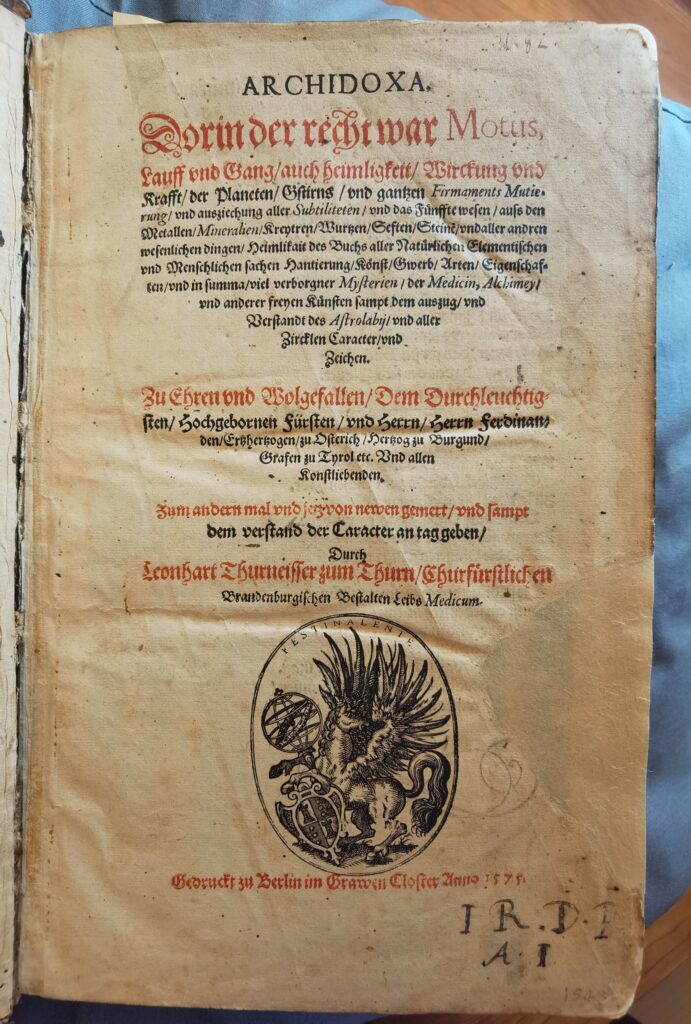
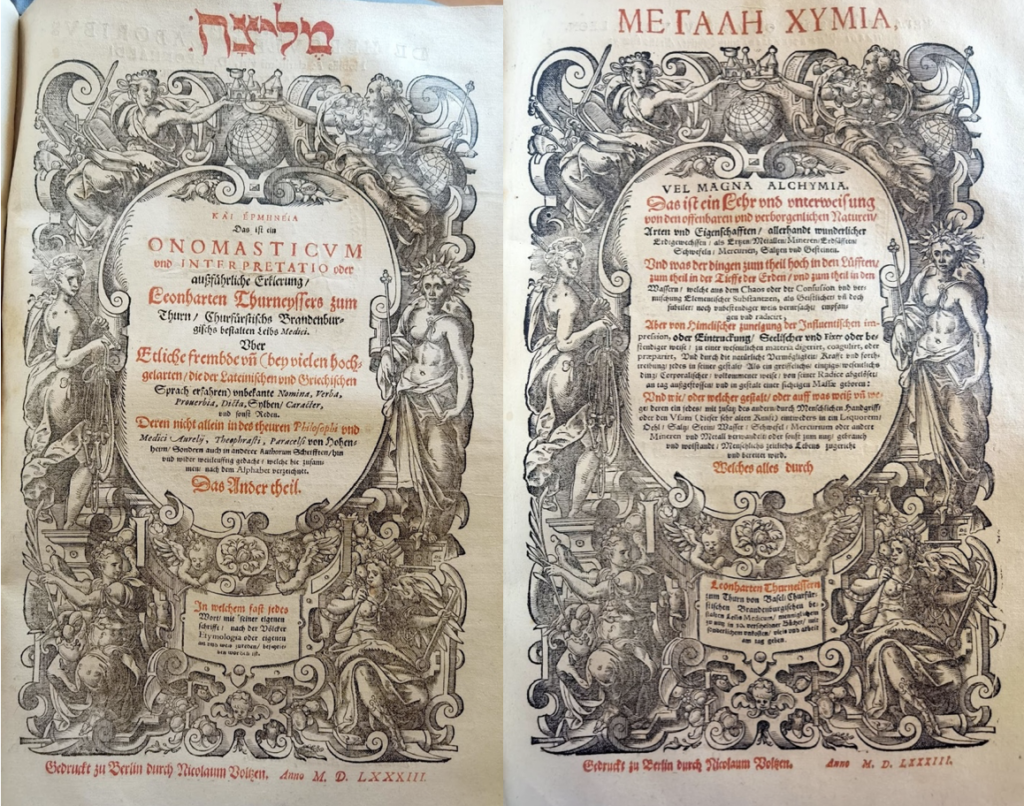
Other scholars began to speak and write against Thurneysser’s medical work and denounce him as a charlatan through the 1570s as he continued to seek the favor of gentry and royalty with his work. In 1579, Thurneysser left Berlin and moved back to Basel and purchased a property there, for which he commissioned stained glass windows depicting aggrandized scenes from his own life.2 According to some biographies, it is after this purchase that he begins to style himself with “zum Thurn,” which seems to play on the word Thurm, meaning “Tower,” and its similarity with his name while also referencing the property in Basel. However, his first published book, Archidoxa, already recorded his name as Leonhard Thurneysser zum Thurn in 1569. The HRC’s copy of the second edition of this work, published in 1575 at Thurneysser’s Grey Monastery, records his name on the title page as “Leonhart Thurneisser zum Thurn” and includes a device that contains a winged horse with an astrolabe and Thurneysser’s coat of arms, which depict a tower. The same device is also depicted on the title page of the HRC’s copy of Thurneysser’s Pison, published in 1572, but is missing from the title pages of the books published in 1583. The HRC owns two of these 1583 editions, Megale Chymia and Onomasticon, in a sammelband with the 1578 Historia und Beschreibung.
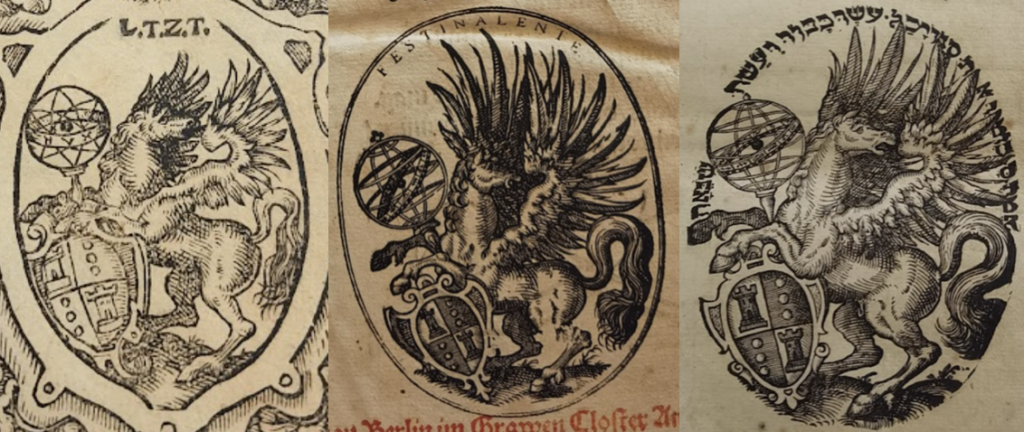
After marrying his third wife, Marina Herbrodt, in Basel in 1580, Thurneysser soon sought to divorce her, and in 1582, much of his wealth and property was awarded to her by the courts of Basel in these divorce proceedings. In 1584, Thurneysser published “Ein durch Noth gedrungenes Außschreiben mein” (A Statement of Mine Compelled by Necessity), in which he railed against the city of Basel and its courts, against his brother Alexander, upon whom he blamed much of his misfortune, and against Marina Hebrodt, named in the text as the “Herbrodt incestress.” One might wonder whether there is correlation between the fact that Thurneysser lost almost everything in 1582, and felt bitter towards his hometown of Basel, and that Thurneysser’s later publications (1583 and after) cease including devices with the tower coat of arms, and cease including the mottos “FESTINA LENTE” (“hasten slowly”) and “ZEIT BRINGT EHREN PREIS” (“Time brings honor and reward”).
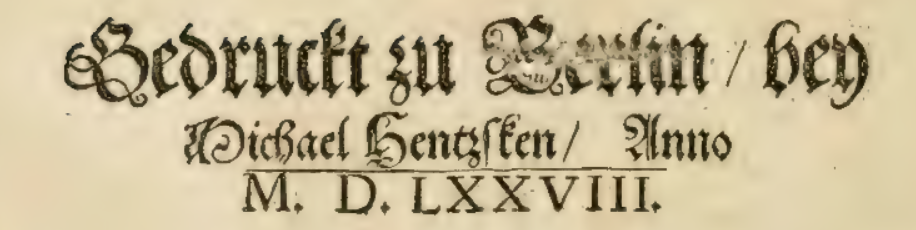
However, it seems more directly attested in the evidence that the changes in Thurneysser’s self-presentation as an author and publisher reflect the fact that he sold his Berlin printing press in 1577, after he had suffered a stroke. Thurneysser sold the press to his typesetter, Michael Hentzke, who is recorded as the publisher of his 1578, Historia und Beschreibung. Hentzke died in 1580, after which the press was left to his widow, who then remarried Nicolaus Voltz, who took over the press and is recorded as the publisher of Thurneysser’s 1583 books.3 We see nearly all Thurneysser’s writings after 1574 being published by the same press that he founded in the Grey Monastery in Berlin, but which underwent several changes in ownership. In the 1583 books printed by Voltz, we see the same engraved illustrated frame in the title pages that lack the mottos and symbols found on Thurneysser’s other works.


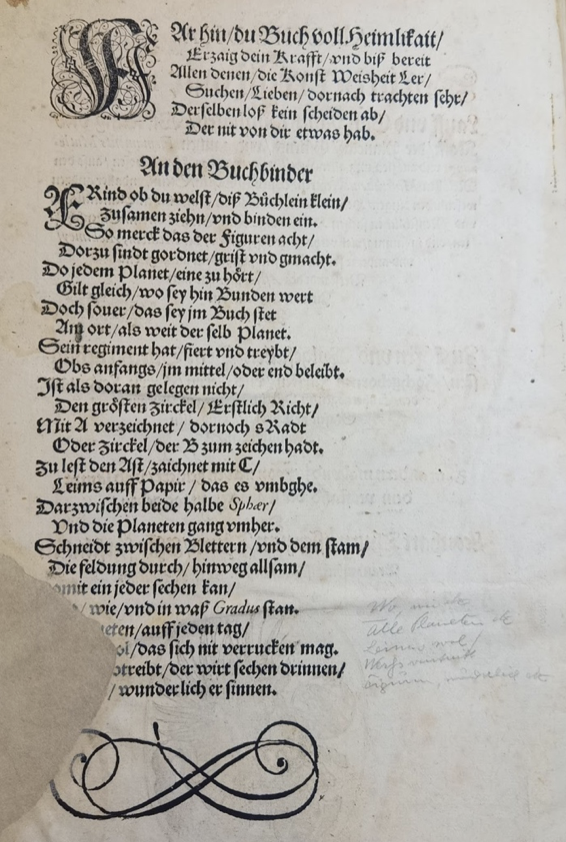
It is evident in Thurneysser’s earlier books that he was extremely invested in his self-presentation, with his works often including leaves of elaborate portraits of himself and several symbols with which he identified, especially an anchor around which is wrapped a serpent with a frog in its mouth, a clock on a boat with a tree growing out the top, and the same coat of arms with towers mentioned above. These three symbols are also all drawn by hand, presumably by Thurneysser, on the cover of his Paracelsus sammelband, along with his mottos and signature. In his 1575 Archidoxa, Thurneysser includes opening notes, written in verse, addressed to the book itself and then to whoever might bind the book. The note to the bookbinder gives clear instructions for the binding and exhorts the binder that it is of the utmost importance that the book be correctly bound, with each illustration in its correct position to correspond with the planets’ positions as described in the book.
The 1583 books printed by Voltz perhaps attest to a period when Thurneysser exerted less control over the specifics of how he was presented as author and publisher of his works, correlating with a time after Thurneysser had lost almost all his wealth in divorcing his third wife. The Megale Chymia still includes a leaf with a portrait of Thurneysser and biblical quotations in many different languages and scripts, but the quotation surrounding Thurneysser’s portrait is no longer the same mottos seen in other books, but is instead a combination of quotations from Cicero and Ovid, reading “VERUM DECUS IN VIRTUTE POSITEM EST, QUAE MAXIME ILLUSTRATUR MAGIS IN REM PUBLICAM MERITIS” and “INVIA VIRTUTI NULLA EST VIA.” It proves an interesting but difficult question to ascertain the exact nature of Thurneysser’s relationship with the printing press he founded through the latter part of his life and through his drastic changes in fortunes, and whether there is correlation with the changes in his self-presentation in his publications.
The latter part of his life after 1583 is more difficult to trace, but Thurneysser was known to have gone to Rome and converted to Catholicism, and served Cardinal Max Sittich von Hohenems and Ferdinando I de’Medici at certain points in these latter years (Gantenbein). Thurneysser eventually died in poverty in Cologne in 1596, with conflicting accounts reporting that he died at a monastery or in the home of a goldsmith. Thurneysser continued to write and publish, especially calendars and almanacs, through the 1580s, but the HRC does not own any of his later publications, and they prove much more elusive than his earlier works. The fact that he converted and was buried as Catholic, and the span of Thurneysser’s life from 1531-1596, speaks to his context with the historical shifts of the Reformation and Counter-Reformation. In 1529, just before Thurneysser’s birth, an iconoclastic riot broke out in his hometown of Basel as a climax to mounting tensions between Protestants and Catholics in the city. It resulted in the expulsion of the city’s senators who were opposed to Protestant Reform and the establishment of the city’s official reformed church, into which Thurneysser was baptized. The Grey Monastery in Berlin given to Thurneysser around 1572 had been home to a Franciscan order that was dissolved in 1539, with the Reformation taking effect in Berlin.4 The Franciscans were still permitted to live in the monastery until the last remaining monk died in 1571, just before Thurneysser moved into the buildings and established his printing press and laboratory.
The Paracelsus editions owned by Thurneysser reflect at least part of what appears to be his ambivalent attitude towards the Reformation even earlier in his life in 1568, when he likely first came into ownership of this book; this was decades before he converted to Catholicism. The first two editions in the sammelband were published by prominent Counter-Reformation Catholic printers, Sebald Mayer and Jaspar Gennep, while the third was printed by Adam von Bodenstein, son of prominent early Protestant theologian Andreas Rudolph Bodenstein von Karlstadt. The widespread sixteenth-century printing of the works of Paracelsus, who had throughout his life been critical of both Catholics and Protestants but was buried as a Catholic, speaks to the broad reception of Paracelsian alchemy and thought.
In February 1954, the Paracelsus sammelband was offered for sale by Lathrop C. Harper Inc., alongside a copy of Thurneysser’s 1569 first edition of Archidoxa and a short tract of 8-leaves on guaiac wood brought from the Americas by Amerigo Vespucci as a remedy for syphilis, also attributed to Paracelsus. Descriptions of these books from their sale are kept together with the Paracelsus sammelband in the HRC and indicate that this book was listed for $750, the Archidoxa for $275, and the tract on guaiac wood for $600. The handwritten notes suggest that whoever purchased the book used their remaining $750 from their rare book acquisition and research funds to purchase the Paracelsus sammelband, but did not purchase the other two items, and it is unknown where they are now held. Lathrop C. Harper (1867-1950) was a prominent bookseller who published extensive series of catalogues, sold books now in the collections of many universities and the Pierpoint Morgan Library, and was heavily involved in the Grolier Club and Bibliographical Society of America.5 After his death in 1950, Lathrop C. Harper Inc. was continued under the ownership of Bernardo Mendel and direction of Otto H. Ranschburg and Douglas G. Parsonage, who would have been in charge in 1954 when the Paracelsus sammelband was sold.6 As exciting as it would be for the HRC to also hold the 1569 Archidoxa and the guaiac wood tract, the Paracelsus sammelband that belonged to Thurneysser is a remarkable object that speaks to Thurneysser’s early career, likely being a book that he owned even before the publication of his first book. Together with the HRC’s other Thurneysser volumes, the evidence of these books attest to details of Thurneysser’s dramatic life and career, which scholars have examined as entry points into discussions of early Paracelsian reception, sixteenth-century travel narratives, early conceptions of race, the development of German printing presses, the Reformation and Counter-Reformation, and histories of science and medicine.7
Rikki Wenxin Liu is a doctorate candidate in the Department of Religious Studies at The University of Texas at Austin. She received her Master of Arts in Religion from Yale Divinity School. Her research interests span Early Christianity, Late Antiquity, Nag Hammadi, apocryphal texts, receptions studies, and magic.
1 Gantenbein, Urs Leo, “Thurneisser Leonhard (auch Thurneysser, Dornesius, Beiname zum Thurn)” in: Neue Deutsche Biographie 26 (2016), S. 232-234.
2 Bulang, Tobias. “Experiencing the World as a Self-Taught Man (Die Welterfahrung Des Autodidakten): Foreign Countries and Languages in the Books of Leonhard Thurneyssers Zum Thurn (Fremde Länder Und Sprachen in Den Büchern Leonhard Thurneyssers Zum Thurn).” Daphnis 45, nos. 3–4 (2017): 510–37.
3 Boerlin, Paul. Leonhard Thurneysser: Drucker in Berlin. Librarium : Zeitschrift der Schweizerischen Bibliophilen-Gesellschaft = revue de la Société Suisse des Bibliophiles. 18.3 (1975):189-201.
4 Reynolds, Dan. “Thurneysser and the Later Privatization of Berlin’s First State-Owned Typefoundry — Blog.” TypeOff., December 4, 2023.
5 “LATHROP C. HARPER, BOOK DEALER, DEAD; Authority on Americana and Medieval Manuscripts Was Consultant to Collectors.” Archives. The New York Times, August 13, 1950.
6 Byrd, Cecil K., Bernardo Mendel: A Brief Biography (Indiana University Press, 1973).
7 Scholarship on race in the writings of Thurneysser: Alff, Carolin. “Contextualizing Race in Leonhard Thurneysser’s Account of Portugal” in Teaching Race in the European Renaissance: A Classroom Guide, ed. Matthieu Chapman and Anna Wainwright. University of Chicago Press, 2023; Herold, Bernardo. “The Diary of the Swiss Leonhard Thurneysser and Black Africans in Renaissance Lisbon.” Renaissance Studies; Oxford: Vol. 32, Iss. 3, (Jun 2018): 463.