President Harry S. Truman is a wild card in historians’ dueling storylines about the atomic bombings of Japan at the end of World War II. For “orthodox” historians, Truman and his advisors let casualty projections, Japanese governmental paralysis, and American public opinion lead them to a coldly rational decision to drop the terrifying new weapons on Japanese cities. For “revisionists,” Truman passed the buck on the bombs (he had little interest in when and where in Japan they would fall), declined to pursue the negotiated surrender that many of his Japan experts preferred, and paid more heed to the looming showdown with Soviet leader Josef Stalin than to the moral ramifications of the world’s first nuclear bomb. The most intense back-and-forth over the historical record began in 1995 when the Smithsonian scrapped a 50th-anniversary exhibit on the bombs amid public and scholarly outcry over its interpretive stance. The backlash and cancellation coincided with the rise of historical internet forums, blogs, and email newsletters, outlets that gave scholarly disagreements increased exposure but perhaps reduced their civility. Some of the rancor may have stemmed from embarrassment that years of close historical analysis had produced so little common ground.
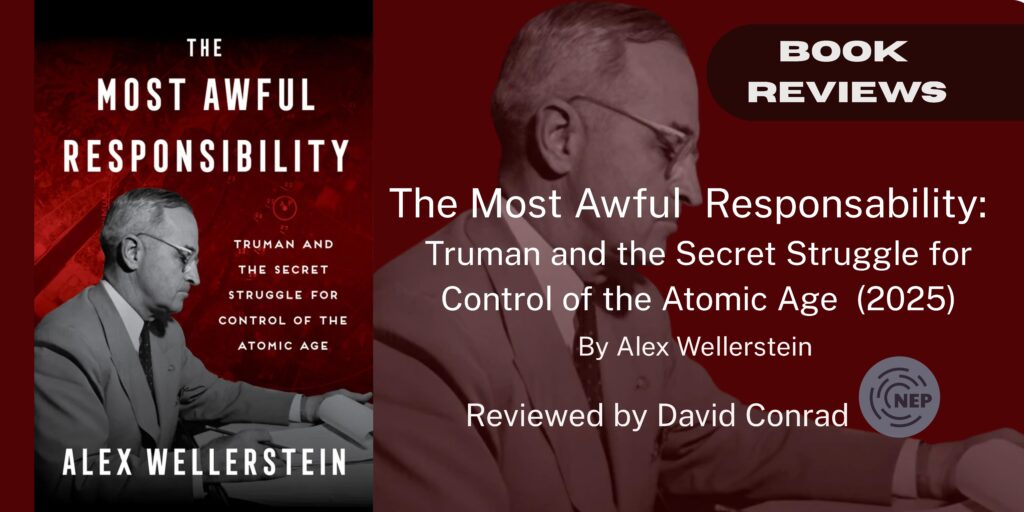
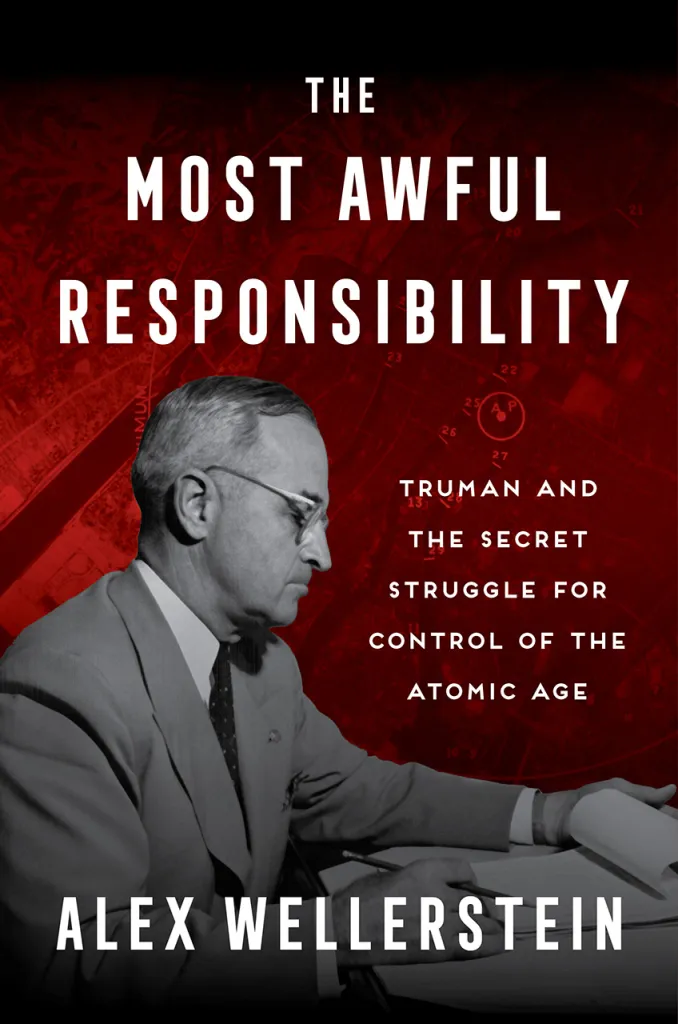
Today’s generation of nuclear scholars are digital natives, and epistemic polarization defines the landscape in which they work and live. Consensus is increasingly beside the point, while creativity adds value. Alex Wellerstein is the ideal contemporary writer to take up the challenge of interpreting Truman and his handling of the nuclear era. Before his new book The Most Awful Responsibility: Truman and the Secret Struggle for Control of the Atomic Age (HarperCollins, 2025), Wellerstein contributed to the public understanding of nuclear warfare by launching an interactive map tool that illustrates the destruction radii and fallout zones of various bombs. This “Nukemap” (https://nuclearsecrecy.com/nukemap/) made a big impact when it hit the internet in 2012; I remember seeing people share what the use of different bombs would mean for their own hometowns. Wellerstein still maintains the service, which remains an excellent educational tool, both informative and intuitive to use.
It is tempting to describe Truman’s approach to the bomb as intuitive as well; having used it out of necessity against Japan, the president then worked to ensure that its use would not become generalized. “It is certainly a good thing for the world that Hitler’s crowd or Stalin’s did not discover this atomic bomb,” the president journaled in July 1945. Stalin’s crowd would successfully test their own version a few years later, when Truman was just beginning his second term.
The question of how exactly Truman tried to maintain the American monopoly on nuclear power — and even his own personal monopoly as military leaders pleaded for access to the weapons — is, however, not intuitive. Answering it is a matter of long-guarded secrets, the kind Wellerstein explored in his first book, Restricted Data: The History of Nuclear Secrecy in the United States (Chicago, 2021). It requires a close reading of how Truman understood, or did not understand, what had happened in Japan. It also requires lingering in a moment that many postwar histories rush through: the four-year stretch between the bombing of Hiroshima and Nagasaki in August 1945 and the detonation of the first Soviet bomb in August 1949. Wellerstein details these early years of the nuclear era through close, highly contextual interpretations of the president’s words and actions. In the book’s final chapters, Wellerstein traces Truman’s decision to regain nuclear supremacy with “the Super,” a nickname for the hydrogen bomb, and demystifies debates about using nuclear weapons in the Korean War that began just as the nuclear arms race became a reality.
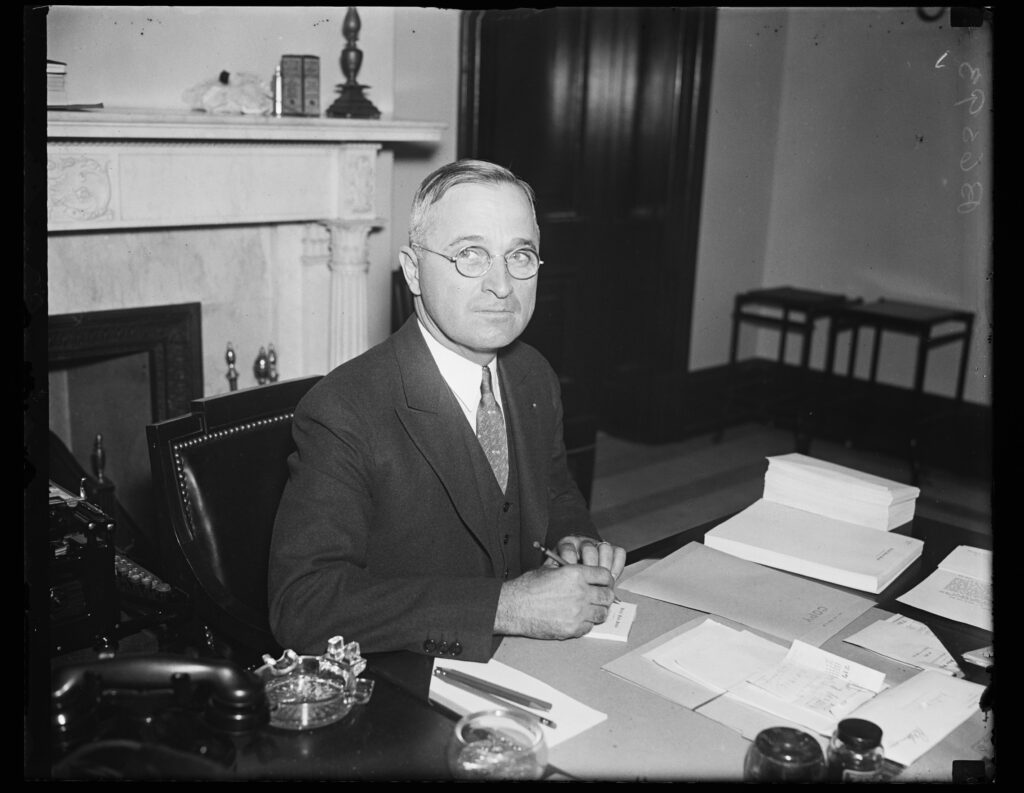
Harry S. Truman, 1934. Source: Library of Congress
Before diving into the early postwar years, Wellerstein must reckon with the atomic bombs that inaugurated the conundrum. He must do so without excessive repetition of the existing literature, and without becoming bogged down in the counterfactual traps of earlier debates. Creativity is part of his solution. Wellerstein opens with a lengthy quotation from Truman that is not exactly a quotation, but rather a paragraph “composed of quotes… which have been only mildly edited for grammatical consistency and clarity.” An endnote provides citation details for each part of the frankenquote, all of which express the president’s horror about nuclear weapons.
This sort of quoting is not conventional practice, but as an opener it efficiently communicates Wellerstein’s thesis: that despite some major misunderstandings and attention lapses beginning with the Hiroshima bomb, Truman had a big-picture understanding of the existential risk the bombs posed to humanity. The introductory not-a-quote also announces Wellerstein’s relatively informal writing style. Periodically, and not to excess, he offers sentences like “But here’s the thing” and rhetorical questions like “What did Truman think?” that are more often found in podcast transcripts than scholarly monographs. This is a good, ahem, thing. A self-consciously approachable style is a welcome corrective to the formal yet highly contentious tone of bomb literature from decades past. By allowing himself to use conversational phrasing, Wellerstein neither stifles the emotional content of the subject matter nor weaponizes it.
As Wellerstein examines Truman’s own tonally mixed comments on the bombs, he detects a contradiction between the president’s willingness to use and develop such weapons and his recognition of the bombs’ irreducibly “terrible” nature and efforts to restrict their use. This is a rhetorical rather than an actual problem, as there is no true contradiction in Truman’s logic. Wellerstein’s “sustained attempt to get inside Truman’s head” (p. xiii) is often needless, since the famously “plain” president wrote frequently and with little guile about the issue. Rightly or wrongly, Truman and virtually all of the people around him viewed the bombs as necessary evils that helped end the Second World War and forestall a third. Truman’s understanding of the bombs contained flaws, especially concerning Hiroshima, as Wellerstein shows in his best chapters. Yet it is no more paradoxical than the logic of orthodox historians who agree with Truman, or of the Cold War presidents who succeeded Truman and shared his views. Truman’s notions about nuclear weapons were not overly complex, and they were in strong accord with the prevailing notions of his day.
Following the trajectory of Truman’s thinking is valuable, though, because it clarifies exactly what Truman knew about the first bombs before they fell, and what he did about the bombs that came after. In the case of the Hiroshima bomb, Wellerstein shows that while the president tacitly approved the military’s plan to destroy Hiroshima, he believed Hiroshima to be “a purely military target” and not a city containing tens of thousands of “women and children.” To some extent this is a familiar idea among bomb historians, and the documents that support it figure in many bomb narratives. But Wellerstein goes so far as to suggest that Secretary of War Henry Stimson, who worked hard to spare the old Japanese capital of Kyoto from destruction, may have misled the president into believing that Hiroshima was a purely military target. Truman paid scant attention to the question of targets, a fact historians have recognized but that Wellerstein views as the foundational truth in Truman’s development of a nuclear conscience.
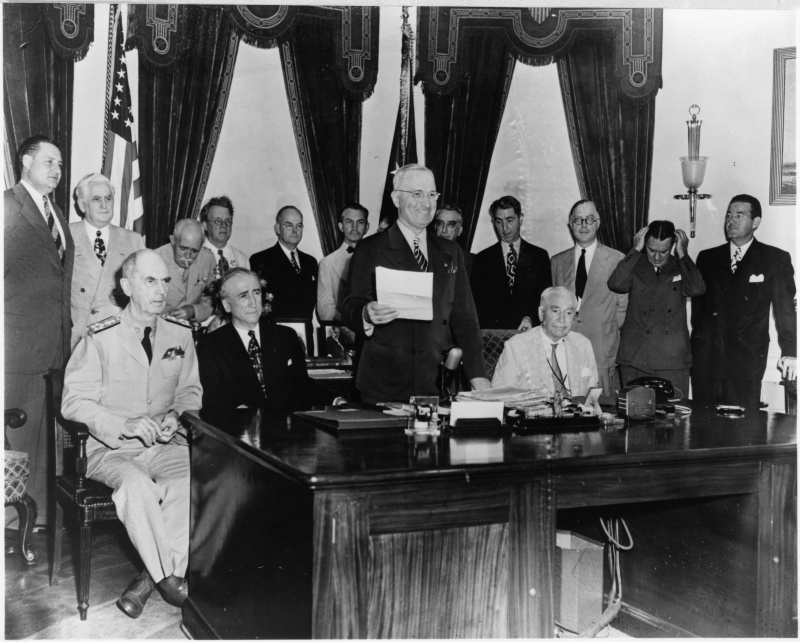
President Harry S. Truman announces Japan’s surrender, August 14, 1945. Source: Harry S. Truman Library & Museum
After Truman “learned that his understanding had been utterly wrong,” and after the Nagasaki bomb took Truman by surprise at a moment when both armistice and surrender were under tense debate in Washington and Tokyo, Truman stated that the civilian death toll left him no choice but to pause the military’s automatic deployment of atomic bombs. Wellerstein details how, in the months and years after Japan’s surrender, Truman shifted authority over nuclear weapons from military bureaucrats to the office of the president. The decentralized way in which the Hiroshima and Nagasaki bombings happened without Truman knowing the critical details would not happen again, because Truman deeply believed that it should not. The weapons he had at first dubbed “the greatest thing in history” (p. 87) very quickly became his “awful responsibility” (p. 93).
Wellerstein’s decisions about what to emphasize should prompt reflection about how we write and teach the atomic bombs and their aftermath. The book’s chapters are short; the World War II section takes up ten chapters, each of a few pages. Wellerstein’s brevity and writing style make his work accessible to students, and his well-sourced account of the atomic bombs should launch memorable classroom discussions.
The remaining chapters of The Most Awful Responsibility contain enough detail about Truman’s inconsistent quest for nuclear authority that even subject matter experts can find new information. A key event for Wellerstein is the establishment of the Atomic Energy Commission in 1946, a much-contested civilian body whose creation made the military feel they had lost a custody battle over atomic bomb material. The outbreak of the Korean War in 1950 receives sustained attention through a nuclear history lens, and Wellerstein shows how the war tested Truman’s authority by exposing conflicting military notions about nuclear warfare. At times Truman largely absented himself from debates, as in nuclear spy scandals and the development of the H-bomb, politically dangerous subjects which Truman preferred to dodge and delegate. In many cases, the buck passed his desk, as it had in 1945. Wellerstein explores obscure-sounding events like Project Venona, Operation Ivy, and NSC-100 (successor to the more famous NSC-68), some of which involved Truman only nominally. The president was often late to weigh in on nuclear questions, and he engaged in self-delusion about issues like peacetime applications of atomic bombs and Russia’s nuclear capacity. Wellerstein acknowledges the inconsistency between such lapses and his preferred image of Truman as a nuclear moralist and leader, but the disconnect weakens the book’s thesis that Truman cared deeply about preventing new nuclear holocausts.
Wellerstein presents a president with conflicting impulses: Truman cared about the chain of command for the country’s growing nuclear arsenal, but he also gave the matter little thought except when the press, Congress, or his advisors made him act. Wellerstein is generally forgiving of Truman’s slowness to assert himself, and of the fact that he often let political pressure decide his path, since his philosophy after Hiroshima was to make it more difficult for the U.S. military to use the country’s growing collection of nukes. Military leaders had dropped the bombs without hesitation in 1945, and some spoke of doing it in Korea and China in 1950, though Wellerstein persuasively argues that the commander in Korea, General Douglas MacArthur, did not go as far down this path as historians have alleged. Truman regularly lowered the temperature of such conversation, declared exclusive power to authorize nuclear strikes, and spoke of boundaries such as only using the weapons in retaliation and only after consulting with key allies.
The book’s conclusion notes that General Dwight Eisenhower’s presidency took a different tack, although the pattern of presidential control that Truman established ultimately survived the 1950s. Given the enjoyability and pedagogical usefulness of The Most Awful Responsibility, one may hope that Wellerstein will follow it up with a closer look at Eisenhower’s “New Look” and its nuclear ramifications. “Ike” was a president with as many conflicting impulses as his predecessor, but he had more focus and intentionality about military problems.
For now, Truman remains the last president to use nuclear weapons in war. Wellerstein has made an engaging, if not entirely convincing, case that Truman’s horror at what happened in Japan is the primary reason for that fact. For Truman and for Wellerstein, placing the burden of responsibility on a single presidential conscience, with its presumed moral sensibilities and capacity for humility, provides a greater safeguard against nuclear disaster than the blunt calculus of military tactics. If that was true even for a leader as inconstant as Truman, then perhaps it is a valid theory. If not, then every presidential election since World War II has been a game of nuclear roulette.
David Conrad received his Ph.D. in History from the University of Texas at Austin in 2016. He is the author of Akira Kurosawa and Modern Japan (McFarland, 2022), and his research and writing focus on postwar Japan, U.S.-East Asian relations, and nuclear history.
The views and opinions expressed in this article or video are those of the individual author(s) or presenter(s) and do not necessarily reflect the policy or views of the editors at Not Even Past, the UT Department of History, the University of Texas at Austin, or the UT System Board of Regents. Not Even Past is an online public history magazine rather than a peer-reviewed academic journal. While we make efforts to ensure that factual information in articles was obtained from reliable sources, Not Even Past is not responsible for any errors or omissions.