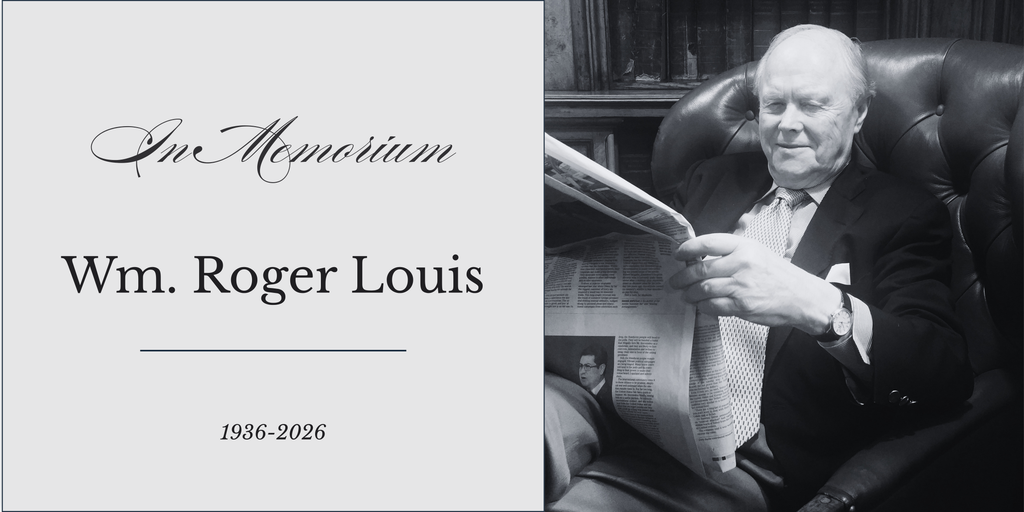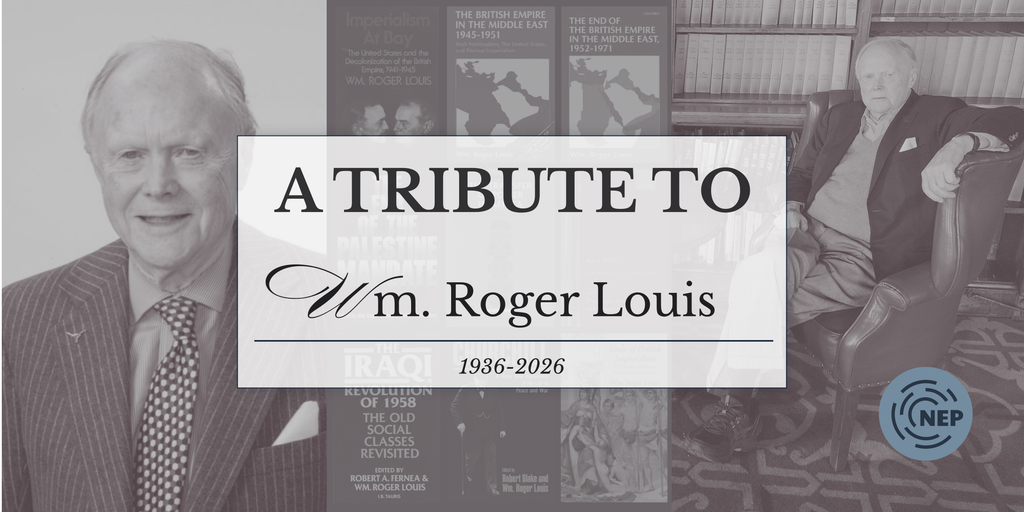
A memorial service for Wm. Roger Louis will be held on Wednesday, November 4, 2026, at 12:00 p.m. at Weed Corley Fish Funeral Homes and Cremation Services – North, located at 5416 Parkcrest Drive, Austin, TX 78731.
By Justin Roberts
Wm. Roger Louis was a colossal figure in the study of the British Empire, especially in the study of later British imperialism in Africa, Asia, and the Middle East. The British journalist and author Geoffrey Wheatcroft went so far as to compare Professor Louis’ study of the British Empire with Edward Gibbon’s canonical work on the Roman Empire. “If Gibbon has a successor,” Wheatcroft said, “it must be Wm. Roger Louis, who has become after a lifetime’s study the greatest and truly incomparable historian of the decline and fall of the British Empire.” Only a small handful of scholars in the field in the past century could credibly be called his equal in energy, presence, or impact. Paul Kennedy, the Richardson Dilworth Professor Emeritus of History and Global Affairs at Yale, put it simply, “There was really nothing quite like him.”
Roger was born in Detroit in 1936, but he grew up in Oklahoma in the 1930s and 1940s. He said in an interview with The Historian in 2000 that he learned the “importance of work, thrift and family” from his parents. His parents made sure that he and his sister were well educated. “Neither of us ever doubted that we were going to college.” He enjoyed literature, devoured books from the local Carnegie library, and played the French horn. He also enjoyed handball, swimming, and gymnastics. He attended church where he had his “first lessons in public speaking” from a charismatic preacher. He later claimed that “Whenever people ask me about my philosophy of life, I repeat the words President Roosevelt once told a reporter: ‘I am a Christian and a Democrat. What more does one need in life?” He continued to use this line throughout his life. He developed a deep “commitment to civil rights” while he was working in various jobs at the YMCA and realized how segregated Oklahoma was. When Roger became president of Sigma Alpha Epsilon at the University of Oklahoma, he tried to pave the way for desegregation in the fraternity.
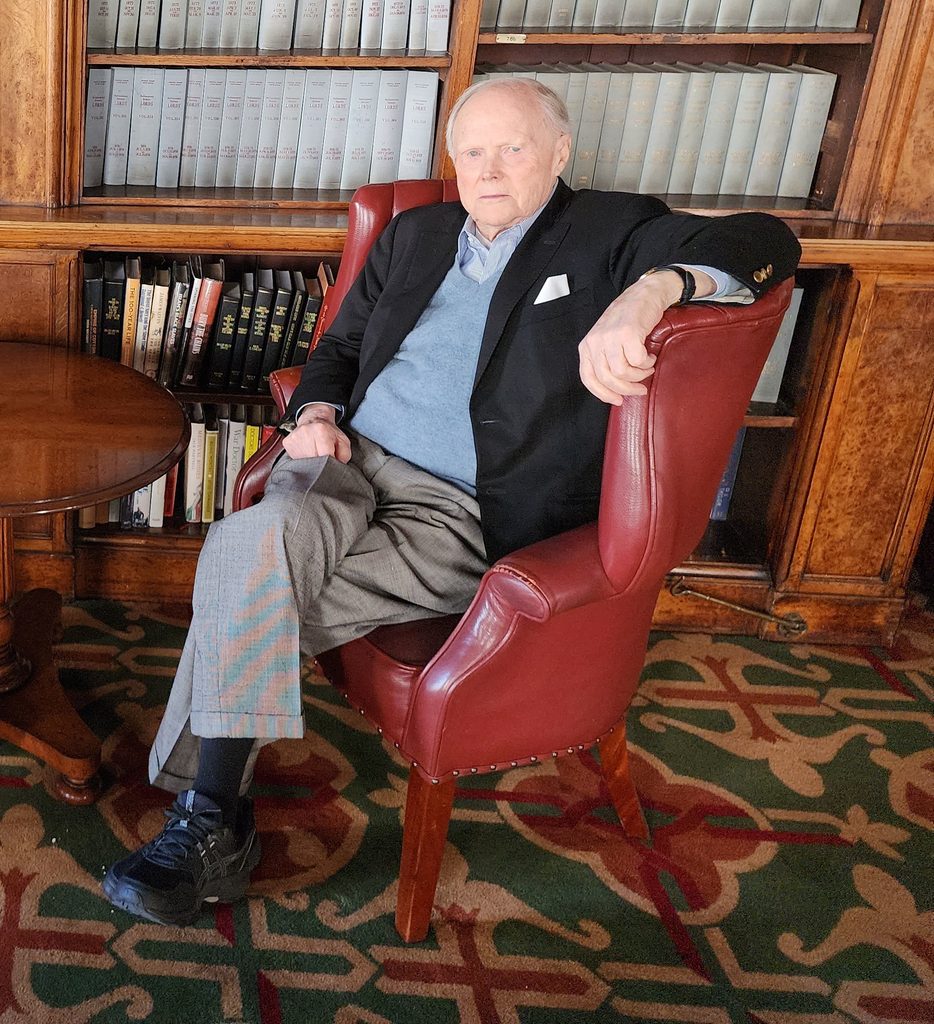
The YMCA also gave Professor Louis his first opportunity to travel outside of Oklahoma. He “learned that there was much more to the world than he had seen in Oklahoma.” He spent time in Freiburg, Germany, and at the Sorbonne in Paris. He learned to speak French and German. He even hitchhiked through the eastern Mediterranean to keep seeing the world. He completed his BA at the University of Oklahoma and then went on to complete his MA at Harvard and his D.Phil. at Oxford, where he was supervised by AJP Taylor. He also worked with Margery Perham and John “Jack” Gallagher. Roger credited Professor Taylor, a renowned stylist, with having “immensely improved my writing.” Professor Taylor taught him to keep his paragraphs short and to limit his discursive footnotes. Professor Taylor also encouraged Roger to write while researching rather than separating these stages. Professor Louis finished his doctorate in two years and taught at Yale from 1962 through 1970 before moving as a full professor to the University of Texas at Austin, where he became the Kerr Chair in English History and Culture in 1985.
Professor Louis was the author or editor of more than thirty books from 1963 through 2025. In fact, it is difficult to determine the precise number of his final scholarly contributions. By 2000, he had published “over fifty articles” and he soon stopped counting all his books and articles on his curriculum vitae. The last version of his CV from 2012 described his total as simply “some thirty books.” By 1967, Roger, who was then an associate professor at Yale, had already published two books. In 1966 alone, he published articles in three of the most prominent journals in his field: American Historical Review, English Historical Review and Journal of Modern History. Professor Louis was just 31 years old, but he had already established himself, Kennedy claims, “as the single most important scholar on the later time of the British Empire.” Roger never slowed down. He said that he “routinely” worked “ten-hour days most days of the week” and that his wife Dagmar “never let me forget that I spent most days at the PRO” [Public Record Office] in London during their honeymoon. He visited the archives in London every single summer for decades and scoured other archives around the world.
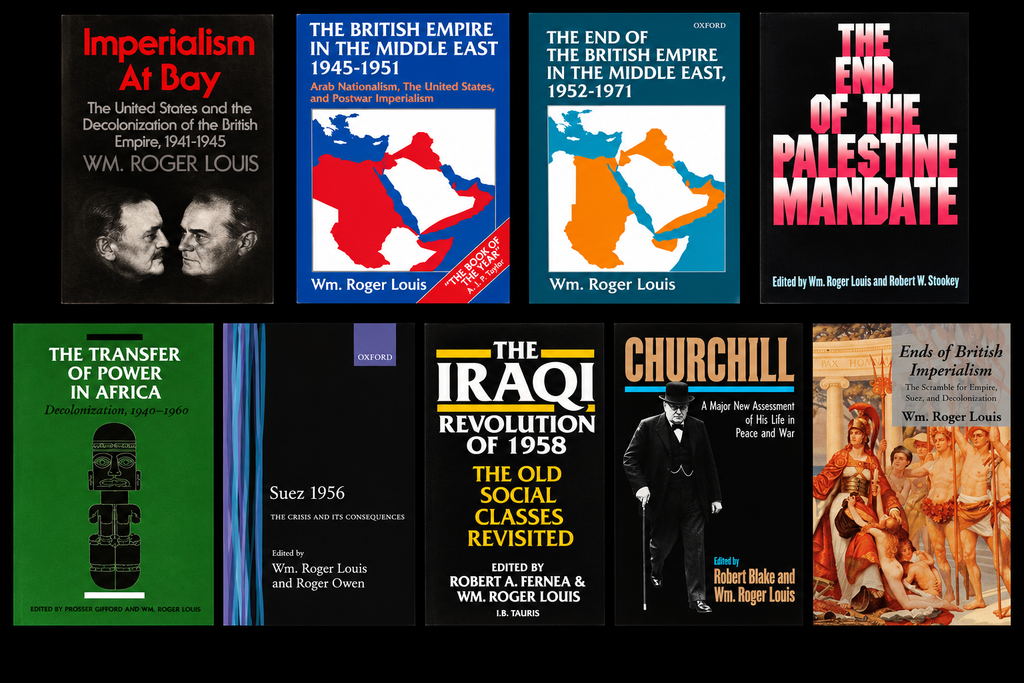
Judith Coffin, his colleague in History for many years at the Forty Acres, said that in terms of “boundless energy,” Professor Louis was “in a league of his own.” David Leal, a professor in Government, says that Professor Louis usually broke up his long days of work with an hour-long stroll around the campus at lunch time. He continued to work after retirement. His last book—The End of the British Empire in the Middle East, 1952-1971—was published with Oxford University Press in June of 2025. It was the second part of a two-part project that he began more than four decades ago on the British Empire in the Middle East. John Darwin, an emeritus professor at Oxford, has described the second book as “a monument of historical scholarship” that offers clear proof of Professor Louis’ “astonishing mastery of the archival record.”
One could argue that the most significant project in Professor Louis’ career was the five-volume Oxford History of the British Empire. He served as the editor-in-chief, shepherding the enormous project through to completion. The five volumes were published in 1998 and 1999. When I was a graduate student in the early 2000s, these volumes were required reading. It remains the definitive collection on the British Empire. Far from simply celebrating the British Empire, Professor Louis ensured that the volumes were intentionally inclusive and nuanced in perspective. In his interview in The Historian in 2000, Professor Louis noted that “several prominent British historians complained about an American being the editor-in-chief” of the project because they worried that “the work would be biased against the British.” Professor Louis wanted to ensure that these definitive volumes on the Empire included complicated and multifaceted perspectives.
Professor Louis described his vision of this project as a “new history of the British Empire” with a “less ideological approach” that told that history “not just from the standpoint of the British, but from those who had been on the receiving end of British imperialism.” He also tried to ensure that the volumes were “less Anglocentric” than traditional histories of the Empire and that they included “the significance the British Empire has had for the Scots, Irish, and Welsh.” He intentionally recruited “junior as well as senior scholars.” It was a successful and generative endeavor. Professor Darwin observed that “The energy and determination with which he drove through the whole series from conception to publication have become legendary.” Queen Elizabeth II named him Commander of the British Empire in 1999 for his role as editor.
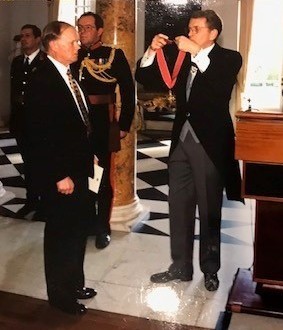
A scholar who has produced as much as Professor Louis and spent as much time in the archives as he did could be expected to devote a little less time to his teaching. Somehow Professor Louis had the energy to be both a prolific researcher and an engaging teacher. He said he learned at Yale that “good teaching and writing go hand in hand” and his advice for younger historians was that “teaching and doing research complement each other” because “you can certainly learn from students in ways that benefit your research, while your historical research can emphatically help you to become a better teacher.”
In fact, Professor Louis’ teaching record clearly shows that he was a remarkable educator for thousands of undergraduate and graduate students since he began in 1970 at the Forty Acres. For more than a half century at UT Austin, he taught students about the British Empire and Commonwealth but also about comparative European colonialism, offering his broad and expansive view of the nature of empires. Professor Coffin recalled that “Every semester,” she would “recommend Roger’s courses to students, telling them it will teach them to read, write, speak, and think” and that it “will prepare them for graduate school in any field.” According to Professor Coffin, Professor Louis had strikingly consistent and high scores in his course evaluations. He was given the President’s Award for Outstanding Teaching in 1992, and he was named a Distinguished Teaching Professor in 1998. He was voted Professor of the Year by the students at the University of Texas in 2009.
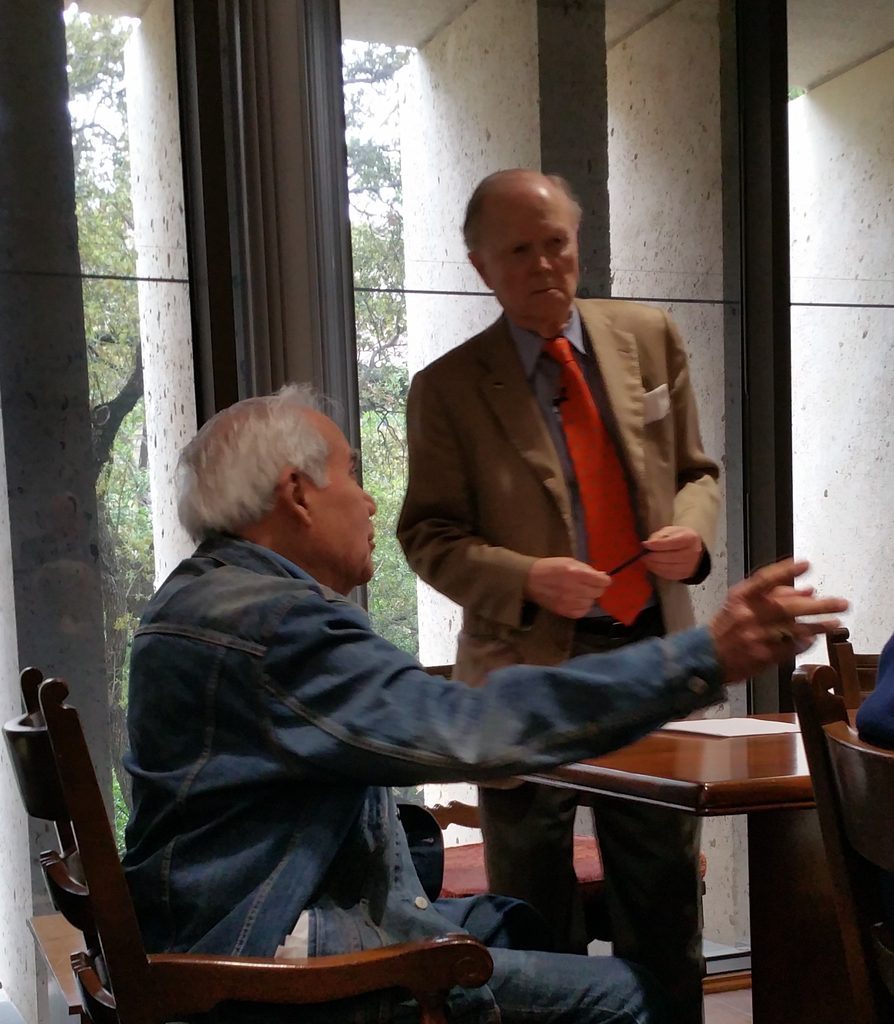
Professor Louis was equally devoted to more extensive supervision of both honors students and graduate students. According to Professor Coffin, he almost never turned away an honors student and as an honors thesis supervisor, he was “willing to read many drafts but firm enough that students do their best work for him.” Bryan Glass, who finished his dissertation under Professor Louis’ supervision, said that “No matter how demanding his schedule, he always made time for me as a graduate student.” According to Professor Glass, Professor Louis’ “combination of generosity, exacting standards, encouragement, and quiet leadership remains one of the most important influences on my own approach to mentoring students and building scholarly communities.” Professor Louis was awarded the Distinguished Graduate Teaching Award in 1984 and the Outstanding Graduate Teaching Award in 1998.
Professor Louis’ energy, vision, and intellect were recognized far beyond Austin. He was awarded the American Historical Association’s George Louis Beer Prize and the Benson Medal of the Royal Society of Literature. He was also awarded a senior fellowship at the National Endowment for the Humanities and a Guggenheim fellowship. He was appointed to the Kluge Chair at the Library of Congress in Washington. He helped organize a decolonization seminar in Washington for many years. In 2001, he became the president of the American Historical Association and the founding director of the American Historical Association’s National History Center. He was also appointed to the US State Department Historical Advisory Committee in 2003, from which he resigned as chair in protest in 2009.
From 1975 through 2022, Professor Louis drew together scholars and people from diverse backgrounds into a passionate and energetic community in Austin focused on the study of Britain and its empire. These sessions became renowned across the campus as a Friday afternoon gathering spot for sharing ideas over a glass of sherry. Professor Louis believed that his beloved British Studies seminar succeeded in “breaking down some of the boundaries that divide departments from each other” and that it “also fostered good relations with people in the Austin community.” He encouraged younger faculty, graduate students, and undergraduates to attend to help keep his community thriving and filled with new voices, and he instituted a regular Friday lunch that, according to David Leal, “introduced the Oxford High Table spirit to campus.” Professor Louis claimed that some community members “loyally attended these Friday sessions for many years.” Professor Louis relished the “intellectual climate” in Austin and especially in “the British studies program where people of different ages, disciplines, and backgrounds discuss anything and everything.” Stephen Ennis, the current director of the Harry Ransom Center, believed that Professor Louis brought the seminar style that was at the heart of his British Studies program from Oxford to Austin and that “for the rest of his life, he was committed to the seminar method of teaching: a table, an invited speaker, and an engaged and informed conversation about history and ideas.”
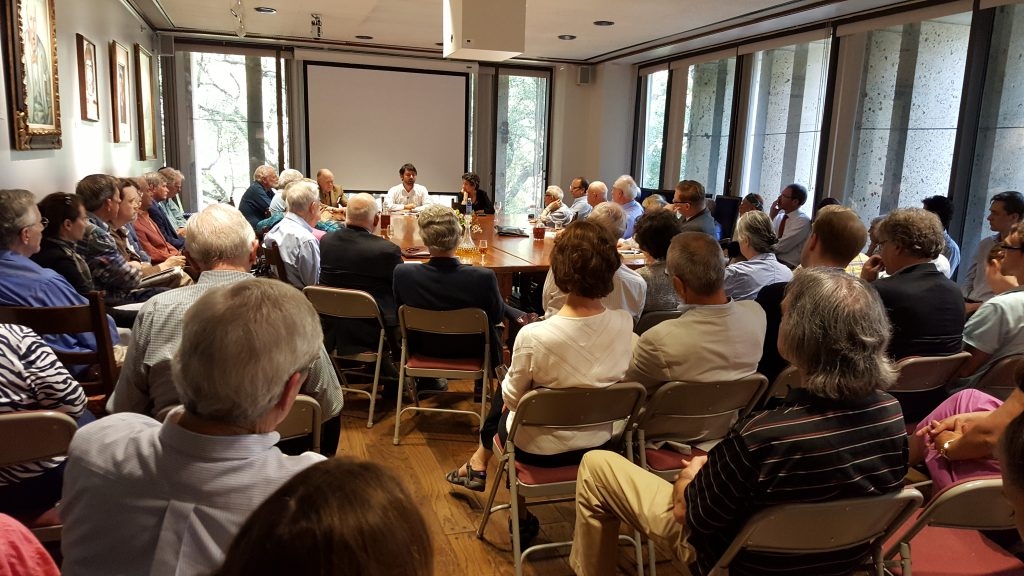
I arrived in Austin in January of 2026 to begin as the director of Professor Louis’ British Studies program. I soon met Professor Louis and some of the still devoted members of his community. I was struck by the influence he had on so many people. His name continues to echo across the university. Professor Louis had cultivated the ability to get along with almost anyone. Professor Kennedy noted that this was always one of Professor Louis’ great talents. He “was simultaneously friendly with that crusty old Oxford Conservative Max Beloff AND with the idiosyncratic radical AJP Taylor; how could anyone get the approval of both?”
Since I arrived, I have encountered dozens of people who testified to the impact Professor Louis and his British Studies program had on them over the more than half a century in which he was a fixture in Austin. They included students, professors, and members of the larger Austin community. Some of these devotees told me they had regularly attended his weekly British Studies seminars on Fridays in the Harry Ransom Center for decades. They spoke of Professor Louis’ passion for meeting people, for reading, and for combing the archives. These devotees continued to meet for the Friday lunch to discuss what they were reading, bringing an eclectic range of interests to the table. Despite his age, Professor Louis continued to attend some of these lunches, where a passionate discussion of books was always at the core of the conversation. Professor Louis believed that asking someone what they were reading was the best way to get to know them and to start a conversation. I had the pleasure of attending Professor Louis’ ninetieth birthday celebration on May 8, 2026, at Tarry House. The room was filled with people who respected and adored Professor Louis. Once again, I had the chance to appreciate the vibrant community he has created. Several speakers rose to offer their appreciation.
“British Studies never stops,” is the line I have heard several times since I started in Austin, meaning that Professor Louis held the seminars at all times, rain or shine. He described the British Empire as “one of the great phenomena of modern world history.” He remained passionate about spreading a deep and abiding interest in this phenomenon and facilitating discussion of it. Professor Louis is no longer with us, but we must honor his memory by maintaining and building his British Studies community in Austin; we must do our best to ensure that British Studies never stops.