• New
  • Features
  • Reviews
  • Texas
  • Teaching
  • Digital
  • Watch & Listen
  • Authors
  • About

The past is never dead. It's not even past

Not Even Past

The Refugees of ’68: The U.S. Response to Czechoslovak Refugees during Prague Spring

April 29, 2019

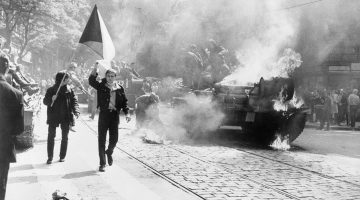
By Jonathan Parker Fifty years ago Soviet tanks rolled through the streets of Prague.  Soviet and Warsaw Pact forces entered Czechoslovakia on August 20, 1968, and within two days occupied the entire country. The Soviet Union and its allies had decided that the reformist experiment, “socialism with a human face,” in communist Czechoslovakia was too […]

The Gorbachev Factor by Archie Brown (2003)

January 21, 2019

By Marcus Golding The fall of the Soviet Union is usually understood from two angles. One argues that the Soviet state could not keep up with the United States’ military superiority and, therefore, collapsed under economic strain. The other perspective suggests that western Europe and the U.S., and specifically the administration of President Ronald Reagan […]

US History at the Movies

November 1, 2018

Films about historical events have enormous power to affect us, both to enlighten and to mislead.  Historical films are perennially popular, often because they tell history through individual lives, because they invent characters and add personal, emotional drama to events that we want to learn about. Those same fictionalizing qualities make them great tools for […]

A Poverty of Rights, Citizenship and Inequality in Twentieth-Century Rio de Janeiro by Brodwyn Fischer (2008)

October 22, 2018

Getúlio Vargas, President of Brazil from 1930-1945, is often credited as the champion of the Brazilian working class during the twentieth century. His policies led to the progressive industrialization of Brazil and to a barrage of labor regulations that protected workers’ rights. However, not everyone benefited equally from these laws. Thousands of poor Cariocas (Rio […]

Episode 108: A History of the U.S. Marine Corps

September 9, 2018

The US Marine Corps may now proudly boast to be the home of the few and the proud, but this wasn’t always the case. In the early part of the 20th century, it was the poorest funded and least respected branch of the military, and at the end of World War Two there was actually […]

Notes From the Field: Bulgaria’s Tolstoyan Vegetarians

February 26, 2018

It seemed like a bad idea then, but I did it anyway. Maybe, just maybe, there was hope that the little museum in the Bulgarian mountain village of Yasna Polyana would be open. Established in 1998, the museum contained the intellectual remnants of the Bulgarian Tolstoyan community, who had created an agricultural commune in the […]

Arresting Dress: Cross-Dressing, Law, and Fascination in Nineteenth-Century San Francisco by Clare Sears (2015)

February 12, 2018

by John Carranza Clare Sears, associate professor of sociology at San Francisco State University, explores cross dressing and its place in the formation of San Francisco as an urban center in the mid- to late-nineteenth century. Sears uses codebooks, arrest records, and court reports to reconstruct the history of cross dressing in an urban setting. […]

Historians on Marriage and Sexuality in the United States

February 7, 2018

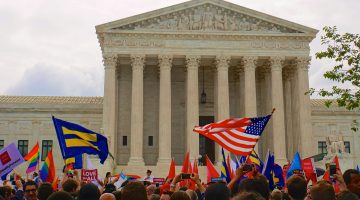
by Alexander Taft In June 2015, by a vote of 5 to 4, the Supreme Court of the United States resolved decades of debate by declaring marriage a fundamental right regardless of sexual orientation. The Obergefell v. Hodges decision changed the landscape of American marriage law, but what was this landscape in the first place? […]

Fire and Fury: Inside the Trump White House by Michael Wolff (2018)

January 29, 2018

by Augusta Dell’omo Donald Trump responded to Michael Wolff’s Fire and Fury: Inside the Trump White House in a predictable way. The President launched an incoherent, childish tweetstorm, labeling Wolff “mentally deranged” and an agent of the “Fake News Media,” which, typically, drew even more attention to the book. Indeed, in the hours after the […]

Cuba’s Revolutionary World

December 1, 2017

As Mao used to say, “The revolution is not a dinner party.” Fidel Castro provided the corollary. “But the counterrevolution” he said, “is always more cruel.”

« Previous Page
Next Page »

Recent Posts

  • The Fox and The Wolf
  • The Spanish Empire’s Hidden Hand: How the Gálvez Network Turned the Tide of the War of Independence
  • Primary Source: On the Pleasures of Printers’ Ornaments
  • Review of Beyond States. Powers, Peoples and Global Order (2024).
  • Understanding History Through Video Games: Europa Universalis IV and Causation 
NOT EVEN PAST is produced by

The Department of History

The University of Texas at Austin

We are supported by the College of Liberal Arts
And our Readers

Donate
Contact

All content © 2010-present NOT EVEN PAST and the authors, unless otherwise noted

Sign up to receive our MONTHLY NEWSLETTER

  • New
  • Features
  • Reviews
  • Texas
  • Teaching
  • Digital
  • Watch & Listen
  • Authors
  • About