• Features
  • Reviews
  • Teaching
  • Watch & Listen
  • About

The past is never dead. It's not even past

Not Even Past

Voices of India’s Partition, Part I

by Amber Abbas

During the summer of 2005 I embarked on my first research trip. I had recently taken a class on oral history methodology and was eager to put my newly acquired skills to use. My research focuses on a tumultuous time in the history of the Indian subcontinent: the 1947 events that gave India its independence and created the new state of Pakistan. My own family hails from Aligarh, a city about 90 miles southeast of New Delhi and, as Muslims, opted to move to Pakistan. I was aware of this as a child, but because I grew up outside Pakistan, it was not until I began my research and had enough comfort speaking Urdu that I persuaded some of my elderly relatives to tell me their stories of the time of independence and partition.
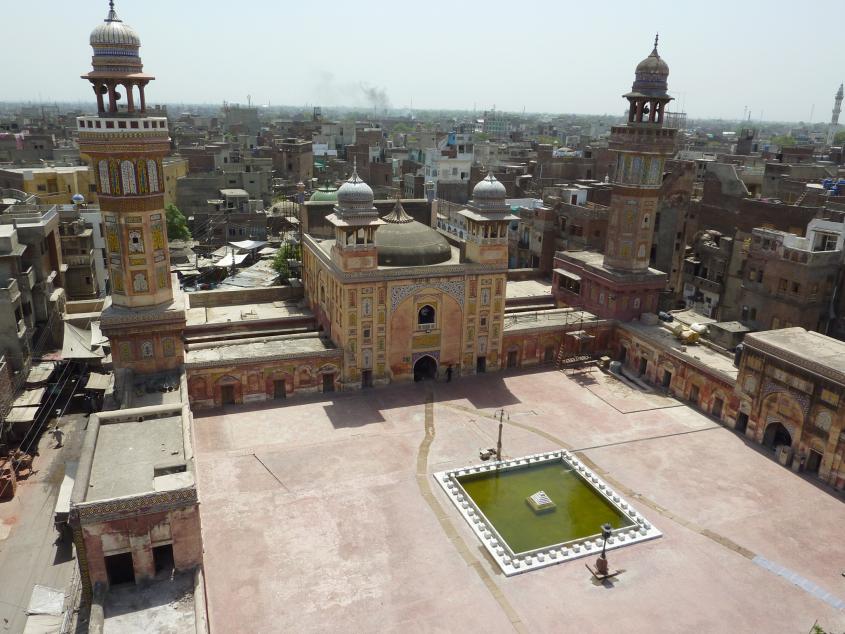
Lahore's old city from the minaret of the Wazir Khan Mosque
Lahore’s old city from the minaret of the Wazir Khan Mosque. Photo by Aaron Jakes.

Mrs. Zahra Haider was married to my grandmother’s cousin, Khurshid Haider. I have known her my whole life, but it is only in the last few years that I have become close with her and her family. She was born in Dehra Dun. Her father’s name was Yaqoob Shah and her mother’s Zohra Shah. She was raised in Lahore by her Aunt because her mother was unwell. Her father was the Auditor General of Pakistan. He was posted for two years in Washington as Pakistan’s representative to the World Bank, and took his family along with him. She married Khurshid Haider, who died a few years before this interview. Currently she lives in Rawalpindi Pakistan with her son Mohsin and his family.

I interviewed Mrs. Haider at her sister’s home in Lahore, Pakistan. As it was June, and very hot, we sat in a room with the air-conditioning running. The hum is audible on the recording. Throughout the interview, Mrs. Haider’s sister, kept coming in to offer us food or fruit.

She speaks here about her experiences during the 1947 partition, an event that played out violently on the streets of Lahore. Mrs. Haider remembershaving her daily routine disrupted by partition’s displacements. Although she briefly mentions the bureaucratic imperatives of partition, she is mostly focused on personal experiences. It was unbearably hot as they prepared for their exams that summer; in August, many of her friends moved away; the school tuition bills had to be paid; she was scolded by a doctor in a refugee hospital for seeking a few moments of normalcy with her friends; she took clothing from her mother’s laundry to give to the refugees. This focus on the everyday helps us, as historians, to understand the experience of women and youth during partition.

Mrs. Haider’s memories come in snippets that take on comprehensive significance and are influenced by the national history of Pakistan. She speaks of conflicts with Hindus yet, it is the loss of her Hindu friends that she feels most sharply. And the innocence of her surprise at their departure is still evident in her voice. As her story concludes, she refers to a woman who died from her wounds after doctors’ heroic attempts to save her. When she died, her baby daughter became an orphan. Though the story is not included here, one of Mrs. Haider’s friends took that baby home and today, she is practically an older sister of Mrs. Haider’s daughter-in-law, Neely, the daughter of that friend who long ago carried a baby home from the refugee hospital.

Zahra Haider’s story gives a glimpse of Lahore, a primary site of partition’s violent upheavals. She shows us that partition’s disruptions were both massive and mundane. Stories like Mrs. Haider’s bring partition down to ground-level where we can see, hear and feel what partition was like for one young girl trying to make sense of the world around her.

LISTEN TO THE ORAL HISTORY INTERVIEW HERE

READ THE ORAL HISTORY INTERVIEW TRANSCRIPT HERE

Voices of India’s Partition, Part I: Mrs. Zahra Haider

Interviewed by Amber Abbas

Lahore, Pakistan (June 28, 2005)

Transcript:

Zahra Haider: Actually, I was born in Dehra Dun, the year was 1928. And Dehra Dun is in India. And I was born there. We came back to Lahore and I lived with my grandparents! My own mother got very ill, she had some problem with her legs, she couldn’t walk. She recovered from that, but at that time she was like that. So my Aunt, my father’s sister, she took me over and then I lived with her all my life and she became my adopted mother.

AA: You have lived most of your life in Lahore?

ZH: Most of my life. I remember when we were in our old house, it was a big house, which is a big house with a big courtyard inside and a big garden outside. It was a big area. And we used to all sleep inside in the courtyard with all the beds laid out and mosquito nets and everything and one table fan for all of us because we used to be in a row, all the beds laid out. Then, you know the first sound one woke up to in the morning, was we could hear the noise of the lion roaring in the zoo! Really! That! And then we could hear the cocks, our own cocks and things crow and everything. And then there used to be the Salvation Army band which used to march around outside on the road of our house. These are the few things. There was a beggar woman who used to come early in the morning and she used to sing for her pennies. Those are the few noises I remember very clearly… We can’t hear any lion any more.

[Audio and Transcript Edited from Original]

AA: What happened in Lahore in your memory during the partition days?

ZH: See, we had gone up to Murree. It happened the summer. First, it started with this that we used to sleep upstairs in our house. On the roof! And we used to see—our neighbors were Hindus—surrounded. We had a lot of neighbors who were Hindus and we were quite friendly with them! But we saw them bringing up guns and things. Then we also got our guns. Inside the city, arson started, in the summer. And people were burning—inside the city, there were houses being burned—Hindus would burn Muslims, Muslims would burn Hindus. I don’t say that it was only “the bad Hindus” who were doing it. Muslims did in retaliation also! I don’t know if they started it but that’s how it [indistinguishable]. And it was such a hot summer, you can’t imagine!

We had to have our exams and all. We used to sit inside there, in the rooms—there were no air conditioners then—with the fans going. We had given our exams and all, then after that the real trouble started. Then, of course, our Hindu friends—we had friends, we used to go to the same college and everything—they took all their things away. We said, “Why are you taking them? You’ll come back when the holidays are over!” They said, “No, we are not going to come back if this is Pakistan.” And they took everything they could, you know, and moved.

AA: From the hostel?

ZH: From the hostel, and even from their homes. This is the sad thing, when one people get uprooted from their homes.

[Audio and Text Edited from Original]

When we came back from the hills, we had to go to college for our studies. And when we went to the college, it was closed. The only thing that was up were the bills, on the boards. And then, of course, we paid our bills! And then when our teachers came in they said that there aren’t enough people here, because most of the students were Hindus and Sikhs. Now we were few Muslim girls left. So they said, “No, we will now start.” Because there were a lot of refugees coming into the hostel. Because ours was Kinnaid College and the brother college was FC [Forman Christian] College. And they made FC College into a hospital. We all went. All the wounded people were taken there, the refugees. We went to work over there. They said they’ll give us marks for that. We went there and you can’t imagine what we saw!

[Audio and Transcript Edited from Original]

There were a whole group of us who had to go to work there. We used to be there form the morning to the evening. Then one afternoon we just said, “Let’s take some cold coffee and have sandwiches and have something to drink.” So we were standing upstairs on the roof and having this when the doctor with whom we were working went past and said “Here you are having so much fun and go and see what’s happening downstairs! We went down and a new lot of refugees had come in. Uff! They were in all those wounded states and everything. Then we started off by cleaning their wounds, giving them bath. We needed clothes for them. Half of them were naked. We came home whichever way we could and took out our mother’s old clothes lying to be washed and took them there and gave it to those people. We washed them, scrubbed them. We couldn’t wash them properly. Their hair was absolutely matted and full of lice! We had to cut it open and it was worn down over here, lice coming down that—they were even going all over our hands. But we had to do that! And we gave them baths and bandaged them then brought food for them, and fed them.

Little children without arms, with their hands cut off, they were just saying, “I have no mother, give me something! Give me something!” So one would give them food and things, and feed them. Then there was one occasion, there was this lady who had maggots in her wounds. And she was a beautiful red-headed girl and she had a little baby with her. The doctor spent the whole morning getting out the—first they said, “She’s about to die, we won’t do anything.” There are so many others who we can help. Then they came around the next morning and she was still living. So he picked out all the maggots. And when he had picked them all out, she died. That was so sad.

« Previous Page

Recent Posts

  • The Politics of Catastrophe: A Brief History of FEMA
  • Beyond the Archive: Digital Histories and New Perceptions of the Past
  • Review of Malaria on the Move: Rural Communities and Public Health in Zimbabwe, 1890-2015 (2025)
  • Historia, ¿para quién? desde la radio pública en México
  • History—For Whom? From The Public Radio in Mexico
NOT EVEN PAST is produced by

The Department of History

The University of Texas at Austin

We are supported by the College of Liberal Arts
And our Readers

Donate
Contact

All content © 2010-present NOT EVEN PAST and the authors, unless otherwise noted

Sign up to receive our MONTHLY NEWSLETTER

  • Features
  • Reviews
  • Teaching
  • Watch & Listen
  • About