• New
  • Features
  • Reviews
  • Texas
  • Teaching
  • Digital
  • Watch & Listen
  • Authors
  • About

The past is never dead. It's not even past

Not Even Past

Meg Lauren’s Songs from the Archive

Meg Lauen's songs from the archive banner

This article is part of the series: History beyond Academia

Meg Lauren’s song “Harriet Ross” tells the story of a fourteen-year-old factory worker from Scranton, Pennsylvania. While working at the Texas State Library and Archives Commission (TSLAC), Lauren had the opportunity to read a letter, written on March 21, 1911, addressed to the governor of Texas. In the letter, Harriet Ross expressed her desire to “correspond with a cowboy.” The first time I heard the song at the Cactus Café open mic on the UT Campus, it struck me as a great example of creative engagement with a primary source that I could potentially share with students. When Raquel, the Associate editor of Not Even Past, mentioned that they were doing a series on “history beyond academia,” her song was the first thing that came to mind. The three of us met back in October 2025 outside of Epoch Coffee to talk about Meg’s approach to writing the song and to record a video of her performing it. Though distinct from the kind of research and writing typical of academic histories, the story of this song’s journey from the archive to a live audience parallels some of the ways that historians engage in historical reconstruction from fragmentary or partial primary source evidence.

Austin musician Meg Lauren, originally from Northern California, has been playing music for about fifteen years. “Both of my parents are musically inclined,” she told me, “but my dad was more of a gigging musician—he played guitar and sang in different bands, so I grew up watching him perform.” Her mother, meanwhile, worked as a county librarian, a line of work that she also found herself drawn to. Meg and her husband moved to Austin after the 2018 wildfires displaced them from their home in Northern California. Shortly after relocating to Texas, Meg found a job at TSLAC, initially working as a library assistant before moving into the archives. “This was different from the more public-facing library jobs I’d done before—I spent most of my time in the stacks, behind the scenes,” she explained. “It’s a research library—most of the materials are in closed stacks.” That archival work would unexpectedly shape her songwriting.
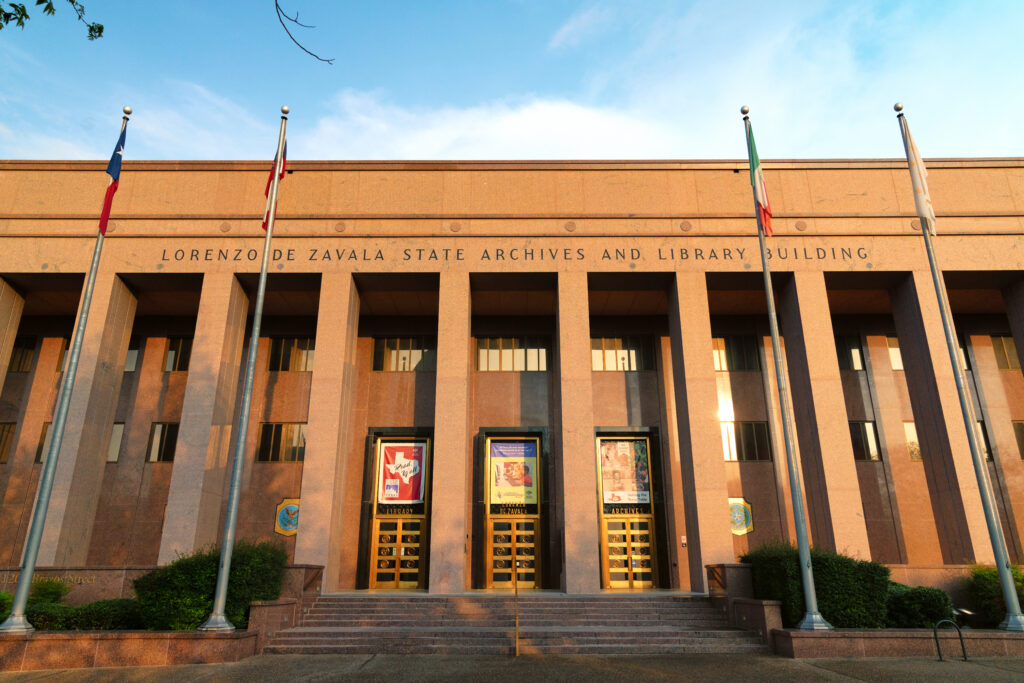
The Lorenzo de Zavala State Archives and Library Building in Austin, home of the Texas State Library and Archives Commission. Photograph by Tony Webster.

The Lorenzo de Zavala State Archives and Library Building in Austin, home of the TSLAC. Photograph by Tony Webster. Source: Wikimedia Commons

The inspiration for the song came when an archivist at the library was working to fulfill a request that required sifting through the records of the Texas Governor’s office. As anyone who has done archival research could tell you, it’s not uncommon for interesting and/or surprising material to come up in the process, even if it may have little to do with the main topic of interest. Finding a brief letter from Harriet Ross, the archivist called Meg and the rest of the team over to take a look. She and the other employees at TSLAC were immediately struck by it. Meg recalled, “Being a musician, when I read the letter, I was like, ‘This should be a song. No doubt about it.’” She took a photograph of the letter and kept it, though she did not write the song immediately. In July 2024, after having left TSLAC, she revisited the letter and began research to inform the songwriting process.

The first clue for learning more about Harriet Ross’s world was the return address on her letter, which traced back to the Sauquoit Silk Mill in Pennsylvania. After looking through resources from historical associations in Scranton and finding only minimal information about this mill where Ross presumably worked or at least lived, Meg turned to a documentary on a silk mill in New Jersey, featuring interviews with former workers—most, if not all of them women—who could elaborate on the working conditions. “Similar to how young boys, called ‘breaker boys’, would help in the coal mines, young women and girls, often recent immigrants, would be hired to work ten-hour days six or seven days a week in the silk mills,” Meg explained. The limited specific evidence available about Ross meant that she had to fill in the gaps with a mix of empathy and imagination. “I could assume that she wanted to escape the life that she was living”, she explained, adding, “And who knows where she first heard about the idea of a cowboy. Some people I asked suggested that she might have read dime-store magazines, which could have given her a romantic image of the ‘Wild West.’ I could only imagine that escaping to Texas to live with a cowboy sounded like the complete opposite of the dark, industrialized atmosphere she lived in.” As an art form, songwriting allows a more imaginative approach to source analysis than one might find in academic writing. At the same time, the use of detail and terminology grounded in background research helps make the song’s image of the past more convincing.
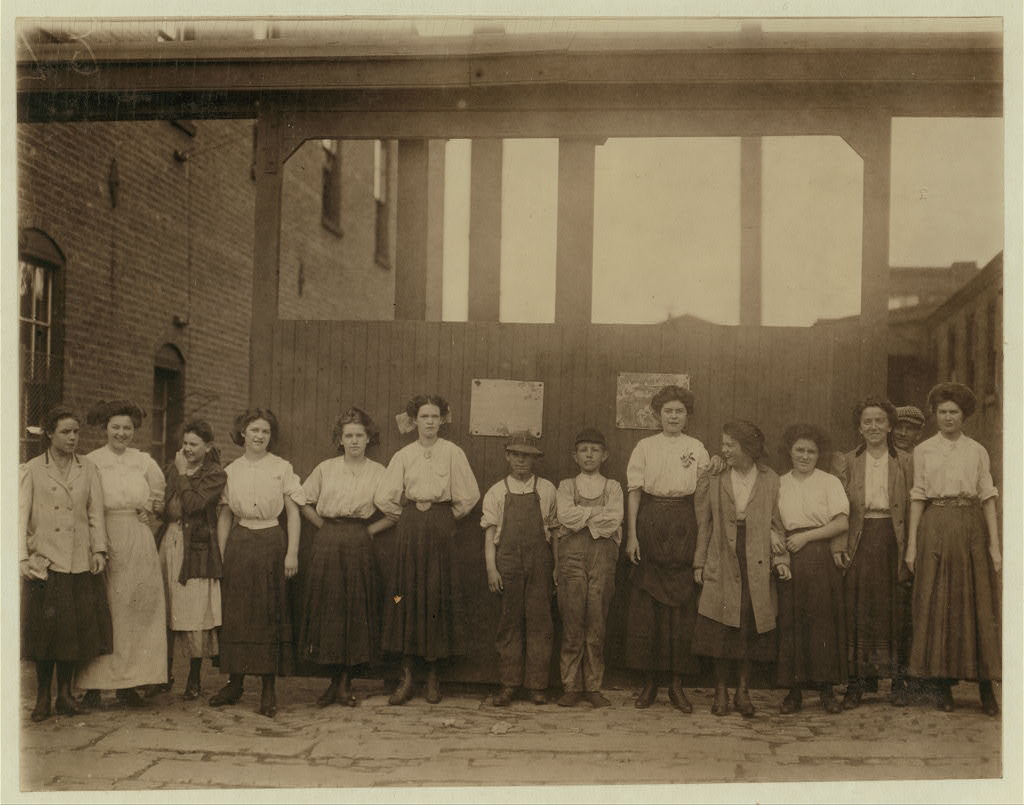
Workers at Hand Silk Mill in Wilmington, Delaware, May 1910. Photograph by Lewis Wickes Hine.

 Workers at Hand Silk Mill in Wilmington, Delaware, May 1910. Photograph by Lewis Wickes Hine. Source: Library of Congress

For Meg Lauren, the value of writing and performing a song like “Harriet Ross” comes from its ability to draw attention to the experiences of historical actors typically left out of dominant narratives. “A lot of our history is often told through the eyes of certain groups, primarily white men, and as a consequence, there isn’t a lot of documentation of working class or poor immigrant men and women, especially young girls that would have been in Harriet Ross’s position”, she observed, “Because there’s not this whole picture I can paint of her life, I can use my own artistic imagination to create her whole world or at least a snapshot of what her world would have been like and elevate a story of someone who would otherwise remain unknown.” Besides coming across as endearing and somewhat sweet, telling the story of Harriet Ross’s letter to the governor also allows audiences to feel a connection with, and gain awareness of, a historical actor who would otherwise be unlikely to appear in a history textbook. The audiences that the song can reach, moreover, very likely include people who might be less likely to read about history in the first place, adding to the potential value and meaning of a song like Harriet Ross. With its relatable and memorable lyrics, Meg’s song demonstrates how even fragmentary archival evidence can inspire new forms of historical storytelling and bring subaltern actors from the past to life.

While her song Harriet Ross has not been released, she hopes to record it either at the end of this year or the beginning of the next one. Meg Lauren’s other music can be found on Spotify, Apple Music, and other streaming platforms. On May 29, she released her EP, Strawberry Season.


Timmy Vilgiate (they/them) is a Ph.D. student in History at The University of Texas at Austin. They earned their B.A. and M.A. in History from the University of Colorado Colorado Springs. Their research looks at the relationship between assimilationist development projects and the study of psychedelic flora in the Sierra Mazateca from the late 19th Century to the mid-20th Century. Outside of history, they also enjoy playing music, sewing, and spending time with their cat Pedro.

The views and opinions expressed in this article or video are those of the individual author(s) or presenter(s) and do not necessarily reflect the policy or views of the editors at Not Even Past, the UT Department of History, the University of Texas at Austin, or the UT System Board of Regents. Not Even Past is an online public history magazine rather than a peer-reviewed academic journal. While we make efforts to ensure that factual information in articles was obtained from reliable sources, Not Even Past is not responsible for any errors or omissions.
The Global United States

By Mark A. Lawrence

For many students, the most exciting thing about history is not the scholarly monographs that we spend years researching and writing and they are often expected to read. Rather, many students are most intensely drawn to the study of the past by reading and analyzing primary sources – the original documents that constitute the raw material of history.

Primary documents can sweep us into the past, giving us direct access to the words, cadences, biases, insights, and passions of remote historical actors. History comes alive, and voices whisper across chasms of time, space, and perception. In the best case, such material can enable students to make their own judgments about the past and to weigh the claims of scholars.

To promote the study of primary source material in my field, the history of U.S. foreign relations, I teamed up with two colleagues over the last few years to compile a volume of documents that we hope will inspire students to delve further into the subject.

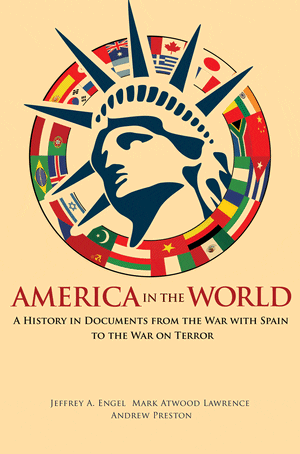
The book, America in the World: A History in Documents from the War with Spain to the War on Terror, encompasses about 125 years of history. It charts the rise of the United States from a peripheral, comparatively weak power in the late nineteenth century to the pinnacle of its military, diplomatic, and cultural influence in the early twenty-first. How and why did this momentous transformation occur? Who resisted and why? What were the attitudes of foreign nations as the United States became a great power of the first order and then surpassed them all?

Via 228 documents, the book helps answer these questions by inviting readers to consider the opinions and pronouncements of some of the people who took part in American policymaking and witnessed the American rise to power. Other historians have published collections of primary-source material on American foreign relations before. But our collection is new and different in at least three respects.

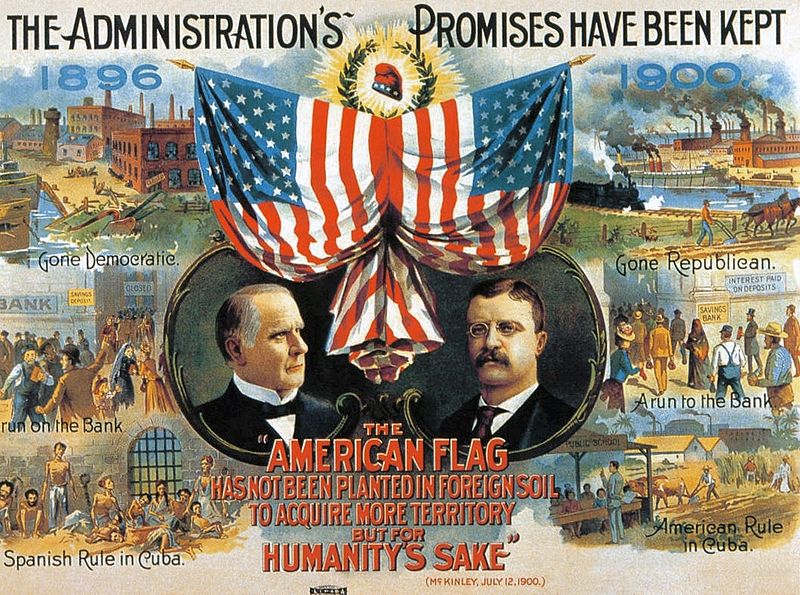
800px-The_Administration's_Promises_Have_Been_Kept
1900 campaign poster celebrating American imperial expansion

First, the book covers a relatively long period of time. Whereas most document collections focus on particular segments of this period, especially the Cold War, our book reveals and explores continuities across the larger flow of time, including the recent post-Cold War years. In fact, the collection features two chapters on the period since 1989, enabling readers to consider contemporary dilemmas faced by the Bush and Obama administrations in light of historical experience.

Second, the collection reflects key recent trends in the study of U.S. foreign relations. In recent decades, diplomatic historians have increasingly called into question the tendency among an older generation to write histories of U.S. policymaking on the basis of U.S. sources alone. Scholars should strive for a truly international kind of history that sets U.S. behavior within an international context and, by making use of foreign archives, views the United States through the eyes of foreign governments and peoples. Diplomatic historians in recent years have also called into question the field’s traditional focus on elite policymakers. Increasingly, scholars have recognized the need to take account of popular opinion and the influences of powerful people outside of government.

ellington6b
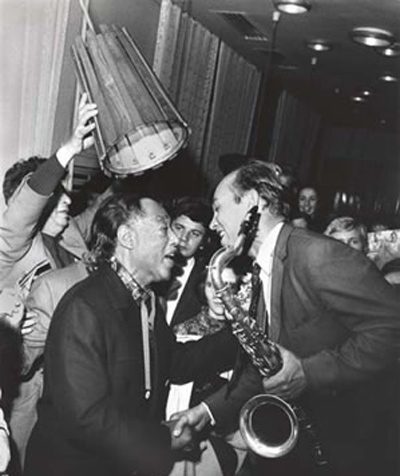
Duke Ellington in the Soviet Union, 1971. Ellington and his orchestra encountered a vibrant – if still partially underground – jazz scene and played with Russian musicians in both official and unofficial capacities. The band leader’s Soviet tour followed the announcement of the upcoming and historic trip to the USSR by President Richard Nixon, a pianist and avid jazz fan.

Our book takes account of both of these critiques of diplomatic history. To be sure, we include many documents reflecting the views of elite American policymakers – presidential declarations, policy memoranda, diplomatic dispatches, are still important sources. But we intermingle this kind of material, which has been the sole focus of nearly all the existing document readers in U.S. foreign relations, with two other kinds of documents: some reflecting foreign perceptions of the United States and others reflecting the opinions of Americans outside policymaking circles – clergymen, cartoonists, musicians, novelists, polemicists, and others.

Third, the book features relatively tight thematic coherence. There is, of course, an infinite number of documents that could reasonably have gone into our book. We handled the problem of over-abundance partly by building each chapter around a single interpretive question that guided our selections. Our chapters are not, that is, mere compilations of important documents related to a general topic or time period – the usual approach in document books. Rather, the chapters contain documents reflecting various perspectives on an interpretive problem that scholars have identified as crucial to understanding U.S. foreign relations. For example, the chapter on the great Cold War crisis of the early 1960s asks why the East-West conflict became so dangerous at that particular time. The chapter on the 1990s, asks how the United States reoriented its foreign policy following the collapse of the enemy that had given shape and purpose to American diplomacy for decades.

Coca-Cola_Morocco
Coca Cola in Morocco

Following this approach, we place conflicting points of view in dialogue with one another to show the development of particular sets of ideas over time. While this approach means that we pass over some important questions, it does, we hope, enhance the book’s appeal by giving the chapters a clear logic and flow.

Whether we have achieved our goals is for readers to decide. But one thing that I and my co-editors – Jeffrey A. Engel of Southern Methodist University and Andrew Preston of Cambridge University – can say for sure is that the book was no small undertaking. Although all three of us pursued other projects at the same time, locating, selecting, editing, and writing introductory material for 223 documents took far longer than we had anticipated – nearly a decade, in fact.

But we’re pleased with the end result, and we hope that innumerable students – and perhaps other readers interested in America’s foreign relations – will use it in the years ahead to find inspiration for the study of history.

Jeffrey A. Engel, Mark A. Lawrence, and Andrew Preston, eds., America in the World: A History in Documents from the War with Spain to the War on Terror

Mark Lawrence’s suggestions for Further Reading can be found here.


You may also enjoy:

Introduction to America in the World

Mark Lawrence on Not Even Past: “The Lessons of History,” “The Prisoner of Events in Vietnam,” “CIA Study [on the consequences of war in Vietnam]”

Jonathan C. Brown, “A Rare Phone Call from one President to Another“


Campaign poster: Wikimedia

Duke Ellington Collection, Archives Center, National Museum of American History, Smithsonian Institution

Coca cola in Morocco via Creative Commons, ciukes/Flickr

bugburnt

Hungary 1956. Crimea 2014? The New Archive (No. 7)

By Charley S. Binkow

With Russian troops on the ground in Crimea, Ukraine, it’s tempting to see parallels with Soviet invasions of the past. As the unique and pressing situation in the Ukraine develops, can historians look to history for guidance? Central European University’s Open Society Archives gives us a window into a similar invasion in Hungary in 1956.

1956

And while the Hungarian Revolution isn’t necessarily the same as the situation in the Crimea, it can help us ask some important questions:  Are Russian interests today different from Soviet interests of the past? What makes Putin different from Khrushchev or Brezhnev? While the origins of the incursions were different, both countries were invaded by a government in Moscow seeking to cement its sphere of influence. The OSA archives can help us dissect the Hungarian revolt to better understand the struggle of the Ukrainian people today.

300-5-48--3-1-7_000281

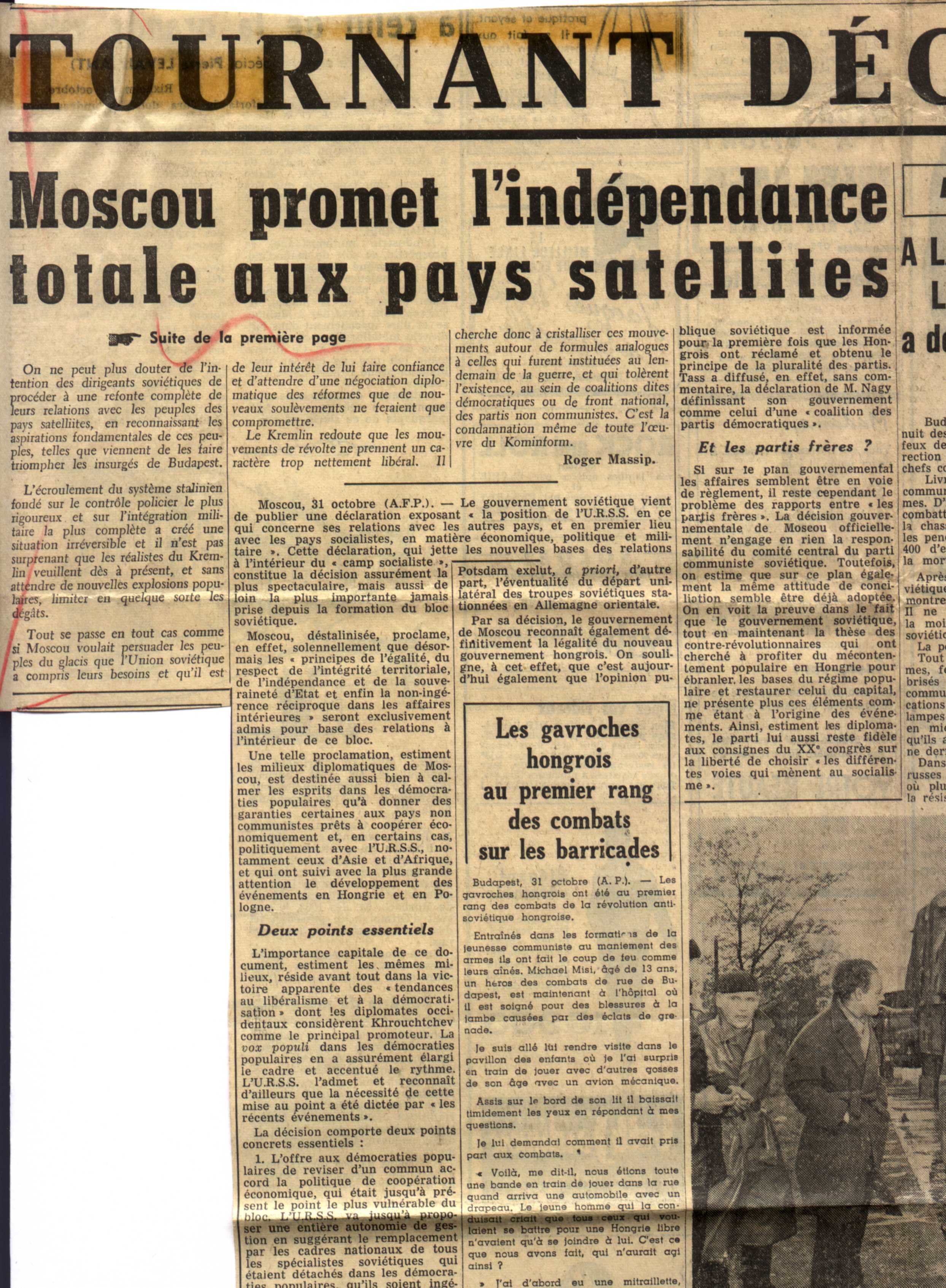
“Moscow promises total independence to its satellites”

With hundreds of primary documents, news sources, and historical overviews, the archive offers an expansive and in-depth look at the Hungarian struggle.  There are several collections from Radio Free Europe/Radio Liberty that offer background reports, newspaper and television excerpts, and various selected documents all germane to the revolt.  You can read articles from The Guardian, memorandums about Hungarian secret prisons, reports from the Associated Press detailing the state of Hungarian refugees, and much more.  Articles and videos in half a dozen languages give us a perspective into the international attention that the uprising received.  One German magazine asks: “Wer will das alles Verantworten?” (“Who will be responsible for all this?”)

OSA archive1

The site also strikes a personal tone.  Columbia University’s Research Project Hungary (CURPH) has digitized its impressive collection of interviews.  These transcripts (written in English) catalogue the lives of hundreds of Hungarian refugees and their stories from 1956.  The catalogue is easy to search and is well worth perusing.

Historians and history lovers can get a lot out of this collection.  The site’s size and navigability reward exploration; rarely does one find an uninteresting document.

bugline2

You may also like earlier reviews from The New Archive:

Henry Wiencek on “Sound Maps”

Charley Binkow on Black History sources on iTunesU

Recent Posts

  • Meg Lauren’s Songs from the Archive
  • Curating History: Dr Pepper, Preservation, and Public Trust
  • The Brands of Garrison Hall at its Centennial
  • The Battles of the Alamo and the Myth of Southern Exceptionalism
  • Primary Source: Magic, Metal, and Medicine in Leonhard Thurneysser’s Paracelsus
NOT EVEN PAST is produced by

The Department of History

The University of Texas at Austin

We are supported by the College of Liberal Arts
And our Readers

Donate
Contact

All content © 2010-present NOT EVEN PAST and the authors, unless otherwise noted

Sign up to receive our MONTHLY NEWSLETTER

  • New
  • Features
  • Reviews
  • Texas
  • Teaching
  • Digital
  • Watch & Listen
  • Authors
  • About