• Features
  • Reviews
  • Teaching
  • Watch & Listen
  • About

The past is never dead. It's not even past

Not Even Past

Everyday Crimes: The Shop on Main Street (1965)

imageBy Tatjana Lichtenstein

“They did it.  Not us!”  According to historian Tony Judt, this was the way Europeans tried coming to terms with the fate suffered by their Jewish neighbors during the Second World War.  Pointing their fingers at the Germans, other Europeans chose to repress the memory of widespread participation or acquiescence in the persecution of Europe’s Jews.  The role of ordinary people in betraying their Jewish neighbors, often in the hope of material rewards, appears in survivor testimonies and was remembered by families and communities as the war came to an end.  Nevertheless, this knowledge was suppressed in the name of reconstruction, a process of social, political, and moral reconstitution after years of occupation and war.  It took a generation before historians, writers, filmmakers, and other voices began questioning this public memory of the Second World War.  In Germany, the Auschwitz Trial (1963-1965) confronted Germans with the Nazi past, and in France, the documentary The Sorrow and the Pity (1969) created a storm of controversy and helped break the taboo surrounding collaboration with Nazi rule.  In communist Eastern Europe, the 1960s witnessed similar challenges to popular memories by writers, artists, and other activists.

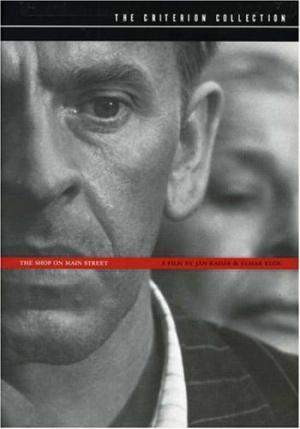
The Academy Award-winning, The Shop on Main Street was one of a series of Czechoslovakian films that looked critically at the participation of regular people in the Holocaust.  Set in a small town in Slovakia, at the time a Nazi puppet state, the film suggests that ordinary men and women were deeply involved in the destruction of Jewish lives.  In difficult conditions, good people do bad things; this is the tragic story of just such a person.

In 1942, Tono Brtko, an underemployed carpenter, embarks on his ‘career’ as an Aryanizer, the non-Jewish manager of a store belonging to the elderly, Jewish widow Rozalie Lautmann, played by the famous Yiddish actress Idá Kaminská.  Driven by an ambitious, domineering wife and his own desire for greater status, Tono becomes a mild-mannered oppressor, but his affection for Mrs Lautmann grows.  Unable to comprehend the new moral order and hence Tono’s real business in her shop, she embraces what she believes to be a new, helpful assistant as a long-gone son.  Kaminská and Josef Kroner as Tono give us complex, powerful, and deeply touching performances.  The film brilliantly investigates the ways people became morally and materially invested in the removal of Jews, the blurred boundary between bystander and perpetrator in moments of persecution, and the fragility of love and courage in times of fear.  Although the filmmakers invited audiences to reflect on the limits of personal responsibility in Communist Czechoslovakia, The Shop on Main Street raised questions that we continue to ask ourselves today:  Why do ordinary people become participants in the persecution and murder of their neighbors?

You may also like:

David Crew, Normal Pictures in Abnormal Times

A List of Films about the Holocaust

For more on Czech Jews, you can read Hillel Kieval, Languages of Community: The Jewish Experience in the Czech Lands
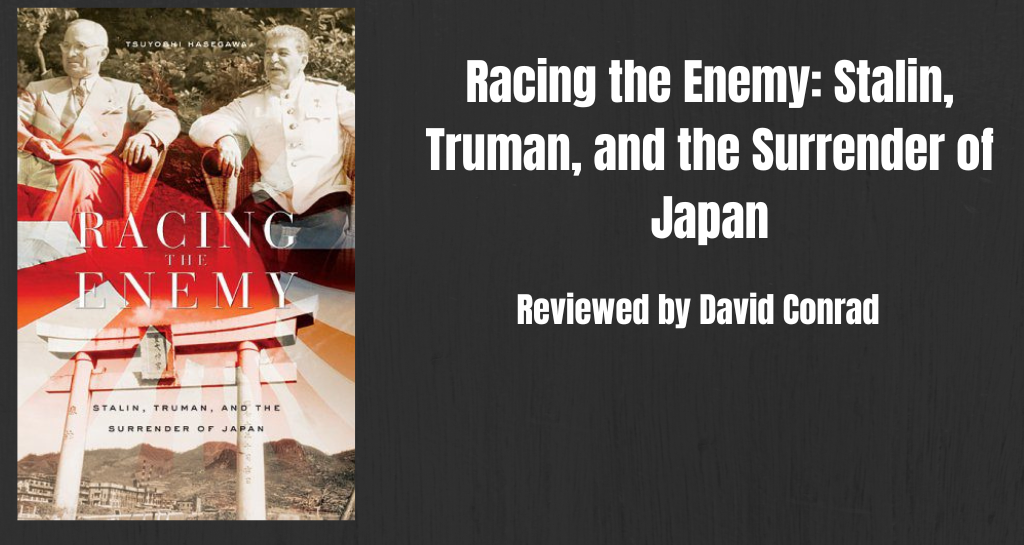
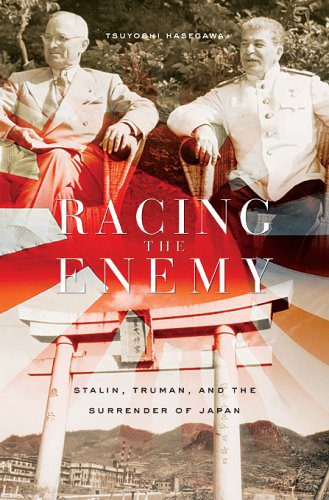
Racing the Enemy: Stalin, Truman, and the Surrender of Japan by Tsuyoshi Hasegawa (2006)

On August 6, 1945, the United States of America became the first (and so far only) nation to use atomic weapons against an enemy.  Since then, the world has wrestled with questions about the bombings of Hiroshima and Nagasaki: Did the A-bombs save American and Japanese lives by hastening Japan’s surrender?  Could the war have ended differently, with less loss of life?  Did the U.S. hope to strike terror in Stalin’s heart as much as in Emperor Hirohito’s?  How much did President Truman know about the bombs, and what did he think about their ethical implications?

These questions do not belong only to armchair generals and academics.  They belong to all inhabitants of this world of nuclear proliferation.  How do we find the answers to these important, emotional, divisive questions?  How do we separate facts from convictions and recreate the events that led to the destruction of two Japanese cities, the loss of hundreds of thousands of lives, and the start of the Cold War?

For starters, we can read Tsuyoshi Hasegawa’s magnificent page-turner, Racing the Enemy.  Hasegawa gives us a riveting, month-by-month, day-by-day, and even minute-by-minute narrative of the end of the war in the Pacific.  The story that emerges is very much a global one.  Hasegawa gracefully moves us from Washington to the Crimea, from Moscow to occupied Manchuria, from Tokyo to the Kuril Islands.  His assiduous attention to detail—to the treachery of time zones, to diplomacy lost in translation, to treaties made and violated—puts us in the thick of momentous and terrifying events.  Rival factions in the Japanese bureaucracy debate how to end the war with honor, Stalin plots territorial acquisition, and the U.S. government rejects diplomatic overtures in favor of an unprecedented show of force.

image

And what of the A-bombs?  According to Hasegawa, Japan surrendered primarily due to the threat of Soviet invasion; the shared fate of Hiroshima and Nagasaki merely provided a palatable public rationale.  The bombs signaled to Stalin that time was not on his side, and led him to hurriedly instigate the almost-forgotten final land battle of World War II.  Truman could have profitably pursued a negotiated, conditional peace, but for political and personal reasons he tacitly supported the use of the weapons of mass destruction.

Racing the Enemy is high political drama grounded in Japanese, Soviet, and U.S. archival material.  It will not be the final word on the end of the war, but it is a powerful and authoritative volume that all subsequent debate on the subject should reference.  No one with even a passing interest in the Pacific theater, atomic warfare, or the early Cold War can afford to miss it.

« Previous Page

Recent Posts

  • Primary Source: How Did Cary Coke Get Her Copy of Queen Catharine?
  • Tapancos and Tradition: Remembering the Dead in Northwestern Mexico
  • “How Did We Get Here” Panel 
  • Hidden Children and the Complexities of Jewish Identity  
  • Long Before the Field: Community, Memory, and the Making of Public History
NOT EVEN PAST is produced by

The Department of History

The University of Texas at Austin

We are supported by the College of Liberal Arts
And our Readers

Donate
Contact

All content © 2010-present NOT EVEN PAST and the authors, unless otherwise noted

Sign up to receive our MONTHLY NEWSLETTER

  • Features
  • Reviews
  • Teaching
  • Watch & Listen
  • About