As the nation celebrated the 2025 Fourth of July, flash flooding swallowed the Texas Hill Country. An entire summer’s worth of rain fell in the area, causing the Guadalupe River to rise dramatically in mere minutes. This disastrous deluge tragically claimed the lives of over 100 people.
President Donald Trump declared the flood a major disaster on July 6, which allowed the affected areas to receive federal relief funding via the Federal Emergency Management Agency (FEMA). Critics have charged FEMA with moving too slowly. Such charges are nothing new. The story of FEMA’s creation and track record is a quintessential example of the ongoing tension between the local and the national in political matters.
Since the dawn of the twentieth century, disasters have become problems for which the technocratic ranks of society tried to solve by employing methods of social engineering. These solutions were frequently intertwined with the political beliefs, ideologies, or agendas held by respective actors. Federal officials began funding and organizing disaster relief operations through the American Red Cross. Prior relief operations were piecemeal, ad hoc, and mostly viewed as local, not national issues. When the Red Cross became a federally funded organization in 1900, this changed the way the U.S. administered disaster relief. The Red Cross acted with a large degree of autonomy because of a substantial donor base made up of private citizens and did not necessarily need a federal mandate to alleviate suffering from a flood, earthquake, or hurricane.
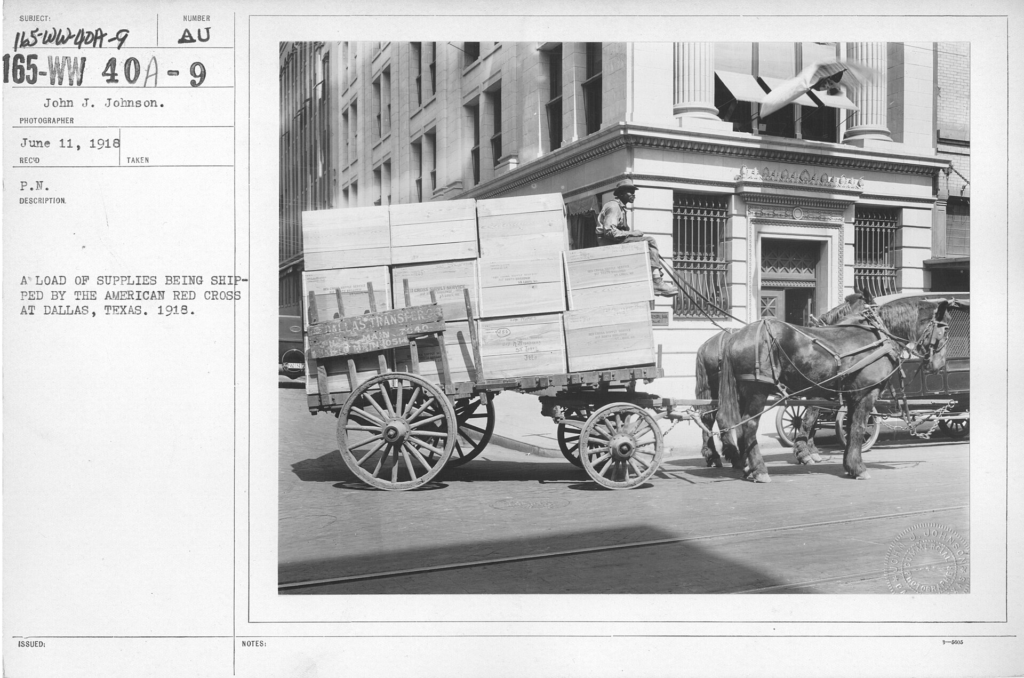
A load of supplies being shipped by the American Red Cross at Dallas, Texas. 1918. Source: U.S. National Archives and Records Administration
The Red Cross’ increased role directly stemmed from a national humanitarian awakening during the Progressive Era (1880-1920). Progressive Era ideals about social control, societal uplift, and racial hierarchy guided how the Red Cross prioritized those who needed aid after a disaster. Frequently, African Americans, Latinos, and those in colonized spaces like Puerto Rico, Guam, and the Philippines, etc., were continually excluded from receiving disaster relief from the Red Cross during this era. The most egregious instances of neglect came in Puerto Rico when several hurricanes devastated the archipelago in 1899, 1928, and 1932. On the mainland, African Americans were forced to perform manual labor to receive aid, were ushered into segregated relief camps, and those who perished were buried in unmarked mass graves following a hurricane in Galveston, Texas, in 1900 and after the Mississippi Flood of 1928. These precedents established by the Red Cross continued to guide the U.S. federal government’s approach to disaster relief throughout the rest of the twentieth century and into the twenty-first century.
Despite administering millions of dollars of aid and deploying the Red Cross on thousands of missions, a consistent disaster policy proved elusive. All previous relief needed Congressional approval, which significantly delayed response times and almost always resulted in a less-than-desired funding package. The Federal Disaster Relief Act of 1950 or Public Law 875, as it became known, changed that. The Act allowed the President to declare a state of disaster and disburse funds directly to the afflicted area instead of waiting on Congress to vote. This proved a double-edged sword because while federal disaster relief responses were more efficient, this Act allowed the President to wield significant executive power over the states and overseas territories. Thus, a new “social contract” was forged between the federal government and the citizenry, where the former assumed more responsibility for what previously had been state or local issues.
Under the Eisenhower administration, disasters truly became a federal responsibility by appointing the Federal Civil Defense Administration (FCDA) as the lead federal agency in disaster response. Previously, the Red Cross was the only quasi-federal agency mandated to handle disaster relief, but because of the highly politicized Cold War fervor and fear of nuclear attack, the FCDA assumed the responsibility. Suddenly, “tornado drills” began to look eerily like “air raid drills.” This linkage between disaster and national security could have only taken shape in the political milieu of the Cold War. This dramatic change in disaster policy strengthened the centralized power of the federal government over the states and territories. However, by the late 1970s, this arrangement lacked efficiency and coordination.
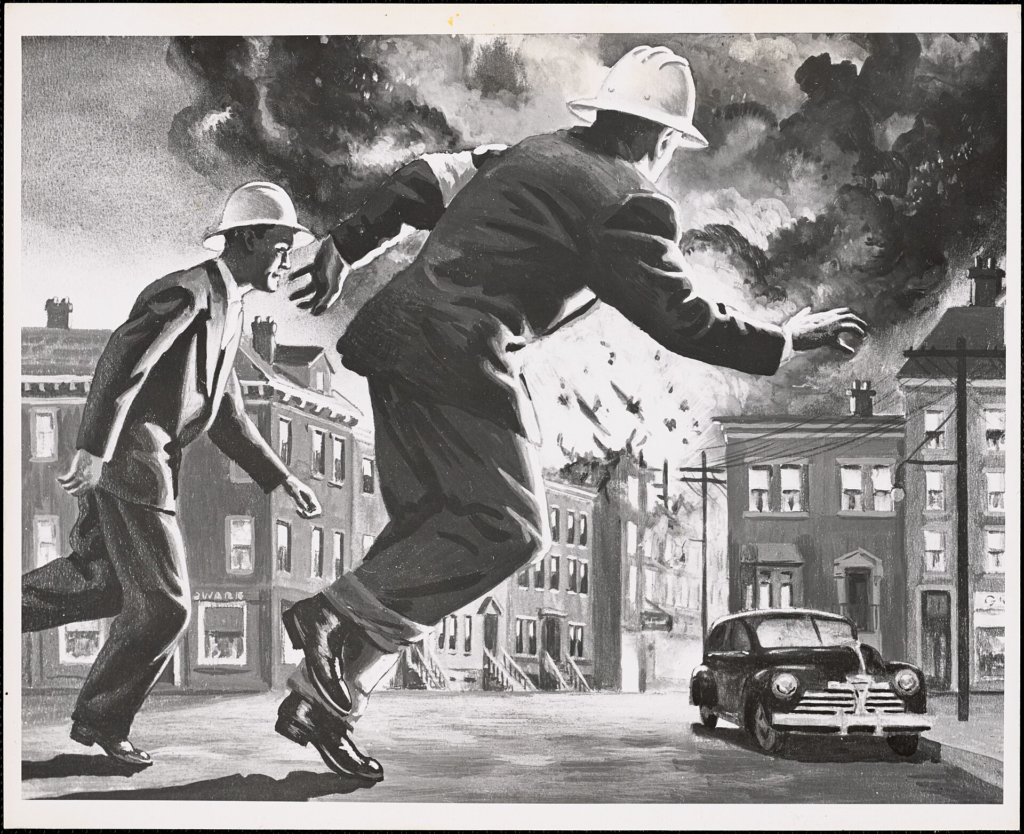
A product of the US Federal Civil Defense Administration, c. 1954. Source: Wikimedia Commons
The Carter administration recognized that by 1978, over twenty federal agencies were planning, training, and executing disaster relief missions. In addition, the Love Canal toxic waste disaster in New York and the Three Mile Island nuclear accident became part of the national conversation in the 1970s as citizens lobbied for more government accountability and adherence to disaster relief resilience. Love Canal was originally built to connect the upper and lower Niagara Rivers, but the project failed and became a chemical dumping site for the Hooker Chemical Company. The company sold the land to the city, filled in the toxic waste, and the city developed houses and schools on top of the land. The conditions in the area were already poor because of the chemicals left behind, and excessive rains in 1978 exacerbated the situation when floodwaters carrying the chemicals spread throughout town. Women and children bore the brunt of this disaster as initially many received chemical burns, and long-term impacts included birth defects and miscarriages. Neighborhood women spoke out against these conditions and became the face of the local and national movements to mitigate these types of disasters.
On March 28, 1979, the Three Mile Island nuclear plant nearly experienced a meltdown after a valve was accidentally left open. The incident threatened immediate consequences to public health and risked escalating into an explosion. Harmful levels of radiation were released around the site and this led to a public outcry against nuclear energy, which questioned the preventative strategies employed by the federal government. A federal hearing about Three Mile Island took place, and it was determined that the site should be shuttered and a massive cleanup effort ordered. In the age of nuclear technology, this proved a massive failure on the part of the U.S. federal government.
The political fallout from the tragedies at Love Canal and Three Mile Island prompted the federal government to take disaster relief and mitigation more seriously. President Jimmy Carter created FEMA in 1979 by executive order. Carter envisioned a single government entity that oversaw all aspects of disaster relief, the funding, coordination, and on-the-ground operations. However, FEMA was built on a shaky foundation. When consolidation occurred in July of 1979, it became a bureaucratic nightmare. A 1980 intergovernmental report described how FEMA was supposed to operate and listed 24 bullet points outlining FEMA’s responsibilities. These ranged anywhere from delivering disaster assistance to developing policy related to riot insurance. In addition to providing on-the-ground relief operations, FEMA also developed a new process for individuals to file claims to receive increased aid in the form of grants. However, the process to apply for this aid proved extremely cumbersome and intricate. These seemingly unnecessary steps to obtain aid continue into the twenty-first century, with the process still proving difficult for many ordinary Americans living in both the domestic U.S. and the territories.
![Hurricane Frederic. Two days after the hurricane struck President [Jimmy] Carter and a number of other White House officials, senior Corps officers, and representatives from FEMA and other federal agencies surveyed the area. Twenty-nine counties in three states were declared disaster areas. [President Jimmy Carter (left) talks to Mobile District Engineer Col. Robert Ryan about the devastation of Hurricane Frederic and the Corps recovery operation plans in Mobile, Ala., in 1979 (Chief of Engineers Lt. Gen. Joseph K. Bratton and Director of Civil Works Maj. Gen. Elvin R. Heiberg look on].](https://notevenpast.org/wp-content/uploads/2026/04/image-8-1024x701.png)
President Jimmy Carter with Mobile District Engineer Col. Robert Ryan, Mobile, Alabama, 1979. Source: Wikimedia Commons
People found ways to work through these systems or to go around them. Through local activism and community solidarity, certain areas afflicted by disasters attempted to eschew federal disaster relief and FEMA altogether because they believed that aid did more harm than good. In the case of Hurricane Maria in Puerto Rico in 2017, Puerto Ricans developed local networks of relief to sidestep FEMA and exercise disaster relief sovereignty instead of relying on federal assistance that was delayed, or, in some instances, never came.
Disaster relief in the United States evolved from the ad hoc efforts of the Red Cross to the centralized bureaucracy of FEMA. Despite these profound changes, there are recurring patterns, most notably the ongoing tension between local needs and national responses. As the recent floods in Texas show, the questions raised a century ago remain unresolved today: who is responsible in moments of crisis, and how can that responsibility be exercised both effectively and equitably? The history of disaster relief in the United States reveals that technical solutions are often entangled with political decisions.
Ian Seavey is an Assistant Professor of History at the University of Texas at Rio Grande Valley. His research centers on the intersection of U.S. foreign relations and disasters.
Colton de los Santos is a student of Religious Studies in the Liberal Arts Honors Program at the University of Texas at Austin.
Antonio Arguelles is a student at the University of Texas at Austin.
The views and opinions expressed in this article or video are those of the individual author(s) or presenter(s) and do not necessarily reflect the policy or views of the editors at Not Even Past, the UT Department of History, the University of Texas at Austin, or the UT System Board of Regents. Not Even Past is an online public history magazine rather than a peer-reviewed academic journal. While we make efforts to ensure that factual information in articles was obtained from reliable sources, Not Even Past is not responsible for any errors or omissions.