This and other articles in Primary Source: History from the Ransom Center Stacks represent an ongoing partnership between Not Even Past and the Harry Ransom Center, a world-renowned humanities research library and museum at The University of Texas at Austin. Visit the Center’s website to learn more about its collections and get involved.
To my fellow researchers: if you are lucky enough to find yourself at the Harry Ransom Center (HRC), you should definitely consult with Dr. Aaron T. Pratt, the Carl and Lily Pforzheimer Curator of Early Books and Manuscripts, who is immensely knowledgeable and helpful. But be warned: Pratt is a bibliographical púca in a knit cap, leading you off your planned route into research parts unknown.
The will-o-the-wisp I followed came in the guise of The Historie of the Civill Warres of France, translated by William Aylesbury and Charles Cotterell, and printed by Ruth Raworth in 1647-8. When I sent Pratt an image of a typographical ornament in Civill Warres, I was certainly not expecting him to point out that the HRC’s copy of the book appeared to have different ornaments than the digitized copy on Early English Books Online (EEBO).1 The next thing I knew, one copy of Civill Warres multiplied into four—three newly acquired—and I had well and truly wandered off the garden path into madness.
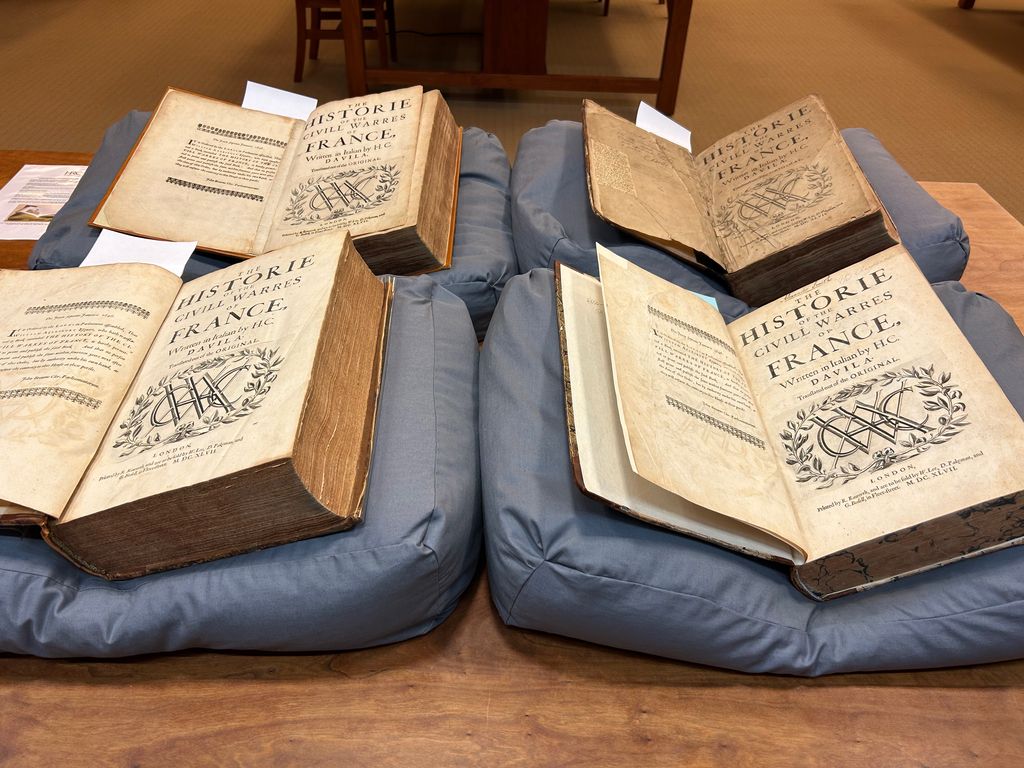
We determined that there were two versions of Civill Warres, which I refer to here as Versions A and B, with nearly identical title pages dated 1647-8. If this was a popular pamphlet, successively printed editions wouldn’t be strange, but Civill Warres is a massive folio. In fact, Raworth and Aylesbury planned to print only the first five chapters (around 102 sheets in folio) initially, to see if the demand warranted the financial investment necessary to print the other ten chapters (268 sheets) for a total of 1,478 pages, not including preliminaries—the perfect light beach read.2
Given the book’s size, it could have taken a single printing house, working at standard speed, between 12-24 months to complete, depending on the number of employees and printing presses. So, the basic question is this: given the enormity of the task, were both versions of Civill Warres printed by the Raworth house c. 1647-8? Or, was vB printed later, with false imprint dates on title pages deliberately set to match vA? Whenever the printing took place, were any other printing houses involved in the work? And what might asking these questions illuminate for scholars more broadly?
Rather than offer any straightforward answers to questions I am still debating, here is one strand of evidence that provides a potentially meaningful contribution. These books abound with bibliographical weirdness, such as running-title issues and stop-press corrections, all complicated by the sophistications of owners and booksellers; but the printers’ ornaments and ornamental capitals were what first caught our eyes, and since I was (originally) at the HRC to develop an ornament catalogue, it seems only right to start there. The ornaments in vB had always struck me as strange, since many of them do not appear in any other books from this printing house, either during the Raworths’ tenure or those of subsequent owners. During its first decade (1638-1648), the Raworth house compositors drew from a limited stock of ornaments repeatedly, so new ornaments always raise a flag. Did they buy them? If so, new or used? Borrow them from another house? Could sections containing unfamiliar ornaments have been printed by a different house? Publishers regularly divided printing jobs, particularly for large books, between multiple printers. Civill Warres has never been identified as a collaboratively printed book. Revising that narrative would change our understanding of an important woman printer’s career and business practices, and of the book trade networks at work during the critical period leading up to the regicide and establishment of the Commonwealth.
When C. William Miller catalogued the ornament stock of Ruth Raworth’s second husband, Thomas Newcombe, who became the house’s nominal owner after their marriage in 1648, he assessed the Raworths’ stock as “a good-sized one,” with “a wide variety of decorative initials and many large, generally attractive ornaments.”3 He admits, however, to examining far fewer Raworth publications, being primarily interested in ornaments used by Newcombe. Having now seen the majority of the books printed in the Raworth house, either in person or digital facsimile, I would characterize the Raworth stock somewhat differently. During John and Ruth Raworth’s tenures, although there are several ornaments and smaller decorative initials used repeatedly, there are a number of large decorative initials, and a few ornaments, used in a single book, never to appear again. A number of possible explanations exist. The appearance of an unfamiliar ornament could indicate shared printing between two or more houses, but some of the one-off ornaments are found in books too short for shared printing to be considered necessary. Alternatively, although they might have owned these ornaments, not all ornaments were physically suited to any publications—the decorative initials or large headpieces used for a large folio like Civill Warres would not be appropriate in size for smaller quarto or octavo books or pamphlets, which comprised the majority of the Raworth-produced books from 1638 until 1648. Ornaments broke, particularly old ones—something purchased second-hand, as they often were, might break after the run of a single book.
As other bibliographers have pointed out, many English printing houses had similar, if not nearly identical, ornaments, which hinders efforts to identify the printers of a given book based on ornaments alone. Even extremely common ornaments can often be distinguished through careful examination, however, and more elaborately decorated texts like Civill Warres frequently contain more unusual, recognizable ornaments, headpieces, and decorative initials. Here are three ornaments from vB that I have located in books by other printing houses. Following the movement of these ornaments could help to pin down when and by whom vB was printed.
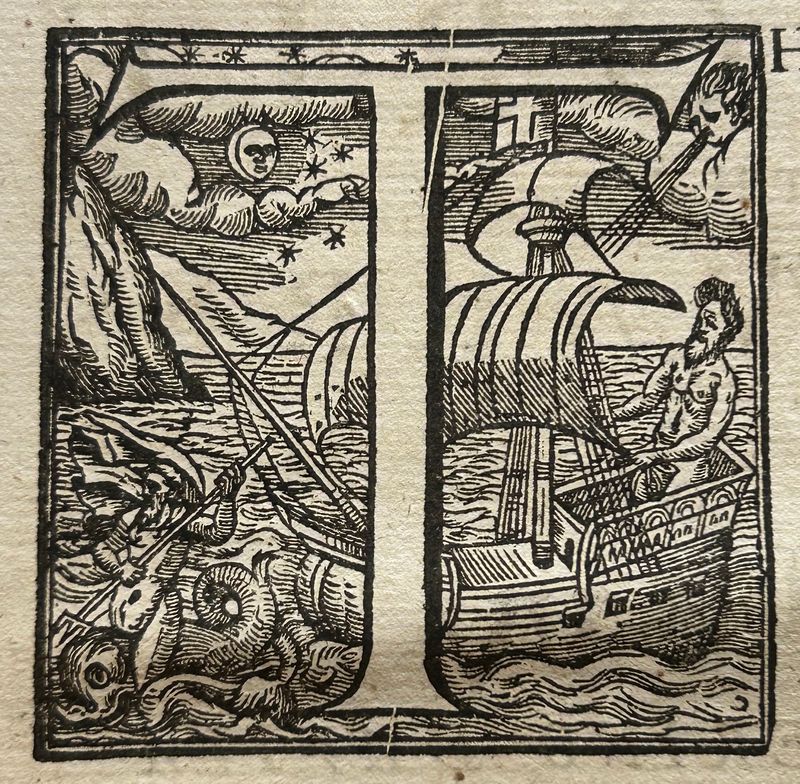
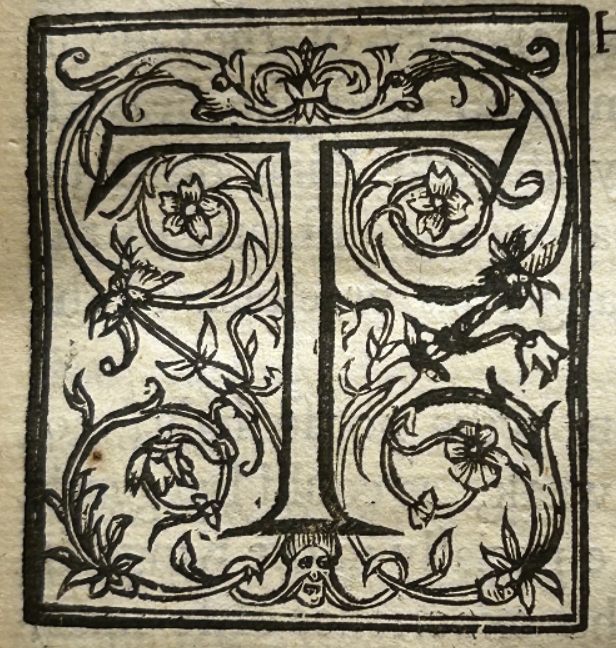
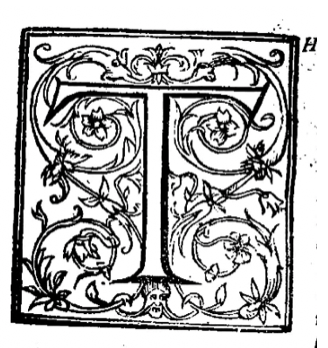
The imagery on this ornamental capital “T” reminded me of The Aeneid, so the label has persisted in my notes. There were at least three cuts of this ornament circulating during the 1630s and 1640s.
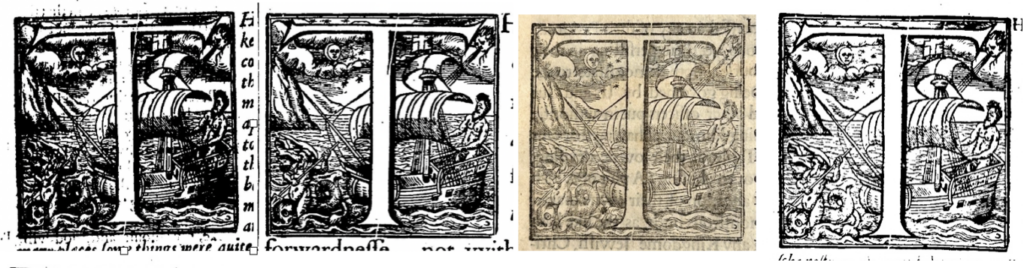
I have found Cut 1, the version in vB, in four other books so far. From left to right, they are:
- A Collection of Sundrie Statutes… printed in 1632 by Miles Flesher, John Haviland, and Robert Young
- Thomas Adams, Commentary…upon the second epistle, printed in 1633 by Richard Badger
- Walter Balcanquhall (for Charles I), A large declaration concerning the late tumults in Scotland, from their first originals, printed in 1639 by Robert Young
- Lancelot Andrewes, XCVI Sermons, printed in 1641 by Richard Badger
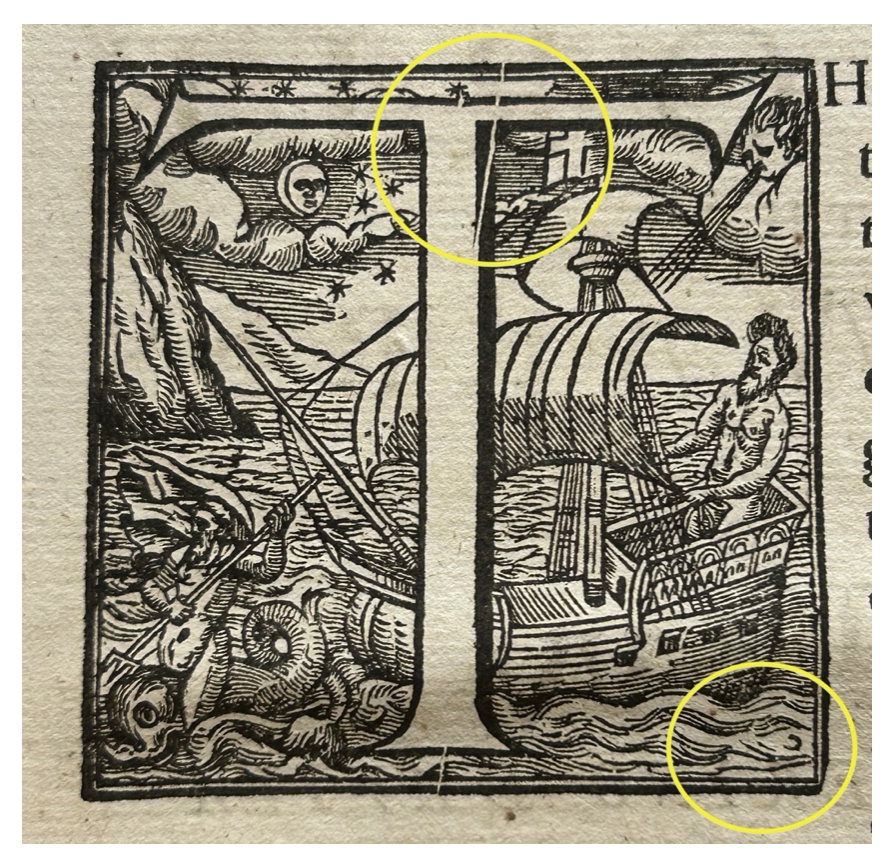
Below, I’ve circled some of the distinctive identifiers of Cut 1, particularly the crack across the top bar of the “T” itself and the backwards “c” in the corner. Although EEBO microfilms are less than ideal for this kind of work, these features are clear enough to be seen even in grainy black and white.
Cut 2 (left below) can be found in two books printed by Richard Badger: Michael Jermin’s Paraphrasticall Meditations (1638) and Lancelot Andrewes’ XCVI Sermons (1641), which actually uses Cuts 1 and 2 as well as a factotum of the same design. Cut 3 (right below) is seen from The Historie of the Council of Trent, printed in 1640 by Robert Young and John Raworth, where it appears in a section printed by the Young house.
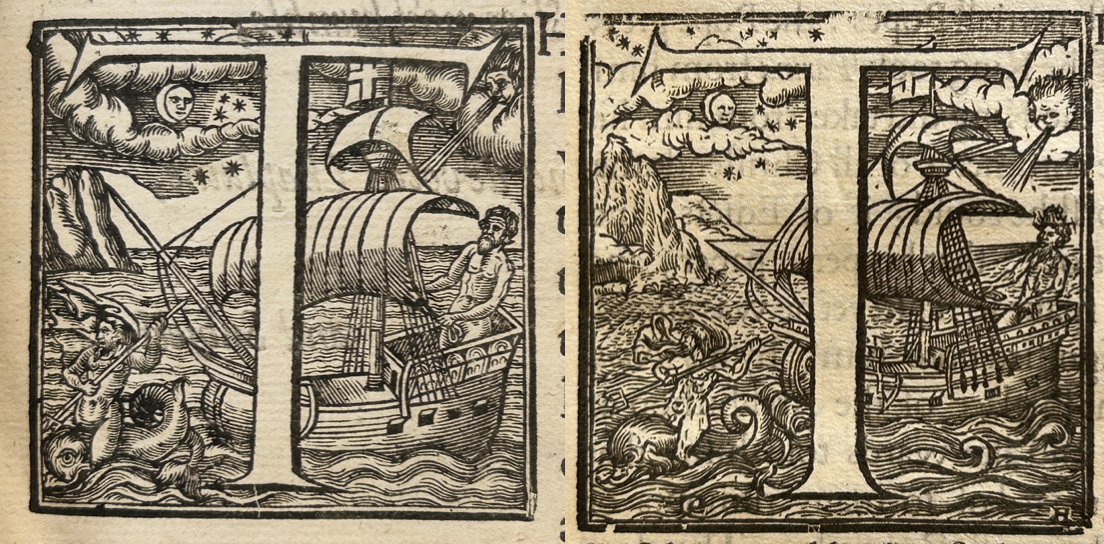
Comparing the three cuts side by side, there are clear differences not only in specific details (the placement of the stars, the corner initials) but in overall style. These variations occurred when the craftsman making a new ornament copied an existing design without worrying too much about the exact details.
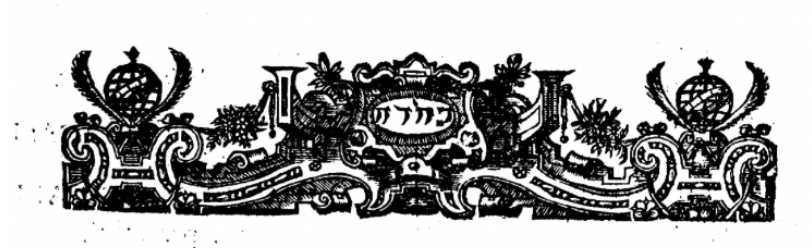
Whereas vA begins each chapter with the same, fairly generic headpiece, Part 1 of vB has two distinctive ornaments on the first pages of chapters 2-5, one of which is the globe headpiece.4
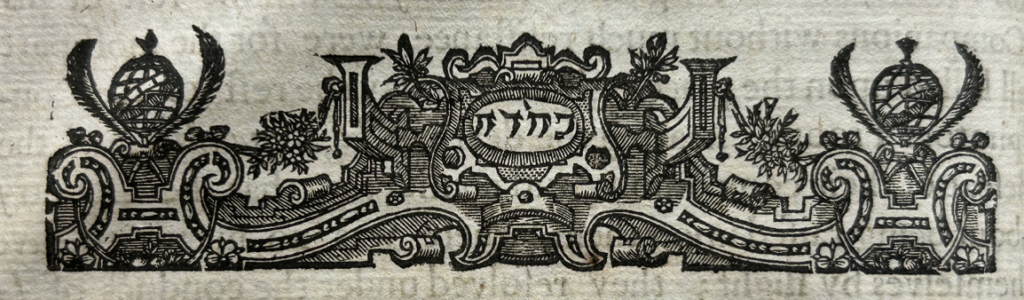
The globe headpiece appears in two books printed by the Young house (active 1625-1653), owned first by Robert Young, then his son James. Recall that the Youngs also printed books containing Cuts 1 and 3 of the “Aeneas T.” The globe headpiece appears in:
1. Du Bartas His Divine Weekes and Workes, printed by Robert Young for William Hope in 1641.
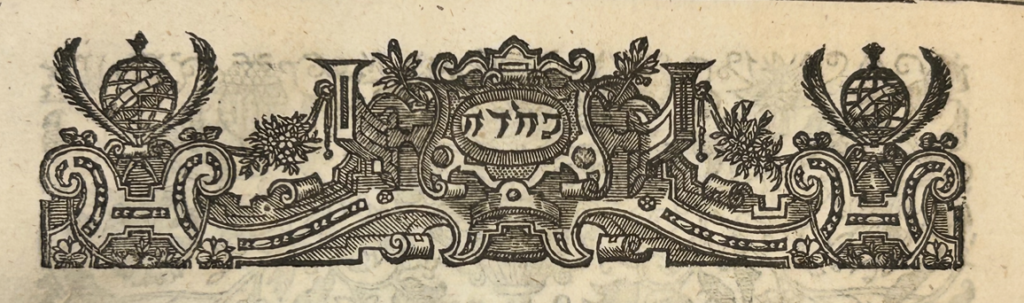
2. Henry and William Lawes, Choice Psalmes Put into Musick, For Three Voices, printed by James Young for Humphrey Moseley and Richard Wodenoth in 1648.
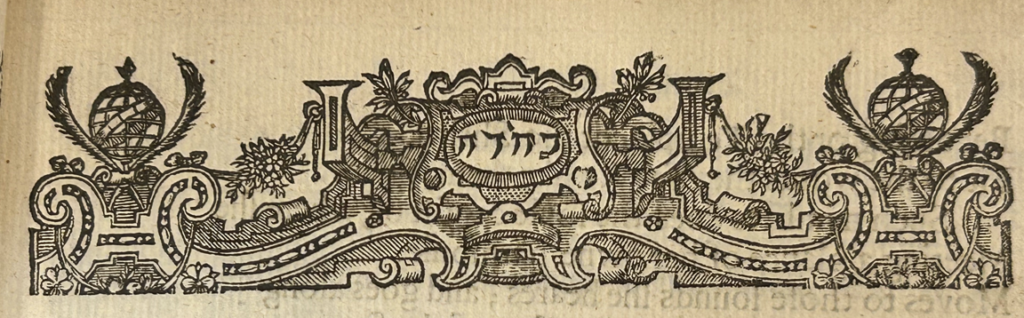
This does appear to be the same cut of the ornament—note in particular in all three examples the shape of the upper right quadrant of the left globe, a possible break in the hatching under the right globe, and the direction of the hatching throughout.
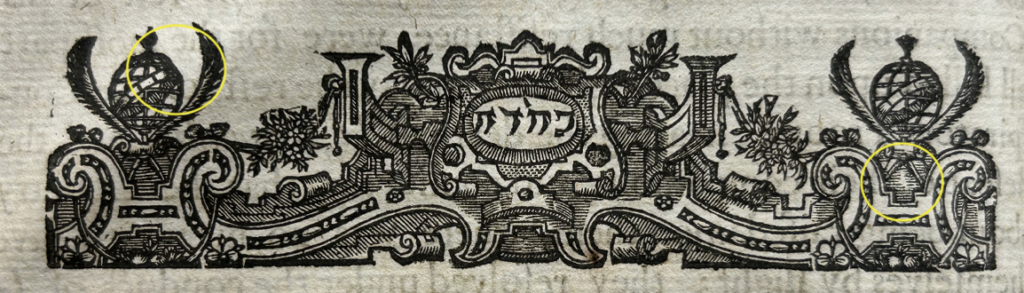
The appearance in the Lawes book is particularly provocative as it was published in 1648, the same year that part of Civill Warres was ostensibly printed.
The last ornament is another decorative “T,” which I call, creatively, the “swirly T.” I have found this ornament in one pre-1648 book: the 1629 edition of Lancelot Andrewes’ XCVI sermons, printed by George Miller for Richard Badger. Note the matching break along the bottom in both books, approximately 19 mm from the right corner.
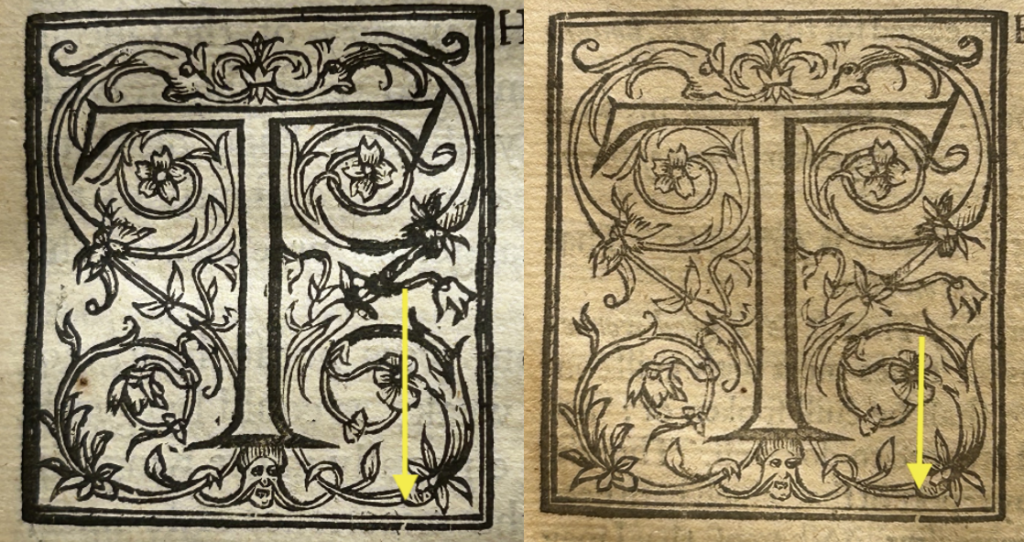
The 1629 Sermons was the final large publication of Miller and Badger’s four-year partnership, after which Badger struck out on his own. I haven’t located this “T” in any other Miller or Badger books yet, but it is possible that Badger retained some ornaments when the partnership dissolved.
When considering these three ornaments as a cluster, a compelling pattern emerges. Prior to Civill Warres, the “Aeneas T” appeared in books printed, in chronological order, by the Flesher-Haviland-Young consortium, by Richard Badger, by Robert Young, and by Badger again. The globe headpiece was used by Robert Young in 1641, then by his son James in 1648. George Miller and Richard Badger used the “swirly T” in 1629. Two names stand out in that list—Young and Badger.
So, where were these three ornaments in 1647-8? Both the Badger and Young printing houses held royal warrants in the 1630s and 40s—Robert Young was the king’s printer for Scotland, while Richard Badger was Prince Charles’ printer.5 The two houses published multiple publications together in 1640, mostly related to the king’s position on the Bishops’ Wars in Scotland. Richard Badger died in 1641. His eldest son, Thomas, had already established a printing house, so Richard left his printing materials to his youngest son, Richard Badger II. By 1647, both Thomas and Richard II appear to have died; Thomas’s widow, Frances, ran their business from 1646 until 1648, when she married former Badger apprentice Richard Constable. The fate of Richard II’s printing materials are murky—in 1645, a Mrs. Badger was given permission to print “those sheets of the Psalter she used to print.”6 This could have been Richard II’s widow, although I have found no record of his marriage. I’m inclined to think it was Richard I’s widow, Alice Badger, who lived until 1655; however, as I haven’t found other evidence that she continued printing, I can’t say for sure if she still owned the Badger ornaments in 1647-8.
The final bit of evidence, however, suggests that Young ended up in possession of some of the Badger ornaments. James Young inherited his father’s printing house c. 1643 and operated it for five years. Then, in June of 1648, James Young sold his titles to William Dugard, the headmaster of the Merchant Taylor School and a newly licensed master printer.7 James Young’s two apprentices were turned over to Dugard on the same day that he informed the company of the purchase. According to Leona Rostenberg, Dugard also acquired Young’s printing equipment, a claim borne out by typographical evidence.8 Dugard used the globe headpiece in Pharmacopoeia Londinensis in 1650, and at least twice more in the following years.9 And in 1655, the “swirly T” appeared in Dugard’s new printing of The Countess of Pembroke’s Arcadia.
So, what does this tell us about the production of Civill Warres? First, it is unlikely that these three ornaments ever belonged to the Raworth house, leaving borrowing ornaments or splitting the work with another house as the most viable scenarios. The Raworths had shared a printing job with the Youngs before, the 1640 edition of Sarpi’s The Historie of the Councel of Trent, in which the Young house employed Cut 3 of the “Aeneas T.” When asked to print Civill Warres, a folio of similar size and scale to the 1640 Sarpi, it might have been natural to seek assistance from the house they had worked with on the earlier project. If vB was printed c. 1647-8, Young might have either lent the ornaments to the Raworth house or printed sections of vB himself; however, if the ornaments changed hands in early 1648 along with the titles and apprentices, William Dugard could have been involved in producing vB instead. If vB was actually printed sometime after 1649, the ornaments were either used or lent by William Dugard.10
Combined, the two versions of Civill Warres used around thirty unique ornaments, each offering potential insights into this book’s story. These must of course be read alongside the evidence of the type itself, the paper, variations in the text, copy-specific details, and historical context. When it comes women like Ruth Raworth, whose lives are underrepresented in traditional archives, developing a better understanding of even a single book can contribute materially to piecing together their stories.
Molly Yarn is a book historian, theatre practitioner, and independent scholar, as well as a freelance indexer and editor. Her first book, Shakespeare’s ‘Lady Editors’: A New History of the Shakespearean Text, was published by Cambridge University Press in 2021/2. She is currently writing a book on women printers in London during the English civil wars and interregnum. This project has been awarded fellowships from the Newberry, Beinecke, and Houghton Libraries, the Harry Ransom Center, the Bibliographic Society (UK) and the Bibliographical Society of America. She holds a PhD from the University of Cambridge.
1 The EEBO copy is held at Yale’s Beinecke Library. The Boston Public Library has also digitized a copy, available on Internet Archive.
2 In Civill Warres, the sections are referred to as books rather than chapters, but that’s just too many uses of the word “book” in an already complicated work of book history.
3 C. William Miller, ‘Thomas Newcomb: A Restoration Printer’s Ornament Stock’, Studies in Bibliography, 3 (1950), pp. 155–70 (p. 156).
4 I have not located an exact match for the other header, which I call the skull header, although George Miller (with Richard Badger) was using some with a similar style in the 1620s and 30s. See, for example, Lancelot Andrewes, XCVI Sermons, 1629.
5 For more on the Badgers, see Peter McCullough, ‘Making Dead Men Speak: Laudianism, Print, and the Works of Lancelot Andrewes, 1626-1642’, The Historical Journal, 41.2 (1998), pp. 401–24, doi:10.1017/S0018246X9800781X; Peter McCullough, ‘Print, Publication, and Religious Politics in Caroline England’, The Historical Journal, 51.2 (2008), pp. 285–313, doi:10.1017/S0018246X08006729.
6 Court Book C, f.221.
7 W. R. Meyer, ‘Dugard, William (1606–1662), schoolmaster and printer’, Oxford Dictionary of National Biography (Oxford University Press, October 2009), doi:10.1093/ref:odnb/8182.
8 Leona Rostenberg, ‘William Dugard, Pedagogue and Printer to the Commonwealth’, The Papers of the Bibliographical Society of America, 52.3 (1958), pp. 179–204 (pp. 186–87).
9 In A short plea for the common-wealth in this monstrous and shaking juncture (1651) and Dialling Performed Instrumentally (1652).
10 Although James Young continued to print until his death c. 1653, the Young books after 1648 contain very few ornaments.
The views and opinions expressed in this article or video are those of the individual author(s) or presenter(s) and do not necessarily reflect the policy or views of the editors at Not Even Past, the UT Department of History, the University of Texas at Austin, or the UT System Board of Regents. Not Even Past is an online public history magazine rather than a peer-reviewed academic journal. While we make efforts to ensure that factual information in articles was obtained from reliable sources, Not Even Past is not responsible for any errors or omissions.