There was no reprieve from the cold or the hail that accompanied it. With each passing year, the weather claimed more homes, livestock, and children, even as the labor never ceased. In the late sixteenth century, the forests of Lorraine, once an independent duchy near the Netherlands, Luxembourg, and Franche-Comté, now part of northern France, were as alive with the chopping of timber and the clanging of metal tools on stone as with the howling of winter winds. The laborers of the region were able to briefly forget the cold, as they sweat over grain and vine. Claudette Dabo could not. Her feet ached; her aging bones could no longer handle the long miles on frozen sludge as they once had. She stopped at the side of the path, extending a shivering outstretched hand, but found little relief. Her neighbors avoided her gaze and passed her by not only because of their own hardships, but because they saw her as more than a sickly old woman. Between 1600 and 1614, the courts of Lorraine accused several people, including Dabo, of being a werewolf.[1]
Claudette Dabo had a forceful presence. Cantankerous and bold, her neighbors feared her. We do not know what she looked like, but we do know she was stubborn and resilient. She was born around 1550 into a tight community among several small river towns in eastern Lorraine.[2] Neither her mother nor her father ever strayed very far from the familiar mountains, and she followed suit.[3] Her work was inherently social as she visited and received other women as guests to exchange her handmade goods and manual labor for money and other necessities. Her wide network of confidants and colleagues extended across several towns.
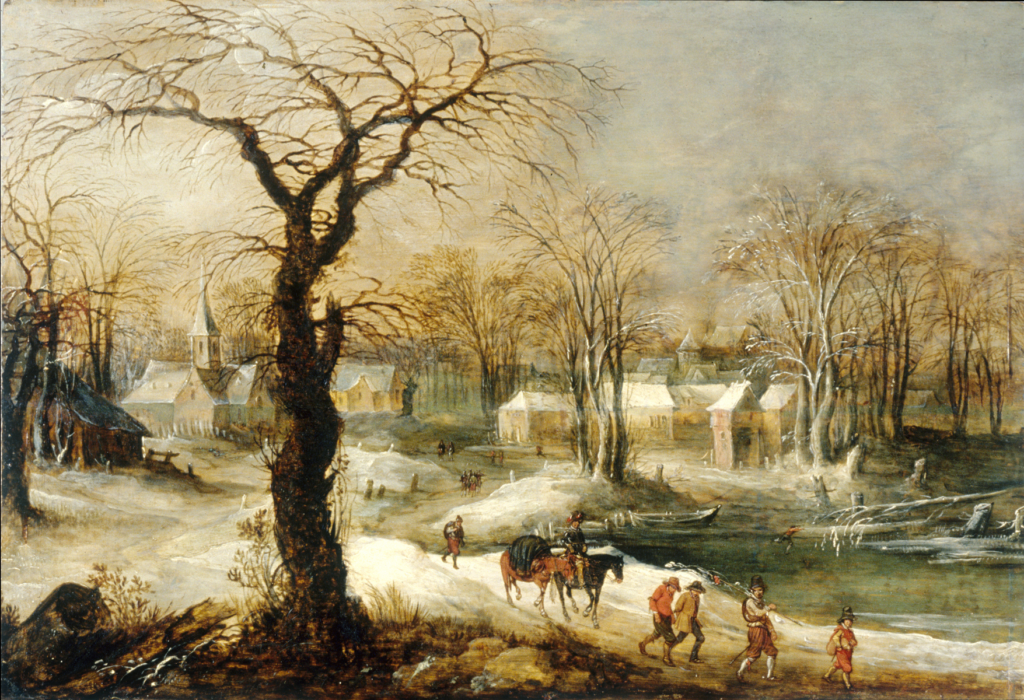
Winter Landscape Ca. 1620. Source: Wikimedia Commons
However, by the turn of the seventeenth century, these towns were gaunt and rotten. During the Little Ice Age (c. 1550–1700), hail fell frequently in this region, destroying crops and leading to large-scale famines. It was impossible to fatten infants when the crops themselves were thin, pale, and broken. The animals, too, adopted frail, unimposing figures. As if, at any moment, they could drop dead from disease or starvation. What little food there was frequently made the villagers fall ill. Regardless, they worked with what little they had.[4]
Sometimes a scream would disrupt the gentle sounds of work. The bleating of farm animals and quiet rasps of spades would come to an abrupt stop as the sounds of violence erupted nearby. Expansion efforts of neighboring states,the now decades-old French Wars of Religion and the nearby Dutch Eighty Years’ War threatened the townspeople with disease and marauders. French soldiers marched through, Dutch soldiers marched back, though to the farmers, it didn’t matter whether the soldiers were French, Dutch, German, or Spanish. They all brought suffering and the smell of stale blood, iron, and war with them.[5]
But it wasn’t just the people who noticed the smell—other animals did too. As with the frequent carnage came wolves. They came down from the Vosges Mountains to stalk neighborhoods and lurk along the forest’s edge. They too brought screams. Children and livestock, weak from their diets and hard work, became prey. Dabo’s stepchildren had long been too big and loud for the wolves, but her neighbors were not so fortunate.[6]
Lorraine had a substantial wolf population at the time, with farmers experiencing frequent attacks prior to their extinction in France in the twentieth century.[7] Historian Jay M. Smith argues that extensive bloodletting was one possible cause for such attacks, as in the case of the Beast of the Gévaudan, which purportedly terrorized southern France nearly a century later.[8] He argues that during the 1590s, because of the chaos of the Wars of Religion, wolves potentially attacked thousands.[9] The wolf population was notably large in Lorraine and Franche-Comté, likely peaking between 1600 and 1614 when the werewolf trials took place.[10] The threat of wolf attacks, particularly to children, was a horrifying reality.
The wolves served as a common enemy against which the predominantly Catholic townspeople could rally. They took up arms to thin the population, yet they suspected other actors could have been responsible for their misfortunes. The whispers grew louder the longer the wet, wintry months kept stomachs growling and coughs lingering. The misery in the town of Gratin was so great that the farmers began to speculate that demonic forces brought wolves and hail. Rumors took root, and fingers pointed to the poor and unpopular like Claudette Dabo.[11]
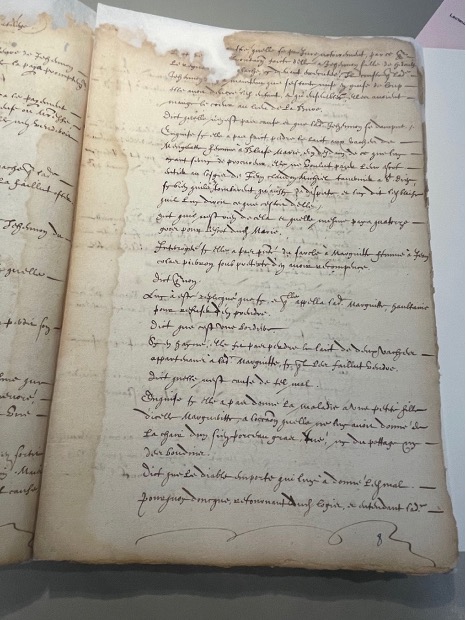
Série B, Cours et juridictions. B 7232-9130, Archives départementales de Meurthe-et-Moselle. Account accusing Dabo of transforming into a wolf.
By 1614, Dabo’s financial struggles became detrimental to her relationships within the community, from which she needed support.[12] During a time when everyone was poor, she was destitute. She opportunistically took advantage of neighborly interactions to ask for financial favors, slowly eroding her relationships. As the years went on, people refused her requests for butter and cheese more frequently.[13] Sometimes it was necessary for her to beg on the streets. She was also itinerant. When generosity ran low in one town, she would walk nearly 20 miles to the town where her mother was born to do so.[14]
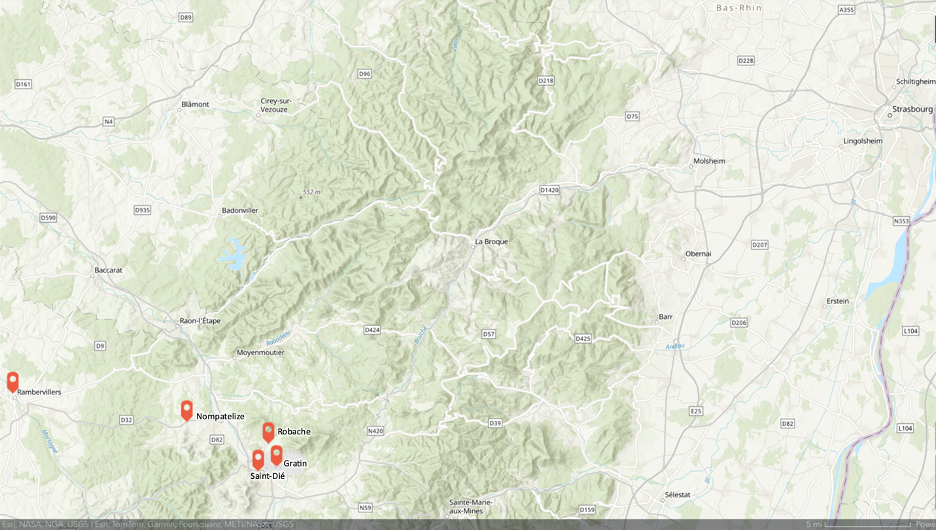
Lorraine and Alsace regions in the northeast of France[15]
Points on map are towns relevant to Dabo’s trial. Her mother was from Rambervillers, and her father was from Nompatelize. Dabo lived in Gratin but had spent the previous ten years living in Robache. Saint Dié was the location of the prosecuting office.
As misfortune followed her throughout her life, the farming villages she called home would, both literally and metaphorically, imprison her. Her contentious home life left her unsupported and alone. She was on her third marriage—this one no happier than the previous two. Having been twice widowed by the age of sixty and in constant turmoil with her immediate family made her the perfect subject of gossip. Regardless of whether or not she was guilty, she was the kind of person who people could believe was a murderer. In one instance, one of her stepsons accused her of killing several horses to spite him, and in turn, she accused him of attempting to kill her with an axe. On another occasion, a different stepson accused her of “pull[ing] away half his beard, and boast[ing] about it.”[16] The community agreed that she had been responsible for his eventual death as well as the deaths of her husbands, who reportedly routinely abused her. When an accused witch, Jehennon Renard, claimed that Dabo had transformed into a wolf and eaten the heart of a small child, people believed the claim.[17]
Accusations against Dabo, claiming she was a werewolf, were based on coincidence and her poor reputation in the community. When Renard accused Dabo, she claimed that they had both been in the form of wolves when they ate the child’s heart.[18] Historian Robin Briggs suggests that the accusation that Dabo and Renard ate the child’s heart may have reflected beliefs about magical practices used to influence trials.[19] After the initial accusation, local testimonies supported the belief that she had potentially transformed. Such accusations, however, were based entirely on Dabo’s proximity to coincidental wolf attacks. Witnesses to one wolf attack against another child claimed to have seen Dabo in the meadow immediately after.[20] Another man accused her of turning into a wolf after his livestock had died suspiciously in the wake of an argument with Dabo over her husband’s debts.[21] He recalled a time a wolf had nearly attacked his daughter, and proposed that Dabo had been the assailant.[22] These accusations pose the question: to what extent did the people of Lorraine believe Dabo was a werewolf? To what extent did they believe that werewolves existed at all?
Lycanthropy did not have one concrete definition, and early modern scholars pursued many different avenues to describe it. The word “lycanthrope” itself has Greek origins, drawing from the Greek lykos for wolf and anthrōpos for human.[23] In Pierre La Primaudaye’s 1618 philosophical work The French Academy, he noted Nebuchadnezzar II as an early lycanthrope, a state which he defined as a mental illness.[24] The French word for werewolf, loup garou, and its early modern translations provide more insight into different interpretations of the words werewolf and lycanthrope. Guy Miege’s 1677 English and French dictionary defined loup garou as a wolf that only consumes human beings, a sorcerer, or someone with a mental illness that believes themself to be a wolf.[25] Miege’s dictionary states, “Loup garou, a mankind wolf, a wolf that once being flesht on men and children will rather starve than feed on any thing else. Loup garou, sorcier, one that possessed with an extream[sic] and strange melancholy believes he is turned wolf, and behaves himself as a wolf.”[26] Similarly, English scholar Robert Burton cited lycanthropia, or “wolf-madness” as a disorder by which an individual believed they were a wolf and acted in such a manner in his 1628 book detailing different kinds of psychological issues.[27] Typically, Neoplatonists believed that literal transformation was impossible because man’s soul was too “noble” to exist within the body of an animal.[28] By the early modern period, scholars tended to define the werewolf as a mental illness or demonic illusion. These scholarly debates, however, mattered little in rural Lorraine, as people claimed to witness literal physical transformations during the Lorraine witch trials.[29]
Dabo often imposed her will on others and held her ground in confrontations. Even throughout the accusations and trial, she withstood torture for longer than many and resisted confession until the last possible moment. As she stood trial for witchcraft, no family members or friends testified in her favor. Those in whom she confided her escape plans shared the information with the court. The people of Lorraine accused her of turning into a wolf because the threat of some greater malevolent power offered a compelling explanation for their misfortune. What little we know about her and people like her comes from the mouths of their opponents, manipulated by courts with anti-heretical agendas. It is with this in mind that we read between the lines to uncover some truth about the lesser-known individuals instrumental to our understanding of history. The victims of the witch trials were often impoverished and/or social outcasts. These accused heretics and witches were scapegoats during times of hardship. The courts did not afford people like Claudette Dabo the luxuries of fairness or sympathy, and it is in understanding their deaths that we can understand the institutions that oppressed them.
Melina Olivas is a Master’s student in the History Department at the University of Massachusetts Amherst, pursuing a Certificate in Public History. She graduated with a BA in History and Government from The University of Texas at Austin with Special Honors in History. She is interested in the intersection between religion and animals in the medieval Mediterranean and making historical information more accessible.
[1] “Lorraine Witchcraft Trials” (website), w273 B 8712 no 2; “Claudette femme Jean Dabo, Grattain (1614). Destitute.”
[2] Série B, Cours et juridictions. B 7232-9130, Archives départementales de Meurthe-et-Moselle.
[3] Série B, Cours et juridictions. B 7232-9130, Archives départementales de Meurthe-et-Moselle.
[4] Robin Briggs, The Witches of Lorraine, (Oxford: Oxford University Press, 2007).
[5] Sarah Ferber, “Reformed or Recycled? Possession and Exorcism in the Sacramental Life of Early Modern France,” in Werewolves, Witches, and Wandering Spirits: Traditional Belief and Folklore in Early Modern Europe, ed. Kathryn A. Edwards, (University Park, USA: Penn State University Press, 2003), https://doi-org.ezproxy.lib.utexas.edu/10.1515/9780271091099-010.
[6] Jay M. Smith, Monsters of the Gévaudan the Making of a Beast, (Cambridge, Mass: Harvard University Press, 2011).
[7] Jean-Marc Moriceau, “The Wolf Threat in France from the Middle Ages to the Twentieth Century,” (2014): 12 ffhal-01011915.
[8] Smith, Monsters of the Gévaudan, 12.
[9] Smith, Monsters of the Gévaudan, 12.
[10] Machielsen, “The Making of a Teen Wolf,” 237.
[11] Philippa Carter, “Work, Gender and Witchcraft in Early Modern England,” Gender and History (July 2023), https://doi.org/10.1111/1468-0424.12717.
[12] Série B, Cours et juridictions. B 7232-9130, Archives départementales de Meurthe-et-Moselle.
[13] “Lorraine Witchcraft Trials” (website), w273 B 8712 no 2; “Claudette femme Jean Dabo, Grattain (1614). Destitute.”
[14] “Lorraine Witchcraft Trials” (website), w273 B 8712 no 2; “Claudette femme Jean Dabo, Grattain (1614). Destitute.”
[15] Made with ArcGIS StoryMaps.
[16] “Lorraine Witchcraft Trials” (website), w273 B 8712 no 2; “Claudette femme Jean Dabo, Grattain (1614). Destitute.”
[17] Série B, Cours et juridictions. B 7232-9130, Archives départementales de Meurthe-et-Moselle.
[18] “Lorraine Witchcraft Trials,” (website), w273, 5.
[19] Briggs, The Witches of Lorraine, 126.
[20] “Lorraine Witchcraft Trials,” (website), w273, 1, 4.
[21] “Lorraine Witchcraft Trials,” (website), w273, 4.
[22] “Lorraine Witchcraft Trials,” (website), w273, 4.
[23] “Lycanthropy Definition & Meaning,” Merriam-Webster, (Accessed April 19, 2024), https://www.merriam-webster.com/dictionary/lycanthropy#:~:text=ly%C2%B7%E2%80%8Bcan%C2%B7%E2%80%8Bthro,possible%20by%20witchcraft%20or%20magic.
[24] Pierre de La Primaudaye, R. Dolman, W. P., Thomas Bowes, William Phillip, and R. (Richard) Dolman, The French Academie Fully Discoursed and Finished in Foure Booke, (London: Printed [by John Legat] for Thomas Adams, 1618): 420. Nebuchadnezzar was the king of the Neo-Babylonian Empire. The Bible depicts him as a tyrant punished by God with insanity.
[25] Guy Miege, A New Dictionary French and English with Another English and French According to the Present Use and Modern Orthography of the French Inrich’d with New Words, Choice Phrases, and Apposite Proverbs, (London: Printed by Tho. Dawks, for Thomas Basset, 1677): 189.
[26] Miege, A New Dictionary, 189.
[27] Robert Burton, Anatomy of Melancholy, (Project Gutenberg, 2004), Subsect 4; Pierre de Lancre, On the Inconstancy of Witches: Pierre de Lancre’s Tableau de l’inconstance Des Mauvais Anges et Demons (1612), trans. Gerhild Scholz Williams, (Tempe, Ariz: Arizona Center for Medieval and Renaissance Studies, 2006).
[28] Brett D. Hirsch, “An Italian Werewolf in London, Lycanthropy and The Duchess of Malfi,” in Early Modern Literary Studies 11 no.2, (September 2005): 3.
[29] Burton, Anatomy of Melancholy, Subsect 4; Nicole Jacques-Lefèvre, “Such an Impure, Cruel, and Savage Beast… Images of the Werewolf in Demonological Works,” in Werewolves, Witches, and Wandering Spirits: Traditional Belief and Folklore in Early Modern Europe, ed. Kathryn A. Edwards, (University Park, USA: Penn State University Press, 2003): 185, https://doi-org.ezproxy.lib.utexas.edu/10.1515/9780271091099-010.
The views and opinions expressed in this article or video are those of the individual author(s) or presenter(s) and do not necessarily reflect the policy or views of the editors at Not Even Past, the UT Department of History, the University of Texas at Austin, or the UT System Board of Regents. Not Even Past is an online public history magazine rather than a peer-reviewed academic journal. While we make efforts to ensure that factual information in articles was obtained from reliable sources, Not Even Past is not responsible for any errors or omissions.