• New
  • Features
  • Reviews
  • Texas
  • Teaching
  • Digital
  • Watch & Listen
  • Authors
  • About

The past is never dead. It's not even past

Not Even Past

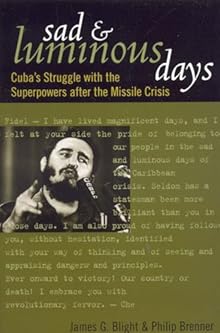
Sad and Luminous Days: Cuba’s Struggle with the Superpowers after the Missile Crisis by James G. Blight & Philip Brenner (2002)

by Aragorn Storm Miller

Throughout the Cold War and the decade that followed it, historians assumed that Cuban and Soviet leaders cooperated closely in the events associated with the Cuban missile crisis. Havana and Moscow, so went the conventional wisdom, put their lots together in a challenge against U.S. hemispheric predominance but, when the stakes veered towards nuclear war, both backed away and gladly compromised with Washington. In the last several years, however, it has become clear that much division existed between the Soviet Union and allies such as Cuba. This book reveals the extent to which the Cuban missile crisis increased U.S.-Soviet cooperation and discredited the Soviet Union in the eyes of emerging communist powers like Cuba and China. Ever fearful of a U.S. invasion, Cuban leader Fidel Castro eagerly accepted Soviet leader Nikita Khrushchev’s offer to place nuclear missiles and a Soviet garrison in Cuba, but Castro played no role whatsoever in the process that led to the missiles’ removal. Indeed, he learned of the U.S.-Soviet agreement over the radio, only days later receiving official notification in a letter from his Soviet sponsors. While Washington and Moscow vowed never to let a peripheral power like Cuba bring them to the brink of Armageddon, Castro and the Cubans pledged to spearhead a revolutionary movement throughout the developing world that would owe nothing to either the capitalist West or the brand of communism peddled by the USSR.
Psychological insecurities played at least as big a role the decision making process in Havana, Washington, and Moscow, as did sober, rational considerations that one might expect from the leaders of nations. During the build-up to the crisis, for example, Kennedy and Khrushchev’s behavior was informed by fears of underestimation. For his part, Castro viewed the missiles as proof that he had gained admission as an equal into the family of socialist nations. When both Soviet and U.S. leaders suggested that the Cubans were irrational and immature actors on the world stage, such apparent paternalism only drove Cuba further in the direction of revolutionary leadership throughout Latin America. For understanding the dynamics of foreign relations—both during the Cold War and more generally—Sad and Luminous Days is an informative and entertaining read.

Conflicting Missions: Havana, Washington, and Africa, 1959-1976 by Piero Gleijeses (2002)

by Yana Skorobogatov

Conflicting Missions: Havana, Washington, and Africa, 1959-1976, takes readers beyond the familiar categories of the Soviet-American Cold War. In the wake of decolonization, as charismatic national leaders emerged across Africa – from Algeria to Zaire – statesmen in Washington and Moscow waited anxiously to see if the new governments would align with democracy or communism. Enter Cuba: a small, poor, underdeveloped island that saw the western hemisphere’s
first successful Marxist revolution just ninety miles away from U.S. shores. Driven by a sense of Third World, post-colonial comradery, Cuban guerrillas staged socialist interventions in Africa in the name of Marxism and anti-imperialism. This book’s depiction of their successes and failures, coupled with Soviet and American reactions to such brazen undertakings, makes for a refreshing literary adventure in Cold War international history.
Conflicting Missions distinguishes itself from traditional Cold War histories by challenging the assumption that the U.S. and U.S.S.R. monopolized ideological intervention in the post-war era. While many readers of twentieth century history are quick to recall Soviet revolts in Budapest and Prague, as well as American operations in Vietnam and Chile, few realize how independently and ardently Cuba took to its own project of global socialist indoctrination during the Cold War. Cuba, striving to fill the aid vacuum left behind by the Soviet government’s growing disinterest funding sub-Sahara African liberation movements, led a leftist movement in Angola against the U.S.’s covert backing of rival regimes. What makes this story so remarkable was the failure of U.S. intelligence to perceive Cuba’s presence in the country. As U.S. Deputy Assistant Secretary Mulcahy recalled how ‘‘Cuba didn’t even enter into our calculations.” By successfully implementing its own revolutionary project and bypassing the world’s preeminent superpower in the process, Cuba proved itself to be a formidable communist actor on a stage where Russia’s diplomatic presence had already begun to wane.

The most enjoyable interludes in the book describe Cuban philanthropy in post-colonial African villages. Stories of Cuban medical workers aiding undeveloped, rural communities bring to the forefront the humanitarian side of Cuba’s brand of communism; frequently neglected in histories of the Cold War. With Cuban doctors around, villagers ‘‘knew that their wounds need not be fatal and that their injuries could be healed.” Comments such as these color a Cold War narrative all too often painted in broad, black and white strokes. That Conflicting Missions achieves this feat in an exceptionally readable, wanderlust-inducing form makes it a welcome addition to the widening circle of global Cold War scholarship.

LBJ and Vietnam: A Conversation

by Mark Atwood Lawrence

Why did the United States choose to fight a major war in Vietnam? The question has bedeviled scholars almost since President Lyndon Johnson made the decision in 1965.

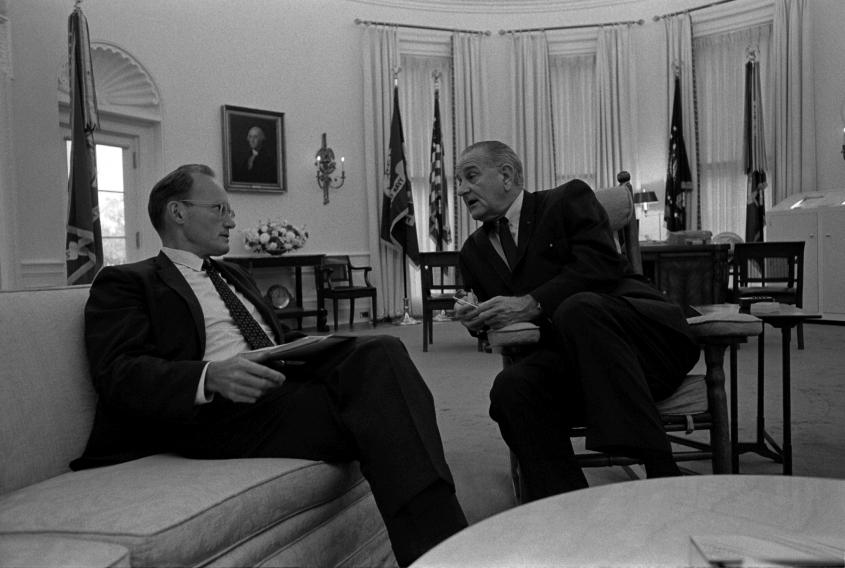
National Security Advisor and close Kennedy aide, McGeorge "Mac" Bundy, with President Lyndon B. Johnson in the Oval Office, 1967.

The most common answer that historians have offered over the years suggests that LBJ believed he had no real option but to commit U.S. forces.  In this view, the president understood that the government of South Vietnam, a strong ally of the United States, would inevitably collapse under the weight of a mounting communist insurgency if Washington did not send troops to help stave off the threat. The president believed, moreover, that such a collapse would amount to a major defeat for the United States in a key part of the world and would imperil U.S. security everywhere by calling into question Washington’s determination to help its allies around the globe. So momentous were the stakes, in short, that LBJ never seriously considered any alternative to escalation. But LBJ was, in this view, certain of another thing too: U.S. troops, once committed, would inevitably succeed in defeating the communist insurgency and bolstering South Vietnam as a pro-U.S. bastion. Johnson was convinced of the necessity of intervening in Vietnam and the certainty of success.

As historians have gained access to secret documentation, however, they have questioned this interpretation. Again and again, newly opened records from the National Archives in Maryland, the Lyndon Johnson Presidential Library at UT-Austin, and elsewhere have demonstrated that the president and his advisers recognized reasonable alternatives to intervention and foresaw the many problems that would beset U.S. forces when they were sent into Vietnam. The result of such discoveries has been to paint a new picture of LBJ’s decision-making in 1964 and 1965. Where scholars once saw certainty and confidence, they now see indecision and anxiety.

One of the best pieces of evidence for this newer view of U.S. decision-making is the recording of a conversation between LBJ and his national security adviser, McGeorge Bundy, on May 27, 1964. This tape, released by the LBJ Library in 1997, is among the most spectacular of the telephone conversations recorded in the Oval Office during the Johnson presidency. Like other chief executives from Franklin Roosevelt to Richard Nixon, LBJ frequently recorded conversations and meetings, most likely in order to have a record to refresh his memory but possibly also to help shape the historical record. Whatever the motive, the recordings unquestionably offer historians a remarkable new resource for appreciating the president’s personal opinions much more fully than ever before.

In his conversation with Bundy, LBJ expresses deep anxiety about what would happen if the United States failed to defend South Vietnam from communist takeover – evidence that bolsters the older, conventional view of U.S. motives for escalation. Fearing what historians would later dub the “domino effect,” Johnson suggests that the communist powers – the Soviet Union and the People’s Republic of China – would be emboldened by a communist victory in South Vietnam and might make trouble elsewhere. The communists, in fact, “may just chase you right into your own kitchen,” the president says in his typical down-home manner. LBJ also provides evidence for the older interpretation by breezily dismissing other powerful Americans who urged him to negotiate a settlement and withdraw U.S. power from South Vietnam. He shows special contempt for Senate Majority Leader Mike Mansfield, charging that the Montana Democrat, a strong advocate of winding down the U.S. role in South Vietnam, had “no spine at all” and took a position that was “just milquetoast as it can be.”

In other parts of the conversation, however, LBJ heaps doubt on the idea that defending South Vietnam was crucial to U.S. security. “What in the hell is Vietnam worth to me?” he asks Bundy. “What is Laos worth to me? What is it worth to this country?” Most chillingly, Johnson shows keen awareness that victory in Vietnam was anything but a sure thing. He worries that full-fledged U.S. intervention in Vietnam would trigger corresponding escalation by communist China, raising the horrifying specter of a direct superpower confrontation, as in Korea a few years earlier, between Chinese and U.S. forces. “I don’t think we can fight them 10,000 miles away from home and ever get anywhere in that area,” LBJ asserts. Moreover, the United States, once committed to a war, might find it impossible to get out. “It’s damn easy to get into a war, but … it’s going to be awful hard to ever extricate yourself if you get in,” LBJ asserts with remarkable prescience.

Johnson also defies the older interpretation of his outlook by showing openness to a range of opinions about how to proceed in Vietnam. To be sure, he hardly expresses enthusiasm about the idea of cutting American losses and withdrawing from South Vietnam, as Mansfield and prominent journalist Walter Lippmann among others were urging at the time. Neither, however, does he dismiss the possibility out of hand when the subject comes up. On the contrary, he urges consideration of a wide range of opinions and expresses hope that Lippmann might sit down with the hawkish Secretary of Defense Robert McNamara to discuss their differences.

Which is the “real” LBJ – the president who dismissed Mansfield as spineless or the president who questioned the real value of an independent, pro-American South Vietnam to the United States? At the end of the day, of course, it’s impossible to say. Both sets of ideas seem to have swirled simultaneously in LBJ’s head as he made fateful decisions. But one thing is certain: simple, rigid interpretations of Johnson’s attitudes to not hold up to the remarkable complexity of the emerging documentary record. To appreciate U.S. decision-making fully will require the release of further sources but also, almost certainly, a willingness to tolerate contradictions, nuance, and ambiguity.

Listen to the conversation (Johnson, Lyndon B. Johnson’s Vietnam Anguish, May 27, 1964: Conversation with national security advisor McGeorge Bundy. 27 May 1964. History and Politics Out Loud. Ed. Jerry Goldman. 30 Sept. 1999. Northwestern University.)

Transcript of the conversation (Telephone Conversation Between President Johnson and the President’s Special Assistant for National Security Affairs (Bundy) Washington, May 27, 1964, 11:24 a.m.. Source: U.S., Department of State, Foreign Relations of the United States, 1964-68, Volume XXVII, Mainland Southeast Asia: Regional Affairs, Washington, DC, Document Number 53. Original Source: Johnson Library, Recordings and Transcripts, Recording of a telephone conversation between the President and McGeorge Bundy, Tape 64.28 PNO 111. No classification marking. This transcript was prepared by the Office of the Historian specifically for this volume.)

« Previous Page

Recent Posts

  • The Radical Spanish Empire Roundtable – Introduction
  • All Eyes on the Petition: Reflections on The Radical Spanish Empire
  • Forgery, Invention, and the History of Skepticism in The Radical Spanish Empire
  • Iberian Subaltern Political Philosophies and The Radical Spanish Empire
  • Lawfare and the Legal Construction of Race in The Radical Spanish Empire
NOT EVEN PAST is produced by

The Department of History

The University of Texas at Austin

We are supported by the College of Liberal Arts
And our Readers

Donate
Contact

All content © 2010-present NOT EVEN PAST and the authors, unless otherwise noted

Sign up to receive our MONTHLY NEWSLETTER

  • New
  • Features
  • Reviews
  • Texas
  • Teaching
  • Digital
  • Watch & Listen
  • Authors
  • About