Formation
What first drew you toward the study of history?
My very uncool, non-academic answer is that my first historical obsession was the film Titanic. This resulted not only in seeing the film multiple times in theaters and being there at midnight for the VHS (!) release but collecting each piece of ephemera—from replicated relics to Titanic-themed computer games. As an MA student, I was a docent at the Molly Brown House Museum in Denver, which commemorates the famous Titanic survivor. When I traveled to the UK for my PhD research, I stopped at each “Titanic” point of interest—from the shipyards in Belfast to the port of departure at Southampton and final stop at Cobh (formerly Queenstown), Ireland. These early experiences shaped my understanding of the relationship between public and academic history and how entertainment can make and shape historical arguments.
Research
What are the core problems or questions that organize your research?
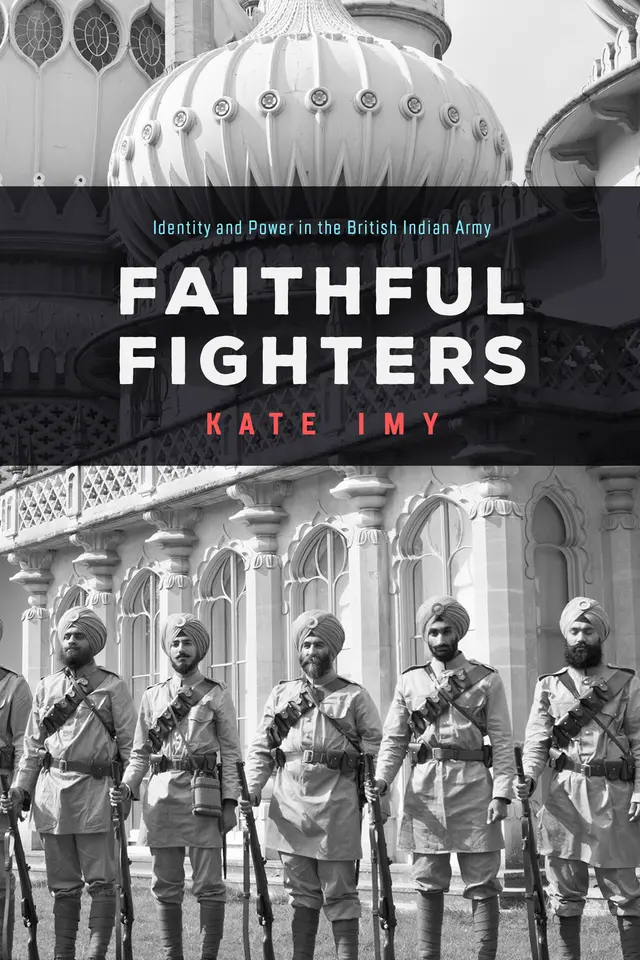
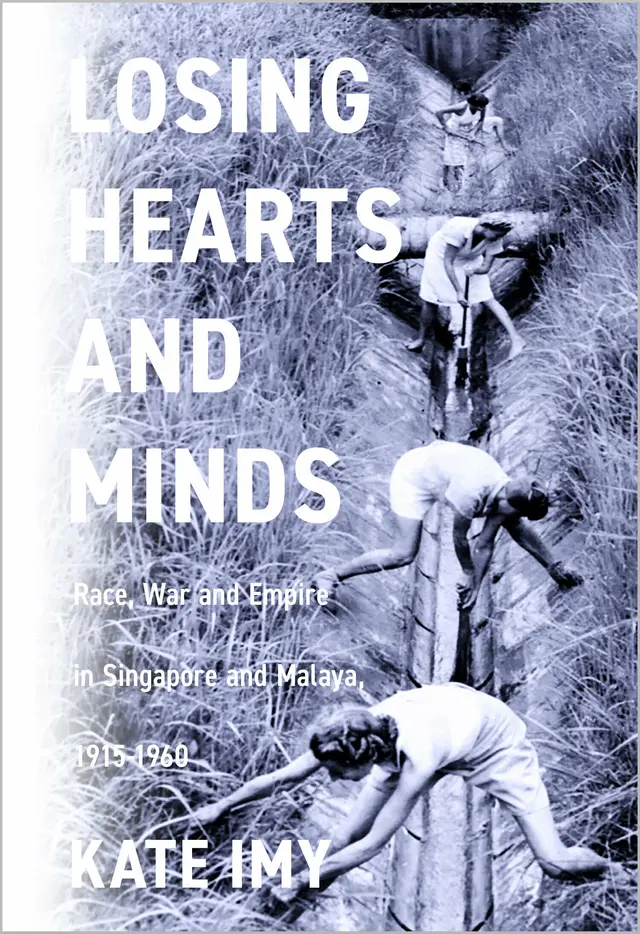
I am very concerned with how individuals navigate inclusion and exclusion through embodied experiences with power. My first book, Faithful Fighters, examined the South Asian troops of the colonial Indian Army who fought for the British Empire in both World Wars. These colonial soldiers were recruited in part because of British perceptions of how soldiers’ religious beliefs contributed to both martial strength and pro-British loyalty. In reality, these soldiers used their proximity to British power, and their religious communities and practices, to challenge the imperial state. My second book, Losing Hearts and Minds, explored the soldiers’ and civilians’ growing disillusionment with colonial power in Southeast Asia among populations considered most loyal— from South Asian soldiers to Eurasian Christians. My in-progress third book, Disabling Divinity, uses a disability lens to explore the unexpected global connections between white settler colonialism and fringe religious networks in a tiny woman’s commune. Each work considers how people benefit from, and are burdened by, proximity to state power that forces them to navigate and often internalize marginalization and exclusion based on race, gender, and disability.
How would you describe your methodological approach?
I am a story-driven historian and obsessive archival researcher. I tend to gather early seeds of ideas from secondary sources, then search the archive for unique stories that challenge my assumptions. I love finding individual people whose lives cross multiple boundaries—be it racial, ethnic, or gender—or who interact with the world in ways I would not expect.
Is there a book, scholar, or intellectual tradition that has been especially formative for your work?
I have been deeply shaped by postcolonial theory and feminist scholarship on the military. At the moment, I am interested in histories of settler colonialism and disability studies.
Have there been moments, whether through engagement with other scholarship or through your own evidence, when your thinking shifted in a significant way?
Having served briefly in the military, I was certain that I would not do a PhD project related in any way to the military. My initial dissertation questions focused on religious interactions between South Asian spiritual leaders and British civilians. I assumed that this would have an exclusively leftist, pacifist, anti-colonial political orientation. Imagine my surprise when I found a British Fascist—Francis Yeats-Brown—who served in India and became a devotee of yoga. Even more interesting, I found another one—J.F.C. Fuller—who served in India and loved yoga and Fascism. While Fuller’s papers were held at Rutgers, where I was working on my PhD, Yeats-Brown’s were held in the Harry Ransom Center, making one of my first PhD research trips to UT! These archival experiences got me to ask deeper questions about violence and conservatism within military institutions and how the racialization of religion shaped both colonial and anticolonial cultures.
Is there an archival or research experience that stayed with you—even if it never made it into your published work?
When researching in the British Library, requesting “files” can mean that you get a giant bound volume containing both your file and files that you did not request. Once, as a graduate student, I decided to flip through the whole volume rather than focus on the one file I requested. There, I found a story of R.A.L. Moysey, a British officer in 1920s India who plotted to kidnap a general’s daughter as leverage to free his Indian male lover from police custody. This story ended up being a cornerstone of my dissertation and first book. It also inspired a screenplay that earned me a place in the Outfest Screenwriting Lab and won the Austin Film Festival’s Josephson Entertainment fellowship. It was a good lesson about being open to finding things where you never expected to look.
Have you ever encountered something in the archives or in your research that was genuinely funny, strange, or unexpectedly human?
As an animal lover, I always appreciate cat prints on documents, or authors who complain about a cat playing with their pencils as they try to write. All of my published work has been completed with numerous cat companions sitting on computers, attacking my notes, or stealing attention away from work. I appreciate sharing cross-time animal antics.
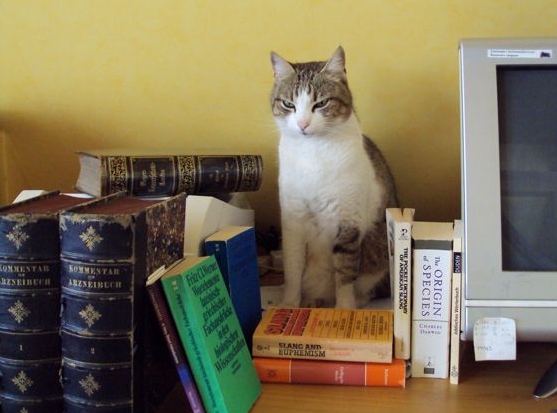
The Cat: Wikimedia Commons
Teaching & Mentorship
How does your research inform your teaching?
Both my research and teaching emphasize the multiplicity of perspectives within war and the British Empire. To facilitate this, I assign an array of written, visual, and audio material ranging from personal memoirs of wartime nurses to the letters and diaries of Indian soldiers, British propaganda films, and oral history interviews with combatants and non-combatants. I want students to gain hands-on experience crafting original arguments with primary source material, and I assign them research-driven assignments. These enable students to familiarize themselves with and use resources such as the Imperial War Museum (UK), the National Archives of Singapore, or the National Army Museum (UK).
How would you characterize your classroom practice?
My classrooms are dynamic spaces where students practice skills by working individually or in groups. Since most undergraduate students lack a background in Britain and the British Empire, I include contextual lectures and readings to guide them through the discussion materials. Discussions take place over visual, written, and auditory primary sources. I also enjoy hosting in-class debates that require students to use primary sources to make the strongest argument possible.
What forms of historical thinking do you most want students to develop, and what do you hope they take away from working with you?
I am an avid researcher always inspired by a good story. I always encourage my students to cast the widest net possible in research and to use multiple types of sources (visual, written, film, oral history) from multiple archives. Most importantly, I want students to feel like they are agents in control of understanding and shaping how history is made through evidence and arguments. This, I believe, makes them more attuned to the various types of media – from films to political speeches – that make historical arguments. I want students to feel empowered to search for, understand, and interpret the past and present with clarity and precision.
Are there books in your field that you would recommend to readers who want to explore it further?
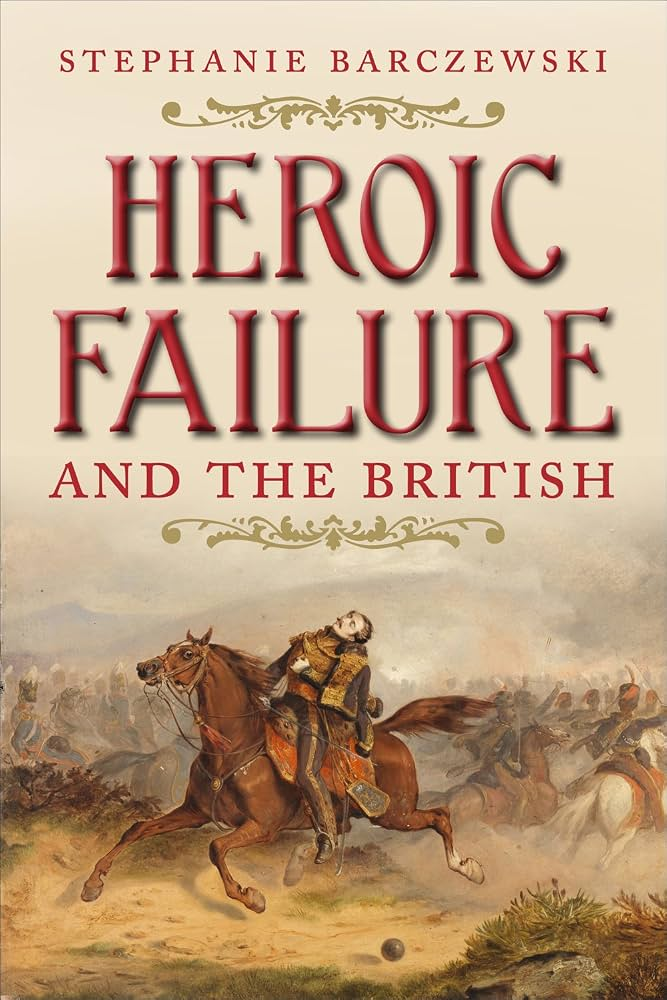
A book I often assign for my Victorian-era courses is Stephanie Barczewski’s Heroic Failure. Undergraduate students tend to enjoy working with this material because it is grounded in good stories. Barczewski uses each chapter to highlight a famous failure in British imperial history—from the Charge of the Light Brigade to the search for David Livingstone. She makes a compelling yet accessible argument—that failure gave British society more sympathetic and sentimental ways to connect to the empire at the height of its power than tales of triumph. Students can often track the argument across multiple case studies. In class, we pair these stories with artistic, photographic, and written primary source materials depicting each individual incident. It is a great springboard for discussion as well as a useful introduction to the British Empire.
Kate Imy is Associate Professor of History at the University of Texas at Austin. She is a historian of war, empire, race, religion, and disability, with a focus on the British Empire, South Asia, and Southeast Asia. She is the author of Faithful Fighters: Identity and Power in the British Indian Army and Losing Hearts and Minds: Race, War, and Empire in Singapore and Malaya.
The views and opinions expressed in this article or video are those of the individual author(s) or presenter(s) and do not necessarily reflect the policy or views of the editors at Not Even Past, the UT Department of History, the University of Texas at Austin, or the UT System Board of Regents. Not Even Past is an online public history magazine rather than a peer-reviewed academic journal. While we make efforts to ensure that factual information in articles was obtained from reliable sources, Not Even Past is not responsible for any errors or omissions.