• New
  • Features
  • Reviews
  • Texas
  • Teaching
  • Digital
  • Watch & Listen
  • Authors
  • About

The past is never dead. It's not even past

Not Even Past

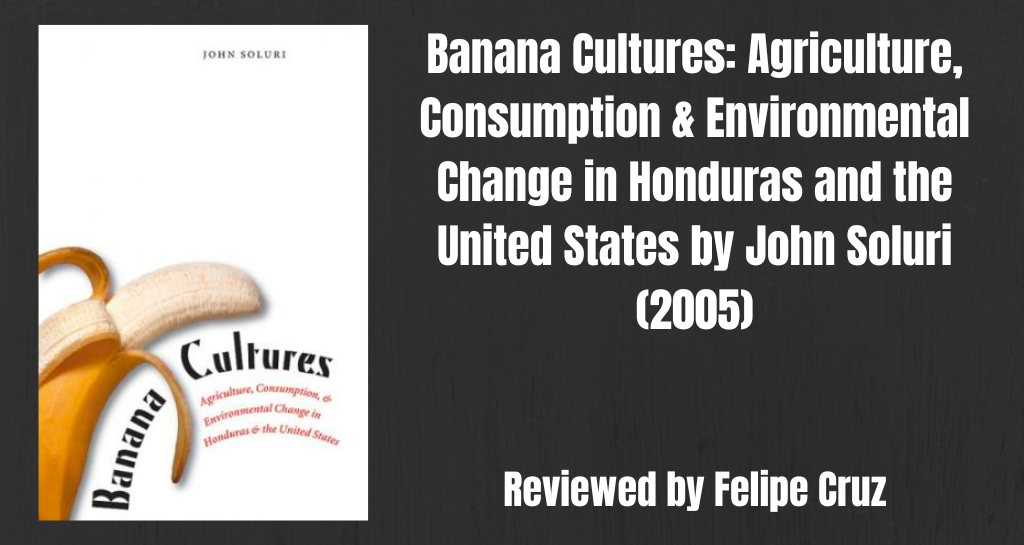
Banana Cultures: Agriculture, Consumption & Environmental Change in Honduras and the United States by John Soluri (2005)

The title of this book is plural for a reason. John Soluri ranges across borders in both directions to show the links between the culture of banana consumption in the United States and its effects on workers and the environment in Honduras, as well as how the realities of banana plantations shaped the banana culture in the United States.  While many authors focus on the fruteras, banana companies such as United Fruit (present day Chiquita), Soluri shows how the companies, the workers, and even banana pathogens were all actors in shaping what he calls “banana cultures,” even if they are not equal in their power to do so.

The early banana trade came at a time when few North Americans had ever tasted a banana; the now familiar fruit was still strange and exotic. Some early twentieth-century cookbooks even warned mothers to cook bananas before serving them to children. Soluri traces the first transactions, when islanders sold bananas at dockside to passing schooner captains, who soon figured they could make a handsome profit importing the exotic fruit.  Residents of the Bay Islands on the North coast of Honduras soon started farms, but within a decade, their production declined heavily as soils weakened.  This would be just the first of many problems encountered in the cultivation of bananas as a monoculture, problems that would shape the history of its cultivation as various pathogens affected large plantations in the prominent Honduran north coast, where a good percentage of United States supply was grown.  As the fruteras started planting on the north coast, the political interference that other historians have so well documented soon followed, such as the planters’ involvement in a coup d’etat to secure government concessions.  Soluri, however, argues that political machinations are not the greatest concern in this history, since the fruit companies would soon find that dealing with workers, independent growers, and banana pathogens would prove much harder than bribing or pressuring politicians.
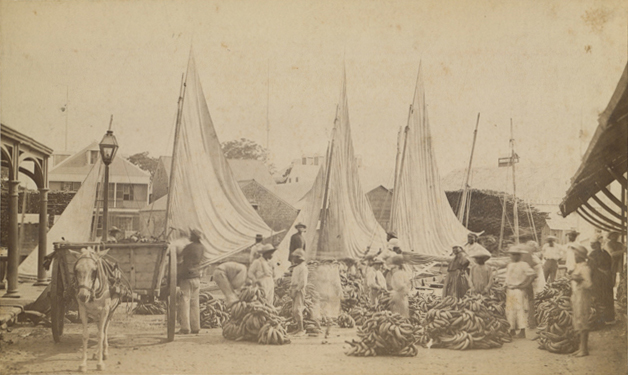
Bananas being unloaded from mule carts at a market in Belize circa 1890. Source: Wikimedia Commons

With the banana monoculture spreading along the Honduran north coast, the importance of workers and pathogens as two principal actors in this book comes to light.  The advent of the Panama disease, which was not a problem in dispersed small scale farms, but now spread like wildfire in massive plantations, brought about monumental changes.  Soluri very meticulously documents the scientific struggle to fight the disease and its correlation to market pressures in the North American market. Because it was easy for the fruteras  to get land concessions from the Honduran government, and because they failed to solve the problem through the creation of hybrids, the companies set about shifting plantation grounds to escape the disease, a land grab with great impact on the north coast and its availability of fertile soils.

Soluri narrates the struggles of workers and independent banana growers based on a number of sources, including censuses, local papers, letters between organizations and officials, worker organizations, literature and more. He dispels the notion that leviathan fruit companies completely pushed out small growers, and rather documents how, in many cases, they were able to use their strength to gain bargaining power. Later on after the 1950s, company employees did the same thing.

Growers and workers used nationalist rhetoric, proposing colonization projects to plant in Indian lands, and they used the fruit companies’ discourse of bringing modernity to the indomitable and disease ridden jungles.  They requested the same kind of land concessions the fruteras obtained from the government, but did so as “true sons” of the Honduran nation.  Growers and employees, Soluri demonstrates, had more power to shape the banana monoculture than previously thought, although expensive treatments against banana pathogens favored the large fruit companies whose massive operations could better absorb the new costs.
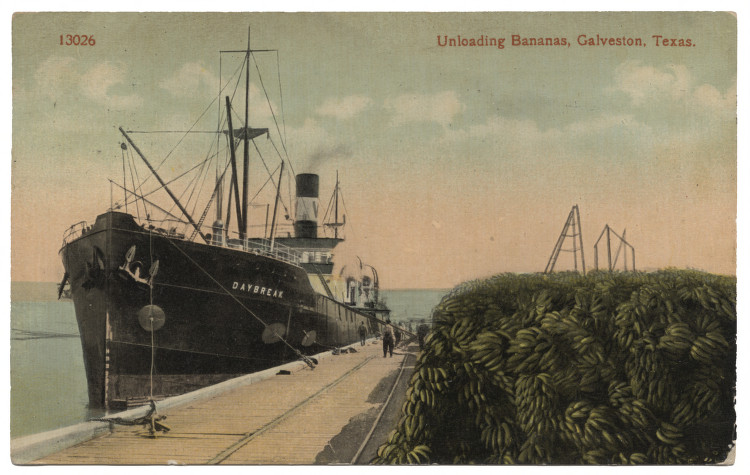
Unloading Bananas, Galveston, Texas circa 1916. Source: Wikimedia Commons

Soluri’s narrative, well-written and informed by popular culture and oral histories, is also very engaging for readers of any background.  By providing a comparative perspective in his last chapter, he also highlights the implications of his approach and points to some other commodities, such as coffee and sugar, that could benefit from his approach.

Considering that literature on Honduras is so scant, Soluri could have written an exciting and easily publishable narrative of the fruteras’ involvement and strong-arming of the Honduran government.  Instead, Soluri breaks the mold with Banana Cultures and shows us that borders, national or disciplinary, should have little meaning for a historian if his subject of study is constantly crossing them.

Further reading:

Author Dan Koepel’s Banana Blog.

An excerpt from Banana Cultures, courtesy of the University of Texas Press.

_________________________________________________________________________________________

The views and opinions expressed in this article or video are those of the individual author(s) or presenter(s) and do not necessarily reflect the policy or views of the editors at Not Even Past, the UT Department of History, the University of Texas at Austin, or the UT System Board of Regents. Not Even Past is an online public history magazine rather than a peer-reviewed academic journal. While we make efforts to ensure that factual information in articles was obtained from reliable sources, Not Even Past is not responsible for any errors or omissions.

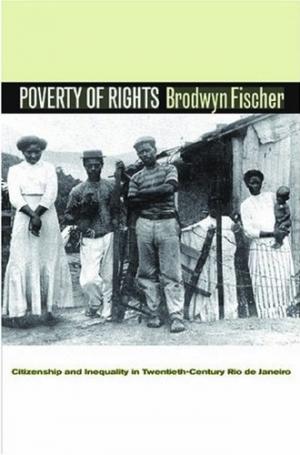
A Poverty of Rights: Citizenship and Inequality in Twentieth-Century Rio de Janiero by Brodwyn Fischer (2010)

by Salvador Salinas

image

Brodwyn Fischer’s A Poverty of Rights: Citizenship and Inequality in Twentieth-Century Rio de Janiero explores the heterogeneous class of the urban poor in Brazil’s national capital from 1920 to 1950. At the center of the book are the favelas, Rio’s infamous shantytowns, where the majority of the urban poor resided. Although the favelados engaged the legal and political system to win property rights for their makeshift neighborhoods, they failed to achieve full civil rights, which compounded the problems they faced as impoverished city dwellers. Using a wide array of sources such as criminal court cases, oral histories, samba lyrics, newspapers, legal codes, and the correspondence of presidents, prefects, bureaucrats, and governors, the book presents several paradoxes and contradictions.  Most twentieth-century Brazilian laws were written in a universal language, yet the urban (and rural) poor were excluded from full citizenship.  Marginalized, Rio’s poor still played a crucial role in city politics.  City ordinances outlawed favela settlements, but the residents of the shantytowns, in many cases, gained recognition of their neighborhoods and remained anchored to Rio’s hillsides.  Informality, however, became critical to the poor’s pursuit of rights.  Civil rights in twentieth-century Rio de Janeiro became privileges of social and economic class, not universal entitlements.

From the beginning, the capital’s poor residences were left out of the city’s planned development.  Sanitation campaigns in the early 1900s pushed the destitute to the city’s fringes – the hillside and suburbs.

image

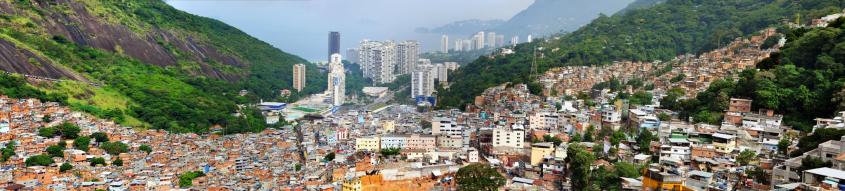
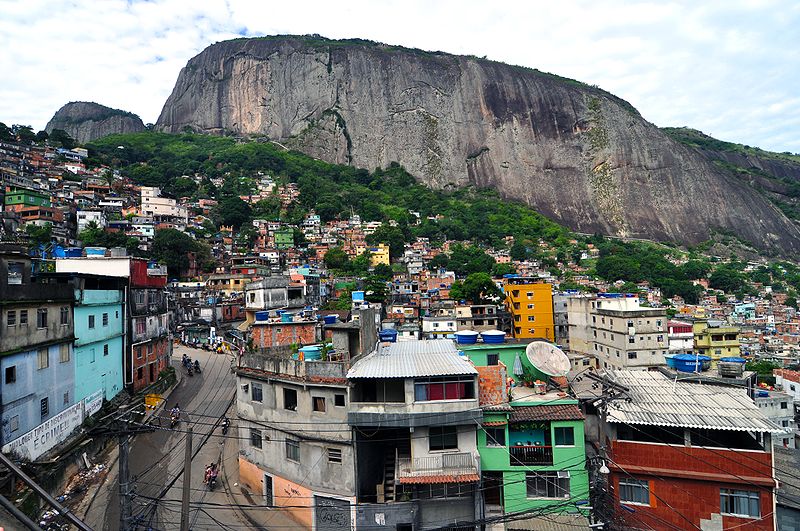
The Rocinha favela, one of the largest and oldest in Rio. 

These neighborhoods were outlawed because of sanitary conditions and building codes, and then received little or no public sanitation, running water, paved roads, electricity, or public transportation.  Yet in-migration to Rio in the 1930s and 1940s caused a housing crunch to turn into a housing crisis as the population of the illegal city reached some one million inhabitants.  The favelados demanded public services, and politicians at least paid lip service to the causes of Rio’s poorest residents. Illegality, in other words, became a cheap form of political currency.

The culture of the poor and their ideas of work and family differed from those of President Vargas, the so-called “father of the poor,” which further marginalized them. The Vargas regime in the 1940s-50s, extolled workers as vanguards of economic progress and national identity, but rarely dignified occupations such as washerwomen, janitors, and servants.  While the regime idealized women as housewives, poor women often worked all day to sustain their families and lived in informal unions with their partners.

image

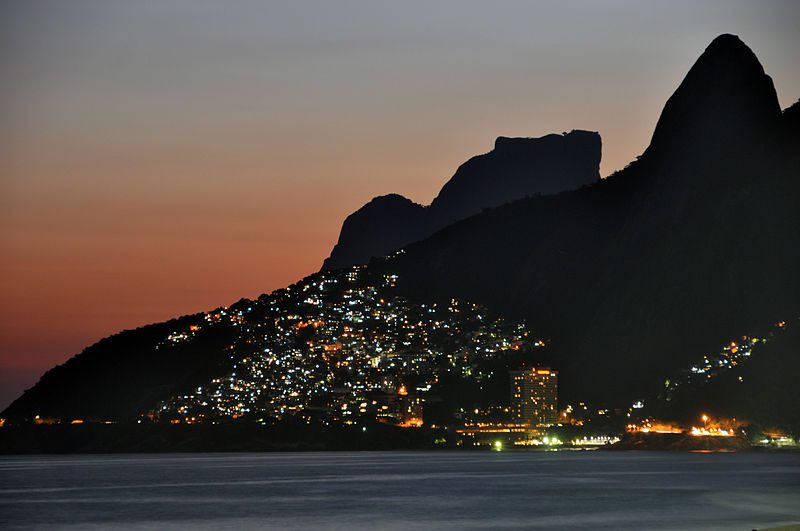
Rio’s Vidigal favela viewed at dusk.

Furthermore, the majority of poor workers were excluded from Vargas’s labor legislation because they could not meet the requirements or obtain the numerous official documents necessary to gain labor benefits. The documents were expensive, the bureaucratic red tape was complex and the process slow, and many poor people did not even have birth certificates to begin the whole process.

image

Documents, in other words, became passports to citizenship.  But the kinds of work the poor performed were not even reflected in the worker legislation, which favored industrial labor.

In the courts as well, Brazilians received differential treatment based on social and economic standing. Middle class defendants were more likely to have their cases dismissed, while the poor were more likely to receive guilty verdicts and harsher punishments.  Again, the fact that the poor lacked documents to prove their citizenship undermined their judicial identity status.

By honing in on the diverse group of the urban poor and their relation to the state through civil rights, Fischer explains why and how the destitute of Rio de Janeiro remained only partial citizens.  The book is a fascinating read for anyone interested in the connections between politics and economics and anyone concerned with democracy in twentieth- and twenty-first-century Brazil.

image

Further reading:

The Favela Painting Project

Life in the Rocinha Favela

All images courtesy of Wikimedia Commons.

Latin America’s Cold War by Hal Brands (2010)

by Michelle Reeves

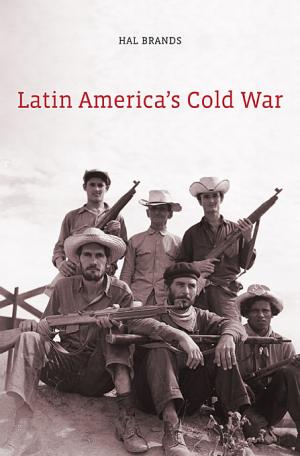
In this new book, covering the entire period of the Cold War in Latin America, Hal Brands restores agency and initiative to Latin American actors, in the process demolishing many of the platitudes that have governed much of the U.S. foreign policy literature.image  Based on prodigious research in a dizzying array of U.S., Latin American, and even East German archives, Brands’s work advances a trenchant interpretation that cannot be ignored. He argues that the origins of the chaos and instability that ravaged Latin America during the Cold War owed less to U.S. interventionism than to the prevailing confluence of local, regional, and global dynamics.

Though the burgeoning Cold War atmosphere did little to discourage the power grabs of authoritarian leaders, their actions were determined less by U.S. prodding and more by elite backlash against the extension of middle- and working-class power that had occurred earlier in the 1940s. The democratic opening of the World War II period gave way to the consolidation of dictatorship during the late 1940s and early 1950s. The Cuban Revolution dramatically altered the landscape of Latin American politics, and here as well, Brands challenges the conventional wisdom concerning the Cuban-Soviet alliance. Castro’s turn toward the Soviets was driven by ideological and political considerations and occurred well before the disintegration in U.S.-Cuban relations. The real story of the 1960s is not, as most historians would have it, the extent of outside interference in Latin America, but rather the insurmountable difficulties that foreign interventionist powers confronted in attempting to expand their influence throughout the region. Brands locates the source of the intense conflicts of the 1970s in the widening ideological gulf between proponents of National Security Doctrine, who sought to eliminate all shadings of leftism, and advocates of liberation theology, which in its most extreme form embraced Marxism as a tool of social justice. The right-wing extremism of the 1970s was a backlash against the guerrilla violence and leftist radicalism of the 1960s.

The revolution in Nicaragua, far from being exemplary of hemispheric trends, in fact owed its success to four distinct though interrelated factors that combined to render the situation in that country unique. Not only was the Nicaraguan system deteriorating from the late 1960s, but the guerrillas had learned enough from the travails of their predecessors to earn substantial support from among the agrarian population. Moreover, the insurgents enjoyed significant foreign backing, not only from Moscow and Havana, but from other Latin American nations as well. Finally, the Carter administration, by means of a confused and incoherent foreign policy, effectively weakened or destroyed the traditional levers of U.S. influence in Nicaragua. The period of revolutionary ferment in 1980s Central America, when viewed through the lens of foreign intervention, reveals the meddling of several players; external intervention, writes Brands, “was not a one-sided affair.”

The wave of democratization that swept the region in the 1980s was rooted in many causes but had much to do with the relationship between dictators and the radical left. In Central America, the strength of the guerrilla insurgencies forced a measure of liberalization, while in South America the destruction of the extreme left deprived the military regimes of their legitimacy. The debt crises of the 1980s, however, were the most determinate factor in democratization, as they provided the pretext for prying open the economies of Latin America to neoliberal reforms. In the final analysis, the course of the Cold War in Latin America was shaped not only by the zero-sum struggle between Washington and Moscow for ideological and strategic dominance in the global south, but by conflicts over internal political dynamics and power structures, the extent – and more importantly, the limits – of U.S. influence, and the emergence of the Third World as both a political bloc and a rhetorical device. Brands has made an impressive and valuable contribution to our understanding of the Cold War in Latin America, and while his interpretation may spark controversy in certain academic circles, this reviewer fervently hopes that he will succeed in driving the debate forward, rather than prompting a rehash of hackneyed claims about the primary responsibility of the United States for Latin America’s problems.

Death is a Festival: Funeral Rites and Rebellion in Nineteenth-Century Brazil by João José Reis (2007)

by Felipe Cruz

Death and the dead were omnipresent in nineteenth century Salvador da Bahia, Brazil. Exuberant funeral processions marched festively in the streets and graves filled the church floors where parishioners stood. Since so many died, death was incorporated into many aspects of life in the city – and the living spent considerable effort in preparing for their own deaths and the deaths of others. In explaining why a crowd of over a thousand people revolted against and destroyed a cemetery in 1836, João Reis’ Death is a Festival brings to life the act of dying in Salvador.

Unlike the numerous revolts that broke out in the preceding two decades, the Cemiterada rebellion in 1836 was not carried out specifically by slaves, federalists, or soldiers. Although people of varying classes and colors took part, it was spearheaded by religious brotherhoods. They revolted against a law forbidding burial in churches and within city limits, a law that granted a burial monopoly to a cemetery on the outskirts of the city. Distancing the dead from the living did not sit well with brotherhood members who wanted to be buried in their own churchyards and provoked all other parties involved in the business of dying.

The government had an arguably legitimate reason for passing such an explosive law: miasma. Miasma, or the gas emanating from putrefying organic matter, was considered dangerous and the subject was all the rage in the medical literature of the time. Doctors in Bahia’s Medical School, trained in France, were appalled by the burial of corpses emanating miasma in church floors. In their medical journals, they often described the dangerous odors of corpses in poorly ventilated churches, and much worse, the mass graves where slaves were buried, as the cause of the high mortality rate in the city. According to the medical profession, the dead in the church’s floor brought death to the city – while to many of its residents, being buried in sacred dirt (even if miasmatic) was crucial to a good afterlife.

João Reis sketches the colorful world of Bahian death and makes a good case for understanding the motives of the rebels on other than financial grounds. Analyzing estate, brotherhood and parish records as well as travelers’ accounts, wills and testaments Reis shows where people preferred to be buried, how they paid for numerous masses to avoid purgatory, and then redeemed their consciences by freeing slaves and paying debts. Wakes brought together great numbers of people, known and unknown to the deceased, including professional prayers and wailing women. Funeral marches were as extensive as one could afford, some including dozens of priests, orchestras and beggars paid to add to the procession. In unearthing the details of funerals, the book also shows how death reaffirmed social distinctions: whether one was carried to the afterlife in a hammock or sumptuous coffin, buried in the hospital’s graveyard or the main cathedral, such differences spoke volumes about class and race. Death is a Festival is a truly seminal work, elegantly written and skillfully translated, and a great read for those interested in the history of medicine and the practices associated with death in Brazil.

The Old Man and the New Man in Revolutionary Cuba

By Frank A. Guridy

The forces that created the Cuban Revolution often get lost in polarizing debates about Castro’s Cuba. Two very different films highlight the changes that ripped through Cuban society in the 1950s and early 1960s and created the Cuban Revolution. The first is Tomás Gutierrez Alea’s Memories of Underdevelopment (Memorias del subdesarrollo) released in Cuba in 1968 and the second is Steven Soderbergh’s 2008 Hollywood biopic Che.

memoriesMemories of Underdevelopment, based on Edmundo Desnoes’s 1967 novel, is perhaps the best-known film in Gutiérrez’s long and productive career. The film dramatizes the forces rapidly transforming Cuban society in the early years of the Cuban Revolution through the eyes of Sergio (skillfully played by Sergio Corrieri), a member of the old Cuban elite that was overthrown by the revolution. Sergio is a frustrated intellectual who, unlike his elite and middle-class contemporaries, decides to stay in Cuba rather than flee to the United States. In Gutierrez’s masterful depiction of Sergio, made evident in the scenes of the coat and tie wearing Sergio aimlessly wandering the streets of Havana, one sees the rapid decline of an older civilian model of Cuban masculinity, one that was predicated on affluence, consumption, and affiliation with the United States, as well as sexual predatory “machismo.” Sergio is in many ways a prototypical “ladies man” who manifests his own alienation by preying upon young women. Yet, Corrieri’s performance evokes sympathy for a character who is lost, yet, keenly aware of the changes that are happening all around him.

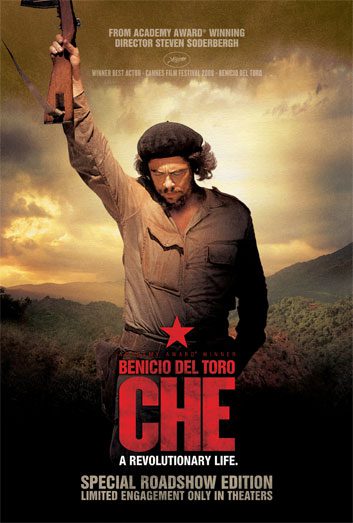
Che-movie-poster2Steven Soderbergh’s Che can be read as a completely different meditation on Cuban manhood. While ostensibly about Ernesto “Che” Guevara, one of the revolution’s key leaders, the film also explores the emergence of the “new man” of 1950s-60s Cuba, the new socialist individual that Guevara hoped to create in the Cuban Revolution. Soderbergh’s lengthy 4-hour movie is divided into two parts: the first portrays Che’s involvement in the guerrilla war against Cuba ruler Fulgencio Batista and the second explores his ill-fated guerrilla campaign in 1967 in Bolivia. Unlike Sergio, who relishes his class privilege, Che (brilliantly played by Benicio del Toro) is a selfless doctor who rejects the benefits of bourgeois existence to devote his entire life to becoming a career revolutionary motivated by “profound feelings of love,” as Che himself put it. Soderbergh’s depictions of Che’s encounters with Cuban peasants, his tending to wounded soldiers, and his fearlessness as a commanding officer in the guerrilla war underscore the model of revolutionary masculinity celebrated by the triumphant Cuban Revolution. While many have criticized the film’s glossing over of Guevara’s involvement in the execution of counter-revolutionaries, viewers who do not give the film a chance will miss an opportunity to gain insights into the factors that explain the triumph of the Cuban Revolution.

sjff_01_img0319Both films satisfy the historian’s desire for accurate representations of the past. Memories gives us a taste of 1960s Cuba not only because it was made at the time, but also due to Gutiérrez’s skillful insertion of archival footage throughout the film. Soderbergh’s beautiful costume and set design, most evident in his attentiveness to the architecture of Cuban provincial towns in the decisive scenes of the Battle of Santa Clara, show that the film was based on solid research. One may quibble with each director’s political choices, but both films are brilliantly executed and provide valuable portrayals of monumental events in Cuban history. Each highlights, in different ways, competing models of Cuban male identity that are in tension with each other to this day.

Conflicting Missions: Havana, Washington, and Africa, 1959-1976 by Piero Gleijeses (2002)

by Yana Skorobogatov

Conflicting Missions: Havana, Washington, and Africa, 1959-1976, takes readers beyond the familiar categories of the Soviet-American Cold War. In the wake of decolonization, as charismatic national leaders emerged across Africa – from Algeria to Zaire – statesmen in Washington and Moscow waited anxiously to see if the new governments would align with democracy or communism. Enter Cuba: a small, poor, underdeveloped island that saw the western hemisphere’s
first successful Marxist revolution just ninety miles away from U.S. shores. Driven by a sense of Third World, post-colonial comradery, Cuban guerrillas staged socialist interventions in Africa in the name of Marxism and anti-imperialism. This book’s depiction of their successes and failures, coupled with Soviet and American reactions to such brazen undertakings, makes for a refreshing literary adventure in Cold War international history.

Conflicting Missions distinguishes itself from traditional Cold War histories by challenging the assumption that the U.S. and U.S.S.R. monopolized ideological intervention in the post-war era. While many readers of twentieth century history are quick to recall Soviet revolts in Budapest and Prague, as well as American operations in Vietnam and Chile, few realize how independently and ardently Cuba took to its own project of global socialist indoctrination during the Cold War. Cuba, striving to fill the aid vacuum left behind by the Soviet government’s growing disinterest funding sub-Sahara African liberation movements, led a leftist movement in Angola against the U.S.’s covert backing of rival regimes. What makes this story so remarkable was the failure of U.S. intelligence to perceive Cuba’s presence in the country. As U.S. Deputy Assistant Secretary Mulcahy recalled how ‘‘Cuba didn’t even enter into our calculations.” By successfully implementing its own revolutionary project and bypassing the world’s preeminent superpower in the process, Cuba proved itself to be a formidable communist actor on a stage where Russia’s diplomatic presence had already begun to wane.

The most enjoyable interludes in the book describe Cuban philanthropy in post-colonial African villages. Stories of Cuban medical workers aiding undeveloped, rural communities bring to the forefront the humanitarian side of Cuba’s brand of communism; frequently neglected in histories of the Cold War. With Cuban doctors around, villagers ‘‘knew that their wounds need not be fatal and that their injuries could be healed.” Comments such as these color a Cold War narrative all too often painted in broad, black and white strokes. That Conflicting Missions achieves this feat in an exceptionally readable, wanderlust-inducing form makes it a welcome addition to the widening circle of global Cold War scholarship.

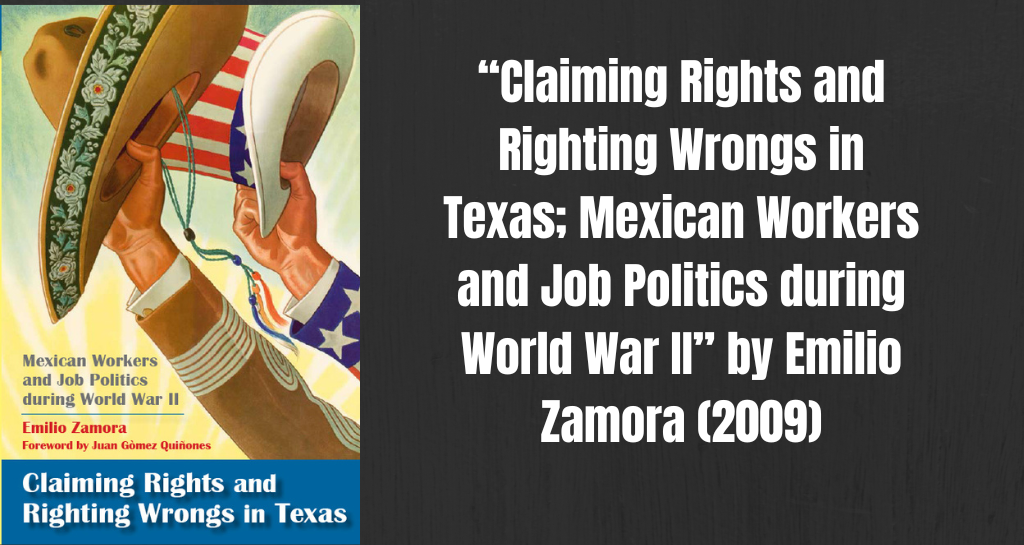
“Claiming Rights and Righting Wrongs in Texas; Mexican Workers and Job Politics during World War II” by Emilio Zamora (2009)

Relations between Mexico and the United States appear so disappointing these days that we may find it difficult to remember them differently. Mexico-U.S. relations, however, have seen better times and recalling them could serve as a model for what is possible. Claiming Rights and Righting Wrong in Texas does this by summoning the memory of World War II, when Mexico and the United States fashioned the closest and most cooperative set of relations that we have ever seen.

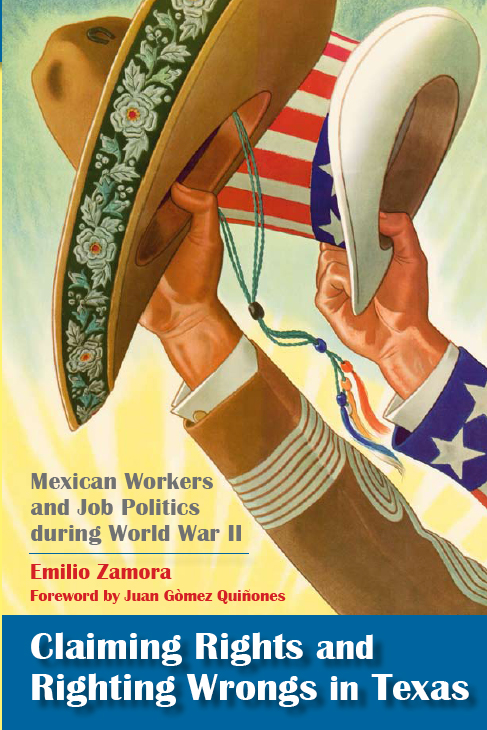
The exuberant WWII poster that appears on the book’s front cover captures the celebrated unity between wartime neighbors, when Mexico intervened on behalf of Mexicans in the United States and the State Department initiated a campaign to improve relations between Mexicans. Mexico’s insistence on elevating racial discrimination to a higher level of importance and the U.S.’s decision to expand its Good Neighbor Policy into the domestic arena, by investigating and settling cases of discrimination during the war, demonstrates how Mexican Americans entered center stage in the political arena of minority and labor politics by way of an international, or more precisely hemispheric, body politic.

Mexico’s decision to deny their contract workers to Texas farmers who were especially known for their lack of hospitality towards Mexicans and the State Department’s insistence on good neighborliness in Governor Coke Stevenson’s administration made the Lone Star state a key site of continued negotiations over racial discrimination and the government’s role in combating it.

Book cover of Claiming Rights and Righting Wrongs in Texas: Mexican Workers and Job Politics during World War II by Emilio Zamora

Claiming Rights and Righting Wrongs in Texas also shows that state and federal agencies promoting good neighborliness contributed to improvements in the social standing of Mexicans, but only to a minor extent. The expanded wartime economy with its unprecedented employment opportunities must be credited with much of their recovery from the hard times of the Depression. Recovery, however, was uneven for both U.S. and Mexico-born as they typically exited the farms and entered the urban-based and higher-paying manufacturing jobs at a slower rate. Inequality for Mexicans, as well as for African-Americans, remained relatively unchecked.

The increased diplomatic cooperation that promoted good will and improved understanding in diplomatic and ethnic relations also allowed for the League of United Latin American Citizens (LULAC) to emerge as the one of the leading proponents of equal rights in the United States. Culturally adept at working the English and Spanish speaking worlds, LULAC representatives acted as intermediaries between Mexican communities in Texas and government officials from Washington, D.C., Austin, and Mexico City. As a result, they built a reputation for LULAC as one of the most effective Mexican organizations coming out of the period of the Second World War.

Despite nagging problems like the persistence of racial discrimination and inequality, the unprecedented attention that Washington, D.C. directed at Mexico and the Mexicans in the United States raised postwar expectations for better relations and encouraged further official activism and Mexican agitation for equal rights in the postwar period.

The good relations that Mexico and the United States established during the war years and the policy focus that they placed on discrimination and inequality among Mexicans in Texas may have been primarily intended as a wartime imperative. But then as now, necessary policies that better relations can provide for expanded visions of improved understanding and good will between governments and peoples.


The views and opinions expressed in this article or video are those of the individual author(s) or presenter(s) and do not necessarily reflect the policy or views of the editors at Not Even Past, the UT Department of History, the University of Texas at Austin, or the UT System Board of Regents. Not Even Past is an online public history magazine rather than a peer-reviewed academic journal. While we make efforts to ensure that factual information in articles was obtained from reliable sources, Not Even Past is not responsible for any errors or omissions.
« Previous Page

Recent Posts

  • The Battles of the Alamo and the Myth of Southern Exceptionalism
  • Primary Source: Magic, Metal, and Medicine in Leonhard Thurneysser’s Paracelsus
  • Faculty Spotlight: Dr. Kate Imy
  • La Historia del Tiempo Presente en México: un campo en construcción
  • The History of the Present Time in Mexico: A Field in Formation
NOT EVEN PAST is produced by

The Department of History

The University of Texas at Austin

We are supported by the College of Liberal Arts
And our Readers

Donate
Contact

All content © 2010-present NOT EVEN PAST and the authors, unless otherwise noted

Sign up to receive our MONTHLY NEWSLETTER

  • New
  • Features
  • Reviews
  • Texas
  • Teaching
  • Digital
  • Watch & Listen
  • Authors
  • About