• New
  • Features
  • Reviews
  • Texas
  • Teaching
  • Digital
  • Watch & Listen
  • Authors
  • About

The past is never dead. It's not even past

Not Even Past

Rise of the Vulcans: The History of Bush’s War Cabinet by James Mann (2004)

by Aragorn Storm Miller

James Mann provides a lively and comprehensive study of the advisers who would guide George W. Bush as he sought to make the world safer for U.S. interests.  Mann argues that Bush’s inexperience led him to rely on—as well as greatly empower—a cohort including some of the most experienced and respected members of the conservative foreign policy making community.  This cohort—Cheney, Rumsfeld, Powell, Wolfowitz, Armitage, and Rice—came up in the ranks together, devoting much thought to altering the means and ends of U.S. foreign policy in order to avoid what they considered to be the errors of previous liberal and conservative administrations.  The Bush administration’s abandonment of realpolitik and judicious use of force, to embrace of ambitious unilateralism and export of U.S. institutions, was thus not as sudden or unprecedented as many contemporary observers suggested.  Such a new way forward had been brewing for decades.
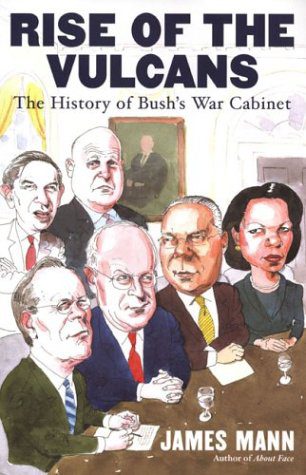
860707As a journalist, Mr. Mann performs his role of “providing the first draft of history” admirably.  Professional historians will appreciate his effort to position Bush’s “Vulcans”—the nickname his advisors used to convey their devotion to toughness and power—as the intellectual fulcrum between U.S. Cold War and post-Cold War conceptions of foreign relations.  The more casual reader will also appreciate Mann’s ability to make these policymakers come alive as human beings who, like anyone, consist of a lifetime of personal dreams, disappointments, goals, and agendas.  Indeed, as historians are becoming increasingly aware, men and women who toil on a specific problem or issue for decades often come to exercise far more influence on national policy than the given president who simply does not have the time to master every foreign policy question.

Righteous Propagation: African Americans and the Politics of Racial Destiny after Reconstruction by Michele Mitchell (2004)

by Ava Purkiss

Michele Mitchell’s Righteous Propagation is a fascinating study of the tactics African Americans used to bolster racial uplift after Reconstruction.  Mitchell presents the book as a social history, revealing moments when African Americans shared ideas on ways to advance the race during the Progressive Era at the end of the 19th and beginning of the 20th centuries. image In the prologue, Mitchell explains, “No longer divided into categories of ‘free’ or ‘slave,’ people of African descent acted upon assumptions that the race was unified, that institution building was possible, that progress was imminent.”  This optimism shaped ideas about collective identity, destiny, and improvement of the race.


Early in the book, Mitchell outlines the ways African Americans idealized emigration to Liberia; the working poor embraced transplantation to Africa as a way to seek economic refuge.  She also asserts that African Americans linked emigration, black colonization in Africa, and the reclamation of manhood.  Here, Mitchell points out an interesting contradiction, explaining that the move to Africa had imperialist overtones, yet many African Americans were united in opposing white imperialism.  Mitchell also discusses sexuality in the context of racial progress: the proper “choice of sexual partner, courtship, heterosexual intercourse, reproduction…,” were all imperative to the racial destiny of African Americans and pervasive in the discourse on racial progress.  Surprisingly, she discovered that within the discussion of sexual politics, African Americans championed eugenic strategies such as birth control advocacy, sexual purity crusades, and “better babies” campaigns to counter racist ideas about biological inferiority.

Focusing on everyday life, Mitchell discusses the importance of cleanliness and living conditions in the black home, and the burdens black women carried at this time: “[African American women] were simultaneously caricatured by white Americans as diseased contaminants and characterized by Afro-Americans as primary agents in regenerating the race’s home life.”  In serving as both agents and targets, African American women were an essential contradiction in the circulation of ideas about racial destiny and improvement.  The final chapter examines miscegenation and the ways individual choices about romantic partners affected the race as a whole.  The author highlights the ways black nationalism, namely the ideologies of Marcus Garvey, stipulated ideals of sexual conduct, masculinity, racial purity, and marriage, which factored into the intimate lives of African Americans and their effort to achieve progress and solidarity.

Righteous Propagation expertly describes the various ways African Americans perceived racial destiny and progress in the post-Reconstruction era.  Mitchell recognizes that African Americans sought respect, freedom, and egalitarianism by disseminating ideas that would benefit the race, but sometimes reinforced the racist tactics that were perpetrated against them.  In doing so, Mitchell does not romanticize the efforts of African Americans, but complicates some of their methods for uplift.

Cynical Realism: Miller’s Crossing by Joel and Ethan Coen (1990)

By Ben Breen

The HBO series Boardwalk Empire may currently be winning laurels for its workmanlike depiction of Prohibition-era gangsters and corrupt politicos, but viewers interested in a more fully-realized work about the Golden Age of American organized crime would be wise to turn to the Coen Brother’s 1990 masterpiece Miller’s Crossing.

image

This film centers on the attempts of an Irish-American mob underboss in 1920s Chicago, played by Gabriel Byrne, to collect on a gambling debt from an unsavory bookie named Bernie Bernbaum (John Turturro, in a riveting and unnerving performance), while he navigates a love triangle between himself, Bernbaum’s sister Verna (Marcia Gay Harden) and his mentor, an aging mob boss played with memorable vigor by Albert Finney. Yet the real appeal of Miller’s Crossing lies not in its convoluted plot, but in its evocative depiction of the distinctive visual style and underworld cant of 1920s Chicago. In a lesser film, the screenplay’s clutter of long-forgotten slang (“now take your flunky and dangle”) might come off as stilted or mannered, but here it seems natural: these are real characters, living real lives in a bygone urban America that is both foreign and familiar.

Miller’s Crossing was loosely based on Dashiell Hammet’s classic 1931 potboiler The Glass Key, but the Coens allow their spectacular ensemble cast to take what could have been a formulaic tale of double-crosses and gang warfare in a highly original direction

image

– despite nods to classic film noir like Carol Reed’s The Third Man (1949) and Orson Welles’ Touch of Evil (1958). Gabriel Byrne, as the brilliant but self-defeating mob lieutenant Tom Reagan, is the anchor of Miller’s Crossing, and the ethical dilemmas he faces in the film function as stand-ins for the larger moral ambiguities embedded in the ambitious and individualistic mindset of America in the twentieth (and twenty-first) centuries.  Byrne’s Tom is a cynical realist who prides himself on his ability to “know the angles” and avoid allowing his conscience to get in the way of business opportunities. Yet at the same time, it is Tom’s aversion to violence — at least when he is forced to perform it himself, at close quarters — that sets in motion the film’s main events. Can criminals maintain a moral compass? And what separates a criminal from a businessman or politician, if all three place rational self-interest above personal ethics?

The Coens, who both wrote and directed the film, are wise to leave the answers to these questions up to the viewer. But Gabriel Byrne and the brilliant ensemble cast that support him are much more than gangster-movie cliches: like Tony Soprano, they are unsettling precisely because they are so familiar, such typical products of an American society that mingles cold-blooded acquisitiveness and violence with a sincere streak of idealism and a desire to do right. The French novelist Stendahl wrote that “a novel is a mirror carried along the highway.” Miller’s Crossing causes us to see criminals not as clichés or villains, but as reflections in that mirror.

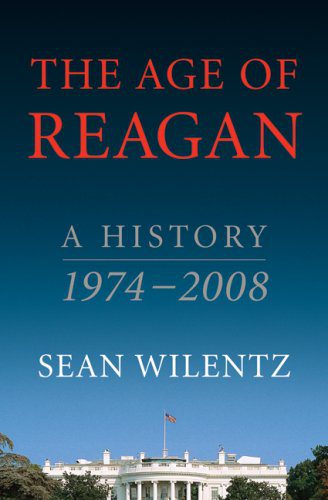
The Age of Reagan: A History, by Sean Wilentz (2008)

by Dolph Briscoe IV

Historians often define political periods in the United States according to the dominant president of the era. Arthur M. Schlesinger, Jr., most famously wrote of an Age of Jackson, and other scholars have proposed Ages of Jefferson, Lincoln, and Franklin D. Roosevelt. Sean Wilentz adds another chapter to this genre, labeling the last quarter of the twentieth century after Ronald Reagan, with his book The Age of Reagan: A History, 1974-2008. From the 1974 Watergate scandal until 2008 when Barack Obama was elected to the presidency, the U.S. witnessed the triumph of political conservatism. Ronald Reagan harnessed conservative angst to win the White House, pursued conservative polices as president both domestically and internationally, and left a legacy his conservative political successors attempted to continue, with mixed results.

41tW9b7OIMLThe Age of Reagan provides a valuable overview of recent U.S. political history. During the 1970s both major political parties experienced internal divisions. Conservative Republicans criticized Nixon, Gerald Ford, and Henry Kissinger’s pursuit of détente with the Soviet Union as dangerously weak foreign policy. Liberal Democrats railed against Jimmy Carter’s ineffective leadership in solving the nation’s economic and social problems. Americans turned away from moderates in both parties and looked to conservatism when they elected Ronald Reagan president in 1980. Reagan succeeded in entrenching conservatism within the federal government, particularly with his judicial appointees and expansion of presidential power.

Yet the author correctly debunks much of the mythology surrounding Reagan, noting that his administration often pursued pragmatic policies, unable or unwilling to roll back much of the liberal reform of past years, and also encountered many setbacks, most notably with the Iran-Contra scandal.

The Age of Reagan goes on to describe the triumphs and travails of Reagan’s presidential successors. George H. W. Bush, less conservative than his predecessor, encountered difficulties in appealing to both the moderate and right-wing factions of his party. Bill Clinton, a self-described New Democrat, governed as a centrist following Republican capture of Congress in the 1994 elections, recognizing this as a requirement in a conservative age. Wilentz concludes with a brief overview of George W. Bush’s tumultuous presidency. During these years conservatism may already have been running on borrowed time, butevents of the Bush years, such as the controversial election of 2000, the disastrous Iraq War, the miserable response to Hurricane Katrina, and the dramatic collapse of the economy ultimately sounded the death knell for the Age of Reagan, as Americans rejected conservatism in favor of Barack Obama’s call for political change. Sean Wilentz’s The Age of Reagan is a fascinating narrative of recent U.S. history, and will prove engaging reading, especially in the aftermath of the 2010 elections.

Time will tell if the Age of Reagan truly is over. The emergence of right-wing groups such as the Tea Party and the continued popularity of demagogic figures like Rush Limbaugh and Glenn Beck suggest that the conservative movement will not exit quietly into the night. The current president and his supporters would have to convince Americans of the superiority of their policies, no small task. Their success or failure will determine whether the United States has entered a new period, perhaps an Age of Obama, or returns to the Age of Reagan.

« Previous Page

Recent Posts

  • NEP Author Spotlight – Aidan Dresang
  • Lesson Plans: The Vietnam War and American Society
  • Lesson Plans: Protest and Social Unrest
  • Lesson Plans: Radio and Communications Technology
  • The Long-Lasting and Perpetuating Effects of Lynching Postcards and Photography
NOT EVEN PAST is produced by

The Department of History

The University of Texas at Austin

We are supported by the College of Liberal Arts
And our Readers

Donate
Contact

All content © 2010-present NOT EVEN PAST and the authors, unless otherwise noted

Sign up to receive our MONTHLY NEWSLETTER

  • New
  • Features
  • Reviews
  • Texas
  • Teaching
  • Digital
  • Watch & Listen
  • Authors
  • About