• New
  • Features
  • Reviews
  • Texas
  • Teaching
  • Digital
  • Watch & Listen
  • Authors
  • About

The past is never dead. It's not even past

Not Even Past

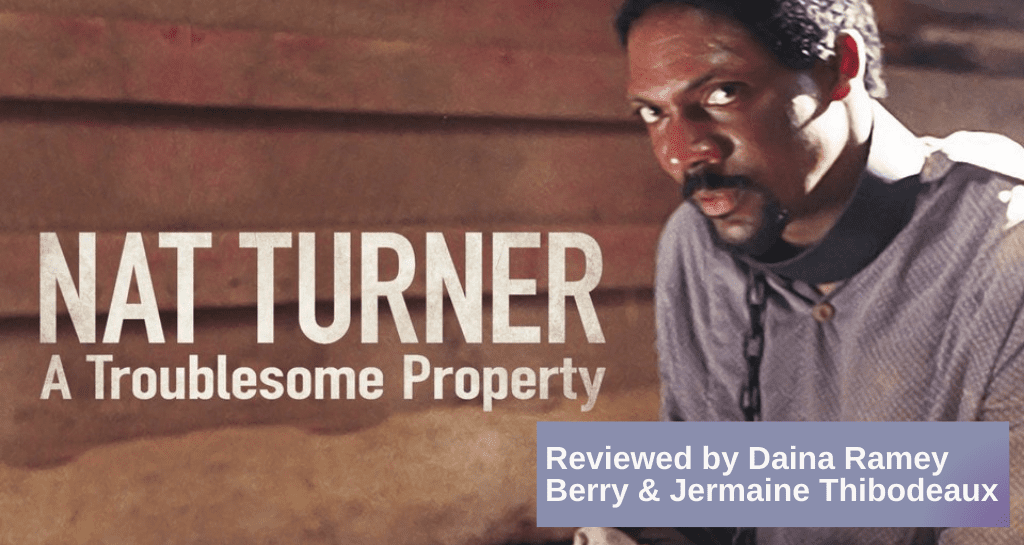
Nat Turner: A Troublesome Property (2002)

By Daina Ramey Berry and Jermaine Thibodeaux

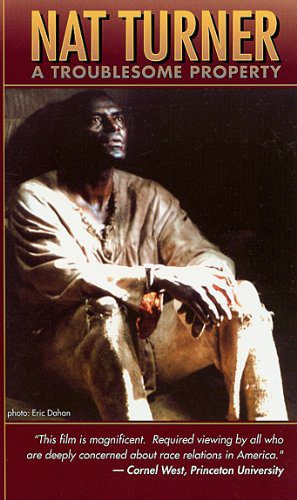
This film tells the story of Nat Turner’s 1831 Virginia slave revolt. For years, historians have grappled with the details of the affair and debated about the ways Nat Turner should be remembered. For some, he was a revolutionary hero; for others, Turner was nothing more than a deranged, blood-hungry killer. After all, it was Turner’s rebellion that sent the South into a frenzy forcing southern legislatures and planters to harden their stances (and laws) on slavery. This PBS movie blends documentary narrative, historical re-enactment, and scholarly reflection to examine the various renditions of the revolt and to uncover the many faces of Nat Turner and slave resistance in general.  Directed by Charles Burnett, this is a film worth watching for those interested in slavery, public history, and the history memory. As part of the Independent Lens series, the PBS website provides a wealth of historical material on Nat Turner, slave rebellion, and historical treatments.
image

Confederates in the Attic: Dispatches from the Unfinished Civil War by Tony Horwitz (1999)

by Kristie Flannery

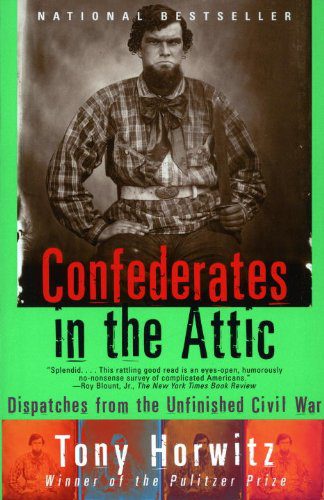
In his introduction to Confederates in the Attic, the Pulitzer Prize-winning author Tony Horwitz recounts the very strange moment when his weekend sleep-in was rudely interrupted by the loud cracking of gunfire.

Confederates in the AtticeThe noise came from an unexpected Civil War re-enactment being filmed outside of his bedroom window.  Horwitz had once been a little boy who would spend hours engrossed in an old, enormous book of Civil War sketches, captivated by images of Yankee and Dixie soldiers engaged in battle.  But despite spending a number of years working as a war correspondent, it was this surprise encounter with the “men in grey” that prompted Horwitz to turn the critical gaze of the journalist upon his own and his country’s enduring fascination with the bloody conflict that pitted American against American in 1861-1865.
Confederates in the Attic is an informative and entertaining record of the extended road trip that Horwitz made through the Confederate heartland of the United States to investigate how Americans and southerners in particular continue to remember the war, and to make sense of that strange and enduring Confederate pride.  Along the way Hortwitz gets to know a number of interesting people.  His exchanges with Civil War enthusiasts from all walks of life spur the narrative along.  They include the famous Civil War Historian Shelby Foote, female members of the Daughters of the Confederacy who devote considerable effort to finding Dixie soldiers in family trees, and bands of modern day “hardcore” Civil War re-enactors; factory workers who devote much of their free time and money to re-living as authentically as possible the experiences of nineteenth-century Confederate soldiers.  For these rough and ready men who are perhaps the most interesting Horwitz introduces us to, this means sewing their own Civil War uniforms, dressing up to march for miles through wild country in ill-fitting boots, and spending nights in open, near-freezing conditions under thin blankets, spooning together for warmth.

Of course race cannot be left out of a book about the Civil War past or present. Horwitz does not meet one Civil War-obsessed African American in his travels.  He concludes through his many conversations with white southerners who cherish the memory of the Confederacy that slavery has been conveniently forgotten in popular conceptions of why the South ceded from the Union and went to war against it.  Horwitz provides a sobering account of the role the Civil War plays in modern racial violence; how in 1995 the ostentatious display of the confederate flag could lead one young man to kill another young man, and how the Klan is never really far away.

Horwitz demonstrates that the Civil War is very much still alive in the imaginations of Americans and shapes the way in which many perceive themselves and the world they live in.  Confederates in the Attic is a must read for anyone studying the US Civil War and modern US history, or history and memory.  It is a wonderful resource for teachers who want to get their students excited about this history and its continued influence on the present.  It is truly a delight to read and would make a perfect gift for anyone who enjoys history.

You may also enjoy hearing UT professor of History Jacqueline Jones read from her book “Saving Savannah: The City and the Civil War.”


Manhattan Projects: The Rise and Fall of Urban Renewal in Cold War New York by Samuel Zipp (2010)

by Kyle Shelton

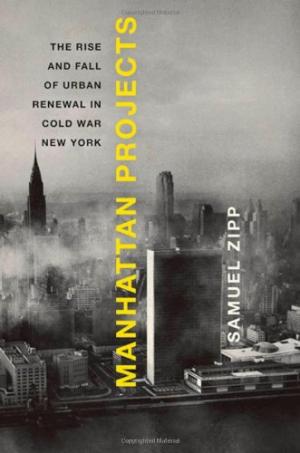
In the 1970s the United Nations complex and the public housing projects of East Harlem projected two disparate images of New York City. imageIf the UN displayed the city’s position as a global capital of culture, politics, and economics, the deteriorating housing projects showed the city’s struggles with overcrowding, high crime rates, and poverty. According to historian Samuel Zipp, the roots of this contradictory double-identity reach back to the rise and fall of the city’s post-World War II urban renewal efforts.
The usual story of urban renewal in America is one of powerful officials, such as New York’s Robert Moses, wielding great power to remake entire cities as they saw fit. Zipp’s Manhattan Projects departs from this narrative by arguing that urban renewal represented a more complicated, contentious process carried out by New Yorkers from all races, classes, and city neighborhoods. For Zipp, renewal politics highlighted questions about what the city should look like, whose interests it should serve, and who would control its remaking. Starting with the celebrated construction of the United Nations complex in 1948 and moving up through the battles over public housing projects in East Harlem in the late 1960s, Manhattan Projects shows how competing visions of renewal and the contests that revolved around its implementation could create symbols of both cultural significance and urban decline.

In the early years of the Cold War, many New Yorkers viewed urban renewal as a “benevolent intervention” that would turn run-down and crowded streets into modern showcases for American democracy and strength. Early renewal efforts stemmed from an “ethic of city rebuilding” that focused on creating an ordered and open city. Zipp argues that the United Nations represented America’s attempts to help remake the world through internationalism and remake the city through modern architecture and superblock construction. In both cases, the goal was to order chaos, whether it was caused by war or overcrowding. Few complained about the UN’s destruction of an old meatpacking district. Instead, the city celebrated renewal’s ability to bring a site of international significance to life from a collection of abandoned abattoirs.

Celebration of redevelopment ebbed, however, when renewal officials sited several projects in the heart of old residential neighborhoods. Rather than accepting the destruction of their homes and communities, many New Yorkers pushed back against renewal. Zipp argues that the rise of resident activism had a contradictory impact on the shape of the city. On the one hand, activism helped preserve historic neighborhoods and prevented displacement of many New Yorkers. On the other, these protests led to the decline of urban renewal as a viable public project. That decline led to the deterioration of public housing and, when combined with segregation that limited the occupational and residential opportunities of many people of color, helped precipitate the urban crises of 1960s and 1970s. Using the building of Lincoln Center and the development of public housing projects throughout the city as examples, Zipp demonstrates the irony of this anti-renewal activism. It protected the close-knit, older neighborhoods of the activists, even as it pushed officials to abandon the residents of public housing projects to a fate of faltering services and non-existent civic support.

By delving deeply into the local politics surrounding the construction of several of New York City’s most iconic landmarks, Manhattan Projects demonstrates that urban renewal’s legacy stretched well beyond the concrete foundations of its projects and the large personalities of its leaders. Renewal fostered competing imaginings of the city’s future, jumpstarted important debates over the meanings and pursuit of progress, and resulted in the formation social issues that continue to shape the city—and its growth—to this day.

Summer for the Gods: The Scopes Trial and America’s Continuing Debate Over Science and Religion by Edward L. Larson (2006)

by Brian McNeil

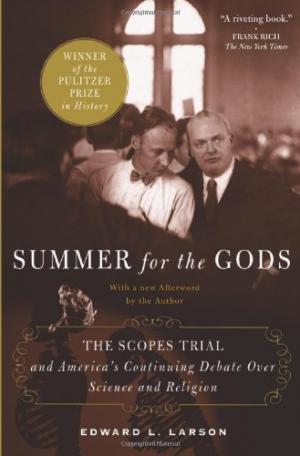
Like most teenagers growing up in Alabama during the late nineties, my first encounter with the 1925 John Scopes Trial came on the first day of my ninth grade biology class. imageInside the front cover of the textbook a message from the Alabama State Board of Education stated: “This textbook discusses evolution, a controversial theory some scientists present as a scientific explanation for the origin of living things, such as plants, animals, and humans.” Passed by the Board of Education in 1995, the supplement went on to say, “No one was present when life first appeared on earth. Therefore, any statement about life’s origins should be considered as theory, not fact.”

The disclaimer in Alabama biology textbooks was the product of a decades-long debate in the United States over science and religion in the classroom. In Summer for the Gods, Edward J. Larson examines this oft-contentious dispute from Darwin to Darrow to Dayton—host of the Scopes Trial and present home of Bryan College, one of the leading institutes of creationist biology. He demonstrates how contemporary thought influenced the debates surrounding the Scopes Trial and, in the last section of the book, how dramatic portrayals such as Inherit the Wind shape our own thinking on evolution today. Yet, as Larson skillfully notes, the “Trial of the Century” stays with us not because of the scientific questions it raised but because the Scopes Trial embodied “the characteristically American struggle between individual liberty and majoritarian democracy.” The Scopes Trial, in other words, asked who would control curriculum in classrooms? Would it be the local many that clung fast to their bibles and looked up to the heavens for the answer to the origin of man? Or, would it be the distant few who studied science and looked down into the earth at the fossil record for the answer to the origins of species?

These are the questions that drew the major antagonists to the Scopes Trial: William Jennings Bryan and Clarence Darrow. Bryan—known as the Great Commoner for his support of the Populist Party in the 1890s—was a reformer who steadfastly held to religion and popular politics. Darrow, the most prominent lawyer in early twentieth-century America, used his sharp legal mind to challenge popular notions of morality and religion. The most memorable aspect of the trial was the back and forth between these two American giants on the lawn outside the courthouse (the trial had to be moved outside to accommodate the interested public). Darrow asked questions that had nothing at all to do with human evolution and everything to do with casting doubt over Evangelical Christianity in general and Bryan’s faith in particular. “Did you ever discover where Cain got his wife?” Darrow asked at one point during Bryan’s testimony. “No sir; I leave the agnostics to hunt for her,” the Commoner acidly replied.

The great strength of Summer for the Gods is Larson’s ability to demonstrate how the debate over science and religion has changed over the decades. As unbelievable as it may sound today when the battle lines are so firmly demarcated and the trenches are so deeply dug, there was a time when fundamentalist Christians attempted to accept evolutionary biology on its own terms. The first section of the book details how this era of good feelings changed following the end of the First World War. Believing that modernism, natural selection, and eugenics caused both the Great War and the social unrest that followed it, fundamentalist Christians fought back against evolutionary biology. Because of this rising tide of conservatism, many states in the early 1920s passed laws that restricted teaching Darwinism in the classroom and ultimately led to the Scopes Trial.

I currently live in Texas, and the great debate in the Lone Star State over curriculum in the classroom has in many ways shifted away from science toward social studies and history. Conservatives and Progressives are now debating the origin and character of the United States, not the origin of human beings. But if Larson were to comment on this dispute over history textbooks, he would surely argue that the debate is not new at all. Instead, he would insist that the same struggle between majoritarian democracy and individual liberty that guided the Scopes Trial frames the present debate over history textbooks in Texas. Larson’s lucid writing, command of detail, and ability to connect the Scopes Trial to longstanding debates in American history make Summer for the Gods a great read.

Further reading:

A detailed description of the Scopes “Monkey Trial” via the University of Missouri School of Law.

The Washington Post on the current debates over history textbooks in Texas.


Sister Arts: The Erotics of Lesbian Landscapes by Lisa L. Moore (2011)

by Mary Katherine Matalon

The 1792 poem “Verses to Abigail Smith,” was preserved by Abigail’s brother, Elihu Hubbard Smith, who transcribed the poem into his diary and chronicled the strong friendship that existed between Sarah Pierce, the author and future founder of the Litchfield Female Academy, and his sisters Abigail and Mary. image Like Smith, Lisa Moore is interested in recording and preserving the rich world of female friendship and same sex desire that she has discovered in a variety of creative media in the late eighteenth century.  While diverse in form, these “sister arts,” including garden design, paper collage, collecting, and poetry, were united by the ways that their practitioners all used the landscape and the natural world both literally and metaphorically to create artworks that forged and memorialized the bonds among women.

In this lavishly illustrated book, Moore analyzes the lives and works of eighteenth-century women who practiced the sister arts:  the artist Mary Delaney, the natural philosopher and collector Margaret Bentinck, the Duchess of Portland, poet Anna Seward, and the aforementioned Sarah Pierce.  Moore is a skilled and vivid storyteller and her compelling prose enables the reader to inhabit the affective and intellectual landscapes these women traversed.    For instance, the Duchess of Portland emerges as an insatiable collector and connoisseur of both female friendships and objects of natural history. In fact, Moore argues, the two practices—the forging of deep and sustained female friendships and the collecting of natural history specimens—were inextricably intertwined for the Duchess, who served as key link among a network of female friends who shared her passion for the natural world. For the Duchess, as for the other women Moore studies, flowers, shells, and other aspects of the natural world become a kind of language through which women can express their love and desire for one another.

Sister Arts: The Erotics of Lesbian Landscapes is simultaneously concise and evocative.  Moore’s analysis not only suggests fresh, new ways of thinking about the history of sexuality and the history of material culture but also suggests ways in which these two, typically separate, fields might overlap.  Moore’s stated goal is not to recuperate a straightforward lesbian identity for her subjects, but to establish the ways in which their creative practices can be read as lesbian, “because of their resonance with central features of lesbian history and culture that are still meaningful.”

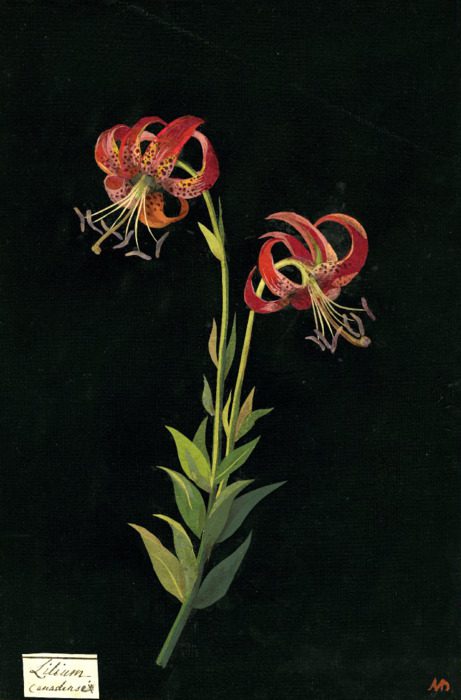
imageMary Delaney‘s botanical illustrations of flowers were considered to be “libertine” by some eighteenth-century critics.

In so doing, she demonstrates how we might map a history of sexuality onto the history of material culture—that is, she shows us how we might begin to read objects, rather than people, as lesbian or queer. For instance, Moore reads the shell grotto created by Mary Delaney and The Duchess of Portland as an important contribution to the lesbian sister arts tradition. Accordingly, Moore emphasizes the aspects of the grotto that accord with this tradition; she excavates the associations between the shells and female sexuality and she explains the way in which the creation of the grotto would have contributed to the two friends’ intimacy.  Ultimately, Moore contends that the grotto serves as a monument to the two women’s passionate friendship.  While we will never know the exact nature of that friendship, Moore demonstrates that inscribing its tangible manifestation—the shell grotto—into the lesbian sister arts tradition allows us to see the ways in which sexuality and intimacy were embedded both within the grotto and the women’s enduring relationship in ways that can be classified as lesbian or queer. Overall, Sister Arts: The Erotics of Lesbian Landscapes is a deeply rewarding book for it both complicates and enriches our view of these women (some of whom have been vastly understudied) and their creative legacies.

Further reading:

Lisa L. Moore’s blog, Sister Arts.

The book’s official page at the University of Minnesota Press.


Freedom Riders: 1961 and the Struggle for Racial Justice, Abridged Edition by Raymond Arsenault (2011)

imageby Matt Tribbe

Fifty years ago, in the spring and summer of 1961, a brave group of activists dared to commit one of the most dangerous acts imaginable at the time: they blatantly obeyed the laws of the United States.  Knowing full well that a majority of white Southerners did not accept federal desegregation orders, and that the Kennedy administration was reluctant to enforce them, hundreds of civil rights activists nonetheless embarked on Southern-bound buses in order to test a recent Supreme Court decision forbidding segregation at interstate bus terminals.  This was not necessarily civil disobedience, disobeying unjust laws for moral and political ends.  Rather, as Raymond Arsenault notes of these “Freedom Rides,” it was a “disarmingly simple act.”  The Freedom Riders would just behave as if Supreme Court rulings were, in fact, the law of the land, and then respond nonviolently to the inevitable bloodied heads, broken bones, firebombings, and intimidating prison stints that greeted their attempts to sit in interracial pairs on buses and integrate restaurants, waiting rooms, and even shoe-shine stands at terminals in the Southern states.  Though few anticipated the full ferocity of the organized white resistance in the Deep South, the Riders hoped that such disturbing scenes of brutality against nonviolent activists who were simply expressing their constitutional rights would shock the nation out of its complacency on Southern segregation.

image

Arsenault offers an engaging chronicle of the Freedom Rides in this new, abridged edition of his definitive 2006 account.  He places the Freedom Rides in their larger historical trajectory, revealing their antecedent in an earlier attempt to desegregate interstate buses in 1947 and examining various civil rights strategies and initiatives over the 1950s that contributed to the decision to launch the campaign. But this book is about a specific moment in time—the summer of 1961—and Arsenault uses his gripping narrative to explore many broader issues confronting the civil rights movement and the nation as a whole in that particular year. We see in all their complexity, for example, the often-strained relationships and clashes over strategy between various civil rights organizations. Most established groups like the NAACP were critical of these provocative actions, yet it was that organization’s unenforced court victories that made the Freedom Rides both possible and necessary.  Another major theme that Arsenault follows over the year is the Kennedy Administration’s consternation at the Rides.  Wary of the embarrassment they might cause the United States at this pivotal moment in the Cold War, just after the Bay of Pigs fiasco and shortly before Kennedy’s first meeting with Soviet Premier Nikita Khrushchev, Attorney General Robert Kennedy constantly urged the Riders to accept a “cooling-off period” so that the administration could deal with Southern segregation in a more deliberate manner.  But as the Riders well knew, “cooling off” meant returning to the unacceptable status quo.  Indeed, to the Kennedys’ great chagrin, they were perfectly willing to cause a national crisis in order to force the administration to finally take meaningful action against segregation.

image

As the emphasis in the book’s title suggests, however, what comes across most vividly in Freedom Riders is the dogged determination of the four-hundred-plus activists who volunteered to continue the Rides over the summer, even after it was clear that violence and incarceration in Southern jails were unavoidable.  Arsenault ably recreates all of the savage beatings and unenviable dilemmas faced by these men and women who risked their well-being, their freedom, and even their lives in order to force America to live up to its principles.

Readers wishing to learn more about this often-overlooked campaign of the civil rights movement and the very diverse group of people who pulled it off; about the movement’s decisive shift toward the strategy of non-violent direct action; about the massive headaches this endeavor caused the Kennedy Administration; about the horrors that faced anyone who challenged Deep South racial mores in the early 1960s; and, perhaps most important, want this story told with both nuance and flair, will enjoy Freedom Riders.


The fiftieth anniversary of the freedom rides this year has brought out a number of moving books, films, and other website materials:

PBS “American Experience,” film, Freedom Riders 

The website for the PBS “American Experience” film, Freedom Riders, includes historical material, maps, biographies, teaching guides, and more.

James Farmer, one of the organizers of the Freedom Rides, interviewed by Terry Gross on NPR’s “Fresh Air.”

Raymond Arsenault interviewed by Terry Gross on NPR’s “Fresh Air”


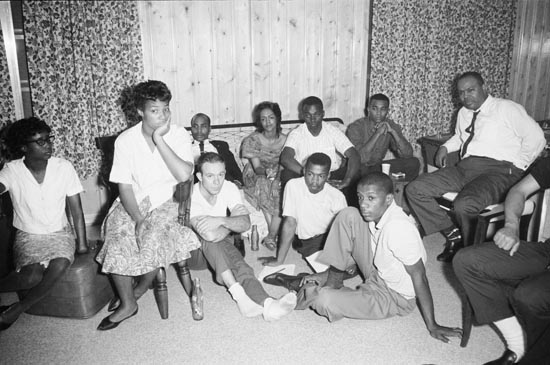
Group photograph: Freedom Riders at the home of Dr. Richard Harris after the church siege in Birmingham, AL. Included are Lucretia Collins (center), James Farmer (far right) and John Lewis (ground, right).
Credit: Johnson Publishing Company
From American Experience, Freedom Riders (fair use)

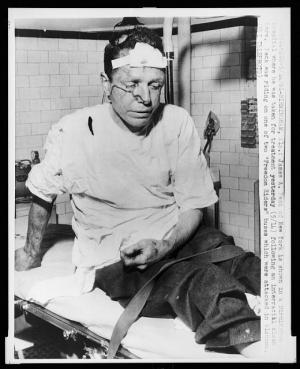
Photograph of James Peck seated on a hospital gurney in Birmingham, Alabama following attack on a Freedom riders bus. By Joseph M. Chapman Public Domain via Wikimedia Commons.


Shadows at Dawn: A Borderlands Massacre and the Violence of History by Karl Jacoby (2008)

by Nathan E. McCormack

In Shadows at Dawn, Karl Jacoby examines the way that perspective influences historical memory and the role that political power plays in selecting which memories become codified in the historical narrative. imageJacoby does this through a study of the Camp Grant Massacre—the death of approximately 140 Apache at the hands of a group of white and Hispanic settlers and Tohono O’odham natives in April 1871 in the Aravaipa Valley in Arizona.
Jacoby examines the settlement of the Arizona-Mexico border region from four perspectives, those of the Apache and O’odham natives, the settlers from Mexico, and settlers from the United States. He relates each group’s story individually, highlighting events forgotten, dismissed, or emphasized, and demonstrating the way each group created a unique narrative about a shared event. In doing so, he calls attention to the influence of numerous factors, that influence the creation of history and group memory, including a culture’s worldview and its political position within the larger social context.

Divided into two overall sections—before and after the Aravaipa massacre—Jacoby begins each group’s narrative with its arrival in the area northeast of the Gulf of California, in present-day southern Arizona (in the case of the O’odham, whose arrival in the area is uncertain, a discussion of its lifestyle before the other groups’ arrivals). Jacoby discusses each group’s interaction with the others from its own perspective, which he gleans by studying historical and biographical narratives, or artifacts with analogous function among the indigenous groups. By addressing the way each group interpreted common events common, for example the cause each group attributed to the Aravaipa attack, Jacoby theorizes about the way that each group envisioned its role in the conflict, and more broadly, the way that it interpreted life in the rugged Arizona territory.

Jacoby’s study presents a fairly straightforward analysis of the events leading up to the Araviapa Canyon attack and does not attempt to present a theoretical explanation for the violence of the frontier or colonialism. The major contribution of Shadows at Dawn, however, is Jacoby’s portrait of each group’s distinctive perspective on the same time period—and, in some cases, the same events. This is particularly useful in postcolonial or subaltern studies, for recovering the voices that are lost when, as is frequently the case, only the history of the dominant or victorious community has been preserved. Jacoby’s approach, however, also highlights the difficulty of subaltern histories—preserving the perspective of conquered peoples, which tends to be lost or destroyed. What fragments remain—in his account the calendar sticks of the Apache serve as an example of these historical remnants—generally paint an unclear or incomplete picture, at best, and the historian must engage in some degree of speculation to construct a narrative based upon them. This is particularly true when dealing with semi-literate groups like indigenous North Americans.

Despite this difficulty, Jacoby utilizes the extant material effectively and acknowledges the challenges that it presents. The result is unique both in its approach and analysis and makes for a readable and accessible study, which avoids the all-too-common trap of theoretical overreaching.

Further reading:

Official website for Shadows at Dawn.


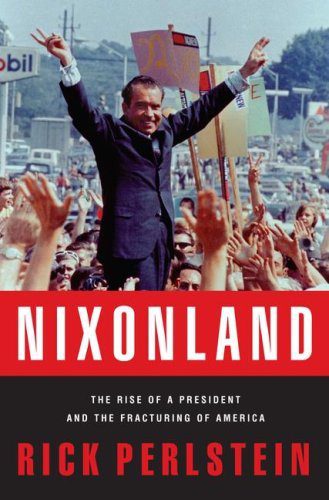
Nixonland: The Rise of a President and the Fracturing of America by Rick Perlstein (2008)

by Dolph Briscoe IV

Rick Perlstein traces the antecedents of contemporary American politics to the period 1965-1972, presenting Richard Nixon as a central figure in creating a foundation for today’s bitter partisanship. Perlstein builds his story around the 1966, 1968, 1970, and 1972 elections, where Nixon, “the brilliant and tormented man struggling to forge a public language that promised mastery of the strange new angers, anxieties, and resentments wracking the nation in the 1960s,” acted as a critical participant.  The author argues that during this time period, Americans intensely divided into two general groups, “each equally convinced of its own righteousness, each equally convinced the other group was defined by its evil.”  Richard Nixon exploited the fears and rages of those Americans who resented elites and activists, further tearing apart the United States into warring political factions and establishing what Perlstein terms “Nixonland.”  The nation of Nixonland persists today in America’s polarized electorate, which remains incapable of escaping the feuds initiated in the 1960s.

nixonlandThe author contemplates why Americans elected two presidents from different parties in landslides over a matter of eight years (Democrat Lyndon Johnson in 1964 and Republican Richard Nixon in 1972).  He concludes that as Democratic liberalism collapsed under the weight of intense unrest at home and violence in Vietnam during the 1960s, Nixon sought to build a new political coalition among Americans who loathed the chaos permeating their society.  Perlstein argues that Nixon particularly courted white southerners and northern working-class ethnics who resented the burgeoning counterculture, antiwar protestors, and Democratic embracement of civil rights.  Yet as Nixon demonized his detractors and successfully captured the presidency in 1968, Democratic victories in the 1970 midterm elections and his increasing paranoia led him to conclude that his failure to be re-elected in 1972 would lead to the downfall of the United States, with its governance placed again in the hands of liberals now all the more influenced by civil rights activists, antiwar protestors, and rebellious youth. These obsessions caused him to resort to any means necessary to win a second term, leading to his own ruin in the Watergate scandal.

Nixonland is a magnificent work presenting a detailed political, social, cultural, and economic history of the United States during the late 1960s and early 1970s.  Perlstein illustrates how the United States of today, especially in its acrimonious politics, owes much of its legacy to this tumultuous era.  Perlstein concludes: “Both populations—to speak in ideal types—are equally, essentially, tragically American.  And both have learned to consider the other not quite American at all.  The argument over Richard Nixon, pro and con, gave us the language for this war.”

Further reading:

An interview with Rick Perlstein by History News Network.


Zeitoun by Dave Eggers (2009)

by Jessica Wolcott Luther

Abdulrahman Zeitoun, a Syrian immigrant turned US citizen, owned a home repair and painting business with his wife, Kathy, in New Orleans in 2005.   When Hurricane Katrina hit the city on August 29 of that year, Kathy and their three children fled the city for Baton Rouge.  Zeitoun, a devoted businessman and neighbor, refused to leave his impending projects.  He hunkered down, readied his canoe (just in case), and rode out the storm.  When the hurricane finally passed, he set out in his canoe to assess the damage to the city, his rental properties, the homes he was repairing and painting, and the offices of his business.

In Dave Eggers’ telling of Zeitoun’s story, the focus is the aftermath of Katrina.  Many of the neighbors that he comes across are elderly, disabled, and trapped in their flooded homes.  More often than not, Zeitoun’s attempts at rescue are impeded rather than helped by the national and local officers and soldiers who feign assistance and then ignore his pleas.  He takes on the daily task of feeding local dogs.  Each day at the same time he returns to a working pay phone in one of his rental units to call Kathy and check in, a mundane ritual that keeps him connected to his family and alleviates Kathy’s worries about Zeitoun’s condition.  When he traveled to his office to take stock of the damage there, he came across a gang of armed men (“criminal opportunists” he called them) stealing from a local gas station and decided to go in the opposite direction.   At one point, while surveying the damage on Tulane’s campus for a professor friend of his, Abdulrahman comes across an acquaintance, Nasser Dayoob, another Syrian immigrant who had fled to the campus when his own home had been flooded.  Zeitoun gave Nasser a place to stay in one his rental units where a renter, Todd Gambino, had weathered the storm.

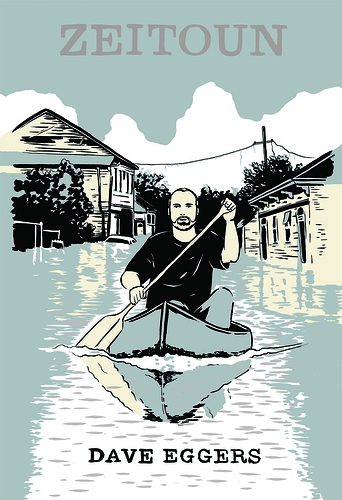
zeitoun book coverOn Tuesday, September 6, when Zeitoun went to the rental unit after making his daily rounds to feed the dogs and check on neighbors, he came across a man he had never met named Ronnie.  Nasser was also there, as was Todd.  Shortly after Zeitoun had finished taking a shower, Nasser yelled for him to come downstairs.  A group of armed and uniformed men were bursting into the house.  They put Adbulrahman, Nasser, Todd, and Ronnie in a boat and took them away.

The second half of Zeitoun’s post-Katrina story, the one that begins with his disappearance at the hands of these men, is riveting.  You follow Kathy as she struggles for weeks to locate him without knowing if he is alive.  She tries to hide her worry from her children while she physically and emotionally unravels at the seams.  It eventually takes a brave act by a person that she does not know for her to find Zeitoun.  Where he is and what has happened to him is both shocking and obvious.

Zeitoun was a man at the intersection of multiple tragedies: the destruction by the hurricane, the chaos of the aftermath, the post-9/11 fears about Muslim Americans, and the pervasiveness of the “war on terror” into our own cities, homes, and lives.  Dave Eggers’ Zeitoun leaves you understanding that no matter what mother Earth can do to us, we can always do worse to each other.

Great Books on Women in US History

By Megan Seaholm

As one of the students in my U.S. women’s history class put it, “Women are just like men; except that they are different.” For all that men and women have had in common these many millenia, women’s experience has often been different. Women’s History Month gives us the opportunity to talk about two new and one not so new “good reads” on the subject.

The University of Texas Press has just published the latest from the impressive authorial team, Judith McArthur and Harold Smith, faculty at the University of Houston-Victoria.  Texas Through Women’s Eyes: The Twentieth Century Experience (2010) begins with “Social Reform and Suffrage in the Progressive Era, 1900-1920,” discussing the civic reforms pursued by white and black clubwomen, labor activism, settlement houses and prostitution districts, and the state woman suffrage campaign.

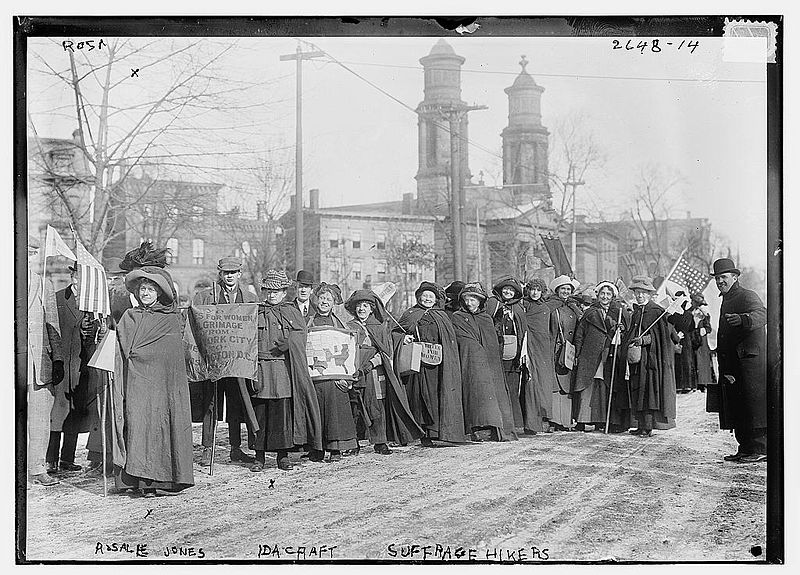
Black and white photograph by Richard Arthur Norton called Suffrage Hikers showing a line of women and men holding protest signs and flags

Texas suffragists were among the few southern suffrage associations to win partial voting rights for women before the federal amendment was passed.  These Texas women pulled a “fast one,” and you will want to read about it.

McArthur and Smith continue through the Great Depression, World War II, the Civil Rights Movement, the Women’s Rights Movement, and the backlash to same in the last decades of the twentieth century.  They make the history they reveal personal with selected documents like “Hallie Crawford Stillwell Gets a Sink and Builds a Bathroom,” “Jessie Daniel Ames Urges Women to Vote against the Ku Klux Klan,”  “Army Nurse Lucy Wilson Serves in the Pacific Theater,” “Ceil Cleveland Becomes a Teenage Bride in the Fifties,” and “Ann Richards Moves from Campaign Volunteer to County Commissioner.”

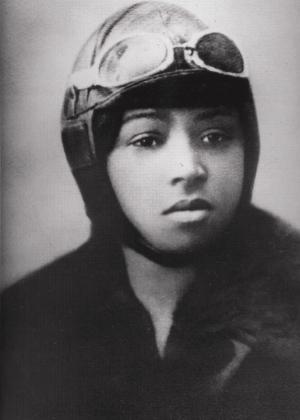
Black and white headshot of Bessie Colman, First African-American Pilot from the National Air and Space Museum

McArthur and Smith are also the coauthors of Minnie Fisher Cunningham:  A Suffragists’ Life in Politics (2005) which won the Liz Carpenter Award for Research in the History of Women from the Texas State Historical Association and the T.R. Fehrenbach Book Award from the Texas Historical Commission.

Christine Stansell, a well-regarded historian at the University of Chicago, provides a national perspective in her latest publication,The Feminist Promise: 1792 to the Present (2010).  Don’t be daunted by the title.  This is not a polemic, nor is it a weighty treatise on social theory. Rather, it is an exceptionally readable narrative of the efforts of American women to improve their social, political and legal situation.  Stansell notes the efforts of women of color and of working class women alongside the more well-known white middle-class activists.  She provides the general reader, as well as the scholar new to women’s history, with a splendid survey of women’s rights activism beginning with the days of the early republic.  Her discussion of the woman suffrage movement is particularly strong because she explains the divisions in the movement and its culminating diversity, which  led to the ratification of the Nineteenth Amendment in 1920.  From the racism of the movement’s “southern strategy” to the dramatic protests of the National Woman’s Party in front of the White House even during World War I, Stansell’s unflinching history is good reading.  Stansell barely pauses once women have won the vote.  Her story continues through the interwar years to the “second wave” of feminism in the 1960s and 1970s.

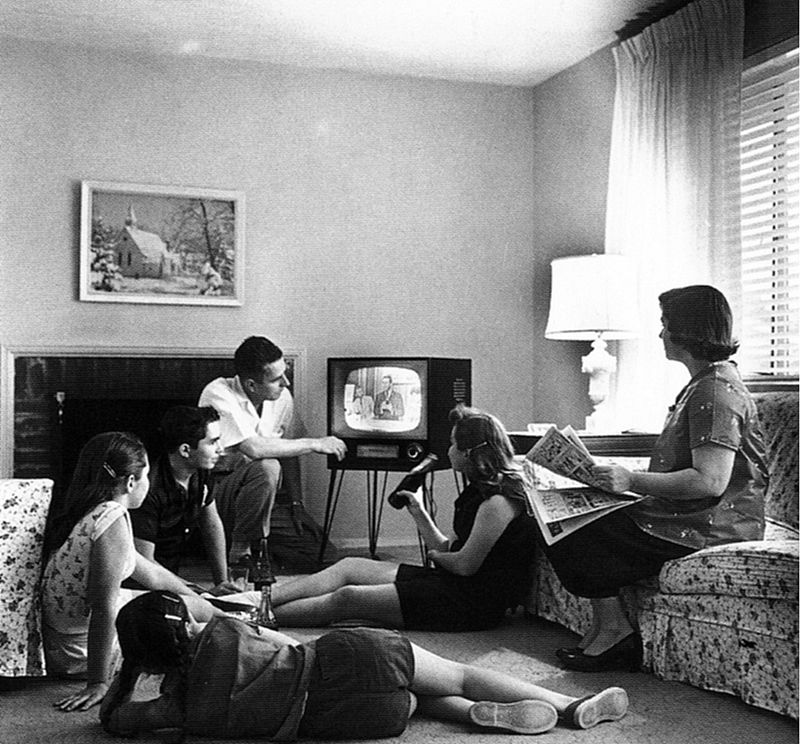
Black and white photograph by Evert F. Baumgardner from 1958 entitled by Family Watching Television

Again, she explains that the “movement” was far from monolithic in goals or tactics, but she acknowledges the accomplishments as well as the internal politics.Stansell’s subject is organized women’s activism, which like activism of all sorts, was viewed with suspicion in the early years of the Cold War, aka “the McCarthy Era.”  Fortunately, Elaine Tyler May moved into the breach with Homeward Bound:  American Families in the Cold War Era (1988).  Who knew that Cold War foreign policy and its home front counterpart had such important implications for family life?  May’s first chapter “Containment at Home: Cold War, Warm Hearth,” shows the ways that the Cold War foreign policy of “containing Communism” was reflected in family life.

The Fifties have been canonized as the nostalgia decade of domestic tranquility before the tumultuous Sixties.  Professor May confounds, or, at least complicates, this happy myth.  The frenzied public celebration of family life introduced new stresses into families and to couples, as social norms regarding dating, birth control, marital sexuality, consumerism, and divorce were in flux.  A history of family life, a history of women’s experience, Elaine Tyler May’s Homeward Bound is a young classic.


Photo credits

Suffrage Hikers, By Richard Arthur Norton, via Wikimedia Commons
Bessie Colman, First African-American Pilot, National Air and Space Museum, via Wikimedia Commons
Family Watching Television, 1958, by Evert F. Baumgardner, via Wikimedia Commons 


The views and opinions expressed in this article or video are those of the individual author(s) or presenter(s) and do not necessarily reflect the policy or views of the editors at Not Even Past, the UT Department of History, the University of Texas at Austin, or the UT System Board of Regents. Not Even Past is an online public history magazine rather than a peer-reviewed academic journal. While we make efforts to ensure that factual information in articles was obtained from reliable sources, Not Even Past is not responsible for any errors or omissions.

« Previous Page
Next Page »

Recent Posts

  • NEP Author Spotlight – Aidan Dresang
  • Lesson Plans: The Vietnam War and American Society
  • Lesson Plans: Protest and Social Unrest
  • Lesson Plans: Radio and Communications Technology
  • The Long-Lasting and Perpetuating Effects of Lynching Postcards and Photography
NOT EVEN PAST is produced by

The Department of History

The University of Texas at Austin

We are supported by the College of Liberal Arts
And our Readers

Donate
Contact

All content © 2010-present NOT EVEN PAST and the authors, unless otherwise noted

Sign up to receive our MONTHLY NEWSLETTER

  • New
  • Features
  • Reviews
  • Texas
  • Teaching
  • Digital
  • Watch & Listen
  • Authors
  • About