• New
  • Features
  • Reviews
  • Texas
  • Teaching
  • Digital
  • Watch & Listen
  • Authors
  • About

The past is never dead. It's not even past

Not Even Past

L.A. City Limits: African American Los Angeles from the Great Depression to the Present by Josh Sides (2003)

by Cameron McCoy

For African Americans in the twentieth century, Los Angeles was a dream destination; black migrants were drawn to it (much as they were drawn to Chicago and Detroit) in search of freedom from the Jim Crow South. However, Los Angeles African Americans quickly confronted their limitations as a minority group. Jobs, housing, education, and political representation spearheaded blacks’ struggles for greater equality in Los Angeles. In L.A. City Limits: African American Los Angeles from the Great Depression to the Present, Josh Sides argues that the migratory experience of blacks in Los Angeles was more representative of the history of urban America than that of northeastern cities such as Chicago and Detroit.
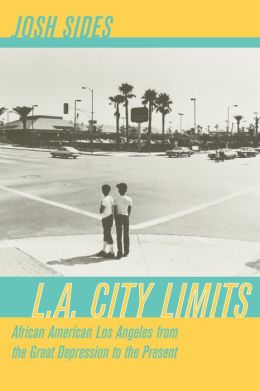
9780520238411_p0_v1_s260x420Sides begins L.A. City Limits by introducing the Great Migration from the early 1900s through the 1930s, as African Americans migrated from Louisiana and Texas. He explores the growth, development, and sustainment of the Los Angeles African American community as compared to the nation as a whole, both in the north and the south. Sides highlights the roles of Leon Washington and Loren Miller as members of the black press, and the significance of the color line in the labor industry as it applied to blacks and Mexican Americans. He discusses the complex nature of racial equality and organized labor among blacks and Mexican Americans.  He also uses several examples that emphasize the separation of the races; not along ethnic lines, but rather to the extent of “white” and “non-white.” As Sides notes, “Multicultural neighborhoods brought blacks and other groups into contact with one another not just as neighbors but also, at times, as fellow parishioners, club members, consumers, friends, and even spouses.” Although Los Angeles African Americans did not live in all-black neighborhoods like in Chicago and Detroit, they still struggled to define their status and “were justifiably ambivalent about their progress” prior to World War II.
image

World War II was a landmark event for African Americans. Between 1940 and 1970, the black population of Los Angles swelled from 63,744 to nearly 763,000. Sides labels this period as the “Second Great Migration,” and provides case studies of the African American experience from three southern cities: Houston, New Orleans, and Shreveport. He then examines how Los Angeles adjusted to this large influx of black southern migrants, revealing the adverse effects of racial segregation, by highlighting major World War II industry opportunities, the “Negro problem,” and the challenges migrants faced as they settled in South Central Los Angeles.

During the postwar era Los Angeles African Americans experienced a negative restructuring of the postwar economy, as economic parity with whites remained outside their grasp. However, there were advances in employment in major industries such as automobile, rubber, and steel manufacturing. Nevertheless, Sides emphasizes that the aerospace industry, which produced significant suburban residential growth, held to racist hiring practices. Despite these economic and employment limitations, Sides concludes that after World War II, life for black men and women in Los Angeles vastly improved. Housing discrimination during the urban crisis in the postwar era, however, together with “ghetto flight” and the emergence of a black middle class widened the gap among blacks, both financially and geographically. In addition, Mexican Americans, who at times adopted a “white or near white” identity, occupied an area within the racial hierarchy where they were viewed with far more tolerance and acceptance than blacks, according to Sides. This increased Mexican integration into white society was largely a reflection of white attitudes toward blacks and Mexicans.
The_sprawling_lights_of_Los_Angeles_and_the_surrounding_area_seen_from_Inspiration_Point_Mount_Lowe_ca._1950_-_NARA_-_541906Sides’s treatment of black political activism illustrates the steps Los Angeles African Americans took in responding to workplace discrimination and police brutality. In his treatment of black activism, Sides examines the signature event of the 1965-Watts Riot and the ideological differences between prominent black organizations, arguing that during the 1940s and 1950s the Communist Party was “the most outspoken and militant advocate for black equality in postwar Los Angeles.”

L.A. City Limits is an important work for students and historians of the American West, race relations, and urban studies. Sides takes a defensive position in his study of the city of Los Angeles in comparison to Chicago and Detroit. He argues that scholarly studies overemphasize the Great Migration to northern cities and a study of Los Angeles provides a more comprehensive view of the overall experience. Sides convincingly constructs the racial hierarchy among minorities, providing an element of Latin American studies that is largely absent from most Great Migration studies. Nevertheless, L.A. City Limits does not completely live up to its title. Sides’s work centers on the years 1945–1964, as opposed to the Great Depression to the present. Despite this limitation, Sides’s examination is a suitable companion to works such as Thomas J. Sugrue’s The Origins of the Urban Crisis: Race and Inequality in Postwar Detroit (1996) and James R. Grossman’s Land of Hope: Chicago, Black Southerners, and the Great Migration (1989).

Photo Credits:

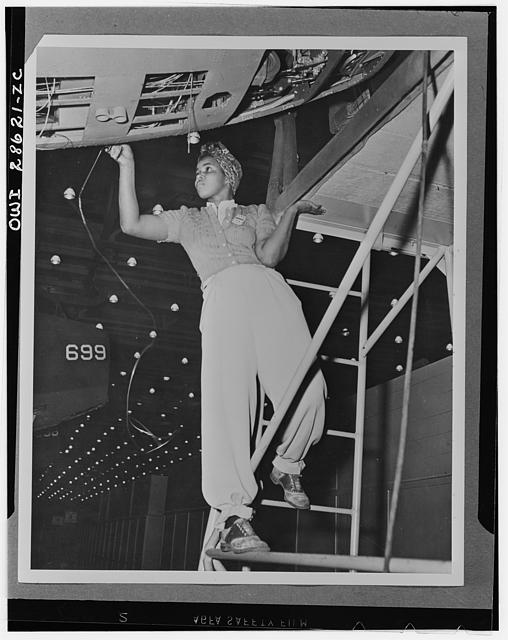
An employee of the Douglas Aircraft Company in Long Beach, CA, circa 1940s (Image courtesy of Library of Congress)

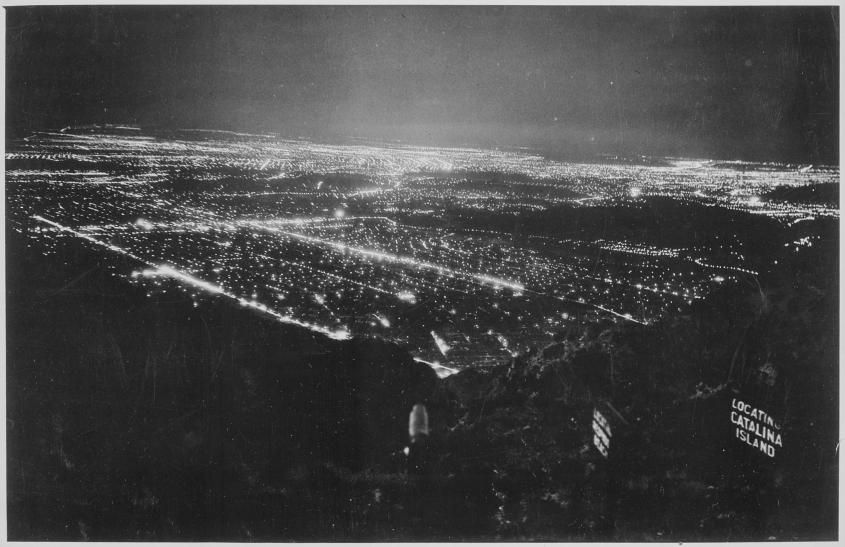
Los Angeles, circa 1950 (Image courtesy of The National Archives and Records Administration)
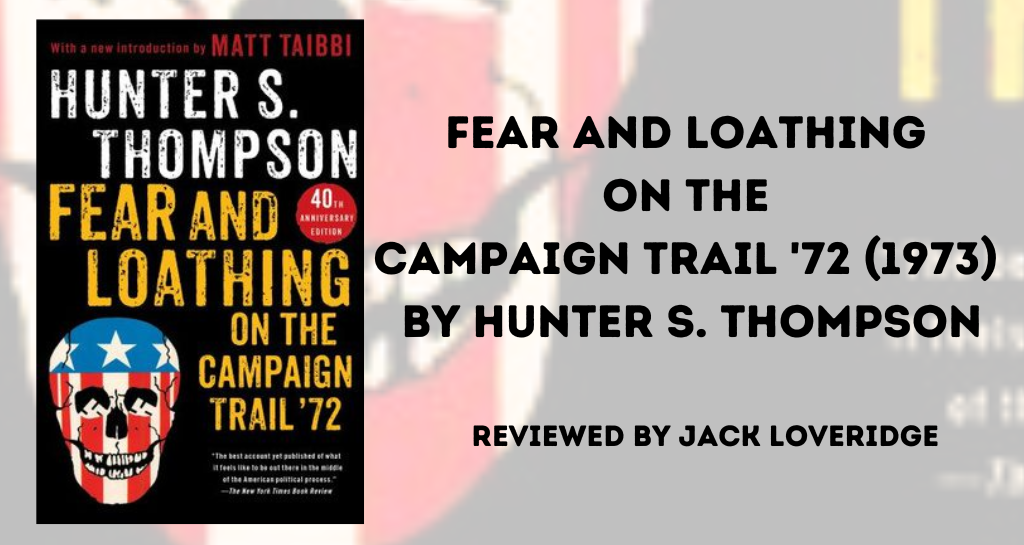
 

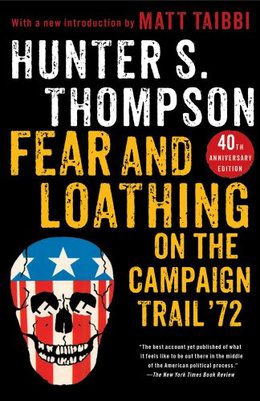
Fear and Loathing on the Campaign Trail ’72 by Hunter S. Thompson (1973)

“How low do you have to stoop in this country to be President?”

Forty years on, that question still haunts the pages of Hunter S. Thompson’s Fear and Loathing on the Campaign Trail ’72 like the ghost of Boss Tweed. First appearing as a series of articles in Rolling Stone Magazine, Thompson’s coverage of the 1972 presidential election shines light on the darker side of the democratic process. Thompson, author of Hell’s Angels and Fear and Loathing in Las Vegas, has the right kind of eyes to see the corruption, the lunacy, and the sheer depravity of choosing a chief executive in modern America. In his landmark work of Gonzo journalism, Thompson chronicles the Democratic Party’s struggle to mount a viable challenge to Richard Nixon as the Vietnam War raged on with no end in sight.

book cover for Fear and Loathing on the Campaign Trail ’72

Thompson powerfully sets the stage for the 1972 Democratic primary contest – a party divided, old coalitions fragmenting, and the chaos of the 1968 election looming over the process. For the first time, the Democrats would choose their nominee exclusively through state primaries rather than a combination of elections and back-room deals. The list of candidates – including Sen. Ed Muskie of Maine, Sen. Hubert Humphrey of Minnesota, Sen. Henry “Scoop” Jackson of Washington, and Gov. George Wallace of Alabama – proved familiar but uninspiring.  In the midst of this drab battle for the soul of the Democratic Party, Thompson spots an honest man in a pack of party hacks: Sen. George McGovern of South Dakota.

McGovern, who died last weekend at the age of 90, emerged in 1972 as the Democratic Party’s unlikely presidential nominee. As a rare liberal spokesman from a conservative state, McGovern championed the anti-war movement in the U.S.

Senate. McGovern, a former history professor and decorated World War II bomber pilot, passionately protested the Vietnam War on the Senate floor, lamenting: “I am sick and tired of old men dreaming up wars for young men to die in.” McGovern’s fledgling campaign picked up steam through the primaries of 1972, and Hunter S. Thompson went along for the ride.

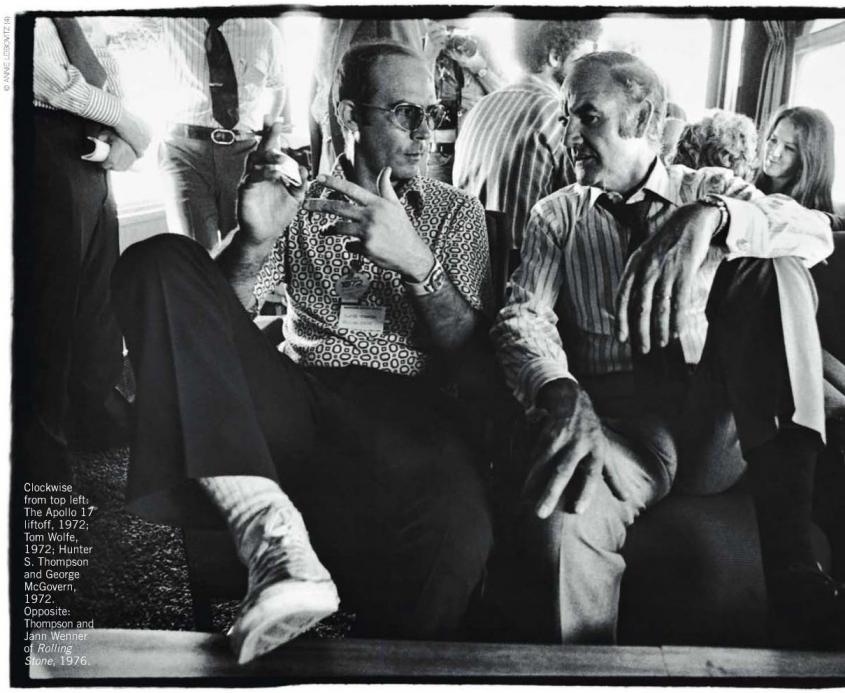
Hunter S. Thompson (left) and Sen. George McGovern on the campaign trail, 1972.

Hunter S. Thompson (left) and Sen. George McGovern on the campaign trail, 1972. Source: Wikimedia Commons.

As a sort of embedded journalist with the McGovern campaign, Thompson shunned the idea of impartial reporting. Objective journalism, he argued, is a “pompous contradiction in terms.” After all, selecting sources and choosing verbs are subjective activities. Besides, Thompson reasoned, artificial objectivity blinded most journalists to the dishonesty of politicians like Richard Nixon, his main antagonist. By this reasoning, Thompson publicly declared his support for McGovern early in the primaries.

At times, Thompson’s irreverent style (which he termed “Gonzo journalism”) also blurs the line between fiction and reality. On the campaign trail, he reported that a rumor was circulating that frontrunner Ed Muskie had been treated with a powerful psychoactive drug called Ibogaine. His report was true. There was indeed a rumor, but Thompson had started it himself. Similarly, Thompson sets his sights on derailing Hubert Humphrey’s nomination bid. Over the course of a brutal series of primary battles between Humphrey and McGovern, Thompson tells of suspected election fraud and attempts to circumvent the newly-instated primary system by the “old ward heeler” from Minnesota.

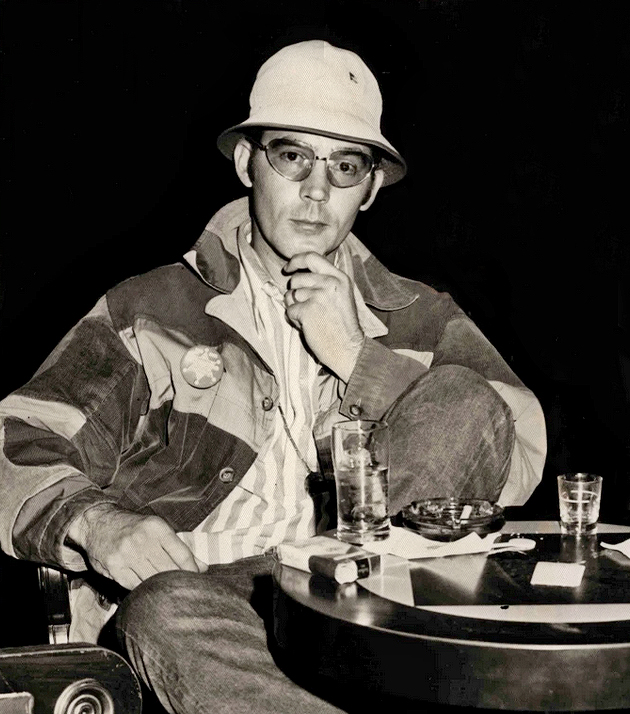
Hunter S. Thompson, 1971
Hunter S. Thompson, 1971. Source: Wikimedia Commons

From the primaries to the convention, Thompson’s colorful prose proves both gripping and darkly humorous. The unprecedented access he gained to McGovern campaign staffers and Democratic Party chiefs enabled him to document every day of the historic contest in graphic detail. Thompson does not simply regurgitate press releases and the transcripts of pool interviews. He vividly relates the feel of life on the campaign trail – the blind euphoria, the hopeless despair, the money, the loneliness, the alcohol, and all. Thompson’s clarity and wit have firmly established Fear and Loathing as a celebrated work of political journalism and its author as an icon of American literature.

But what of the hero? What of George McGovern?

McGovern lost every state in the Union, save for Massachusetts and the District of Columbia. Nixon’s landslide victory represented the first time a Republican carried every Southern state and delivered the incumbent a then-record 520 electoral votes. Thompson rattles with contempt in his reflections on the Nixon landslide but maintains enough composure to analyze the reasons for McGovern’s devastating loss. First, the ugly primary fights with Humphrey left the liberal McGovern labeled as the candidate of “Amnesty, Acid, and Abortion.” Second, the fractured Democratic establishment never fully united behind its nominee.

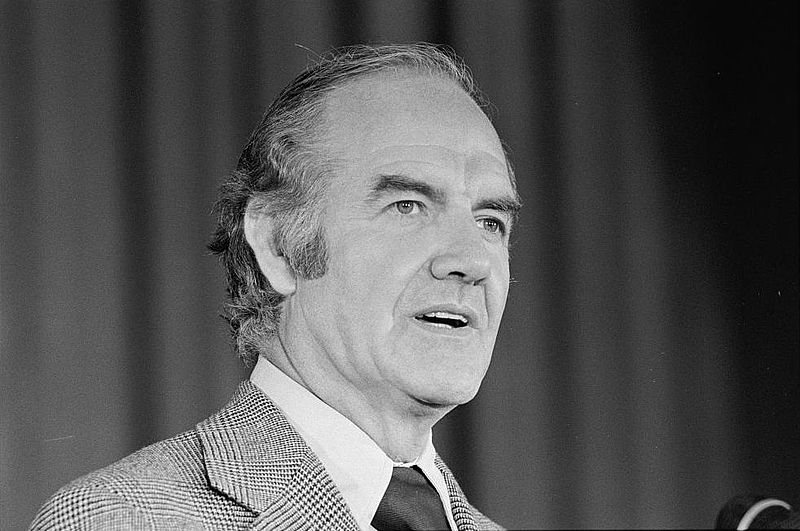
Senator McGovern, 1972
Senator McGovern, 1972. Source: Wikimedia Commons

Perhaps most significantly, McGovern’s running mate, Sen. Tom Eagleton of Missouri, was revealed to have undergone electroconvulsive therapy for depression. After waffling for days, McGovern asked Eagleton to step down to be replaced by former Peace Corps director Sargent Shriver. Through these debacles, Thompson portrays McGovern as an honest man making foolish mistakes. These political errors undermined public confidence in McGovern’s judgment and reinforced his image as “too liberal” for the country.

While the American public rejected McGovern in 1972, Thompson viewed him as the last best hope for America. As he writes: “The tragedy of all this is that George McGovern, for all his mistakes […] is one of the few men who’ve run for President of the United States in this century who really understands what a fantastic monument to all the best instincts of the human race this country might have been.”

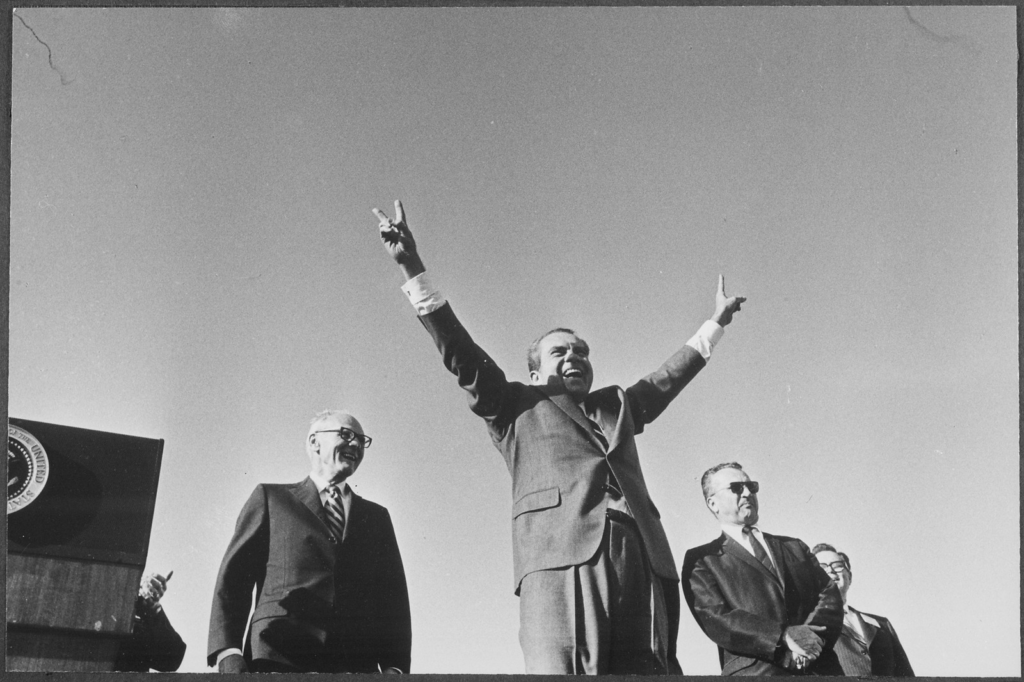
Nixon at a campaign event
Nixon at a campaign event. Source: Wikimedia Commons.

In light of the social upheaval of the 1960s and the persistent trauma of war in Vietnam, McGovern’s grassroots campaign provided a powerful contrast to the heavy-handed and often secretive Nixon Administration. Indeed, as Thompson tracked McGovern’s campaign for Rolling Stone, Bob Woodward and Carl Bernstein diligently investigated the June 17, 1972, Watergate burglary in the pages of the Washington Post. To avoid a probable impeachment, Nixon resigned the presidency just over two years later. As Fear and Loathing on the Campaign Trail ’72 brilliantly reveals, George McGovern inspired many with a vision of an honest and humane government intent on building peace at home and abroad. It is a vision that has been eroding ever since.


The views and opinions expressed in this article or video are those of the individual author(s) or presenter(s) and do not necessarily reflect the policy or views of the editors at Not Even Past, the UT Department of History, the University of Texas at Austin, or the UT System Board of Regents. Not Even Past is an online public history magazine rather than a peer-reviewed academic journal. While we make efforts to ensure that factual information in articles was obtained from reliable sources, Not Even Past is not responsible for any errors or omissions.

Joseph Smith: Rough Stone Rolling by Richard Lyman Bushman (2007)

by Rachel Ozanne

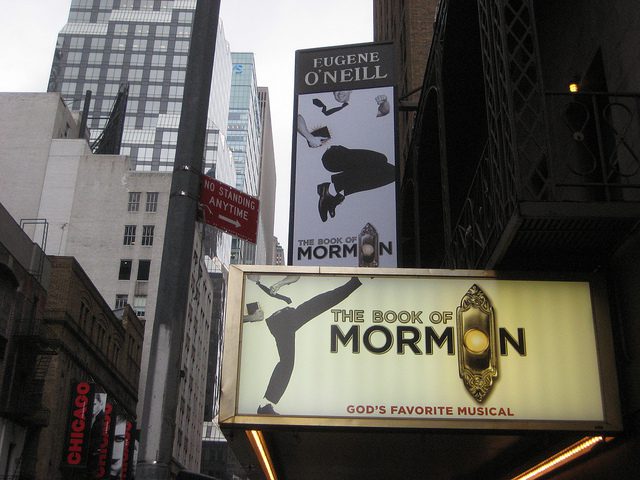
In the past ten years, Americans have shown a sustained interest in cultural depictions of the Church of Jesus Christ of Latter-day Saints (LDS), or the Mormon Church. South Park’s 2003 episode “All about Mormons” and the 2011 musical The Book of Mormon satirized the founding of the LDS church. Other television shows, however, like HBO’s Big Love and TLC’s Sister Wives have tried to portray other non-LDS strands of Mormonism in a more complex way by exploring modern day polygamy. Now with Mitt Romney’s nomination for the Republican Party candidate for President, the Mormon faith once again finds itself in the spotlight.

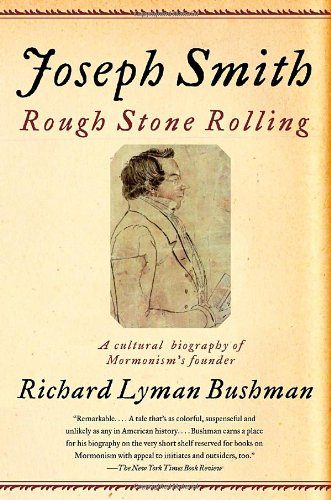
51Z7ku6pZDLWith all the drama of television, or quite frankly a presidential campaign, the historical origins of Mormonism can get lost in the shuffle. Despite all the media coverage, a religion that some scholars have deemed the quintessential American religion remains largely misunderstood by the American public. For those interested in learning more, however, about many of the fundamental doctrines and the beginnings of the Mormon (and particularly LDS) Church, I recommend Richard L. Bushman’s recent biography of Mormonism’s founder Joseph Smith, Jr., Rough Stone Rolling.

In Rough Stone Rolling, Bushman brings his extensive knowledge of early Mormon history to expand upon his first book about the life of Joseph Smith, Joseph Smith and the Beginnings of Mormonism, by tracing the entirety of Smith’s life from the cradle to the grave with a special emphasis on the cultural context out of which he came. Bushman himself is a member of the LDS Church, but his pro-Mormon bias does not prevent him from presenting Smith as a flawed human being, noting that Smith never set himself up as a perfect moral exemplar, but rather a “rough stone rolling”—one that would be smoothed over in time.

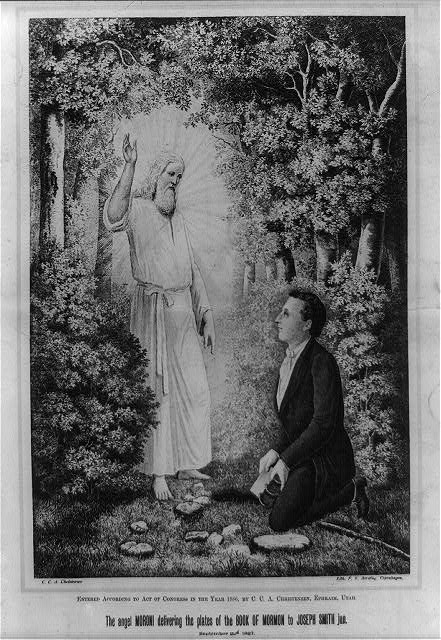
Angel_Moroni“The angel Moroni delivering the plates of the Book of Mormon to Joseph Smith jun.” 1886 print (Image courtesy of Library of Congress)

Bushman’s approach to writing a biography of Joseph Smith almost necessarily focuses heavily on Smith’s spiritual development and how it went hand in hand with the development of Mormonism. Thus, the narrative of the book is punctuated by major events of Smith’s spiritual life, well known to followers of Joseph Smith: his first contact with the Angel Moroni; his discovery of the golden plates on which the Book of Mormon was written; the transcription of those plates into an English text; the restoration of the Aaronic priesthood and the priesthood of Melchizedek in 1829; the founding of the church in 1830; and various revelations that instituted new doctrine or prompted the growing Mormon church to move from New York to Ohio and eventually to Illinois, where Smith was killed.

However, Bushman also spends much time providing the cultural and political context of Smith’s life. In so doing, he implicitly engages with a number of debates about Mormon history. For instance, did Joseph Smith invent the Book of Mormon or was he truly divinely inspired? Was he a power hungry man who had “convenient” revelations resting the sole power of revelation for the LDS church in him or did he really hear commands from God?

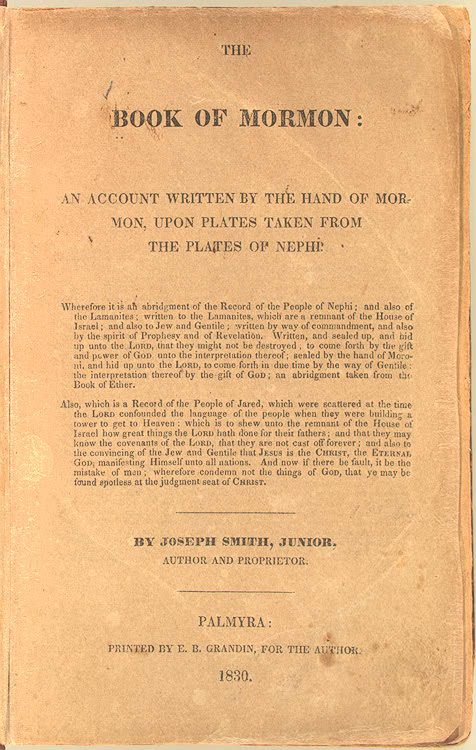
vc0066611830 copy of The Book of Mormon (Image courtesy of Wikimedia Commons)

Bushman’s treatment of polygamy is particularly engaging, given that mainstream Mormonism (the LDS Church) officially gave up polygamy in 1890. Even though Bushman doesn’t support polygamy himself, he tries to explain why “plural marriage” (the Mormon term for polygamy) made sense in the context of Joseph Smith’s theology. In particular, Bushman claims that Smith emphasized the importance of family, so he created, or was inspired to create, rituals to ensure that marriage and family lasted for eternity—marriage sealing and baptism for the dead, for instance. In this light, taking on multiple wives was considered another way to extend the family and preserve as many people together in the afterlife as possible.

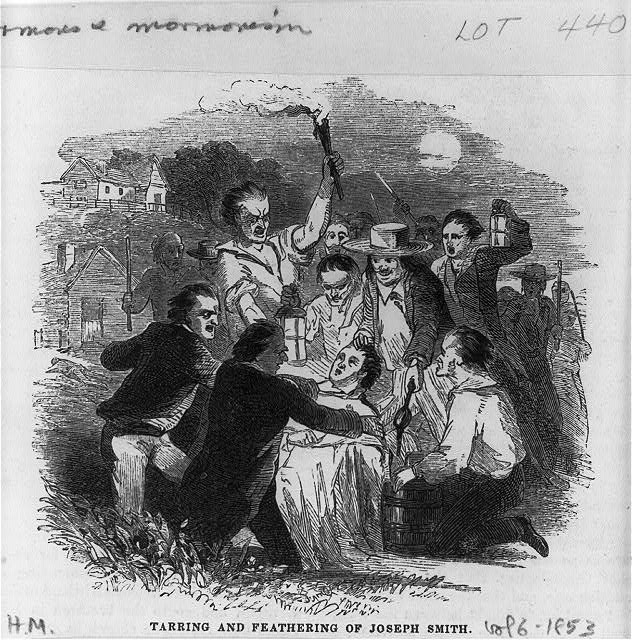
TF_Jsmith1853 Harpers Magazine engraving of Smith being tarred and feathered (Image courtesy of Library of Congress)

Perhaps it is unsurprising that he takes a sympathetic view of polygamy, because he views Smith sympathetically throughout the book. Skeptics may find his matter-of-fact dealings with angels and revelations a bit hard to swallow, and strong opponents of polygamy will not likely be satisfied with Bushman’s assessment that plural marriage was mostly a loving institution at its beginning. It is important to remember, however, that Smith was not the only antebellum American experimenting with different kinds of marriage or claiming to receive messages directly from God. He was in good company with the Oneida Community, Ellen G. White and the Seventh-day Adventists, and many other 19th-century religious groups.

image

The Book of Mormon Broadway musical, New York City, 2011 (Image courtesy of Brechtbug/Flickr Creative Commons)

As a biography of Joseph Smith, Rough Stone Rolling only tracks the development of the Church of Latter-day Saints up to Smith’s death in 1844 at the hands of some angry Illinois citizens. Readers interested in the rest of the story will have to pick up other books to learn about schisms in the early church; the trek westward of the followers of Brigham Young; the contest between Mormons and the U.S. government over the legality of polygamy; and the history of race and Mormonism. Nevertheless, Bushman’s history provides great insight for a reader trying to understand the appeal of Joseph Smith and the Mormon faith from the outside.

Lords of Finance by Liaquat Ahamed (2009)

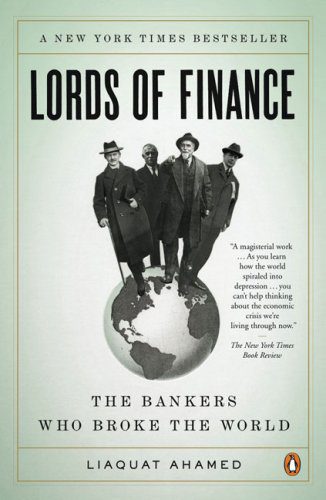
imageby Mark Eaker

For those watching the financial markets, events in Europe are front and center.  Market participants await announcements by government leaders, finance ministers, central bankers, and economists with anticipation. Depending upon the degree of optimism or pessimism generated by a given announcement, the market reaction leads to hundreds of billions of dollars lost or gained on equities, currencies, bonds and commodities from Frankfurt and London to New York and Tokyo.  One might assume that the enormous worldwide impact that events in Europe are having is a function of globalization, new forms of financial engineering, and the speed of information transfer brought about by the Internet. Without doubt each of those has had an impact, but as the Liaquat Ahamed’s superb history of the events leading up to the Great Depression reminds us, it has all happened before.

Lords of Finance is a multiple biography of the four most prominent central bankers of the 1920s: Mantagu Norman of the Bank of England; Benjamin Strong of the New York Federal Reserve Bank ; Emile Moreau of the Banque de France and Hjalmar Schacht of the Reichsbank. There is a colorful supporting cast including the economist John Maynard Keynes, Winston Churchill as Chancellor of Exchequer and Thomas Lamont of J.P. Morgan & Co. However, the focus is on the actions and inactions of the four bankers.

image

Ahamed did not write the book in anticipation of our reaction to the financial crisis of 2008. He does not draw direct comparisons of the events of the 1920s to those of today. His narrative is an artful description of the roles each of the men played with rich and meaningful insights about their individual characters, their relationships with one another, their ambitions, and their personal struggles. Those insights are not just bits of historical gossip but they are at the heart his explanation of the failure of the United States and Europe to confront the problems that ultimately brought about the Depression and set the stage for the rise of Hitler and Nazi Germany.

image

The historical and biographical details are engrossing. In addition, Ahamed’s economic and investment background allows him to deliver an excellent primer on currency, the gold standard, and international banking.

Although Ahamed does not relate the events or lessons to today’s problems, it is hard for a reader to refrain from doing so. At the root of Europe’s problem was the debt burden imposed on Germany in the form of reparations after World War I and the decisions made to return to the gold standard at pre-war rates of exchange. Today’s problems are also related to excessive external sovereign debts and a Euro currency mechanism, which, like the gold standard, eliminates devaluation as an instrument of economic policy. In the 1920s, the economic prescription was austerity and it is the same medicine being prescribed today.

Let’s hope for a better outcome and that someday another author will describe the events of our era as well as Ahamed does the 1920s.

Photo Credits: 

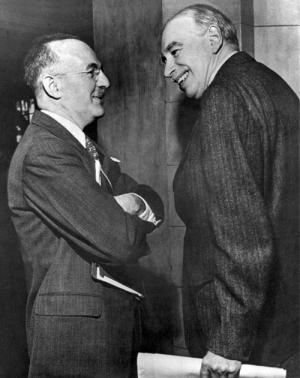
John Maynard Keynes and Harry Dexter White at the 1946 Bretton Woods Conference (Photo courtesy of Wikipedia Commons)

The Federal Reserve Bank of New York, 1936 (Photo Courtesy of The New York Public Library. Photography Collection: Miriam and Ira D. Wallach Division of Art, Prints and Photographs)

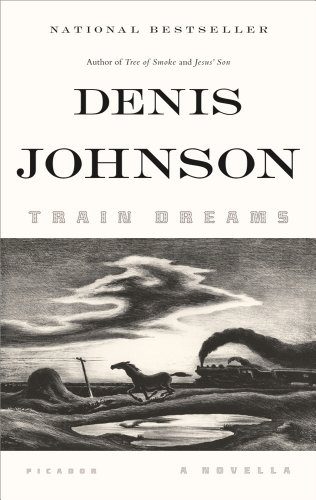
Train Dreams by Denis Johnson (2012)

by Jacqueline Jones

On the surface, Train Dreams appears to be an historical novel; most of the story takes place during the first third of the twentieth century, and it includes real people and places. Yet as a narrative, the novel—or rather, novella (consisting of 116 short pages)—is fundamentally ahistorical. The protagonist Robert Grainier lives for 80 years, but he remains outside the mainstream of American life; when he dies, he has never used a telephone.  He has no heirs, and he has no personal history before the time he can remember as a boy.  He never learns anything about his parents or the place of his birth, and in fact he “soon misplaced this earliest part of his life entirely.” Thus he lacks a sense of his own beginnings.

TD_0Grainier suffers a great tragedy in mid-life, and that tragedy shapes his subsequent being in the world, but he does not seem to change much as a person; throughout the book he remains a skinny and steady hard worker, and though we feel for him in his loneliness, we do not learn much about him as a person.  The book is not organized chronologically, and from start to finish certain constants endure—Grainier’s encounters with the menacing magnificence of nature in northern Idaho, and with the “the hard people of the northwestern mountains”—his people—who live there.  Johnson highlights the railroad as a metaphor and as a source of employment for Johnson, but it is not a machine that takes us from one place to another; rather, its whistle blends with the howl of the coyote, and as it passes through the valley where Grainier lives, it enters his dreams.

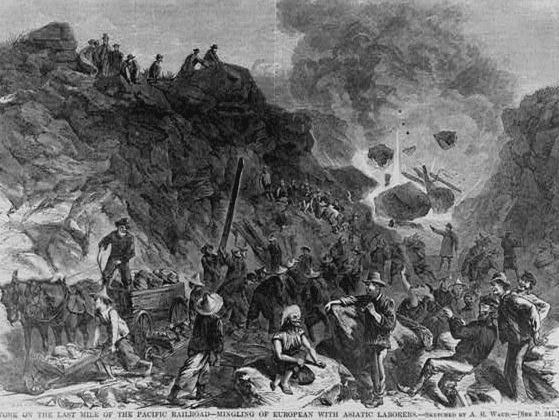
From a historian’s perspective, the greatest virtue of Train Dreams is its evocation of the rough life followed by railroad construction workers and lumbermen in the Pacific Northwest.  As a young man Grainier spends time as what he calls a “layabout,” but what we today would call a casual worker.  He helps to blast tunnels, bridge canyons, cut trees, and roll logs.  He embraces outdoor engineering feats as intrinsically heroic, hailing the spanning of a 60-foot deep, 112-foot wide gorge akin to building the pyramids. He and his co-workers “fought the forest from sunrise until suppertime,” and then collapse, exhausted, into their bunks.

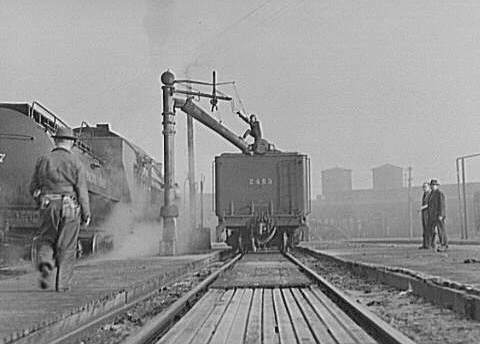
Screen_shot_2012-07-13_at_3.28.05_PM_0An 1869 sketch depicts men Working on the last mile of the Pacific Railroad. European and Asian laborers mingle together. (Image courtesy of the Library of Congress)

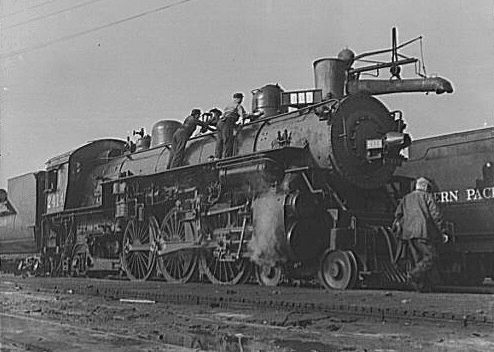
Screen_shot_2012-07-13_at_3.28.21_PMRailroad workers for the Southern Pacific Company in San Francisco. (Image courtesy of the Library of Congress)

By the time he is in his late 30s Grainier is making and saving money to care for his wife Gladys and their daughter Kate, whom he regularly leaves in their valley cabin for months at a time while he seeks work wherever he can find it.  Returning from a railroad job in the fall of 1920, he sees that a fire has consumed the valley and that Gladys and Kate have vanished:  “Soon he was passing through a forest of charred, gigantic spears that only a few days past had been evergreens.  The world was gray, white, black, and acrid, without a single live animal or plant, no longer burning yet full of the warmth and life of the fire.” Devastated by the loss of his family, Grainier slowly rebuilds a cabin on the site of the old one, and lives isolated from the rest of the world, as long as his savings sustain him.

Juxtaposed to the tenderness Grainier feels for his family is the deep and persistent violence that Johnson presents as a fundamental fact of rural western life. The author punctuates his story by accounts of horrific deaths—a lumber worker killed by a falling tree branch; a 12-year old girl murdered by her father when he discovers she is pregnant (unbeknownst to him, raped by her uncle); an Indian run over by a train, his remains scattered in tiny pieces along the track; a teen done in by a weak heart while lifting a sack of cornmeal; a prospector blown to bits while trying to thaw out a stick of dynamite on his wood stove.

Screen_shot_2012-07-13_at_3.28.35_PMSouthern Pacific Company railroad yards in San Francisco. (Image courtesy of the Library of Congress)

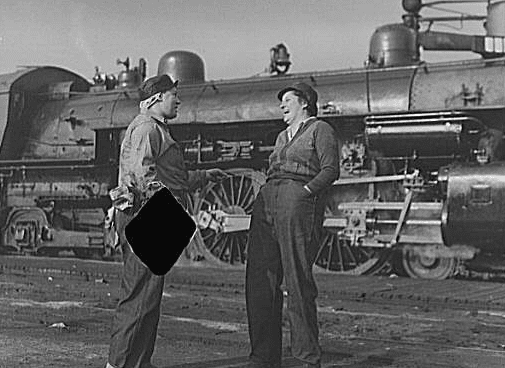
Screen_shot_2012-07-13_at_3.28.48_PMWomen railroad workers take over the cars and maintenance of freight and passenger trains in the Southern Pacific Company yards at San Francisco. (Image courtesy of the Library of Congress)

Gladys appears as a ghost to tell her widowed husband the circumstances of her own painful demise; in fleeing the fire with Kate she fell onto rocks in a river, breaking her back. The rushing waters bore her away.  Train Dreams contains other elements of magical surrealism—think Toni Morrison flirting with Paul Bunyan–mainly as a means of melding humans and animals into a single life-force that animates the mountains and valleys. After years of living alone, Grainier  hears terrifying stories of a “wolf-girl,” half person and half beast, who roams the land with no other apparent purpose than to strike fear into hearts of grown men: She was “a creature God didn’t create.  She was made out of wolves and a man of unnatural desires.” Predictably, this wolf-girl turns out to be Grainier’s long-lost daughter Kate, though the first and only time they confront each other, she shows no recognition of her father, and quickly disappears forever into the forest.  To mourn, Grainier howls with the wolves, his lament echoing off the mountainsides.

 One of the great pleasures of Train Dreams is the evocative language Johnson uses to describe the brutality of entwined natural and human forces. A group of white men grab and try to lynch a Chinese railroad worker accused of stealing, but the attackers are at least momentarily thwarted when their victim “shipped and twisted like a weasel in a sack, lashing backward with his one free fist at the man lugging him by the neck.” Grainier finds that his snug home with Gladys and Kate has been reduced to “cinders, burned so completely that its ashes had mixed in with a common layer all about and then had been tamped down by the snows and washed and dissolved by the thaw.” Yet there is beauty too:  Before too long, as Grainier drives through the valley in a wagon “behind a wide, slow, sand-colored mare, clusters of orange butterflies exploded off the blackish purple piles of bear sign and winked and fluttered magically like leaves without trees.” At night Grainier contemplates his own solitude as he “watched the sky.  The night was cloudless and the moon was white and burning, erasing the stars and making gray silhouettes of the mountains.”

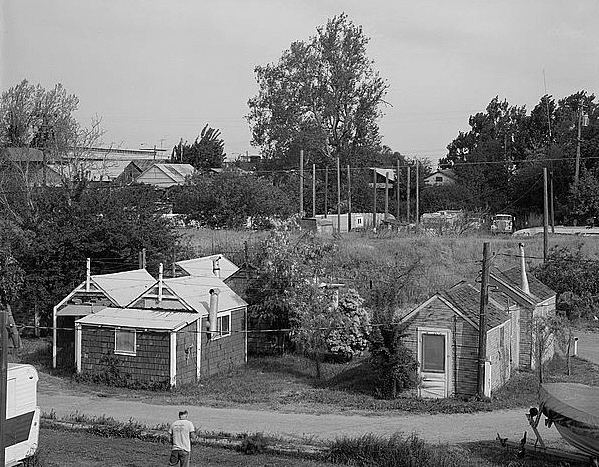
Screen_shot_2012-07-13_at_3.28.58_PMRailroad worker housing along the Southern Pacific Railroad tracks in Sacramento County, CA. (Image courtesy of the Library of Congress)

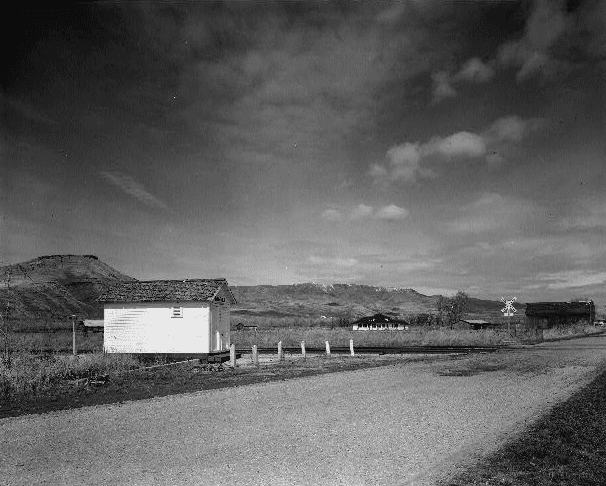
Screen_shot_2012-07-13_at_3.29.11_PMA tool shed along the Idaho Northern Railroad in Gem County, ID. (Image courtesy of the Library of Congress)

This spring the Pulitzer Prize board rejected all three nominees put forth by the fiction jurors—David Foster Wallace’s The Pale King (a behemoth at fifty chapters and 500 pages), Karen Russell’s Swamplandia!, and Johnson’s Train Dreams. If the Pulitzer intends to reward “the great American novel” or even “a great American novel,” then it is not difficult to discern the rationale behind the board’s decision to bypass Train Dreams at least. Johnson has written a novella that is more literary than historical (and his novel, Tree of Smoke, did win the National Book Award). Even had he intended to reveal the fraught enterprise of modern “progress”—the human price it exacts, and the natural barriers to it—then Train Dreams is only a qualified success, for it lacks the substance of a larger early twentieth-century story.  Missing here  is any meaningful intertwining of technology, capitalism, community, and the exploitation of labor and the organized resistance of laborers to that exploitation.  The evocations of Train Dreams are not exclusively American; we can imagine, and document, similar themes in the history of Canada or Australia, for example—the prejudice and anger of various ethnic groups toward each other; the hard living of single men toiling in the forests and on the railroads; the unforgiving nature of the seasons; and the predatory wiles of beasts which are, perhaps, not so different from humans after all.  Still, the story is a great pleasure to read.

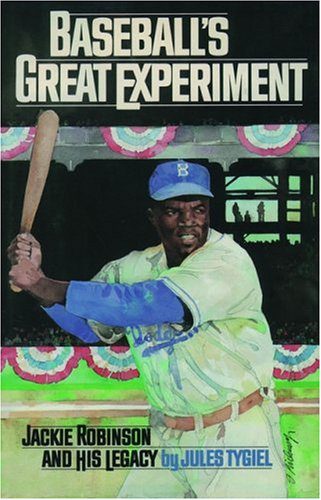
Baseball’s Great Experiment: Jackie Robinson and His Legacy by Jules Tygiel (1997)

by Dolph Briscoe IV

Historian Jules Tygiel presents not only an account of Jackie Robinson’s heroic struggle to integrate Major League Baseball, but a larger history of links between African American history, baseball, and the modern civil rights movement. Baseball’s Great Experiment further raises questions about race and sports in our current day.

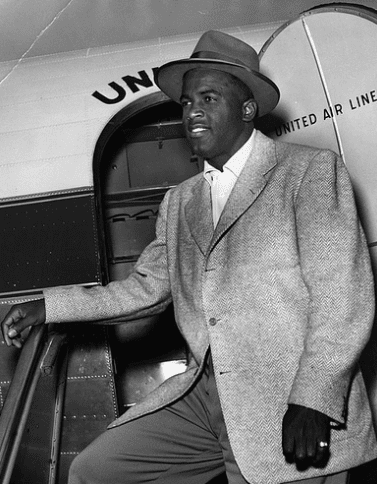
bookThe integration of baseball in the immediate post-World War II years profoundly impacted American racial attitudes and culture.  Baseball, the national pastime and most popular sport at the time, had remained segregated even as football and basketball had begun integrating.  Brooklyn Dodgers executive Branch Rickey became convinced that the integration of African Americans into Major League Baseball would serve as both a moral cause and an untapped resource of talented players that could strengthen his team.  Rickey recruited Jackie Robinson, a former army lieutenant and exceptional athlete who had played numerous sports at UCLA, to initiate his great experiment.  Robinson suffered threats, taunts, and abuse while breaking baseball’s color line in 1947, but performed remarkably on the field, carrying himself with a righteous dignity that amazed Americans.  Tygiel contends that Robinson’s quest raised awareness among white Americans ignorant to the scourge of racism in their midst.  Additionally, the integration of baseball influenced future civil rights initiatives by providing an example of brave nonviolent protest in the face of brutal opposition, and also through illustrating how economic factors could undermine segregation.

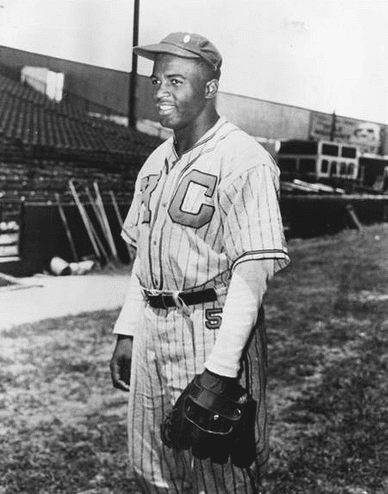
Screen_shot_2012-07-06_at_11.43.30_AMTygiel emphasizes the importance of Rickey and Robinson’s endeavor in the struggle for black equality.  Robinson played the 1946 season for the Montreal Royals before joining the Dodgers the next year, thereby also challenging Jim Crow in the minor leagues.  Integration in the minors became as critical as in the majors, since farm clubs provided opportunities for blacks to develop their baseball skills.  The author notes that black ball players in the minors often continued to face vicious racism, even after Robinson broke down the color barrier in the majors.  Robinson’s success with the Dodgers eventually caused other ball clubs to recruit athletes from the Negro leagues, continuing baseball’s integration.  Soon African American athletes like Larry Doby, Roy Campanella, Don Newcombe, and Satchel Paige starred in Major League Baseball.  These ball players became heroes to the larger black community and caused whites to reexamine their racial attitudes. Black major and minor leaguers often challenged southern segregationist mores while in spring training by attempting to integrate hotels, restaurants, and other public venues, setting the stage for later civil rights battles.  Tygiel argues that the successful coalition of black protestors (like Robinson), white liberals (such as Rickey), and sympathetic members of the press (both white and black) created a precedent for the modern civil rights movement.

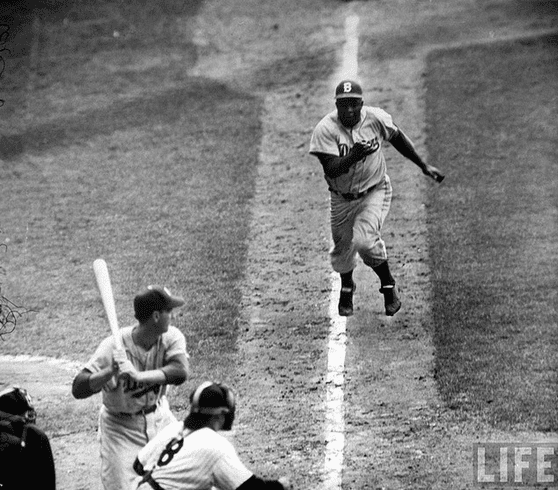
Screen_shot_2012-07-06_at_11.44.27_AMThe economics of baseball in small town life also played a role in integrating baseball.  Major and minor league spring training provided valuable income for hosting locales, most of which were in the South.  After some initial resistance, southern boosters largely abandoned their protests against integrated teams for fear of losing their lucrative deals with baseball clubs.  Economics outweighed social customs for most business people seeking to build a prosperous South.

Screen_shot_2012-07-06_at_11.45.50_AMYet while Robinson and Rickey’s great experiment achieved success, the author reminds us that inequality persists in baseball, and indeed, other sports.  In the years following his retirement from baseball, Robinson became disillusioned with the pace of racial integration in baseball, and in society itself.  The lack of African Americans in manager and front office positions in Major League ball clubs particularly disturbed him.  Although the number of minority coaches has increased since 1983 when this book was published,  we continue to see a disproportionately low number of minorities in coaching and organizational positions not only in baseball, but also in football, basketball, and in other sports, at both the college and professional levels of play. Baseball’s Great Experiment illustrates the fascinating story of the struggle to integrate baseball while encouraging us to contemplate the continued presence of racism in sports.  Today, with sports occupying such a prominent place in American life, readers will benefit from studying this interesting and moving book about race and athletics.

Photo Credits:

(Image courtesy of ozfan22/Flickr Creative Commons)

(Image courtesy of Black History Album/Flickr Creative Commons)

(Image courtesy of stechico/Flickr Creative Commons)


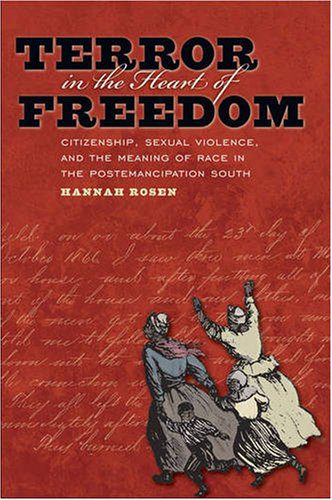
Terror in the Heart of Freedom: Citizenship, Sexual Violence, and the Meaning of Race in the Postemancipation South by Hannah Rosen (2008)

by Cristina Metz

To say that the US Civil War (1861-65) was tragic and destabilizing is a glaring understatement.image Hundreds of thousands died or were wounded in combat, entire cities were destroyed, and afterwards, the large segment of the nation that had seceded had to be reincorporated into the national body, and a new citizen-subject remained to be embraced by post-bellum societies. Hannah Rosen’s Terror in the Heart of Freedom analyzes the experiences of recently freed blacks, released from the bonds of slavery and plantation life, who sought to create new lives as freedmen and women. Many headed to cities as part of a “mass exodus from slavery.” The city of Memphis, Tennessee became one such “city of refuge” where freedpersons practiced their freshly conferred citizenship. They established new communities, built churches, opened their own schools, and formed African American benevolence societies that sponsored community events. In short, freedpersons in Reconstruction Memphis, as in many other cities, catalyzed changes in the socio-spatial boundaries of urban spaces that had previously been closed to them.
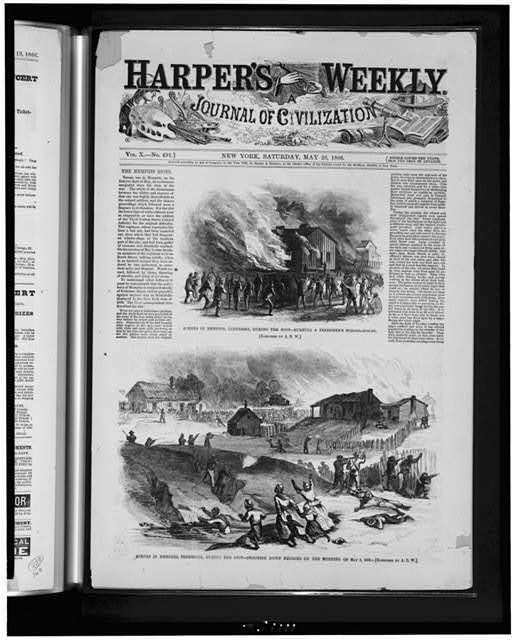
These changes did not come without tensions, which the continued occupation of southern cities by federal troops exacerbated. White society had also undergone transformations in the wake of the Civil War. In Memphis, working-class white immigrants filled a political vacuum left by the outmigration of the city’s antebellum commercial and political elite. These immigrants lived primarily in South Memphis, a region of the city that also happened to be a major destination for recently arriving freedpeople. Not only did the emerging white elites have to contend with a federal force that undermined their hegemony, they also encountered an expanding entrepreneurial and professional Black elite that they viewed as another threat to their political and economic ascendance. These tensions came to a head on Tuesday, May 1, 1866 in what is known as the Memphis Riot.

On this day, black Union soldiers that had been the primary federal force occupying Memphis turned in their weapons as part of their very public discharge. Because of the public nature of their de-armament, Rosen believes that the city police and white civilians chose this day to act. Over the course of three days, white rioters killed 48 African Americans, wounded 70 to 80, and set fire to 91 homes, four black churches, and 12 black schools. The rioters also raped several freedwomen. What started as a clash between black Union soldiers and Memphis police soon came to affect many more people and to symbolize much more.

image

Recently, historians have found that the Memphis Riot was not entirely spontaneous, random, or anarchic. It was “well-orchestrated” and the assailants made a “clear political expression.” What historians have missed in previous studies, Rosen argues, is the symbolic weight of the sexual assaults that African American women suffered during the riot. In the wake of the riots, a series of Congressional hearings were convened in Memphis with the aim of clarifying what had happened in Memphis that May. Rosen goes back into the records of the congressional investigating committees that took freedpeople’s testimonies in Tennessee, the Carolinas, Georgia, Alabama, Mississippi, and Florida, as well as the records of the Bureau of Refugees, Freedmen, and Abandoned Lands to uncover the “coherent symbolic order” demonstrated in the riot. This order was the “nexus of racial and gendered meanings…performed and rearticulated through [rape].”

Why did freed people testify? Rosen’s close analysis of the meanings and discourses embedded in their testimony about the rapes suggests that for freedmen and women, testifying was an act intended to claim the right of all citizens “to live free of violence.” Freedom for formerly enslaved persons meant more than “to be free.” It also meant “to be a citizen,” which presupposed the same rights and protections for all citizens (in law and practice, however, citizen typically signified adult male). Women who described acts of rape had to “find the words to narrate and record” what they had witnessed or experienced. Many of the testimonies of freedwomen who the white rioters raped described the men as having acted very nonchalantly before the sexual assault. Rosen interprets this as stemming from a mentality that saw black women as occupying a position so low on the socio-sexual hierarchy that they simply did not have the choice to refuse a sexual act. Several women recalled having asserted their free status to no avail. Quite convincingly, Rosen contends that by ignoring freedwomen’s freedom claims “the assailants thereby asserted, through their words and gestures, that emancipation was of no significance and that black women continued to be different from white women…who were…protected from sexual exploitation by patriarchal family structures and the rights of citizens.”

White northerners viewed the Memphis Riot as evidence of the continued need to take a hardline in the reintegration of former Confederate states. One of the most polemical Reconstruction Acts, which set the terms for the reincorporation of the seceded states, was the 14t Amendment. Southern states debated the issue of universal citizenship rights and their extension to former slaves in a series of Constitutional Conventions. Rosen examines one such convention held in Little Rock, Arkansas, in January 1868 to uncover the meanings ascribed to masculinity and femininity that contributed to the “racist terror” that continued unabated from 1865 to 1876 even though Congress and the northern press publicized the riot and the testimonies of freedpeople.

What is so powerful about Rosen’s study is that it shows the hope that freedpersons had for their future, their trust that government institutions would protect their rights as citizens, and the mentalité that “impinged on their ability to claim their rights as citizens.” The subject matter is not light, but Rosen offers a study of the post-bellum period that helps us interpret the violence against African Americans that was to come and it proposes a way of “reading” rape that has relevance to studies of violence against women used as a political weapon, both past and present.

Photo credits:

  • Alfred R. Waud, “Scenes in Memphis, Tennessee, during the riot,” 1866.
  • Harper’s Weekly via The Library of Congress

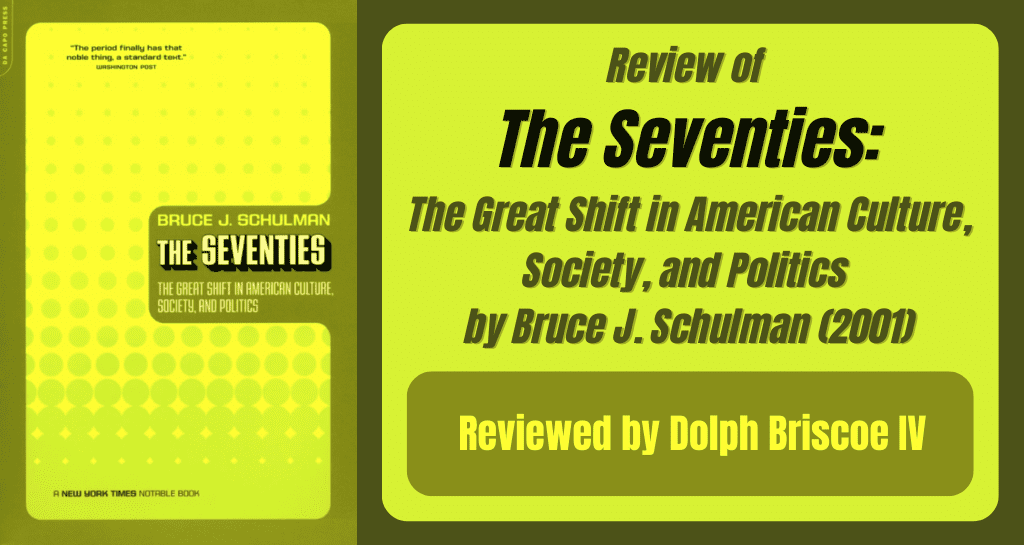
The Seventies: The Great Shift in American Culture, Society, and Politics by Bruce J. Schulman (2001)

banner image for The Seventies: The Great Shift in American Culture, Society, and Politics by Bruce J. Schulman (2001)

Bruce J. Schulman, in his 2001 work The Seventies: The Great Shift in American Culture, Society, and Politics, surveys the history of an overlooked decade. Defining the “long 1970s” as the period between Richard Nixon’s entrance in the White House in 1969 and Ronald Reagan’s landslide reelection in 1984, Schulman counters popular conceptions that the decade was seemingly forgettable and unimportant. Instead, he argues that during the 1970s, the United States experienced a transformation in multiple facets of its character that helped shape our current time.

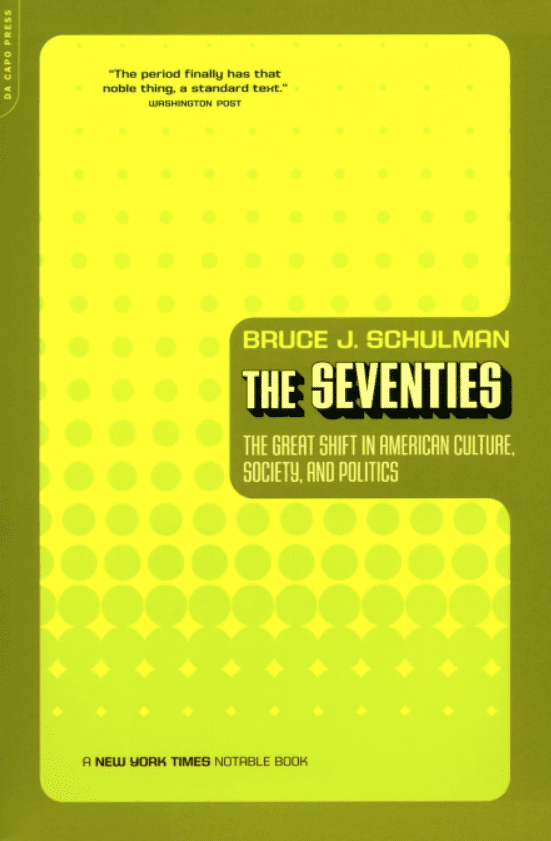
book cover for the seventies

Schulman’s narrative weaves together politics, economics, social developments, and cultural trends to illustrate the significance of this decade. The author asserts that the 1960s effectively ended with the turbulent events of 1968, and when the “Great American Ride,” or booming postwar economy, finally ran its course. During the 1970s, political power in the United States shifted from the Northeast and Midwest to the South and Southwest, the so-called Sunbelt, as Americans, jobs, and federal dollars flocked to these warmer and more business-friendly regions. Politicians such as Richard Nixon, Jimmy Carter, and Ronald Reagan hailed from Sunbelt states, and recognized such political trends. Indeed, the author suggests that the United States encountered no less than a “southernization” of American life in the decade.

"'No Gas" Signs Were a Common Sight in Oregon During the Fall of 1973, Such as at This Station in Lincoln City Along the Coast
An October 1973 photograph by David Falconer: “‘No Gas” Signs Were a Common Sight in Oregon During the Fall of 1973, Such as at This Station in Lincoln City Along the Coast. Many Stations Closed Earlier, Opened Later and Shut Down on the Weekends 10/1973.” Image courtesy of the author via the National Archives.

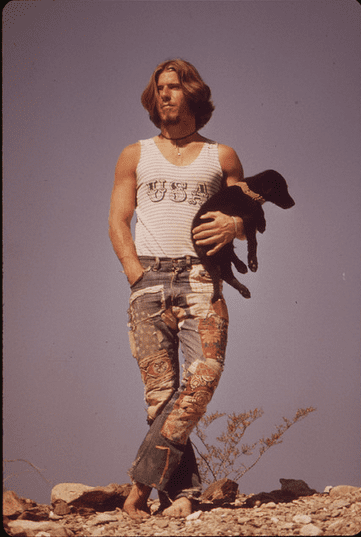
Americans experienced significant changes in their attitudes during these years. The tragedy of Vietnam and the trauma of Watergate created much skepticism toward government. People looked to the private sphere and its potential for solving economic and societal problems, a key theme of the later 1980s. Yet while conservatism toward government grew amongst the populace in the 1970s, social and cultural legacies from the 1960s became more mainstream. Many Americans, even southerners, began to accept the immorality of formal, explicit racial segregation and disfranchisement. Long hair and outrageous clothing became the norm for Americans of all political and social backgrounds, while sexuality outside of traditional marriage became widely practiced and accepted, especially amongst the younger generation.  Schulman contends that personal liberation and rebellion against authority became key themes of the 1970s, as Americans sought individualism through new outlooks on religion, popular culture, and sexuality.

"Hitchhiker with His Dog, "Tripper", on U.S. 66. U.S. 66 Crosses The Colorado River At Topock
A May 1972 photograph by Charles O’Rear: “Hitchhiker with His Dog, “Tripper”, on U.S. 66. U.S. 66 Crosses The Colorado River At Topock: 05/1972.” Image courtesy of the author via the National Archives.

Although such tendencies developed, not all Americans welcomed them. The author notes that by the late 1970s, the New Right emerged as a powerful force in politics.  Religious conservatives, most notably Jerry Falwell’s Moral Majority, decried social excesses, while anti-feminists, such as Phyllis Schlafly, organized against the Equal Rights Amendment.  Affirmative Action and racial busing divided Americans. Economic conservatives railed against taxes. Cold Warriors disillusioned with détente and the outcome of the Vietnam War theorized a new foreign policy, based on American international power and aggressiveness toward the Soviet Union, known as neoconservatism. Schulman proposes that such groups played a major role in Ronald Reagan’s election and reelection to the presidency through exploiting American anxiety. The author commendably illustrates how the 1970s, rather than being an uneventful and lackluster decade, critically affected the course of United States history. The Seventies will prove insightful reading for anyone wishing to reflect upon this transformative time in our nation’s recent past.

You may also like:

[The Environmental Protection Agency’s (EPA) project, Documerica, a collection of photographs taken by freelance photographers from 1971-77 that capture moments related to environmental problems, EPA activities, and everyday life in the 1970s.]

Dolph Briscoe IV’s review of Sean Wilentz’s The Age of Reagan: A History.


The views and opinions expressed in this article or video are those of the individual author(s) or presenter(s) and do not necessarily reflect the policy or views of the editors at Not Even Past, the UT Department of History, the University of Texas at Austin, or the UT System Board of Regents. Not Even Past is an online public history magazine rather than a peer-reviewed academic journal. While we make efforts to ensure that factual information in articles was obtained from reliable sources, Not Even Past is not responsible for any errors or omissions.

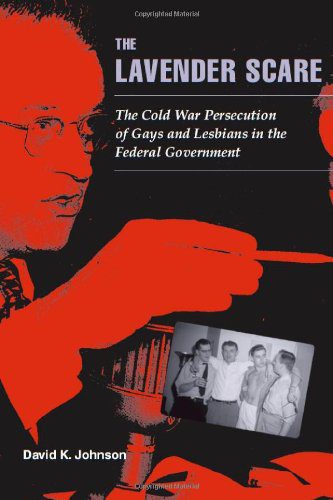
The Lavender Scare: The Cold War Persecution of Gays and Lesbians in the Federal Government by David K. Johnson (2006)

by Joseph Parrott

In 1958 Frank Kameny was out of a job. A Harvard trained astronomer and veteran of World War II, he had been working for the Army Map Service.image In the wake of the Russian launch of Sputnik in October of 1957, the American government was rushing to catch up, and the young scientist seemed poised to play a role in the new emphasis on space exploration. Yet within just a few months, Kameny’s career was over because he was a homosexual. His story was not unique. He was one of many victims of the Lavender Scare – a manifestation of Cold War paranoia and social bigotry that led to the dismissal of hundreds and possibly thousands of gays and lesbians from government jobs.
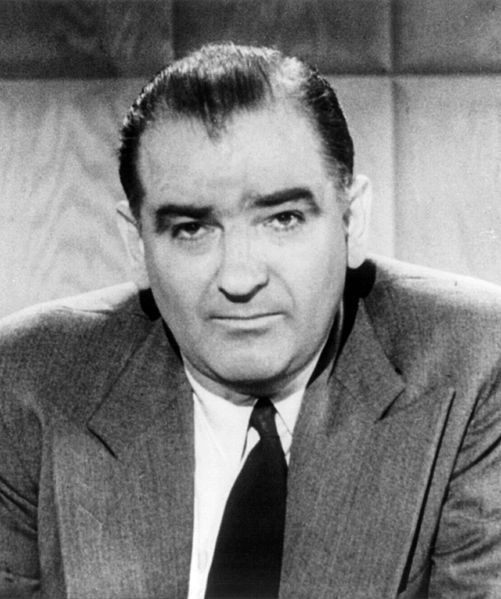
Historian David K. Johnson sheds light on this forgotten episode in American history. The Lavender Scare grew from the McCarthy persecutions of the 1950s, but Johnson argues that its policies lasted far longer and became more institutionalized than the anti-communist hysteria. The government dismissed homosexuals on the grounds that emotional weakness and the likelihood of blackmail made them security risks. No evidence supported these accusations and medical experts challenged the idea that homosexuals were in any way different from the majority of employees, but to little avail. Executive departments hurried to dismiss employees suspected of homosexuality, lest ambitious congressmen – already suspicious of the expansion of bureaucratic policymaking – target them for public scrutiny. In the midst of the Cold War, fear, politics, and prejudice combined “to conflate homosexuals and communists.”

The Lavender Scare offers an arresting political narrative, but Johnson also makes sure to present the very human face of this drama. Johnson utilizes extensive interviews to demonstrate the way the purges changed the lives of victims and the social milieu of Washington D.C. itself. The rapid growth of the federal government during the Depression and its relatively egalitarian hiring practices attracted large numbers of young people seeking employment, including many homosexuals hoping to escape the limitations of small town life. By 1945, Washington was, in the words of one resident, “a very gay city,” where vibrant communities thrived and authorities tolerated homosexual activity.  In an effortless combination of social and political history, the author shows how the rise of the national security state transformed gay Washington, forcing many to leave and others to endure years of joblessness.

image

Persecution also inspired a nascent movement in defense of gay lifestyles. Activists like Frank Kameny recast the discrimination against homosexuals as an issue of civil rights. The Mattachine Society of Washington organized picketing and supported challenges to government dismissals, consciously combining “political activism with service to and affirmation of the gay subculture.” Johnson explores how these vocal demands led the government to reevaluate its policies and the connection between the private and public lives of its employees. These early manifestations of homosexual activism not only helped end decades of vocational persecution, but they also informed the networks and tactics that would come to define a movement.

image

In light of Frank Kameny’s death last October at the age of 86, it is appropriate to look back at the origins of the LGBT activism. The recent repeal of the military’s “Don’t Ask, Don’t Tell” policy demonstrates that cause of homosexual equality has made great strides, specifically in regard to government service. But at the same time, the continuing debate over the necessity of this policy and calls to reinstate it remind the country that Kameny’s ultimate goals have not yet been achieved. David Johnson’s smart, well-written, and truly engaging book clearly lays out the history of anti-gay sentiment in the modern federal government. It also, perhaps, hints at ways activists can continue to challenge discrimination in the future.

Photo credits:

United Press, Joseph Raymond McCarthy, 1954

Library of Commons via Wikimedia Commons

Kay Tobin Lahusen, “Barbara Gittings, Frank Kameny, and John Fryer in disguise as “Dr. H. Anonymous,”” 1972

New York Public Library Manuscripts and Archives Division via Wikimedia Commons

You may also like:

Dolph Briscoe’s review of Clint Eastwood’s latest film J. Edgar, about the first director of the F.B.I.


Governing the Tongue: The Politics of Speech in Early New England by Jane Kamensky (1999)

by Zachary Carmichael

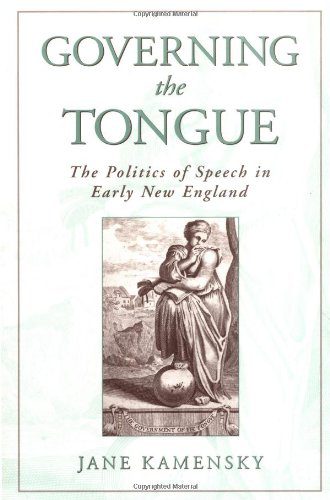
Governing the Tongue discusses the importance of verbal communication in seventeenth-century New England society.image Kamensky argues that early settlers were uniquely preoccupied with the act of speech and held to specific but unwritten rules about correct speaking.  Speech was bound up with Puritan religious beliefs and represented a way of directly interacting with God’s word.  Right speech could represent a link with the divine, but incorrect speaking constituted a break with the natural order.  Regulating oral communication presented both philosophical and practical difficulties that informed larger issues of social status and order, and Puritans thought uncontrolled speech could corrupt their fragile society.
Multiple social hierarchies governed correct speaking, including class, wealth, age, and gender, Kamensky’s most useful lens of analysis.  A married woman, she argues, had to be a “goodwife,” supporting the head of the household, her husband.  Women made up the majority of the nonconformist congregations and often held radical beliefs, most famously Anne Hutchinson, banished from Massachusetts Bay in 1638.  For Puritan leaders, ungoverned speech equaled the threat of uncontrollable women, exemplary of the social disorder they feared. Women faced some of the harshest penalties for violating speech limitation. Ann Hibbens, for example, was brought to court for complaining too loudly in public about a dispute with male carpenters over the quality of their work, but the trial soon became an evaluation of Hibbens’ continued violation of right speech expectations and her failure to support her meek husband.  Excommunicated in 1641, Hibbens was executed for witchcraft fifteen years later because of a “quarrelsome” tongue.

Kamensky also focuses on speech expectations among men, emphasizing the contested verbal domains of fathers and sons.  Sons often found it difficult to establish patriarchal order in their own households while remaining verbally respectful to their fathers, exemplified by the case of John Porter, Jr., the only Puritan ever brought to trial for rebelling against his father.  John, Jr. insulted and criticized his father repeatedly, failing to live up to high expectations in a society that valued the orderly transmission of status and property from father to son.  Although John Porter, Sr. was one of the wealthiest men in Salem, his son died destitute after being taken to court for his disobedience.  Kamensky contends that Porter’s parental disrespect echoes a larger struggle in New England during the 1660s, when generational tension between the founders and their children brought the issue of verbal respect to a head.

image

After illustrating the elaborate rules that governed women’s and men’s tongues, Kamensky convincingly argues for the decline of this system at the end of the seventeenth century.  A falling away from original ideals for speech behavior, aided by the increased importance of the written word, paralleled the larger religious and intellectual declension of Puritanism.  Discussing the witchcraft trials of the 1690s, Kamensky emphasizes the role of speech in the supposed activity of those practicing witchcraft, including curses and demonic possession, and in the public trials, which depended upon verbal testimony.  The emotional and physical trauma of the accusations and executions in towns like Salem helped to debase the “currency of speech” for New Englanders.  Numerous apologies from both accusers and judges failed to restore social order, as they once had done.

Kamensky acknowledges the difficulty of hearing Puritan voices in the available evidence. Writing a book about speech, solely using written records is a paradoxical and ultimately unachievable task, but she does an excellent job of finding examples of recorded speech in court records, sermons, and other writings..  Kamensky argues that although it is impossible to get back to the “hearfulness” of New England, the careful recording of court documents, responses to sermons, and quotations in diary entries brings us close to being able to hear the Puritans speak.

Kamensky’s study is a valuable account of the people and ideas responsible for the Puritans’ complicated relationship with the spoken word.  She ably identifies the tension between free and governed speech, leaving the reader with the impression that, in Puritan New England, public speech could be both necessary and dangerous.

Photo credits:

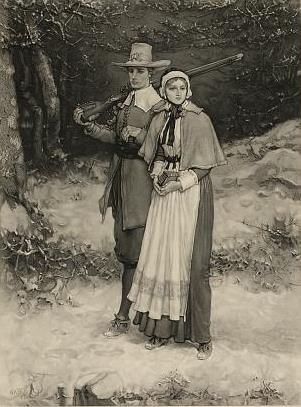
George Henry Boughton (artist) and Thomas Gold Appleton (engraver), Puritans Going to Church, 31 March 1885

Library of Congress


You may also like:

UT professor of history Jorge Canizares-Esguerra’s DISCOVER feature on John Winthrop’s famous speech “City Upon a Hill.”


« Previous Page
Next Page »

Recent Posts

  • NEP Author Spotlight – Aidan Dresang
  • Lesson Plans: The Vietnam War and American Society
  • Lesson Plans: Protest and Social Unrest
  • Lesson Plans: Radio and Communications Technology
  • The Long-Lasting and Perpetuating Effects of Lynching Postcards and Photography
NOT EVEN PAST is produced by

The Department of History

The University of Texas at Austin

We are supported by the College of Liberal Arts
And our Readers

Donate
Contact

All content © 2010-present NOT EVEN PAST and the authors, unless otherwise noted

Sign up to receive our MONTHLY NEWSLETTER

  • New
  • Features
  • Reviews
  • Texas
  • Teaching
  • Digital
  • Watch & Listen
  • Authors
  • About