You’ve heard of samurai, perhaps the most quintessential symbol of Japan, but how well do you really know these famed, so-called warriors? Did you know the term “samurai” actually refers to the samurai class and that half of that class were women? Perhaps you’ve heard of bushidō, the “way of the warrior,” yet were you aware that this concept was manufactured in the nineteenth century, after the samurai class ceased to exist?
Curators Rosina Buckland and Joe Nickols, along with historian Oleg Benesch, set out to topple everything that people think they know about samurai in the British Museum’s Samurai exhibition (February 3 – May 4, 2026). The show brought together more than 280 objects, with loans from twenty-nine different lenders, and traces nearly 1,200 years of Japanese history. I spoke with Buckland about her vision for Samurai, her favorite artworks, and how the landmark exhibition came together. Before turning to that conversation, it is worth looking at how the exhibition frames the history and legacy of the Samurai.
To tell this story, the exhibition is organized into three chapters. “Rise of the Samurai” traces the development of the samurai as an elite fighting force during the Muromachi and Warring States periods (ca. 1336–1573). Samurai gradually transitioned from using bows and arrows in battle to wielding the well-known katana and wakizashi swords so closely associated with their image today. The show’s next chapter, “The Long Peace,” follows samurai’s development from warriors to an administrative class during the two hundred and fifty years of stability ushered in by the Tokugawa regime (1600–1868). During this era, samurai acted as bureaucrats, political strategists, and public safety officers, ensuring that the government ran smoothly. They were also connoisseurs of the arts and artists in their own right. The exhibition’s final chapter, “After the Samurai,” traces how samurai identity remained popular and relevant long after the class was abolished in 1871. In the 1880s, bushidō (the “way of the samurai”) was created and billed as a centuries-old code of honor that reflected the morality and ethics shared among samurai. In actuality, bushidō was largely based on a mythologized version of medieval samurai culture, partly influenced by nineteenth-century Europe’s idealization of its own medieval past. After 1945, the figure of the samurai was slowly demilitarized and became an integral part of pop culture, featured in films, video games, manga, anime, novels, and costumes.
Swords, suits of armor, and scenes of the stereotypical, valiant samurai abound in the exhibition—after all, as Buckland notes, samurai armor is so well-known that one can have it “in a silhouette form, and people will recognize it”—yet Samurai hopes that viewers will also empathize with the men and women behind the menpō (face mask). Viewers can relate to samurai bureaucrats, much as they might sympathize with a modern-day office worker facing a computer full of monotonous spreadsheets. The two artworks commissioned for the exhibit, Noguchi Tetsuya’s Duck and Man and Peter Copping’s clothing ensemble Softening the Samurai, both play on the idea of the samurai administrator. Copping’s samurai-inspired outfit is decorated with paper clips, a humorous nod to today’s office worker, while Noguchi’s samurai looks particularly haggard as he sits upon his rubber duck, a charming combination of whimsy and realism.
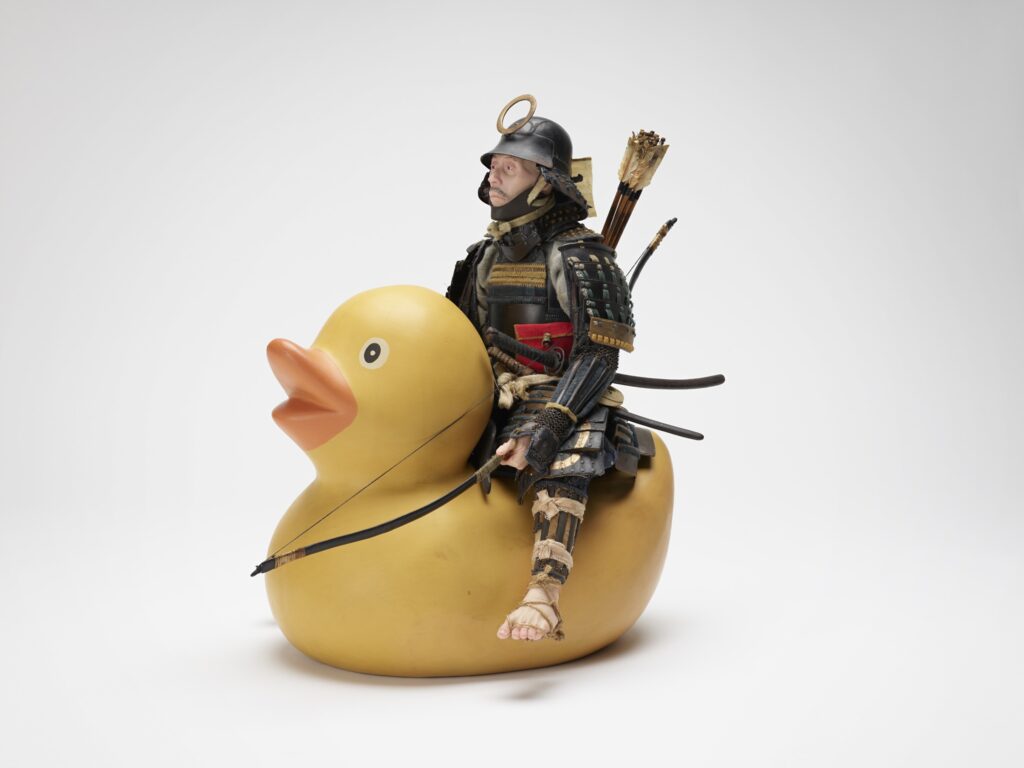
Noguchi Tetsuya, Duck and Man, 2025. Commissioned by the Trustees of the British Museum. © Noguchi Tetsuya. Photography © The Trustees of the British Museum.
Buckland, Nickols, and Benesch also take great care in telling the story of how Japan’s “warrior spirit” was evoked to encourage fighting for imperialism. The exhibition unflinchingly acknowledges how bushidō and tales of legendary samurai like Kusunoki Masashige (1294–1336) were used to recruit and motivate soldiers. Every officer was given a military sword, guntō, to remind him of a supposed samurai ethos that he possessed. After 1945, heirloom samurai swords carried by high-ranking military personnel were claimed as war booty and found their way into collections across the world, often with their twentieth-century wartime history conveniently hidden.
The British Museum’s exhibition features the many, diverse faces of samurai throughout Japanese and global history. In the interview that follows, Rosina Buckland takes us behind the scenes of the exhibition’s making, the ideas that shaped it, the process of bringing it together, and some of the objects that stand out to her most. The interview has been edited for length and clarity while preserving Buckland’s original voice as closely as possible.
Interview with Rosina Buckland
Isabel Schmidt: How does the exhibit Samurai challenge standard myths of who the samurai were and what they did?
Rosina Buckland: I knew from the beginning that the samurai image was very widely recognized and enjoyed. It was played with and consumed, but people had quite a narrow understanding of the samurai, which people understand to mean “a man in armor.”
Our exhibition challenges that assumption. I even stopped saying “the samurai” because I found that was quite problematic or complicated. Instead, I say “the class of people who we call the samurai.” “Samurai” isn’t even a word that is commonly used in Japan, so already you’re on quicksand trying to use that term. Warriors in the medieval period were mononofu or tsuwamono, and then you get the bushi class (bukei), so a big chunk of the exhibition’s Section Two was looking at the samurai as a social class, doing social history. This just messed with visitors’ heads. They could not believe that “samurai” just meant a social class, and therefore half the class is women. It kind of upset people, almost, that samurai are not these idealized warriors. People know the word “samurai,” because it’s out there in popular culture. It has been played with and used creatively for six hundred years now in a relatively unproblematic way.
IS: Why do you think that samurai, or the samurai class, have had such a hold on the global imagination for the last 150 years, perhaps even longer? What has made them such a lasting idea?
RB: They are very recognizable. I think the Japanese armor is very recognizable. Maybe it’s the armor lacing, the shoulder guards, and the colorfulness that make it instantly recognizable. You can do a samurai armor silhouette, and people will recognize it. I think that makes it very effective and powerful. But the mythologization of samurai also started early. It has deep roots. The first suit of armor in the West was given by Shogun Tokugawa Hidetada to King James I in 1613. So there was a consciousness of samurai armor in Western Europe hundreds of years ago. I’m going to qualify that, because the English actually forgot that it was Japanese, so there wasn’t a great consciousness of it being Japanese. But of course there were other suits of armor across Europe. There was some awareness of what the Japanese warrior looked like hundreds of years ago, but then from the late nineteenth century, when there was a boom for anything Japanese, there’s a lot of imagery, a lot of photography, of men dressed up as warriors, and the suits of armor themselves were being exported. So, I think the fictionalization of “the samurai” was very much underway beginning in the late nineteenth century.
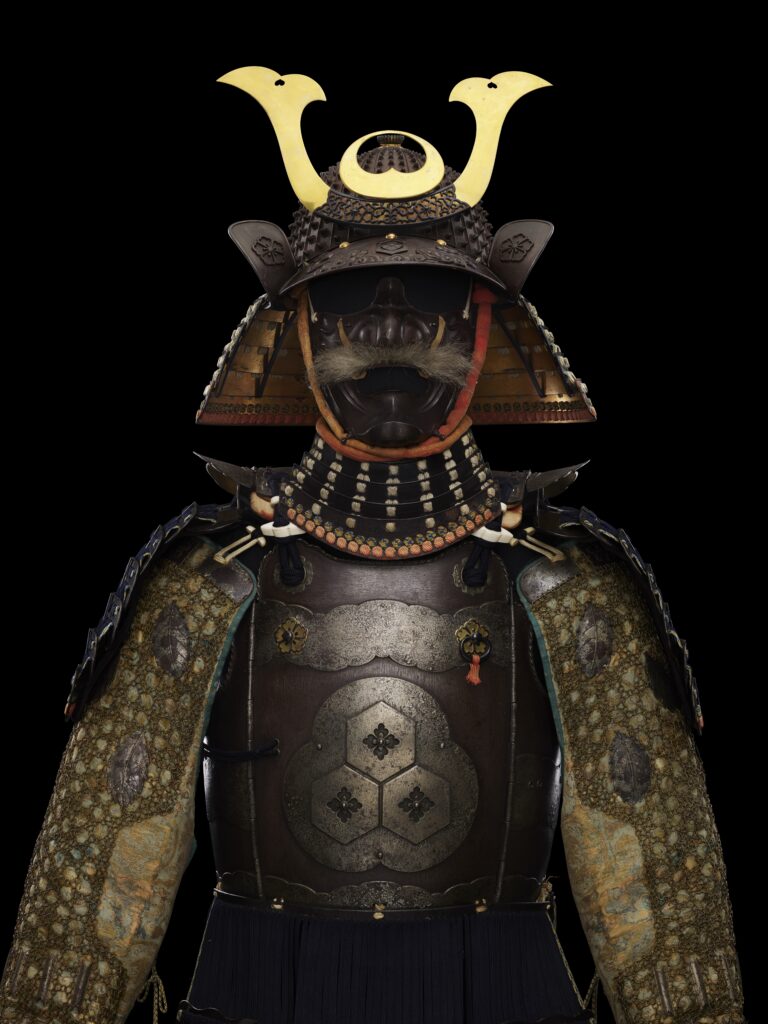
Suit of armour with bullet-proof cuirass embossed with crest, Japan, 1600–1700. © The Trustees of the British Museum.
Two things to add. First, I think, the concept of “samurai” becomes a free-floating fiction when the samurai class is abolished. People are no longer wearing that armor, so it becomes available for everybody to play with. And then, of course, the samurai myth gets promoted by Japan itself in the first half of the twentieth century in a problematic way, when the Japanese are idealizing the medieval warrior. But this ideal is also very malleable. For example, in Section 3.1 of the exhibition, where we were talking about the period of militarism and colonial expansion in Japanese history and how the samurai image was used, we had the propaganda from the Allied Powers and the propaganda from the Axis powers.
The samurai image took hold quite early, and there’s lots of great stories, loads and loads of stories from Heike Monogatari (Tales of Heike, twelfth century) in particular. The samurai image has been mythologized in Japan for centuries through paintings. We had some of the battle screens, handscroll paintings, and woodblock prints in the exhibition. So, there is a huge popular consumption of the “samurai ideal” from the 1700s onwards, if not earlier. When we were giving tours, we would explain in the exhibition’s woodblock print section, “this is where the pop culture consumption of the samurai image begins.” It doesn’t begin with movie director Akira Kurosawa. It’s just different media being employed to entertain people with these very exciting stories of warriors.
IS: Speaking of giving tours, what would you say is your favorite object in the exhibit, if you had to pick just one?
RB: I usually say the portrait of the young Japanese man, Ito Mansho, who was the head of the Tenshō embassy delegation that was sent from Kyushu to Europe (Domenico Tintoretto, Portrait of Itō Mancio, 1585, oil on canvas). He was a samurai, and his family were retainers of the Ouchi Daimyo in Hyūga Province. In 1583, Alessandro Valignano, the Jesuit missionary to Japan, sent them off to Europe. Valignano wanted to boast of how many converts they’d made in Japan. I think it must have been like going to the moon for these four young samurai men and their retinue.
Itō and the other members of the mission must have told stories about Europe, and Japanese people must have thought, “They are making it up! They don’t have chopsticks; they don’t eat rice. How do they live?” So, I think there was an amazing cultural encounter that happened there. Also, the painting is beautiful. It was a painting by Domenico Tintoretto when the mission was traveling back through Venice, and it was commissioned by the city state of Venice. Itō has a beautiful ruff and a velvet coat. The badge he’s been given is the rank of the Cavalier of the Golden Spur (Cavaliere dello Speron d’oro), and he’s wearing that on his cap, so he’s been made into a sort of Italian or Venetian nobleman. He just looks very poignant, and I thought it was a beautiful painting, and totally not what people would expect as a samurai.
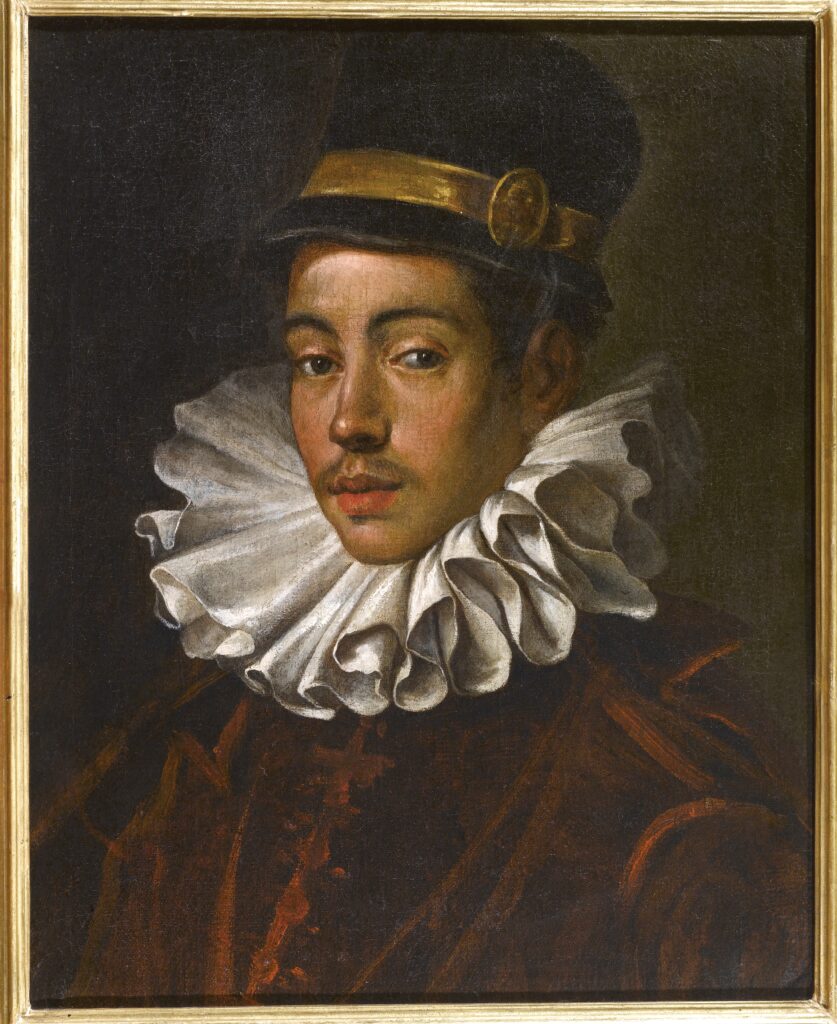
Domenico Tintoretto, Portrait of Itō Mancio, 1585. Oil on canvas. Property of Fondazione Trivulzio, Milan.
IS: Many reviews of Samurai have praised the animations, displays, and music that accompany the objects. Can you tell me about some of your favorite parts of the exhibition design and special effects?
RB: We had an external design company, and I think a lot of the direction was determined by the target audience (18-to 35-year-olds). I’d say that the pop culture material at the end of the exhibition was an integral part. It included manga, video games, anime, films, and TV programs. We didn’t have an adequate budget to do everything we wanted with media. Most of our pop culture material was from the last twenty to thirty years. We had stuff from the early 2000s, but also a lot of recent things like the movie 13 Assassins with Keanu Reeves or the video games Ghost of Tsushima or Nioh 3, which came out a couple of days after the exhibition. We also had fashion pieces.
Because of all this pop material, the exhibition design team decided to target 18-to-35-year-olds. So the exhibition had a very different aim than if it had been geared towards, say, 50-to-60-year-olds. I believe the exhibition appealed to multiple audiences, because kids love armor. And there was a lot of art, so the 40-to-60-year-old demographic would also have been interested. But the 18-to-35-year-old demographic determined the mood of the exhibition. The in-house designer leading the project used the words “theatrical” and “dramatic” to describe the concept design.
At the beginning of an exhibition project, we have the concept design stage, which lasts only six weeks, so it pretty much fixes the direction of the exhibition. Things don’t change much from concept design; they just get refined through the next stage, called “scheme design.” So, right at the beginning in concept design, the designers proposed that we would have a very dark feeling for the first section, because it was about war, and then a much lighter vibe for section two, and then we would return to a dark feeling for the political turmoil of the Meiji era and early twentieth century militarism.
It was supposed to be lighter again during the final section, but it was mainly a kaleidoscope of footage we projected onto banners and the screen at the back. It was very lively, very dynamic. And the exhibitions team put red trims around the bottom of the cases in the dark sections to liven them up. From the beginning, the exhibitions team had planned to keep one wall free in Section One so we could add animation. A lot of visitors have commented on that. A lot of people asked me, “was it taken from a film?” But it was made specially for the exhibition, and it recreates a battle scene. It took a lot of persuasion for the exhibition team to get the helmets, flag, banners, and bow right. We had three screens for each of the exhibition’s three sections. We had large projection screens showing a costume drama. We had Shōgun (2024 TV series) in Section One, and then the NHK Taiga drama Segodon (2018) in Section Two, and then we wanted The Last Samurai (2003 film)for Section 3, but Warner Brothers stopped communicating with us. We thought it might have been because they were going through a company merger and acquisition last year. We got Last Samurai Standing (2025 TV series) instead, focused on the fall of the bakumatsu (pre-modern government). It included soldiers in western uniform using guns against traditional samurai, so those helped set the scene for Section Three.
The first two film clips were very much about showing interiors, because it was impossible to show people in the exhibition what such spaces looked like. For example, what does the inside of a castle look like? What does the inside of a residential palace look like? So, those clips were really useful.
The only other design elements I can think of were what we called “the cutouts.” These were graphic reproductions of woodblock prints of heroes. We had about six or seven of those men and women. They stuck out from right angles next to the cases. And then we did taglines, such as “the samurai who survived his nemesis,” “the samurai who leapt over eight boats,” or “the samurai who rescued her children.” They sort of jazzed things up. And then we had a long wall in Section Two with a cityscape that was adapted from a woodblock print by Hiroshige III, where night transitioned to day.
To be frank, we needed to do certain design elements to make up for the fact that we didn’t have enough money. Clever design elements were created to fill spaces where we’d wanted to borrow objects, but they were too expensive, or we couldn’t borrow them for conservation reasons. For example, we planned on having a figure in armor on a horse, but that didn’t happen in the end. The one we wanted to borrow wasn’t available, and it was way too expensive to commission a new horse mannequin, so things got shifted around. And the designers came up with big, graphically powerful things that would fill the space.
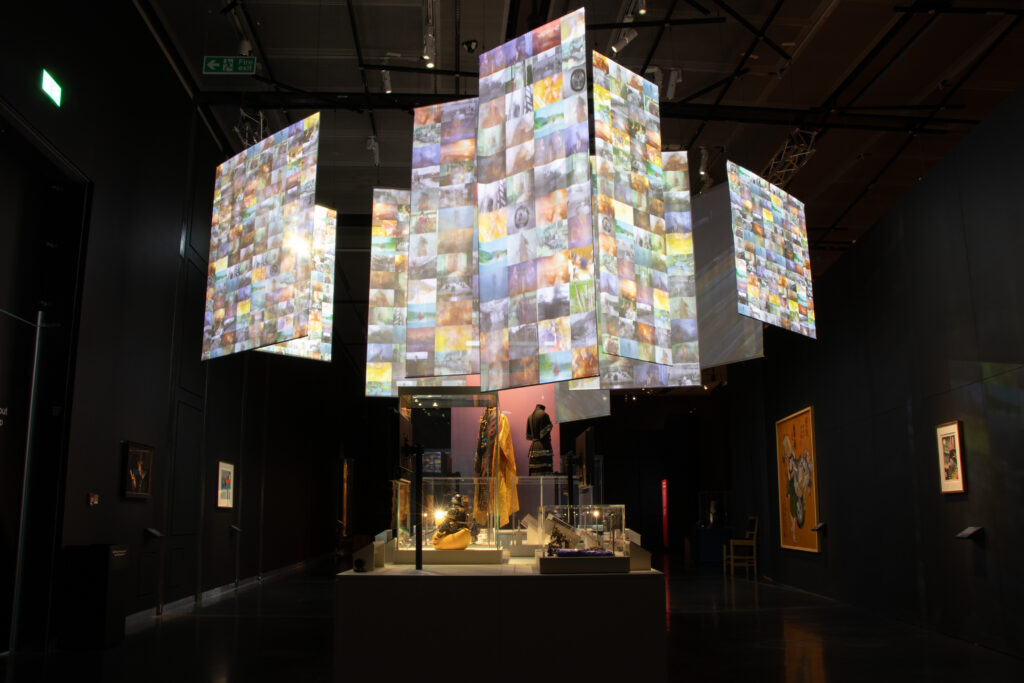
Installation view of Samurai at the British Museum, 2026. © The Trustees of the British Museum.
IS: One of the major samurai myths that you hoped to bust was the idea that the samurai class were exclusively male. Half of the samurai class were women! What were your favorite objects in the exhibit that highlighted this?
RB: Sadly, we didn’t have as many objects for women as I’d hoped, and, again, it boiled down to budget. We did have more cases at one point in the design plan, but we had to cut cases and two exhibition themes had to be combined into one. We’d hoped to have more robes for women. But we did have a beautiful robe from the Victoria & Albert Museum for a young unmarried woman of samurai class.
The palanquin (dating from the Edo Period, 1600–1868), I think, was probably the most effective object for discussing samurai women. The palanquin was on open display in the middle of the gallery, so that immediately had a visual impact. It drew people’s attention, and we had the Segodon (NHK historical period drama, 2018) clip with a woman being carried playing in the background. Lots of people said, “What’s in the box?” And I said, “That’s the high-ranking woman, she’s in the palanquin, she’s being carried because she’s too posh to walk. So she gets carried all the way into the room, and then she’ll get out,” and everybody said, “Oh, it’s so small, I wouldn’t want to sit in one of those.” “Well, you’re kneeling down.” “Oh, it looks hard.” “Well you would have a cushion.” The palanquin came from the Victoria & Albert Museum (V&A). Because palanquins are big and heavy and expensive to transport, we were worried we wouldn’t be able to get that one. There was actually another one at the Horniman Museum in London, but they had a moratorium on loans because they’re doing a big rebuilding project. The V&A also had a lot of its collection unavailable, because they were doing a big collections move, so we were very glad to get the palanquin. They took it off display for us and temporarily shipped it across London.
Another point is that women were present in the exhibition throughout, not only in the cases that were about women. I did receive one comment that there wasn’t enough about women in the exhibition. I thought more people would make that comment. But I pointed out to people that a lot of the objects we might associate initially with men were probably enjoyed by women as well. If you’ve got a painting on a wall or a ceramic on display, it’s not just a male owner or patron who’s enjoying it, necessarily. For example, the handscroll of Shuten Doji (dating from the seventeenth century) was part of dowries, so women were regularly enjoying deluxe illustrated handscrolls of warrior stories. One of the paintings we displayed in the case about samurai as artists was by a woman, and that woman was Sadahime, the younger sister of Matsudaira Sadanobu (daimyo of Shirakawa province, modern day Fukushima prefecture, 1759–1829). Sadahime painted a very sweet picture of a cat asleep beneath a peony bush. It said on the back that it was by the wife of a daimyo, but I was able to pin down her identity further. She was the wife of the daimyo of Echizen Province (modern day Fukui prefecture) and she was the younger sister of Matsudaira Sadanobu. This connected her work to other objects, because Sadanobu helped drive the Kansei reforms (1787–1793) and we had a satirical novel that was making fun of the Kansei reforms.
IS: The British Museum’s incredible collection of Japanese art was on display in Samurai, but the exhibition also featured works from twenty-nine lenders. What were some of your favorite works that traveled to the British Museum for this exhibition?
RB: There were 280 objects in the exhibition, and 75% of them were from the museum’s collection, so it was very heavily our collection, which makes it cheaper. You don’t have to pay for them if you own them already. But it was also a very good way of showcasing just how much we’ve got in the collection. Anyway, it was really easy. People kept saying, “it’s such a beautiful exhibition, so many beautiful objects,” and I said, “well, that’s what’s in the British Museum’s collection, and there’s loads more we could have put out.” It’s not difficult to put out beautiful Japanese objects.
As for loans, the Tintoretto is obviously a fabulous loan object (Domenico Tintoretto, Portrait of Itō Mancio, 1585, oil on canvas). We were really glad that the private lender in Italy was willing to lend that. And there was another, even bigger portrait painted of Hasekura Tsunenaga (1615) from thirty years later that also came from a private lender in Italy. I think the John C. Weber collection in New York was also important to the show He’s a wonderful, kind individual, and has a fantastic collection, much of which has been on loan or given to the Met over the years. We received the woman’s firefighter outfit with the red felt jacket (ca. 1800–1850) from him.
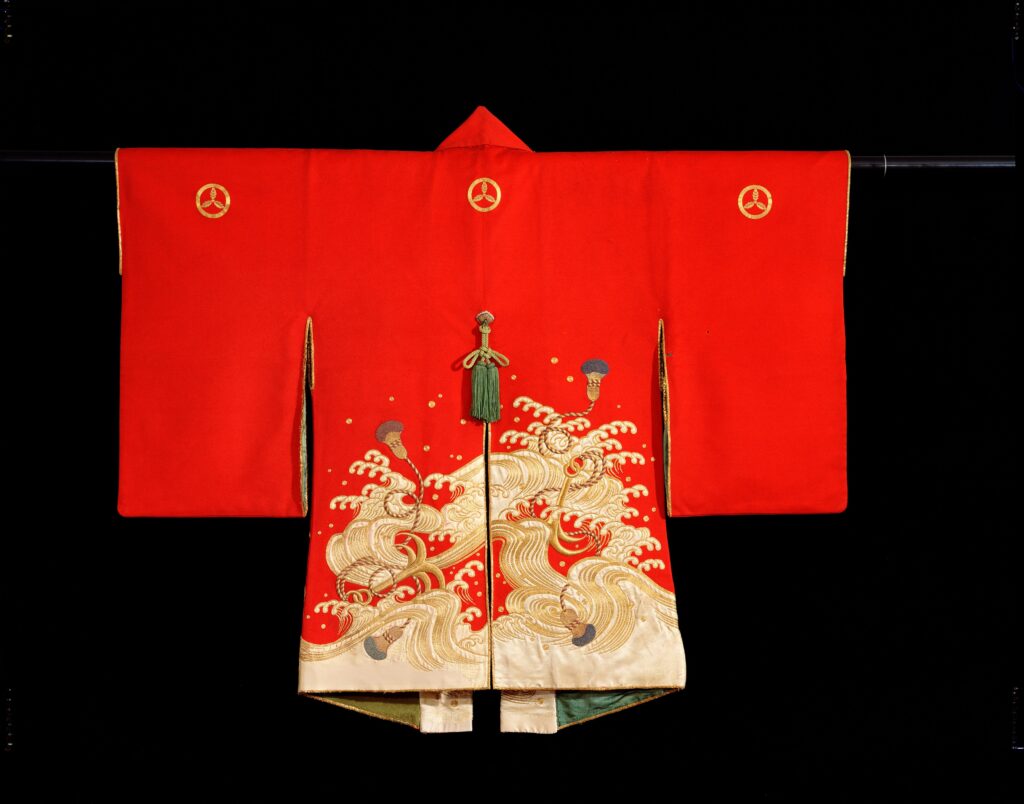
Woman’s firefighting jacket and hood, Japan, 1800–50. John C. Weber Collection. Photo © John Bigelow Taylor.
IS: There were some really special artworks made specially for this show (Peter Copping’s Lanvin clothing ensemble, Softening the Samurai; Noguchi Tetsuya’s Duck and Man). Can you tell me more about them? How did the British Museum end up connecting with these artists?
RB: I’d found a catalog of Noguchi Tetsuya’s work at the Tokyo National Museum a few years back, and I just fell in love with his work. It’s so quirky and unexpected, whimsical and endearing. He says that these men aren’t necessarily samurai (the title of his main show was This Is Not a Samurai), but that they are men in armor. Noguchi is also very much focused on meticulous recreations of armor. He tries to even reproduce the wear and tear on the armor to make it look like it’s been lived in and used. He makes these wonderful scale miniature recreations of armor, and then he places these armored figures in very incongruous situations with briefcases or headphones. Noguchi wants to humanize the samurai, because he felt that they’d been too heroized and idealized, and I felt the same.
I wanted to knock the samurai off their pedestal in Samurai, because people idealize the warrior, and we listen. We’re hearing more rhetoric about the warrior in contemporary politics in America, and I don’t think we should be idealizing or glorifying war. So I was careful to include a scroll that showed the brutality of war. I was careful to explain the brutality of medieval warfare, and that is by no means unique to Japan, it’s brutal everywhere across the world. Everywhere has its horrific practices. It’s a brutal, horrific, and harrowing experience for those fighting and for those affected by it.
So, I contacted Noguchi’s agent and said that I wanted to commission a piece. I was going to borrow a painting, but we ended up buying the painting. We had a couple conversations about what kind of thing he would create for the sculptural commission, and he came up with the idea of the rubber duck. He’d wanted to do that for a while, the incongruity of a samurai and a bath toy. But it’s also a very popular item in the British Museum shop.
Regarding the Lanvin piece, it was curator Joe Nickols who had some contacts with fashion companies, and he contacted Lanvin, and, after a conversation with Peter Copping, Peter was willing to create an object inspired by the works that we’d shown him from the exhibition. His piece was inspired by the ideas that we had for the exhibition. He was “softening the samurai,” as he put it, taking inspiration from the kamishimo (a formal two-piece outfit worn by male members of the samurai class in the Edo period), but making it into a softer, feminine form by creating a dress. And then Copping alluded to the bureaucratic aspects by adding paper clips and pen nibs to embellish it.
IS: What were some of the trickiest objects to transport to London and install? Any fun installation moments?
RB: I don’t know about fun installation moments, because the lending institution does all of the packing, so we didn’t have to deal with those challenges. Private collections tend to be more flexible, since they can make the decisions themselves, because it’s an individual who owns the objects, whereas institutions have rules that they have to abide by. So it can be much more straightforward working with private lenders. I think the Liverpool armor was probably the most challenging to transport, because, strictly speaking, you’re supposed to ask for loans a year ahead, at least a year ahead, but because we were struggling to find an O-yoroi armor suit, we asked the Museum of Liverpool about six months beforehand. They were just amazing in cooperating and achieving everything in time: getting it off display, getting a conservation assessment and treatment, getting it packed. They asked us if they could bring it in at the very last stage of the exhibition, and so it was sort of down to the wire, but it all happened successfully in the very last few days before the show opened, Also the Darth Vader costume was interesting because that was actually the largest object in the exhibition. It arrived in two massive crates. I don’t know that I’ve got any fun installation stories, but it was a surprise when we walked in and there were two massive crates because every part of the Darth Vader costume was robustly protected. And he looked fantastic when he was all up on display.
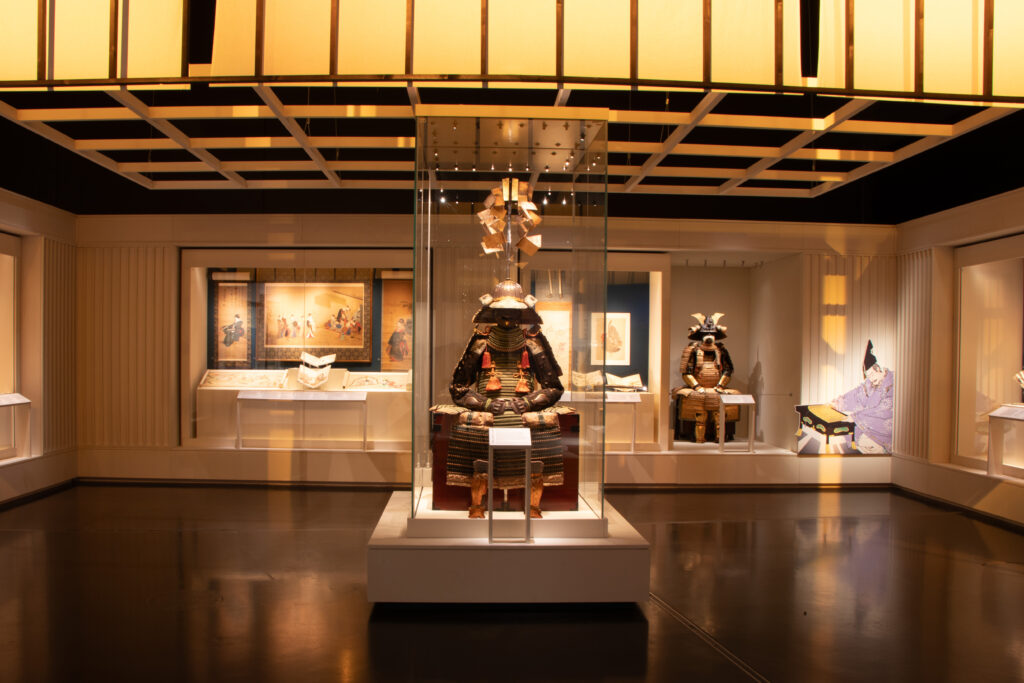
Installation view of Samurai at the British Museum, 2026. © The Trustees of the British Museum.
IS: What are the mechanics like when putting together such a big show (insurance, shipping, etc.)? What are some things audience members don’t know about or consider when they attend a big exhibition like this?
RB: I suppose if anybody thinks about it, they know that it costs money to transport things, but apparently it costs three times as much now for transport as before the pandemic, with fuel costs rising. And that’s probably only going to get more complicated. I suppose people are not aware of the amount of rules and bureaucracy that surrounds lending objects. We don’t actually have commercial insurance, we have government indemnification, which will basically pay out if anything were to happen to objects, but everything is done to make sure that there are no mishaps. So it’s huge levels of care being taken to ship objects that people probably are not aware of, and there are costs involved in that as well.
IS: Can you tell us about the exhibition section that was focused on the first half of the twentieth century?
RB: This section is one of the aspects of the exhibition that made it unique and was the most sensitive. I felt very strongly that, when you tell the story of the samurai right through to the present day, you have to deal with that politically sensitive, maybe eighty-year period from the 1870s to the 1950s. First samurai are discredited for a while after they’re abolished in the 1870s. They’re seen as relics of the feudal era, and Japan is modernizing. But then there’s this revival from the 1890s onward and that’s when the idealization of the samurai recommences. But it takes on a much more nationalist tone from the early twentieth century onwards, and gets used in government rhetoric, and, to a certain extent, in imagery.
Oleg Benesch’s (Buckland’s research partner for the exhibition) and my conclusion was that the samurai image was actually more important outside of Japan during Japan’s years of militarism and colonial expansion (1920s onwards) than it was within Japan. You don’t find the samurai image that much within Japan during this time period. There’s rhetoric about it, but not so much the image.
The whole bushido rhetoric that gets reified and codified is from the 1890s. It’s not just Nitobe Inazō (author of the English-language book Bushido: The Soul of Japan, 1899) who creates it; there are other thinkers around that time who were discussing bushido or some kind of “way of the samurai.” Ultimately we wanted to focus on how bushido was co-opted in the 1920s and 1930s as a motivation for self-sacrifice in the name of the empire, so we had a section on that, and I don’t think there was any opposition to it. I think all of the comments about the exhibition that were slightly critical were saying “you didn’t do enough of this, that, or the other,” and if you’re trying to do an exhibition that covers a sweep of thousand years, that’s inevitably going to be the case. We would have liked to do more on women, we would have liked to have done more on education or intellectual activities. I would have liked to have done more about the war, but we also had to go with the vibe of the exhibition. The exhibition was aimed at young people. You don’t want to go too deep into that dark story, but we still wanted to acknowledge it.
You can’t jump from the Meiji period to the post war period. Something happens with the samurai image through that seventy-year period, so we wanted to make sure that we covered that. It’s still sensitive. We did have comments from people, such as “My grandfather was in a prisoner of war camp. Why didn’t you talk about those?” The reason we didn’t was partly because there wasn’t space to do that, but also partly because it doesn’t have relevance for the samurai image. That part of the war’s history needs to be done in a different exhibition. And we did have the chance to go into more depth about that in the exhibition catalogue, so we were directing people to the book and saying “we can’t do it in a sixty-word label, please read the book.”
Isabel Schmidt is an MA student in Japanese art history at Kyushu University and a Japanese Government Monbukagakushō Scholar. Her research focuses on late Edo- and early Meiji-era woodblock prints, and her broader interests include museum curating, arts access, and equity in the arts.
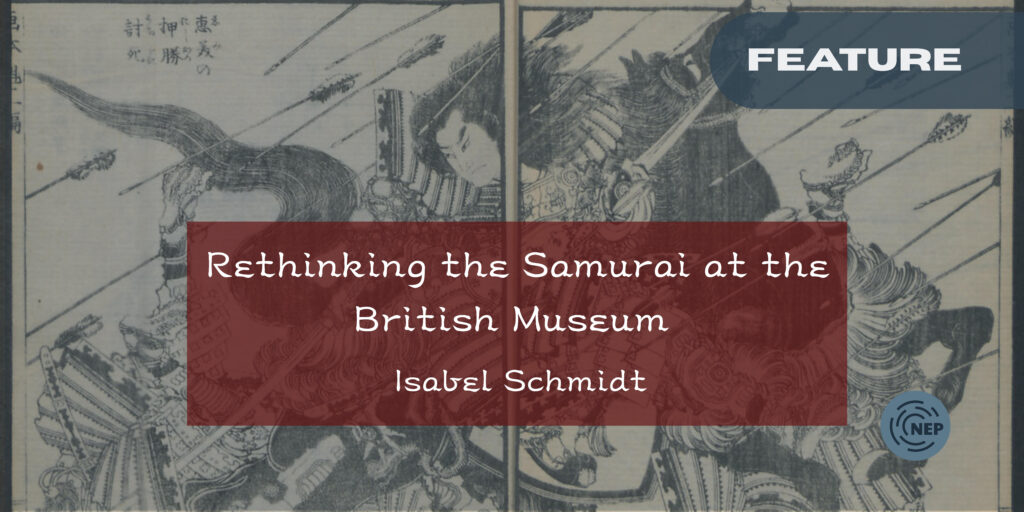
Banner image: Katsushika Hokusai, A Picture Book of Japanese Warriors (Ehon Musashi Abumi), 1836. The Metropolitan Museum of Art. Public domain.
The views and opinions expressed in this article or video are those of the individual author(s) or presenter(s) and do not necessarily reflect the policy or views of the editors at Not Even Past, the UT Department of History, the University of Texas at Austin, or the UT System Board of Regents. Not Even Past is an online public history magazine rather than a peer-reviewed academic journal. While we make efforts to ensure that factual information in articles was obtained from reliable sources, Not Even Past is not responsible for any errors or omissions.