• New
  • Features
  • Reviews
  • Texas
  • Teaching
  • Digital
  • Watch & Listen
  • Authors
  • About

The past is never dead. It's not even past

Not Even Past

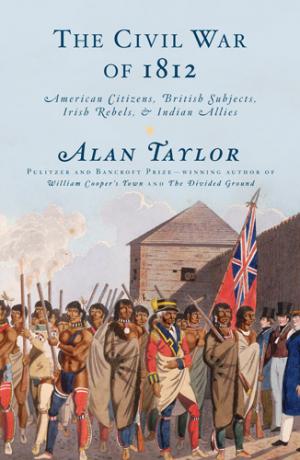
The Civil War of 1812: American Citizens, British Subjects, Irish Rebels, & Indian Allies by Alan Taylor (2010)

by James Jenkins

The War of 1812 was not a war between two nations, but rather a civil war, in which “brother fought brother in a borderland of mixed peoples.”   Alan Taylor focuses on the U.S.-Canada borderland, which stretched from Detroit to Montreal. Before the war, the distinctions between British subjects and American citizens in the region remained uncertain. imageThe British asserted that their empire’s subjects remained subjects for life, precisely when a stream of Irish people were migrating to the United States. Moreover, immigrants from the United States made up the majority of Upper Canada (present-day Ontario). Although the War of 1812 resulted in a stalemate from a diplomatic or military perspective, it gave closure to the contested border and resulted in the emergence of the United States and Canada as modern nation-states.
Taylor identifies four components that made the War of 1812 a civil war. First, The Republican-led American government vied with Britain over who would control Upper Canada. Yet, the U.S.’s poorly trained military struggled to occupy even a sliver of Canadian territory. Taylor describes how supply lines, propaganda, and prisons all played pivotal roles in the war’s outcome. Second, American Federalists sympathized with Britain. Most Federalists opposed the war and some even contributed to Britain’s war effort by smuggling, spying and threatening secession. Moreover, the United States never waged a significant campaign on the upper St. Lawrence River because Federalists in Ogdensburg, NY used their political influence to block such a strategy.  Possessing the St. Lawrence River would have weakened all of Upper Canada, which relied on the seaway for supplies. But Republican politicians from western New York and Kentucky successfully lobbied to make the Detroit and Niagara Rivers the primary American fronts. Third, Irish republicans who had immigrated to the United States renewed a failed rebellion in Ireland by enlisting in American forces. But, they also faced Irish soldiers who had joined the royal army, pitting Irishman against Irishman.

Taylor describes a fourth aspect to the civil war: the involvement of Native peoples. Many Indians joined British forces in the hopes of stopping further U.S. settlement in the Ohio Valley. However, Native peoples are curiously peripheral to Taylor’s narrative, and he instead highlights their ability to terrify untrained American soldiers and provide fodder for anti-British propaganda. Taylor’s emphasis on imagined Indians leaves some paradoxical questions unanswered. For instance, he argues that American General William Henry Harrison’s troops considered arming Indians to be racial treason. Yet Taylor has little to say about the two hundred some Native people who joined Harrison’s forces.  In addition, Taylor offers almost no biographical details on Native individuals. Those wishing for the next chapter of Taylor’s The Divided Ground (2006), which places the Haudenosaunee at the center of the American Revolution, will be disappointed.

Despite this shortcoming, Taylor’s borderland approach and assiduous research make for a welcome revision to an often overlooked war. The Civil War of 1812 should appeal to a large audience thanks to Taylor’s engaging narratives and elegant writing style.

History Underfoot

by Erika M. Bsumek

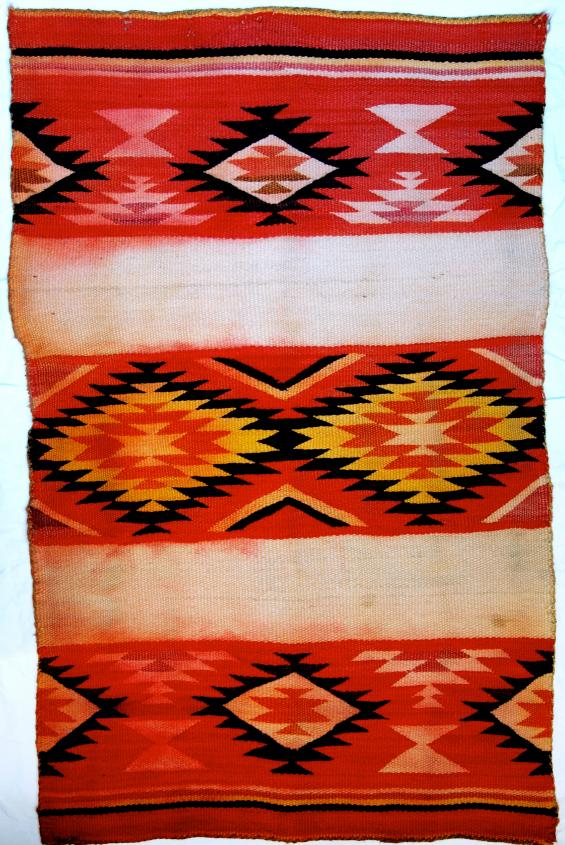
History can sometimes surround us – sometimes it’s even underfoot. This rug, from the Art and Art History Library Collection at the University of Texas, represents the kind of textiles that were made by skilled Navajo weavers and sold on the Navajo reservation from the late 19th into the early 20th century.

image

The attractive geometric designs of such creations corresponded with other fashion forward styles of the era and they became popular additions to dens and “Indian corners” across the U.S. Navajo rugs have had a lasting influence on interior design ever since. Consumers currently spend millions of dollars every year for antique rugs and blankets, newer rugs still being created by Navajo weavers, or even the less expensive “American Indian style” rugs made in Mexico or India.

So, what’s the history of a rug like this one and why should we care about it? One view is that after the arrival of the Spanish and the introduction of sheep in North America, weaving became central to the development of trade goods throughout the Southwest. Thus, Navajo textiles reflect Spanish influence and cultural exchange. When Anglos began settling in the region, they developed a taste for woven goods and further altered the trade. Traders encouraged weavers to include borders, like the Greek key style design found in this rug, similar to those found on Persian rugs.

Navajo rug with geometric pattern

In the 1880s, the white traders who encouraged these changes knew that the beautiful Navajo textiles could be sold to white consumers – if marketed correctly. Another view, the Navajo view, is that Spiderwoman (a key spiritual figure in Navajo cosmology) gave Navajo women the skill they needed to fashion cotton and wool into beautiful creations to trade and feed their families.

Traders like Lorenzo Hubbell, who ran the Ganado Trading Post in Ganado, Arizona, turned their attention to selling Navajo rugs as a way to generate income for the post. Hubbell’s first step was to convince famed hotelier Fred Harvey to stock his hotel gift shops with Navajo blankets and rugs. Harvey also used Navajo rugs as decorative accessories throughout his hotel. This meant that railway tourists to the Southwest could simply stroll into the hotel’s lobby, see the beautiful the rugs used throughout the hotel, enter the store, and purchase a rug to take home. Beyond Harvey’s gift shop sales, traders like Hubbell also published catalogues that they shipped to potential customers or curio stores throughout the United States. The text and advertisements that appeared in trader catalogues promoted the traders as much as, if not more so, than the weavers.

image

This kind of marketing made Navajo textiles part of an emerging fascination with “primitive’ peoples. By the early 1900s, Americans across the United States were collecting goods from Africa, Asia, and the American Southwest. Just as painters like Picasso began to include elements of indigenous art in modernist art forms, consumers could buy goods that reflected similar design elements: geometrical, bold, abstract.

As consumer fascination with Navajo rugs took hold in the marketplace, rugs grew in value. But, where were the weavers who made the products? How were they treated? Ironically, although Navajo textiles took on social value, Indians were being de-valued in society. Government efforts to assimilate Indians remained strong well into the twentieth century. In response, Navajo weavers, in particular, have worked to preserve their culture through their weavings. So, the next time you see a Navajo rug, you might want to consider its history – and more importantly, the history of the people who made it.

Read more about the marketing of Navajo crafts:

Erika Bsumek, Indian-Made: Navajo Culture in the Marketplace, 1868-1940

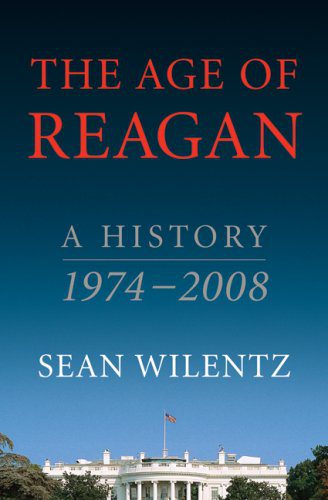
The Age of Reagan: A History, by Sean Wilentz (2008)

by Dolph Briscoe IV

Historians often define political periods in the United States according to the dominant president of the era. Arthur M. Schlesinger, Jr., most famously wrote of an Age of Jackson, and other scholars have proposed Ages of Jefferson, Lincoln, and Franklin D. Roosevelt. Sean Wilentz adds another chapter to this genre, labeling the last quarter of the twentieth century after Ronald Reagan, with his book The Age of Reagan: A History, 1974-2008. From the 1974 Watergate scandal until 2008 when Barack Obama was elected to the presidency, the U.S. witnessed the triumph of political conservatism. Ronald Reagan harnessed conservative angst to win the White House, pursued conservative polices as president both domestically and internationally, and left a legacy his conservative political successors attempted to continue, with mixed results.

41tW9b7OIMLThe Age of Reagan provides a valuable overview of recent U.S. political history. During the 1970s both major political parties experienced internal divisions. Conservative Republicans criticized Nixon, Gerald Ford, and Henry Kissinger’s pursuit of détente with the Soviet Union as dangerously weak foreign policy. Liberal Democrats railed against Jimmy Carter’s ineffective leadership in solving the nation’s economic and social problems. Americans turned away from moderates in both parties and looked to conservatism when they elected Ronald Reagan president in 1980. Reagan succeeded in entrenching conservatism within the federal government, particularly with his judicial appointees and expansion of presidential power.

Yet the author correctly debunks much of the mythology surrounding Reagan, noting that his administration often pursued pragmatic policies, unable or unwilling to roll back much of the liberal reform of past years, and also encountered many setbacks, most notably with the Iran-Contra scandal.

The Age of Reagan goes on to describe the triumphs and travails of Reagan’s presidential successors. George H. W. Bush, less conservative than his predecessor, encountered difficulties in appealing to both the moderate and right-wing factions of his party. Bill Clinton, a self-described New Democrat, governed as a centrist following Republican capture of Congress in the 1994 elections, recognizing this as a requirement in a conservative age. Wilentz concludes with a brief overview of George W. Bush’s tumultuous presidency. During these years conservatism may already have been running on borrowed time, butevents of the Bush years, such as the controversial election of 2000, the disastrous Iraq War, the miserable response to Hurricane Katrina, and the dramatic collapse of the economy ultimately sounded the death knell for the Age of Reagan, as Americans rejected conservatism in favor of Barack Obama’s call for political change. Sean Wilentz’s The Age of Reagan is a fascinating narrative of recent U.S. history, and will prove engaging reading, especially in the aftermath of the 2010 elections.

Time will tell if the Age of Reagan truly is over. The emergence of right-wing groups such as the Tea Party and the continued popularity of demagogic figures like Rush Limbaugh and Glenn Beck suggest that the conservative movement will not exit quietly into the night. The current president and his supporters would have to convince Americans of the superiority of their policies, no small task. Their success or failure will determine whether the United States has entered a new period, perhaps an Age of Obama, or returns to the Age of Reagan.

LBJ and Vietnam: A Conversation

by Mark Atwood Lawrence

Why did the United States choose to fight a major war in Vietnam? The question has bedeviled scholars almost since President Lyndon Johnson made the decision in 1965.

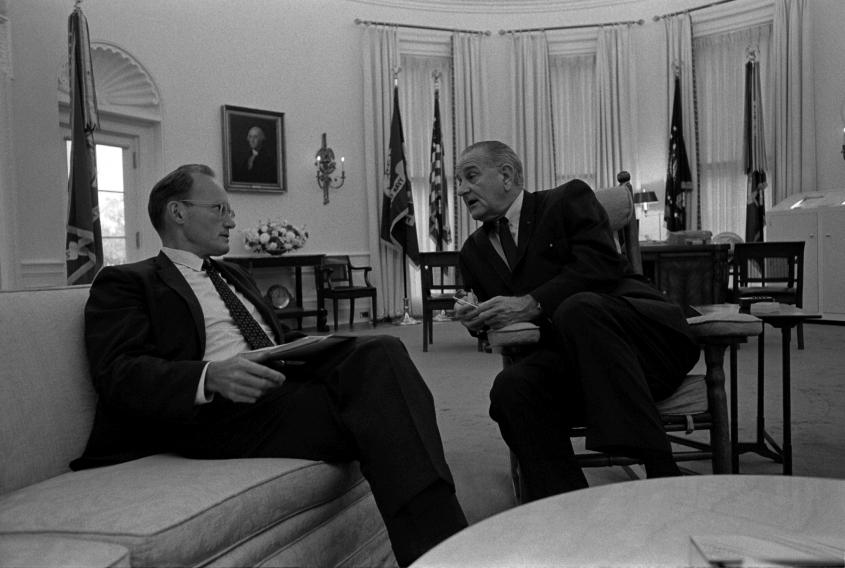
National Security Advisor and close Kennedy aide, McGeorge "Mac" Bundy, with President Lyndon B. Johnson in the Oval Office, 1967.

The most common answer that historians have offered over the years suggests that LBJ believed he had no real option but to commit U.S. forces.  In this view, the president understood that the government of South Vietnam, a strong ally of the United States, would inevitably collapse under the weight of a mounting communist insurgency if Washington did not send troops to help stave off the threat. The president believed, moreover, that such a collapse would amount to a major defeat for the United States in a key part of the world and would imperil U.S. security everywhere by calling into question Washington’s determination to help its allies around the globe. So momentous were the stakes, in short, that LBJ never seriously considered any alternative to escalation. But LBJ was, in this view, certain of another thing too: U.S. troops, once committed, would inevitably succeed in defeating the communist insurgency and bolstering South Vietnam as a pro-U.S. bastion. Johnson was convinced of the necessity of intervening in Vietnam and the certainty of success.

As historians have gained access to secret documentation, however, they have questioned this interpretation. Again and again, newly opened records from the National Archives in Maryland, the Lyndon Johnson Presidential Library at UT-Austin, and elsewhere have demonstrated that the president and his advisers recognized reasonable alternatives to intervention and foresaw the many problems that would beset U.S. forces when they were sent into Vietnam. The result of such discoveries has been to paint a new picture of LBJ’s decision-making in 1964 and 1965. Where scholars once saw certainty and confidence, they now see indecision and anxiety.

One of the best pieces of evidence for this newer view of U.S. decision-making is the recording of a conversation between LBJ and his national security adviser, McGeorge Bundy, on May 27, 1964. This tape, released by the LBJ Library in 1997, is among the most spectacular of the telephone conversations recorded in the Oval Office during the Johnson presidency. Like other chief executives from Franklin Roosevelt to Richard Nixon, LBJ frequently recorded conversations and meetings, most likely in order to have a record to refresh his memory but possibly also to help shape the historical record. Whatever the motive, the recordings unquestionably offer historians a remarkable new resource for appreciating the president’s personal opinions much more fully than ever before.

In his conversation with Bundy, LBJ expresses deep anxiety about what would happen if the United States failed to defend South Vietnam from communist takeover – evidence that bolsters the older, conventional view of U.S. motives for escalation. Fearing what historians would later dub the “domino effect,” Johnson suggests that the communist powers – the Soviet Union and the People’s Republic of China – would be emboldened by a communist victory in South Vietnam and might make trouble elsewhere. The communists, in fact, “may just chase you right into your own kitchen,” the president says in his typical down-home manner. LBJ also provides evidence for the older interpretation by breezily dismissing other powerful Americans who urged him to negotiate a settlement and withdraw U.S. power from South Vietnam. He shows special contempt for Senate Majority Leader Mike Mansfield, charging that the Montana Democrat, a strong advocate of winding down the U.S. role in South Vietnam, had “no spine at all” and took a position that was “just milquetoast as it can be.”

In other parts of the conversation, however, LBJ heaps doubt on the idea that defending South Vietnam was crucial to U.S. security. “What in the hell is Vietnam worth to me?” he asks Bundy. “What is Laos worth to me? What is it worth to this country?” Most chillingly, Johnson shows keen awareness that victory in Vietnam was anything but a sure thing. He worries that full-fledged U.S. intervention in Vietnam would trigger corresponding escalation by communist China, raising the horrifying specter of a direct superpower confrontation, as in Korea a few years earlier, between Chinese and U.S. forces. “I don’t think we can fight them 10,000 miles away from home and ever get anywhere in that area,” LBJ asserts. Moreover, the United States, once committed to a war, might find it impossible to get out. “It’s damn easy to get into a war, but … it’s going to be awful hard to ever extricate yourself if you get in,” LBJ asserts with remarkable prescience.

Johnson also defies the older interpretation of his outlook by showing openness to a range of opinions about how to proceed in Vietnam. To be sure, he hardly expresses enthusiasm about the idea of cutting American losses and withdrawing from South Vietnam, as Mansfield and prominent journalist Walter Lippmann among others were urging at the time. Neither, however, does he dismiss the possibility out of hand when the subject comes up. On the contrary, he urges consideration of a wide range of opinions and expresses hope that Lippmann might sit down with the hawkish Secretary of Defense Robert McNamara to discuss their differences.

Which is the “real” LBJ – the president who dismissed Mansfield as spineless or the president who questioned the real value of an independent, pro-American South Vietnam to the United States? At the end of the day, of course, it’s impossible to say. Both sets of ideas seem to have swirled simultaneously in LBJ’s head as he made fateful decisions. But one thing is certain: simple, rigid interpretations of Johnson’s attitudes to not hold up to the remarkable complexity of the emerging documentary record. To appreciate U.S. decision-making fully will require the release of further sources but also, almost certainly, a willingness to tolerate contradictions, nuance, and ambiguity.

Listen to the conversation (Johnson, Lyndon B. Johnson’s Vietnam Anguish, May 27, 1964: Conversation with national security advisor McGeorge Bundy. 27 May 1964. History and Politics Out Loud. Ed. Jerry Goldman. 30 Sept. 1999. Northwestern University.)

Transcript of the conversation (Telephone Conversation Between President Johnson and the President’s Special Assistant for National Security Affairs (Bundy) Washington, May 27, 1964, 11:24 a.m.. Source: U.S., Department of State, Foreign Relations of the United States, 1964-68, Volume XXVII, Mainland Southeast Asia: Regional Affairs, Washington, DC, Document Number 53. Original Source: Johnson Library, Recordings and Transcripts, Recording of a telephone conversation between the President and McGeorge Bundy, Tape 64.28 PNO 111. No classification marking. This transcript was prepared by the Office of the Historian specifically for this volume.)

« Previous Page

Recent Posts

  • NEP Author Spotlight – Aidan Dresang
  • Lesson Plans: The Vietnam War and American Society
  • Lesson Plans: Protest and Social Unrest
  • Lesson Plans: Radio and Communications Technology
  • The Long-Lasting and Perpetuating Effects of Lynching Postcards and Photography
NOT EVEN PAST is produced by

The Department of History

The University of Texas at Austin

We are supported by the College of Liberal Arts
And our Readers

Donate
Contact

All content © 2010-present NOT EVEN PAST and the authors, unless otherwise noted

Sign up to receive our MONTHLY NEWSLETTER

  • New
  • Features
  • Reviews
  • Texas
  • Teaching
  • Digital
  • Watch & Listen
  • Authors
  • About