• Features
  • Reviews
  • Teaching
  • Watch & Listen
  • About

The past is never dead. It's not even past

Not Even Past

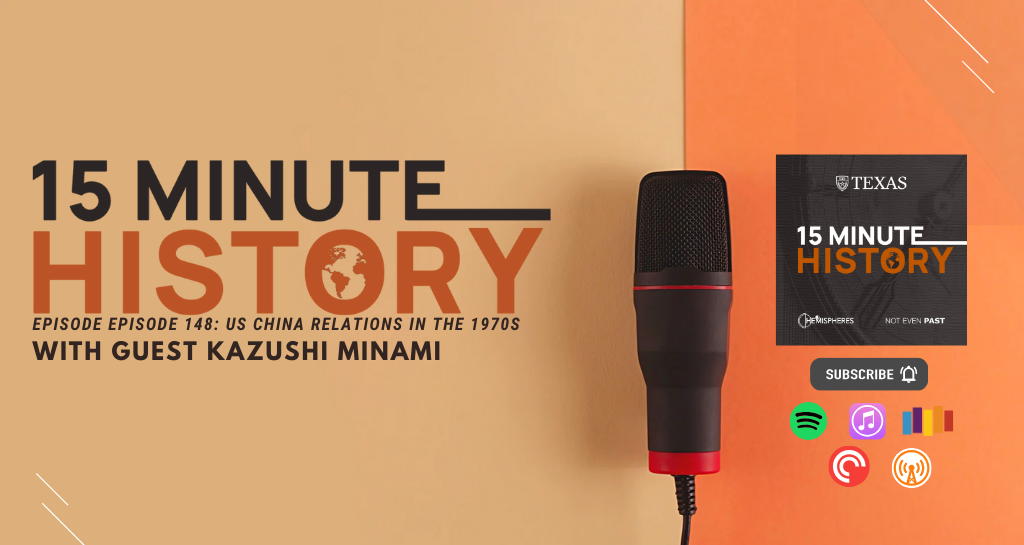
15 Minutes History – US China relations in the 1970s

During the 1970s, relations between the US and China were transformed. Previously the two nations were cold war enemies. But Kazushi Minami argues that the ’70s saw Americans reimagine China as a country of opportunities, while Chinese reinterpreted the US as an agent of modernization, capable of enriching their country. Crucial to this process was “people’s diplomacy” the title of Minami’s book on US-China relations which focuses on how Americans and Chinese from all walks of life engaged in people-to-people exchanges across the realms of business, culture and sport. Minami teaches history at Osaka University in Japan.


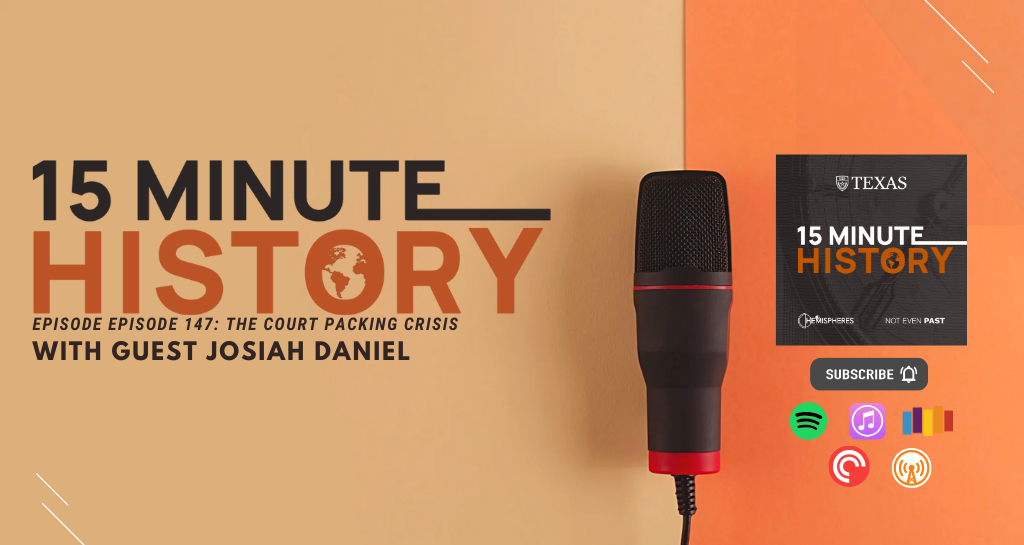
15 Minutes History – The Court Packing Crisis

In 1937, American politics was gripped by President Roosevelt’s court-packing plan. Frustrated with what he perceived to be an aging, obstructionist Supreme Court, Roosevelt pressed Congress to expand the court from 9 to 15 members. Stepping into the ensuing maelstrom was Texas congressman Hatton Sumners, chair of the House judiciary committee, an ally of Roosevelt, and an opponent of the plan.

We’re joined today by Josiah Daniel. Now a full time legal historian, Daniel was a partner in the intl. law firm Vinson & Elkins. He received his JD in Law and MA in History from UT Austin. 

This is Democracy – Reforming Democracy

This week, Jeremi and Zachary are joined by Michael Ignatieff to discuss the current state of the institutions of democracy, how they are being questioned by some political movements, and how they can be reformed and strengthened.

Zachary sets the scene with his poem entitled, “A Constitution of the Soul.”

Michael Ignatieff is a historian and the former leader of the Liberal Party of Canada. He has served as rector and president of Central European University and is the author, most recently, of On Consolation: Finding Solace in Dark Times. Ignatieff published an important article this summer in the Journal of Democracy, “When Democracy is on the Ballot:”

This is Democracy – Political Violence

This week, Jeremi and Zachary are joined by Joanne Freeman to discuss political violence in the American political landscape from a historical perspective, and disperse some of the myths and misconceptions around it.

Zachary sets the scene with his poem entitled “The War of Independence”


Joanne Freeman is the Class of 1954 Professor of American History and American Studies at Yale University. She is the author of two groundbreaking books on political violence in America history: Affairs of Honor: National Politics in the New Republic and The Field of Blood: Violence in Congress and the Road to Civil War. Prof. Freeman writes frequently for the New York Times, Washington Post, Atlantic. and other publications. She is a regular guest on CNN, MSNBC, and other news networks. Her webcast — “History Matters (…& so does coffee!)” — can be joined every Friday morning at 10:00am EST: 

This is Democracy – Mexican Elections

This week, Jeremi and Zachary are joined by Kenneth Greene to discuss the recent June elections in Mexico, and how they reflect the current state of democracy in Mexico and beyond.

Zachary sets the scene with his poem entitled, “Across the Moat.”

Kenneth Greene is Associate Professor of Government at the University of Texas at Austin. His research focuses on democratization, political parties, and voting behavior, as well as Mexico’s politics. He is the author of: Why Dominant Parties Lose: Mexico’s Democratization in Comparative Perspective.

This is Democracy – European Democracies

This week, Jeremi and Zachary are joined by Isabel Cademartori to discuss the current state of European Democracy and how recent elections have been shaking things up.

Zachary sets the scene with his poem entitled, “Sighing.”

Isabel Cademartori was elected as a Member of the German Bundestag from Mannheim in 2021. She is a rising young leader in the German government. Cademartori served as a city councillor in Mannheim since 2019. She is a member of the Social Democratic Party of Germany, which leads the current coalition government in Germany.

This is Democracy – D-Day and Its Legacies

This week, Jeremi and Zachary are joined by Dr. John W. Hall to discuss the D-Day landing during World War II, and what lessons can be learned from its legacy.

Zachary sets the scene with his poem entitled, “In Leipzig on D-Day.”

John W. Hall is a professor and holder of the Ambrose-Hesseltine Chair in U.S. Military History at the University of Wisconsin–Madison. He served fifteen years as an active-duty infantry officer in the U.S. Army. He also served as a historian to the U.S. Military Academy at West Point, U.S. European Command, U.S. Central Command, and the Joint Chiefs of Staff. He is the author of Uncommon Defense: Indian Allies in the Black Hawk War and numerous essays on American warfare.

This is Democracy – China’s Domestic and Foreign Policy

On this episode of This Is Democracy, Jeremi and Zachary are joined by Sheena Chestnut Greitens to discuss the changing political landscape in China and how that affects their relationship to the United States and other world leaders.

Zachary sets the scene with his poem entitled, “Far Away.”

Sheena Chestnut Greitens is an Associate Professor at the LBJ School of Public Affairs at the University of Texas at Austin, where she directs UT’s Asia Policy Program.  She is also a Nonresident Scholar with the Asia Program at the Carnegie Endowment for International Peace. Dr. Chestnut Greitens’ first book, Dictators and Their Secret Police (Cambridge, 2016), examines variations in internal security and repression in Taiwan, South Korea, and the Philippines during the Cold War.  Her second book, Politics of the North Korean Diaspora (Cambridge, 2023), focuses on authoritarianism, security, and diaspora politics. She is currently finishing her third book manuscript, which addresses how internal security concerns shape Chinese grand strategy. 

Alexei Navalny’s Legacy and Anti-Putin Resistance

Moscow’s southeast neighborhoods of Maryino and Lyublino always seem to be where the authorities locate controversial events. On March 1, 2024, it was Maryino who hosted the funeral of Russian dissident Alexei Navalny.  The church that held the ceremony is a post-Soviet building and dominates the center of a neighborhood otherwise filled with high-rise apartments, broad streets, shopping centers, and a string of parks and ponds along the Moscow River. On the day of the funeral, striking photos showed the lines of people paying their respects against the backdrops of apartment blocks. Other photos soon appeared online from inside the church despite authorities forbidding photography.  Having world historical events occur in a neighborhood you usually associate with medical visits, shopping, haircuts, and eating Uzbek food and sushi is surreal. With Navalny’s death, however, my wife and I also had a grim sense of both déjà vu and inevitability. 

When assassins shot journalist Anna Politkovskaya at her home in central Moscow in 2007, I was teaching English to cheery businesspeople a few blocks away.[1]  When assassins shot politician Boris Nemtsov on a bridge by the Kremlin in 2015, I was researching in the Moscow archives. My reaction was writing a post for Not Even Past about how Russian TV coverage immediately made light of Nemtsov’s “ladies’ man” reputation.[2]  Over the next month, I walked past the murder scene to view the mound of flowers on the sidewalk.  The pile was usually small because the city ordered the street cleaners to remove them daily.  When we awoke to Navalny’s death on February 16, we were saddened but not very surprised.

Alexey Navalny in court, February 2021.
Source: Wikimedia Commons

Born to a Ukrainian father and a Russian mother, Navalny was involved with several political parties before gaining international attention for leading protests against fraud in the 2011 Russian parliamentary elections. His profile rose in 2013 as he became a candidate for the Moscow mayoral position.  Afterward, he organized protests and investigated corrupt politicians while facing increasing legal troubles and threats. Navalny believed that Putin had him poisoned in August 2020, leading him to nearly die. He sought medical care in Germany even as Russian authorities seized his assets and apartment.[3]  So why did Navalny return to Russia knowing he would face certain imprisonment and likely death? 

Political dissidents making a crucial choice about remaining in exile or returning home have a long history that weaves through the Russian Imperial and Soviet periods to the present.  Vladimir Lenin and Leon Trotsky were in exile in Switzerland and Brooklyn, respectively, when the February Revolution overthrew Tsar Nicholas II in 1917. They only returned home (Lenin with German assistance) after the government had fallen.  During Joseph Stalin’s rule in the Soviet Union, Trotsky was forced into exile once again, this time to Mexico City, where he was assassinated in 1940.  Historian Barbara Martin has highlighted how Soviet dissidents such as Alexander Solzhenitsyn and Roy Medved faced this conundrum in the post-Stalinist Soviet Union. While life in exile was safer and provided academic and political freedoms, leaving felt like a dereliction of duty or abandoning your home. It also lessened dissidents’ authority among their fellow citizens.[4]  Navalny seemed to take this point to heart and hence accepted the risk of confrontation with the regime, likely believing that his brave anti-Putin legacy would be cemented even at great personal risk.

A political dissident in exile. Leon Trotsky (wearing a white suit) in Mexico, 1938.
Source: Wikimedia Commons

Navalny’s return to Russia in January 2021 was stunningly brave, even as the end result was strikingly predictable. However, he is also a complex figure, and his actions, words, and legacy are intertwined in a set of wider issues and conflicts.

Consider for a moment the Russians in the apartments overlooking his funeral, not the mourners. Assessing Navalny’s popularity through Russian opinion polls, many of them problematic, is difficult.[5] But as I lived and visited Russia, even during Navalny’s poisoning, exile, return, and arrest saga, I heard many people expressing negative voices against him. Some recurring comments were skepticism about his anti-corruption campaigns or the simple belief that he was just another self-aggrandizing politician.  With the 2014 Maidan Revolution in Ukraine, the Russian occupation of Crimea, and the Russian intervention in Eastern Ukraine, cynicism turned to accusations of treason and other conspiracy theories, all repeated in various iterations in the Russian official media. 

Navalny protesting in Moscow, 2013.
Source: Wikimedia Commons

Part of this seems obvious. Russia’s full-scale invasion of Ukraine in 2022 solidified the state media’s portrayal of Navalny as a foreign agent. Furthermore, numerous new laws have designated Navalny, his organization, and most anti-Putin journalists and organizations as treasonous foreign terrorists acting on behalf of the West or Ukraine. The onslaught of such accusations wears people down.  And yet, sociologist Jeremy Morris argues that his contacts’ reaction to Navalny has little to do with propaganda. Many Russians simply dislike Navalny’s image and consider his campaigns naïve and inconsequential.[6] In other words, you can trust that conversations with Russians in Russia about his death are often very different than the coverage by non-Russian media. 

Aside from propaganda and everyday anti-Navalny sentiment, his politics and statements have also been a point of contention among other anti-Putin politicians and activists.  While Navalny is often portrayed as a stereotypical “Russian liberal,” earlier in his political career, he spoke the language of Russian ethno-nationalism. He amplified racial stereotypes directed towards Russia’s large immigrant and Muslim communities, as well as its other numerous non-Russian ethnic groups. He attended the far-right Russian marches, which blamed most of Russia’s ills on immigrants and called for mass deportations.  He moderated such stances over time and apologized. Still, his early remarks defined his image for many non-Russian ethnic groups within and outside of Russia.[7]  Even as his wife, Julia Navalnaya, took the reigns of his organization, the question of where non-ethnic Russians stand within their vision of Russia remains uncertain.[8]

The logo of "Russia of the Future," Alexey Navalny's party.
The logo of Alexey Navalny’s party – “Russia of the Future.” Source: Wikimedia Commons

In the context of the Russian occupation of Crimea in 2014, Ukrainians and Crimean Tatars (the indigenous Muslim minority of Crimea) had good reasons to be skeptical of his denunciations of the full-scale Russian invasion in February 2022.  Beginning with the 2014 occupation of Crimea, Navalny had denounced Russian methods but echoed the Russian nationalist ethos that Russia and Crimea possessed a kind of supernatural bond.[9]  As someone who was researching Stalin’s ethnic cleansing of Crimea at the time the occupation began, this was disappointing, to say the least.   He made such statements as Russian authorities began a new wave of repressions, arrests, and sometimes murders of Crimean Tatars, Crimean Ukrainians, and Russians who protested Putin.[10] 

One point that many of Navalny’s varied detractors may agree on (albeit for different reasons) is that the Western media is too focused on Navalny himself and less on the audiences he represents.  At the very least, the acknowledgment of Navalny should come with a recognition of the bravery and defiance of individuals and victims outside the media spotlight.  There are thousands of other political prisoners in Russia and occupied Ukraine, and Putin’s army and occupation kill Ukrainians every day.  These prisoners suffer from malnourishment, torture, and death.  In Ukraine, the use of torture, rape, and mass executions is now well documented.[11]  In Russia, dissident Vladimir Kara-Murza is now serving a 25-year sentence for condemning the war and has become chronically ill.[12]  Last year, Crimean Tatar activist Dzhemil Gafarov died in a southern Russian prison after being tortured and denied medical release.[13]  The list of absurd arrests for anti-war activities is far too long to recount here. One of the latest examples is the 7-year prison sentence for Russian poet Alexander Byvshev, who questioned the morality of Russia’s invasion.[14]  In other words, the legacy of sacrifice and resistance to Putin is multi-national and multi-ethnic in scope and is far more diverse and broad than just Navalny, the individual.

Vladimir Kara-Murza is now serving a 25-year sentence for condemning Russia's invasion of Ukraine.
Vladimir Kara-Murza is now serving a 25-year sentence for condemning Russia’s invasion of Ukraine.
Source: Wikimedia Commons.

In the month since his death, Russia-related news has remained grim.  Russian attacks have killed dozens of Ukrainian civilians and left the country’s second-largest city, Kharkiv, without power.  Putin has “won” his latest election with absurd margins. He used the election celebrations to signal “enthusiastic voting” in Russian-occupied Ukraine and, almost with a sense of accomplishment, finally mentioned the now-deceased Navalny by name. However, the events of last week showed that Putin does not control everything in Russia. ISIS-K militants launched a horrific terrorist attack on a Moscow concert venue, killing well over 100 people.  Putin’s reaction has been a confused mix of attempting to blame Ukraine and the West, while Russian society and the state have descended into targeting Muslim immigrants and ethnic minorities with threats, deportations, and violence.

Both Russia’s present and its future seem grim. That is perhaps when it is best to think of Alexei Navalny. If nothing else, a consensus seems to have developed that Navalny was remarkable for being a Russian optimist and having the audacity, no matter how flawed or naïve, to believe that Russia’s current course could be reversed. Realistic or not, I do think about that possibility every day and whether – just maybe – there might be some truth to his belief.


Andrew Straw is a historian of Soviet Crimea. He has taught courses on Russian and Soviet history at the University of Texas and Huston-Tillotson University. At the moment, he teaches high school world history and is an instructor for the University of Texas OnRamps history program. He continues research as an independent scholar and is preparing a book proposal that will focus on Stalin’s Crimea policy and Crimean Tatars in the immediate postwar period. He can be reached at astraw@utexas.edu or on Twitter at @astrawism1


[1] https://www.iwmf.org/community/anna-politkovskaya/

[2] https://notevenpast.org/tag/boris-nemtsov/

[3] https://www.bbc.com/news/world-europe-54369664.amp

[4] https://www.bloomsbury.com/us/dissident-histories-in-the-soviet-union-9781350192447/

[5] https://www.levada.ru/2021/02/05/vozvrashhenie-alekseya-navalnogo/

[6] https://postsocialism.org/2024/02/16/russia-lost-its-greatest-and-most-naive-optimist-a-curmudgeons-obituary-of-alexei-navalny/

[7] https://www.euronews.com/2023/07/07/racist-or-revolutionary-is-alexei-navalny-who-many-westerners-think-he-is

[8] https://www.themoscowtimes.com/2024/02/29/navalnys-difficult-relationship-with-indigenous-russians-a84291

[9] https://www.themoscowtimes.com/2023/03/07/navalnys-policy-shift-on-crimea-may-be-too-little-too-late-a80396

[10] https://unn.ua/en/news/at-least-60-people-died-from-repressions-in-crimea-during-russian-occupation-ctrc

[11]https://www.theguardian.com/commentisfree/2024/mar/25/russia-weaponising-sexual-violence-ukraine-values

[12] https://www.npr.org/2023/04/17/1168667764/vladimir-kara-murza-prison-sentence

[13] https://khpg.org/en/1608812709

[14] https://www.reuters.com/world/europe/russian-anti-war-poet-gets-seven-year-jail-term-over-poem-ukraine-war-2024-03-22/

The views and opinions expressed in this article or video are those of the individual author(s) or presenter(s) and do not necessarily reflect the policy or views of the editors at Not Even Past, the UT Department of History, the University of Texas at Austin, or the UT System Board of Regents. Not Even Past is an online public history magazine rather than a peer-reviewed academic journal. While we make efforts to ensure that factual information in articles was obtained from reliable sources, Not Even Past is not responsible for any errors or omissions.
Flawed Assertions and Questionable Evidence: A Critical Examination of Howard Zinn’s A People’s History of the United States

In his seminal work, A People’s History of the United States, Howard Zinn presents a compelling alternative perspective on American history. In an important article, Professor Aaron O’Connell, who teaches at UT, made a powerful case for using Zinn in the classroom:

To take my students through the long history of violence in America, I use a book that has been in the news lately: Howard Zinn’s A People’s History of the United States. This book is well-known – even controversial, both inside academia and out – partly because Zinn tackles some of the sacred cows of America’s national mythos: Is Christopher Columbus better remembered as a genius sailor or a genocidaire? What does it say about the progression of liberty that single women in New Jersey had the vote until 1807 when it was stripped from them by an all-male state legislature? Most importantly, why have so many history books focused almost exclusively on the stories of white, wealthy men whose total numbers have never approached half – or even a quarter – of the country’s total population?

Zinn’s answer to all of these questions is that there have always been long-standing structural inequalities in American society that have shaped everything from the writing of laws to the ways they are interpreted to the stories we tell today about the nation’s past. It is nice to think of America as one big family, Zinn explains, but telling the story that way conceals fierce conflicts in that family’s history “between conquerors and conquered, masters and slaves, capitalists and workers, dominators and dominated in race and sex. And in such a world of conflict, a world of victims and executioners, it is the job of thinking people, as Albert Camus suggested, not to be on the side of the executioners.”[1]

In a class I took with Professor O’Connell, he challenged us to assess Zinn. In this article, I evaluate some of the flaws primarily related to his framing of economic issues that I saw within Zinn’s text. This does not diminish Professor O’Connell’s broader point that Zinn’s perspective is a valuable supplement to our historical education, but hopefully, it adds to the discussion and provides additional nuance in evaluating Zinn’s work.

cover of Howard Zinn's "A People's History of the United States."

Zinn sets out to challenge entrenched views of American history and to debunk what O’Connell describes as some of “the sacred cows of America’s national mythos.”  While he succeeds in part, Zinn’s narrative reveals certain flaws. While I applaud Zinn’s goal, it is also important to maintain a fair and objective portrayal of events. I contend that Zinn’s selective use of evidence compromises the overall credibility of his narrative, exposing a lack of both an objective attitude and a comprehensive understanding of the economic system. Zinn asserts that, for government officials, the economy is “a short-hand term for corporate profit,” and their economic policies are primarily directed towards “the needs of corporations.”[2]  This is a central strand of Zinn’s critiques, and it’s here that I will focus my attention.

In supporting this sweeping argument about government priorities, Zinn neglects many crucial aspects of economics, such as the global events that were out of the control of the US government. For instance, his depiction of big oil and gas corporations’ profits and the public’s struggles with inflation and unemployment in the 1970s lacks a nuanced understanding of the economic factors contributing to the stagflation of 1973–1975 and 1979–1983. According to Alan Blinder, the 15th vice chairman of the Federal Reserve and an influential economist, the inflation of 1973 was pushed by a combination of special factors such as the food shock, the energy crisis, and wage-price control.[3]The first two factors were predominantly products of foreign conflicts and natural disasters beyond the control of the US government. Thus, a more critical approach would involve evaluating how well the US government managed the crisis by comparing its economic status to similar nations rather than hastily attributing domestic economic hardship solely to the government. Zinn’s work is powerful and illuminating, yet I think he sacrifices accuracy when it comes to economics as he tries to fit everything into one narrative.

Zinn tends to single out the United States, but detailed data from the Foreign Labor Statistics program shows that all major developed countries suffered from a surge in unemployment from 1974 to 1975.[4] Although the US had the highest unemployment rate in 1975–1976 and was affected the most by the stagflations of the 1970s, its economic state gradually improved during the 1980s. The unemployment rate remained one to two percent lower than in Canada and Europe, whose rates were generally lower than in the US back in the 1960s. Indeed, from 1960 to 2000, US unemployment rates improved from relatively high levels to the lowest among the G7 countries.[5] This suggests that the American establishment produced significant gains for people when it came to matters of employment. Zinn might argue that such decent economic standing was built on the expansion of American imperialism—a plausible assumption. However, this would contradict Zinn’s previous claim that government-promoted economic interests were solely the interests of corporations, as the majority of Americans seemed to have benefited.

book cover for "a people's history of the United States."

In broad terms, Zinn views any abolition of price regulation or adjustment of corporate tax as a tool to advance corporate interests. The wage-price control system implemented by President Nixon was undeniably a deliberate policy adopted by the establishment. Zinn appears to endorse price control for its popularity, considering that he criticizes President Carter‘s end of price regulation as a departure from populism and embracing big oil and gas interests.[6] However, Zinn overlooks the start of this price regulation—Nixon’s wage-price control policy and the Emergency Petroleum Allocation Act. This legislation established a strict oil price regulation, setting a price ceiling of $5.25 a barrel for all the oil coming from wells drilled before 1973.[7] Instead of building his argument on this widely recognized government policy, Zinn presents a document meant only for the Arabian-American Oil Corporation’s internal deliberations to argue that “the system” always works in favor of the oil corporations.[8] This flawed presentation of evidence weakens his argument, as Zinn selects a corporate discussion, lacking meaningful implications about the government’s attitude, over an act passed by Congress as his evidence. Interestingly, the document Zinn cites was revealed by a Senate subcommittee investigating multinational corporations, indicating the government’s confrontational attitude towards oil corporations. It seems to contradict Zinn’s narrative of a government corrupted by the business world.

Line at an American gas station, June 1979.
American drivers lining for gas, June 1979.
Source: Wikimedia Commons.

Furthermore, Zinn fails to acknowledge the disastrous effect of price regulation or comprehend the economics at play. Dr. Blinder identifies “the imposition and subsequent demise of wage-price controls” as the primary driving factor behind the 1973–1975 double-digit stagflation. The wage-price control system accumulated inflation as it struggled to maintain regulation, contributing to the dramatic price behavior in the market. As the price control system eventually collapsed, the surging catch-up inflation was released, leading to sharp accelerations and decelerations of nonfood and nonenergy prices in 1974.[9]

Zinn’s critique of corporate tax deduction, based on the correlation between low capital investment and lower corporate taxes in 1973–1975 and 1979–1982, ignores the context of double-digit stagflation during both time periods.[10] It’s far more likely that low capital investment reflects a weak economy, with the tax deduction being the government’s response to stimulate economic growth—an interaction evident, for example, in the relationship between governmental policies and national GDP during the COVID-19 recession.

In summary, Zinn selectively presents evidence while either disregarding or downplaying instances when the president disagreed with Congress, Democrats clashed with Republicans, or the primary goals of governmental policies were genuinely aligned with social well-being. Considering Zinn’s own sentiments expressed in his opening chapter, where he observes that nations are not communities and individuals cannot be viewed as a homogenous collective group, it becomes evident that what Zinn perceives as the establishment—the wealthy and government officials serving their interests—is hardly a unified group with shared objectives. Recent political events underscore that conflicts among political factions do not necessarily benefit the American people. Quite the opposite, a yearning for a return to an era characterized by political stability and harmony is discernible among many citizens.

Editorial cartoon drawing showing President Jimmy Carter as the biblical David confronting Goliath labeled "Inflation." By Edmund S. Valtman, 1978.
Editorial cartoon drawing showing President Jimmy Carter as the biblical David confronting Goliath labeled “Inflation.” By Edmund S. Valtman, 1978.
Source: Library of Congress.

After reading A People’s History of the United States, I find that Zinn’s argument is persuasive in some ways but also suffers from selective use of evidence and inconsistency. He condemns Carter for demolishing price regulation yet does not credit Nixon for its creation; he talks about how the public should know that welfare only took a tiny part of the taxes, yet in the previous chapter, he boosts the success of popular movements marked by social spending taking thirty-one percent of the budget; he observes how the establishment used the press as a tool to inflame public opinion, yet he relies heavily on polls conducted by the press to directly reflect the supposed people’s will. While Zinn has undoubtedly covered essential and neglected facets of history, his selective and hypocritical use of evidence erodes the credibility of his major claims.

How can readers trust a historian to reveal the true history when he himself omits crucial contexts for the evidence he presents? How can people believe in the validity of a thesis arguing that specific economic concerns are the driving factor behind decision-making when the author himself cannot acknowledge the nuances of the modern economic system? How can people agree with Zinn’s cynical assessment of our political system when he himself fails to appreciate the complexity of it? The delicate balance between acknowledging historians’ inevitable personal bias, as Zinn himself admits, and maintaining an objective stance seems to elude Zinn. His work, while groundbreaking in many respects, may be perceived as crossing the line into the realm of subjective opinion on many occasions. Ultimately, this raises questions about the extent to which readers can trust Zinn’s narrative as an objective and comprehensive account of American history.

In the end, I’m more critical than Professor O’Connell, but I share his belief that Zinn’s A People’s History of the United States is a valuable text for the classroom. Despite its flaws, Zinn’s book is worth reading and writing about because it fulfilled the primary goal of academic research: it got me thinking.

Yunzhou Lu is an undergraduate computer science major who is also pursuing a Core Text and Ideas certificate as well as a history minor. He is a history enthusiast and is particularly interested in economic history, global diplomacy, and premodern military history. Yunzhou hopes to keep history learning a lifelong passion that brings fulfillment to his free time and gives him lenses through which to view contemporary issues.  


[1] Aaron O’Connell, “Why Study the Ugliest Moments of American History? Reflections on Teaching Howard Zinn’s A People’s History of the United States,” Not Even Past, October 3, 2020,

Why Study the Ugliest Moments of American History? Reflections on Teaching Howard Zinn’s A People’s History of the United States

[2] Howard Zinn, A People’s History of the United States (HarperPerennial, 2015), 537-539 https://files.libcom.org/files/A%20People%27s%20History%20of%20the%20Unite%20-%20Howard%20Zinn.pdf

[3] Alan Blinder, “The Anatomy of Double-Digit Inflation in the 1970s”, Inflation: Causes and Effects, January 1982, 268-269, http://www.nber.org/chapters/c11462

[4] Constance Sorrentino and Joyanna Moy, “U.S. labor market performance in international perspective”, Monthly

Labor Review, June 2002, 17

[5] Sorrentino and Moy, “U.S. labor market performance in international perspective”, 17-18

[6] Zinn, A People’s History, 532

[7] Christopher R. Knittel, “The Political Economy of Gasoline Taxes: Lessons from the Oil Embargo”, Tax Policy and the Economy 28, no.1 (2014):105-106, https://doi.org/10.1086/675589

[8] Zinn, A People’s History, 511

[9] Blinder, “The Anatomy of Double-Digit Inflation in the 1970s,” 266-268

[10] Zinn, A People’s History, 540

The views and opinions expressed in this article or video are those of the individual author(s) or presenter(s) and do not necessarily reflect the policy or views of the editors at Not Even Past, the UT Department of History, the University of Texas at Austin, or the UT System Board of Regents. Not Even Past is an online public history magazine rather than a peer-reviewed academic journal. While we make efforts to ensure that factual information in articles was obtained from reliable sources, Not Even Past is not responsible for any errors or omissions.

« Previous Page
Next Page »

Recent Posts

  • What is MACRI? Meet the Organization Showcasing Mexican American Civil Rights History in San Antonio and Beyond 
  • Primary Source: An Expressionist Art Dealer’s Legacy in Books
  • AVAnnotate:  A Research and Teaching Tool for Creating Digital Exhibits and Editions with Audiovisual Recordings
  • A Shogun’s Tale: How William Adams Became the West’s Favorite Samurai
  • Review of Puerto Rican Chicago: Schooling the City 1940-1977 (2022).
NOT EVEN PAST is produced by

The Department of History

The University of Texas at Austin

We are supported by the College of Liberal Arts
And our Readers

Donate
Contact

All content © 2010-present NOT EVEN PAST and the authors, unless otherwise noted

Sign up to receive our MONTHLY NEWSLETTER

  • Features
  • Reviews
  • Teaching
  • Watch & Listen
  • About