• New
  • Features
  • Reviews
  • Texas
  • Teaching
  • Digital
  • Watch & Listen
  • Authors
  • About

The past is never dead. It's not even past

Not Even Past

This is Democracy – Mexican Elections

This week, Jeremi and Zachary are joined by Kenneth Greene to discuss the recent June elections in Mexico, and how they reflect the current state of democracy in Mexico and beyond.

Zachary sets the scene with his poem entitled, “Across the Moat.”

Kenneth Greene is Associate Professor of Government at the University of Texas at Austin. His research focuses on democratization, political parties, and voting behavior, as well as Mexico’s politics. He is the author of: Why Dominant Parties Lose: Mexico’s Democratization in Comparative Perspective.
This is Democracy – European Democracies

This week, Jeremi and Zachary are joined by Isabel Cademartori to discuss the current state of European Democracy and how recent elections have been shaking things up.

Zachary sets the scene with his poem entitled, “Sighing.”

Isabel Cademartori was elected as a Member of the German Bundestag from Mannheim in 2021. She is a rising young leader in the German government. Cademartori served as a city councillor in Mannheim since 2019. She is a member of the Social Democratic Party of Germany, which leads the current coalition government in Germany.

This is Democracy – D-Day and Its Legacies

This week, Jeremi and Zachary are joined by Dr. John W. Hall to discuss the D-Day landing during World War II, and what lessons can be learned from its legacy.

Zachary sets the scene with his poem entitled, “In Leipzig on D-Day.”

John W. Hall is a professor and holder of the Ambrose-Hesseltine Chair in U.S. Military History at the University of Wisconsin–Madison. He served fifteen years as an active-duty infantry officer in the U.S. Army. He also served as a historian to the U.S. Military Academy at West Point, U.S. European Command, U.S. Central Command, and the Joint Chiefs of Staff. He is the author of Uncommon Defense: Indian Allies in the Black Hawk War and numerous essays on American warfare.

This is Democracy – China’s Domestic and Foreign Policy

On this episode of This Is Democracy, Jeremi and Zachary are joined by Sheena Chestnut Greitens to discuss the changing political landscape in China and how that affects their relationship to the United States and other world leaders.

Zachary sets the scene with his poem entitled, “Far Away.”

Sheena Chestnut Greitens is an Associate Professor at the LBJ School of Public Affairs at the University of Texas at Austin, where she directs UT’s Asia Policy Program.  She is also a Nonresident Scholar with the Asia Program at the Carnegie Endowment for International Peace. Dr. Chestnut Greitens’ first book, Dictators and Their Secret Police (Cambridge, 2016), examines variations in internal security and repression in Taiwan, South Korea, and the Philippines during the Cold War.  Her second book, Politics of the North Korean Diaspora (Cambridge, 2023), focuses on authoritarianism, security, and diaspora politics. She is currently finishing her third book manuscript, which addresses how internal security concerns shape Chinese grand strategy. 

Alexei Navalny’s Legacy and Anti-Putin Resistance

Moscow’s southeast neighborhoods of Maryino and Lyublino always seem to be where the authorities locate controversial events. On March 1, 2024, it was Maryino who hosted the funeral of Russian dissident Alexei Navalny.  The church that held the ceremony is a post-Soviet building and dominates the center of a neighborhood otherwise filled with high-rise apartments, broad streets, shopping centers, and a string of parks and ponds along the Moscow River. On the day of the funeral, striking photos showed the lines of people paying their respects against the backdrops of apartment blocks. Other photos soon appeared online from inside the church despite authorities forbidding photography.  Having world historical events occur in a neighborhood you usually associate with medical visits, shopping, haircuts, and eating Uzbek food and sushi is surreal. With Navalny’s death, however, my wife and I also had a grim sense of both déjà vu and inevitability. 

When assassins shot journalist Anna Politkovskaya at her home in central Moscow in 2007, I was teaching English to cheery businesspeople a few blocks away.[1]  When assassins shot politician Boris Nemtsov on a bridge by the Kremlin in 2015, I was researching in the Moscow archives. My reaction was writing a post for Not Even Past about how Russian TV coverage immediately made light of Nemtsov’s “ladies’ man” reputation.[2]  Over the next month, I walked past the murder scene to view the mound of flowers on the sidewalk.  The pile was usually small because the city ordered the street cleaners to remove them daily.  When we awoke to Navalny’s death on February 16, we were saddened but not very surprised.

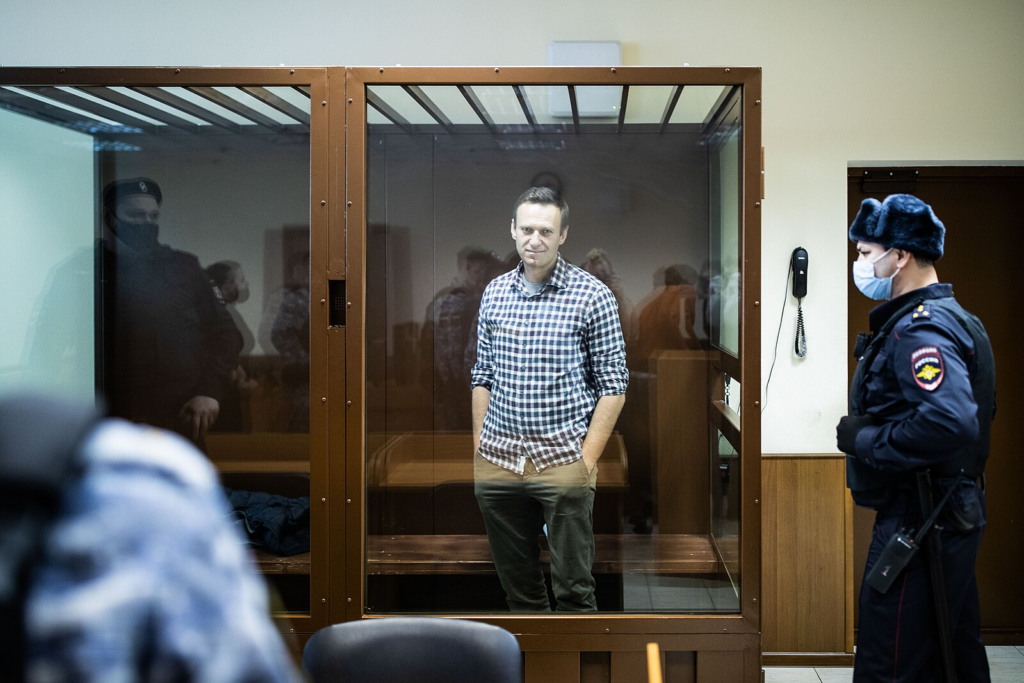
Alexey Navalny in court, February 2021.
Source: Wikimedia Commons

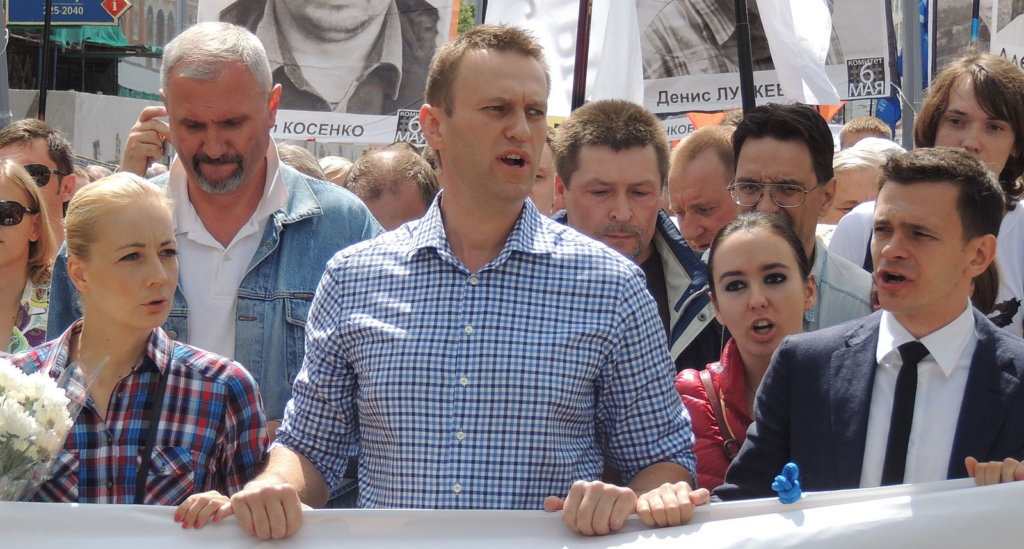
Born to a Ukrainian father and a Russian mother, Navalny was involved with several political parties before gaining international attention for leading protests against fraud in the 2011 Russian parliamentary elections. His profile rose in 2013 as he became a candidate for the Moscow mayoral position.  Afterward, he organized protests and investigated corrupt politicians while facing increasing legal troubles and threats. Navalny believed that Putin had him poisoned in August 2020, leading him to nearly die. He sought medical care in Germany even as Russian authorities seized his assets and apartment.[3]  So why did Navalny return to Russia knowing he would face certain imprisonment and likely death? 

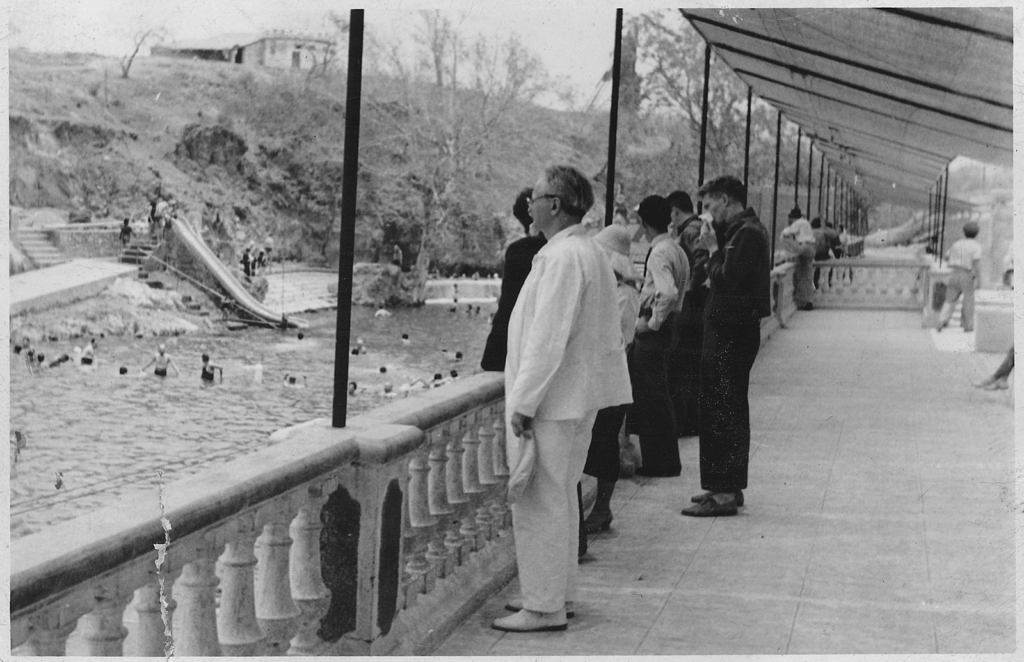
Political dissidents making a crucial choice about remaining in exile or returning home have a long history that weaves through the Russian Imperial and Soviet periods to the present.  Vladimir Lenin and Leon Trotsky were in exile in Switzerland and Brooklyn, respectively, when the February Revolution overthrew Tsar Nicholas II in 1917. They only returned home (Lenin with German assistance) after the government had fallen.  During Joseph Stalin’s rule in the Soviet Union, Trotsky was forced into exile once again, this time to Mexico City, where he was assassinated in 1940.  Historian Barbara Martin has highlighted how Soviet dissidents such as Alexander Solzhenitsyn and Roy Medved faced this conundrum in the post-Stalinist Soviet Union. While life in exile was safer and provided academic and political freedoms, leaving felt like a dereliction of duty or abandoning your home. It also lessened dissidents’ authority among their fellow citizens.[4]  Navalny seemed to take this point to heart and hence accepted the risk of confrontation with the regime, likely believing that his brave anti-Putin legacy would be cemented even at great personal risk.

A political dissident in exile. Leon Trotsky (wearing a white suit) in Mexico, 1938.
Source: Wikimedia Commons

Navalny’s return to Russia in January 2021 was stunningly brave, even as the end result was strikingly predictable. However, he is also a complex figure, and his actions, words, and legacy are intertwined in a set of wider issues and conflicts.

Consider for a moment the Russians in the apartments overlooking his funeral, not the mourners. Assessing Navalny’s popularity through Russian opinion polls, many of them problematic, is difficult.[5] But as I lived and visited Russia, even during Navalny’s poisoning, exile, return, and arrest saga, I heard many people expressing negative voices against him. Some recurring comments were skepticism about his anti-corruption campaigns or the simple belief that he was just another self-aggrandizing politician.  With the 2014 Maidan Revolution in Ukraine, the Russian occupation of Crimea, and the Russian intervention in Eastern Ukraine, cynicism turned to accusations of treason and other conspiracy theories, all repeated in various iterations in the Russian official media. 

Navalny protesting in Moscow, 2013.
Source: Wikimedia Commons

Part of this seems obvious. Russia’s full-scale invasion of Ukraine in 2022 solidified the state media’s portrayal of Navalny as a foreign agent. Furthermore, numerous new laws have designated Navalny, his organization, and most anti-Putin journalists and organizations as treasonous foreign terrorists acting on behalf of the West or Ukraine. The onslaught of such accusations wears people down.  And yet, sociologist Jeremy Morris argues that his contacts’ reaction to Navalny has little to do with propaganda. Many Russians simply dislike Navalny’s image and consider his campaigns naïve and inconsequential.[6] In other words, you can trust that conversations with Russians in Russia about his death are often very different than the coverage by non-Russian media. 

Aside from propaganda and everyday anti-Navalny sentiment, his politics and statements have also been a point of contention among other anti-Putin politicians and activists.  While Navalny is often portrayed as a stereotypical “Russian liberal,” earlier in his political career, he spoke the language of Russian ethno-nationalism. He amplified racial stereotypes directed towards Russia’s large immigrant and Muslim communities, as well as its other numerous non-Russian ethnic groups. He attended the far-right Russian marches, which blamed most of Russia’s ills on immigrants and called for mass deportations.  He moderated such stances over time and apologized. Still, his early remarks defined his image for many non-Russian ethnic groups within and outside of Russia.[7]  Even as his wife, Julia Navalnaya, took the reigns of his organization, the question of where non-ethnic Russians stand within their vision of Russia remains uncertain.[8]

The logo of "Russia of the Future," Alexey Navalny's party.
The logo of Alexey Navalny’s party – “Russia of the Future.” Source: Wikimedia Commons

In the context of the Russian occupation of Crimea in 2014, Ukrainians and Crimean Tatars (the indigenous Muslim minority of Crimea) had good reasons to be skeptical of his denunciations of the full-scale Russian invasion in February 2022.  Beginning with the 2014 occupation of Crimea, Navalny had denounced Russian methods but echoed the Russian nationalist ethos that Russia and Crimea possessed a kind of supernatural bond.[9]  As someone who was researching Stalin’s ethnic cleansing of Crimea at the time the occupation began, this was disappointing, to say the least.   He made such statements as Russian authorities began a new wave of repressions, arrests, and sometimes murders of Crimean Tatars, Crimean Ukrainians, and Russians who protested Putin.[10] 

One point that many of Navalny’s varied detractors may agree on (albeit for different reasons) is that the Western media is too focused on Navalny himself and less on the audiences he represents.  At the very least, the acknowledgment of Navalny should come with a recognition of the bravery and defiance of individuals and victims outside the media spotlight.  There are thousands of other political prisoners in Russia and occupied Ukraine, and Putin’s army and occupation kill Ukrainians every day.  These prisoners suffer from malnourishment, torture, and death.  In Ukraine, the use of torture, rape, and mass executions is now well documented.[11]  In Russia, dissident Vladimir Kara-Murza is now serving a 25-year sentence for condemning the war and has become chronically ill.[12]  Last year, Crimean Tatar activist Dzhemil Gafarov died in a southern Russian prison after being tortured and denied medical release.[13]  The list of absurd arrests for anti-war activities is far too long to recount here. One of the latest examples is the 7-year prison sentence for Russian poet Alexander Byvshev, who questioned the morality of Russia’s invasion.[14]  In other words, the legacy of sacrifice and resistance to Putin is multi-national and multi-ethnic in scope and is far more diverse and broad than just Navalny, the individual.

Vladimir Kara-Murza is now serving a 25-year sentence for condemning Russia's invasion of Ukraine.
Vladimir Kara-Murza is now serving a 25-year sentence for condemning Russia’s invasion of Ukraine.
Source: Wikimedia Commons.

In the month since his death, Russia-related news has remained grim.  Russian attacks have killed dozens of Ukrainian civilians and left the country’s second-largest city, Kharkiv, without power.  Putin has “won” his latest election with absurd margins. He used the election celebrations to signal “enthusiastic voting” in Russian-occupied Ukraine and, almost with a sense of accomplishment, finally mentioned the now-deceased Navalny by name. However, the events of last week showed that Putin does not control everything in Russia. ISIS-K militants launched a horrific terrorist attack on a Moscow concert venue, killing well over 100 people.  Putin’s reaction has been a confused mix of attempting to blame Ukraine and the West, while Russian society and the state have descended into targeting Muslim immigrants and ethnic minorities with threats, deportations, and violence.

Both Russia’s present and its future seem grim. That is perhaps when it is best to think of Alexei Navalny. If nothing else, a consensus seems to have developed that Navalny was remarkable for being a Russian optimist and having the audacity, no matter how flawed or naïve, to believe that Russia’s current course could be reversed. Realistic or not, I do think about that possibility every day and whether – just maybe – there might be some truth to his belief.


Andrew Straw is a historian of Soviet Crimea. He has taught courses on Russian and Soviet history at the University of Texas and Huston-Tillotson University. At the moment, he teaches high school world history and is an instructor for the University of Texas OnRamps history program. He continues research as an independent scholar and is preparing a book proposal that will focus on Stalin’s Crimea policy and Crimean Tatars in the immediate postwar period. He can be reached at astraw@utexas.edu or on Twitter at @astrawism1


[1] https://www.iwmf.org/community/anna-politkovskaya/

[2] https://notevenpast.org/tag/boris-nemtsov/

[3] https://www.bbc.com/news/world-europe-54369664.amp

[4] https://www.bloomsbury.com/us/dissident-histories-in-the-soviet-union-9781350192447/

[5] https://www.levada.ru/2021/02/05/vozvrashhenie-alekseya-navalnogo/

[6] https://postsocialism.org/2024/02/16/russia-lost-its-greatest-and-most-naive-optimist-a-curmudgeons-obituary-of-alexei-navalny/

[7] https://www.euronews.com/2023/07/07/racist-or-revolutionary-is-alexei-navalny-who-many-westerners-think-he-is

[8] https://www.themoscowtimes.com/2024/02/29/navalnys-difficult-relationship-with-indigenous-russians-a84291

[9] https://www.themoscowtimes.com/2023/03/07/navalnys-policy-shift-on-crimea-may-be-too-little-too-late-a80396

[10] https://unn.ua/en/news/at-least-60-people-died-from-repressions-in-crimea-during-russian-occupation-ctrc

[11]https://www.theguardian.com/commentisfree/2024/mar/25/russia-weaponising-sexual-violence-ukraine-values

[12] https://www.npr.org/2023/04/17/1168667764/vladimir-kara-murza-prison-sentence

[13] https://khpg.org/en/1608812709

[14] https://www.reuters.com/world/europe/russian-anti-war-poet-gets-seven-year-jail-term-over-poem-ukraine-war-2024-03-22/

The views and opinions expressed in this article or video are those of the individual author(s) or presenter(s) and do not necessarily reflect the policy or views of the editors at Not Even Past, the UT Department of History, the University of Texas at Austin, or the UT System Board of Regents. Not Even Past is an online public history magazine rather than a peer-reviewed academic journal. While we make efforts to ensure that factual information in articles was obtained from reliable sources, Not Even Past is not responsible for any errors or omissions.

Flawed Assertions and Questionable Evidence: A Critical Examination of Howard Zinn’s A People’s History of the United States

In his seminal work, A People’s History of the United States, Howard Zinn presents a compelling alternative perspective on American history. In an important article, Professor Aaron O’Connell, who teaches at UT, made a powerful case for using Zinn in the classroom:

To take my students through the long history of violence in America, I use a book that has been in the news lately: Howard Zinn’s A People’s History of the United States. This book is well-known – even controversial, both inside academia and out – partly because Zinn tackles some of the sacred cows of America’s national mythos: Is Christopher Columbus better remembered as a genius sailor or a genocidaire? What does it say about the progression of liberty that single women in New Jersey had the vote until 1807 when it was stripped from them by an all-male state legislature? Most importantly, why have so many history books focused almost exclusively on the stories of white, wealthy men whose total numbers have never approached half – or even a quarter – of the country’s total population?

Zinn’s answer to all of these questions is that there have always been long-standing structural inequalities in American society that have shaped everything from the writing of laws to the ways they are interpreted to the stories we tell today about the nation’s past. It is nice to think of America as one big family, Zinn explains, but telling the story that way conceals fierce conflicts in that family’s history “between conquerors and conquered, masters and slaves, capitalists and workers, dominators and dominated in race and sex. And in such a world of conflict, a world of victims and executioners, it is the job of thinking people, as Albert Camus suggested, not to be on the side of the executioners.”[1]

In a class I took with Professor O’Connell, he challenged us to assess Zinn. In this article, I evaluate some of the flaws primarily related to his framing of economic issues that I saw within Zinn’s text. This does not diminish Professor O’Connell’s broader point that Zinn’s perspective is a valuable supplement to our historical education, but hopefully, it adds to the discussion and provides additional nuance in evaluating Zinn’s work.

cover of Howard Zinn's "A People's History of the United States."

Zinn sets out to challenge entrenched views of American history and to debunk what O’Connell describes as some of “the sacred cows of America’s national mythos.”  While he succeeds in part, Zinn’s narrative reveals certain flaws. While I applaud Zinn’s goal, it is also important to maintain a fair and objective portrayal of events. I contend that Zinn’s selective use of evidence compromises the overall credibility of his narrative, exposing a lack of both an objective attitude and a comprehensive understanding of the economic system. Zinn asserts that, for government officials, the economy is “a short-hand term for corporate profit,” and their economic policies are primarily directed towards “the needs of corporations.”[2]  This is a central strand of Zinn’s critiques, and it’s here that I will focus my attention.

In supporting this sweeping argument about government priorities, Zinn neglects many crucial aspects of economics, such as the global events that were out of the control of the US government. For instance, his depiction of big oil and gas corporations’ profits and the public’s struggles with inflation and unemployment in the 1970s lacks a nuanced understanding of the economic factors contributing to the stagflation of 1973–1975 and 1979–1983. According to Alan Blinder, the 15th vice chairman of the Federal Reserve and an influential economist, the inflation of 1973 was pushed by a combination of special factors such as the food shock, the energy crisis, and wage-price control.[3]The first two factors were predominantly products of foreign conflicts and natural disasters beyond the control of the US government. Thus, a more critical approach would involve evaluating how well the US government managed the crisis by comparing its economic status to similar nations rather than hastily attributing domestic economic hardship solely to the government. Zinn’s work is powerful and illuminating, yet I think he sacrifices accuracy when it comes to economics as he tries to fit everything into one narrative.

Zinn tends to single out the United States, but detailed data from the Foreign Labor Statistics program shows that all major developed countries suffered from a surge in unemployment from 1974 to 1975.[4] Although the US had the highest unemployment rate in 1975–1976 and was affected the most by the stagflations of the 1970s, its economic state gradually improved during the 1980s. The unemployment rate remained one to two percent lower than in Canada and Europe, whose rates were generally lower than in the US back in the 1960s. Indeed, from 1960 to 2000, US unemployment rates improved from relatively high levels to the lowest among the G7 countries.[5] This suggests that the American establishment produced significant gains for people when it came to matters of employment. Zinn might argue that such decent economic standing was built on the expansion of American imperialism—a plausible assumption. However, this would contradict Zinn’s previous claim that government-promoted economic interests were solely the interests of corporations, as the majority of Americans seemed to have benefited.

book cover for "a people's history of the United States."

In broad terms, Zinn views any abolition of price regulation or adjustment of corporate tax as a tool to advance corporate interests. The wage-price control system implemented by President Nixon was undeniably a deliberate policy adopted by the establishment. Zinn appears to endorse price control for its popularity, considering that he criticizes President Carter‘s end of price regulation as a departure from populism and embracing big oil and gas interests.[6] However, Zinn overlooks the start of this price regulation—Nixon’s wage-price control policy and the Emergency Petroleum Allocation Act. This legislation established a strict oil price regulation, setting a price ceiling of $5.25 a barrel for all the oil coming from wells drilled before 1973.[7] Instead of building his argument on this widely recognized government policy, Zinn presents a document meant only for the Arabian-American Oil Corporation’s internal deliberations to argue that “the system” always works in favor of the oil corporations.[8] This flawed presentation of evidence weakens his argument, as Zinn selects a corporate discussion, lacking meaningful implications about the government’s attitude, over an act passed by Congress as his evidence. Interestingly, the document Zinn cites was revealed by a Senate subcommittee investigating multinational corporations, indicating the government’s confrontational attitude towards oil corporations. It seems to contradict Zinn’s narrative of a government corrupted by the business world.

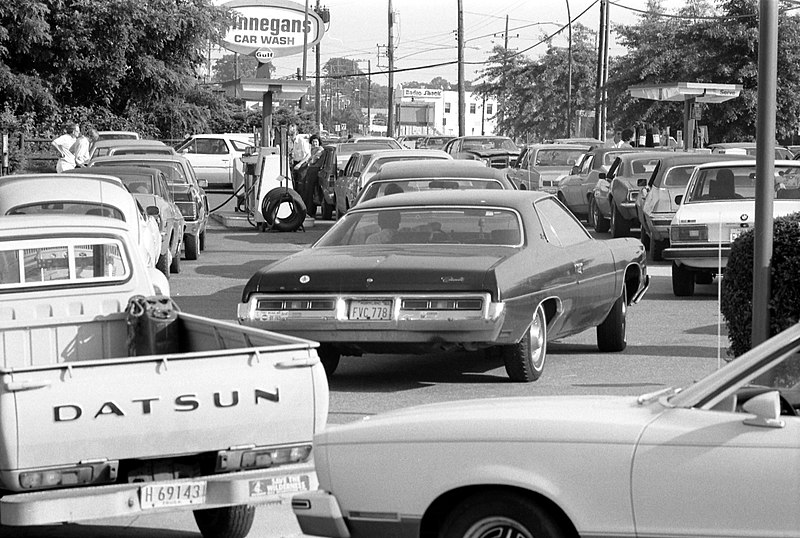
Line at an American gas station, June 1979.
American drivers lining for gas, June 1979.
Source: Wikimedia Commons.

Furthermore, Zinn fails to acknowledge the disastrous effect of price regulation or comprehend the economics at play. Dr. Blinder identifies “the imposition and subsequent demise of wage-price controls” as the primary driving factor behind the 1973–1975 double-digit stagflation. The wage-price control system accumulated inflation as it struggled to maintain regulation, contributing to the dramatic price behavior in the market. As the price control system eventually collapsed, the surging catch-up inflation was released, leading to sharp accelerations and decelerations of nonfood and nonenergy prices in 1974.[9]

Zinn’s critique of corporate tax deduction, based on the correlation between low capital investment and lower corporate taxes in 1973–1975 and 1979–1982, ignores the context of double-digit stagflation during both time periods.[10] It’s far more likely that low capital investment reflects a weak economy, with the tax deduction being the government’s response to stimulate economic growth—an interaction evident, for example, in the relationship between governmental policies and national GDP during the COVID-19 recession.

In summary, Zinn selectively presents evidence while either disregarding or downplaying instances when the president disagreed with Congress, Democrats clashed with Republicans, or the primary goals of governmental policies were genuinely aligned with social well-being. Considering Zinn’s own sentiments expressed in his opening chapter, where he observes that nations are not communities and individuals cannot be viewed as a homogenous collective group, it becomes evident that what Zinn perceives as the establishment—the wealthy and government officials serving their interests—is hardly a unified group with shared objectives. Recent political events underscore that conflicts among political factions do not necessarily benefit the American people. Quite the opposite, a yearning for a return to an era characterized by political stability and harmony is discernible among many citizens.

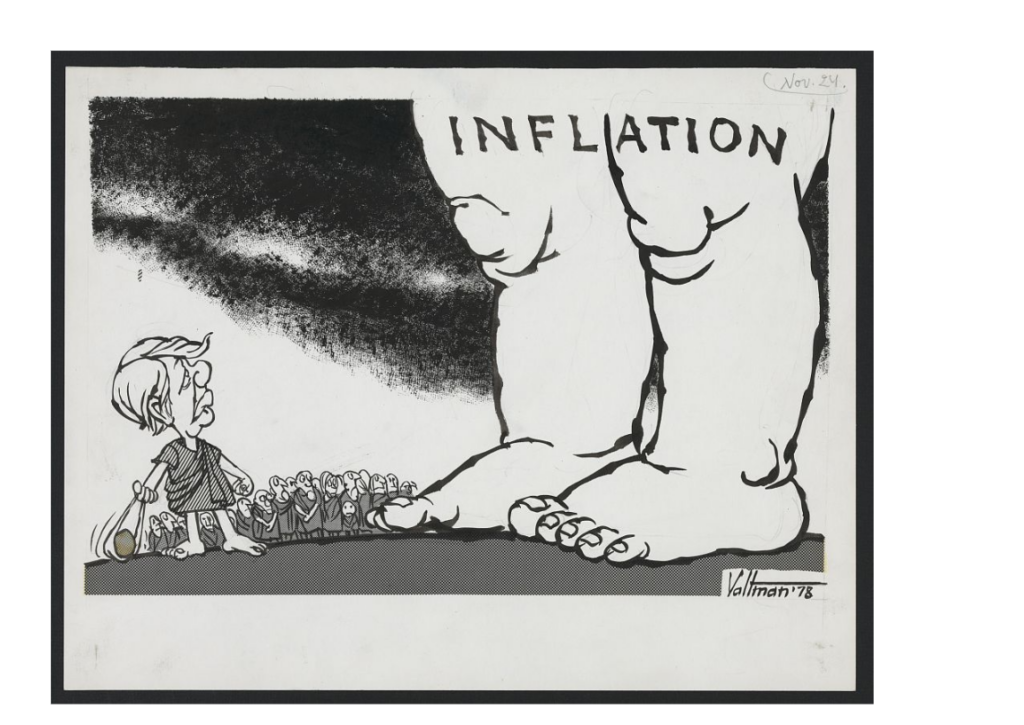
Editorial cartoon drawing showing President Jimmy Carter as the biblical David confronting Goliath labeled "Inflation." By Edmund S. Valtman, 1978.
Editorial cartoon drawing showing President Jimmy Carter as the biblical David confronting Goliath labeled “Inflation.” By Edmund S. Valtman, 1978.
Source: Library of Congress.

After reading A People’s History of the United States, I find that Zinn’s argument is persuasive in some ways but also suffers from selective use of evidence and inconsistency. He condemns Carter for demolishing price regulation yet does not credit Nixon for its creation; he talks about how the public should know that welfare only took a tiny part of the taxes, yet in the previous chapter, he boosts the success of popular movements marked by social spending taking thirty-one percent of the budget; he observes how the establishment used the press as a tool to inflame public opinion, yet he relies heavily on polls conducted by the press to directly reflect the supposed people’s will. While Zinn has undoubtedly covered essential and neglected facets of history, his selective and hypocritical use of evidence erodes the credibility of his major claims.

How can readers trust a historian to reveal the true history when he himself omits crucial contexts for the evidence he presents? How can people believe in the validity of a thesis arguing that specific economic concerns are the driving factor behind decision-making when the author himself cannot acknowledge the nuances of the modern economic system? How can people agree with Zinn’s cynical assessment of our political system when he himself fails to appreciate the complexity of it? The delicate balance between acknowledging historians’ inevitable personal bias, as Zinn himself admits, and maintaining an objective stance seems to elude Zinn. His work, while groundbreaking in many respects, may be perceived as crossing the line into the realm of subjective opinion on many occasions. Ultimately, this raises questions about the extent to which readers can trust Zinn’s narrative as an objective and comprehensive account of American history.

In the end, I’m more critical than Professor O’Connell, but I share his belief that Zinn’s A People’s History of the United States is a valuable text for the classroom. Despite its flaws, Zinn’s book is worth reading and writing about because it fulfilled the primary goal of academic research: it got me thinking.

Yunzhou Lu is an undergraduate computer science major who is also pursuing a Core Text and Ideas certificate as well as a history minor. He is a history enthusiast and is particularly interested in economic history, global diplomacy, and premodern military history. Yunzhou hopes to keep history learning a lifelong passion that brings fulfillment to his free time and gives him lenses through which to view contemporary issues.  


[1] Aaron O’Connell, “Why Study the Ugliest Moments of American History? Reflections on Teaching Howard Zinn’s A People’s History of the United States,” Not Even Past, October 3, 2020,

Why Study the Ugliest Moments of American History? Reflections on Teaching Howard Zinn’s A People’s History of the United States

[2] Howard Zinn, A People’s History of the United States (HarperPerennial, 2015), 537-539 https://files.libcom.org/files/A%20People%27s%20History%20of%20the%20Unite%20-%20Howard%20Zinn.pdf

[3] Alan Blinder, “The Anatomy of Double-Digit Inflation in the 1970s”, Inflation: Causes and Effects, January 1982, 268-269, http://www.nber.org/chapters/c11462

[4] Constance Sorrentino and Joyanna Moy, “U.S. labor market performance in international perspective”, Monthly

Labor Review, June 2002, 17

[5] Sorrentino and Moy, “U.S. labor market performance in international perspective”, 17-18

[6] Zinn, A People’s History, 532

[7] Christopher R. Knittel, “The Political Economy of Gasoline Taxes: Lessons from the Oil Embargo”, Tax Policy and the Economy 28, no.1 (2014):105-106, https://doi.org/10.1086/675589

[8] Zinn, A People’s History, 511

[9] Blinder, “The Anatomy of Double-Digit Inflation in the 1970s,” 266-268

[10] Zinn, A People’s History, 540

The views and opinions expressed in this article or video are those of the individual author(s) or presenter(s) and do not necessarily reflect the policy or views of the editors at Not Even Past, the UT Department of History, the University of Texas at Austin, or the UT System Board of Regents. Not Even Past is an online public history magazine rather than a peer-reviewed academic journal. While we make efforts to ensure that factual information in articles was obtained from reliable sources, Not Even Past is not responsible for any errors or omissions.

Review of From Label to Table: Regulating Food in America in the Information Age(2023) by Xaq Frohlich

banner image for Review of From Label to Table: Regulating Food in America in the Information Age(2023) by Xaq Frohlich

Go to the supermarket, check out the food information detailing the nutritional facts, buy it, and take it home. These everyday actions define our connection with food and shape who we are as consumers. Through social media, we are constantly confronted with information that associates food with health, wellness, and organic products as an endless line connecting what we eat now and the consequences in our future. Yet these decisions are not just about individual actions. Rather, food, technology, marketing, and nutritional facts — and the networks that bind them — have their own history of institutional and social construction through the twentieth century.

It is this context that Xaq Frohlich, a historian of science, technology, and food, takes as a starting point for his book. As a result, From Label to Table presents the history of institutionalism around nutritional facts, the social construction of consumers, the changes around the perception of food and its marketing, and the search to make food scientific and objective in the United States during the twentieth century.

The book’s six chapters present the history behind the construction of nutrition facts, following the different stages of the Food and Drug Administration‘s (FDA’s) decision-making. Frohlich identifies three stages in the relationship between consumers and food: the era of adulteration (1880s to 1920s), the age of food standards (1930s to 1960s), and the era of information (1970s to the present). Each era witnessed distinct politics and marketing techniques (production, distribution, and consumption) as well as legal and scientific expertise that created a conception of the consumer and worked with consumer tactics. One of the book’s main contributions is that this periodization embraces a more extensive macro-historical process in the United States in the twentieth century, from food scarcity to overconsumption.

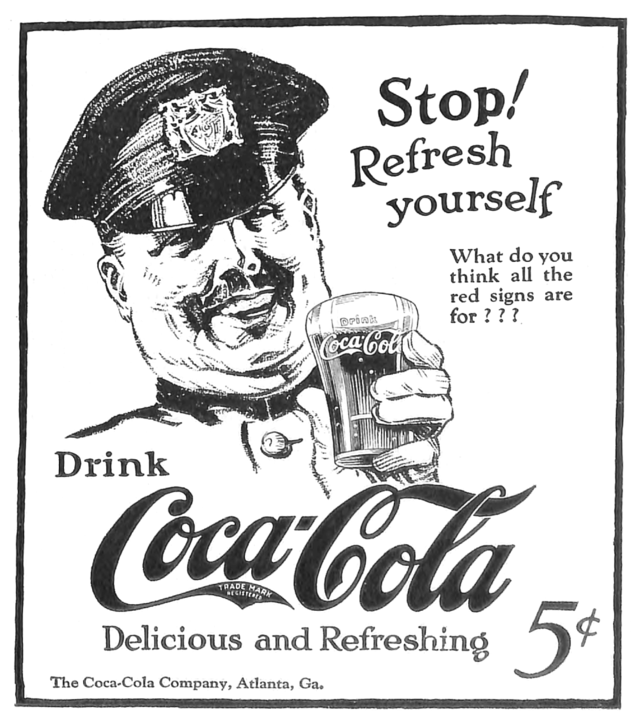
Coca-Cola ad Elks Magazine, 1924
Coca-Cola ad Elks Magazine , 1924.
Source: Wikimedia Commons.

During the first decades of the twentieth century, urbanization and industrialization modified how people in the United States produced, consumed, and packaged food. Likewise, the development of global corporate entities, such as Coca-Cola, set the course towards a visual component through packaging and consumers’ feelings. Similarly, some companies produce food with vitamin-infused components. This process was modified through World War II, when food production accelerated via technology, specifically through long-term storage and heating infrastructures, such as refrigerators and microwaves. For the author, this global component encompasses decision-making around new food regulations in the United States.

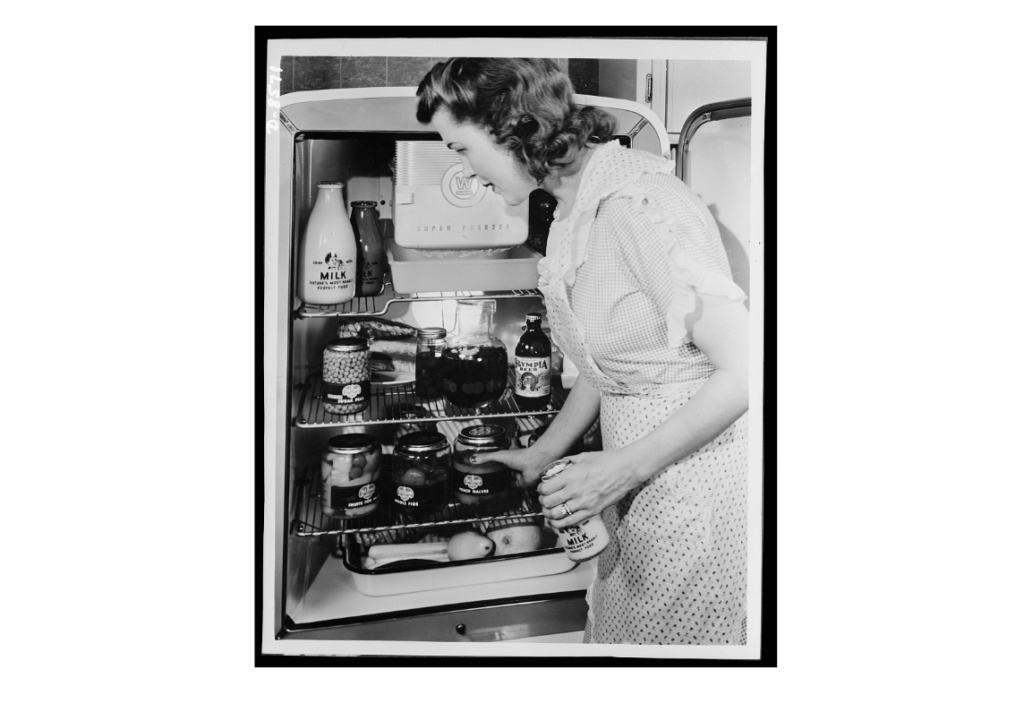
Frohlich proposes two developments that changed the relationship between consumers and food in the decades following World War II. The first was the role of women as principal consumers. For the FDA and food production companies, women represented the new ideal food consumer, and they looked for new ways to persuade them to purchase their products. At the same time, food and science focused on medical debates such as using artificial sweeteners and their links to diabetes, cholesterol, and heart disease, increasing consumer information through what Frohlich calls nutritionism. At the same time, the expansion of supermarkets was a “self-service revolution,” increasing consumers’ independence in choosing food (p. 58-9). Both changes, Frohlich argues, pushed the state away from food regulations and contributed to increasing individual consumer choices and the role of private companies through nutritional labels.

Commercial for food packed in glass containers featuring a woman, produced by the Office of War Information
Commercial for food packed in glass containers featuring a woman, produced by the Office of War Information.
Source: Library of Congress.

This process increased exponentially between the 1970s and the 1990s. In the 1970s, the FDA sought to include food labels that would aid individual consumer research, which, united with the role of private food companies, moved the food and medical debates more and more into the private sector. In an increasingly neoliberal context, nutritional information mashed together science and numbers. For Frohlich, the connection between health and nutrition can also be traced to the first Earth Day in 1969. Here, the emergence of ecologism in the United States increased the connection between individual decisions about food and climate change. This awareness of food production is fundamental to understanding, for example, the introduction of the biotech industry in producing genetically modified foods in the 1990s and our present debates about organic products.

Another contribution of the book is the conception of nutrition facts as an everyday technology. On the one hand, Frohlich shows how nutrition facts are a technological infrastructure. During the twentieth century, the development of nutrition labels and facts created a specific language of nutrition, where food was related to science and, as a marketing technique, to health. Of central importance in this historical process is how this language was incorporated into everyday American life. Here, the author’s theoretical approach is practical not only for food studies but can also be incorporated into the history of everyday technology in a broad spectrum, considering the relationships of consumers –emotional, informational, and risk ties— with technology and vice versa.

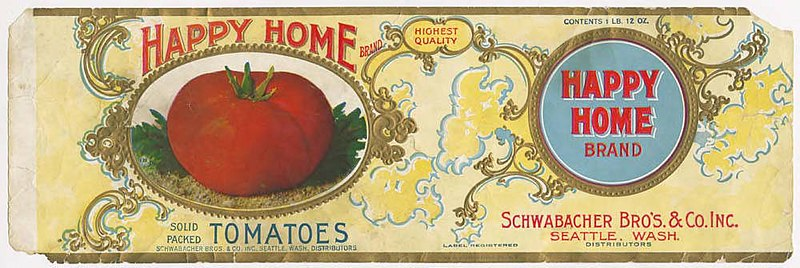
Happy Home Brand Tomatoes can label, 1920
Happy Home Brand Tomatoes can label, 1920.
Source: Wikimedia Commons
.

On the other hand, for Frohlich, introducing a new language into the private sphere represents a singular vision from the United States regarding confidence in science and objectivity and an inclination to regulate food markets from public and private politics. As he mentions, this regulation culture can be viewed as a form of governability, connecting science, technology, and state formation. Moreover, the search for food regulation through nutritional facts also had a background form of state deregulation. These methodological and theoretical proposals can also help to study the formation of a liberal state and the limits of individual choices related to technologies outside the United States. For example, taking the case of the European Union and some Latin American countries, such as Chile and Mexico, which have also initiated their national food regulation policies, Frohlich’s definition of regulatory culture can be expanded in the future by focusing on other cases with a global perspective.
Whereas the book centers around “Americans’ relationship to food” (p. 20), and the evolution of nutritional facts during the twentieth century, it covers other themes, including the role of experts and expertise, consumerism, marketing techniques, and public and private spheres, all linking to the complex relationship between food and science through informative elements. Today, following Frohlich’s proposals, the study of this relationship opens doors toward a wider historiography of technology and food studies. But it also connects to the current public debates about the negatives associated with the production and consumption of genetically modified food, the consumers’ search for organic food production, and the medical –and pseudo-medical– information to which we are exposed daily about how to eat “correctly.”


Yohad Zacarías is a doctoral student in the Department of History at the University of Texas at Austin. As a Fulbright doctoral fellow, her interests focus on electrification’s urban, environmental, and technological impact in Chile and Latin America between the 19th and 20th centuries. As a pre-doctoral project, she is researching the history of design and everyday technology in Chile during the 1970s and 1990s through advertising campaigns to reduce electricity consumption. 

The views and opinions expressed in this article or video are those of the individual author(s) or presenter(s) and do not necessarily reflect the policy or views of the editors at Not Even Past, the UT Department of History, the University of Texas at Austin, or the UT System Board of Regents. Not Even Past is an online public history magazine rather than a peer-reviewed academic journal. While we make efforts to ensure that factual information in articles was obtained from reliable sources, Not Even Past is not responsible for any errors or omissions.

Review of Stamped from the Beginning: The Definitive History of Racist Ideas in America (2016), by Ibram X. Kendi

banner image of Review of Stamped from the Beginning: The Definitive History of Racist Ideas in America (2016), by Ibram X. Kendi

Ibram X. Kendi’s magnum opus, Stamped from the Beginning: The Definitive History of Racist Ideas in America, is a transformative work that transcends traditional scholarship to provide a profound examination of the roots and manifestations of racism in the United States. Published at a critical juncture in history–marked by both symbolic progress and persistent racial challenges–Kendi’s groundbreaking narrative dissects the historical development of racist ideas. As the nation grappled with the paradox of having its first African American president during the final years of Barack Obama‘s presidency, the book emerged against a backdrop of heightened awareness of racial injustice, debates about Confederate symbols, and the rise of white nationalist ideologies. Ibram X. Kendi’s exploration of the historical roots of racism provided a timely lens through which to understand and address contemporary racial issues during this pivotal period. In addition, it offers an invaluable lens through which contemporary policymakers can confront and dismantle systemic inequities. As a historian and scholar of race and discrimination in America, Kendi takes readers through the annals of American history and reveals the insidious evolution of racist ideologies from their inception to the present day.

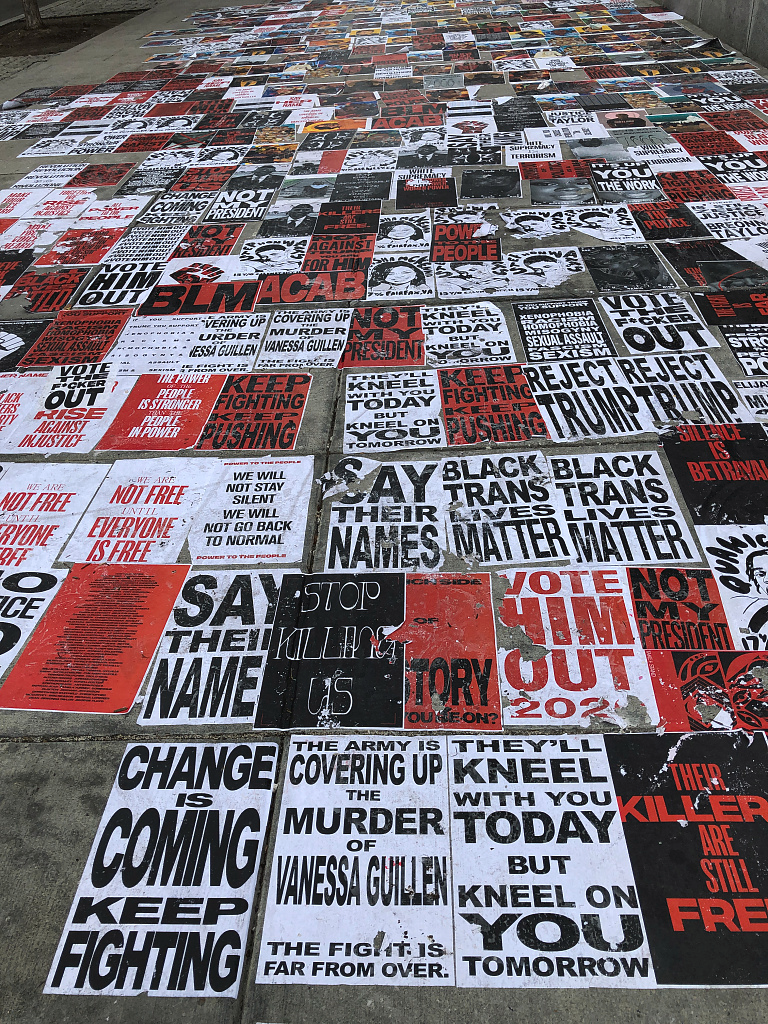
Black Lives Matter protest signs on the ground, Washington, DC, 2020
Black Lives Matter protest signs on the ground, Washington, DC, 2020.
Source: Library of Congress

At its core, Kendi’s work challenges the conventional wisdom regarding the roots of systemic racism. While the prevailing perspective often centers on individual attitudes and actions as the primary drivers of racial disparities, Kendi posits that racist ideas have historically been intertwined with policies. Thus, Kendi challenges simplistic categorizations and encourages a more comprehensive understanding of the historical development of racist ideologies. The essence of Kendi’s work lies in its commitment to truth-telling. He urges readers to acknowledge the historical context that has fueled the persistence of discriminatory policies, encouraging a paradigm shift from mere acknowledgment to proactive dismantling. Stamped from the Beginning is not merely a historical scholarship; it is a call to action that prompts policymakers to scrutinize their beliefs and assumptions, fostering a critical examination of the systems they construct and maintain.

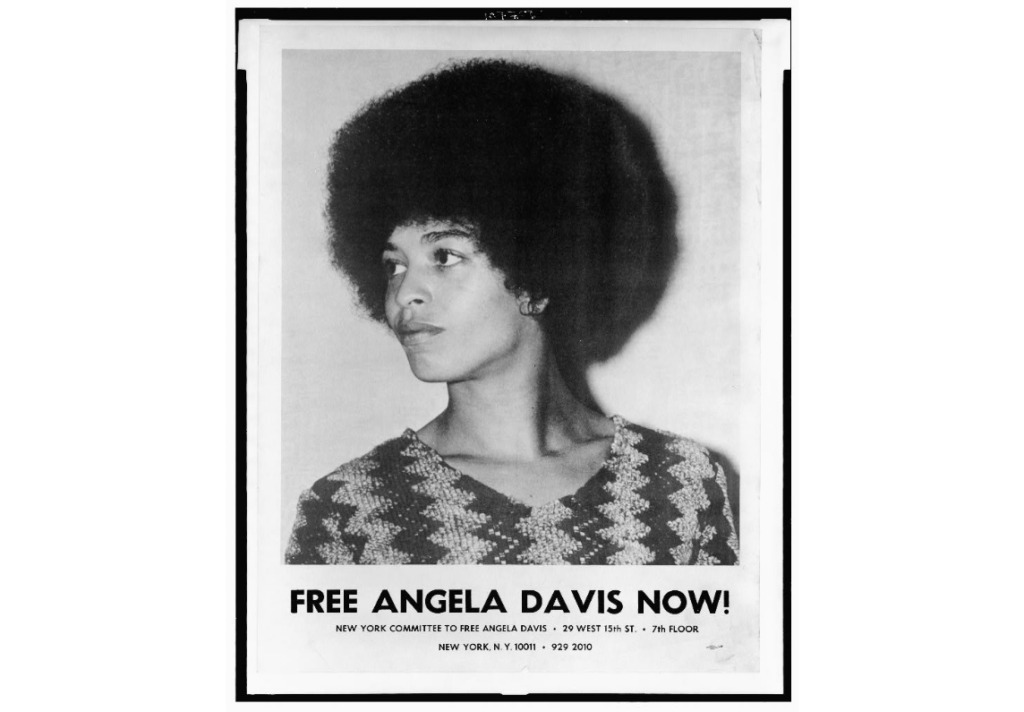
Kendi’s theory shifts the conventional paradigm in the discourse on racism. He argues that racism is not solely a product of individual attitudes but is deeply embedded in the policies and structures of society. Kendi’s comprehensive exploration revolves around the lives and beliefs of five key historical figures representing different periods in American history. These figures, including Cotton Mather, Thomas Jefferson, William Lloyd Garrison, W.E.B. Du Bois, and Angela Davis, offer a spectrum of perspectives on race, illustrating the multifaceted nature of racism and how it became ingrained in societal structures and policies. By doing so, Kendi challenges the prevailing notion that racism is merely a collection of isolated incidents or prejudiced beliefs. Considering racism’s persistence, Kendi suggests shifting our focus toward policies and institutional structures. The book also challenges the binary framework that often separates individuals into “racist” or “not racist” categories. Kendi proposes a spectrum of racism, introducing the terms “segregationist,” “assimilationist,” and “antiracist” to describe different approaches and beliefs regarding race. This nuanced framework encourages readers to reflect on their own positions on this spectrum and consider the broader implications of their ideas within the context of systemic change.

Free Angels David poster, 1971
Free Angela David poster, 1971.
Source: Library of Congress

The book’s relevance extends beyond historical analysis, making it an essential read for anyone seeking a deeper understanding of the ongoing struggle against racism in the United States. Stamped from the Beginning emerged at a critical period in American history during the latter years of Barack Obama’s presidency. Published in 2016, the book entered the literary scene amid a nation grappling with the paradox of celebrating its first African American president while confronting enduring racial inequality. Kendi’s work engaged with contemporary challenges and provided historical context to elucidate their origins, becoming a crucial resource for those seeking to comprehend the historical racial injustice continuum underpinning present-day struggles.

Stamped from the Beginning is exceptionally accessible, employing a narrative style that makes it understandable to a diverse audience. Kendi sidesteps unnecessary jargon, ensuring that the material remains open to different readers. The book’s rigorous approach and original research draw on various primary and secondary sources, contributing to new insights into understanding racist ideas and their policy impact through a historical rhetorical analysis of speeches and correspondences. While the use of Kendi’s specific individual case studies–Mather, Jefferson, Garrison, Du Bois, and Angela Davis–provides powerful case studies and allows for a nuanced exploration of racism, I argue that this approach is limiting.

The concern here is that by centering the narrative primarily on the lives and beliefs of specific individuals, the book risks overlooking or underemphasizing broader collective societal attitudes and actions. Racism is not solely the product of a few influential individuals but is often deeply ingrained in the structures and norms of a society. A more expansive examination of collective forces, social movements, and systemic influences would provide a more holistic understanding of how racist ideas permeate and persist in society. I argue that if Kendi explored the influence of institutions, cultural norms, and widespread attitudes alongside individual narratives, he could have provided a more complete picture of the complex interplay between racism and society, which is one of the main arguments he makes throughout the book.

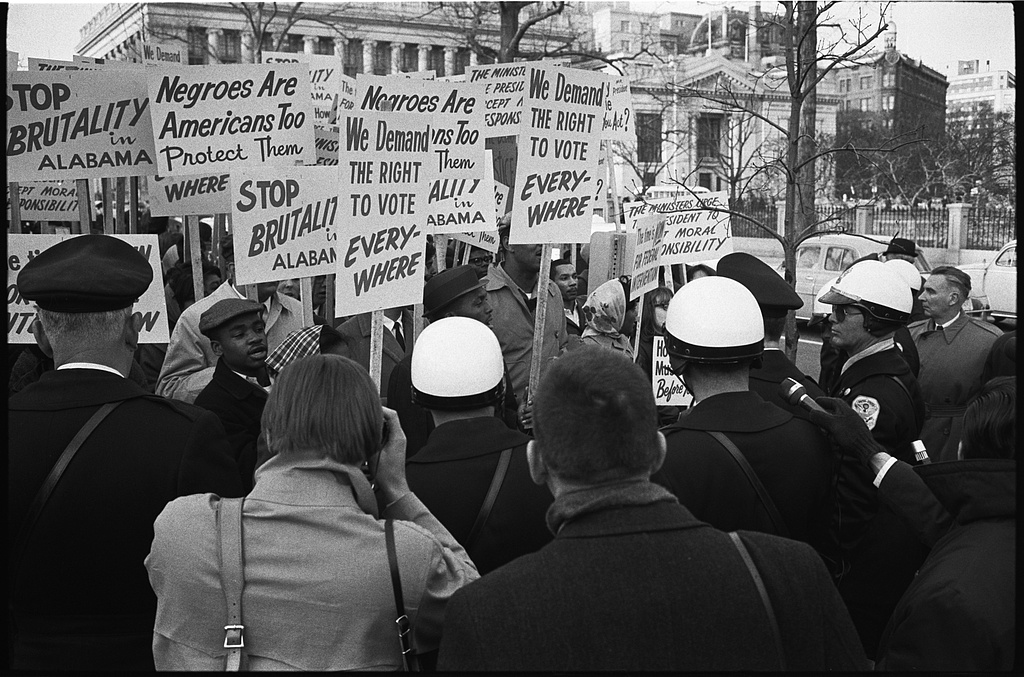
African American demonstrators outside the White House, protesting police brutality against civil rights demonstrators in Selma, Alabama, 3.12.1965
African American demonstrators outside the White House, protesting police brutality against civil rights demonstrators in Selma, Alabama, 3.12.1965.
Source: Library of Congress

While the book effectively demonstrates how individual actions contribute to the perpetuation of racist ideologies, it may leave some readers wanting a more comprehensive analysis of the broader societal context in which these individuals operate. Exploring the influence of institutions, cultural norms, and widespread attitudes alongside individual narratives could provide a more complete picture of the complex interplay between racism and society. While the book successfully highlights the role of specific historical figures in shaping racist ideas, a broader examination of the social and institutional forces that contribute to the perpetuation of racism could enhance the reader’s understanding. Regardless, Stamped from the Beginning is a beacon in public policy literature, accessible and engaging yet deeply rooted in original research. It introduces a transformative theory that prioritizes policies in the fight against racism, challenges conventional paradigms, and encourages further exploration within the field. As a result, the book becomes a pivotal cornerstone in reshaping the discourse on race. It should be considered a canonical work in public policy for its transformative potential and paradigm-shifting insights.


Maddie (Williams) Shorman is a doctoral student in the LBJ School for Public Affairs at the University of Texas at Austin. Her doctoral research focuses on the transnational networks of religious nationalism. She is currently using network and content analysis to map church-state relations regarding views on violence from the pre-Constantine times to the modern era. 

The views and opinions expressed in this article or video are those of the individual author(s) or presenter(s) and do not necessarily reflect the policy or views of the editors at Not Even Past, the UT Department of History, the University of Texas at Austin, or the UT System Board of Regents. Not Even Past is an online public history magazine rather than a peer-reviewed academic journal. While we make efforts to ensure that factual information in articles was obtained from reliable sources, Not Even Past is not responsible for any errors or omissions.

The Wars of Oppenheimer

Banner image for The Wars of Oppenheimer by David Conrad

It’s a three-hour, ultra-big-screen, deeply-researched box office mega-hit about… J. Robert Oppenheimer, project manager. Leslie Groves, the manager’s manager. Kitty Oppenheimer, the manager’s kids’ manager. Lewis Strauss, the wanna-be manager. Harry Truman, the buck-stops-here manager. James Byrnes, President Truman’s manager. The scientists of the Manhattan Project were thoroughly unmanageable. The bomb? It was everybody’s fault, and nobody’s in particular. Nuclear war by committee. It’s Oppenheimer: Destroyer of Responsibility.

Director and screenwriter Christopher Nolan isn’t wrong. The essence of the Manhattan Project, several characters remind us, was compartmentalization. The less any one project member knew about how to make an atom bomb, the less he or she could reveal to an enemy — especially a Soviet, an enemy of the Allied variety.

One of the movie’s smartest choices is to place the story of mankind’s first nuclear weapon in its ideological context. It excels at depicting the intellectual context, the scientific rivalries, and the egos surrounding the bomb. It deals tolerably well with the political context, the way World War II‘s messy wrap-up determined how the bomb was used. But where Oppenheimer sets itself apart from most other movies on the topic is in its depiction of the bomb as a turning point in the debate over communism: a debate that had raged for years and would only intensify as the nuclear era began.

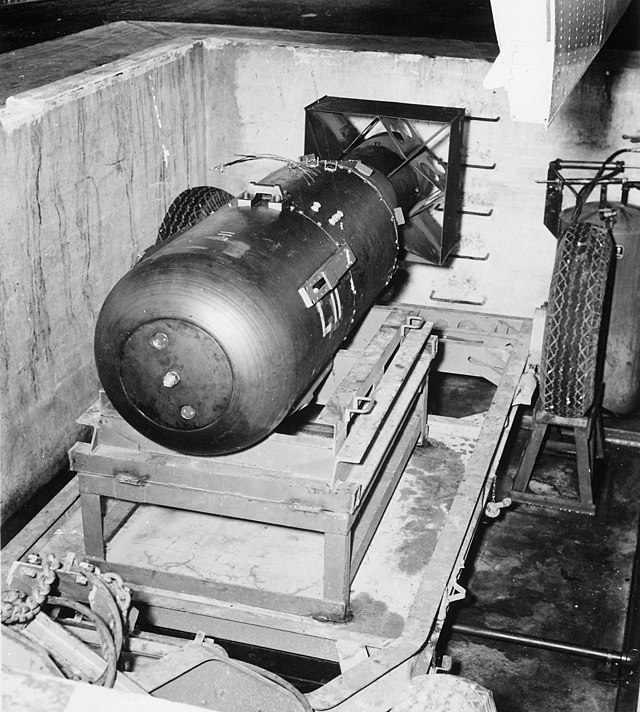
"Little Boy," the nuclear bomb that was dropped on Hiroshima on August 6, 1945.

“Little Boy,” the nuclear bomb that was dropped on Hiroshima on August 6, 1945. The bomb killed tens of thousands of Japanese civilians.
Source: Wikimedia Commons.

Around a third of the movie takes place many years after the bomb, when Oppenheimer’s (Cillian Murphy) security clearance is under review and his occasional colleague Lewis Strauss (Robert Downey, Jr.) is seeking Senate confirmation to join President Eisenhower’s cabinet. If this sounds obscure and more “inside baseball” than a gripping thriller, it is, and Nolan leans into its wonkiness with the confidence of a director who answers to no one. Unlike the rest of the movie, these flash-forward scenes are shot in black and white, a palette that cinematographer Hoyte van Hoytema uses beautifully. Nolan, who is known for trippy time-bending films like Interstellar and Tenet, collapses about a decade’s worth of bureaucratic infighting into an interwoven, frenetic, emotional, and at times corny parallel movie that he grafts onto his more conventional biopic.

It is in this seemingly tacked-on portion of the film that the theme of communism vs. anti-communism stakes out its central position. The postwar rift between “the free world” of liberal capitalism and the opposing world of the communist bloc was dangerous because, after the bombs reached a certain strength, either side could have started the war to end all wars as well as terminating all known life. However, because that hasn’t yet happened (as of the publication of this article), Nolan has to illustrate the tension indirectly. While a McCarthy-era committee grills Oppenheimer and his wife Kitty (Emily Blunt) about their prewar communist sympathies, the bitter and conniving Strauss faces a divided U.S. Senate and a rebellion of atomic scientists.

The end result is two clear camps, Strauss’ and Oppenheimer’s. And in their pride and addiction to power, both ramp up pressure until the other is destroyed. Excessive makeup and monologuing from Strauss and unearned heroics from the Oppenheimers notwithstanding, this petty skirmish after the war is key to the movie’s message.

Oppenheimer reminds us that, if we seek the origins of the Second World War in the First, the people who lived it had a more recent and more relevant frame of reference: the Spanish Civil War (1936-39). This was the first major trial by combat between fascism on the one hand and communism and republican democracy on the other. It was the romantic struggle that drew in Langston Hughes, Ernest Hemingway, and Casablanca‘s Rick Blaine. It was the proving ground for foreign, notably American, idealists who risked their lives or at least sent money to ensure that freedom –  in the left-wing sense of progressive thinking and non-traditional living – would not go quietly into the night as Europe’s balance of power tilted sharply to the right.

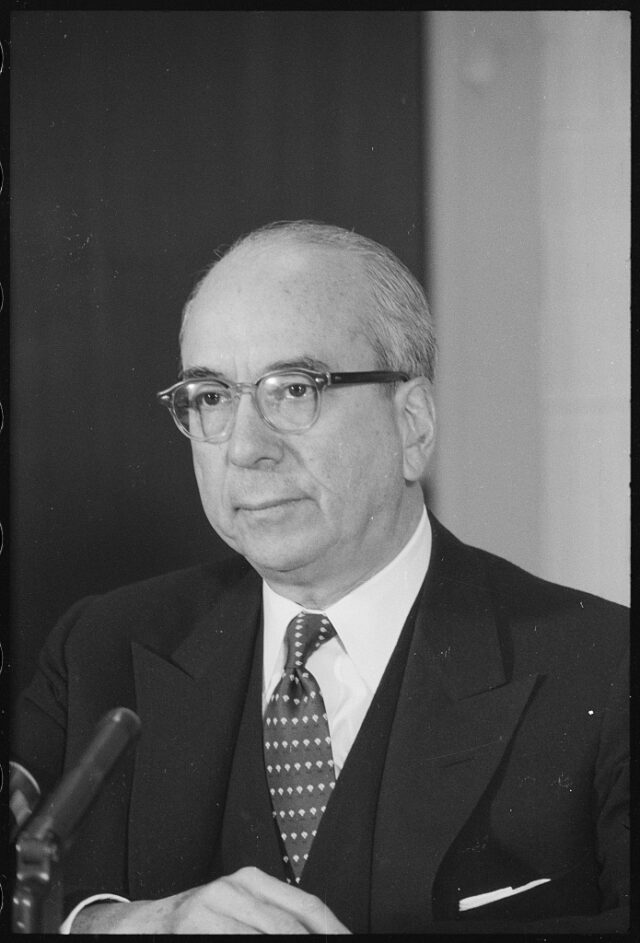
Lewis Strauss
Lewis Strauss during his tenure as the chairman of the Atomic Energy Commission (AEC).
Source: Library of Congress

Oppenheimer and his family and friends sent money through the robust international organization of the Communist Party. Nolan shows Oppenheimer as politically naive but stubbornly loyal to his communist girlfriend Jean (Florence Pugh) and fellow-traveling best friend Chevalier (Jefferson Hall). He also shows Oppenheimer’s support for unionizing and integrating academia, two supposed vectors for communist infiltration.

Nolan details how Oppenheimer’s politics made him a difficult pick to keep the U.S. military’s highest secret. Matt Damon’s character, General Leslie Groves, is a show-stealer as a buttoned-up, blunt-talking Pentagon man — the Pentagon man, since he was the one who built it — who forms a surprisingly close relationship with the Bhagavad Gita-quoting egghead he chooses for the job. Casey Affleck appears in one indelible scene as a hardened anti-communist who sees through Oppenheimer’s prevarications about his past. Nolan also shows how Oppenheimer and the scientists he recruited, a team that included a number of left-leaning academics and Jewish scientists, reacted to the realization that the atomic bombs would fall not on the Germans whose bomb program they’d been racing, but on a largely defeated Japan. Though the movie chooses not to show Japan at all, a scene in which Oppenheimer visualizes his Los Alamos team with Hiroshima- and Nagasaki-style burns is one of the film’s most powerful moments.

Oppenheimer dodges a real discussion of the surrender of Japan, about which whole movies have been devoted (see, for example, Japan’s Longest Day by Kihachi Okamoto). It mentions the Potsdam Conference, where Truman (Gary Oldman, in another instance of too much makeup) received Groves’s news about the successful Trinity Test, but viewers must read on their own about the conference’s significance for Japan’s surrender planning. He shows Byrnes (Pat Skipper), Truman’s Secretary of State and “Assistant President,” but conveys nothing about how the bomb changed Byrnes’ and, therefore, Truman’s thinking about the Soviet role vis a vis Japan. Relevant but outside the film’s scope are discussions about nuclear science in postwar Japan and the long shadow Hiroshima and Nagasaki cast over Japanese politics and art. These are directions the movie could have gone, but for Nolan the atomic bomb is not about Japan.

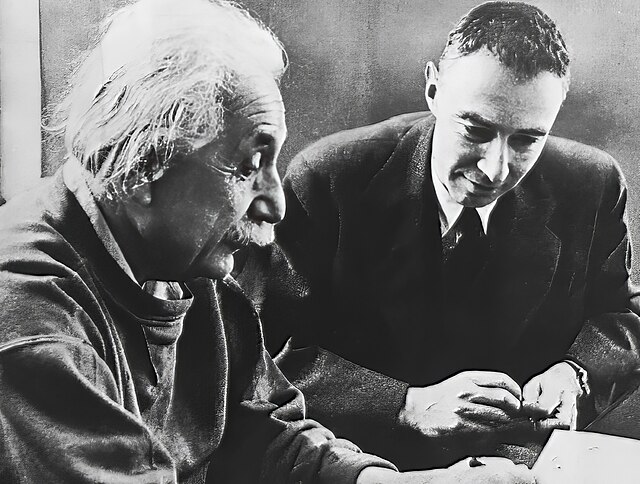
By the same token, the people who made the bomb are not defined by it. Oppenheimer emerges from the movie as an intellectual on par with the likes of Albert Einstein (Tom Conti) and Niels Bohr (Kenneth Branagh). He butts heads, always with the greatest professional respect, with Enrico Fermi, Edward Teller, Ernest Lawrence, and Werner Heisenberg, all brilliantly cast and sharply written. They all feel as though they could star in their own movies with the bomb as a mere footnote. The birth of nuclear weapons, it seems, was an almost accidental consequence of their combined genius. Their governments weaponized them, Nolan’s film tells us, and most of them had the good grace to feel uneasy about it.

Albert Einstein and Robert Oppenheimer.
Albert Einstein and Robert Oppenheimer. Source: Wikimedia Commons

Nolan’s is not a reductive kind of hero worship; these (almost) household-name scientists do, amazingly, feel like real people, and none are more flawed than Oppenheimer himself. The research that Nolan did to get these men right is obvious, and his Oppenheimer, like the real one, says that he feels blood on his hands and anxiety about the planet’s future. Yet equally obvious is the fact that Nolan sees the bomb-builders as visionaries, and if they felt they had no choice but to beat Hitler to the bomb, if they declined to take responsibility for what happened in Japan, then Nolan will go no further down those roads than they. What happened happened, now on to the Cold War.

Oppenheimer is Nolan’s second visit to World War II after 2017’s Dunkirk, and hopefully, it will not be his last. His understanding of the era — its mindsets, its cadences — is remarkable, and his handling of very big and very different personalities within the era is impressive. The film is his best-looking to date. There are beats that don’t work and paths not taken that deserved a closer look, but complex themes come through clearly and speak well of Nolan’s skills as a historian. Oppenheimer‘s success with audiences is a good thing well deserved.

But don’t miss Barbie, either.


David A. Conrad received his Ph.D. from UT Austin in 2016 and published his first book, Akira Kurosawa and Modern Japan, in 2022. He is currently working on a second book, which will also focus on postwar Japan. David lived in Japan’s Miyagi prefecture for three years and can’t wait to go back to his home away from home.

The views and opinions expressed in this article or video are those of the individual author(s) or presenter(s) and do not necessarily reflect the policy or views of the editors at Not Even Past, the UT Department of History, the University of Texas at Austin, or the UT System Board of Regents. Not Even Past is an online public history magazine rather than a peer-reviewed academic journal. While we make efforts to ensure that factual information in articles was obtained from reliable sources, Not Even Past is not responsible for any errors or omissions.

“Free Walter Collins!”: Black Draft Resistance and Prisoner Defense Campaigns during the Vietnam War

banner image for “Free Walter Collins!”: Black Draft Resistance and Prisoner Defense Campaigns during the Vietnam War

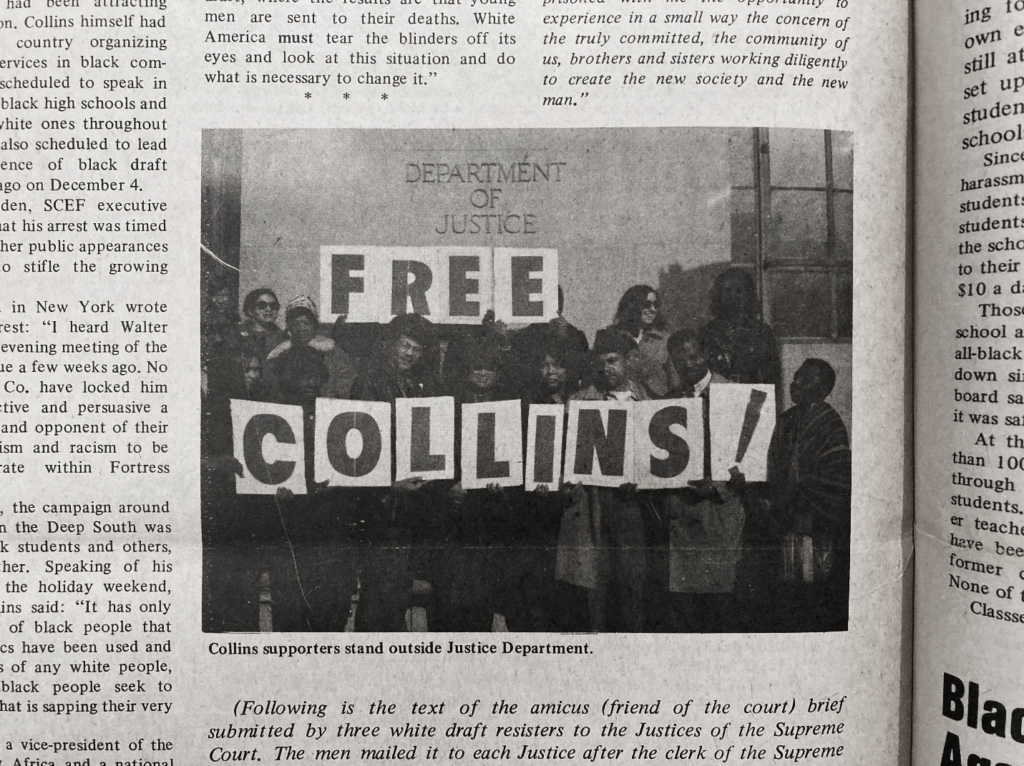
On December 10th, 1970, Dara Abubakari led a delegation of activists to Washington, D. C., where they visited the Department of Justice, the Selective Service headquarters, and the White House.[1] Activists representing a range of civil rights, Black nationalist, and anti-war organizations, including the Southern Christian Leadership Conference (SCLC), the Republic of New Africa (RNA), and the National Association of Black Students (NABS), participated in the December demonstration. Outside the Department of Justice, one group posed for a photo with signs, which read “Free Collins!” The delegation appeared on behalf of Abubakari’s son, Walter Collins, who had been imprisoned a few weeks earlier. Convicted of refusing induction into the U.S. military based on his opposition to the Vietnam War, Collins was facing five years in prison, even after numerous appeals. With few remaining avenues available for challenging Collins’ sentence in court, his supporters presented their case to individual government officials, and the broader public, in hopes of arousing concern.

A December 1970 photograph of pro-Collins demonstrators outside the Justice Department's headquarters in Washington, D. C.
A December 1970 photograph of pro-Collins demonstrators outside the Justice Department’s headquarters in Washington, D. C. Image courtesy of the author.

Collins’ legal predicament was not unique. Hundreds of thousands of Americans avoided compulsory military service during the Vietnam War by filing exemptions as conscientious objectors, seeking medical deferments, leaving the country, or simply failing to report for induction—practices broadly categorized as draft evasion or resistance. Of those who refused induction or committed other draft violations, around 9,000 were convicted, and over 3,000 were imprisoned.[2] However, Collins’ legal case and the popular movement that developed around it offer particularly vivid examples of political repression and collective resistance during the Vietnam War era.

Between his sentencing in 1969 and his release from prison in 1972, Collins, his legal team, and his supporters worked tirelessly to appeal his sentence, publicize his case, and mobilize people on behalf of other draft resisters and political prisoners. They petitioned the U.S. Supreme Court, organized public demonstrations, and distributed literature across the country and abroad. Instead of stifling resistance, Collins’ imprisonment actually spurred the development of new campaigns and organizations tailored to advocate for Black political prisoners.

Campaigns around the cases of Black draft resisters like Collins also reveal the particular ways in which civil rights activists engaged in anti-war organizing. Collins’ supporters constructed a large and diverse coalition, and in the process, they developed a critique of the draft as a weapon against movements for social and racial justice. Their campaign blurred the line between foreign policy and domestic politics, revealing how thoughtfully Black civil rights activists situated themselves on the world stage during the 1960s and 70s.

From Civil Rights to Draft Resistance

Walter Collins was born and raised in New Orleans, Louisiana. His family had a long history of involvement in the Southern Black Freedom Struggle. His maternal grandparents, Arthur and Izama Young, were active in the fight to abolish the poll tax, and they helped establish a school system for Black students in Plaquemines Parish, Louisiana. They belonged to the National Association for the Advancement of Colored People (NAACP), one of the nation’s earliest civil rights organizations, and the Universal Negro Improvement Association (UNIA), a group founded by Marcus Garvey on a platform of racial pride and economic self-sufficiency.[3] These groups offered the Youngs and other African American families important organizational structures for challenging discrimination in employment, voting, and education.

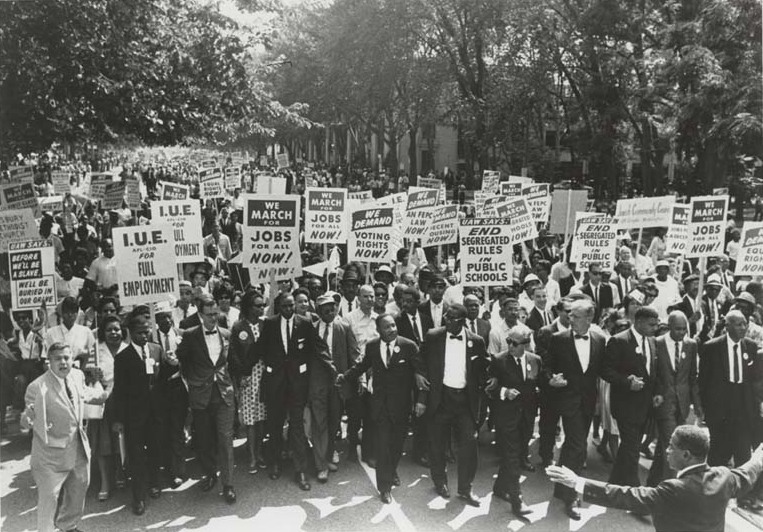
Civil rights organizers leading a column of participants in 1963's March on Washington.
Civil rights organizers leading a column of participants in 1963’s March on Washington up Constitution Avenue in Washington, D. C. Martin Luther King, Jr. is situated in the middle of the first row of marchers. Source: Wikimedia Commons.

Collins’ mother, born Virginia Young, followed in her parent’s footsteps. She engaged in activism surrounding voting rights, reparations, and police violence, and she participated in landmark events, like the March on Washington in 1963. She held leadership positions in organizations including the Southern Conference Educational Fund (SCEF), an interracial civil rights group, and the Universal Association of Ethiopian Women (UAEW), a Pan-African organization founded by Audley “Queen Mother” Moore. During the late 1960s, she became a regional vice president of the Republic of New Africa (RNA), a Black nationalist organization, and she adopted the name Dara Abubakari around this time.[4]

Walter Collins’ career as an activist began in the early 1960s, when he participated in the New Orleans sit-in movement as a high school student. During the following years, he attended Louisiana State University in New Orleans and worked with groups like SCEF and the Student Nonviolent Coordinating Committee (SNCC) to organize communities across the Deep South around issues including voting rights, working conditions, and public education. At the time of his arrest, Collins was active in SCEF’s Grass Roots Organizing Work (GROW) project in Laurel, Mississippi, where he and his colleagues provided support to a local woodcutter’s union.[5]

Over the course of the 1960s, as the Vietnam War escalated, Collins became more deeply involved in anti-war activism. In this respect, he was not unique. While the popular imagery of the 1960s and 1970s anti-war movement typically centers on white students, activists involved in civil rights and Black Power organizing were among the most vocal critics of the war. Many viewed American intervention in Vietnam as an imperialist project, and they objected to the enormous financial cost of the war, which undercut domestic programs. The draft also became a major issue, as Black men were overrepresented as draftees and among wartime casualties.[6] Leading civil rights organizations and activists issued statements and delivered speeches condemning the war.[7]

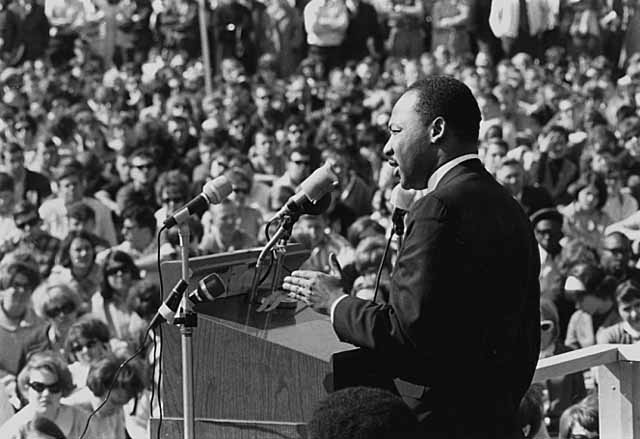
In April 1967, for instance, Martin Luther King Jr. deplored American militarism in a powerful speech entitled “Beyond Vietnam.” Speaking at Riverside Church in New York City, King directed criticism toward the draft, which took “black young men who had been crippled by our society and [sent] them eight thousand miles away to guarantee liberties in Southeast Asia which they had not found in southwest Georgia and East Harlem.”[8] Sharing many of these concerns, Collins joined the Central Committee for Conscientious Objectors (CCCO). He also began providing informal draft counseling to Black students in New Orleans, quickly gaining a reputation for his knowledge on the subject.[9]

Martin Luther King, Jr. speaking at an April 1967 rally against the Vietnam War on the campus of the University of Minnesota in Minneapolis
Martin Luther King, Jr. speaking at an April 1967 rally against the Vietnam War on the campus of the University of Minnesota in Minneapolis. Source: Wikimedia Commons/Minnesota Historical Society. Image reproduced under the terms of Creative Commons’ Attribution-Share Alike 2.0 Generic License.

Black women like Dara Abubakari also played critical roles in anti-war and anti-draft organizing. They published news articles, created and distributed literature, and established organizations, including the National Black Anti-War Anti-Draft Union (NBAWADU). Some of these women framed their activism in gendered terms and relied on their positions as wives or mothers to claim authority on the subject.[10] Gwendolyn Patton, a NBAWADU founder and SNCC member, laid out this logic in an article published in 1968. She wrote: “If there has ever been a time when we want to know what we can do for the revolution, we can begin now by not allowing this system to draft our sons, our loved ones, our men.”[11] Abubakari consistently used her position as the mother to spark conversations about the war with other women and to advocate on behalf of Collins and other draft resisters.

The Draft as Political Repression

In January 1967, Draft Board 156 in New Orleans reclassified Collins as 1-A, meaning that he was eligible for military service. When he initially registered with the Selective Service System in 1963, Collins received a student deferment. He supplied the required material to confirm his status as a full-time student between 1964 and 1966, but failed to provide this evidence in January 1967, leading to his reclassification. Over the next three years, Collins’ conflict with the draft board intensified. In August 1967, they attempted to send him an induction notice, but it was delivered to the wrong address. After receiving the second notice in September, and learning that he no longer had a student deferment, Collins tried to register as a conscientious objector. While draft officials supplied the required paperwork, they informed him that it was too late to submit it because he had already received an induction notice. Between September and the following March, Collins received four additional notices and failed to report for induction each time. On two occasions, he actually appeared at the induction center, but officials turned him away for wearing an anti-war pin and carrying anti-war literature.[12]

While Collins’ student deferment may have legitimately expired, many of his SCEF colleagues believed his civil rights and anti-war activism had factored into the draft board’s decision. As SCEF Executive Director Anne Braden recounted, Collins’ “trouble with the draft started in the fall of 1966, just after he [had] spent the summer organizing opposition to the Vietnam War in New Orleans.”[13] Many civil rights and anti-war groups experienced heightened government surveillance and repression during the 1960s. Through initiatives like the Federal Bureau of Investigation’s (FBI) Counterintelligence Program (COINTELPRO) and the Central Intelligence Agency’s (CIA) Operation CHAOS, government officials illegally surveilled, infiltrated, and discredited civil rights, Black Power, and anti-war organizations. For activists like Collins, it seemed that draft boards were performing a similar function. Numerous activists associated with groups like SCEF and SNCC were drafted during this period. In June of 1967, for instance, SNCC reported that seventeen members had already been indicted for draft resistance.[14] Others were arrested for holding anti-war demonstrations at induction centers.[15] Within this context, Collins’ supporters understood his being drafted as a form of political repression. They viewed him as a draft resister and a political prisoner.

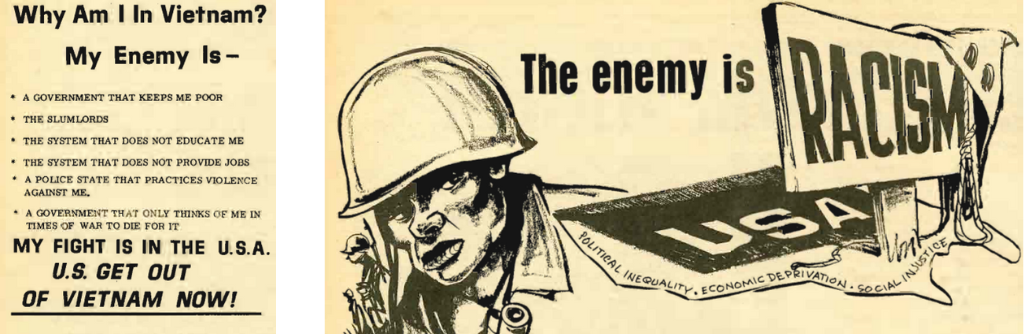
"The enemy is racism": two graphics combining antiwar and pro-civil rights messaging.
“The enemy is racism”: two graphics combining antiwar and pro-civil rights messaging.
Source: Flo Kennedy, “Harlem Against the War,” The Movement 3, no. 5 (May 1967).

On June 18, 1968, Collins was indicted on six counts of refusing induction. His case came before the U.S. District Court for the Eastern District of Louisiana in July 1969, and the jury found him guilty of five counts of draft evasion. Judge Edward Boyle sentenced Collins to five years for each count—to be served concurrently—and issued a fine of $2,000.[16] Following his sentencing, Collins and his legal team brought the case before the Fifth U.S. Court of Appeals in New Orleans. They focused their case on two key issues. First, the composition of Draft Board 156 violated Section 10(b)(3) of the Selective Service Act. Four of the board’s five members were not residents of the area that it covered, and the chair was not even a resident of Orleans Parish. Other draft resisters had successfully appealed their sentences on this basis. Second, Collins and his attorneys took the argument further by claiming that, regardless of residency, the all-white draft board could not be representative of the majority Black population that it covered. This was a major issue across the country and particularly in the South. In Louisiana, along with a handful of other Southern states, there were no Black members serving on draft boards as of 1966.[17] Despite these efforts, however, Collins’ appeal was unsuccessful.

After the Fifth U.S. Court of Appeals refused to overturn Collins’ sentence in April 1970, his attorneys turned to the U.S. Supreme Court. They filed three petitions in August, November, and December of 1970, but the court ultimately declined to hear the case. Authorities arrested Collins in his home in New Orleans in November 1970 and placed him in Parish Prison.[18] There, he awaited transfer to the federal prison in Texarkana, Texas.

“Free Walter Collins and All Political Prisoners!”

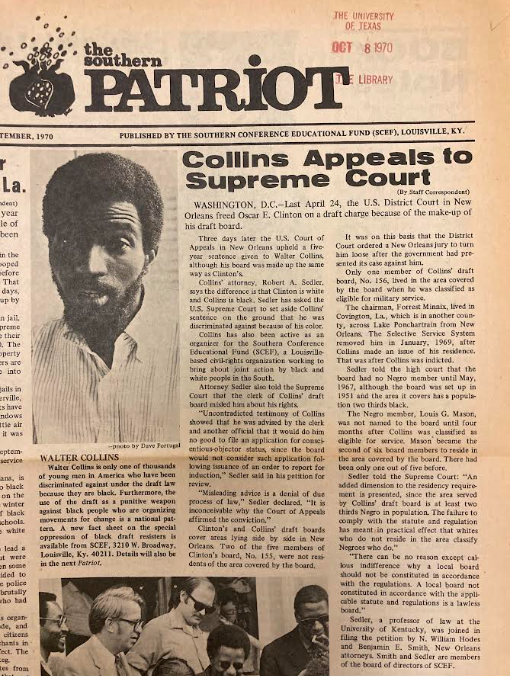
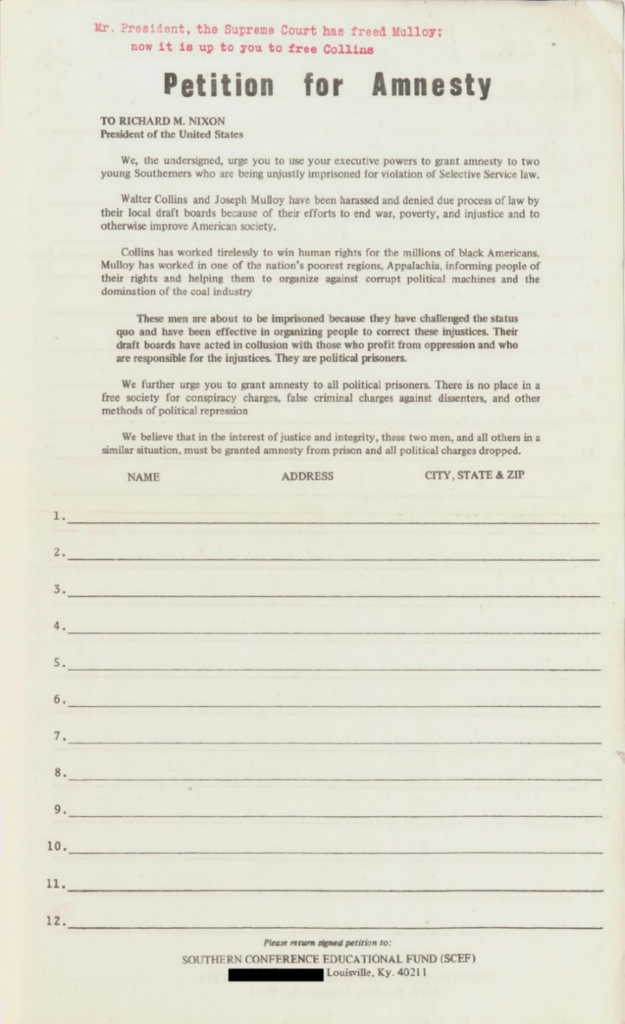
Although Collins’ appeals failed, his supporters continued advocating on his behalf. They circulated petitions, published articles, and organized demonstrations to publicize his case. Drawing from prior experience organizing defense campaigns, Abubakari worked with colleagues in SCEF and other groups to spearhead a popular campaign on Collins’ behalf. In addition to financially supporting his legal defense, SCEF coordinated a publicity campaign around the case in hopes that public protest would pressure officials to reverse his sentence. Articles about Collins frequently appeared in the group’s monthly publication, the Southern Patriot, and in its news briefs. The organization also distributed fliers with information about his case. One flier from 1970 titled “An Enemy of the People” characterized the draft as “a weapon to jail young men who are active in movements against social injustice.”[19] The author urged readers to actively support Collins and other political prisoners by writing to Judge Boyle and contributing funds to the legal defense. SCEF also circulated petitions that accumulated almost 20,000 signatures.[20]

An article about Collins published by the Southern Patriot, the official publication of the Southern Conference Educational Fund (SCEF), in October 1970
An article about Collins published by the Southern Patriot, the official publication of the Southern Conference Educational Fund (SCEF), in October 1970.
Image courtesy of the author.

While SCEF provided an important base for organizing on behalf of Collins, Abubakari also worked to create a more permanent organization dedicated solely to defending Black draft resisters. On the weekend of March 5, 1971, just a few months after the December demonstrations in Washington, D.C., Abubakari and other delegates reconvened in the national capitol. They congregated at the NABS headquarters and founded the International Committee for Black Resisters (ICBR). The founding members, who included notable activists like Ella Baker and Queen Mother Moore, laid out the following program:

  1. International support for Black resisters and political prisoners;
  2. Opposition to apprehension of Black men into the military or into jail for refusing the military;
  3. Research and communications on the international level about the cases of Black resisters and political prisoners;
  4. An international Legal Resistance Network;
  5. Black draft counseling and programmatic planning for high school students;
  6. “Free Walter Collins” campaign.[21]

In Abubakari’s words, the ICBR aimed to “internationalize the struggle for Black draft resisters and to generate international and national support for their release.”[22] As her statement suggests, ICBR members not only worked to free Collins but also supported larger campaigns to provide amnesty to all Black draft resisters. Collins’ supporters also looked to international forums to publicize the case, and they distributed petitions abroad through organizations like Amnesty International. They understood their project as global in scope and explicitly sought international support for U.S. political prisoners. Although there are few traces of ICBR activities in the historical record after this founding meeting, the group’s platform, and their particular emphasis on the status of Black draft resisters, represented an important intervention within the anti-war movement.

Following the meeting, Abubakari embarked on a cross-country tour with Carl Braden, a longtime civil rights activist and SCEF director. They visited college campuses, churches, and community centers in over forty states to publicize Collins’ case. Abubakari delivered speeches in cities across the United States, including New York, Chicago, Louisville, Austin, and Los Angeles.[23] When asked about her upcoming plans in November 1971, Abubakari emphasized her determination to free her son. She responded, “I’ll finish a whole year of touring and if Walter’s not out of prison by then, I’ll start all over again.”[24]

One of the petitions circulated by the SCEF during its campaign to free Walter Collins.
Image courtesy of the Georgia State University Library’s Special Collections Division.

While Abubakari mobilized activists across the country on his behalf, Collins translated his organizing skills to a new context—the federal prison in Texarkana, Texas. While imprisoned, Collins allied himself with fellow inmates to protest mail censorship, corporal punishment, and the lack of adequate medical care in the facility. Firsthand experience with long-term incarceration not only solidified his understanding of his predicament as political repression, but it also brought him face-to-face with the issues that incarcerated people across the nation—from San Quentin to Attica—raised through legal suits, popular protests, and uprisings. During the spring of 1972, Collins became involved in a hunger strike and work stoppage at Texarkana.[25] Although the strike lasted less than a week, newspaper reports reveal that almost five-hundred men participated in the protest. They compiled a list of grievances addressed to Warden Connett and elected a group, which included Collins, to serve as a negotiating team. In response, prison authorities transferred many of the leaders to other facilities and temporarily placed Collins in solitary confinement.

During the fall of 1972, Collins’ parole board recommended an early supervised-release based on “good time” he had accrued while incarcerated. Although Warden L. M. Connett initially refused to free Collins, based on his participation in the strike earlier that year, he eventually complied due to public pressure. After spending two years in prison, Collins was paroled in December 1972.[26] He joined his SCEF colleagues in extending his gratitude to supporters: “Protests from across the nation and around the world helped the warden to change his mind about keeping Collins in prison for an extra five months and voiding his chances of parole. . . . Walter Collins joins the board and staff of SCEF and the editors of The Southern Patriot in thanking all of those who supported him and his fellow prisoners while he was at Texarkana.”[27]

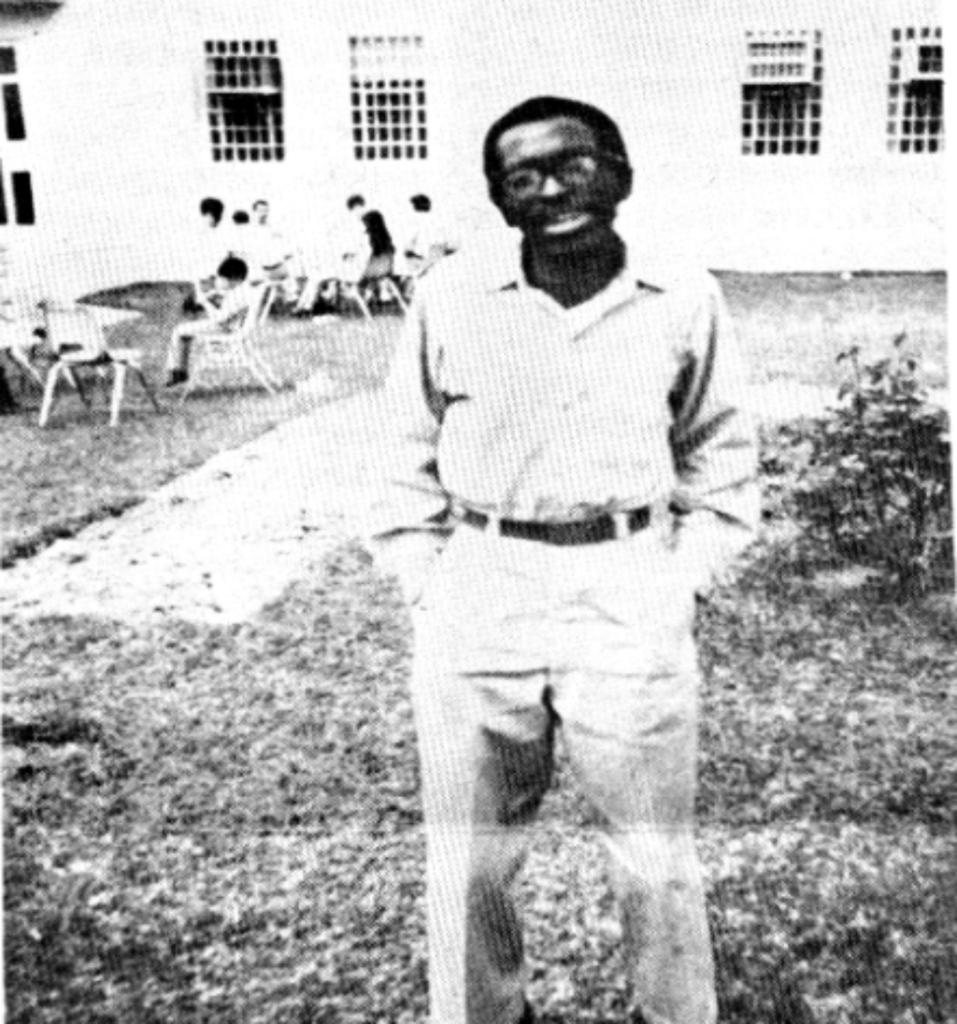
Walter Collins imprisoned at the federal penitentiary in Texarkana, Texas after his conviction for refusing induction
Walter Collins imprisoned at the federal penitentiary in Texarkana, Texas after his conviction for refusing induction.
Image courtesy of the author.

Following his release, Collins remained active in campaigns to free draft resisters and other political prisoners. In 1977, President Jimmy Carter granted full pardons to any person who had violated the Selective Service Act between 1964 and 1973. Collins went on to serve as an Executive Director of SCEF and a coordinator for the National Moratorium on Prison Construction in Atlanta, Georgia. During the late 1980s, he returned to New Orleans, and in 1995, at the age of fifty, he passed away after being diagnosed with cancer.[28]

Conclusion

Walter Collins was one of many political prisoners whose legal cases captured national attention and inspired widespread protest during the 1960s and 1970s. Although the individuals and organizations involved in this campaign did not achieve all of their goals—Collins’ eventual release was based on procedure rather than a landmark court case and the ICBR seems to have had only a brief existence—they were able to construct coalitions and develop strategies that could be used in future organizing. Both Abubakari and Collins continued to participate in campaigns to free draft resisters and political prisoners, and they shared the skills they developed with other activists. They led workshops on movement building, spoke at demonstrations, and provided organizational support for other campaigns.

Studying defense campaigns allows historians and community organizers to think more expansively about social movements and their relative success. Defense campaigns were not only logistical solutions to political repression but also represented important sites where participants articulated larger ideas about freedom and justice. Collins’ supporters did not only object to the drafting of conscientious objectors, but to the draft and the war more generally. They understood all draft resisters, and particularly Black draft resisters, as political prisoners, and they used the campaign to free Walter Collins as a space to organize around these issues. By engaging seriously with the ideas that activists involved in defense campaigns put forward and exploring the various strategies that they developed, we can think more critically about their impact over time, while also identifying tools that might be useful in present struggles for racial and social justice.


[1] “Widespread Support Builds For Black Draft Resisters,” Southern Patriot 28, no. 10 (December 1970): 8; Fred Shuttlesworth and Carl Braden to SCEF Board, Advisory Committee and Staff, November 18th, 1970, Anne and Carl Braden Papers, Box 76, Folder 2, Wisconsin Historical Society; “News from Southern Conference Educational (SCEF),” December 11th, 1970, GI Press Collection, 1964-1977, Wisconsin Historical Society, https://content.wisconsinhistory.org/digital/collection/p15932coll8/id/25229.

[2] David Cortright, Peace: A History of Movements and Ideas (Cambridge, UK: Cambridge University Press, 2008), 165.

[3] Ashley Farmer, “Mothers of Pan-Africanism: Audley Moore and Dara Abubakari,” Women, Gender, and Families of Color 4, no. 2 (Fall 2016): 276, 286.

[4] “SCEF Blasts Hoover On ‘Justice’ Remark,” Chicago Daily Defender, November 27th, 1968, 10; “Orleanian Named VP of Republic of New Africa,” Louisiana Weekly, April 19th, 1969, 1; “Women taking deeper look at cause of war,” Daily World, July 19th, 1969, 10; “Republic New Africa’s New Executive Council,” New York Amsterdam News, April 25th, 1970, 3; “Mrs. Collins Is Delegate To Women’s Congress,” Louisiana Weekly, July 25th, 1970, 2; Ashley Farmer, “Reframing African American Women’s Grassroots Organizing: Audley Moore and the Universal Association of Ethiopian Women, 1957-1963,” Journal of African American History 101, no 1-2 (Winter/Spring 2016): 87-89.

[5] “SCEF Worker Convicted For Refusing Draft,” Southern Patriot 27, no. 7 (September 1969): 4; “Cancel Summer Vacations For Ballot Fight,” Louisiana Weekly, June 22nd, 1963, 1; Bob Zellner, “Report, Evaluation, and Proposals for the Future,” November 13th, 1970, Civil Rights Vertical Files, Box 159-13, Folder 11, Moorland-Spingarn Research Center, Howard University; Walter Collins, interview by Kim Lacy Rogers, Part 6, May 20th, 1979, Box 4, Side 2, Kim Lacy Rogers Civil Rights Oral History Collection, Tulane University, New Orleans, Louisiana, https://digitallibrary.tulane.edu/islandora/object/tulane%3A83107; Kim Lacy Rogers, Righteous Lives: Narratives of the New Orleans Civil Rights Movement (New York: NYU Press, 1993), 20.

[6] Office of Deputy Assistant Secretary of Defense, “Negroes and the War in South-East Asia,” Anne and Carl Braden Papers, Box 76, Folder 2, Wisconsin Historical Society.

[7] See, for instance: Mississippi Freedom Democratic Party, “MFDP and Viet Nam,” July 31st, 1965, https://www.crmvet.org/docs/pr/650731_mfdp_pr_vietnam.pdf; Student Nonviolent Coordinating Committee, “Statement on Vietnam,” January 6th, 1966, https://www.crmvet.org/docs/snccviet.htm; Student Nonviolent Coordinating Committee, “Report on Draft Program,” 1966, https://www.crmvet.org/docs/6608_sncc_draft-resist.pdf; Diane Nash Bevel, “Journey to North Vietnam,” Freedomways 7, no. 2 (Spring 1967): 118-128, https://www.crmvet.org/info/67_nash_vietnam.pdf; Flo Kennedy, “Harlem Against the Draft,” The Movement 3, no. 5 (May 1967): https://www.crmvet.org/docs/mvmt/6705mvmt.pdf; Huey P. Newton, “Message on the Peace Movement [1969],” in The Black Panthers Speak, ed. Philip S. Foner (Cambridge, MA: Da Capo Press, 1995), 67-70.

[8] Martin Luther King Jr., “Beyond Vietnam—A Time to Break Silence,” April 4th, 1967, https://www.americanrhetoric.com/speeches/mlkatimetobreaksilence.htm. King’s longtime associate Vincent Harding wrote the original draft of this speech.

[9] “On the Military: Interview with Walter Collins,” Southern Exposure 1, no. 1 (Spring 1973): 6; “SUNO Students To Strike If 10 Demands Are Not Met,” Louisiana Weekly, April 12th, 1969, 1, 7; Marcus S. Cox, “‘Keep Our Black Warriors Out of the Draft’: The Vietnam Antiwar Movement at Southern University, 1968-1973,” Educational Foundations (Winter/Spring 2006): 123-144, https://files.eric.ed.gov/fulltext/EJ751764.pdf.

[10] Ashley Farmer, “’Heed the Call!’ Black Women, Anti-Imperialism, and Black Anti-War Activism,” Black Perspectives, August 3rd, 2016, https://www.aaihs.org/heed-the-call-black-women-anti-imperialism-and-black-anti-war-activism/; Rhonda Y. Williams, Concrete Demands: The Search for Black Power in the 20th Century (New York: Taylor & Francis, 2014), 143-146; Lauren Mottle, “‘We Resist on the Grounds We Aren’t Citizens’: Black Draft Resistance in the Vietnam War Era,” Journal of Civil and Human Rights 6, no. 2 (Fall/Winter 2020): 26-52.

[11] Gwen Patton, “Black Militants and the War,” Student Mobilizer, January 1, 1968, GI Press Collection, 1964-1977, Wisconsin Historical Society, https://content.wisconsinhistory.org/digital/collection/p15932coll8/id/34169.

[12] United States v. Collins, 426 F.2d 765 (5th Cir. 1970).

[13] Annie Braden, “Southern Group Launches Campaign,” Baltimore Afro-American, October 11th, 1969, 18.

[14] “New SNCC Leaders Outline Their Plans,” Southern Patriot 25, no. 6 (June 1967): 1, 6; “Fred Brooks Refuses Draft,” Southern Patriot 25, no. 11 (December 1967): 4; “‘You Can’t Do This To Me’: Draft Evader Gets 5 Years,” Miami Herald, April 28, 1968, 22-A; “Black Draft Resisters: Does Anybody Care? A Fact Sheet,” undated, Anne and Carl Braden Papers, Box 76, Folder 2, Wisconsin Historical Society.

[15] “SNCC Workers Indicted,” The Movement 3, no. 5 (Spring 1967): 4.

[16] United States v. Collins, 426 F.2d 765 (5th Cir. 1970); “Orleans Man Indicted On Draft Charges,” Shreveport Journal, June 19th, 1968, 12; “Louisiana Man Indicted On Draft Charges,” Daily Advertiser, June 19, 1968, 12; “Collins Is Free On Bond Pending Appeal of Term,” Shreveport Journal, July 10th, 1969, 20; “Sentenced To 5 Years In Draft Case,” Louisiana Weekly, July 19th, 1969, 1; “Jail Black Activist As A Draft Evader,” Michigan Chronicle, July 26th, 1969, 15.

[17] United States v. Collins, 426 F.2d 765 (5th Cir. 1970); “‘Bias’ Charged In New Orleans Draft Case,” Chicago Daily Defender, August 8th, 1970, 20; “US Argues against Collins Appeal,” Southern Patriot 28, no. 9 (November 1970): 5; News Release, Office of Public Information, Selective Service System, December 16th, 1970, Anne and Carl Braden Papers, Box 76, Folder 2, Wisconsin Historical Society, 6.

[18] United States v. Collins, 426 F.2d 765 (5th Cir. 1970); Walter Collins v. U.S., 400 U.S. 919 (1970); “Court Upholds Charges Against Walter Collins,” Louisiana Weekly, May 9th, 1970, 9; “Court Rejects Challenge Of Draft Board Alignment,” Town Talk, November 16th, 1970, 4; “Judge Boyle Refuses To Cut Draft Resister’s Term,” Louisiana Weekly, February 27th, 1971, 5; “Nab La. Activist on draft dodge rap,” Chicago Daily Defender, December 1st, 1970, 4; “24-year-old draft activist arrested to serve 5 years,” Baltimore Afro-American, December 12th, 1970, 16.

[19] Southern Conference Educational Fund, “An Enemy of the People,” GI Press Collection, 1964-1977, Wisconsin Historical Society, https://content.wisconsinhistory.org/digital/collection/p15932coll8/id/61302/rec/148.

[20] Southern Conference Educational Fund Revenue and Expense Operating Fund, June 30th, 1970, Civil Rights Vertical Files, Box 159-13, Folder 11, Moorland-Spingarn Research Center, Howard University; Southern Conference Educational Fund, “An Enemy of the People,” GI Press Collection, 1964-1977, Wisconsin Historical Society, https://content.wisconsinhistory.org/digital/collection/p15932coll8/id/61302/rec/148; “20,000 petition Nixon for black,” Chicago Defender, February 17th, 1971, 27.

[21] “International Black Draft Resisters Committee Formed in Washington,” Sun Reporter, March 20th, 1971, 13; “Draft Resisters Group Formed,” Los Angeles Sentinel, March 25th, 1971, A2; “Draft Resisters Organize in Washington,” Sacramento Observer, March 25th, 1971, C10; “Group organized to aid black draft dodgers,” Chicago Daily Defender, April 10th, 1971, 14.

[22] “International Black Draft Resisters Committee Formed in Washington,” Sun Reporter, March 20th, 1971, 13.

[23] “Lawman Guest Speaker,” New York Amsterdam News, April 17th, 1971, 28; “Freedom for draft resisters,” Chicago Daily Defender, October 23rd, 1971, 18; “Foe of draft to speak,” Courier-Journal, May 16th, 1971, 24; “Interracial Officials Due at UT,” Austin Statesman, June 14th, 1971, 8; “Prisoner’s Mother Guests,” Los Angeles Sentinel, November 11th, 1971, B6.

[24] Jean Murphy, “Lifelong Battler in Struggle to Free Jailed Draft Resisters,” Los Angeles Times, November 14th, 1971, D3.

[25] “Inmates End Strike At Texarkana Prison,” Corpus Christi Times, April 12th, 1972, 11; “Men Strike in Texarkana,” Southern Patriot 30, no. 5 (April 1972): 6; “News from the Southern Conference Educational Fund (SCEF),” May 10th, 1972, 1; “Collins Letters on Revolt,” Southern Patriot 30, no. 5 (May 1972): 6; “Federal Prisoners Protest,” San Antonio Register, July 7th, 1971, 7.

[26] “Walter Collins’ Parole in Doubt,” Southern Patriot 30, no. 8 (October 1972): 8; “Collins Wins Release,” Southern Patriot 30, no. 9 (November 1972): 8; “Draft Resister Freed One Month Late,” New Pittsburgh Courier, January 6th, 1973, 22.

[27] “Collins Wins Release,” Southern Patriot 30, no. 9 (November 1972): 8.

[28] “New executive director of SCEF is named,” Courier-Journal, December 12th, 1973, 12; ; “Statement of Walter J. Collins, Coordinator, National Moratorium on Prison Construction,” in Hearing Before a Subcommittee of the Committee on Government Operations, House of Representatives (Washington, D.C.: U. S. Government Printing Office, 1983), 125, https://www.ojp.gov/pdffiles1/Digitization/88401NCJRS.pdf; Jeanne Friedman, “Fallen Comrades: Walter Collins,” http://www.vvaw.org/veteran/article/?id=305.

The views and opinions expressed in this article or video are those of the individual author(s) or presenter(s) and do not necessarily reflect the policy or views of the editors at Not Even Past, the UT Department of History, the University of Texas at Austin, or the UT System Board of Regents. Not Even Past is an online public history magazine rather than a peer-reviewed academic journal. While we make efforts to ensure that factual information in articles was obtained from reliable sources, Not Even Past is not responsible for any errors or omissions.

« Previous Page
Next Page »

Recent Posts

  • NEP Author Spotlight – Aidan Dresang
  • Lesson Plans: The Vietnam War and American Society
  • Lesson Plans: Protest and Social Unrest
  • Lesson Plans: Radio and Communications Technology
  • The Long-Lasting and Perpetuating Effects of Lynching Postcards and Photography
NOT EVEN PAST is produced by

The Department of History

The University of Texas at Austin

We are supported by the College of Liberal Arts
And our Readers

Donate
Contact

All content © 2010-present NOT EVEN PAST and the authors, unless otherwise noted

Sign up to receive our MONTHLY NEWSLETTER

  • New
  • Features
  • Reviews
  • Texas
  • Teaching
  • Digital
  • Watch & Listen
  • Authors
  • About