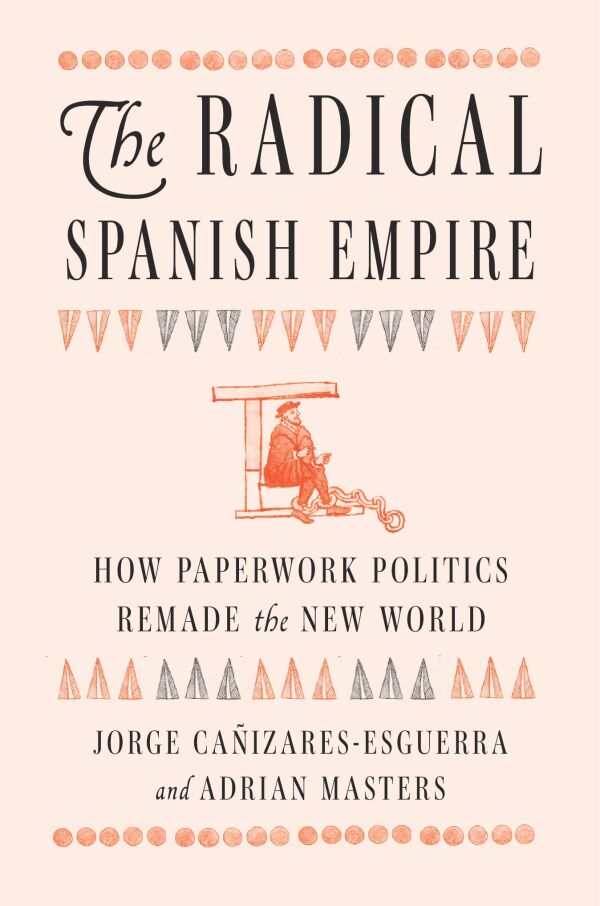
This special roundtable brings together four distinguished scholars to examine the arguments advanced in Jorge Cañizares-Esguerra and Adrian Masters’ recent publication The Radical Spanish Empire: How Paperwork Politics Remade the New World (Harvard University Press, 2026). Drawing on research conducted across 26 archives and tens of thousands of documents, the book offers a new interpretation of the Spanish conquest and the formation of the early colonial state in the Americas.
Rather than offering conventional book reviews, the essays that follow engage with the book from the perspective of each contributor’s own research and expertise, and are intended to be read in conversation with one another. Together, they explore the book’s implications for the histories of empire, law, political thought, race, and archival practice.
As Spanish conquistadors swept through the New World, the Spanish Crown envisioned a rigidly hierarchical aristocratic order that would flourish in their wake. At first, that vision appeared within reach: the leading conquistadors ruled as noblemen over millions. Yet the Spanish empire in the New World quickly became a hotbed of efforts to overturn the emerging order. As the conquistadors retreated, new centres of power emerged around influential friars and Indigenous lords, only to give way in turn to new political arrangements.
The Radical Spanish Empire (RSE) shows that these social orders broke down thanks to the challenges mounted by countless individuals across the Spanish Americas–including non-elite Spanish and Indigenous people, women, and the enslaved. To achieve their goals, they turned not only to outright violence but also to massive amounts of paperwork: petitions, complaints, lawsuits, and secret testimonies. Through this grassroots “lawfare,” vassals undercut the emerging seigneurial dynasties of the conquistadors, stripped the friars of theocratic authority, and curtailed the might of native lords. Collectively, they spearheaded movements against tyranny and slavery, proposed and challenged laws, produced new types of knowledge, created archives and historical accounts, and questioned the nature of truth itself. In the process, however, these actors also gradually co-created a lasting new society of orders–one that would solidify in the 1570s with viceroys, bishops, and inquisitors at its apex.
The roundtable discussion begins with Harvard historian Daniel Carpenter, who examines RSE’s analysis of petitioning as the preferred form of radical political participation in the sixteenth-century Spanish Empire. As a specialist on colonial and republican petitioning in the Anglo-American world, Carpenter situates RSE in the much larger context of other early modern empires and grassroots politics.
The New University of Lisbon historian Pedro Cardim, specialist on both Spanish and Portuguese imperial politics, uses RSE to evaluate comparatively vernacular political philosophies and the politics of subaltern petitioning in colonial Brazil.
The University of San Francisco Professor Katrina Olds, historian of early modern Iberian local religious traditions via the circulation of forged documents and artifacts, engages with RSE’s arguments on counterfeited documents as a central political strategy of factional sixteenth-century indigenous politics.
Finally, University of Oregon’s Professor Michelle McKinley, historian of the law and of Afro American women petitioners in seventeenth-century Peruvian religious tribunals, evaluates RSE’s claims on the use of bottom-up paperwork as causal factors in the generation of both colonial radical politics and new racial hierarchical social orders.
The views and opinions expressed in this article or video are those of the individual author(s) or presenter(s) and do not necessarily reflect the policy or views of the editors at Not Even Past, the UT Department of History, the University of Texas at Austin, or the UT System Board of Regents. Not Even Past is an online public history magazine rather than a peer-reviewed academic journal. While we make efforts to ensure that factual information in articles was obtained from reliable sources, Not Even Past is not responsible for any errors or omissions.