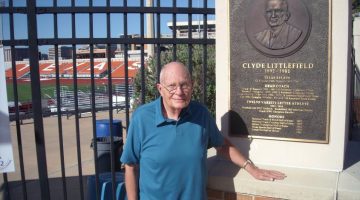
Most days Clyde Rabb Littlefield may be found busily managing a real estate investment and property management business from a small office adorned with Longhorn sports memorabilia in the historic Robinson-Rosner building in downtown Austin.
The past is never dead. It's not even past
Most days Clyde Rabb Littlefield may be found busily managing a real estate investment and property management business from a small office adorned with Longhorn sports memorabilia in the historic Robinson-Rosner building in downtown Austin.
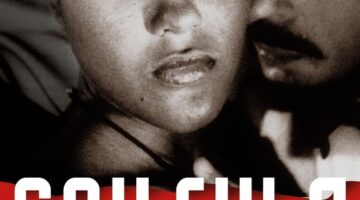
An extravagant party on the rooftop of a Havana hotel. It’s the late 1950s; hedonistic tourism is booming in the City. A band plays loud. Drinks. Laughter. Our line of vision moves from the hotel’s rooftop to a crowd of tourists below, where we see a woman and follow her into the pool. Underwater....Hailed today a classic for its inventive cinematography, "I am Cuba" was virtually forgotten for three decades.
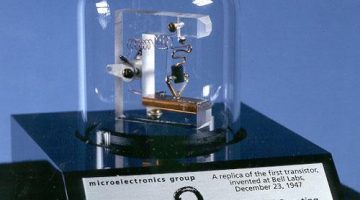
The transistor is one of the most essential components of modern technology. Developed in the late 1940s and early 1950's, this device enabled scientists to amplify and redirect electrical power, a crucial innovation in the field of electronics.
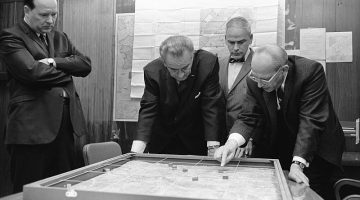
In the months following his resounding electoral triumph over Barry Goldwater in November 1964, President Lyndon Baines Johnson made momentous decisions to escalate U.S. military involvement in Vietnam. Most consequentially, he ordered the bombing of North Vietnam: first retaliatory strikes following a National Liberation Front attack on the U.S.
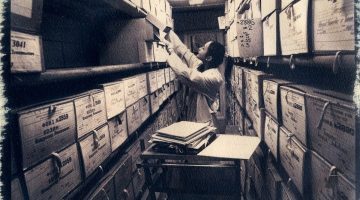
Historians won’t be giving up their visits to archives or their days picking notebooks and letters out of boxes any time soon. But the path to those boxes has changed dramatically as institutions and history enthusiasts have been digitalizing and posting their treasures online.

Between 1977 and 1991, Michael L. Gillette, executive director of Humanities Texas and former director of the LBJ Library Oral History Program, sat down with Lady Bird Johnson to discuss her childhood, family life and experiences as First Lady. For the first time anywhere, Not Even Past is publishing audio segments from these incredible conversations.
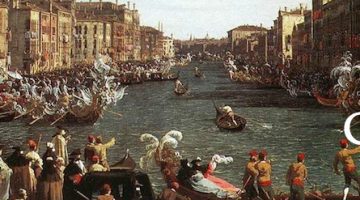
Internet technology is starting to have a profound influence on the ways we do history. Historians have found new places to write history, new ways to make sources available, and some historians have mastered the digital technology to create new kinds of data and new kinds of sources for asking new kinds of questions about the past.
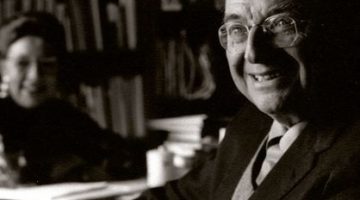
Perhaps one day some whimsical people with money will get together and honor books for their subtitles. Lawrence Friedman’s new biography of Erich Fromm, subtitled “Love’s Prophet,” wins for getting the total picture; for, in just two words, capturing a imagewhole life. But it couldn’t have been a difficult choice.
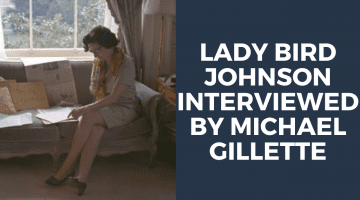
I had already conducted the first five oral history interviews with Lady Bird Johnson when she telephoned my LBJ Library office one day in the spring of 1978. Her first words were “Hello, Mike.
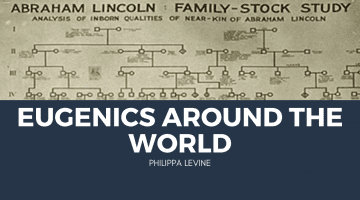
Early in the twentieth century governments all over the world thought they had found a rational, efficient, and scientific solution to the related problems of poverty, crime, and hereditary illness. Scientists hoped they might be able to help societies control the social problems that arose from these phenomena. From Mexico to Maine, from Switzerland and Scandinavia to South Carolina, from India to Indiana, the science-turned-social-policy known as eugenics became a base-line around which social services and welfare legislation were organized.