• Features
  • Reviews
  • Teaching
  • Watch & Listen
  • About

The past is never dead. It's not even past

Not Even Past

Primary Source: An Expressionist Art Dealer’s Legacy in Books

Banner for Josiah Simon, Primary Source: An Expressionist Art Dealer's Legacy in Books

This and other articles in Primary Source: History from the Ransom Center Stacks represent an ongoing partnership between Not Even Past and the Harry Ransom Center, a world-renowned humanities research library and museum at The University of Texas at Austin. Visit the Center’s website to learn more about its collections and get involved.

“Only in extinction is the collector comprehended,” wrote Walter Benjamin, in his now widely read essay on book collecting.1 What holds a book collection together, its unifying force, is the personality of the collector themselves. A “living” collection grows, is rearranged, books are lost or disappear, and found again. All the while, the collector orchestrates behind the objects. “[T]o a true collector,” Benjamin reminds, “the acquisition of an old book is its rebirth.”2 The desired object is reborn into the ordered obsession of the collector. Inversely, however, when a collector passes away—“in extinction”—the objects themselves are often left to tell the story of the collector. This is one such story. 

In 1962, nearly one year after the German-Jewish art dealer, gallerist, and publisher J. B. (Israel Ber) Neumann (1887-1961) had passed, The University of Texas at Austin purchased his personal library for $10,000, a small sum for what today could easily be valued at tenfold that amount. The director of the University Art Museum at the time, Donald B. Goodall, wrote that Neumann’s “Art and Literature Library,” as it was first introduced in a wired message from the director at the Museum of Modern Art, “may form a nucleus of research and publication around one of the major centers of critical and dealing activity during the important years when Modern Art was being introduced to this country.”3 

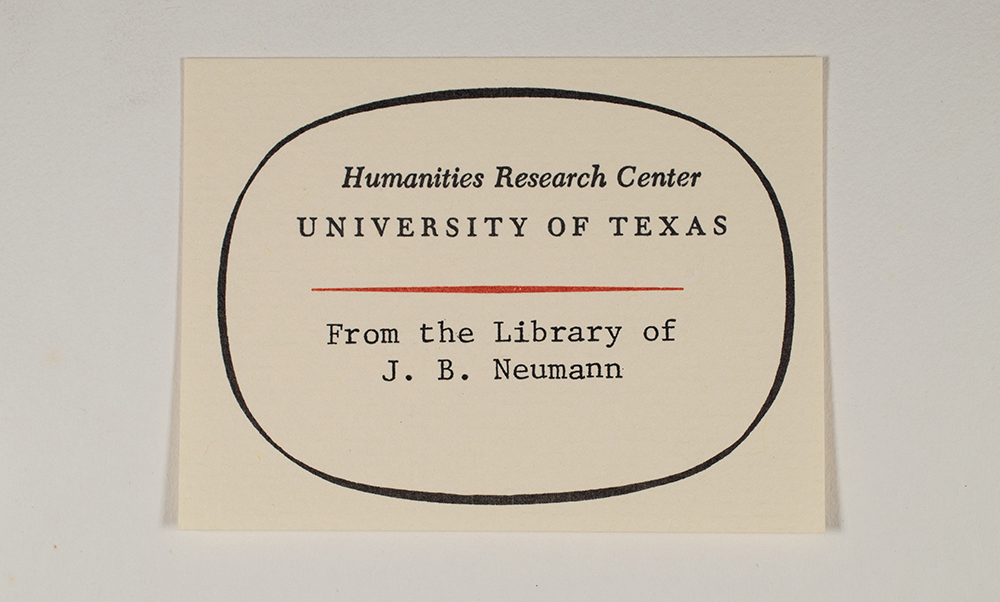
University of Texas Humanities Research Center bookplate, "From the Library of J. B. Neumann," in Guillaume Apollinaire, The Cubist Painters

University of Texas Humanities Research Center bookplate, “From the Library of J. B. Neumann,” in Guillaume Apollinaire, The Cubist Painters (New York: Wittenborn and Company, 1944). Harry Ransom Center, ND 1265 A62.

Goodall had good reason to be optimistic about the purchase. Neumann was a pioneering figure in the Berlin art scene during the rise of the German avant-garde before and after the first World War. He championed the likes of Max Beckmann, exhibited members of the now infamous artist group “Die Brücke,” and hosted the first ever exhibition of Dada painting and sculpture—all while opening new galleries in Munich, Düsseldorf, and Bremen. He published the expressionist journal Der Anbruch and gained renown through his periodicals J.B. Neumanns Bilderhefte and later Artlover. Risking all, he would immigrate to New York City in 1923 to help usher in the first wave of modern German art in the United States, founding “J.B. Neumann’s Print Room,” later renamed to the “New Art Circle.” He supported numerous young artists and German immigrants and helped establish a vibrant culture around art on the then nascent 57th Street. Fighting tirelessly for what he lovingly termed “living art,” Neumann collaborated with the most important dealers, collectors, and artists of his age. 

Today, however, Neumann’s name is far less known—and his personal library all but dissolved. Originally acquired at over 4,500 items, fewer than 100 are now cataloged at the Ransom Center. And while the reach of his personality can still be found in the footnotes, forewords, and prefaces to many important publications and catalogs on modern German art—and especially on German Expressionism—the man’s remarkable character has disappeared behind the very artists he helped promote. Other German art dealers, such as Alfred Flechtheim and Curt Valentin, are more prominently remembered for their role in establishing an international market for modern German art. The story of Neumann’s library, then, is not only another footnote to an otherwise obscure figure but holds the promise of rehabilitating one of the most important art dealers of the twentieth century. 

If not for a lucky antiquarian find, this promise may have disappeared forever. As it stands, even before I knew his name, or anything of his personal library, I acquired nearly 200 German-language books that had been deaccessioned by UT, all belonging to Neumann. Thus “reborn” into my own collection, the stories these books seemed to tell through their inscriptions, marginal notes, and extensive focus on the graphic arts sparked a growing curiosity into the man. Who was he? How had his books arrived in Austin, Texas? Were they part of a larger library? And what role might they play in telling a more complete story? In the summer of 2025, with these questions in mind, I began a research fellowship at the Harry Ransom Center on an adjacent topic. Could I perhaps, I thought, as an aside to my primary research, unlock some of the mysteries of Neumann’s books?

It is a rare stroke of fortune when a researcher’s hopes and the hard truths of archival research align. Confirming my suspicion, an initial discovery at the Ransom Center proved among the most important: the “acquisition letters” on the purchase of Neumann’s library. Part of the Center’s own archive, the two institutional letters argue for the importance of the library and describe its contents, which consisted of “folios, monographs, critical works, catalogues and periodicals.” The first letter, dated January 1, 1962, broadly introduces the collection and highlights Neumann’s historical significance:

During the years after the first World War, J. B. Neumann was one of a small group of believers in the growth of modern art ideas, and coming here from Germany, his gallery was one of three or four seminal points in the emergency of contemporary art in the United States. His library was a working apparatus and supported the exchange of art works and correspondence which occurred between Neumann and many of the world’s most important innovators, among them Beckmann, Rouault, Kandinsky, Max Weber, and the German Expressionists. After the team of Stieglitz-Steichen, he can be considered the most influential dealer-personality to have propagated the cause of modern art in America. 

The second letter, dated February 6, 1962, was intended to give a more detailed account of the collection. It lists a selection of “Early Editions” and “Rare Items,” along with an estimate of their current market value. For the researcher, these letters prove quite substantial: they give a picture of the library in its entirety; help confirm which books are still catalogued at the university; and can even help in confirming which books now in private hands may have once belonged to the collection.  

After this first success, staff at the Harry Ransom Center helped to locate a second file containing various ephemera, mostly notes and small drawings, that were withdrawn from J.B. Neumann’s books as they were being cataloged.4 While only consisting of a few items, this file provides an initial sense of Neumann’s personality and character. One can easily imagine the expansive network of museum directors, investors, artists, and friends that took shape as Neumann established himself in the United States after 1923. One finds, for example, a sketch for a business proposal drafted on a hotel notepad (“Mr. Moir, Let’s start a picture business”); a charming watercolor by the German-born artist Vita Petersen; a letter from the membership committee of the American Artists’ Congress, signed by the graphic artist Lynd Ward; a beautiful endpaper from the collection of Richard Beer Hoffmann, an Austrian-Jewish dramatist and poet; and a publisher’s letter detailing the process for reproducing Max Beckmann’s illustrations for a post-war edition of Goethe’s Faust.

After moving to the United States, Neumann remained in close contact with his European associates, even if his status as a Jewish art dealer made it increasingly difficult to maintain his status quo in Germany. Nevertheless, after a forced interruption from 1933 until 1945 during the reign of the Nazi regime, he resumed his visits as often as his finances would allow. And he always made a point to bring back as many exhibition catalogs as possible, filling the shelves of his library with memories from his trips. In a letter from 1947 to a Swiss museum director he writes: “Kataloge sind so wichtig weil wir das Museum mit uns nach Hause nehmen können. Als ich die vielen Jahre von Europa abgeschnitten war, lebte ich (seelisch-kuenstlerisch) nur von den Katalogen” [Catalogs are so important because we can take the museum home with us. When I was cut off from Europe for many years, I lived (emotionally and artistically) only from catalogs].5 

Of little financial value in and of themselves, Neumann’s catalogues spanned a period of nearly fifty years, documenting the rise of modern art along with sometimes substantial notes on his buying and selling practices. Unfortunately, the catalogues once at UT were almost entirely deaccessioned or lost; only a small remnant is now in private hands. Some of the most significant “Early Editions” and “Rare Items,” though, do remain. The Center holds, for instance, Neumann’s copies of the 1532–1534 edition of Albrecht Dürer’s Human Proportions, a masterpiece from one of Germany’s most famous artists, and Richard Huelsenbeck’s Dada Almanach (1920), an early and now quite collectable anthology of Dadaist texts. Although Neumann’s library can no longer be salvaged or reconstructed in full, there is a meaningful nucleus. In the fragments of the library, we can glimpse something of the whole.  

When Neumann opened his first gallery, “Das Graphische Kabinett J.B. Neumann,” in Berlin in 1911 (founded in 1910), his primary focus was to support artists “young and new.” In a promotional brochure, now held in the general collections at UT and from Neumann, he reproduces an excerpt from the first painting exhibition he hosted in 1913: “Wir wünschen rechtzeitig die Teilnahme des Amateurs auf die Arbeiten der Jungen zu lenken und gerade bei uns vermag dieser das schöpferische Moment des Sammelns zu genießen: die Freude Unbekanntes zu entdecken” [We wish to opportunely direct the participation of the amateur towards the work of the young, and precisely with us he may enjoy the creative moment of collecting: the joy of discovering the unknown].6

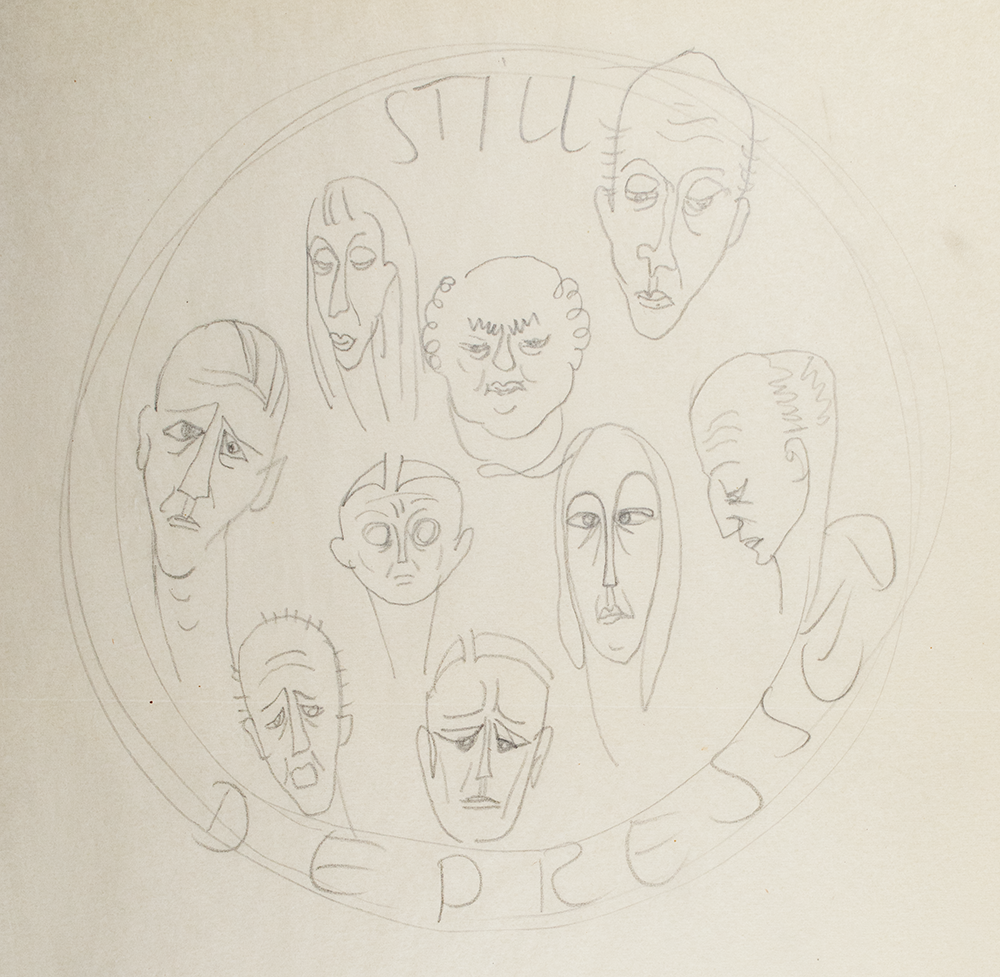
Neumann maintained a lifelong passion not only for the “creative moment of collecting,” but also for his professional task: nurturing “the commerce between artist and admirer,” especially involving works that were still unknown. As an art dealer, he thereby had a hand in building some of the most important private and public collections in the United States while also supporting the artistic and financial efforts of his artists. Neumann’s empathy comes into focus in a folded sketch he composed under the heading “Still Depressed.”

A sketch by J. B. Neumann, "Still Depressed."
A sketch by J. B. Neumann, “Still Depressed.” Harry Ransom Center, Manuscripts Withdrawn from Books, Box 1, AML.

Expressionist in tone, the sketch depicts a group of people, perhaps artists under Neumann’s patronage. Their long El Grecian faces emanate melancholy and capture the weight and isolation of the individual. The plight of the artist is expressed alongside Neumann’s own disposition as an art dealer: despite his constant striving, his artists are still discontent. Perhaps they had hoped for more immediate success? Perhaps their financial burdens are still too great? Worthy of further study—it lies outside this short essay, for example, to match each face to a corresponding artist—this sketch raises questions on the role of the art dealer and shows how personally involved Neumann was in the life and work of his artists. 

Neumann’s great love for art often manifested in the practicalities of his relationships. Whether mediating commissions, dealing directly to the public, or securing works for exhibitions, his life intersects with many well-known personalities of the art world. One such figure is the German illustrator, painter, and satirist George Grosz. Grosz grew to international fame, alongside John Heartfield, as a central agitator in the post-war Dada movement in the Weimar Republic and continued to find success after emigrating to the United States in 1933. A master draftsman, he captures in his drawings the contradictions of bourgeois city-life, confronting his viewers with the bitter, and often dark underside of modern society.  

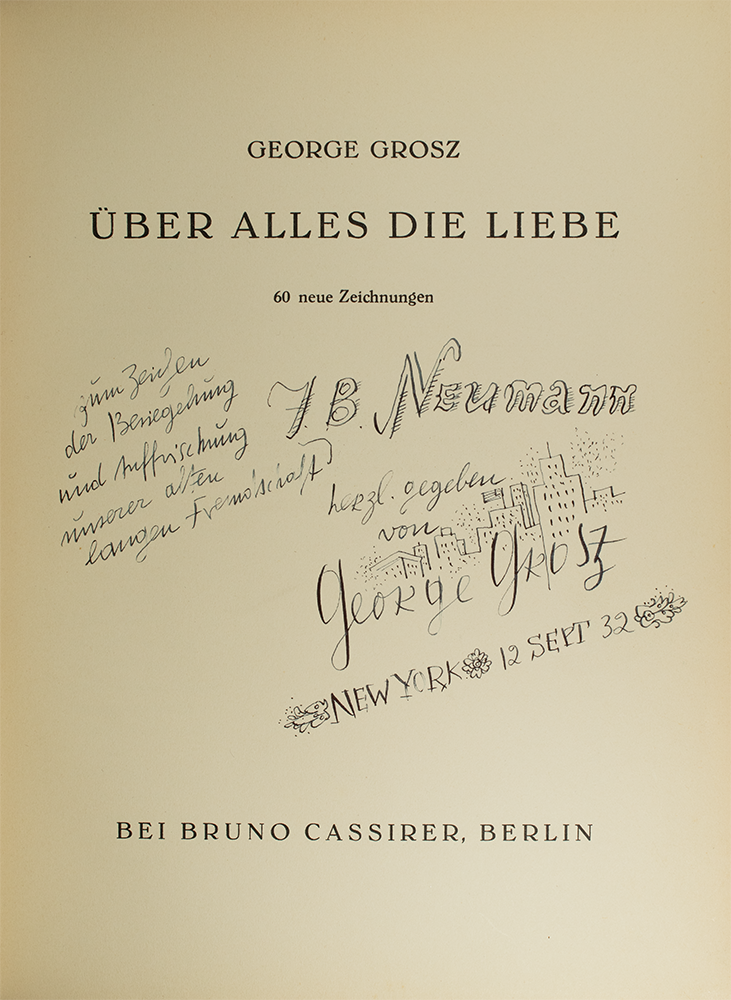
In the Center’s catalog, five books associated with Grosz note Neumann provenance.7 Grosz and Neumann had originally collaborated at the height of the German avant-garde in Berlin, where Neumann also sold and exhibited works by Grosz. Significantly, it was Neumann who hosted some of the first Dada evenings in Berlin and the first ever exhibition of Dada painting and sculpture. Books from Neumann’s library point towards an intimate friendship that was important for both. Their relationship is wonderfully on display in an inscription to Neumann in Grosz’ book Über alles die Liebe, a collection of drawings published by Bruno Cassirer in 1930: 

Inscription from George Grosz to J. B. Neumann in George Grosz, Über alles die Liebe
Inscription from George Grosz to J. B. Neumann in George Grosz, Über alles die Liebe (Berlin: Bruno Cassirer, 1930). Harry Ransom Center, NC 1145 G78.

The inscription reads: “Zum Zeichen der Besiegelung und Auffrischung unserer alten langen Freundschaft” [As a gesture of confirmation and renewal of our old, long friendship]. Already in 1925, shortly after moving to New York, Neumann had offered “to do all he could” to help Grosz, if he ever wanted to follow. Grosz had long been fascinated with the United States, as reflected in childhood sketches and stories about the American West, and when in 1932 the political situation in Germany was faltering, he leaned heavily on his “long friendship” with Neumann. Grosz would emigrate to the United States with his family in 1933, only shortly before Hitler came into power. 

No longer able to work in the same leftist-satirical vein that had brought him fame in Germany (most notably with the journal Simplicissimus and later with the Malik Verlag, the anti-fascist publishing house founded and run by Wieland Herzfelde, John Heartfield’s brother), Grosz sought meaningful work and renewed artistic impulse in a new political environment. A snapshot of Grosz’ new world can be partially reconstructed from sources held at the Ransom Center. These sources also show how prominent Neumann was in New York in the early 1930s and point towards possible avenues for further research. 

The first of these items is an inscribed copy of O. Henry’s The Voice of the City (1935), published by Georg Macy for The Limited Editions Club, which Grosz had set aside for “J.B.N.”—Neumann. Lauded in the introduction as a “great European artist,” Grosz produced twenty haunting watercolors and small illustrations throughout, showing his developing style and eagerness to adapt as an American artist. By good chance, the Center also holds the files of publisher Georg Macy, which contain letters detailing the behind-the-scenes financial negotiations with Grosz and the first proofs of his watercolors. And in good archival fortune, examining these files led me to evidence of a more substantial link between Grosz and Neumann: a simple, yet compelling art school pamphlet. Before moving to New York, Grosz placed his hope in the hands of his old friend, and Neumann suggested opening an art school together with Maurice Sterne, the well-known American painter and sculptor, to help finance Grosz. The ”Sterne Grosz Studio,” directed by Neumann, only lasted from 1932 until 1936 but serves nonetheless as a prime example of how Neumann fought not only for the physical survival of modern works of art but also for the financial and political survival of the artists themselves.

As an art dealer and personality, Neumann’s reach far exceeded what is documented today. In fact, he was not only in frequent communication with the most important publishers and artists of his age, as the example of Macy and Grosz shows, but was also known and respected beyond the strictly artistic sphere. One of the most surprising—and significant—discoveries from Neumann’s library is a collection of inscriptions to him by the German philosopher Martin Heidegger: two from 1953 and one from 1957. While Heidegger was not known to be an art collector, his writings on art and poetry— especially his essay “On the Origins of the Work of Art”—are central contributions to twentieth-century aesthetic theory. His magnitude in the world of philosophy cannot be overstated. So, what had the world-famous philosopher wanted with a Jewish art dealer from New York, especially given Heidegger’s troubling position on the “Jewish Question”?

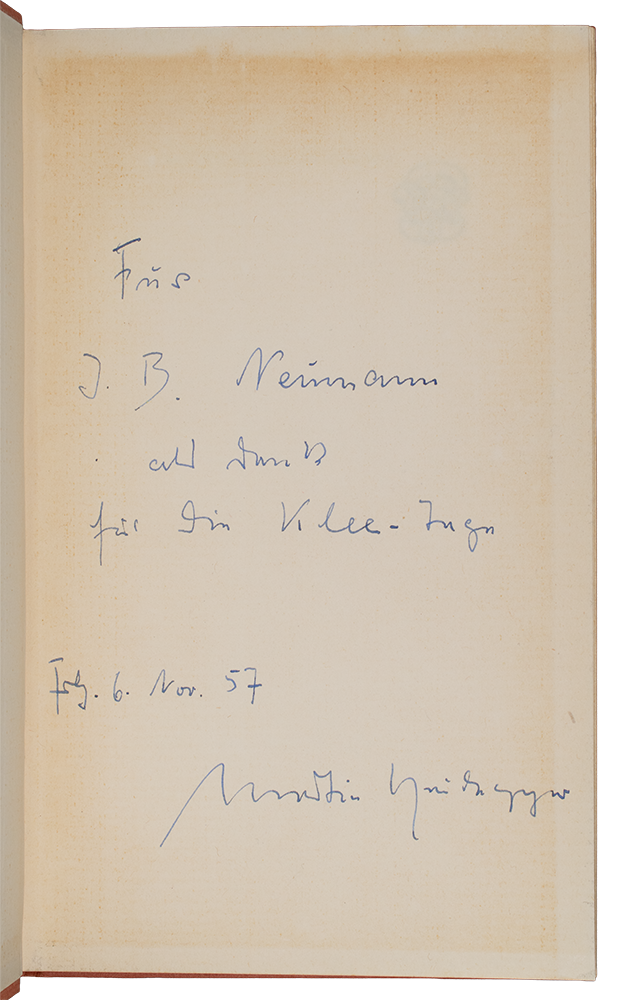
Not much can be gleamed from the two inscriptions from 1953, except the likelihood that Neumann had personally visited “Heidegger’s hut,” the infamous cabin near Freiburg in the Black Forest, while on one of his yearly trips to Europe. The third inscription however, dated November 6, 1957, is revealing. It reads: “Für J.B. Neumann, all Dank für die Klee-Tage” [To J.B. Neumann, all thanks for the Klee-days]. Paul Klee (1879-1940) had already reached legendary status by the 1950s, only shortly after his death. Neumann, who writes with embarrassment how he had underestimated Klee’s abilities when they first met, eventually saw Klee as the artist closest to his own heart. In addition to his activities as a dealer and publisher, Neumann was a respected lecturer, holding public talks on Klee, among many others. Perhaps Heidegger himself had sought Neumann’s insights on the artist?

Inscription from Martin Heidegger to J. B. Neumann in Martin Heidegger, Identität und Differenz
Inscription from Martin Heidegger to J. B. Neumann in Martin Heidegger, Identität und Differenz (Pfullingen: Günther Neske, 1957). Harry Ransom Center, BD 236 H4.

Whatever the specifics, it seems all but certain that Heidegger and Neumann met in 1957 and discussed Paul Klee. Adding to this, it is known that Heidegger, in anticipation of a 3rd edition of “On the Origins of the Work of Art,” wrote down his “Notes on Klee” sometime “between Summer 1957 and Autumn 1958”—exactly the period when Neumann met with him.8 Is it possible, then, that Heidegger’s turn towards Klee, a significant development still in debate, was encouraged by Neumann? Could further investigation lead to a more substantial link between Neumann and Heidegger’s philosophy of art? These questions alone suggest a need for further research into Neumann’s legacy. And the encounters with Heidegger and Grosz are merely two examples among many.  

Taking Neumann’s library as a starting point for research lends significance and context to what otherwise could quickly be overlooked. This was my experience when, while searching through the files at the Ransom Center on the writer and art collector Nancy Wilson, whose published essay on Paul Klee had piqued my curiosity, I stumbled upon a pamphlet, with a note in Neumann’s hand.9 To my surprise and delight, I could now see an entire life unfold in the details of this pamphlet: A pensive and seeking photograph; charming correspondence with a touch of business flair: (“Dear Nancy, at last I got your address. I love your essay on Klee—I am longing to see you again […] I have some beautiful Klees!”); the distinct yet connected worlds of Germany and the United States; and a pioneering spirit who heralded some of the most famous artists of the twentieth century. This came with the realization that Neumann had an almost unfathomable, and certainly still underappreciated, impact on the world of modern art.       

As an art dealer, J.B.—as his closest friends and patrons would call him—was of a different make than his contemporaries. For him, art was never merely a business, but more akin to faith or a religious experience. In fact, he identified more closely with the artists he supported than with the dealers with whom he stood in competition: “Most of the artists whom I have promoted have been Expressionists. I guess you could call me an Expressionist, too. If there is such a thing as an Expressionist art dealer, then I am it. What would that be? Well, let’s put it this way. It’s a dealer who is obsessed with the idea that selling a certain picture will not only save him from his landlord, but also save his soul.”10

Josiah Simon is an independent scholar, bookseller, translator, and teacher living in Austin, TX. He holds a PhD in German from the University of Oregon. Simon has taught German, humanities, and philosophy at various institutions across the United States and has conducted research at the University of Heidelberg, the Ruhr-University Bochum, and the Harry Ransom Center (UT-Austin). His recent scholarship has appeared in the Franz Rosenzweig Yearbook and he is an active contributor to the Hans Ehrenberg-Studien.


1 Walter Benjamin, “Unpacking my Library,” in Illuminations (New York: Schocken Books, 1968), 67.

2 Ibid., 61.

3 Harry Ransom Center, HRC Archive, Box 545, Folder 35. 

4 Harry Ransom Center, Manuscripts Withdrawn from Books, Box 1, AML 1.7

5 Ibid.

6 “Das Graphische Kabinett J.B. Neumann / Berlin 1910 – 1917.” Promotional Brochure. University of Texas Libraries, Library Storage Facility, 708.3 G767G.

7 Harry Ransom Center, NC 1145 G78; PS 2649 P5 V6 1935; PT 2638 W744 G4 1931; PT 2617 U43 D6 1921; NC 1509 G74.

8 “Special Topic on Heidegger and Paul Klee”, Philosophy Today 61.1 (Winter 2017): 7-17.

9 Harry Ransom Center, Nancy Wilson Ross Papers, Box 84.

10 J.B. Neumann, Confessions of an Art Dealer, unpublished, Museum of Modern Art, J.B. Neumann Papers, II.B.2.


The views and opinions expressed in this article or video are those of the individual author(s) or presenter(s) and do not necessarily reflect the policy or views of the editors at Not Even Past, the UT Department of History, the University of Texas at Austin, or the UT System Board of Regents. Not Even Past is an online public history magazine rather than a peer-reviewed academic journal. While we make efforts to ensure that factual information in articles was obtained from reliable sources, Not Even Past is not responsible for any errors or omissions.

Filed Under: 1900s, Archives, Art/Architecture, Biography, Europe, Features, Ideas/Intellectual History, Material Culture, Museums, Primary Source, United States

Primary Source: How Did Cary Coke Get Her Copy of Queen Catharine?

This and other articles in Primary Source: History from the Ransom Center Stacks represent an ongoing partnership between Not Even Past and the Harry Ransom Center, a world-renowned humanities research library and museum at The University of Texas at Austin. Visit the Center’s website to learn more about its collections and get involved.

Mary Pix’s Queen Catharine; or, the Ruines of Love (1698) was not a smash hit. Very few of her plays were. While a handful enjoyed revivals on the stage throughout the 1690s and 1700s, none of her playbooks received a second run in print. That said, after Aphra Behn and Susanna Centlivre, Mary Pix was the most prolific woman playwright of the English Restoration.1 No fewer than twelve of her plays were produced between 1696 and 1706.2 And like many playwrights, regardless of gender, Pix used print to court aristocratic interest and, ideally, patronage. The copy of Queen Catharine at the Ransom Center may be the very one that Pix presented to the book’s dedicatee, Cary Coke. 

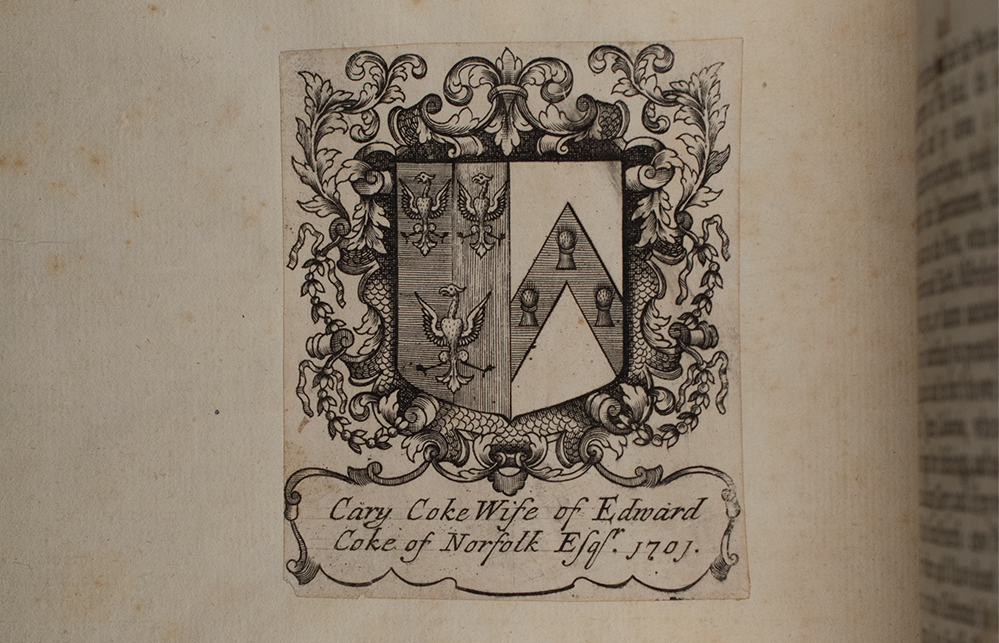
Bookplate of Cary Coke from Mary Pix, Queen Catharine; or, the Ruines of Love
Bookplate of Cary Coke from Mary Pix, Queen Catharine; or, the Ruines of Love (London: William Turner and Richard Basset, 1698). Harry Ransom Center, Ak P689 698q.

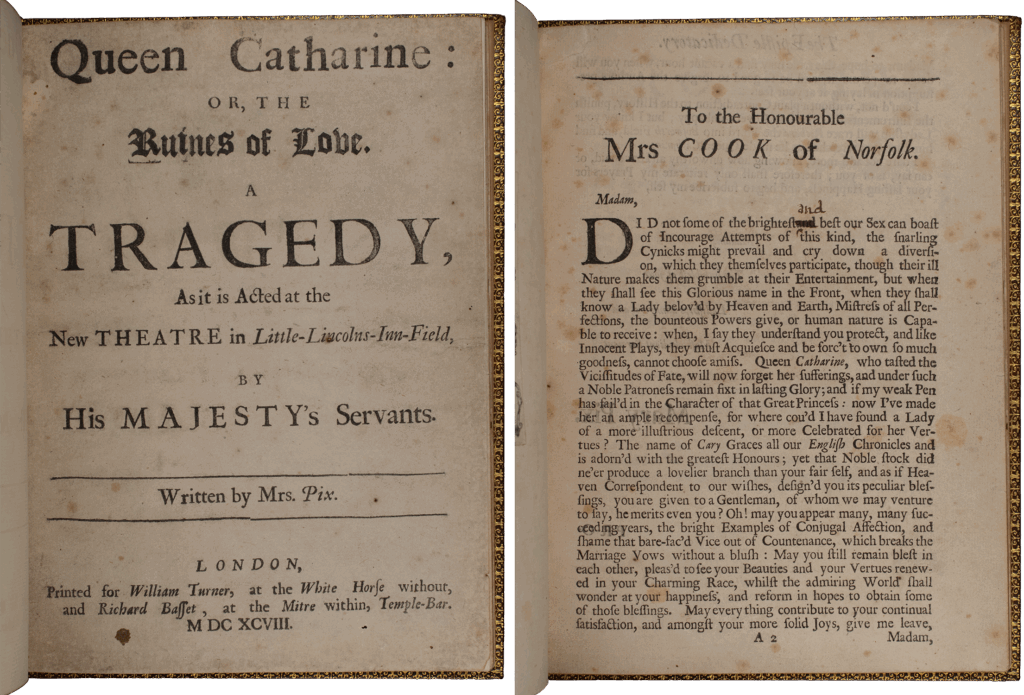
Part of the George A. Aitken Collection, which came to the Ransom Center in 1921, this copy of Queen Catharine is, from the outside, typical of the playbooks that went through the hands of nineteenth- and early-twentieth-century book collectors. It has been rebound in red leather and features marbled endpapers. Oddly, though, the volume’s only bookplate before arriving at the University of Texas appears not at the very front but on a leaf inserted after the playbook’s title-page. On the back—the verso—of that leaf, the plate reads, “Cary Coke Wife of Edward Coke, Esq. 1701.” The fact that it comes after the endpapers is not in and of itself unusual: book collectors in the early eighteenth century understood, perhaps better than modern ones, the impermanence of book bindings, and often glued their plates to the blank versos of title-pages. A bookplate following a title-page, however, is odd.  A little more than 300 of the Cokes’ playbooks are now at Oxford University’s Bodleian Library, and none include a plate in this position. Of the 30 total volumes in which they have been bound together, 24 include either Edward or Cary’s plate. In 22 of them, it appears on the verso the first play’s title-page.3 So, the question becomes: why is Cary Coke’s bookplate on an extra leaf in this copy of Queen Catharine? And what can this tell us about the history of this playbook before it arrived at the University of Texas?

Title-page and sig. A2r with handwritten correction from Mary Pix, Queen Catharine; or, the Ruines of Love
Title-page and sig. A2r with handwritten correction from Mary Pix, Queen Catharine; or, the Ruines of Love (London: William Turner and Richard Basset, 1698). Harry Ransom Center, Ak P689 698q.

One clue may lie in a single handwritten correction. On the first page of the dedication to Coke, there is a typesetting error. What should be “brightest and”—“Did not some of the brightest and best of our Sex can boast of incourage attempts of this kind…”—lacks a space between the two words, appearing as “brightestand.”4 In the Center’s copy of Queen Catharine, someone has attended to this error, crossing out “and” and rewriting the word above in an early hand that roughly mimics the font. Given the bookplate, the emendation may have been made by Pix herself before she presented the book to Cary Coke. Or maybe it was made by Coke upon receiving the playbook from Pix. If a presentation copy, the playbook may have been kept separate from the bound playbooks, which include another copy of the Queen Catharine edition. (The volume including that copy bears Edward Coke’s bookplate, not Cary’s.) It isn’t hard to imagine that Cary Coke would want a special, personal copy of a play dedicated to her to remain apart from the larger, household collection of plays. It also isn’t difficult to imagine Pix taking a moment to correct a typesetting error in her dedication before sending or presenting the copy to the dedicatee. Of course, though, we can probably never know for sure.

There is also the matter of Aitken himself. That a Pix play found a home in Aitken’s collection at all is appropriate, given his wide-ranging interest in English books and a scholarly interest in the literature of Queen Anne’s reign in particular.5 However, few records indicating when and from where Aitken purchased his books survive. Aitken’s association with notorious book-forger and thief Thomas J. Wise (a few examples of their personal correspondence do survive in the Aitken collection) complicates matters further. Wise’s determination to create fine copies of early playbooks for his own collection (in)famously drove him to steal leaves out of copies at the British Museum (now the British Library).6 He also went so far as to forge entire editions of nineteenth-century books that did not exist, relying on his otherwise sterling reputation as a bibliophile to pass said forgeries off as legitimate.7 Since a working connection is known to exist between Aitken and Wise, and given Aitken’s relative lack of auction records or other bills of sale, it may be necessary to approach the Aitken collection with some degree of caution. But should Aitken and, by extension, the Ransom Center’s Queen Catharine be found “guilty by association” with Wise? 

Arguably no. Although the bookplate placement is curious, the playbook leaves themselves show no signs of having been manipulated by Wise or his binder. And Wise, fortunately, is not known to have forged provenance in this way. Aitken, too, clearly had many sources for his books apart from Wise. How the Cary Coke’s copy of Queen Catharine left the rest of the playbook collection at her home, Holkham Hall, is unclear, but it appears that it did in fact end up here in Austin, Texas, offering a window—even if a clouded one—into the relationship between two influential literary women.

Rachel Spencer is a PhD candidate in the Department of English at UT Austin. Her research focuses on 16th- and 17th-century drama, book history, performance studies and theater history, and feminist theory.

1 The “Restoration” is the period after 1660 when Charles returned to England as King Charles II. Having been closed since 1642, London’s theaters also reopened that year.

2 There are still some questions as to whether Pix may have produced thirteen plays, but the scholarly consensus tends to consider Zelmane no longer part of her canon. See: Annette Kramer, “Mary Pix’s Nebulous Relationship to Zelmane,” Notes and Queries 41, no. 2 (1994): 186-87.

3 Due to the condition of two volumes, Holk. d.4 and Holk. d.15, I did not personally confirm the location of the bookplates, but SOLO, the Bodleian’s library database, claims both volumes bear Edward Coke’s bookplate.

4 Harry Ransom Center, Ak P689 698q

5 “Aitken, George Atherton, 1860-1917,” The Online Books Page

6 David Foxon, Thomas Wise and the Pre-Restoration Drama: A Study in Theft and Sophistication (London, The Bibliographical Society, 1959).

7 The forgeries were first revealed in John Carter and Graham Pollard, An Enquiry into the Nature of Certain Nineteenth-Century Pamphlets (London: Constable and Company, 1934).


The views and opinions expressed in this article or video are those of the individual author(s) or presenter(s) and do not necessarily reflect the policy or views of the editors at Not Even Past, the UT Department of History, the University of Texas at Austin, or the UT System Board of Regents. Not Even Past is an online public history magazine rather than a peer-reviewed academic journal. While we make efforts to ensure that factual information in articles was obtained from reliable sources, Not Even Past is not responsible for any errors or omissions.

Filed Under: 1400s to 1700s, Europe, Features, Gender/Sexuality, Ideas/Intellectual History, Material Culture, Museums, Primary Source Tagged With: 17th century, English literature, Harry Ransom Center

Primary Source: The Chopped-Up Second Life of a Coverdale Bible

Kōan Brink, "The Chopped-Up Second Life of a Coverdale Bible," part of Primary Source: History from the Ransom Center Stacks

This and other articles in Primary Source: History from the Ransom Center Stacks represent an ongoing partnership between Not Even Past and the Harry Ransom Center, a world-renowned humanities research library and museum at The University of Texas at Austin. Visit the Center’s website to learn more about its collections and get involved.

Today, when a book is outdated or simply no longer wanted, it heads to a secondhand bookstore, a friend, or sometimes, a dumpster. In the early modern period, however, the leaves of unwanted books frequently became ripe candidates for recycling. (A leaf is what you turn in a codex-form book; each has two sides—two pages.) These leaves, determined to be “waste,” were used in the construction of new bookbindings.1 Such waste frequently turns up in the Harry Ransom Center’s collection. A third edition of Robert Burton’s The Anatomy of Melancholy (1628), for example, is bound with printed waste from the Apocrypha in unidentified small-format edition of the King James Bible translation. In another instance, a Book of Common Prayer (1549) utilizes parts of a thirteenth-century manuscript as pastedowns, glued to the inside of the book’s front and back covers.2 In some cases, waste is the only material evidence of a text that survives today, and thus serves as a mechanism of preservation. As Adam Smyth writes, “Often, an institution’s response to printed waste—to remove or maintain? to catalog or ignore?—is a useful indicator of the waste text’s cultural standing at that moment.”3

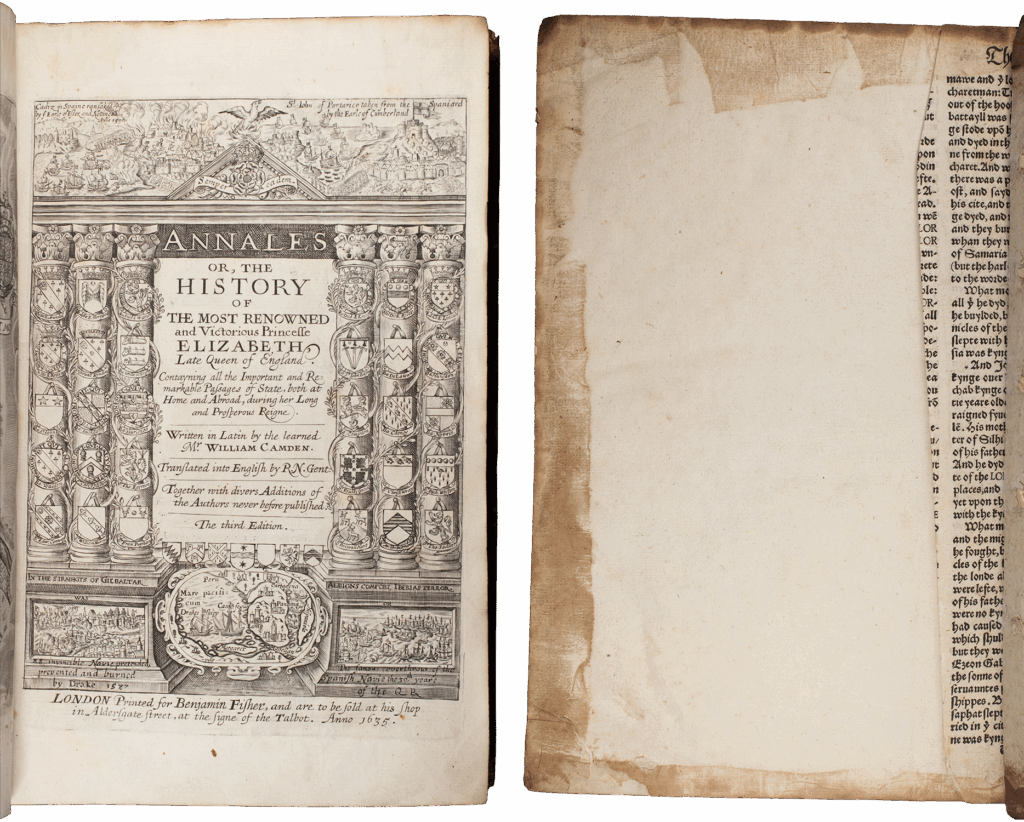
Title-page and rear endleaf, showing Coverdale waste, from William Camden, Annals, or, The history of the most renovvned and victorious princesse Elizabeth, late Queen of England (London: Benjamin Fisher, 1635). Harry Ransom Center, uncataloged acquisition.

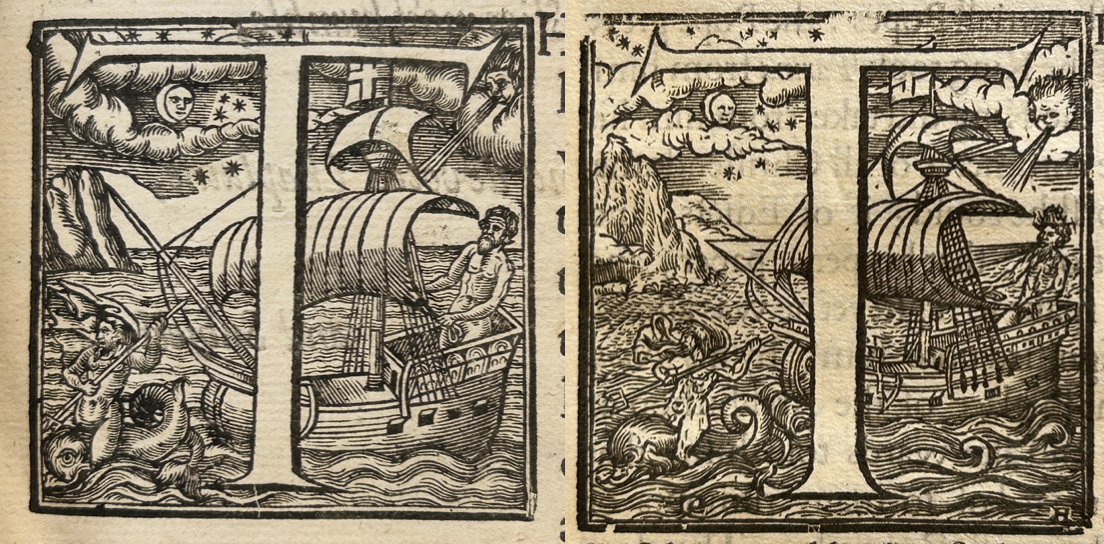
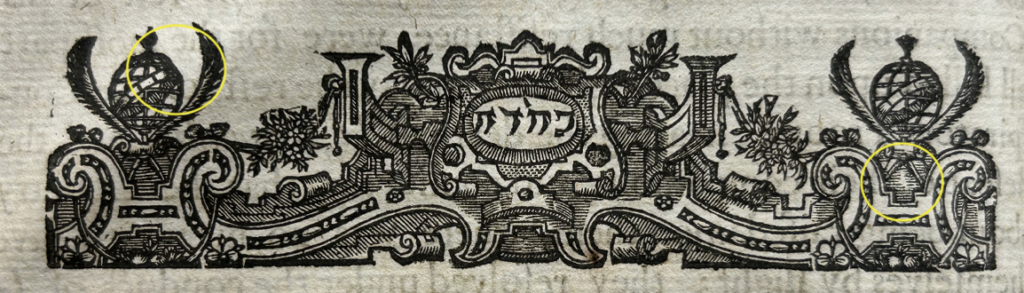
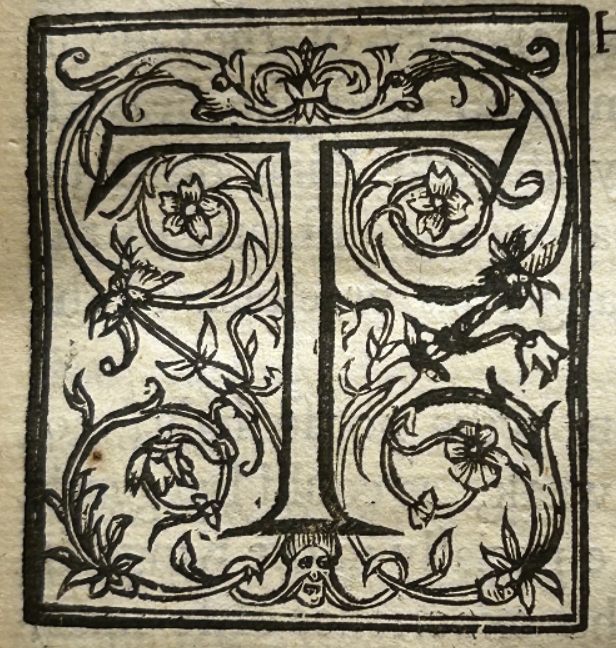
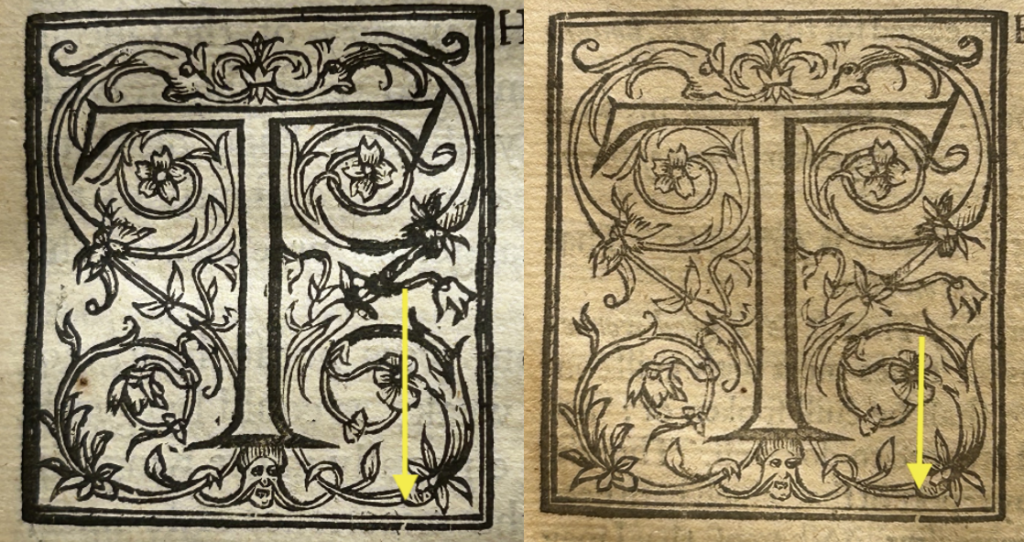
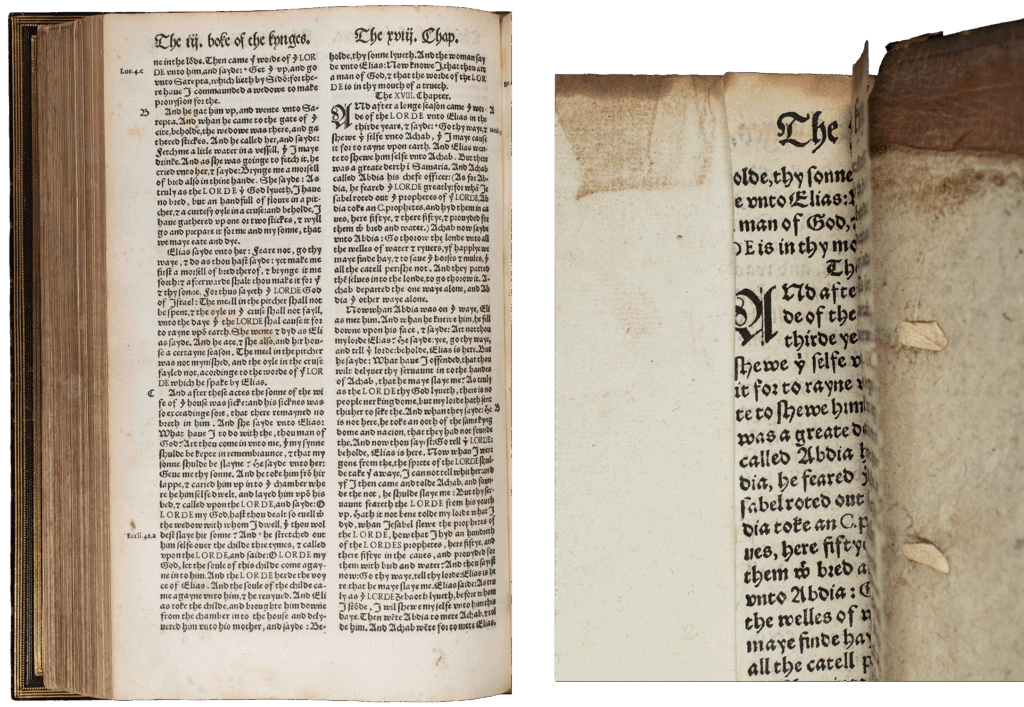
The Ransom Center recently acquired an early history of Queen Elizabeth I, a third printing of the Annales by William Camden (1635). The Center did not have a copy of this exact edition, so the volume helpfully filled a gap, but it was primarily attractive because it uses scraps from a Coverdale Bible (1535)—the first full bible printed in the English language—as binding waste, parts of leaves from III Kings (I Kings in most Protestant bibles). While the Center has long held copies of the landmark book, one receives a particular history of the early modern English bible from the fragments; preserved in the Camden, they become a kind of sedimentary record from a century earlier. Around 1635, an old Coverdale could apparently just be seen as waste. Today, though, any part of a copy would be attractive to collectors. In 1973, a Coverdale Bible missing 24 leaves sold for $50,000; today this translates to roughly $353,000 (there are no known complete copies).4 At the time of writing, AbeBooks lists another copy for a cool $1.5 million, describing the book as “the finest known copy in private hands.”5 There’s also a healthy market for individual leaves. In 2022, one Coverdale leaf sold for $780. To compare, a complete 1635 Camden usually sells for around $1,000.6

Biblia The Bible (Cologne?: E. Cervicornus and J. Soter?, 1535), sig. ll2v, and detail of rear endleaf, showing Coverdale waste, from William Camden, Annals, or, The history of the most renovvned and victorious princesse Elizabeth, late Queen of England (London: Benjamin Fisher, 1635). Harry Ransom Center, uncataloged acquisition.

Given the religiosity of early modern England, it might seem sacrilegious that someone would slice up a sacred text like the bible. The re-use of religious texts in new books, though, has a long history.7 And when it comes to bibles in particular, it is important to remember that the sixteenth and seventeenth centuries were an era of consistent and very public changes in what the “correct” bible should be. One that was popular and expensive in 1535 did not necessarily retain its value in 1635. Even in its own century, the Coverdale quickly gave way to the new-and-improved Matthew, Taverner, Great, Geneva, and Bishops’ Bible translations.8 In 1611, the King James became the official version in parishes and quickly found its way into households across England. This was the case in 1635, when the third edition of Annales was published. Despite Queen Elizabeth I’s famous statement that, “There is only one Christ, Jesus, one faith. All else is a dispute over trifles,”9 bible translations could be hotly contested, depending on which monarch was on the throne and which factions had influence. Religious and bibliographic turmoil often go hand in hand.10 The fact that a Coverdale was used as part of a binding speaks, perhaps more than anything else, to the ubiquity of outmoded bibles by 1635. The fragments in the Camden almost certainly came from a copy of the book that had circulated—and probably sustained significant damage—and not from unbound sheets that had been languishing in a warehouse for 100 years. This damaged-yet-durable quality of early modern bible leaves made them ideal for strengthening new books. 

The third edition of Annales was published only seven years before the English Civil War began in 1642, during a period when tensions within English Protestantism were growing. Given the morphing religious and political climate, it is tempting to read the relationship between biblical waste and its host text in a poetic or reciprocal manner, to say that the two texts—by their mere physical proximity—must be in conversation with one another, whether synergistically or antagonistically. As Smyth writes, “Waste thus complicates or thickens the historicism of the text, since to read waste is to be aware of multiple temporalities.”11 III Kings is about Davidic succession. At one point, David’s attendants try and find a virgin to look after him; Queen Elizabeth was commonly known as the “Virgin Queen.” III Kings is also a history and depicts Solomon building up a navy; Queen Elizabeth crucially expanded Britain’s naval and thus colonial power. Stories such as these appear frequently in the Bible, however, and there is zero reason to think that the binder intended a meaningful juxtaposition, especially given that the Coverdale components are scraps with incomplete sentences. Nonetheless, the two texts’ proximity can serve as a snapshot of English culture at the moment they came together. Camden’s retrospective history of Elizabeth offered nostalgia in a period of increasing turmoil under Charles I, and the Coverdale Bible was not in popular use. Both were facts around 1635.

So, when did a first-edition Coverdale make the transition from plausible binding support to collector’s item? “Protestant revivalism from the 1780s, followed by Catholic renewal from the 1830s, combined to give a new religious aesthetic to Christian practice in Britain,” one where objects such as bibles become renewed sites of devotional sentimentality.12 The British and Foreign Bible Society had been founded in 1804 to ensure that every household was able to procure a bible.13 On the one hand, this meant that bibles became more commonplace. On the other, more attention to English bibles in general made some editions special, helping turn them into monuments of the English Reformation. Even collectors more focused on literature, such as the American banker Carl H. Pforzheimer (1879-1957), came to see bibles as essential to a high-quality collection. The Ransom Center acquired its second 1535 Coverdale when Pforzheimer’s pre-1701 English books and manuscripts arrived in 1986. With the Camden, part of a third has joined the collection.

Kōan Brink is the Graduate Research Assistant for Early Book and Manuscripts at the Harry Ransom Center and a doctoral student in the Department of English at UT Austin. Their research focuses on early modern England— particularly poetry—religious texts, bibliography, and the history of the book. 


1 Adam Smyth, “Printed Waste: ‘Tatters Allegoricall’,” in Material Texts in Early Modern England (Cambridge: Cambridge University Press, 2018), 137. 

2 Harry Ransom Center, PR 2223 A1 1628 and -q- BX 5145 A2 1549c.

3 Smyth, 152.

4 Measuring Worth, accessed September 28, 2025, https://measuringworth.com.

5 “Fine Hardcover (1535) 1st Edition | Crawford Sterling Rare Books and Manuscripts,” AbeBooks, accessed September 28, 2025.

6 “Rare Book Transaction History Search Results,” Rare Book Hub, accessed October 10, 2025. (Access requires subscription.)

7 Anna Reynolds, “‘Such Dispersive Scattredness’: Early Modern Encounters with Binding Waste,” Journal of the Northern Renaissance 8 (2017).

8 John N. King and Aaron T. Pratt, “The Materiality of English Printed Bibles from the Tyndale New Testament to the King James Bible,” in The King James Bible after 400 Years (Cambridge: Cambridge University Press, 2013), 74.

9 “Elizabeth I,” Newberry Library, accessed September 24, 2025.

10 Reynolds. 

11 Smyth, 153.

12 Mary Heimann, “Victorian Piety and the Revival of Material Religion in Britain,” Orca: Online Research at Cardiff, accessed October 11, 2025.

13 Ibid.

Filed Under: 1400s to 1700s, Europe, Features, Ideas/Intellectual History, Material Culture, Museums, Primary Source, Religion Tagged With: 16th century, 17th century, English literature, Harry Ransom Center, Literature

Recent Posts

  • Review of Brown Skins, White Coats: Race Science in India, 1920-66 (2022)
  • Las cosas tienen vida:  Un podcast sobre el rol de los objetos coloniales en nuestras vidas actuales 
  • Las cosas tienen vida: A Podcast About the Role of Colonial Objects in Our Present Lives 
  • Review of Disenfranchised: The Rise and Fall of Industrial Citizenship in China (2019).
  • Review of The Years of Theory: Postwar French Thought to the Present (2024).
NOT EVEN PAST is produced by

The Department of History

The University of Texas at Austin

We are supported by the College of Liberal Arts
And our Readers

Donate
Contact

All content © 2010-present NOT EVEN PAST and the authors, unless otherwise noted

Sign up to receive our MONTHLY NEWSLETTER

  • Features
  • Reviews
  • Teaching
  • Watch & Listen
  • About