• New
  • Features
  • Reviews
  • Texas
  • Teaching
  • Digital
  • Watch & Listen
  • Authors
  • About

The past is never dead. It's not even past

Not Even Past

The Battle of Chile

October 25, 2017

“Where is that terrible beauty we planted so long ago?”  -Santiago del Nuevo Extremo Rodolfo Müller is almost a hundred years old, now.  He still lives in the same house as always, off Simón Bolivar, between Hamburgo and Coventry. That’s in Ñuñoa, a township on the near west side of Santiago.  It’s a big house, […]

Foreign Policy from Candidate to President: Richard Nixon and the Lesson of Biafra

December 5, 2016

By Roy Doron On November 19, 2016, President Barack Obama, speaking on the transition of power to Donald Trump said “once you’re in the Oval Office … that has a way of shaping … and in some cases modifying your thinking.” The 2016 election will undoubtedly be remembered as one of the most unconventional and […]

Playing Indian, by Philip Deloria (1999)

October 24, 2016

By Mark Sheaves Images of American Indians are ubiquitous in contemporary US culture. Step into a convenience store and you can’t help but notice that two of the most popular tobacco brands, Redman Chewing Tobacco and Natural American Spirits, are adorned with the face of a feathered-headdress wearing chief. Approximately 2,000 high schools across the […]

Restless Youth: The CIA, Socialist Humanism, and Yugoslavia’s 1968 Student Protests

October 17, 2016

By Aleksej Demjanski The 1960s saw an explosion of student activism across the globe. This increase in youth movements for social change was so influential that U.S. President Lyndon B. Johnson had the Central Intelligence Agency illegally monitor student movements both at home and abroad. After some investigation, the CIA produced an over two-hundred-page report, titled […]

History and Advocacy: Brazil in Turmoil

October 13, 2016

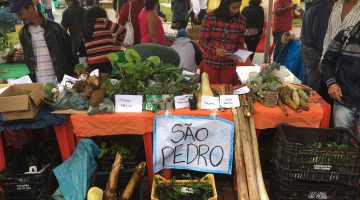
Picture of a market stall in São Pedro, Brazil

Edward Shore considers the implications of Brazilian President Dilma Rousseff's impeachment for the social and environmental rights of of Brazil's traditional peoples, including three thousand rural black communities descended from fugitive slaves called "quilombos." He underscores the need for historians to use scholarship for the advancement of social justice. He addresses current threats to the territorial and environmental rights of quilombo communities in São Paulo's Atlantic Rainforest.

The Museum of Sour Milk: History Lessons on Bulgarian Yogurt

September 19, 2016

One evening this summer, I found myself careening down a country road at breakneck speed to the town of Studen Izvor on the Bulgarian border with Serbia.  Stunning scenery enveloped a string of thinly populated towns, some peppered with socialist-era industrial ruins that somehow added to the charm. Edit, the wife of my friend and […]

The Sword and the Camera: Becoming ISIS

April 1, 2016

When it comes to Islamic fundamentalism and inter-Arab politics, the influential Palestinian journalist Abdel Bari Atwan, has seen it all. Since the 1980s he carefully documented the slow metamorphosis of a young Arab generation that came to believe that it had nothing to lose at home and everything to gain from a festival of death and glory in the distant mountains of Afghanistan.

Digital Teaching: Ping! Are you listening? Taking Digital Attendance

February 4, 2016

How do you know if students are actually watching a live-streaming online lecture? Excellent question!

A Father’s Love: Francois LaBorde’s Letters

February 4, 2015

The letters were written in Spanish and are my own translation. All of the letters and images are from: Francisco A. Chapa Family Papers, MS 405, University of Texas at San Antonio Libraries Special Collections.

The French entrepreneur Francois LaBorde was born April 16, 1867 in Arudy, France. He arrived to Rio Grande City by steamboat up the Rio Grande. Soon after settling there, he met Eva Marks, the daughter of a French immigrant father and a Mexico born, but Texas raised, mother.

“12 Years a Slave” and the Difficulty of Dramatizing the “Peculiar Institution”

November 10, 2013

The challenge of informing an inquisitive American public about the nation’s own two-hundred year old tragedy—slavery—has not fallen squarely on the shoulders of historians and other scholars. Artists, and particularly filmmakers, have played a central role in helping the larger public grapple with the horrors and indeed, aftershocks of human bondage.

« Previous Page
Next Page »

Recent Posts

  • The Fox and The Wolf
  • The Spanish Empire’s Hidden Hand: How the Gálvez Network Turned the Tide of the War of Independence
  • Primary Source: On the Pleasures of Printers’ Ornaments
  • Review of Beyond States. Powers, Peoples and Global Order (2024).
  • Understanding History Through Video Games: Europa Universalis IV and Causation 
NOT EVEN PAST is produced by

The Department of History

The University of Texas at Austin

We are supported by the College of Liberal Arts
And our Readers

Donate
Contact

All content © 2010-present NOT EVEN PAST and the authors, unless otherwise noted

Sign up to receive our MONTHLY NEWSLETTER

  • New
  • Features
  • Reviews
  • Texas
  • Teaching
  • Digital
  • Watch & Listen
  • Authors
  • About