• New
  • Features
  • Reviews
  • Texas
  • Teaching
  • Digital
  • Watch & Listen
  • Authors
  • About

The past is never dead. It's not even past

Not Even Past

More than Archives: Dealing with Unfinished History

by Jimena Perry

In July 2017, as part of my dissertation research, I had the opportunity to participate in an assembly of the Association of Victims of Granada (Asociación de Víctimas de Granada, ASOVIDA), in Colombia. This organization is composed of the survivors of the violence inflicted by guerrillas, paramilitaries, and the National Army during the 1980s, 1990s, and early 2000s. ASOVIDA was legally created in 2007 after three years of victims organizing, learning about their rights, and finding ways to prevent brutalities from happening again. Since the early 2000s, amidst the ongoing armed conflict in Colombia, the people of Granada began a process of awareness, prevention, and production of memories of the atrocities they experienced. To this day, the members of ASOVIDA gather on the first Saturday of each month to talk about their concerns as victims, to participate in community decisions, and to continue with their grieving and reparation process.
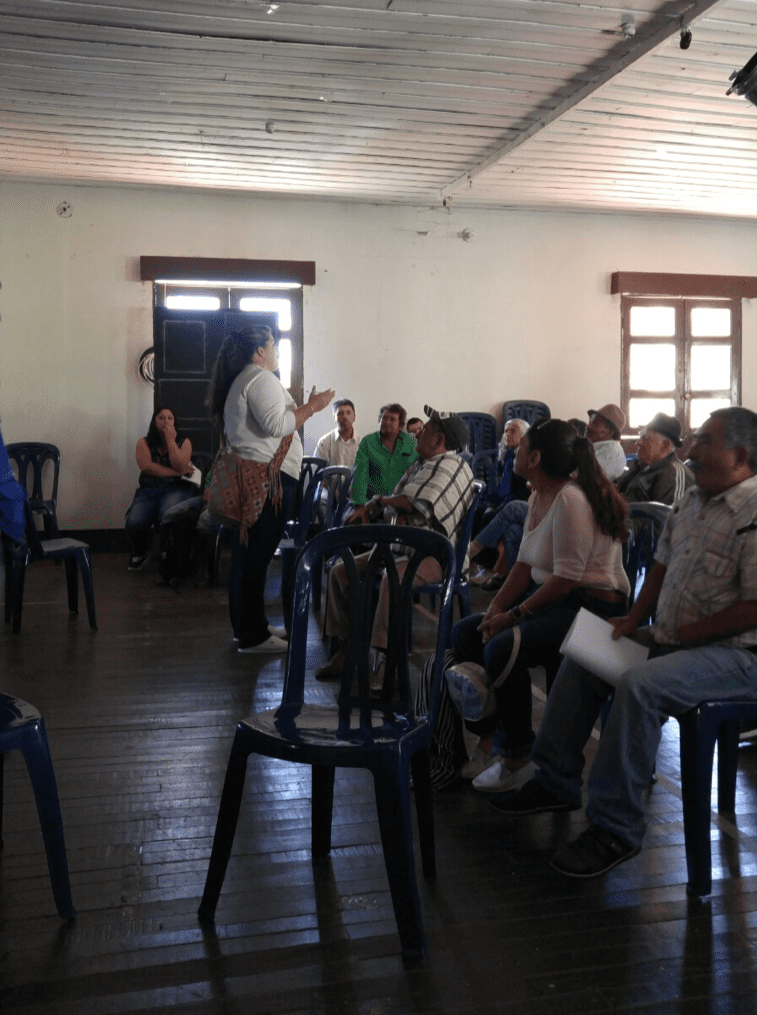
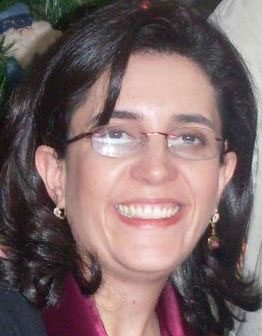
Gloria Ramírez, President of ASOVIDA introduces Jimena Perry to the crowd (Jimena Perry, 2017)

My dissertation is about the production of historical memories about the armed conflict in Colombia, including institutions like ASOVIDA and The Hall of Never Again, a space for remembering and honoring the victims of massacres, disappearances, targeted killings, bombings, and other forms of violence in Granada. Therefore, ASOVIDA´s president asked me to present my project before the assembly. She wanted me to tell the community why I am interested in ASOVIDA and the Hall, what I am going to do with the information gathered, and what benefits my work could bring to them. ASOVIDA´s president requested my presence at the assembly because some of my primary sources are the contents of so-called bitácoras, notebooks designed to make the victim´s grieving process easier. In these texts, one can read mothers talking to their children, husbands to their wives, brothers to sisters, children to their parents, and other family members remembering their departed loved ones. The bitácoras become both objects to be exhibited and historical sources for studying the violence endured by a particular person or family and how they survived. Bitácoras also provide an account of the story and character of the dead person, why he or she was important and help the public and visitors of the Hall to learn about local history and to link the survivors to community reconstruction processes. They are intimate accounts of the survivor’s feelings along with very personal stories, consequently, using them requires an ethical commitment and a deep respect towards their authors.

When requested to present my project before the assembly, my first reaction was surprise. Why should I do this? If the bitácoras are part of the Hall of Never Again´s exhibit they are already public records; they are meant to be read, but when I thought carefully about the request, I realized that the authors had reasonable suspicions. I am an outsider, a researcher who comes and goes; I have not suffered violence in the same way, and there I am using their cherished stories for an academic endeavor.
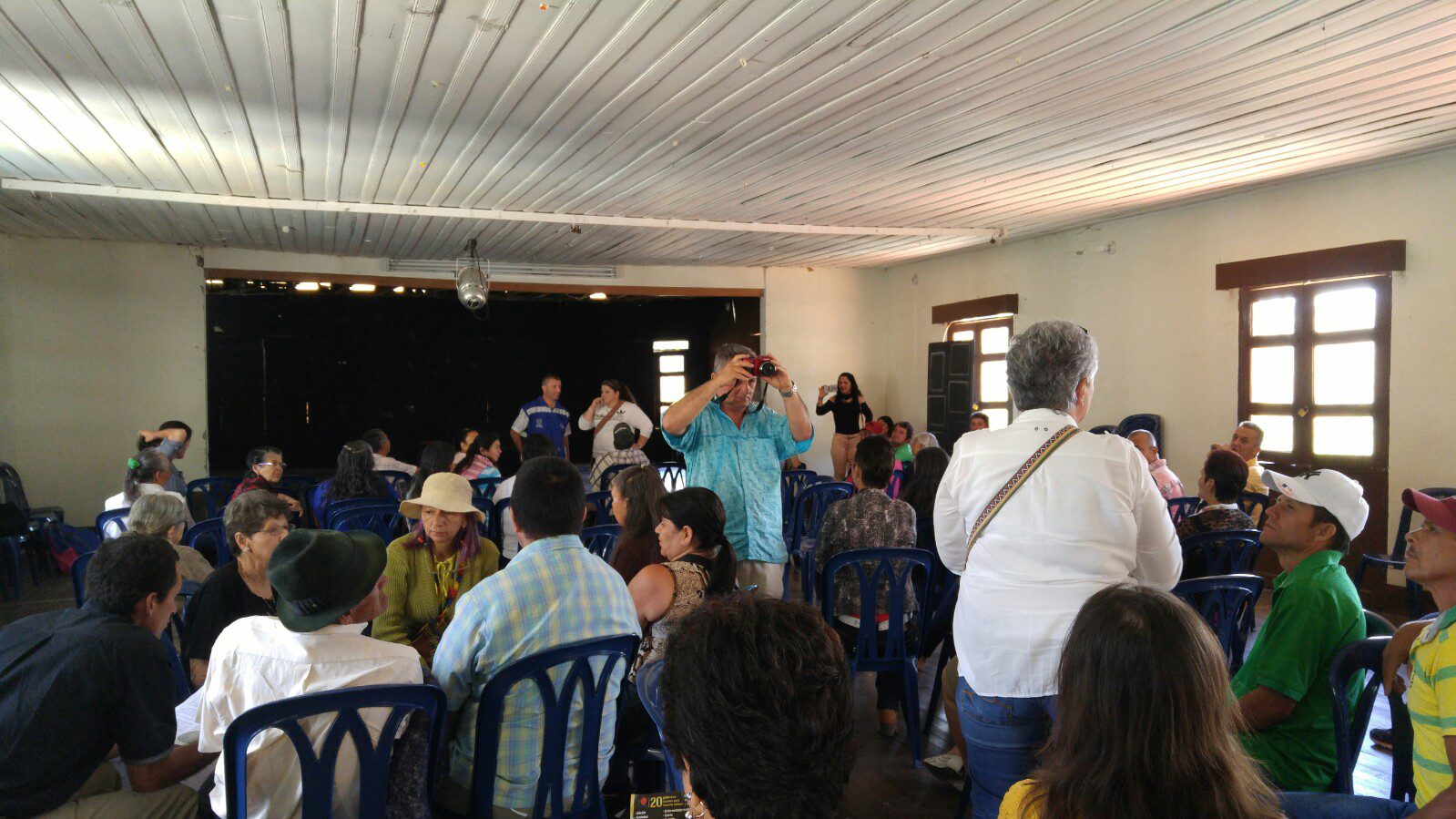
Assembly victims discussing about what forgiveness means to them (Jimena Perry, 2017)

It made even more sense when I saw the inhabitants of Granada at the assembly´s meeting. Regular people working to achieve peace in their town looked at me with curiosity. They wanted to know who was I and what was I doing there. Seeing all those people, interested in finding peace for themselves, their families, and town, I understood that academic research becomes secondary to dealing with people´s lives and feelings. I was willing to leave out of my dissertation the contents of the bitácoras if the community did not grant me permission to use them. The main purpose of my presence at the assembly was letting people know that I intend to use their stories in an academic endeavor, as an example of memory production ASOVIDA´s president introduced me and stated why I was there giving me the floor. I started by telling them about my own story. I mentioned my background, where I came from, and why I was so interested in the bitácoras. They listened carefully. I emphasized the academic purpose of my research and assured them that I would not use their names, that I was not going to sell their stories, and that when my research is over I would go back and show it to them. So far, I have traveled to Granada three times.

After my presentation, ASOVIDA´s president told the members of the assembly to think about my request to use their testimony. She asked them to consider why would they let me use their stories and to take their time. When the time for voting came, I was surprised and delighted with the results. The victims’ assembly approved my project and my use of the bitácoras by a vast majority. Then there were some questions and even suggestions. Granada´s victims want visibility, their voices heard, the world to know all the brutalities committed against them and their struggles for survival. Granada´s inhabitants believe that letting the world know what happened in their town can help prevent violent acts to happen again. With this in mind, they told me they granted their authorization to use their testimonies. I thanked them feeling grateful for their trust and an immense commitment to use my work to serve the people of Granada.
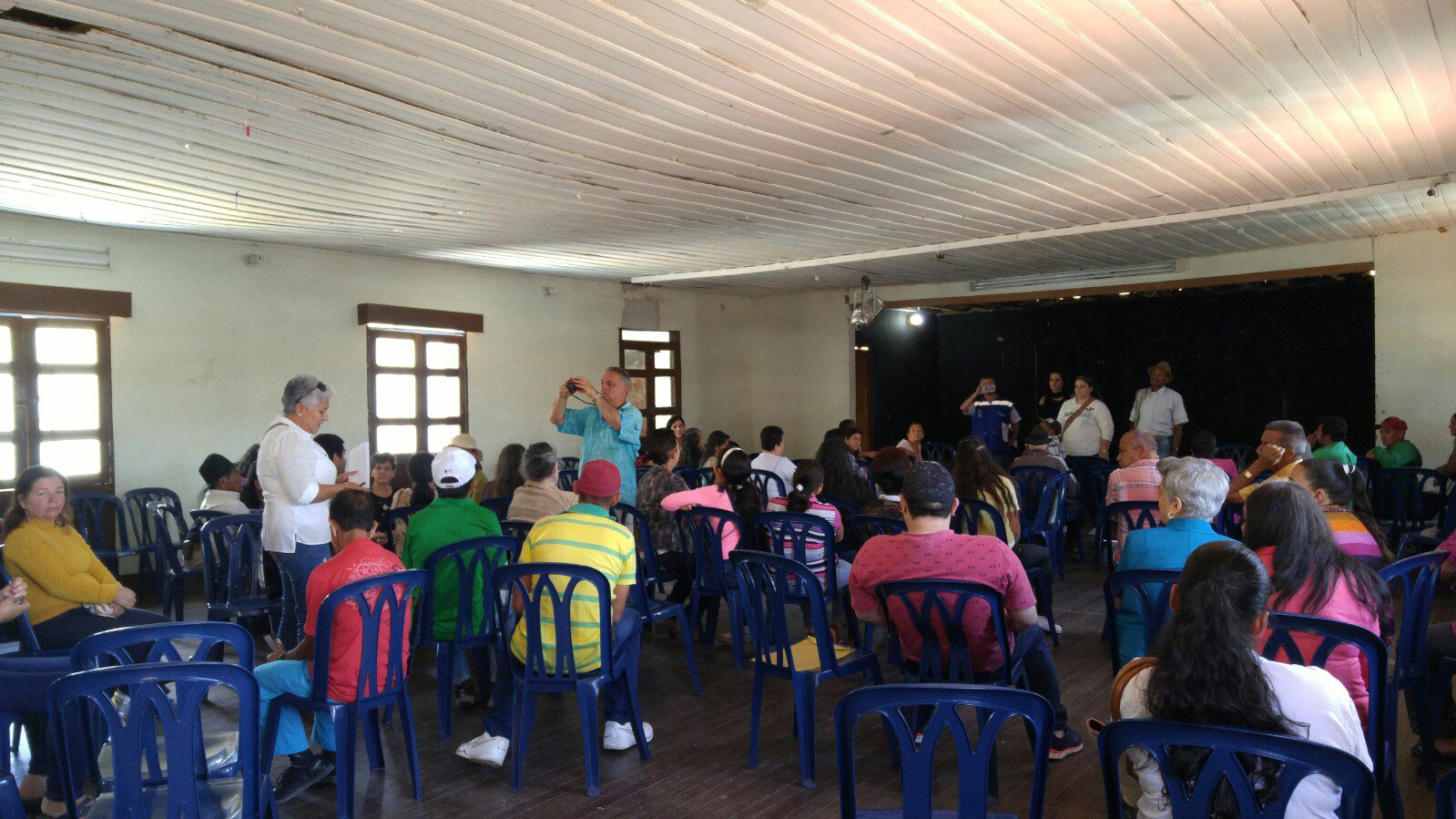
During this assembly the victims were asked to work in groups to think about what peace and reconciliation can be achieved in Granada (Jimena Perry, 2017)

This experience with Granada´s victims of violence changed my priorities regarding my work. I realized the enormous ethical commitment I had made in dealing with memories about a recent violent past that is still fresh, remembrances that still give people nightmares and fears. I also understood that more than the bitácoras, victims themselves are the ones who really matter. I knew this before, but seeing the people, talking to them, answering their questions raised different questions about academic research. How can one deal with intimate stories of pain without being disrespectful? How far must researcher go to achieve her or his goals? How to avoid being the kind of person that goes to a community, takes what is needed from the people, and never returns? How not to be another source of stress for the victims?

After speaking to the assembly and talking to the real protagonists of the Colombian armed conflict, I believe that analyzing the community coming to terms with its pain can encourage other social groups to do the same. In addition, I want to think that my work will inspire more victims to tell their stories and start a grieving process. I want to honor the trust Granada´s people gave me. I want my work to help them heal and I want to make the testimonies of the bitácoras known to as many audiences as possible. After attending the assembly, I feel that one of the priorities of my work should be writing a story in which the community of Granada can recognize itself. I want my dissertation to become a text in which the Granada inhabitants find their own voices. Memory production is an ongoing process that hopefully would continue until the victims feel their healing is complete, but meanwhile, their efforts for achieving peace in their town should be encouraged and acknowledged.

More by Jimena Perry on Not Even Past:

Too much Inclusion? Museo Casa de la Memoria, Medellín, Colombia
Time to Remember: Violence in Museums and Memory in Colombia, 2000-2014
History Museums: The Hall of Never Again


You may also like:

Madeleine Olson reviews Mapping the Country of Regions: The Chorographic Commission of Nineteenth-Century Colombia
Jorge Cañizares-Esguerra on Colombian history in the Netflix hit-series Narcos
Vasken Markarian traces complaint reports in the Guatemalan National Police Historical Archive
 

IHS Panel: The Confederate Statues at UT

What do statues commemorating Confederate leaders mean? Why has the university decided to remove such statues? And why has the issue been so controversial? On Thursday, August 31 2017, speakers from the University of Texas, the Texas State Historical Association, and the Briscoe Center for American History came together to address these questions and more.

Featured speakers included:

Walter L. Buenger
Chief Historian, Texas State Historical Association; Summerlee Foundation Chair in Texas History, and Barbara White Stuart Centennial Professor in Texas History | The University of Texas at Austin

Peniel E. Joseph
Director of the Center for the Study of Race and Democracy; Barbara Jordan Chair in Ethics and Political Values in the Lyndon B Johnson School of Public Affairs; and Professor of History | The University of Texas at Austin

Ben Wright
Associate Director for Communication at the Briscoe Center for American History and curator of “From Commemoration to Education: Pompeo Coppini’s Statue of Jefferson Davis” | The University of Texas at Austin

with

Jacqueline Jones, Moderator
Professor and Chair of the Department of History; Ellen C. Temple Chair in Women’s History; and Mastin Gentry White Professor of Southern History | The University of Texas at Austin

This event was sponsored by the Institute for Historical Studies.

Connected content:

Mark Sheaves on slavery and its legacy in the USA
Leslie Harris and Daina Ramey Berry on history and memory in Savannah
Jacqueline Jones discusses Civil War Savannah


The views and opinions expressed in this article or video are those of the individual author(s) or presenter(s) and do not necessarily reflect the policy or views of the editors at Not Even Past, the UT Department of History, the University of Texas at Austin, or the UT System Board of Regents. Not Even Past is an online public history magazine rather than a peer-reviewed academic journal. While we make efforts to ensure that factual information in articles was obtained from reliable sources, Not Even Past is not responsible for any errors or omissions.

Time to Remember: Violence in Museums and Memory in Colombia, 2000-2014

By Jimena Perry

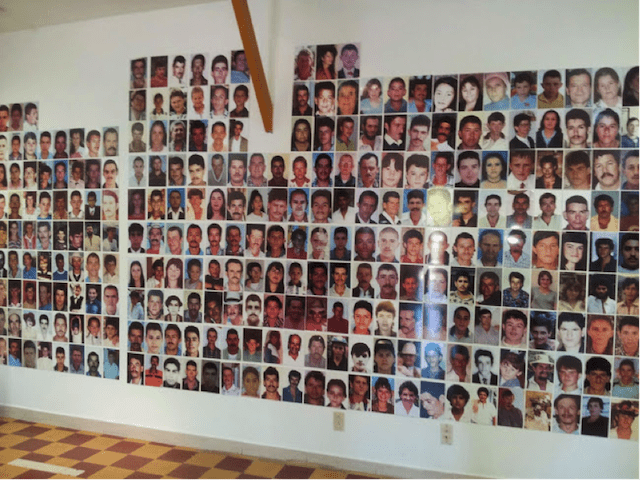
Jimena PerryDuring the summer of 2014 I had the chance to visit the Hall of Never Again (El Salón del Nunca Más) in the Department of Antioquia, in northwest Colombia. What started just as a tourist visit soon became a research interest. Growing up in a country overwhelmed by an ongoing armed conflict, the Hall made quite a huge impression on me due to the visual narrative it contained. Photographs of the faces of approximately180 victims of the violence are displayed on a wall to highlight a history in which the victim’s voices are privileged. It was quite different from the discourses shaped by state institutions such as the National Museum of Colombia that feature official histories about national identity and citizenship. These contrasting accounts of recent brutalities in Colombia made me want to explore the ways that individuals and communities remember their violent pasts. Grieving, as part of a remembrance process, has no handbook and no formulas; it is not a unilinear process. It is complex and ongoing. Grief and memories of violence are informed by history and culture and require to be understood as a social dynamic practice.

The Colombian violence of the 1980s, 1990s, and early 2000s, the subject of my work, left many victims. It also left many survivors of atrocities who needed some kind of closure in order to continue with their lives. During these decades, civilians found themselves caught among four armed actors: the National Army, paramilitaries, guerrillas, and drug lords, who were fighting over the control of land and civilians. These groups committed brutalities such as kidnappings, disappearances, forced displacement, bombings, massacres, and targeted murders. In order to cope with and overcome the trauma caused by all this violence, diverse communities set up museums and displays. These acts of memory and reconciliation demonstrate that people and communities remember and represent the past differently. Some exhibitions portray violence, others focus on personal histories and others turn to the strength their cultural traditions give them. They contain different meanings and intentions, and take a variety of forms including traveling museums, murals, houses, kiosks, and even cemeteries devoted to remembering the ones who are gone. But they all work towards the same goal: never again.

View of the wall with the pictures at the Hall of Nevermore.

View of the wall with the pictures at the Hall of Nevermore. Courtesy of the author. 

My interest in studying historical representations of violence was sparked when I realized that in Colombia, memories about the atrocities of the 1980s, 1990s, and early 2000s are quite diverse and do not appear in state institutions. I also came to understand that although grieving has a place for the reconstruction of facts and a search for “truth,” these are not the most important aspects for individuals and communities. After talking with community leaders and reading the scholarship on memory and museums, I can say that instead of truth quests people want to feel that their absent loved ones are not forgotten, that their lives meant something.

The Center for Memory, Peace, and Reconciliation, Colombia.

The Center for Memory, Peace, and Reconciliation, Colombia. Courtesy of the author.

Part of the attention that communities are devoting to the production of historical memories of violence is closely related to the diverse healing processes grounded in local cultures. The rural memory venues I am researching emphasize local traditions, beliefs, and patterns of behavior. Their displays illustrate how violence altered their way of life and how individuals and groups are coping with new realities, silences, and absences. Culture becomes a cohesive factor, the resource communities appeal to in order to heal and envision a future.

Therefore, my research has two major parts. First, it relies on ethnographic descriptions of the memory sites and the violent episodes they are representing. Second, these memories of violence help me analyze how contemporary citizenship is understood in Colombia, as rooted in these communities’ struggles with the violence past

And my research has a third component—public history. Writing and researching about memory venues in Colombia is my way of helping in the healing of local communities. My wish is that my work will help people feel that their histories are not forgotten and that they are an inspiration for generations to come.

I also want my writing about memory venues in Colombia to contribute to a new, more diverse, sense of national identity. I want the narratives portrayed in these venues to be incorporated into a national discourse. One of my hopes is that by reading about the testimonies and descriptions about recent Colombian violence in local memory projects, the general public can go beyond the gory details about violence and remember the victims as living family and community members, and as part of the Colombian community. My aspiration is that the diverse Colombian voices become part of the project of nation-state building. Everybody talks about the importance of respecting and understanding other ways of seeing the world, but when it comes down to concrete political actions, alterity is often ignored.

bugburnt

You may also like these articles by Jimena Perry on two museums that represent the Colombian violence since the 1960s: the Hall of Never Again, a community-led memory museum in Colombia, and The Center for Memory, Peace, and Reconciliation, Bogotá, Colombia

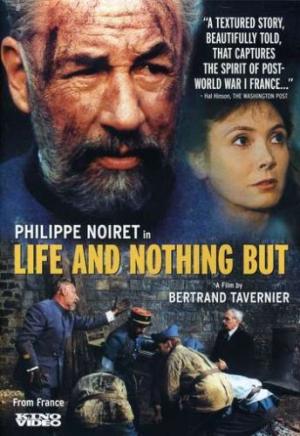
Life and Nothing But (1989)

By Judy Coffin

French historians love this film.  It’s hard to convey the horrors of what was long called The Great War: the almost unimaginable losses at battles like Verdun and the Somme; the mobilization of whole economies, states, and societies to supply those battles and to replenish the men and material afterwards; the stench of rotting corpses (human and animal) in the trenches; and the grinding boredom of trench life – interrupted by terrifying bombardment or the dreaded command to go “over the top,” through the mud, barbed wire, and, further on, the machine gunners on the enemy side. Life and nothing butStanley Kubrick’s Paths of Glory (with Kurt Douglas, 1957) captures some of the view from the trenches. So does PBS’s multi-disc documentary: The Great War and the Shaping of the Twentieth Century.  Not surprisingly, though, the most popular films about World War I – like the brilliant Lawrence of Arabia  — are set far from the un-cinematic slog of the western front. Life and Nothing But is set on the front, but after the war, where the French are trying both to tally their losses and commemorate their victory. Both projects are heartbreaking and, in some important sense, impossible. That’s the point, and the film captures one of the tragedies of war and a more specific tragedy of twentieth-century French history.

Philippe Noiret plays French Major Delaplane, charged with trying to discover the fates of the over 300,000 French soldiers missing at the end of the war. Most of them were dead, it would turn out. 1.4 million French soldiers were killed, out of 8.4 mobilized. Delaplane presides over a ramshackle, improvised office filled with clerks compiling lists of the dead and descriptions of the missing. In the psychiatric hospital next door, teams of doctors work with soldiers whose minds have been destroyed: trying to get them to walk, to speak, or to recover bits of memory that might help to identify them. In the surrounding countryside, crews dig in a tunnel that had been mined by the Germans, destroying a Red Cross train and the wounded it was carrying. On designated days families of the missing are permitted on site, and they comb through long tables of rings, watches, and occasionally photographs searching for bits and pieces of their loved ones’ lives.

Into this melancholy scene come two women. Irène de Courtil, (Sabina Azena) wealthy and beautiful, is looking for her missing husband and the much younger, middle-class Alice (Pascale Vignal) searching for her fiancé, whom she met while he was a soldier. Alice had taught school during the war, but then had to give up her post to a veteran returning from the front. (This is a nicely understated rendering of the government’s policy after World War I.) She now is working in a café in the area near Delaplane’s project, hoping for news.

No spoilers here, and the plot matters! But you will find love, of course, and deception, class resentments, and cynicism (softened by love). It’s not grim, but haunting. It’s hardly an action film –- I don’t want you to be disappointed — but then World War I was not usually an action war. It’s about a country whose past is mined, literally and figuratively, but which is compelled to return to that past. It’s about memory, a subject that has fascinated historians for decades now. It’s smart about commemoration: Tavernier makes us ask what the French state wants to commemorate and how, what the families want to remember, and what Delaplane, Irène, and Alice, respectively, are looking for. It’s acerbic about the politics of commemoration too. Delaplane has to produce a body for the Tomb of the Unknown Soldier. “Ah non,” the government’s representative says refusing one of the bodies that the major offers him: “certainly not a black!” Why not? Roughly half a million troops from France’s colonies fought in the war.

France’s victory cost more than the country could pay. Reparations would prove a dangerous illusion. We know this, and we know what happened in a few decades later. But this film doesn’t preach or offer general lessons: it looks closely at a grieving culture, trying to gather up the pieces and move on – to what we now know will be another war.

More great French war films:
François Truffaut, The Last Metro

Marcel Ophuls, The Sorrow and the Pity

Marcel Ophuls, Hotel Terminus: the Life and Times of Klaus Barbie

Jean-Pierre Melville, Army of Shadows

Joseph Losey, Mr. Klein

Louis Malle, Au Revoir les Enfants

« Previous Page

Recent Posts

  • The Battles of the Alamo and the Myth of Southern Exceptionalism
  • Primary Source: Magic, Metal, and Medicine in Leonhard Thurneysser’s Paracelsus
  • Faculty Spotlight: Dr. Kate Imy
  • La Historia del Tiempo Presente en México: un campo en construcción
  • The History of the Present Time in Mexico: A Field in Formation
NOT EVEN PAST is produced by

The Department of History

The University of Texas at Austin

We are supported by the College of Liberal Arts
And our Readers

Donate
Contact

All content © 2010-present NOT EVEN PAST and the authors, unless otherwise noted

Sign up to receive our MONTHLY NEWSLETTER

  • New
  • Features
  • Reviews
  • Texas
  • Teaching
  • Digital
  • Watch & Listen
  • Authors
  • About