• New
  • Features
  • Reviews
  • Texas
  • Teaching
  • Digital
  • Watch & Listen
  • Authors
  • About

The past is never dead. It's not even past

Not Even Past

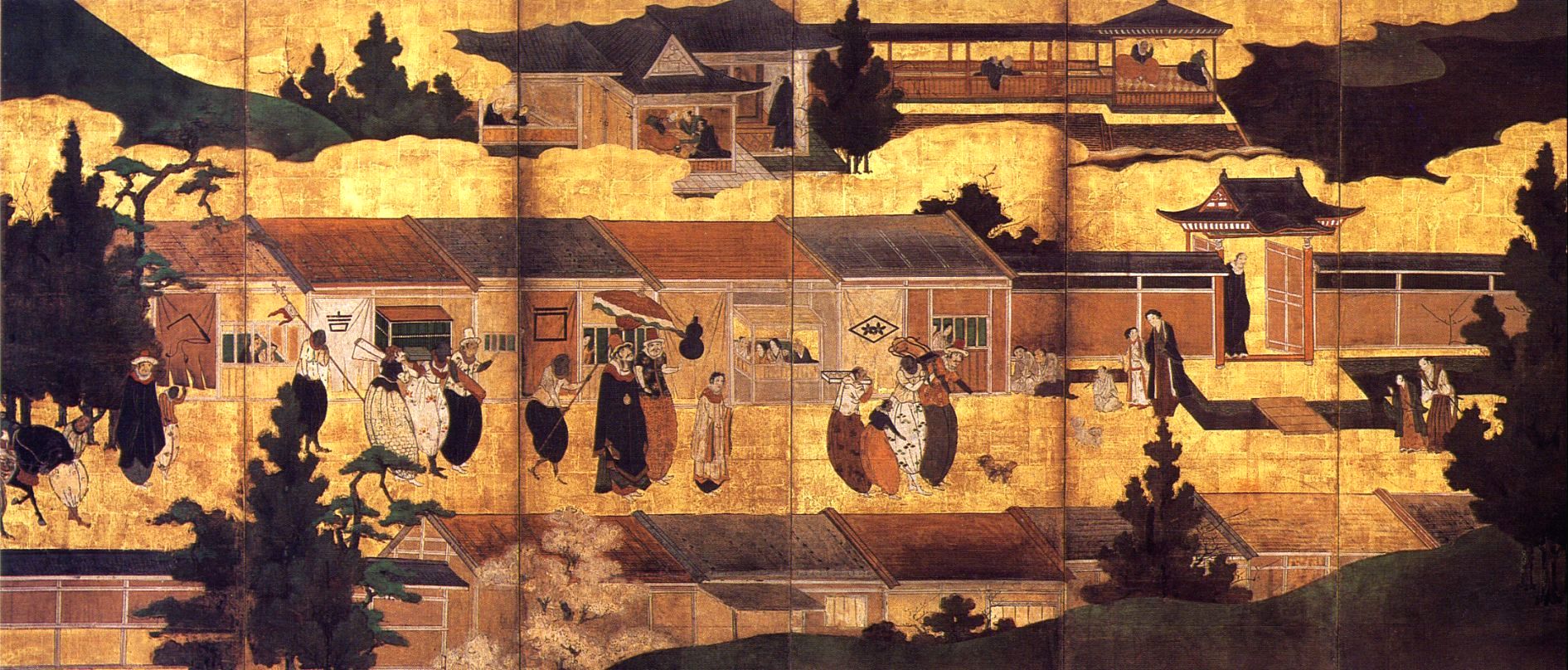
Nanban Art: Colonial Latin America Through Objects (No. 2)

(via Wikimedia Commons)

This series features five online museum exhibits created by undergraduate and graduate students at the University of Texas at Austin for a class titled “Colonial Latin America Through Objects.” The class assumes that Latin America was never  a continent onto itself. The course also insists that objects document the nature of historical change in ways written archives alone cannot.

John Monsour’s exhibit on Nanban screenfolds exemplify the deep connections of the colonial Americas to early-modern Japan. Portuguese Jesuits and merchants arrived in southern Japan in the mid-sixteenth century with commodities from India, Europe, and the Americas and with hundreds of Luso-Africans. The foreigners were called “Nanban” (barbarians from the south). The Jesuits gained a foothold with Japanese lords that led to the massive conversions of commoners and nobles. Jesuits and Japanese artisan established workshops that produced many Nanban objects, including screenfolds documenting new European cosmographies. The maps also document the introduction of  Chinese-Korean maps. Monsour’s exhibit shows the maps on Edo workshops led by Jesuit and the new cosmographies they engendered.

More from the Colonial Latin America Through Objects series:

Of Merchants and Nature by Diana Heredia López

You may also like:

Brittany Erwin reviews The Archaeology and History of Colonial Mexico by Enrique Rodriguez Alegría
Acapulco-Manila: the Galleon, Asia, and Latin America, 1565-1815 by Kristie Flannery
Purchasing Whiteness: Race and Status in Colonial Latin America by Ann Twinam
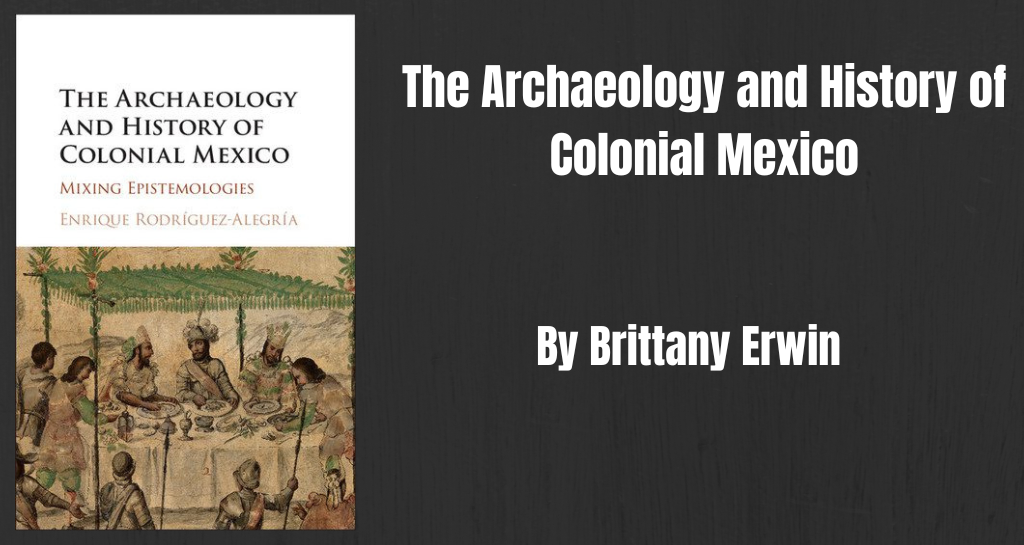
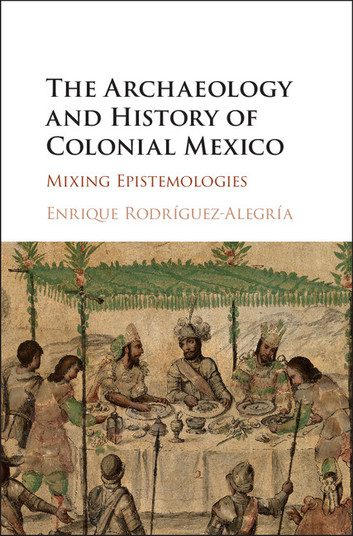
The Archaeology and History of Colonial Mexico by Enrique Rodríguez Alegría (2016)

In this study of the social significance of material culture in Mexico City and Xaltocan in the early colonial period, Rodriguez Alegría uses a variety of sources, including archaeological evidence relating to food consumption, catalogues of ceramic sherds from several dig sites in these cities, and wills, stock lists, and auction records. His use of archaeological data and historical records together reveals the benefits of incorporating disparate kinds of evidence: the archaeological data on food and material consumption filled in the blanks of historical records, which often leave out explicit descriptions of such daily practices.

The works of historians and anthropologists frequently overlap in theme and subject, however, the two disciplines gather and use evidence differently. Rodríguez Alegría argues that such differences should not stand in the way of interdisciplinary investigations. His main contribution is a discussion of the ways scholars conceptualize their methodologies. He asserts that in an interdisciplinary study, there should not be a contest over which kind of evidence is more worthwhile. Rather, researchers should pay careful attention to the implications of the interpretative strategies they use.

Part of what makes his methodology innovative is his acceptance of the inherent incommensurability of archaeological and historical evidence. He outlines common interpretative strategies used in each of these disciplines, openly acknowledging the differences between them. For archaeologists, analogical reasoning is common because it allows them to utilize “known behaviors in the present” in order to shed light on “unknown behaviors [of] the past.” Historians, on the other hand, tend to conceptualize evidence from their documents as synecdoches, “where qualities or practices found in a document or a few documents are replicated to stand for wider processes or patterns in a society.”

In his openness to the contradictions that result from simultaneously using these distinct methods, Rodríguez Alegría creates a provocative rejection of the established practice of seeking an uncontested line of reasoning. He asserts that the incorporation of more evidence fundamentally creates a more nuanced understanding, even if all the pieces do not come together to neatly form a single image. As a result, both the synecdoche favored by historians and the analogy used in anthropology have their place in a single work.

Rodríguez Alegría provides numerous examples of the benefits of interdisciplinarity, including his illustration of how quantitative and qualitative analysis of pottery fragments combine with historical data on markets and production methods to reveal new understanding of of the role of pottery in these cultures. In that sense, the writing and presentation style achieves the important goal of encouraging cross-disciplinary understanding.

The most compelling aspect of this work is the author’s insistence that scholars redirect their attention towards a more critical analysis of how they interpret their evidence. Forcing this awareness about discipline-determined approaches to data analysis promises new insights, but it also presents potential problems. At some point, scholars have to assert a coherent narrative, or at least a conceptual image, of the phenomenon under investigation. That process inherently requires a selection of relevant information. If scholars choose to incorporate apparently contradictory data collected outside of their discipline, they could face criticism for knowingly promoting an argument that goes against some of the data. It is possible that the scholarly community as a whole would resist this approach because of the widely ingrained attachment to uncontested narratives that Rodríguez Alegría criticizes.

This work prompts an important reexamination of disciplinary divisions and approaches to the interpretation of evidence. It fundamentally brings the question of what makes a document representative of a larger phenomenon to the forefront of historical analysis. Furthermore, it encourages scholars to think about how their investigation engages with contextual information from unwritten sources. Overall, Rodríguez Alegría’s book opens up an important discussion on the value of questioning the validity of even the most standardized interpretive strategies. As he points out, establishing a narrative is fundamental for historians because of its apparent utility in illustrating change over time. It is also, however, a method that reflects our aesthetic preference for presenting information this way. Both historians and anthropologists must, therefore, aim to break down barriers that would prevent the fruitful sharing of methodologies between disciplines.

Also by Brittany Erwin on Not Even Past:

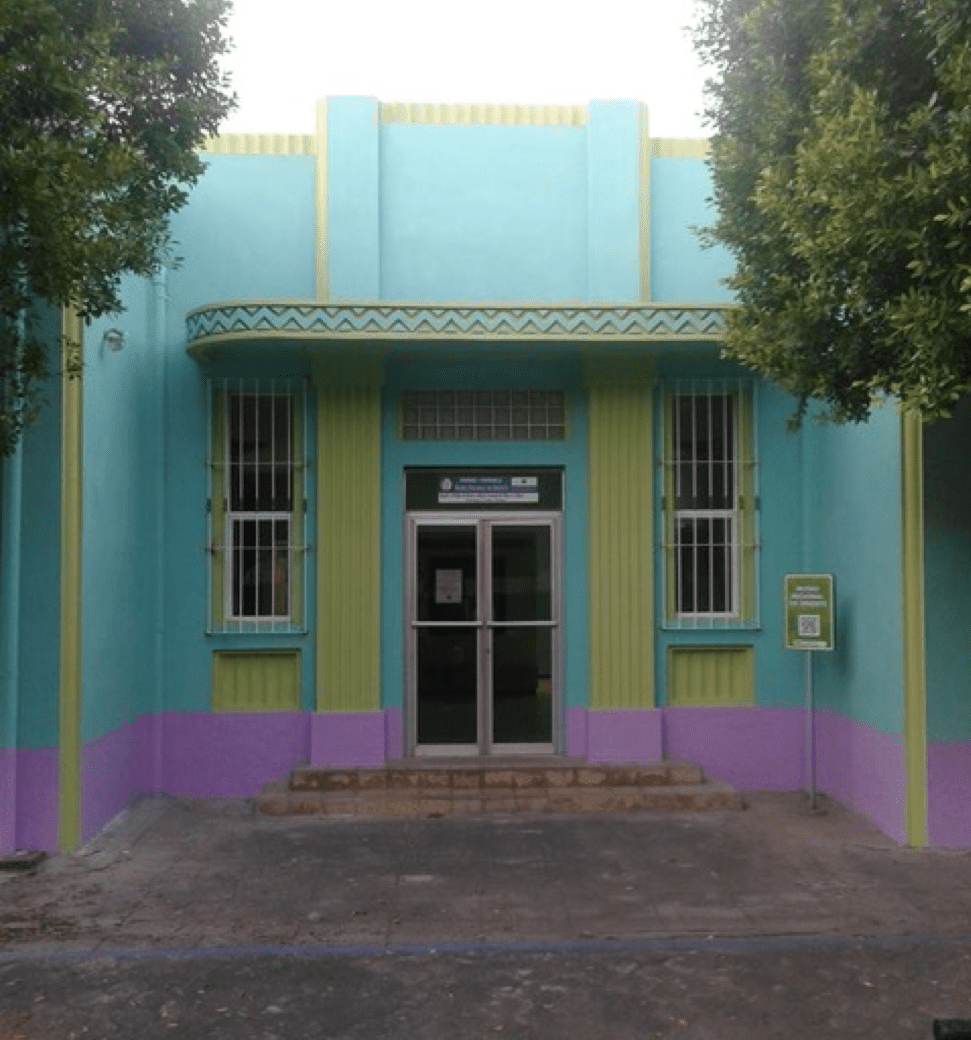
The Museo Regional de Oriente in San Miguel, El Salvador
The National Museum of Anthropology in in San Salvador

You may also like:

Haley Schroer reviews Infrastructures of Race: Concentration and Biopolitics in Colonial Mexico by Daniel Nemser (2017)
Explore Diana Heredia’s virtual exhibition “Of Merchants and Nature: Colonial Latin America through Objects”
Ann Twinam reviews No Mere Shadows: Faces of Widowhood in Early Colonial Mexico by Shirley Cushing Flint (2013)

Of Merchants and Nature: Colonial Latin America Through Objects (No. 1)

(via Biblioteca Medicea Laurenziana)


This new series features five online museum exhibits created by undergraduate and graduate students at the University of Texas at Austin for a class titled “Colonial Latin America Through Objects.” The class assumes that Latin America was never  a continent onto itself. The course also insists that objects document the nature of historical change in ways written archives alone cannot.

Diana Heredia López’s exhibit centers on the Florentine Codex, a twelve volume encyclopedia of Aztec knowledge compiled by Franciscan friars and dozens of Nahua scribes trained in the mid sixteenth century in in Latin and classical learning. These polyglot Indians surveyed the natural history of central Mexico using Pliny’s model. The latter described objects along the ways they were processed, consumed, and transformed. She focuses on Nahua agave, cotton, figs, and gourds and the fabrics and containers they engendered.

The Museo Regional de Oriente in San Miguel, El Salvador

By Brittany T. Erwin

In the tiny nation of El Salvador, the West dominates. As a result of commercial and political relationships that developed in the nineteenth and twentieth centuries, there has been significant influence in this Central American country from the United States and Western Europe. However, within the Salvadoran context, the predominance of western history and culture refers to the marked differences between the eastern and western regions of the country, and the east often gets the short end of the stick. One institution born in 1994 pushed back against this enduring stigma by celebrating the difference of the east.

In the west of this mountainous and volcano-ridden country lies the capital city of San Salvador. Founded in 1524, this sprawling metropolis is home to busy streets and extensive networks of both interregional and international exchange. Far away from that hustle and bustle, and at the foot of the frequently active Chaparrastique Volcano, lies San Miguel. This city, the third-largest in the nation is the proprietor of the first museum built in the eastern half of the country.

Museo Regional de Oriente (Brittany Erwin, 2017)

Housed in a former textile factory and one-time military complex, the Regional Museum of the East (Museo Regional de Oriente) tells the story of the east through the multidisciplinary lenses of archaeology, ethnography, and history. Under the direction of Saúl Cerritos, this institution promotes a celebration of the distinct history and heritage of the East. Even without capital-city resources, it tells the important stories of indigenous life in the pre-hispanic era, the complexities of sociocultural interactions during centuries of conquest and immigration, and the resulting diffusion of cultural practices that continues today.

The collections begin with a display of ceramic artifacts whose particular motifs and production techniques place them firmly outside the Mayan influence that permeates western El Salvador. Extensive historical context in Spanish and English accompanies these carefully preserved pieces, dating from the Paleo-Indian period through the post-Classical period, which ends around the time of Spanish contact.

The exhibitions then shift to reflect the living culture of the zona oriental. Displays of artisanal products and pottery with both a modern presence and historical roots reveal the enduring influence of indigenous culture. The final permanent exhibition hall showcases the dozens of local festivals that guide public life in the city and throughout the east. From the elaborate costumes they inspire to the coordinated offerings and ritualized dances that they require, these fiestas reveal an important aspect of local identity. On that note of energetic cultural pride, the tour concludes.

Inside the Museo Regional de Oriente (Brittany Erwin, 2017)

The museum also houses two temporary exhibits, which change several times a year to reflect contemporary issues of historical interest and investigation. Currently on display are a photographic history of the railroads that connected the people and markets of the East until the early 2000s and an exhibit reflecting on the nation’s anniversary of peace after the civil wars of 1980-1992.

This modest museum, constructed in the shadows of its influential western rival leaves a strong impression. Through a careful selection of local artifacts and the presentation of a region-centered dialogue, it encapsulates both the history and culture of the proudly idiosyncratic eastern region of El Salvador.

You may also like:

Julia Guernsey discusses the links between sculpture and political authority in Mesoamerica
Vasken Makarian reflects on Central American history through digital archives
Jimena Perry on memory and violence in Medellín’s House-Memory Museum, Colombia

Historical Objects: Latin America

“Colonial Latin America Through Objects” is a class taught by Prof. Jorge Cañizares that offers a view of a region’s past by exploring material remains: currencies, playing cards, musical scores, water mills, comets, relics, mummies, coded messages, to name only a few of the 50 objects studied. The class introduces students to a region from unusual angles that upset deeply seeded assumptions about Hispanics.

The students are required to produce two online museum exhibits. The five best exhibits for the mid–term are sampled here. These five exhibits address unusual aspects of colonial Latin America through their material culture. Click on links to see full exhibits (and credits for images).

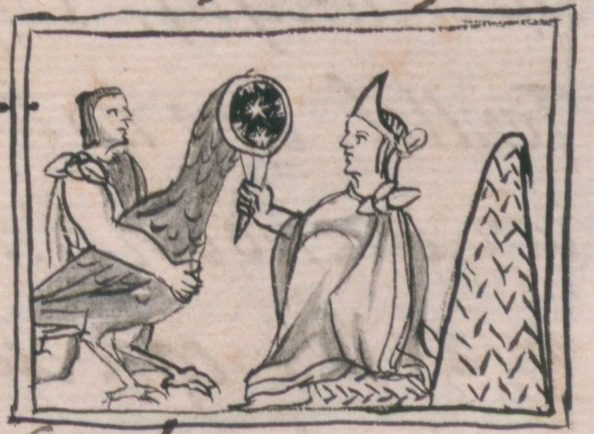
The history of conquest as described in sixteenth-century indigenous codices by Tymon Sloan

Bernadino De Sahagun, Illustration of the Mirror-Faced Bird, La Historia Universal De Las Cosas De Nueva Espana,1577 Ink on Paper Medicea Laurenziana Library, Florence, Italy

Bernadino De Sahagun,
Illustration of the Mirror-Faced Bird, La Historia Universal De Las Cosas De Nueva Espana,1577
Medicea Laurenziana Library, Florence, Italy

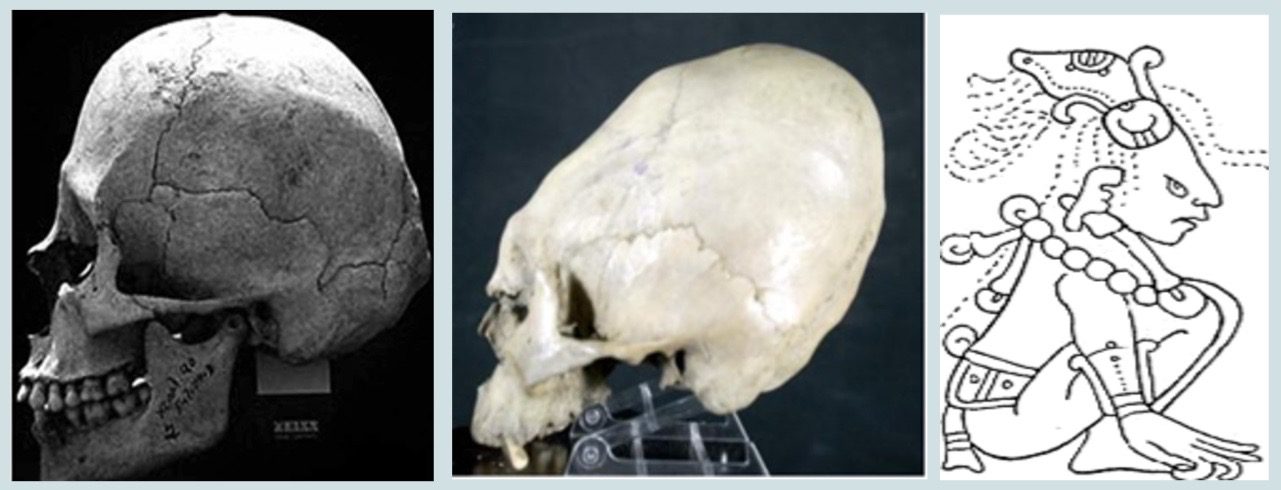
Cranial Deformity and Identity by Aaron Quintanilla

skulls

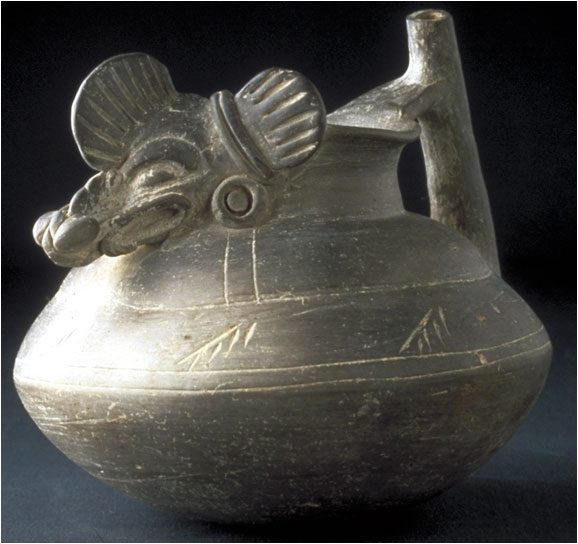
Native Drinking Cups of the New World by Riley Reynolds

choc-vessel

Ancient Zapotec Chocolate Vessel (Gardiner Museum of Ceramic Art)

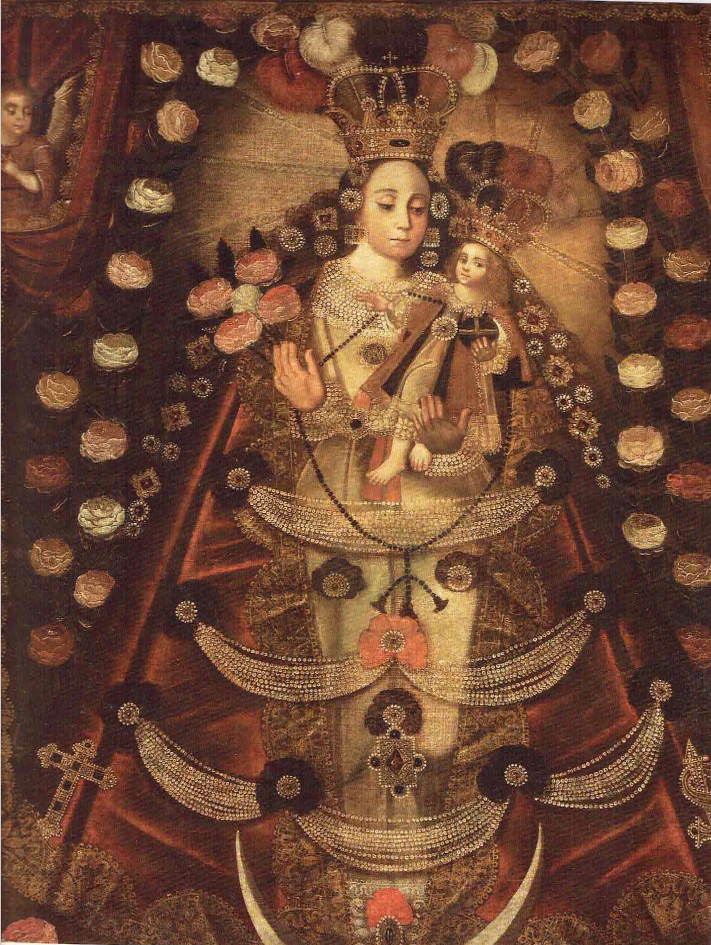
Syncretism and Marian Representations by Lily Folkerts

our-lady-of-the-rosary-of-pomata

Our Lady of the Rosary of Potama (Anonymous, 17-18c, New Mexico History Museum)

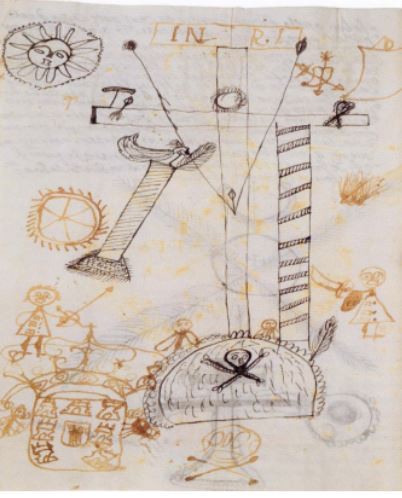
Las Bolsas de Mandingo: Deconstructing Misconceptions of Traditional African Religions in the Luso-Atlantic World, by Maryam Ogunbiyi

bolsas

Manuscript showing syncretism of African and Portuguese Catholic representations

bugburnt

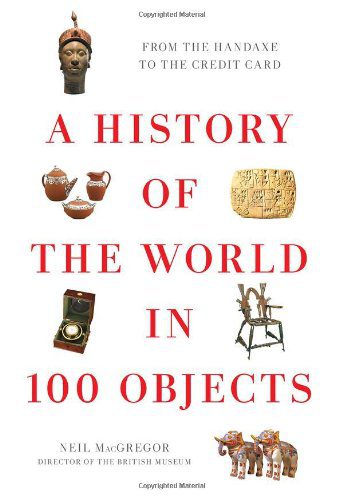
A History of the World in 100 Objects by Neil MacGregor (2011)

by Cynthia Talbot

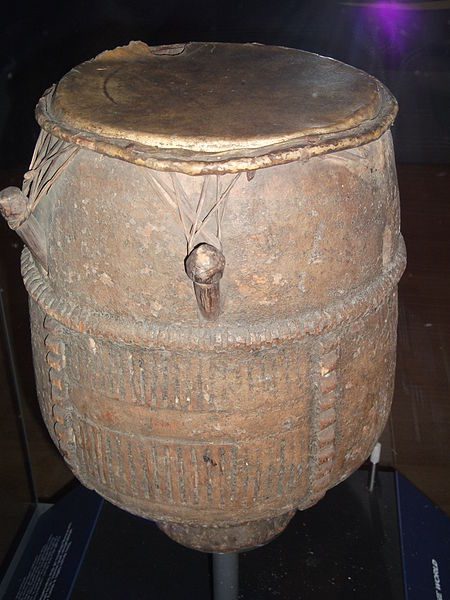
Objects not only inform us about the time and place when they were made, but often have subsequent biographies of use that shed light on later historical developments.  Take this wooden drum acquired in Virginia around 1730 and sent to a wealthy collector in England.

510rjJmFWxLIdentified as an American Indian artifact, it was one of 71,000 items in the founding collection of the British Museum, the world’s first national public museum.  Since its founding in 1753 the British Museum’s collection has grown to more than 8 million objects, yet this drum still holds a special significance.  A recent examination of the instrument’s wooden body revealed that it was made in West Africa, even though it had been obtained in North America and was long assumed to be of American Indian origin.  Scholars now believe that the drum traveled across the Atlantic in a slave ship and spent some time on a Virginia plantation before winding up in London.  It is a remnant, in other words, of the Atlantic slave trade, as well as of the Enlightenment impulse to collect and classify material from around the world.

 The fascinating past lives of this drum are among the many glimpses into complex historical processes offered by A History of the World in 100 Objects  by Neil MacGregor, the Director of the British Museum. 

image

Based on a set of radio programs aired in 2010 by the British Broadcasting Company (BBC) in collaboration with the British Museum, the book is a later print adaptation that closely follows the contents of the radio broadcasts.  The twenty parts into which the book is divided, each covering 5 objects, are organized both chronologically and by theme.  Collectively, the objects cover a breath-taking expanse of time, beginning with a stone chopping tool from the famous Olduvai Gorge dating back about two million years and ending with a Chinese solar-powered lamp made in 2010.  They come from all over the globe: Papua New Guinea, Peru, Pakistan, Paris, and St. Petersburg, among other places. 

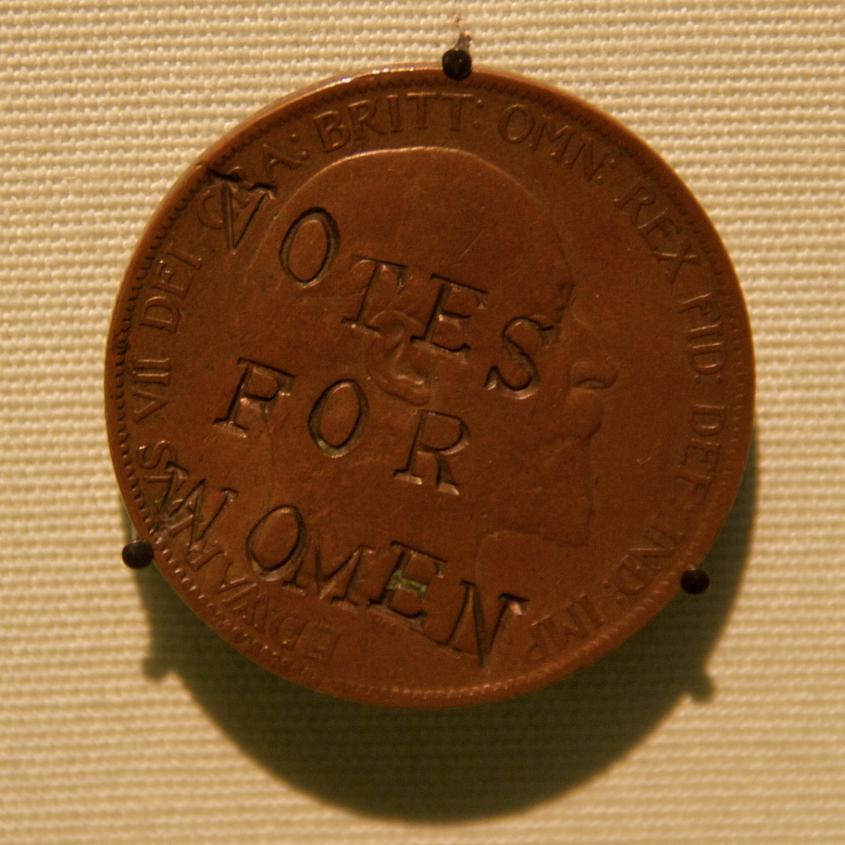
Suffragette-defaced_pennyAlong with representing numerous societies from around the world, the 100 items also illustrate the wide variety of material objects that humans have created over time.  A ceramic roof tile from Korea, a bark shield from Australia, and a North American stone pipe are included in the selection, along with stone sculptures, paintings, and luxury goods that are more typical of museum exhibits.  One of the most interesting objects from the perspective of everyday life is a British penny minted in 1903 that someone illegally stamped with the slogan “Votes for Women.” Defacing coinage was among the milder tactics adopted by British suffragettes in their long campaign to obtain voting rights for women, but it was an effective way to spread their message.  They finally achieved success in 1918.

The diversity of objects contributes to the success of this project, but so too does Neil MacGregor’s engaging style of communication and constant attention to the significance of the artifacts, not only for the societies where they originated but also in terms of the larger world.  In the section on the Lewis Chessmen, for example, MacGregor shows how things like chess pieces can teach us about the societies that produced them.

Beserker2C_Lewis_Chessmen2C_British_MuseumMade out of walrus ivory in the late twelfth century, probably in Norway, the Lewis Chessmen were discovered buried in a sand bank on Lewis Island in 1831.  The Norse influence on this part of Scotland is revealed in the “berseker” chess pieces derived from the fierce warriors of Old Norse literature, the equivalent of the modern rook.  Another piece in this and other European chess sets, the bishop, replaced the war elephant of the original Indian game, in a reflection on the powerful role played by churchmen in medieval Europe.

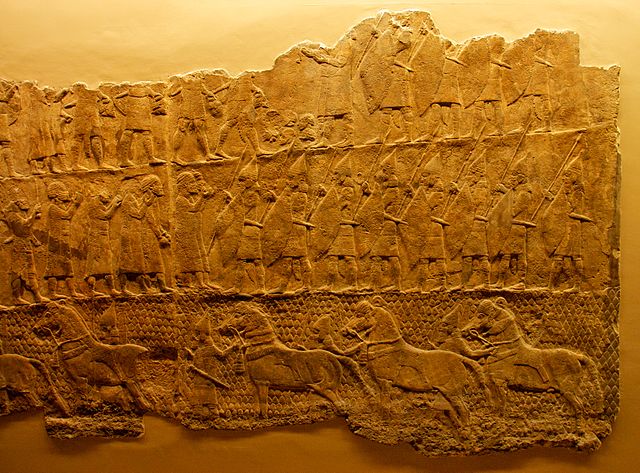
MacGregor is also skilled at highlighting how objects convey human experiences that transcend the barriers of time and place.   We learn not only about the techniques of warfare from relief sculpture that depict the conquest of the Biblical town Lachish ca. 700 BCE, but also about the suffering of the local people after they surrendered to the Assyrians.  MacGregor compares the Assyrian practice of forcibly resettling conquered populations to Stalin’s mass deportations in the Soviet Union during the 1930s-50s, and to the displacement of many refugees in the recent Balkan conflicts.  

640px-Lachish_Relief2C_British_Museum_1All in all, A History of the World in 100 Objects is an impressive achievement: a captivating introduction to the main themes of world history by means of a focus on tangible artifacts.  The British Museum and the BBC have done a commendable job of making it accessible to the public, as well, through their companion websites.  The original radio programs can still be heard online or downloaded as podcasts, while one or more images of each object can also be viewed along with a map of its original location.  There is even a section for teachers containing lesson plans and a game, making this an even more useful resource for the classroom.

Companion websites:

100 Objects at The British Museum
100 Objects at the BBC

You may also like:

Enlightenment: Discovering the World in the Eighteenth Century  (2003),
Kim Sloan, editor

“A History of New York in 50 Objects”

Photos courtesy of Wikimedia Commons

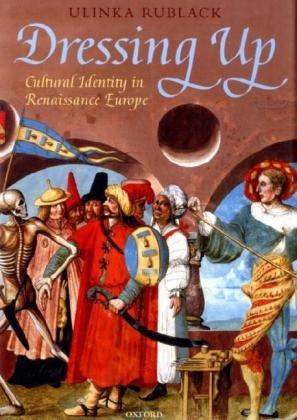
Dressing Up: Cultural Identity in the Renaissance by Ulinka Rublack (2010)

by Benjamin Breen

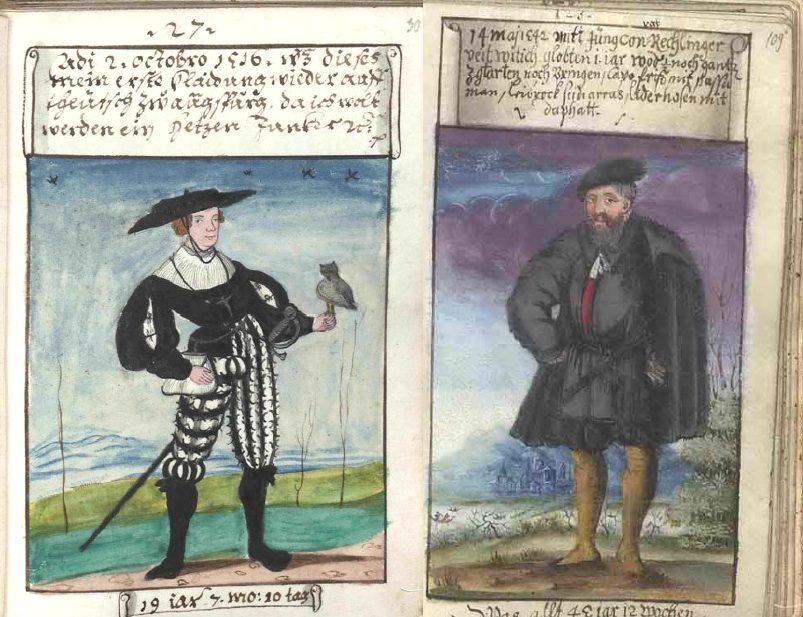
Matthäus Schwarz of Augsburg was, in many respects, a rather typical (if unusually successful) early modern merchant: he worked his way up from an apprentice clerk to a chief accountant in the powerful Fugger banking dynasty, he married, went to war, had children, and, in 1574, he died. imageSchwarz’s life may well have been forgotten if he had not taken the unusual step of memorializing it in an extraordinary manuscript. In his Klaidungsbüchlein, or “Book of Clothes,” Schwarz commissioned one hundred and thirty seven vivid watercolor paintings depicting the clothes he wore at each stage of his life, from his “first dress in the world” as a days-old infant to the somber robes of mourning he wore as a world-weary man of sixty-seven.
In her brilliant study Dressing Up: Cultural Identity in Renaissance Europe, Cambridge professor Ulinka Rublack uses Schwarz’s book and other largely unexplored visual evidence to argue that clothes matter in history. In the early modern period, the focus of her study, Rublack sees clothing as comprising a “symbolic toolkit through which people could acquire and communicate attitudes toward life and construct visual realities in relation to others.” Personal adornment could create communities and assert individuality; it could display wealth, express political allegiances, proclaim nationality, and visualize inner emotional states. Indeed, owing to harsh “sumptuary laws” forbidding commoners from wearing luxury goods such as pearls, silks or cloth-of-gold, clothing choices could even be a matter of life or death.

Perhaps the most admirable aspect of Dressing Up is the manner in which Rublack combines sophisticated theoretical arguments about the role of clothing in the “self-fashioning” of Renaissance individuals with concrete, lively details and startlingly vivid illustrations (there are one hundred and fifty six in all, many in color). Rublack has a particularly discerning eye for interesting anecdotes. In the introduction alone, we learn that a gang of youths known as the “Leather Trousers Group” terrorized the streets of 1610s Kyoto, that the French essayist Montaigne hated codpieces, and that medieval contemporaries blamed the defeat of the French knights at the Battle of Crécy on their passion for “clothing so short that it hardly covered their rumps.”

breen Matthaus_Schwarz
Mathhäus Schwarz’s Klaidungsbüchlein, or “Book of Clothes,” documented the Augsberg merchant’s personal adornment from infancy to old age. In the image at left, he stands proudly as a youth of nineteen; at right, we see him in the more sombre dress of a middle-aged man.

image

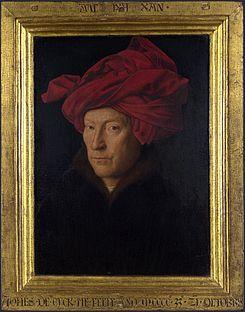
Jan van Eyck’s 1433 Man in a Turban, a probable self-portrait, forever immortalized a flamboyant fashion choice in the then-new technique of oil paint.

The book’s illustrations range equally widely. Rublack revisits famous self-portraits by Albrecht Dürer and Jan van Eyck to show how Renaissance artists employed their own bodies to exemplify their creative gifts, and uses evidence from a number of well-chosen woodcuts and etchings to demonstrate how clothing choices expressed national and religious allegiances. Particularly interesting — because they are so rarely used as historical evidence — are the photographs of actual clothing from the medieval and early modern periods. Rublack analyzes an incredibly closely-fitted silk doublet once owned by a medieval French duke, for instance, to argue that the rise of tight-fitting male clothes in the fourteenth century “reinvented masculinity and femininity, as well as a sense of what critics regarded as effeminate.”

Dressing Up draws much of its evidence from the German-speaking lands of the sixteenth century, and a notable secondary argument running through the book is that early modern Germany was far more connected to the wider world than has typically been admitted. Banking houses like Matthaüs Schwarz’s employer, the Fuggers, played an especially important role as financiers of long-distance trading voyages, and Rublack’s book shines in its exploration of how German printed texts made sense of the sartorial choices of indigenous groups beyond Europe (Chapter Five, “Looking at Others”). Throughout, Rublack’s clear writing style admirably balances intellectual heft and archival expertise with a spritely and quietly humorous authorial voice.

Like the “Book of Clothing” of Matthaüs Schwarz, this book is much more than a catalogue of obsolete clothing styles. It is an exploration of human nature, and of how human beings throughout history have expressed their inner lives through their exterior coverings.

Further reading:

Ulinka Rublach on “Renaissance Fashion: the Birth of Power Dressing” in History Today.

More images from Matthäus Schwarz’s Book of Clothes via Res Obscura.

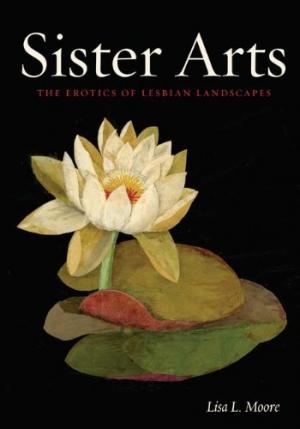
Sister Arts: The Erotics of Lesbian Landscapes by Lisa L. Moore (2011)

by Mary Katherine Matalon

The 1792 poem “Verses to Abigail Smith,” was preserved by Abigail’s brother, Elihu Hubbard Smith, who transcribed the poem into his diary and chronicled the strong friendship that existed between Sarah Pierce, the author and future founder of the Litchfield Female Academy, and his sisters Abigail and Mary. image Like Smith, Lisa Moore is interested in recording and preserving the rich world of female friendship and same sex desire that she has discovered in a variety of creative media in the late eighteenth century.  While diverse in form, these “sister arts,” including garden design, paper collage, collecting, and poetry, were united by the ways that their practitioners all used the landscape and the natural world both literally and metaphorically to create artworks that forged and memorialized the bonds among women.

In this lavishly illustrated book, Moore analyzes the lives and works of eighteenth-century women who practiced the sister arts:  the artist Mary Delaney, the natural philosopher and collector Margaret Bentinck, the Duchess of Portland, poet Anna Seward, and the aforementioned Sarah Pierce.  Moore is a skilled and vivid storyteller and her compelling prose enables the reader to inhabit the affective and intellectual landscapes these women traversed.    For instance, the Duchess of Portland emerges as an insatiable collector and connoisseur of both female friendships and objects of natural history. In fact, Moore argues, the two practices—the forging of deep and sustained female friendships and the collecting of natural history specimens—were inextricably intertwined for the Duchess, who served as key link among a network of female friends who shared her passion for the natural world. For the Duchess, as for the other women Moore studies, flowers, shells, and other aspects of the natural world become a kind of language through which women can express their love and desire for one another.

Sister Arts: The Erotics of Lesbian Landscapes is simultaneously concise and evocative.  Moore’s analysis not only suggests fresh, new ways of thinking about the history of sexuality and the history of material culture but also suggests ways in which these two, typically separate, fields might overlap.  Moore’s stated goal is not to recuperate a straightforward lesbian identity for her subjects, but to establish the ways in which their creative practices can be read as lesbian, “because of their resonance with central features of lesbian history and culture that are still meaningful.”

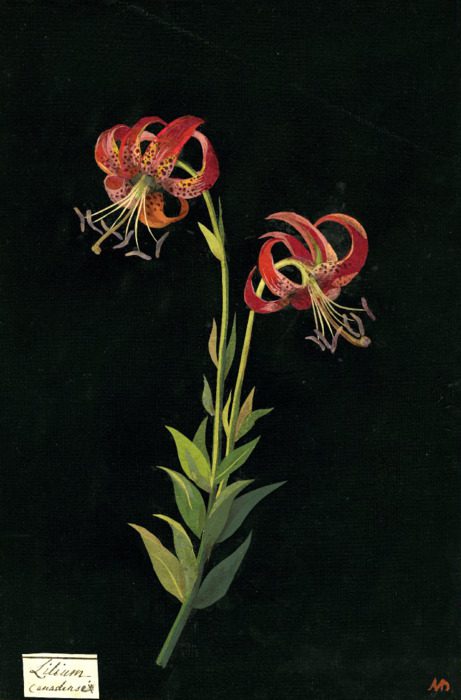
imageMary Delaney‘s botanical illustrations of flowers were considered to be “libertine” by some eighteenth-century critics.

In so doing, she demonstrates how we might map a history of sexuality onto the history of material culture—that is, she shows us how we might begin to read objects, rather than people, as lesbian or queer. For instance, Moore reads the shell grotto created by Mary Delaney and The Duchess of Portland as an important contribution to the lesbian sister arts tradition. Accordingly, Moore emphasizes the aspects of the grotto that accord with this tradition; she excavates the associations between the shells and female sexuality and she explains the way in which the creation of the grotto would have contributed to the two friends’ intimacy.  Ultimately, Moore contends that the grotto serves as a monument to the two women’s passionate friendship.  While we will never know the exact nature of that friendship, Moore demonstrates that inscribing its tangible manifestation—the shell grotto—into the lesbian sister arts tradition allows us to see the ways in which sexuality and intimacy were embedded both within the grotto and the women’s enduring relationship in ways that can be classified as lesbian or queer. Overall, Sister Arts: The Erotics of Lesbian Landscapes is a deeply rewarding book for it both complicates and enriches our view of these women (some of whom have been vastly understudied) and their creative legacies.

Further reading:

Lisa L. Moore’s blog, Sister Arts.

The book’s official page at the University of Minnesota Press.


« Previous Page

Recent Posts

  • Meg Lauren’s Songs from the Archive
  • Curating History: Dr Pepper, Preservation, and Public Trust
  • The Brands of Garrison Hall at its Centennial
  • The Battles of the Alamo and the Myth of Southern Exceptionalism
  • Primary Source: Magic, Metal, and Medicine in Leonhard Thurneysser’s Paracelsus
NOT EVEN PAST is produced by

The Department of History

The University of Texas at Austin

We are supported by the College of Liberal Arts
And our Readers

Donate
Contact

All content © 2010-present NOT EVEN PAST and the authors, unless otherwise noted

Sign up to receive our MONTHLY NEWSLETTER

  • New
  • Features
  • Reviews
  • Texas
  • Teaching
  • Digital
  • Watch & Listen
  • Authors
  • About