• New
  • Features
  • Reviews
  • Texas
  • Teaching
  • Digital
  • Watch & Listen
  • Authors
  • About

The past is never dead. It's not even past

Not Even Past

The First Texans: An Exhibit in Jester Hall

By Nakia Parker

Tucked away in a corner on the second floor of Jester Residence Hall at UT Austin stands a thought provoking exhibit that pays tribute to Native Americans, the “First Texans.” Many times I have hurriedly passed by this area and only given it a casual look. In fact, the day I went to visit the exhibit,, students were standing directly across from it, laughing, doing dance routines, and hanging out with friends. No one even glanced in the corner. However, I strongly encourage taking the time to explore this well-constructed and respectful gallery honoring the first inhabitants of Texas.
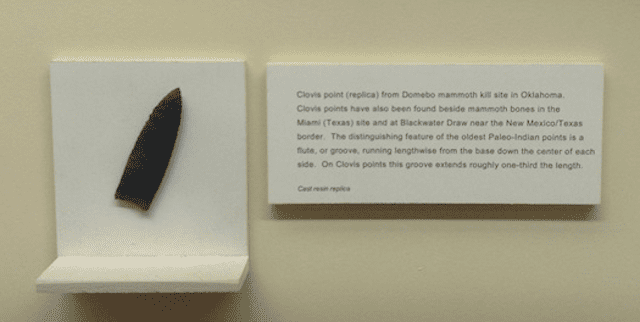
Clovis point (replica) from Domebo mammoth kill site in Oklahoma.
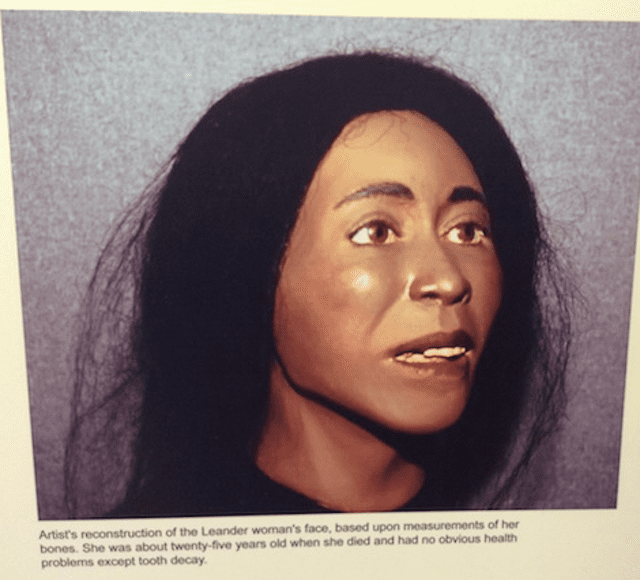
Artist Rendition of Leander Indian Woman

The idea for the exhibit was hatched by Floyd Hoelting, Executive Director of the Division of Housing and Food Service. With the help of his staff members, student leaders, the Institute of Texan Cultures, and other experts in the field of archaeology, sociology, and anthropology, the commemoration became a reality. In six panels, the gallery traces the history of Native Americans in the region, commencing around 13,000 BCE, to the arrival of the Spanish in the early 16th century. But the displays do much more than simply chronicle the experiences of indigenous people who lived thousands of years ago. It also seeks to dispel common stereotypes surrounding these cultures and to demonstrate that Texas history does not begin and end with the Alamo. For example, the second plaque discusses the populating of the Texas region by the Clovis peoples. Archeologists and anthropologists had previously described the Clovis as a nomadic band of hunters, but they were actually were a sedentary people who participated in farming and created complex architectural structures to protect themselves from the elements. In addition, artifacts such as bowls, hunting instruments, and drinking utensils aid the visitor in reconstructing what life was like for indigenous people in centuries past. Visitors should also make sure to pay attention to what is under them as well as around them, because complementing the panels and artifacts nicely is the beautiful design found on the floor of the exhibit, which features a map of Native American archeological sites located in every section of the state.
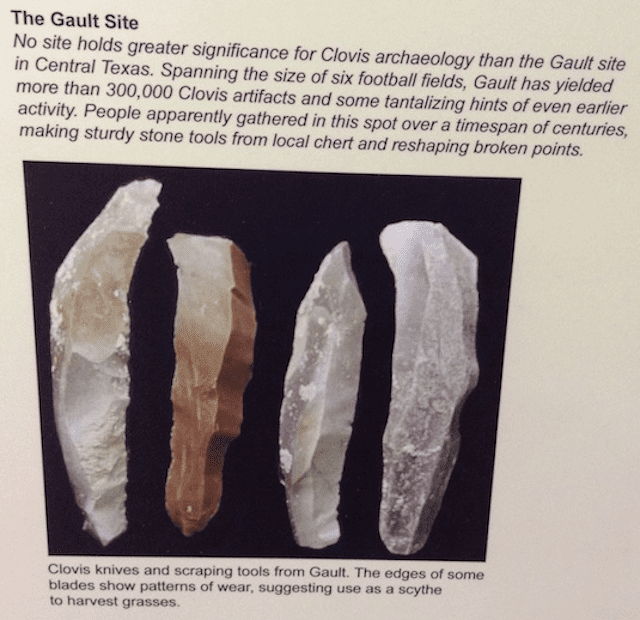
Clovis Artifacts from Gault Site, Central TX.

The First Texans exhibit is a part of Jester Hall’s Gallery of Texas Cultures that showcases over thirty different ethnic groups of the state, highlighting the specific role each played in molding and influencing the politics, education, and culture of Texas. According to its website, “as a visual resource, the gallery is intended to increase the knowledge of the history and contributions of ethnic groups among students, faculty, staff and visitors while as a physical resource, the gallery is intended to provide the venue to inspire conversation, learning and a greater understanding of others.” Visitors who take the time to see The First Texans display will surely agree that it achieves its intended purpose.
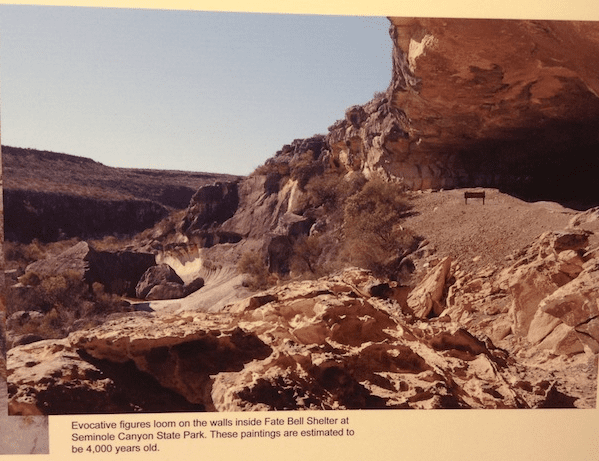
Wall Paintings at Seminole Canyon State Park
Wall Paintings estimated to be 4,000 years old at Seminole Canyon State Park

You can see some of the exhibit at The Gallery of Texas Cultures website.

You may also like in Texas History:

Confederados: The Texans of Brazil

“The Battle of Bandera Pass and the Making of Lone Star Legend”

A Texas Ranger and the Letter of the Law

“The Die is Cast”: Early Texans Face the Comanches

Standard Oil writes a “history” of the old south

Stephen F. Austin visits a New Orleans bookstore


bugburnt


Images courtesy of Nakia Parker


The views and opinions expressed in this article or video are those of the individual author(s) or presenter(s) and do not necessarily reflect the policy or views of the editors at Not Even Past, the UT Department of History, the University of Texas at Austin, or the UT System Board of Regents. Not Even Past is an online public history magazine rather than a peer-reviewed academic journal. While we make efforts to ensure that factual information in articles was obtained from reliable sources, Not Even Past is not responsible for any errors or omissions.

A Father’s Love: Francois LaBorde’s Letters

By Lizeth Elizondo

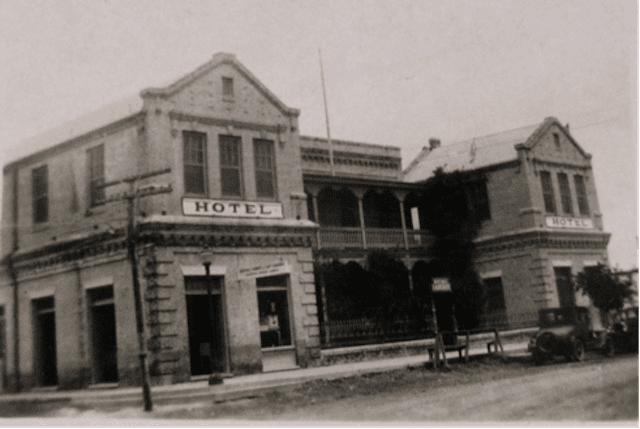
The French entrepreneur Francois LaBorde was born April 16, 1867 in Arudy, France. He arrived at Rio Grande City, Texas by steamboat up the Rio Grande in 1878. Soon after settling there, he met Eva Marks, the daughter of a French immigrant father and a mother who was born in Mexico but raised in Texas. The French connection must have been part of their initial attraction. They married on March 2, 1896 and their first daughter, Blanche, was born a year later. Francois fostered his love for French architecture in the LaBorde House, the opulent hotel he built and filled with exquisite European fixtures. His hotel still operates, and is one of the most elegant hotels in south Texas.

Francois LaBorde, Paris, 1883

In the course of my research on the LaBorde House, I came across a hidden gem. Deep within the Chapa Family papers housed at The University of Texas at San Antonio, one box filled with an assortment of archival items, including legal documents, personal correspondence and photographs offer a glimpse into the LaBorde family. Among these items are four handwritten letters, exchanged between François LaBorde and his daughter Blanche. These letters reveal intimate details about their lavish lives and the unconditional love they had for each other.

Francois LaBorde died at the age of 50, of a possible suicide. Blanche was only twenty years old when tragedy struck their family, but she was fortunate to know how much her father loved her. These letters are a portal into their close father-daughter relationship as well as many social customs of the period. They reveal a warm-hearted man who is only remembered in history as the visionary of a grandiose hotel. Here’s a quick peek at the LaBordes’ exceptional life.


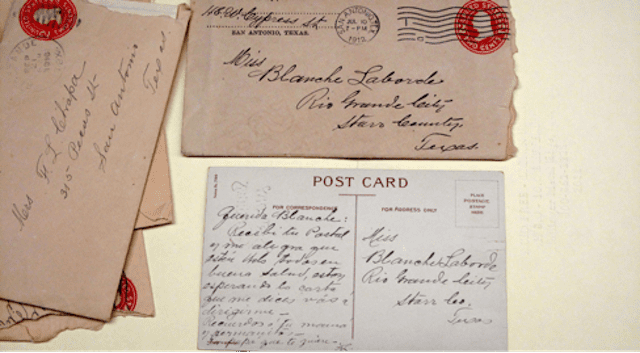
From: 118 W. Cypress St.

To: Miss Blanche LaBorde

Rio Grande City, Starr County Texas

July 10, 1912

My Dearest Blanche,

I received your postcard and I am glad that you all are doing well and in good health. I am still waiting for that letter you said you will send me. Greetings to your mom and little sister.

Dad who loves you, F.L.*

The letters were written in Spanish and are my own translation. All of the letters and images are from: Francisco A. Chapa Family Papers, MS 405, University of Texas at San Antonio Libraries Special Collections.

Fifteen-year-old Blanche, the oldest daughter of Francois LaBorde received this post card from her father with a scribble on the front image that reads “Be Happy.” The letters were written in perfect Spanish by her dashing father, a French merchant who had immigrated to Rio Grande City, Starr County Texas, around thirty years earlier. The LaBordes were an atypical family in South Texas thanks to their wealth and social status, but were, like many other families, representative of the region’s common intermarriage and multiculturalism.

Young Eva Marks, no date, Corpus Christi, TX

LaBorde had a keen eye for business and he quickly integrated himself to the community. Around 1890, he opened a general merchandise store in Rio Grande City and also maintained a strong economic connection to his homeland. He knew the popularity of leather gloves in the European market and made a successful business of shipping primary materials (tanned goods) to French glove makers. His family also had a strong connection with San Antonio. In fact, his wife and their five children spent most of their time at 118 W. Cypress St., their San Antonio home, while LaBorde lived in a palatial Parisian style home he built for the family in 1899 in Starr County. LaBorde’s businesses kept him busy in Rio Grande City, but the family traveled back and forth between the two homes.

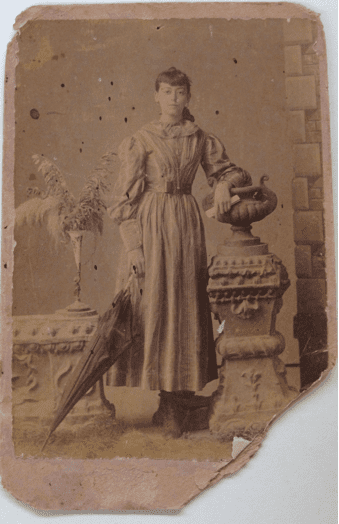
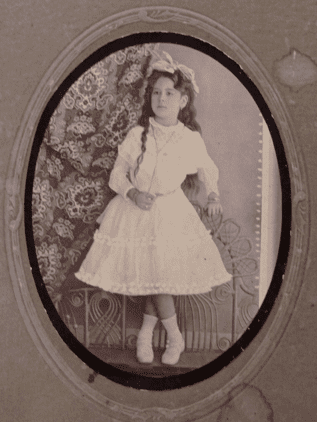
Young Blanche LaBorde, n.d., n.p.
 
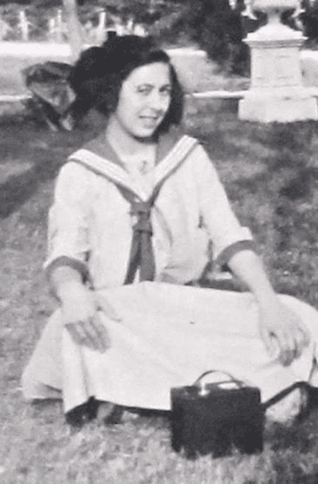
Young Blanche in her school uniform, n.d., n.p.

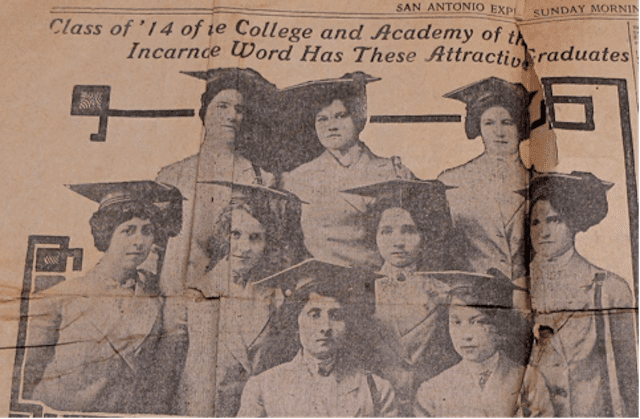
Blanche attended the College and Academy of the Incarnate Word in San Antonio run by the Sisters of Charity. “No pains are spared by the Sisters to mold the character of the young ladies,” explained the college’s handbook. Blanche and her classmates were instilled with “the great guiding principles of honor, rectitude, and piety.” In 1914, Blanche graduated, and from what the letters reveal, she moved to the family home in Rio Grande City soon after.

Blanche LaBorde, first one on left, middle row.

In December 1914, eighteen-year old Blanche was staying in their Rio Grande City home, while her father was in San Antonio. The letters exchanged between the two, reveal health problems as the likely reason why he was staying with his wife and other children away from Rio Grande City. His anguish over his business matters comes through as he makes requests to Blanche to deal with some urgent business. As usual, Francois wrote his letters entirely in Spanish.

From: F. LaBorde 118 W. Cypress St. San Antonio TX

To: Miss Blanche LaBorde, Rio Grande Starr County, TX

San Antonio, Dec. 10, 1914


My Dearest Daughter,

We have received all of your nice letters, and just now the last one, where you complain that I have not replied? But I am doing it now, letting you know that I am glad that you are doing well, but it upsets me to read that you are losing weight so fast, you tell me you weigh less and that is not right. Take care of yourself, so that upon your return, you are just as healthy as when you left.

I hope you have a nice, fun time there, and that when it is no longer convenient for you to be there, you come up. Tonight I will write you a long letter. You know that I have your Christmas present ready, and as soon as you arrive I will give it to you.

Would you do me a favor and tell Tina that I am doing well, that I no longer have health issues. Your father, who loves you, wishes you stay healthy.

LaBorde 

P.S. I am sleeping really comfortable during my nap (siesta) there is no more telephone noise to bother me. L.

Another letter however, also includes her mother’s script, which reveals that as a Texan, she was much more comfortable communicating in a mix of both English and Spanish.


From: F. LaBorde 118 W. Cypress St. San Antonio TX

To; Miss Blanche LaBorde, Rio Grande Starr County, TX

San Antonio, Dec 16, 1914

Miss Blanche LaBorde,

Rio Grande Texas


[Scribbled in Spanglish on top margin]:

The baby went by to see the portraits of Chiffonier and said aunty is sure pretty here, her feelings are hurt because Caterina told her last night that her aunty had said that she didn’t love her. She did not come outside all day, poor baby. Last night we went to see the window displays. It is really cold, but we are all wrapped up, greetings to everyone. Mamma


My dearest daughter,

I received your sweet letter of last Friday and we were so glad to read that you are doing well healthwise and that you had fun at the last Saturday’s dance. Let me know how soon you will come back, since you can come back as soon as you wish.

Please find out how much I have to pay for the county taxes and when I have to pay them. Also, ask Mr. Monroe when Don Jose M. Longoria will pay me what he owes me.

Without further ado, lots of greetings to all of you, and “good luck,”

Your father who loves you,

LaBorde 

[Scribbled postscript by Eva in Spanish:]:

And I did not write because I do not have enough room, but it is already 9, and I am just having breakfast, the boys are off to school, your dad is getting up and I think the express is coming. Kisses to everyone.

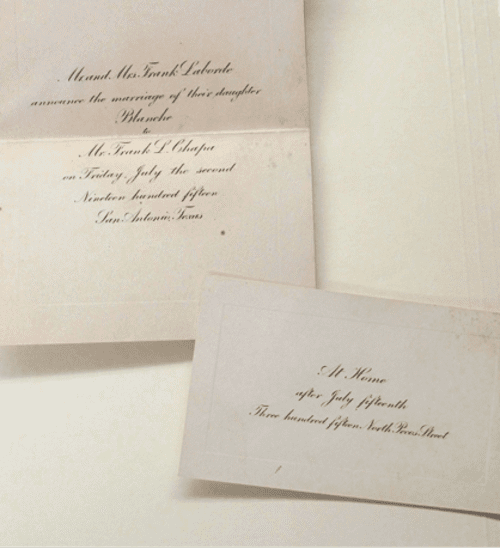
Things changed for the LaBorde family after Blanche’s graduation. Although there is a one-year gap in correspondence, it can be assumed that sometime in that year (or perhaps earlier) Blanche met her dashing soul mate. On Friday, July 2, 1915, nineteen-year-old Blanche eloped with Frank Chapa, a descendant of the Canary Islanders who settled San Antonio, where he was born and raised. They informed her parents via telegram and the news baffled them. The telegram written in broken English reads,

Blanche LaBorde

In care of Frank Chapa, 

Your telegram received very sorry the way you do it. Mother and Father suffering from the shock but god help you be happy. Your loving mother and father.

LaBorde

It is likely that Eva wrote the telegram, since Francois typically communicated in Spanish. Or perhaps out of anger and shock, he managed to piece together this succinct message in English. The frustration over this rash decision could not have lasted long, since the LaBorde’s officially announced their daughter’s marriage soon after.

Wedding Invitation: Card One reads Mr. & Mrs. Frank LaBorde. Announce the marriage of their daughter Blanche To Mr. Frank L. Chapa. On Friday, July the second Nineteen hundred fifteen San Antonio, Texas Second Card reads: At home after July Fifteenth Three hundred fifteen North Pecos Street.
Wedding Invitation: Card One reads Mr. & Mrs. Frank LaBorde. Announce the marriage of their daughter Blanche To Mr. Frank L. Chapa. On Friday, July the second Nineteen hundred fifteen San Antonio, Texas
Second Card reads: At home after July Fifteenth Three hundred fifteen North Pecos Street.
Blanche LaBorde Chapa & Col. Frank Chapa, n.d., n.p.

It is important to note that in this official wedding announcement, Francois refers to himself as Frank. He was a man who adapted his name to every occasion. In the 1910 census of Starr County, he is listed as Francisco, his business cards had the name Francois, his daughter’s wedding announcement, Frank, and people in the community of Rio Grande City knew him as “Don Pancho” (the typical Spanish nickname for Francisco). His social and business ties forced him to interact with the Spanish, English, and French speaking worlds so often, that he was comfortable transforming his personality as he saw fit. He wrote his letters to Blanche in Spanish but all of his children spoke French. In fact, Rio Grande City neighbors remembered hearing the family speak French often. In a 1982 interview, LaBorde’s youngest daughter Ernestine (only 7 years old when her father died), said she remembered her father as “a warm vital man of good spirits with a stylish mustache, a bon vivant who enjoyed luxury and travel. I always addressed him in French, the minute he walked in the house, I would say: ‘Je vous aime beaucoup’ and he loved it.” LaBorde was most comfortable communicating in either French or Spanish, his son-in-law, Frank Chapa, recalled that he spoke little English.

A letter written a year after their elopement reveals that whatever pain was caused by Blanche and Frank’s sudden marriage became a thing of the past for the family.

From: F. LaBorde Rio Grande Texas  To: Mrs. F. L. Chapa 315 Pecos St San Antonio Texas Sep 21, 1916

My Dearest Daughter Blanche,

I have received your lovely letters, one with the date of the 17th and the other last Sunday and I thank you for your affection, and I am glad that you are all in good health.

The business matters that brought me down here seem to be ok, but I will soon find out.

I am working on drafting plans and budgets for the hotel. Constantino was here studying them, but we have to see the architect for certifications. There is great possibility that it will be approved.

Take good care of your mother, give my best regards to her and your little siblings and Frank and all of the Chapa family in general.

Your dad who loves you, F. LaBorde


La Borde House transformed into a hotel

The hotel that Francois is referring to in this letter is actually the additions made to his family’s home to create the LaBorde House. He transformed the palatial home of the LaBorde family into an exquisite hotel that still stands today. The celebration of his accomplishment was unfortunately short lived. A few months after the official opening of the hotel, on the morning of August 11, 1917, Francois was found dead. The official death certificate reveals the cause of death was a gunshot wound in the head. It is still a mystery to this day, weather it was an accident, a business feud gone horribly wrong, or a suicide.

What is a fact is that these letters reveal the immense love LaBorde had for his daughter. One can only imagine the void left in Blanche’s life when her father died and the incredible loss and heartache over the sudden end to their correspondence.

Just as Francois was a visionary in his business endeavors, Blanche also proved to have had a keen eye for choosing a husband. They were married for 45 years and had two girls, Marie Ernestine and Beatrice. In 1960, Blanche died of pneumonia but Frank lived to be 90 years old, until his death in 1985. The name Blanche lived on in the LaBorde family. Blanche’s younger brother Leonard, named his daughter after her in 1927. The memory of Francois LaBorde also lives on in Rio Grande City. His majestic French-style hotel still draws visitors to the area thanks to his exquisite taste and French heritage, which reminds tourists and locals alike of the conglomeration of cultures that met along the Rio Grande.

*The letters were written in Spanish and are Lizeth Elizondo’s translation. All of the letters and images are from: Francisco A. Chapa Family Papers, MS 405, University of Texas at San Antonio Libraries Special Collections.


bugburnt


You may also like in Texas History:

Confederados: The Texans of Brazil

“The Battle of Bandera Pass and the Making of Lone Star Legend”

A Texas Ranger and the Letter of the Law

“The Die is Cast”: Early Texans Face the Comanches

Standard Oil writes a “history” of the old south

Stephen F. Austin visits a New Orleans bookstore


bugburnt


The views and opinions expressed in this article or video are those of the individual author(s) or presenter(s) and do not necessarily reflect the policy or views of the editors at Not Even Past, the UT Department of History, the University of Texas at Austin, or the UT System Board of Regents. Not Even Past is an online public history magazine rather than a peer-reviewed academic journal. While we make efforts to ensure that factual information in articles was obtained from reliable sources, Not Even Past is not responsible for any errors or omissions.
Confederados: The Texans of Brazil

By Nakia Parker

After the American Civil War ended in April 1865, white Southerners living in the defeated Confederacy faced an uncertain social, economic, and political future. Many, disappointed in the outcome of the conflict and fearful of vengeful reprisals from the victorious Union government, decided to leave the United States altogether and start afresh in a foreign land. Central and South America, in particular, seemed a safe and welcoming haven for ex-Confederates living in the Gulf South region of Alabama, Texas, Mississippi, and Louisiana. The overwhelming choice of destination for these discontented emigrants was Brazil, where slavery was still legal and the Emperor offered attractive economic incentives, such as inexpensive land ownership and favorable tax laws. These expatriates, possibly numbering into the thousands, became known as “Confederados,” the Portuguese word for “Confederates.” However, not everyone living in the recently vanquished Confederate States of America was keen on the idea of beginning a new life in Brazil. An editorial written on the August 25, 1865 in the Houston Tri-Weekly Telegraph meticulously weighs the advantages and disadvantages of the Brazilian emigration movement.

Transcription of the editorial that appeared in the Houston Telegraph

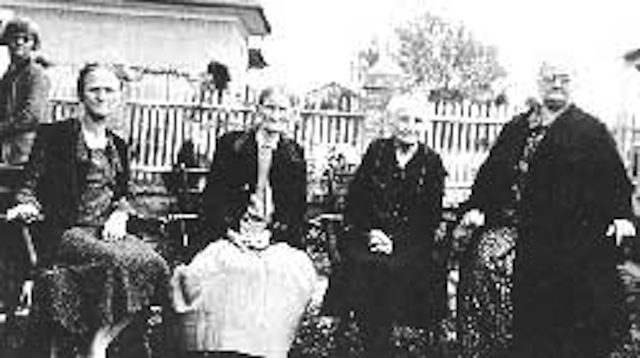
The first Americans residing in Brazil, 1867. Via Wikimedia Commons.
The first Americans residing in Brazil, 1867.

In an attempt to “look at the question fairly,” the editorial highlighted similarities between Texas, the South in general, and Brazil, such as their comparable climates and agricultural production. Yet, the parallels abruptly stop there. The writer of the piece employed common racial stereotypes of the day, claiming that while both Brazil and the U.S. South each had “plenty of free negroes,” people of Afro-Brazilian descent were “of a much lower order of intelligence than ours,” yet enjoyed “social equality.” Even more interesting is the emphasis on the commonalities between Black and White Southerners — their shared religion, language, and “familial” ties — ignoring the devastating, bloody conflict over slavery that just ended a mere few months prior.

Thus, the seedlings of the “Lost Cause” mythology of paternalistic slave owners and happy slaves as a part of their extended family reveals itself in the article’s description of Southern African-Americans. Furthermore, the document vacillates from the practical to the poignant, imploring readers to consider such factors as the financial costs of making an overseas move, the health risks of resettling in an unfamiliar land, the repercussions of moving to a country with a different political and religious infrastructure, along with the emotional and psychic wages of leaving behind beloved friends, family, and an established way of life, no matter how “shaken,” for unsure prospects. The author resolutely came to the conclusion: “No Brazil for us. The “land of the South, imperial land is still for us our home and grave. We hope to go to heaven from it.”

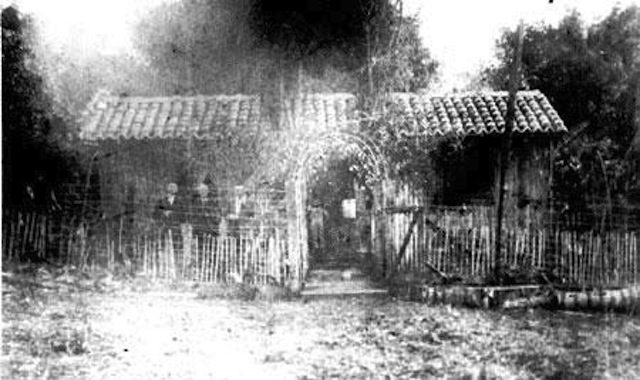
House of the first confederate family in Americana, Brazil. Image via Wikimedia Commons.
House of the first confederate family in Americana, Brazil.

Despite the objections of the unknown writer, many Texans did leave for Brazil. Today, many of their descendants honor their American South/Brazilian lineage with a festival known as the Festa Confederada. This annual celebration combines Brazilian culture, such as dances and music, with traditional “Southern” foods, Confederate uniforms, antebellum dresses, and the waving of Confederate flags. This proud, yet problematic, commemoration highlights the powerful hold that the Civil War exercises not just in the American South, but in the “global South” as well.

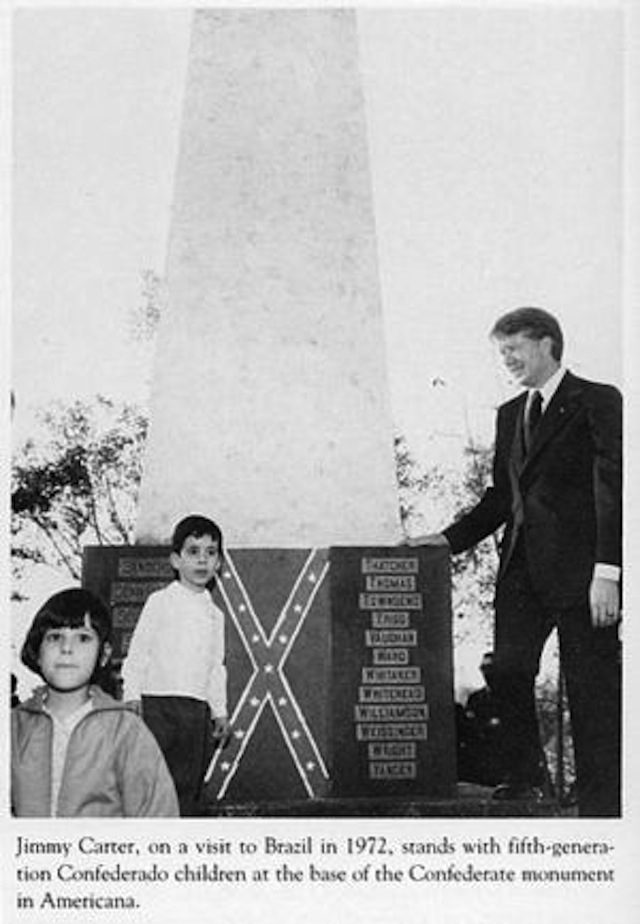
In 1972, Georgia Gov. Jimmy Carter visited Brazil and remarked on the similarity between American Southerners and Confederados, descendants of Confederates who emigrated to Brazil after the Civil War. Via Wikimedia Commons.
In 1972, Georgia Gov. Jimmy Carter visited Brazil and remarked on the similarity between American Southerners and Confederados, descendants of Confederates who emigrated to Brazil after the Civil War.

More amazing finds at the Briscoe Center:

A Texas Ranger and the Letter of the Law

“The Die is Cast”: Early Texans Face the Comanches

Standard Oil writes a “history” of the old south

Stephen F. Austin visits a New Orleans bookstore


bugburnt


All images via Wikimedia Commons.


The views and opinions expressed in this article or video are those of the individual author(s) or presenter(s) and do not necessarily reflect the policy or views of the editors at Not Even Past, the UT Department of History, the University of Texas at Austin, or the UT System Board of Regents. Not Even Past is an online public history magazine rather than a peer-reviewed academic journal. While we make efforts to ensure that factual information in articles was obtained from reliable sources, Not Even Past is not responsible for any errors or omissions.
The Future of Cuba-Texas Relations

By Jonathan C. Brown

Jonathan Brown teaches courses on the history of Latin American revolutions. He is now completing a manuscript on “How the Cuban Revolution Changed the World.” Professor Brown took the first of his four trips to Cuba in 2006. On the very day that the government announced President Fidel Castro’s incapacitating illness (August 1), Brown was touring the prison cum-museum where Fidel and Raúl Castro spent two years as political prisoners. Brown heard the news of the leadership change from the museum guide herself at the moment she was showing him the prison beds these two revolutionaries occupied in 1954. What a memorable moment for an historian!Since then, Professor Brown has busied himself negotiating the exchange agreement between the University of Texas and the Universidad de La Habana, organizing two UT conferences on Cuba, bringing three Cuban scholars to campus as visiting professors, reading thousands of documents on U.S.-Cuba relations, and delivering dozens of talks and papers on his research. Here are his thoughts on the implications for Texas-Cuba connections.

Within a week of President Barack Obama’s announcement about the renewal of diplomatic relations with Cuba, the Austin American Statesman ran a cartoon entitled “America Prepares to Invade Cuba.” It depicted a line of passengers dressed in beach wear boarding a plane heading to Havana.

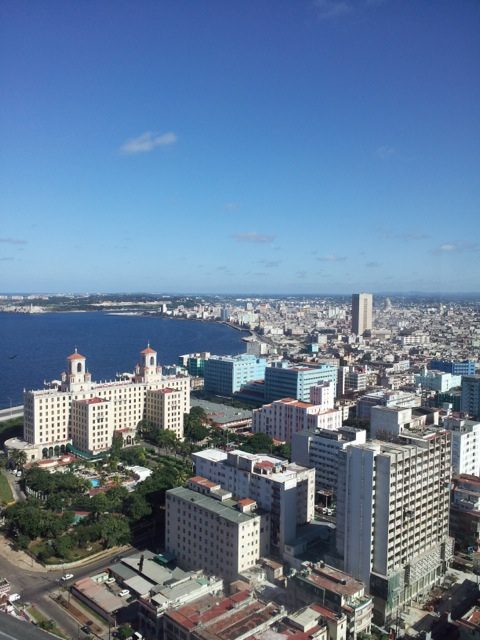
The skyline of Havana has scarcely changed since 1959. The building below left is the Hotel Nacional, built in the 1920s. Photo by Reggie Wallesen.
The skyline of Havana has scarcely changed since 1959. The building below left is the Hotel Nacional, built in the 1920s.

Perhaps the cartoonist exaggerated, for President Obama merely loosened existing restrictions. Cuban Americans may travel to the island several times per year and send more money to relatives there. Non-Cuban Americans may travel there more freely, although special licenses are still required. The U.S. government will allow Americans to use their credit and debit cards in Cuba. The president may have cut the Gordian Knot ending 54 years of mutual hostility and eliminating one of the last vestiges of the Cold War. But he did not sever it completely.

Likely presidential candidate Jeb Bush has already stated that, if elected, he would reinstate travel restrictions. With two conservative Cuban Americans also likely to run for the presidency, including Senator Ted Cruz of Texas, the Cuban Embargo will remain a lively issue of debate. By the way, Jeb Bush holds a BA in Latin American Studies from the University of Texas at Austin.

The Cold War between Washington and Havana will not end until Congress says it’s over. That may not happen any time soon. Many Senators and Congressmen from Texas oppose the repeal of three pieces of “Cuban boycott” legislation dating from 1963, 1992, and 1996. Together these laws restrict travel, trade, and investment.

What changes may we expect in Texas-Cuba relations in the near term? More Texans will visit Cuba, not technically as tourists but in “cultural” exchanges. Students too. Literature professor César Salgado already is planning to take UT students on a Maymester trip to Cuba at the end of the spring semester.

President Obama’s announcement has ended restrictions on the use of U.S. credit and debit cards in Cuba—a positive boon that will enable Texans to compete for hotel rooms and rental cars on a par with travelers from Mexico and Canada. United and American Airlines are contemplating direct flights to Cuba from Houston and Dallas. For now, we Texans have to go through special charter flights from Miami International Airport. Of course, there are illegal alternatives that I do not recommend.

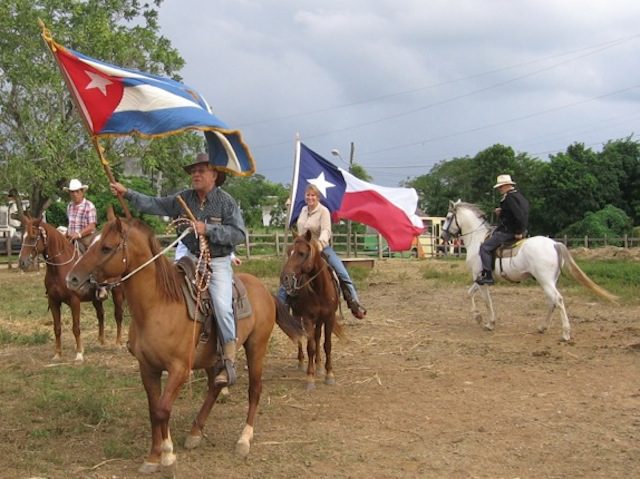
The Cuban and Texas flags flying together during a pleasure ride outside of Havana. This event (minus the Texas flag) made page 3 of the NY Times on November 12, 2007.

Will U.S. recognition encourage Cuban politics to become more democratic? Cuban leaders will say they have already established democracy. The Revolution assures equality for all and no citizen lacks for health care, education, and basic subsistance. Socialism, they say, has no room for the privileged and wealthy “one percent.” President Raúl Castro told the Cuban people that U.S. diplomatic recognition will not make the Communist Party give up power. He will hold power until 2018, when most of this year’s freshmen class will graduate from UT-Austin.

Where is Fidel Castro? He’s retired. Fidel never recovered fully from his 2006 operation for an intestinal blockage, and he has not appeared in public for many months. Raúl Castro is his brother.

Would Cuban political continuity be a good thing? Yes and no. Political stability will preserve the integrity of the Revolutionary Police and Armed Forces. Gang warfare, drug trafficking, and blatant corruption do not plague the Cubans as they do citizens of other Latin American countries. Even though many neighborhoods are blighted for the lack of building materials, Americans should feel safe wandering through Cuban cities. For example, personal safety in Havana compares favorably to Chicago, where the mayor’s son got mugged last month. Political continuity also has a downside. As in China, more engagement with the United States will not make the Cuban government any more tolerant of political protest. Dissidents will continue to face intimidation, prison terms, and deportation. At the very least, diplomatic engagement should remove Washington’s hostility as an excuse for suppressing domestic protesters.

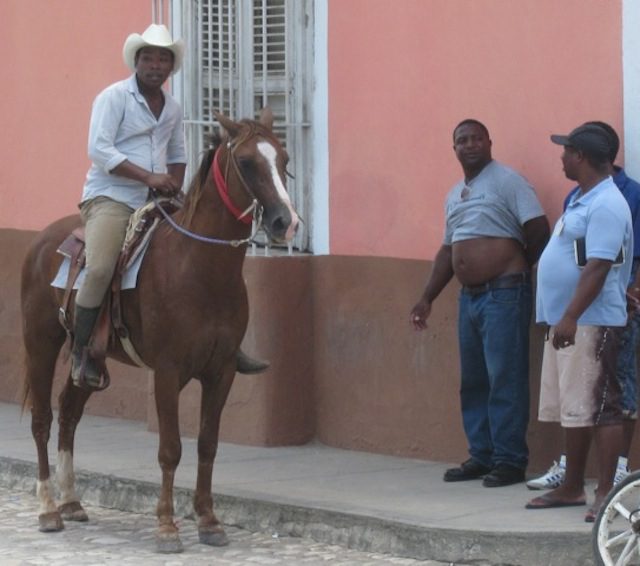
Street scene in Trinidad, Cuba.

Will Texas benefit economically from the loosening of restrictions? Very definitely, yes. Texans already sell agricultural products to Cuba through a “humanitarian” exclusionary clause in the embargo. American suppliers may send food and pharmaceuticals if the Cuban government pays for them before shipment. The arrangement is cumbersome.

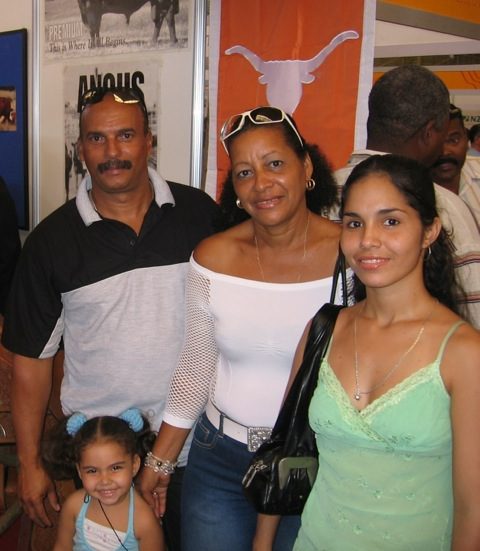
A family stops by a booth at the Havana trade fair in 2008.

For several years, the Texas-Cuba Trade Association, of which I am a volunteer consultant, has lobbied Washington to remove U.S. export limitations. President Obama accomplished as much as he could and Texas producers expect Cuban trade to expand. One Texas A & M economist predicts that our state’s exports to Cuba of chicken, pork, rice, beans, wheat, and corn could top $400 million within a couple of years.

Has the U.S. economic boycott really kept Cuba poor, as its leaders often claim? Only somewhat. Since 1990, when the Soviet subsidies ended, Cuba came to rely on trade and investment from every country of the world except the United States. Still, the Cubans are barely better off than when they lost Moscow’s largesse. Government over-regulation prevents entrepreneurial initiative.  I traveled through the countryside last summer and observed little growing in the fields other than invasive spiny bushes called marabú. Cubans have to buy two-thirds of their foodstuffs from abroad.

Rural transport in the Sierra Maestra mountains where Fidel Castro fought as a guerrilla leader.

Will Texas corporations receive repayment for the land and businesses confiscated by the Cuban Revolution in 1959 and 1960?   No, they will not. Texas cattlemen as well as Standard Oil (today ExxonMobil of Irving, Texas) had grazing lands and oil refineries seized by revolutionary militias. Today, the Cuban government cannot afford repayment. Yet it will be strong enough to resist any such demands.

Will Cuban-Americans living in Texas be able to reclaim their lost properties? They might try but they will not succeed. Political continuity will reject such claims, and citizens now living in those houses and working those lands will resist as well.

How will loosening restrictions in U.S.-Cuban relations affect revolutionary programs promoting socialist equality? It already has. Since the end of generous Soviet subsidies in 1990, the Castro government promoted more tourism. Needing foreign exchange, Fidel also encouraged relatives abroad to send cash remittances to family members in depressed Cuba. Those Cuban citizens who had relatives abroad suddenly got more money to buy essentials than those who still depended principally on state rationing.

Cuba still maintains a dual monetary system. The state pays its employees in pesos. The hotels, shops, and restaurants operate on convertible dollarized pesos, called the CUC. One CUC equals about 20 pesos. Workers in the tourist industry get tips in CUCs and automatically make more money than state workers, teachers, public health workers, and even physicians. Therefore, income differentials are already disrupting socialist equality.

Will Cuban race relations change with an upsurge of tourism? Some experts say that more than half of Cuba’s eleven million people have some degree of African heritage. Remember that sugar and slaves went together in the Caribbean like cotton and slavery did in Texas. Because sugar grew all over Cuba and cotton only in the Deep South, African influences are much stronger in Cuban society and culture than in the United States. The 1959 Revolution further boosted Afro-Cuban prominence because many middle-class whites chose to flee to Miami.

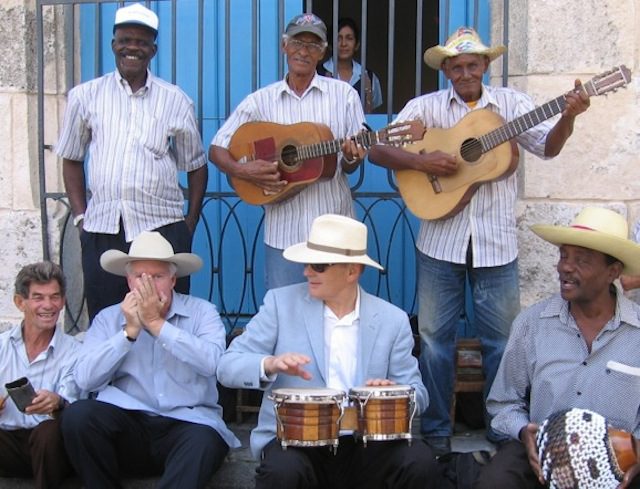
Two visiting yankis sit in with a Havana street band. The author plays the bongos and on my right, John Parke Wright, a Florida cattleman, riffs on the harmonica.
Two visiting yanquis sit in with a Havana street band. The author plays the bongos and on my right, John Parke Wright, a Florida cattleman, riffs on the harmonica.

Cuban race relations are refreshing and debilitating all at the same time. Today in the streets of Havana, visitors notice how easily persons of diverse racial backgrounds mingle. They work, play, socialize, marry, eat, and live together to a greater extent than in the United States. Fidel Castro boasted that the revolution ended discrimination in Cuba because it eliminated class distinctions. Yet racial prejudice did not end. White males continue to dominate the ruling party and military elites. Moreover, hotel employers apparently believe that European tourists prefer white hostesses and black maids, white waiters and black kitchen workers. More white Cubans live abroad and their remittances go predominately to white relatives in Cuba. The poorest and least healthy Cubans are mainly black.

Cubans lounging on the wall along the famous Malecón, Havana’s seaside boulevard.

Is President Obama correct that United States recognition will benefit the Cuban people? It will not change the government, and economically some will benefit more than others. However, I am convinced that U.S. diplomatic recognition of Cuba will benefit Texans as much as the Cuban people. Those UT students who want to learn about the Cold War in Latin America and about the largest Caribbean island will take advantage of the executive order. So will Texans who cherish the freedom to experience the only capital (Havana) of Latin America that does not have a traffic jam, the only cities of Latin America that still look like they did 50 years ago, and new places to snorkel that are not in Mexico. Believe it or not, Cuba has more live music than Austin.

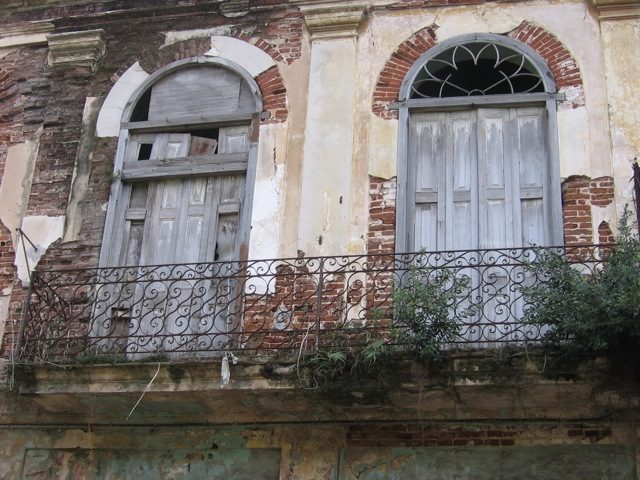
Cuba’s government is renovating run-down buildings such as this one in the historic Havana Vieja.

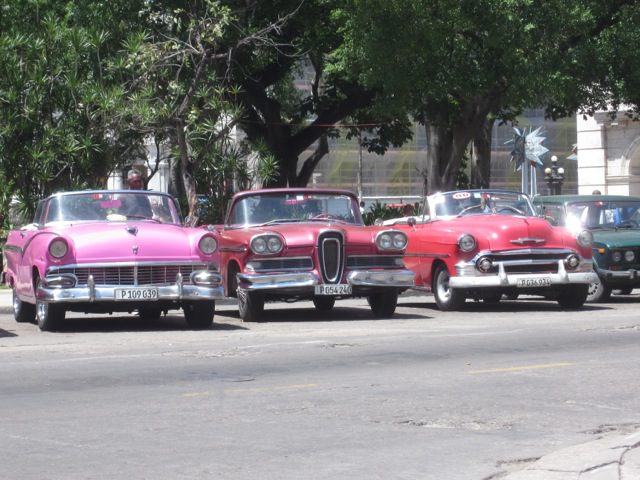
Finally, what about those vintage Fords and Chevys?   In the near term, they will remain the vehicles of choice in urban transportation. These 1940 and 1950 American models – DeSotos, Imperials, Buicks, Chryslers, Cadillacs, Nash Ramblers, and a Studebaker or two – share the roads with Soviet Ladas of the 1970s and modern Japanese automobiles. Detroit’s old cars have become part of the cultural identity of the country. But sooner or later, whenever commercial restrictions are lifted by Congress, Texas collectors may be able to repatriate many of these old-fashioned gems.

A taxi stand in Old Havana.

This author’s advice: Get yourself to Cuba before this aspect of the country’s charm disappears.

You may also like:

Jonathan Brown discusses Capitalism After Socialism in Cuba and President Lyndon Johnson’s phone call to Panamanian President Roberto F. Chiari

Blake Scott and Andres Lombana-Bermudez on the Panamanian tourism industry and Blake Scott on Cuban tourism


Photo credits:

First photo by Reggie Wallesen.

Remaining photos courtesy of Jonathan Brown.

Corrected to show that Jeb Bush earned a BA (not an MA as originally stated) in Latin American Studies at UT Austin (January 27, 2015).


The views and opinions expressed in this article or video are those of the individual author(s) or presenter(s) and do not necessarily reflect the policy or views of the editors at Not Even Past, the UT Department of History, the University of Texas at Austin, or the UT System Board of Regents. Not Even Past is an online public history magazine rather than a peer-reviewed academic journal. While we make efforts to ensure that factual information in articles was obtained from reliable sources, Not Even Past is not responsible for any errors or omissions.
“The Battle of Bandera Pass and the Making of Lone Star Legend”

This article is part of an occasional series of articles highlighting the extraordinary collection of historical documents in the Briscoe Center for American History at UT Austin.

By Nathan Jennings

 http://freepages.genealogy.rootsweb.ancestry.com/~bhughes/AndrewJacksonSowell.html
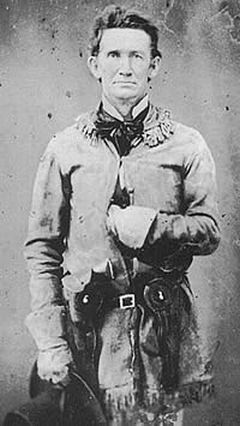
Andrew Jackson Sowell and ”Big Foot” Wallace.

The John Coffee Hays Collection at UT Austin’s Briscoe Center for American History contains a printed oral history by early Texas historian Andrew Jackson Sowell. The oral histories recount the involvement of settler Thomas Galbreath in three frontier skirmishes between the Texas Rangers and Comanche warriors during the 1840s. Sowell’s article serves as an example of the way Texas’s early events were passed orally by participants and thus became part of the inexact, and possibly fictional, landscape of Lone Star lore and legend. Though the article is undated, it names Sowell as the author and was probably taken from the column, “Frontier Days of Texas” that he wrote in the San Antonio Light newspaper during the 1910s. The son of Texan settlers, Sowell interviewed Galbreath himself, as well as participants Benjamin Highsmith and Creed Taylor decades after the events took place. Since Sowell was not born until 1848, he captured the history from aging frontiersmen who recounted their experiences years after the era of the Texas Republic (1836-46).

In addition to offering an overtly romanticized and partisan description of the Texas Rangers’ role in frontier dominance, the validity of the article has been called into question by several modern historians. The most controversial Anglo-Indian skirmish in the article, famously called the Battle of Bandera Pass, narrates how John Coffee Hays’s Texas Rangers defeated a much larger Comanche force in the Texas Hill Country. As historian Stephen Moore points out, Sowell places the fight in 1841, but men listed as participants do not appear in Hays’s rosters until 1842. Some, such as Samuel Walker, do not even arrive in Texas until years later. Furthermore, the author places the event in the wrong county. A current historical marker stands in Bandera, in south-central Texas, but the battle probably took place in Kendall County to the east. Not a single primary source memoir, report, or contemporaneous press account records this battle, which is uncommon for fights of that scale during the period, and consequently brings even its occurrence into question.

John Coffee Hay, circa 1857. Via Wikimedia Commons.

The result of this flawed amalgamation of oral histories was the addition of another legendary feat of martial prowess to the lore of Texas history. Though possibly fictional and probably incorrect, the Battle of Bandera Pass became accepted as fact for generations of proud Anglo-Texans. In a larger context, printed articles of this manner assisted in establishing the iconic Texas Ranger at the apex of popular Texan cultural masculinity. Offered as stories of bravery and victory at the expense of feared Comanche opponents, Sowell’s writings came to symbolize a past Golden Age for Lone Star nationalism.

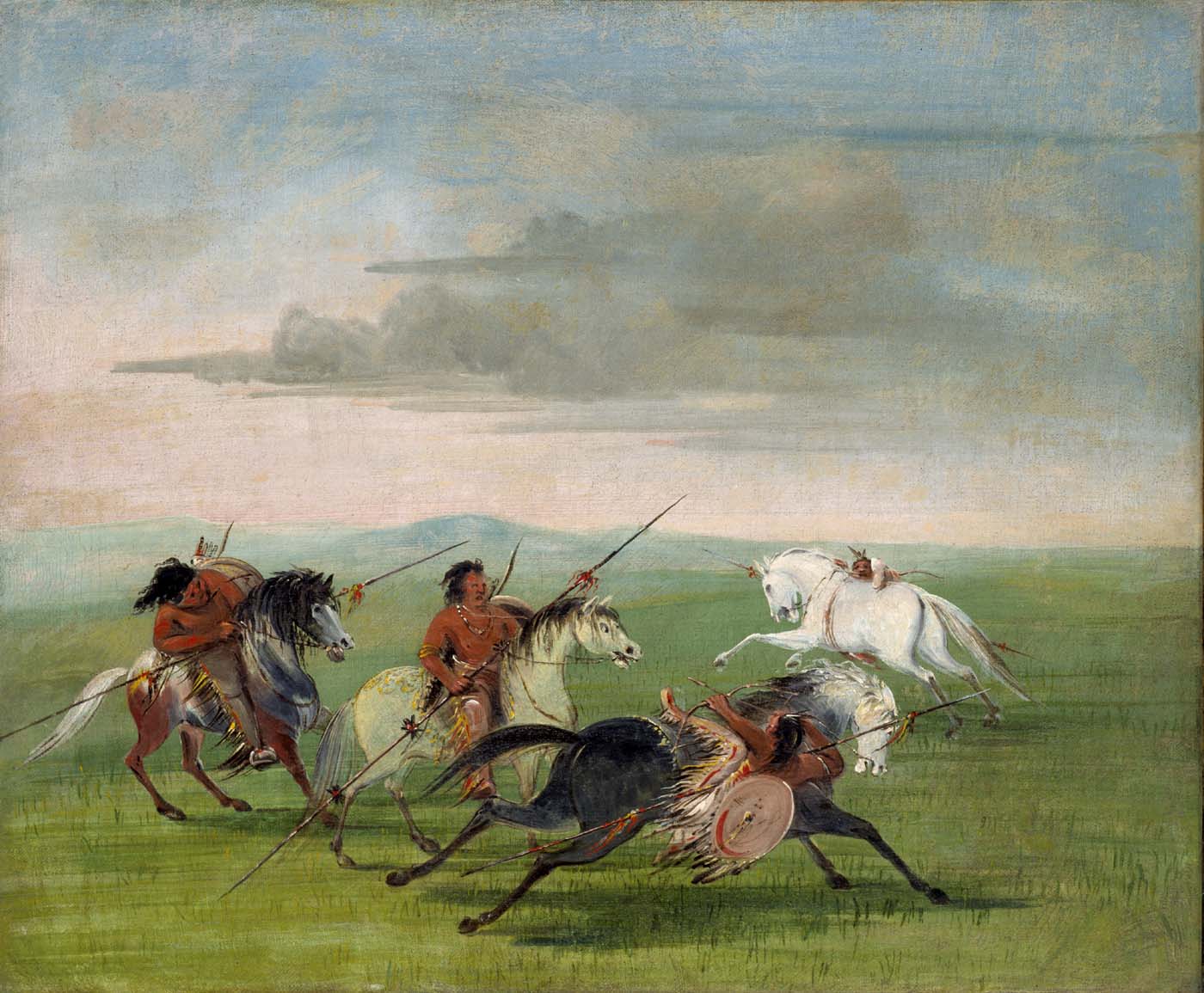
Comanche Feats of Horsemanship by George Catlin 1834. Via Wikimedia Commons.
bugburnt


More amazing finds at the Briscoe Center:

A Texas Ranger and the Letter of the Law

“The Die is Cast”: Early Texans Face the Comanches

Standard Oil writes a “history” of the old south

Stephen F. Austin visits a New Orleans bookstore


bugburnt


First image courtesy of http://freepages.genealogy.rootsweb.ancestry.com/~bhughes/AndrewJacksonSowell.html

Second and third images via Wikimedia Commons.


The views and opinions expressed in this article or video are those of the individual author(s) or presenter(s) and do not necessarily reflect the policy or views of the editors at Not Even Past, the UT Department of History, the University of Texas at Austin, or the UT System Board of Regents. Not Even Past is an online public history magazine rather than a peer-reviewed academic journal. While we make efforts to ensure that factual information in articles was obtained from reliable sources, Not Even Past is not responsible for any errors or omissions.
A Texas Ranger and the Letter of the Law

This article is part of an occasional series of articles highlighting the extraordinary collection of historical documents in the Briscoe Center for American History at UT Austin.

By Nathan Jennings

John Salmon “Rip” Ford had a long military career as a soldier of the Texas Republic (1836-46). He was a volunteer in the Mexican War, a Texas Ranger on Texas’s borders, and commander of a Confederate Cavalry Regiment in the Civil War. Ford’s archive at UT Austin’s Briscoe Center for American History, contains records of his activities as a physician and newspaper editor, as well, revealing an uncommon breadth of occupational skills. But the bulk of the archive is occupied by Ford’s voluminous memoirs, which span his life from 1815 to 1892.

John Salmon Ford, photographed while serving as a Colonel in the Confederate 2nd Texas Cavalry during the War Between the States. Original photograph circa 1860 to 1865. (Via Wikimedia commons
John Salmon Ford, photographed while serving as a Colonel in the Confederate 2nd Texas Cavalry during the War Between the States. Original photograph circa 1860 to 1865. (Via Wikimedia commons)

Those memoirs detail an informative event in the history of civil-military relations in nineteenth-century Texas. In 1858 Ford refused to follow the orders of a District Judge to arrest eighteen Anglo-Texans accused of murdering reservation Native Americans. This account of what became known as the Garland Affair, after the main culprit, Peter Garland, and Ford’s perspective on the event, provide insight into how Texas Rangers prior to the Civil War perceived themselves in relation to both civil law enforcement and military service.

Ford’s memoir is notable for the clear distinctions he makes between civil authority and military limitations. His argument and actions, as he described them, contradict the popular notion of the Texas Rangers serving as the premier law enforcement order during Texas’s early years. When Judge N. W. Battle ordered the Captain Ford to “forthwith arrest” Garland and his band of settlers in Central Texas for the murder of seven Native Americans, including women and children, the ranger flatly refused. Ford articulates the difference between a “sheriff” and a “military officer,” and further questions the order on “principal” to use his company to “attack a body of American citizens.” He finishes by emphatically stating that the judge had no authority “to command me, as the captain of a company of rangers, to arrest Garland and others.” He also worried that “a civil war might have been the consequence.”

This argument, made by the senior Texas Ranger in the state, revealed the purely military intent of the early ranger forces. Even though the guilt of Garland and the others was never in doubt, and the judge ordered a legal arrest, Ford nevertheless refused “to act except in strict subservience to law.” These Texas Rangers viewed themselves as irregular cavalry, not police forces. It is equally possible that the ranger felt disinclined to move against a fellow Anglo citizen on behalf of a native victim, or that he was hesitant to provoke a possible violent confrontation between his force and the settler militia. Regardless of motive, Ford’s intransigence also reveals that, despite the volatility of Texas’s rough frontier culture, the historical American aversion to military interference in civil matters had matriculated westward. Eventually the captain offered to subordinate his company under the prosecuting leadership of “the civil authorities” to “assist” in the arrest. Garland and his perpetrators, however, were never arrested.

These writings are now partially edited in Stephen Oates’s 1987 book, Rip Ford’s Texas.

More amazing finds at the Briscoe Center:

“The Die is Cast”: Early Texans Face the Comanches

Standard Oil writes a “history” of the old south

Stephen F. Austin visits a New Orleans bookstore


The views and opinions expressed in this article or video are those of the individual author(s) or presenter(s) and do not necessarily reflect the policy or views of the editors at Not Even Past, the UT Department of History, the University of Texas at Austin, or the UT System Board of Regents. Not Even Past is an online public history magazine rather than a peer-reviewed academic journal. While we make efforts to ensure that factual information in articles was obtained from reliable sources, Not Even Past is not responsible for any errors or omissions.
Has Texas Seen its Last Liberal?

EDITOR’S NOTE: A new HBO documentary, “All About Ann: Governor Richards of the Lone Star State,” takes a look back at the life of the political icon.

By Zachary Montz

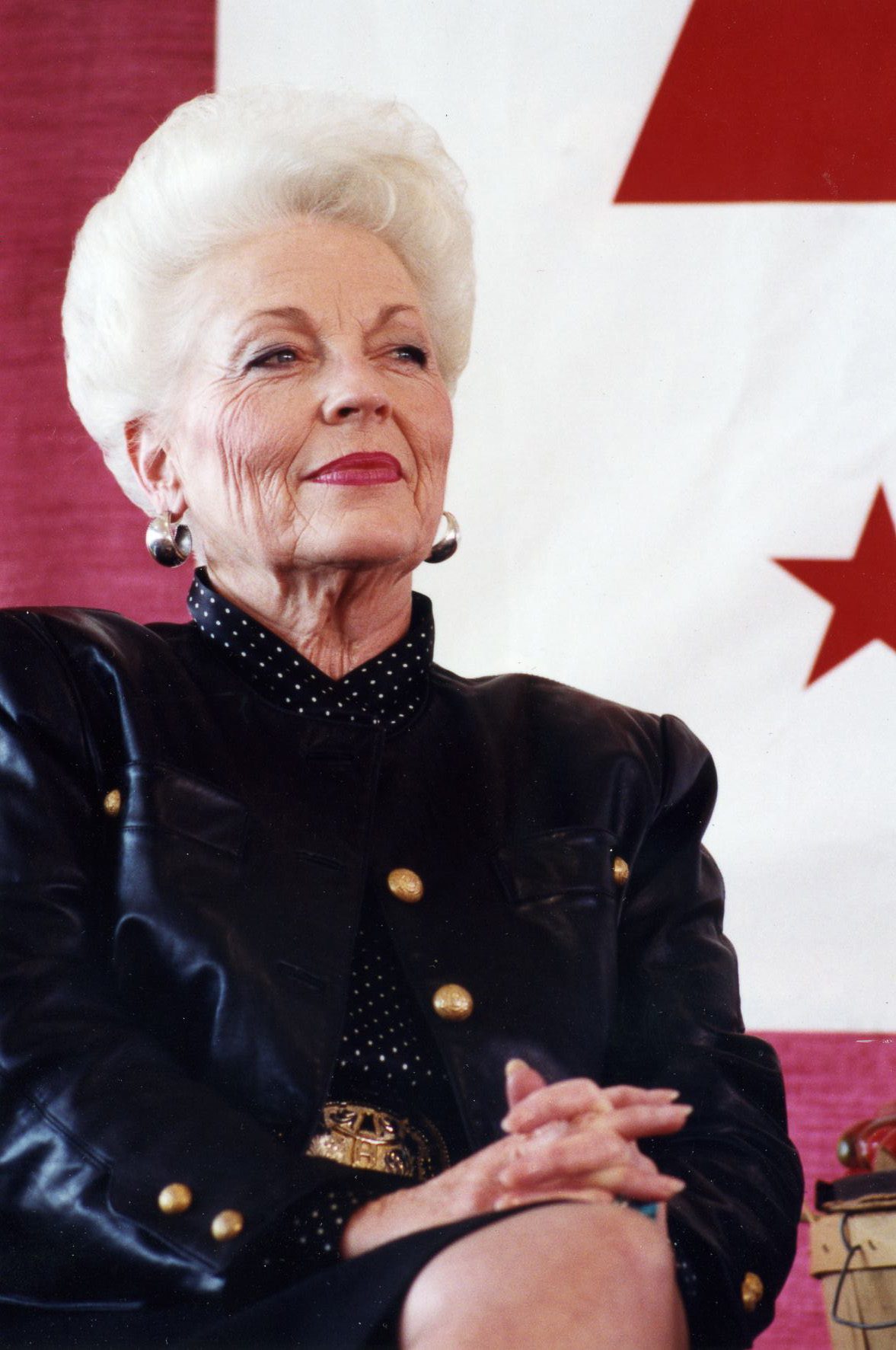
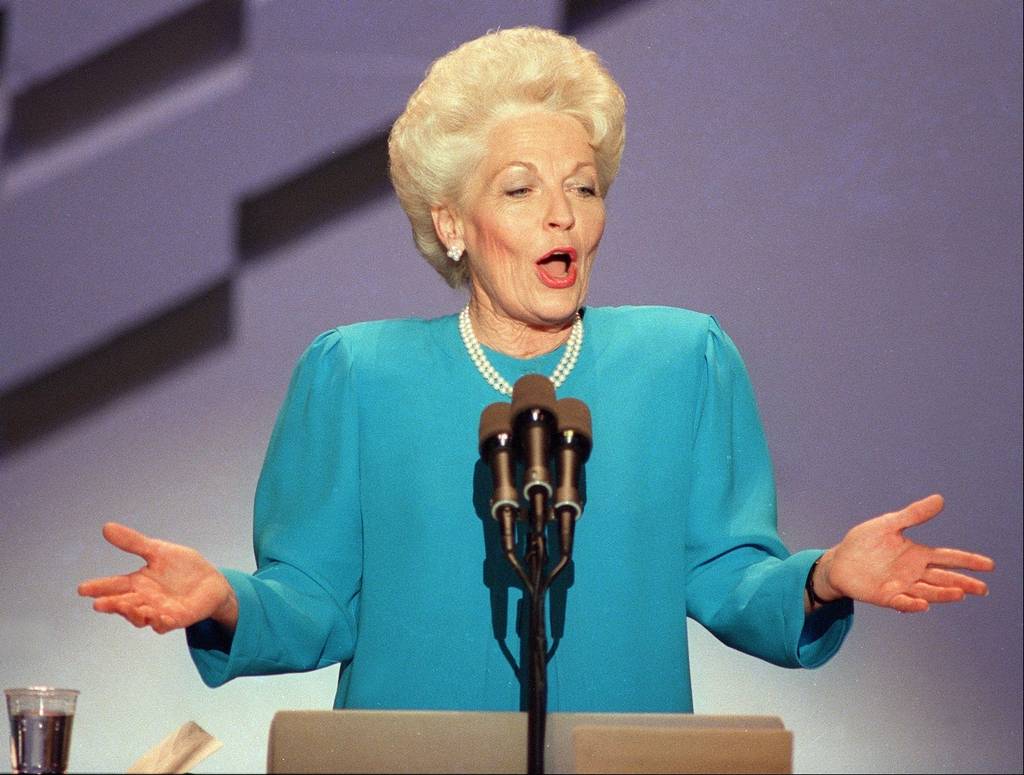
“Good evening, ladies and gentlemen. Buenas noches, mis amigos! I am delighted to be here with you this evening, because after listening to George Bush all these years, I figured you needed to know what a real Texas accent sounds like.” This is how America first met Ann Richards, her trademark white hair lit by the spotlight as she delivered the keynote address at the 1988 Democratic National Convention in her distinctive Central Texas twang. Richards, then the state treasurer, poured it on that night, mixing a stalwart defense of activist government with swipes at the Republican nominee, fellow Texan George H.W. Bush, including her perfectly landed mocking line, “Poor George, he can’t help it – he was born with a silver foot in his mouth,” that brought the audience to its feet. Along with the jabs, Richards gave delegates the country wit and big personality they might have expected from a rising Texas politician. But here, too, was something new from a state famous for its macho self-image: a woman, and a proud, sharp-tongued liberal at that. The fiery speech won the hearts of delegates, prompting some to wonder if the Democrats had nominated the wrong person. Ann Richards had become a national star.

Texas Governor Ann Richards in 1992 (Kenneth C. Zirkel/Wikimedia Commons)

Texas Governor Ann Richards in 1992 (Kenneth C. Zirkel/Wikimedia Commons)

Richards’s keynote provides the opening for HBO’s recently-premiered documentary “All About Ann: Governor Richards of the Lone Star State,” which airs on the cable network throughout May, as well as on HBOGo. An opportunity for longer-settled Texans (and non-citizens too) to revisit the life and career of the woman who rose to the top of the state’s conservative and male-dominated political scene, this excellent documentary also serves to introduce Richards to a new generation, who know a Texas where the politics have gone from conservative to right-wing and are almost as single-gender as they were when Richards was elected governor in 1990.

Originally released in 2012, this product of first-time documentarians Jack Lofton and Keith Patterson, was subsequently acquired by HBO’s documentary division, which recut the film to tighten its focus on Richards’ career in statewide office, from her election as State Treasurer in 1982 to her gubernatorial loss to George W. Bush in 1994. While “All About Ann” features commentary from Bill Clinton, Michael Dukakis, Dan Rather and other national figures, some of the best insights come from interviews with Richards’ inner circle of advisors, namely long-time chief of staff Mary Beth Rogers and speechwriter Suzanne Coleman. Contributions from Richards’ former husband David and from her children, including daughter Cecile, now a Democratic political player and Planned Parenthood president, give viewers a look at Richards’ time both before and after her stint in big-league politics and provide a sense of how the many sides of her well-known personal life – as a mother, grandmother, teacher, divorcee, and recovering alcoholic – helped shape her political outlook and public persona.

Of course, there is no substitute for the woman herself, and the film is wise to let Richards, who died in 2006, tell much of her own story. The directors take advantage of archival newsreel, interviews, and televised debates and speeches to show the full depth of Richards’ character, her knack for language, and the prodigious communication skills (one thing we learn is that Richards’ mother enrolled her in “expression lessons” as a child) that took her to the Governor’s Mansion.

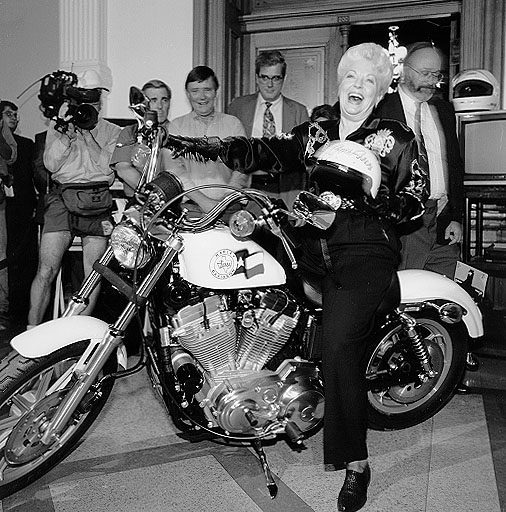
Ann Richards poses on a motorcycle (Texas State Library and Archives Commission)

Ann Richards poses on a motorcycle (Texas State Library and Archives Commission)

Viewers get only a quick run through Richards’ life before elected office: her upbringing in Waco and high school debating triumphs, her marriage in college to David Richards, who would become a prominent labor and voting rights lawyer, and her time raising four children in Dallas and later Austin. As she explains it, a career in politics was not something she had initially considered. “I was exactly what the magazines said I ought to be,” Richards recalled, “I was a hostess, a fabulous cook, a chauffer, [and] I was very involved with my kids.” Richards had been involved on the outside of politics, doing the “women’s jobs” of social planner and campaign volunteer, but when David passed on a chance to run for a seat on the Travis County Commissioners court in 1976, Ann jumped into the game, winning election in her first race. Richard worried that the dramatic shift in her life and the new role she would play in her family would spell trouble for her marriage. She was right. Although they remained on generally good terms, the couple split in 1980 and divorced in 1984.

It was around the same time that Richards went through treatment for alcohol addiction. Richards’ personal life was the subject of many a dirty political attack during her career, the most common of which were that she had fallen off the wagon or that she was bisexual. In the 1990 Democratic gubernatorial primary Richards was dogged by Attorney General Jim Maddox’s frequent allegations of past cocaine use. Richards skillfully dodged the question, turning it into an opportunity to talk frankly with voters about overcoming her alcohol problem. Not that Richards couldn’t play rough too. In the same race she put away former Governor Mark White with ads that implied – with no real proof – that he had been paid to steer state business to a Houston bond firm.

Watching Richards counterpunch her way to victory in a good, old fashioned Texas melee like the ’90 primary is a delight for the political junkie, but it would be a mistake to let Richards’ campaigning talents distract from what was at the heart of Richard’s political story: her desire, as she put it, to create a “new Texas,” one where the “doors of government” would “swing open” to “let the people in.” As the documentary makes clear, this purpose was present from the beginning of Richards’ entry into public service, and the film gives considerable attention to her tenure as State Treasurer, where Richards earned acclaim for reforming an office that was a bastion of good-old-boy inefficiency when she took over in 1983. Richards modernized the Treasury, both by computerizing its workings and by emphasizing the hiring of minorities and women in an effort to make the government of Texas better reflect the state’s diverse population.

Ann Richards speaking at the 1988 Democratic Convention (Associated Press)

Ann Richards speaking at the 1988 Democratic Convention (Associated Press)

In the debates over hiring and affirmative action in the 1980s, many conservatives argued that measures to create diverse workforces would come at the expense of job performance. Excellence and diversity were counterpoised values. Richards had no need to play that game. “They told me that I was asking the impossible, that I simply could not find Hispanics and blacks and women who were capable… of really high-class financial management,” Richards recalled in 1991. But her success in the Treasury, she argued, “has been directly the result of opening the door and giving an opportunity to people who were dying to prove themselves.” In Ann Richards’ new Texas, diversity and excellence went hand in hand. And one only had to look at other areas of Texas government to know that the opposite was also true: a closed door, and the old boys network that thrived behind it, could be a recipe for incompetence and corruption.

Richards’ commitment to diversity and her vision of an open government, among other convictions, put her in the left-liberal wing of the Texas Democratic Party, an outsider compared to the so-called pragmatic or conservative Democrats who continued in the tradition of LBJ and John Connally. Texas liberals had rarely been in the driver’s seat of their own party, never mind in the Governor’s Mansion, and given the state’s current domination by Republicans, it is worth asking how Richards ever managed her upset victory in 1990. Certainly her opponent had something to do with it. That year, the Republicans nominated Clayton Williams, a man who seemed to be made in their own self-image: a wealthy businessman, a rancher, and a straight-shooter. What they got was a political fool who shot himself in the foot enough times to blow an early double digit lead. The documentary airs the full “Claytie” blooper reel. It would be pure comedy if Williams’s attitude towards women didn’t seem so out of our present political moment: a disgusting rape “joke,” a comment about Richards that he would “head her and hoof her and drag her through the dirt,” and a decision (a premeditated one, as the film reveals) to refuse to shake his opponent’s hand after a televised debate.

Ironically, it is the clownish version of Williams that conservatives like to remember, for it allows them to write off Richards as an accidental governor, one who won only by dint of her pitiful opponent. But as several of Richard’s former staffers point out in “All About Ann,” it wasn’t only the misogyny that undid Williams. The margin of victory came from working class voters, especially in East Texas – a generally-conservative group, but one with a populist streak. Richards could out-good-ole-boy the good-ole-boys and could poke fun at Texas’s bubbas while winning their vote, and her campaign coupled her personal touch with a concerted effort to portray Williams as a big businessman unconcerned with working Texans. Williams’ steadfast refusal to release his tax returns, and his out-of-the-blue admission in the campaign’s final week that he had paid no taxes during the crash year of 1986, helped Richards rack up votes in East Texas, sealing the election for her.

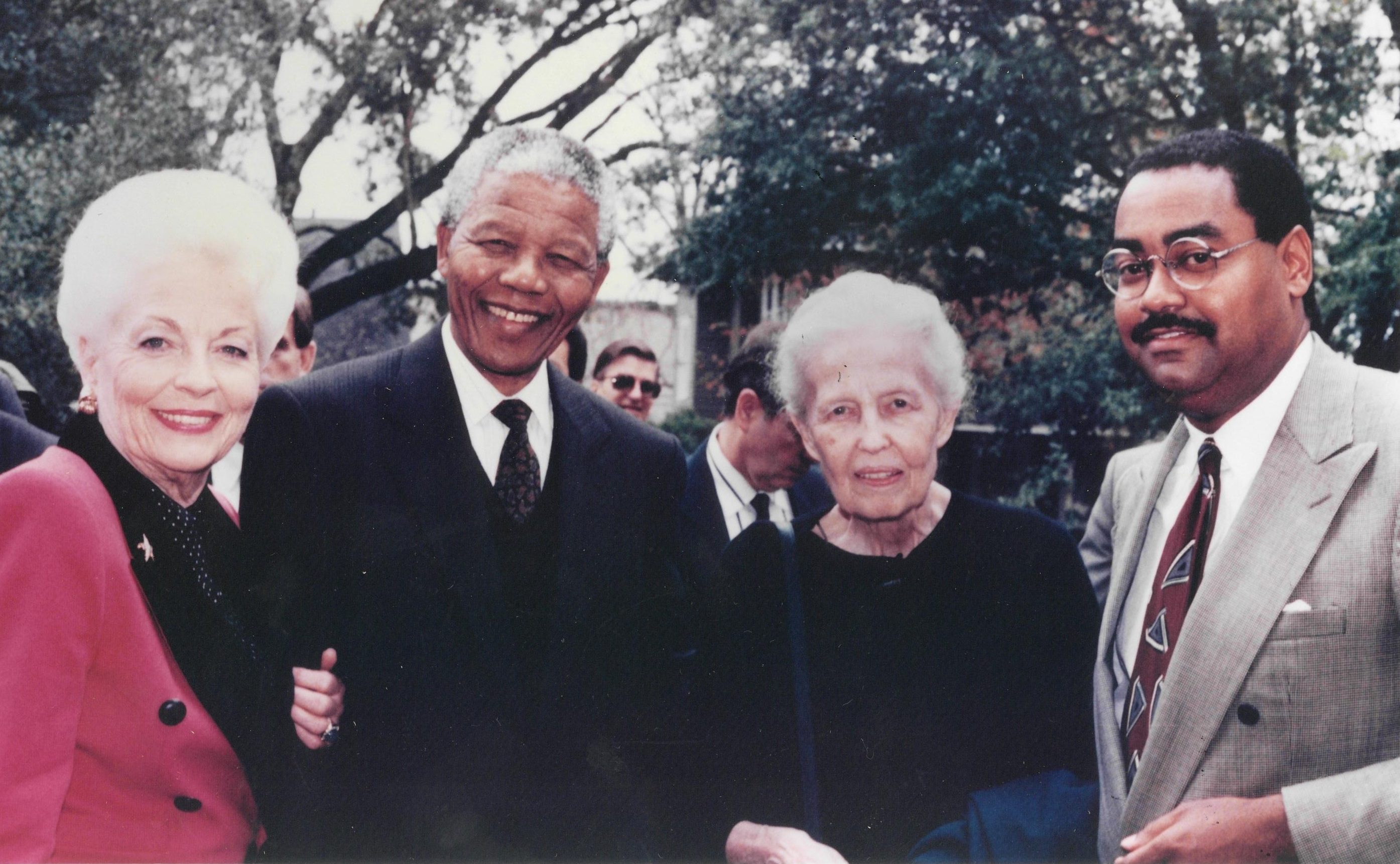
From left: Texas Governor Ann Richards, Nelson Mandela, Dominique de Menil, And Texas State Senator Rodney Ellis (Senator Rodney Ellis/Wikipedia)

From left: Texas Governor Ann Richards, Nelson Mandela, Dominique de Menil, and Texas State Senator Rodney Ellis, 1991 (Senator Rodney Ellis/Wikipedia)

Richards began her governorship ready to “make changes that should have been made a long time ago.” Continuing her record as treasurer, she appointed an even split of men and women in her first 100 days. The officials reflected the diverse state: 54% were white, 25% Hispanic, and 21% black. The film provides a laudatory overview of Richards’ term. She threw out rubber-stamp regulators in the insurance department, passed a new ethics law, put teeth into seldom-enforced environmental rules, and implemented an addiction treatment program in state prisons to reduce recidivism, all broadly popular moves that kept her personal approval ratings high and grew her national profile.

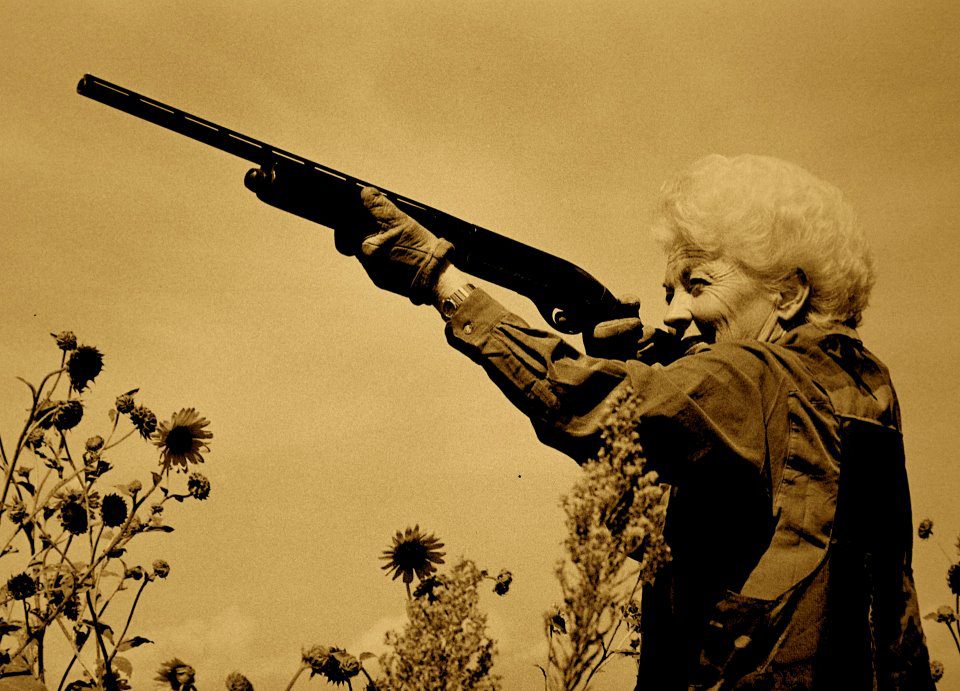
This approving account of Richards’ time in office provides little sense of her shortcomings, and notably excludes mention of struggles involving the budget and school finance. The oversight is compounded by the directors’ failure to include any interviews with either critics or opponents of the former Governor. As a result, “All About Ann” is hard pressed to explain just how Richards, despite her personal popularity, lost decisively to George W. Bush in 1994. The film provides two culprits: Karl Rove, a political consultant made uniquely powerful by a lack of scruples, and an election cycle unusually hostile to Democrats. The film puts Rove behind rumors that Richards’ supposed legions of gay supporters were poised to spread their “lifestyle” through the public schools, and a whisper campaign about gun confiscation, an effective, if unoriginal, charge that was bolstered by Richards’ veto of concealed carry legislation. Meanwhile, Bush – a likeable, attractive, and disciplined campaigner – could play it straight, avoiding the personal attacks and mistakes that destroyed his Republican predecessor. Although he criticized Richards for being soft on crime and presented his own ideas about education reform, Bush ran against Bill Clinton as much as the sitting Governor, attacking an unpopular president in a midterm year that would give Republicans control of Congress.

Just as the idea of Richards as an accidental governor denies her ground-breaking victory, the story presented by her allies that she was felled by forces beyond her control denies Richards’ role in her own defeat. As Jan Reid argues in his sympathetic, but by no means uncritical, 2012 biography of Richards, the Governor’s term can be seen as a parabola: real successes in the first two years were followed by a decline in the latter two. Richards divided her time and energy between governing in Austin and involvement in the national scene, leaving her without a clear program and on the defensive against a rising tide of Republican attacks. In 1990 Richards had been the brassy outsider. Four years later, lacking a bold policy agenda to match her personality, she was open to being defined by her enemies and vulnerable to the sorts of attacks – guns, God and gays – that Rove and Co. used to great effect. Her campaign centered on the complaint that Bush was a spoiled novice whose only qualification for the Governorship was that he thought he was entitled to it. She couldn’t convince enough Texas voters that he was not.

Image of Ann Richards firing a gun from the film, "Backwards and In High Heels" (Texas Democrats)

Image of Ann Richards firing a gun from the film, “Backwards and In High Heels” (Texas Democrats)

Richards would find plenty to do after leaving the Governor’s Mansion. She had no interest in running for another elected office, telling the public after her loss that “I’ve been doing this for 18 years – not as long as I was a housewife – and now I look forward to something new.” The documentary shows the many roles she played: as a lobbyist and strategist, lecturer, stump speaker for female Democratic candidates, and as a fantastic talk show guest. All throughout she continued her fight on behalf of the causes she had advanced during her political career, especially the rights of women to control their own bodies, right up until her death from esophageal cancer in 2006.

The release of “All About Ann” comes as another Texas woman, the first, in fact, since Richards, has received the Democratic gubernatorial nod, and comparisons between the two are inevitable. Like Ann Richards, Wendy Davis has captured national attention and built a dedicated base among Texas women at a time when reproductive rights are at the forefront of political conversation. Unlike Richards, however, Davis faces a Republican Party that is much more dug in, and her opponent, Greg Abbott, while perhaps not having the personal likability of George W. Bush or Rick Perry’s deep understanding of the right wing id, is no Clayton Williams. And outside of her core supporters, Davis has yet to show that she can connect with Texas voters in the way that Richards did in 1990.

But “All About Ann” reminds viewers that Richards too faced an uphill battle when she declared her candidacy for the governorship. It was against these long odds when she was at her fighting best. The documentary closes with a poignant clip of Richards speaking at a LGBT fundraiser in 2003, coughing her way through a powerful address, already suffering from failing health. Recalling the many barriers to women and minorities that had fallen in her lifetime, Richards encouraged her audience to continue the effort to create the sort of “pluralistic society where human dignity is cherished” that had been at the heart of her political life. “We have got to remember that we have the power… that dreams can come true if we are willing to work for them.” It has been the mantra of Texas liberals in the many fights they lost in Ann Richards’ lifetime, and in the few that were won.

Zachary Montz received his PhD in History from UT Austin in 2014

bugburnt

Sources:

Some background information on Richards’ term as Governor, as well as demographic information on her appointees, is drawn from Jan Reid’s excellent biography, Let the People In: The Life and Times of Ann Richards (University of Texas Press, 2012)

“The Die is Cast”: Early Texans Face the Comanches

This article is part of an occasional series of articles highlighting the fascinating collection of historical documents in the Briscoe Center for American History at UT Austin.

by Nathan Jennings

The Telegraph and Texas Register was the most influential newspaper in the region between colonial settlement and the Civil War. Based in Houston and intended for popular consumption, the nationalistic editorials in this publication offer a window into how the newly formed Lone Star Republic viewed the challenges of rapid territorial expansion into contested territories along the lower Great Plains.

One editorial in the Telegraph, published on November 3, 1838, provides a particularly revealing view of the new republic’s reaction to increased conflict with the Penateka Comanche people. This specific time in Texas’s history represented a transitional stage between the Texas Revolution of 1836 and the Anglo-Indian Wars that exploded across the plains between 1839 and 1841. Though the Anglo-American colonies of Mexican Tejas had frequently grappled with smaller tribes east of the Colorado River, they had yet to decisively engage the massed cavalries of the Plains Indians. The Telegraph article by Francis Moore was written in response to a recent Comanche victory over a group of settlers, and focused on the confrontation emerging in the San Antonio region.

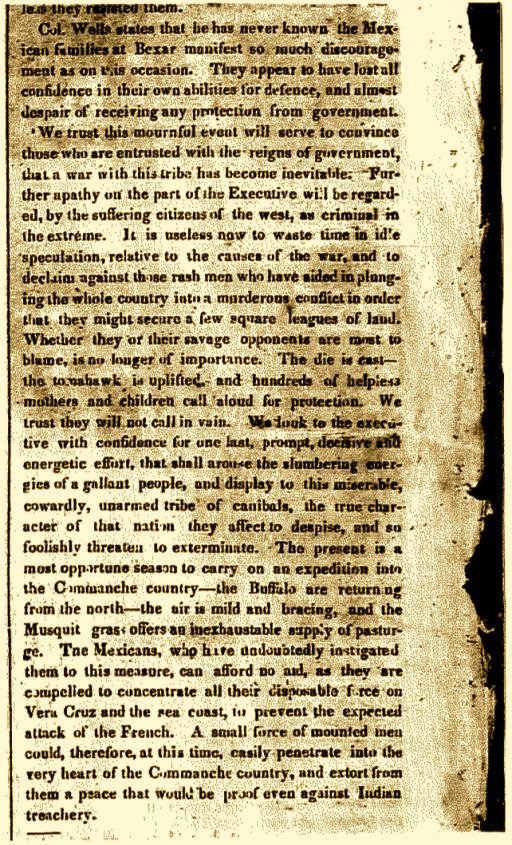
Page from the Telegraph and Texas Register newspaper from Nov. 3, 1828

Moore’s editorial sheds light on three ways Anglo-Texans perceived the Comanche and the threat of their power.  First, the article emphatically stated that “war with this tribe has become inevitable” and called for mobilization by the Texas government. This enthusiasm for large-scale warfare represents a transition from the Texans’ historical reliance on localized militia to a society-wide engagement with national armies. Second, the editor admits the culpability of “rash men” who have “aided in plunging the whole country into a murderous conflict” in order to seize western property, but then fatalistically disregards this causality, shifting blame onto the Native population: “The die is cast — the tomahawk is uplifted, and the hundreds of helpless mothers and children call aloud for protection.”

The third point reveals a tactical shift in ideas about defeating the Native American warriors. Moore suggested that the republic launch the offense with an “expedition” of “mounted men” to “penetrate into the very heart of the Comanche country.” This shows that by 1838, Anglo-Texans had fully embraced the cavalry culture of the region. They also apparently understood that their own defensive strategies were insufficient against arguably the most lethal raiders in North America, who were defending their territory against European settlers who were seizing and occupying it.

Page from the Telegraph and Texas Register newspaper from Nov. 3, 1828

The editorial’s prescriptions –to mobilize the army and population for a large-scale, cavalry war — would soon become tragic reality. Over the next three years the Texan and Comanche peoples clashed in an unprecedented scope of ethnic warfare to decide the fate of West Texas. While both peoples launched massive and destructive invasions into each other’s heartlands, the Anglo-American sustained use of expeditionary methodology suggested by the Telegraph proved decisive. By 1845 Texas broke the power of the southern Comanche for a generation and the Lone Star Republic solidified its control of the territories between the Red River and the Rio Grande.

The full text: 

We trust this mournful event will serve to convince those who are entrusted with the reins of government, that a war with this tribe has become inevitable. Further apathy on the part of the Executive will be regarded, by the suffering citizens of the west, as criminal in the extreme. It is useless now to waste time in idle speculation, relative to the causes of the war, and to declaim against those rash men who have aided in plunging the whole country into a murderous conflict in order that they might secure a few square leagues of land. Whether they or their savage opponents are most to blame, is no longer of importance. The die is cast-the tomahawk is uplifted, and the hundreds of helpless mothers and children call aloud for protection. We trust they will not call in vain. We look to the executive with confidence for one last, prompt, decisive and energetic effort, that shall arouse the slumbering energies of a gallant people, and display to the is miserable, cowardly, unarmed tribe of cannibals, the true character of that nation the affect to despise, and so foolishly threaten to exterminate. The present is a most opportune season to carry on an expedition into the Comanche country-the Buffalo are returning from the north-the air is mild and bracing, and the mesquite grass offers an inexhaustible supply of pasturage. The Mexicans, who have undoubtedly instigated them to this measure, can afford no and, as they are compelled to concentrate all their disposable force on Vera Cruz and the sea coast, to prevent the expected attack of the French. A small figure of mounted men could, therefore, at this time, easily penetrate into the very heart of the Comanche country, and extort from them a peace that would be proof against Indian treachery.

More amazing finds at the Briscoe Center:

Standard Oil writes a “history” of the old south

And Stephen F. Austin visits a New Orleans bookstore


The views and opinions expressed in this article or video are those of the individual author(s) or presenter(s) and do not necessarily reflect the policy or views of the editors at Not Even Past, the UT Department of History, the University of Texas at Austin, or the UT System Board of Regents. Not Even Past is an online public history magazine rather than a peer-reviewed academic journal. While we make efforts to ensure that factual information in articles was obtained from reliable sources, Not Even Past is not responsible for any errors or omissions.

Handbook of African American Texas

By Joan Neuberger

Do you love Texas history? The Texas State Historical Association, which makes Texas history readily accessible through its Digital Gateway to Texas History, now offers a huge, new, terrific series of readings in the Handbook of African American Texas.

Launched on Juneteenth, 2013, the anniversary of the day in 1865 when news of the Emancipation Proclamation reached African American Texans, this 800 article online encyclopedia includes more than 300 new entries and is part of the 26,000 article collection called the “Handbook of Texas.” The project was envisioned and spearheaded by Merline Pitre of Texas Southern University and former TSHA president. She worked with Randolph B. “Mike” Campbell of the University of North Texas and TSHA chief historian.

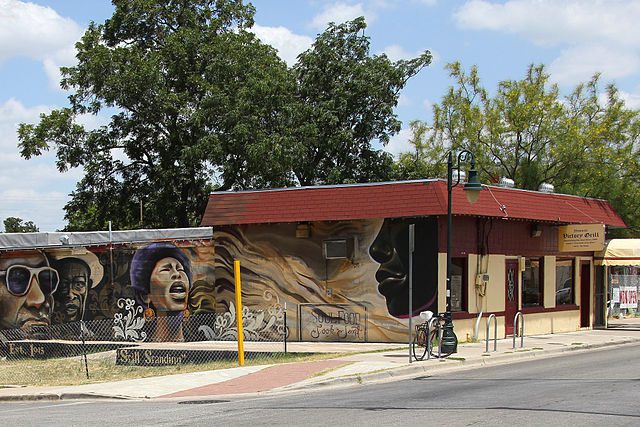
Read articles about the Victory Grill, originally opened in 1945 for servicemen returning from fighting in World War II (and pictured below).

image
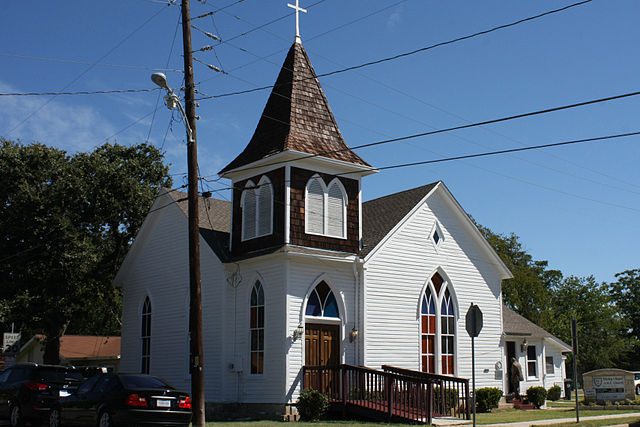
Or the history of the African Methodist Episocpal Church in Texas (this is the Wesley Chapel AME Church in Georgetown, built in 1904).

Photograph of the front facade of the Wesley Chapel AME Church in Georgetown, Texas

You can read about everything from Black Cowboys to Black Visual Artists, and everything in between: African American Texans in the arts, business, community organizations, education, the military, journalism, religion, sports, and slavery & civil rights.

You can find an introduction to this wonderful new resource in the Newsletter of the TSHA.

Photo Credits: Wikimedia Commons.


The views and opinions expressed in this article or video are those of the individual author(s) or presenter(s) and do not necessarily reflect the policy or views of the editors at Not Even Past, the UT Department of History, the University of Texas at Austin, or the UT System Board of Regents. Not Even Past is an online public history magazine rather than a peer-reviewed academic journal. While we make efforts to ensure that factual information in articles was obtained from reliable sources, Not Even Past is not responsible for any errors or omissions.
The Rise and Fall of the Austin Dam

If you cross the Colorado River at Redbud Trail and look upstream toward Tom Miller Dam, there amid the tumbled rocks you can still see the wreck of Austin’s dream. In 1890, the citizens of Austin voted overwhelmingly to put themselves deeply in debt to build a dam, in hopes that the prospect of cheap waterpower would lure industrialists who would line the riverbanks with cotton mills. Austin would become “the Lowell of the South,” and the sleepy center of government and education would be transformed into a bustling industrial city.

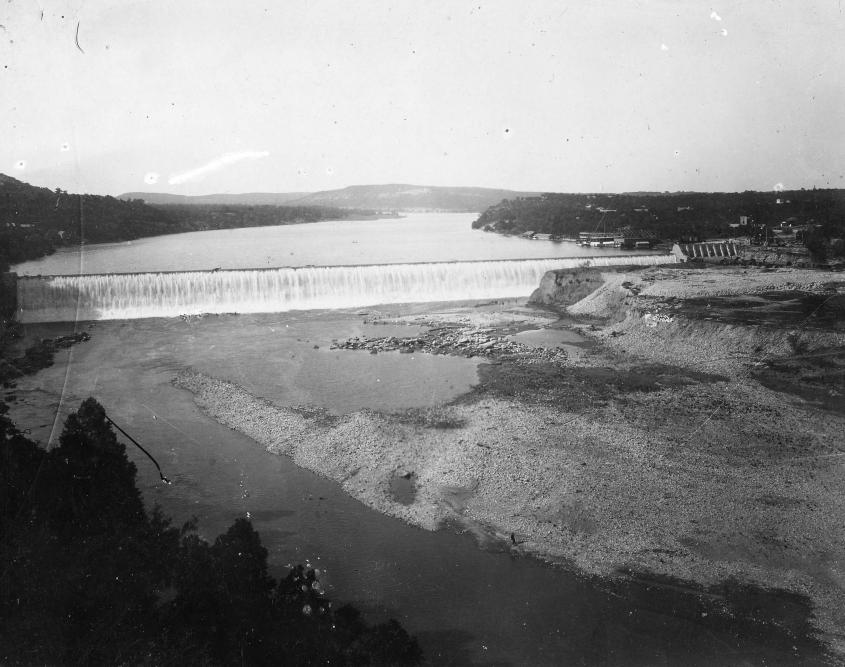
Black and white image of the completed Austin dam from the 1890s
View of the completed Austin Dam, 1890s. (LCRA Archives, W00108)

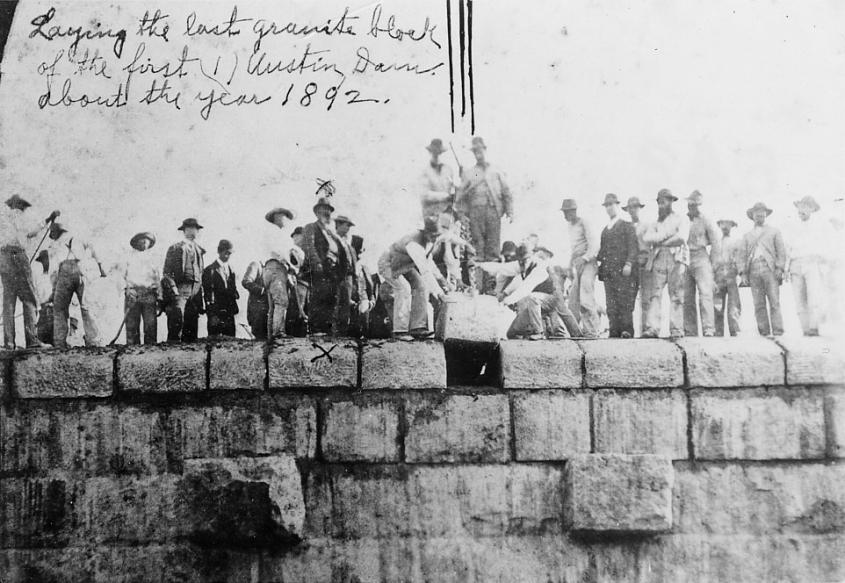
It never happened quite that way, of course. After strenuous efforts to sell enough bonds, and after several setbacks during construction, the city managed to complete the great granite dam in 1893 at a site just northwest of town. Standing sixty feet high and stretching nearly 1200 feet across the river, it was then one of the largest dams in the world. A. P. Wooldridge and other boosters of the project had originally envisioned harnessing the river to drive mill machinery directly, but the engineers they called in soon steered them toward the new technology of the day, and the powerhouse erected on the east bank of the river was filled with electrical dynamos that supplied current to Austin’s new network of electric streetcars, as well as to the “moonlight towers” the city acquired in 1895. The shores of the lake that formed behind the dam—named “Lake McDonald” for John McDonald, the mayor who had whipped up support for the project—attracted new residents and developers, while the waters of the lake itself drew those seeking respite from the Texas heat. Austin boomed in the mid-1890s, driven largely by land speculation. Monroe Shipe established “Hyde Park,” a classic “streetcar suburb” north of downtown, and smaller developments sprang up around the city.

Black and white image of a group of men laying large granite blocks for the first Austin Dam in 1892
Laying the last granite block in the first Austin Dam, 1892 (LCRA Archives W100198)

One of the biggest land deals was engineered by San Antonio banker and businessman George Brackenridge, who had acquired a large tract of land just downstream from the proposed site of the dam, evidently hoping to sell mill sites once the dam was completed. But the promised cotton mills never materialized. The flow of the Colorado proved to be far more variable than the project’s promoters had claimed, and the dam was never able to produce the kind of steady power needed to drive a bank of mills. At times it barely sufficed to power the lights and streetcars.

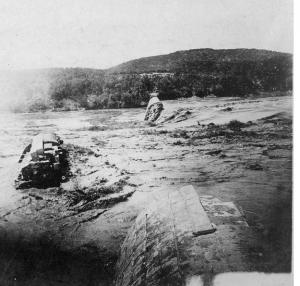
Having never lived up to expectations, the dam failed spectacularly on 7 April 1900. Enormous storms upriver sent a torrent of water cascading eleven feet over the crest of the dam. After the rains had stopped, Austinites came out that bright Saturday morning to see their local version of Niagara. Then at 11:20 am they heard a loud crack—“like a gunshot,” several said—and watched in horror as a central section of the dam gave way and slid sixty feet downstream. Water blasted into the powerhouse, wrecking it and killing eight people. Lake McDonald vanished, and though the western end of the dam still stood, the eastern half was destroyed. More than a century later, great chunks of it are still to be found scattered in the riverbed, forming part of the present Red Bud Isles.

Black and white image of the destroyed Austin Dam with large chunks of debris in the water after the flood of 1900
The first Austin Dam in pieces after the April 1900 flood (LCRA Archives W100514).

 The Austin Dam was probably doomed from the start. Over the objections of their engineers, McDonald and other city leaders had chosen a singularly poor site to build a dam: the exact spot where the Balcones Fault Zone passes under the river. The rock on the eastern end of the site was so loose and fractured it could be shoveled up and water percolated freely through it, undermining the foundation of the dam. Nor had the dam been properly built. Joseph Frizell, the original engineer on the project, quit in disgust, complaining that McDonald had meddled with the design and let the contractor use inferior materials. Faced with such knavery, Frizell said, a responsible engineer had no choice but “to abandon the work as he would abandon fire and pestilence.” A string of other engineers quit the project, too, and the eventual collapse of the dam was in some ways not a surprise.

After 1900, the people of Austin did what they could to recover from the disaster. Having gotten a taste of city-owned electric power, they refused to go back; they bought out the local private power company, which used steam-driven generators, and today’s Austin Energy municipal utility is in a sense a legacy of the old Austin Dam. The city also tried to rebuild the dam itself, but a dispute with the contractor left the repairs unfinished in 1912, and another flood in 1915 damaged it further. By then Brackenridge had given up his hopes for industrial development, and in 1910 he donated his five hundred acres of riverside land to the University of Texas, which now uses it for student housing and a biological field laboratory.

The wrecked dam sat derelict, “a tombstone on the river,” until the Lower Colorado River Authority stepped in and, with federal money, rebuilt it as Tom Miller Dam, completed in 1940. The remaining portions of the 1893 and 1912 dams were incorporated into the new structure, but are now hidden under new layers of concrete. By the time it was finished, however, Tom Miller Dam was already overshadowed by the much larger LCRA dams built upstream at Lake Travis (Mansfield Dam) and Lake Buchanan (Buchanan Dam), which for the last seventy years have provided water, hydroelectric power, and flood control for Central Texas.

Most Austinites barely notice Tom Miller Dam today, and few know the story of the old Austin Dam at all. Over the years I’ve have several students write research papers and senior theses about the dam and its effects on Austin in the 1890s; one of the best, by Ed Sevcik, was published by the Southwestern Historical Quarterly in 1992 as “Selling the Austin Dam.” Ed emphasized how the story of the dam reflected an ongoing tension in Austin between proponents of development, eager to spend public money to try to attract private business, and those who see such urban bustle and industry as something to be avoided rather than embraced. It is a story that has not ended even yet.

Notes:

The Lower Colorado River Authority website has more historical material, including a large digital photographic archive.

Ed Sevcik, “Selling the Austin Dam: A Disastrous Experiment in Encouraging Growth,” Southwestern Historical Quarterly (96:2, Oct 1992)

Lauren Belfer, City of Light (2003). A novel, set in Buffalo in 1901, about building dams for electricity and the conflicts that came with industrialization, with a wide-ranging view of gender and class conflicts in that period.

Click here for Bruce Hunt’s previous article on Austin’s moonlight towers.

Photographs courtesy of the Lower Colorado River Authority


The views and opinions expressed in this article or video are those of the individual author(s) or presenter(s) and do not necessarily reflect the policy or views of the editors at Not Even Past, the UT Department of History, the University of Texas at Austin, or the UT System Board of Regents. Not Even Past is an online public history magazine rather than a peer-reviewed academic journal. While we make efforts to ensure that factual information in articles was obtained from reliable sources, Not Even Past is not responsible for any errors or omissions.

« Previous Page
Next Page »

Recent Posts

  • Meg Lauren’s Songs from the Archive
  • Curating History: Dr Pepper, Preservation, and Public Trust
  • The Brands of Garrison Hall at its Centennial
  • The Battles of the Alamo and the Myth of Southern Exceptionalism
  • Primary Source: Magic, Metal, and Medicine in Leonhard Thurneysser’s Paracelsus
NOT EVEN PAST is produced by

The Department of History

The University of Texas at Austin

We are supported by the College of Liberal Arts
And our Readers

Donate
Contact

All content © 2010-present NOT EVEN PAST and the authors, unless otherwise noted

Sign up to receive our MONTHLY NEWSLETTER

  • New
  • Features
  • Reviews
  • Texas
  • Teaching
  • Digital
  • Watch & Listen
  • Authors
  • About