• New
  • Features
  • Reviews
  • Texas
  • Teaching
  • Digital
  • Watch & Listen
  • Authors
  • About

The past is never dead. It's not even past

Not Even Past

Review of The Women Who Threw Corn: Witchcraft and Inquisition in Sixteenth-Century Mexico (2025)

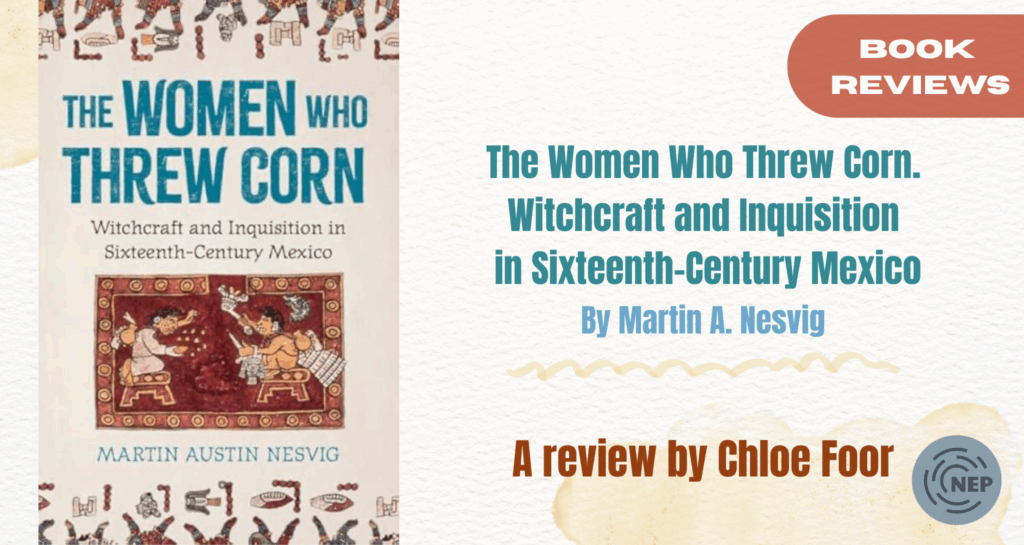
Banner for: Review of The Women Who Threw Corn: Witchcraft and Inquisition in Sixteenth-Century Mexico.

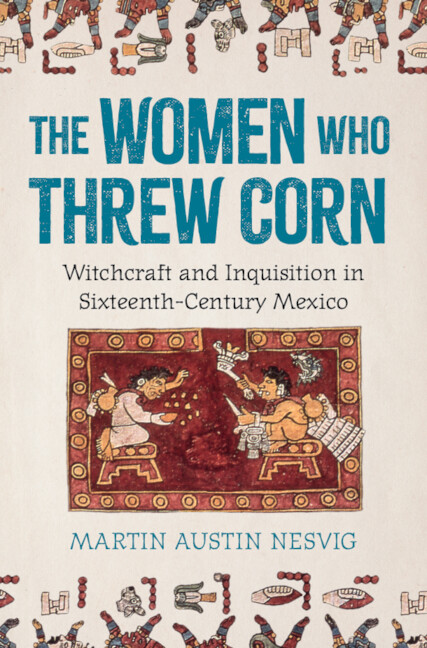
Martin Nesvig’s newest book, The Women Who Threw Corn, offers a novel approach to the cultural view and development of sorcery and magical practices in sixteenth-century Mexico, as seen through the lens of acculturation, or cultural assimilation between groups. This is the first book in an upcoming two-part series called Xolotl Rite, and whereas this book highlights women, the second will focus on the acculturation of non-Indigenous men. Organized into three parts, “Witches and their Enemies in the Early Modern World,” “Magic in the 1520s and 1530s,” and “The Cultural Hybrid Healer-Witch,” the book’s structure enables readers to engage directly with whichever section most interests them. Through a detailed analysis of previously unexamined magic-related investigations (p. 153), Nesvig demonstrates that the acculturation of the non-Indigenous population to Nahua culture occurred more quickly and at an earlier stage than earlier scholarship has suggested.

Using a methodology of “reverse ethnohistory,” he inverts the traditional historiography of studying Indigenous responses to Spanish customs and their imposition through colonialism, instead looking into how non-Indigenous women adapted healing and spiritual concepts taken from Nahua culture. In this way, he flips the focus of “histories of discovery, women, witchcraft, the Inquisition, and the social history of settler-colonialists” (p. 20). 

Book Cover of The Women Who Threw Corn

The first three chapters comprise Part I, which examines the “legal, theological, and cosmological ideas about magic and sorcery in both Spain and Mexico” (p. 25). The primary methodology here is a linguistic analysis, analyzing how certain terms relating to magic were translated both into Spanish and into Nahuatl and how false equivalencies were established between the Spanish “witch” and the Nahua “nahuallis,” how the Spanish “sorcery” became the Nahua “tlaphohualiztli.” The following section analyzes early sorcery trials and investigations in Mexico City, unpacking how the women on trial rapidly acculturated themselves to Nahua ideas of magic across class and ethnic boundaries. Part III rounds out the narrative by exiting the geographical scope of Mexico City and extending the time frame to the latter half of the sixteenth century. In this part especially, Nesvig investigates the more physical and visual aspects of magic, such as tattooing, the evil eye, and the use of peyote and patle. By the end of the book, Nesvig recounts a story of a non-Indigenous woman using Mesoamerican forms of magic without the use of a Nahua intermediary, demonstrating a far greater extent of acculturation for the time period than has previously been understood.

The deep and complex analysis of previously unexplored sorcery investigations makes Part II the highlight of the book. Here, Nesvig pays particular attention to the variety of ways that different populations in colonial Mexico City incorporated Nahua ideas of magic based on their own cultural background. For example, Nesvig demonstrates that Spanish women adopted Mesoamerican iconography, powders, roots, and yerbas to conduct love magic and the Nahua language to conduct spells, and Indigenous healing rites. On the other hand, women of African descent utilized freedom magic that drew upon Nahua materiality, while the Spanish witches did not. Nesvig also sheds light on the unequal ways that the courts treated Spanish and African women on trial for witchcraft. Finally, Canarian, Morisca, and North African women, who were seen as oversexed, understood the stereotypes associated with their ethnicities and used sex and love magics as survival strategies. Nesvig argues that their own liminal position in Spanish society allowed them to quickly adapt and acculturate to Mesoamerican forms of magic.  Each of the case studies analyzed across the chapters helps Nesvig demonstrate that the process of acculturation in the capital city was both immediate and rapid among women from many different ethnicities and social classes.

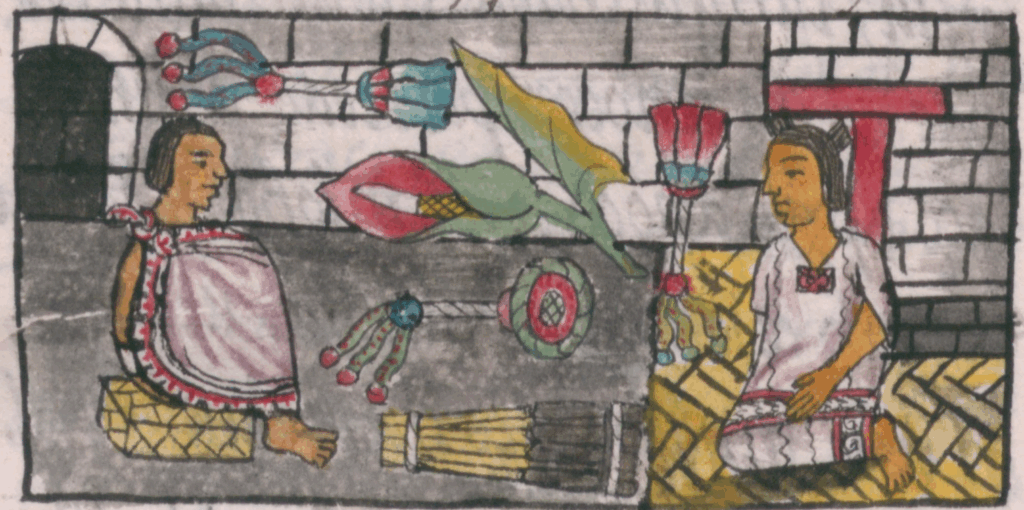
Flowers, incense burners and perfumes. Florentine Codex.

Flowers, incense burners and perfumes. Florentine Codex. Source: Wikimedia Commons

One area of potential confusion lies in the text’s near-synonymous use of the terms “witch” and “sorcerer.” In Inquisition historiography, scholars typically emphasize that Spanish authorities distinguished between the two: witches were those who entered into an explicit pact with the devil, while sorcerers practiced magic without such a pact. Nesvig acknowledges this distinction, yet often employs the two terms interchangeably, which at first can appear imprecise. On closer reading, however, this choice proves consistent with his broader aims. Because Nesvig approaches magic-related practices primarily through an Indigenous lens, retaining the Spanish-imposed differentiation would have distorted that perspective. The Nahua themselves likely would not have marked such a rigid boundary between witchcraft and sorcery, and the fluidity of Nesvig’s terminology reflects this. Whether entirely intentional or not, the effect is to demonstrate how non-Indigenous women engaged with and absorbed Nahua understandings of magic, for which the Spanish categories would have been ill-suited.

Another point of confusion is Nesvig’s use of the term “cultural syncretism,” or the merging and blending of multiple cultures, as a factor in the process of acculturation. While Nesvig does not fall into the most serious critique of “syncretism,” it is still important to be aware of how its use might impact the work. The framework of syncretism has been heavily contested, especially among scholars of religious studies, mostly due to its connotations indicating that each of the cultures in the melding process could be distilled to a “pure” version that existed before their contact. However, especially when looking at religion and spiritual beliefs, cultures are continually changing due to both internal and external factors, and the idea of a “pure” version of a culture is reductive. Therefore, while Nesvig’s framework of acculturation is convincing and helps develop his argument, his use of cultural syncretism to demonstrate it is something that must be carefully unpacked so as to not fall into the term’s contested history. 

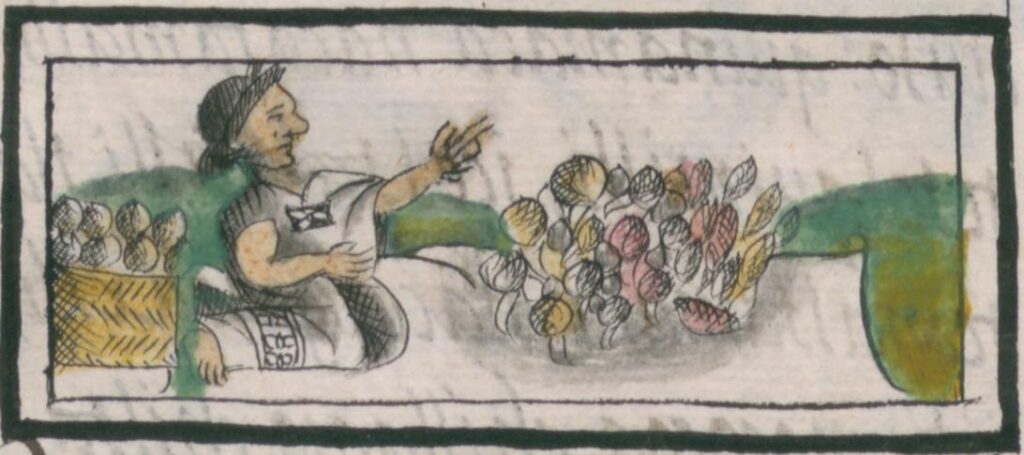
The tamal and tortilla seller.

The tamal and tortilla seller. Source: Wikimedia Commons

Despite this minor point of contention, The Women Who Threw Corn is a fascinating and accessible read for anyone interested in the history of magic, European-American contact, or histories of gender. Seen primarily through the evolution of magic practices in New Spain in the sixteenth century, Nesvig demonstrates how non-Indigenous women utilized Nahua words, materials, and spiritual iconography in the creation of their spells. Beyond this, the methodology of a reverse ethnohistory is intriguing, and can be useful for future histories of Indigenous and non-Indigenous contacts. If The Women Who Threw Corn is any indication, the second book in the Xolotl Rite series promises to be equally impressive.


Chloe Foor is a Phd student in History at the University of Texas at Austin. Her current project focuses on how physical spaces impacted gendered, racial, and religious identities in the New Kingdom of Granada in the seventeenth century, as well as how historical actors manipulated those identities to claim space for themselves. Currently, she is working with the JapanLab/History Games Initiative to develop a video game highlighting Cartagena Inquisition’s witchcraft trials during the early seventeenth century.


The views and opinions expressed in this article or video are those of the individual author(s) or presenter(s) and do not necessarily reflect the policy or views of the editors at Not Even Past, the UT Department of History, the University of Texas at Austin, or the UT System Board of Regents. Not Even Past is an online public history magazine rather than a peer-reviewed academic journal. While we make efforts to ensure that factual information in articles was obtained from reliable sources, Not Even Past is not responsible for any errors or omissions.
Filed Under: 1400s to 1700s, Gender/sexuality, Latin America and the Caribbean, Religion, Reviews Tagged With: 16th century, Mexico, witchcraft

Constructing a Canyon: Black CCC Workers and the Making of Palo Duro

In September 1935, Jimmie Lee Robinson and fourteen other Black Civilian Conservation Corps (CCC) workers stationed at Palo Duro State Park in the Texas Panhandle wrote to President Franklin Delano Roosevelt to protest their treatment in the CCC camp. “We work some time six days in a week,” they said, “and have to go to Canyon or on a long hike to keep from getting home sick.” Their letter ended with a petition asking to be relocated to a different CCC camp “near their own race.” [1] This complaint reflects Black workers’ deliberate assignment to Palo Duro Canyon, the “Grand Canyon of Texas,” because of its distance from nearby communities.

I encountered this letter while working on a larger project about how Palo Duro State Park became a symbol of Texas Panhandle history in the 1930s. What struck me was how easily this story—and the people behind it—had been forgotten. Palo Duro itself is a vast canyon in the Texas Panhandle visually defined by its colorful rocks and geological formations. But visitors to parks often don’t think about who built the trails, roads, and buildings that shape their experience of a landscape. Even less attention is paid to how that infrastructure tells a story—one that often excludes the full history of who lived in, used, and transformed these spaces.

Palo Duro Canyon Lighthouse

Palo Duro Canyon Lighthouse. Source: Wikimedia Commons.

In the 1930s, CCC leadership charged young men with building the park’s foundational infrastructure. These structures told a version of the canyon’s history centered on white settlers while erasing the presence of both Black and Indigenous peoples, respectively. Even as they shaped the park’s landscape, Black people were subjected to segregation and geographic isolation at the hands of the federal government and the Texas State Parks Board.

To place the CCC’s work in a larger historical context, I turned to ClioVis—a mind-mapping tool developed by Dr. Erika Bsumek of UT-Austin’s History Department. ClioVis allowed me to visualize how a history of Palo Duro—told through the names of places and promotional materials—has long excluded the people who helped build it.

As I charted this history of Palo Duro, it became clear how the story of Palo Duro Canyon mirrored broader patterns of West Texas history—beginning with its earliest inhabitants. Indigenous people had lived in the canyon since as early as 10,000 B.C.E. In 1541, the canyon may have been a backdrop to Spaniard Francisco Vázquez de Coronado’s quest to find the fictional Quivira, one of the famed ‘seven cities of gold,’ a mythical indigenous paradise. In the mid-18th century, the Comanche (Nemene) arrived at the Panhandle Plains and “held Palo Duro Canyon as a prominent camp and trading site,” building a formidable power capable of challenging Texas expansion.[2]

In an assault on Comanche power, the United States’ army expelled them from the canyon in the 1874 Battle of Palo Duro, part of the Red River Wars. In the remainder of the decade, nuevomexicano pastores—Hispanic pastoralists who drove sheep onto the Southern Plains—continued their use of the plains. In 1876, rancher Charles Goodnight established an important cattle ranch in the depths of the canyon. The Panhandle’s ‘JA Ranch’ became a respected institution in the ranching industry. 

In 1933, the CCC answered community calls to transform the canyon into a park. President Franklin Delano Roosevel created the CCC program to employ mostly young men during the Great Depression to build much of the country’s wilderness infrastructure. Young men enlisted in the program and the federal government assigned them to a CCC company, where they often lived in a future park and built roads, hiking trails, and other park facilities. Their work not only gave the public access to remote areas but also shaped how visitors experienced parks. They also influenced how people understood the history of the natural spaces through the naming of places, buildings, and landmarks.

CCC boys at work, ca 1930s

CCC boys at work. 1935. Source: Library of Congress

Soon after CCC work began, Palo Duro became the site of the largest CCC camp in the country and found itself at the center of conflict over the racial segregation of CCC workers. At its inception, the CCC camp at Palo Duro was integrated with Black and white workers. This changed in the summer of 1935 when CCC national director Robert Fechner issued a policy calling for the segregation of CCC camps. Texas State Parks Board Chairman David E. Colp, forced to select a camp to host only Black workers, said that “The Palo Duro is called ideal for negro companies owing to its location 13 miles from town.”[3] Colp hoped to avoid conflict between white communities and Black CCC workers by geographically isolating Black companies. Soon, Palo Duro State Park’s CCC camp hosted only Black workers. Consequently, they played a vital role in building the park’s infrastructure. 

In my ClioVis project, I look specifically at how the park focused on non-indigenous men like Goodnight and Coronado to construct a frontier experience for Palo Duro tourists. Although Black workers built much of the park, CCC leadership tasked them with installing signs and creating landmarks that celebrated white pioneers. The ‘Goodnight Trail’ aimed to honor Charles Goodnight being the ‘first white pioneer to enter the canyon,’ supposedly tracing his historic entrance path. The trail also positioned Palo Duro as a place to experience history as it connected the Panhandle Plains Historical Museum (in Canyon, Texas) to the park’s entrance. Once in the park, visitors encountered ‘El Coronado Lodge,’ named to honor Conquistador Francisco de Coronado. Meanwhile, trails such as ‘Kiowa Trail’ and ‘Indian Trails’ acknowledged an Indigenous past but—in the context of promotional materials I analyzed—framed it as something distant, rather than as an integral part of the canyon’s ongoing history. Regardless, the park’s infrastructure told a story of the region that surrounded white pioneers and settlers, not indigenous people and the Black workers who built the park. 

Photo of El Coronado Lodge ca. 1930s

Photo of El Coronado Lodge. Untitled. Project Reports on Civilian Conservation Corps Projects in State and Local Parks, 1933-1937. National Archives and Records Administration. SP-13-16.

The power behind these names is best explained through the concept of place-making. Anthropologist Keith Basso coined the term place-making to refer to the act of assigning meaning to places. Basso argues that “…place-making is a way of constructing history itself, of inventing it, of fashioning novel versions of ‘what happened here.’”[4] He argues that through place-making, humans develop entire frameworks for understanding existence and the history around them. Therefore, the naming of places in Palo Duro State Park to honor colonizers asserted a settler-based history of the canyon itself. 

Palo Duro State Park map, 1937

Palo Duro Canyon State Park – Base Map. 1937. Source: Wikimedia Commons

Even as Black workers built this infrastructure, they resisted the geographical isolation the state forced upon them. As noted earlier, fifteen Black workers sought President Roosevelt’s help in being relocated closer to Black communities. We “have to go to Canyon or on a long hike to keep from getting home sick,” they wrote.[5] The Black workers’ letter to Roosevelt spoke to the geographical isolation of Palo Duro Canyon, reinforced by racist policies barring them from visiting nearby Canyon, Texas and transportation challenges in reaching Amarillo, the nearest non-sundown town. At the same time, the Black workers demonstrated the ways they experienced the canyon on their own terms. As their letter said, the workers went on hikes, likely exploring distant corners of the park. The Black workers’ letter to Roosevelt encapsulated the complex nature of the Palo Duro CCC Camp. 

By the summer of 1936, CCC workers’ grievances culminated in a strike. Angered by their forced geographical isolation, the workers refused to continue their labor, and a standoff ensued. They stood against an unnamed CCC commander as well as blacksmith Sid Harrison. With both sides brandishing picks and other tools as weapons, it was initially unclear if violence would erupt. The youth workers demanded better working conditions and voiced their feeling of isolation. CCC Commander Walter Caserta apparently diffused the strike after a four-hour negotiation. By the end of the summer, likely because of this confrontation, the Black companies moved to a different CCC site, and Company 894, an all-white CCC group from Bonham State Park, soon took over park construction at Palo Duro.[6]

Structure of Road from Bottom of Canyon. People seen in the distance. ca. 1930s

Structure of Road from Bottom of Canyon. Palo Duro Texas. 1933-1936. Project Reports on Civilian Conservation Corps Projects in State and Local Parks, 1933-1937, Record Group 79: Records of the National Park Service. National Archives and Records Administration. SP-13-16.

Despite their role in building the park, Black people were erased from its historical narrative. Promotional materials failed to acknowledge their contributions to the park’s infrastructure, just as the CCC leaders and Texas State Parks Board reinforced this erasure through the park’s design. Beyond the park’s construction, Black pioneers like the widely revered Matthew ‘Bones’ Hooks played a vital role in the region’s history, yet their stories were similarly overlooked. Instead, the park’s infrastructure promoted a history of the white settler pioneer. Together, this structural erasure of history constitutes what historian Erika Bsumek calls ‘infrastructures of dispossession’—the ways physical and social infrastructure further alienate Indigenous—and in this instance, Black—communities from land.[7]

The consequences of this erasure are still felt today. Historian Carolyn Finney emphasizes that park infrastructure’s orientation to white audiences perpetuates disparities between white and Black people’s use of public lands. In this sense, I hope to counterweave Black workers’ history into Palo Duro’s landscape. After all, the letter from Black workers to President Roosevelt and their strike are significant events in the creation of the park. However, to make this effort truly meaningful, further work must be done to recover the voices, names, and lives of those who built the park. 

In my ClioVis timeline, I expand on not only the work of Black CCC workers but also extend my argument to include the alienation of indigenous communities from the canyon’s history. ClioVis allowed me to create a network of events to visualize the connection between events in the canyon’s history and the ways the CCC brought (or didn’t bring) that history to park visitors through infrastructure. 

This story of Palo Duro Canyon is not unique. People worked in segregated CCC camps in natural spaces across the United States. The park infrastructure they built often told revisionist histories about the parks. On top of this, many parks themselves were inaccessible to Black people. The State of Texas forbade Black people from entering Palo Duro until the federal government forcibly desegregated the Texas State Parks System in 1964. 

Nevertheless, the infrastructure built at Palo Duro positioned the park as a particularly special symbol of Texas Panhandle history. In 1966, the community demonstrated the park’s importance to their historic mythos by inaugurating the musical TEXAS in the canyon’s basin. Producers called it “A Musical Celebration of Panhandle History.” In that sense, it becomes even more important that the history of Black CCC workers is brought to the forefront of the landscape’s narrative.


[1] Jimmie Lee Robinson and Arlena Evans, et al, Letter to Roosevelt, September 21, 1935, quoted in Jackson, “The Imprint of the Civilian Conservation Corps on Palo Duro Canyon, 1933-1937,” 148.

[2] Zapata, “Palo Duro Canyon, Its People, and Their Landscapes: Building Culture(s) and a Sense of Place Through the Environment since 1540,” 17.

[3] “CCC Companies Will Be Changed During This Week,” The Canyon News, August 15, 1935, Newspapers.com.

[4] Keith H. Basso, Wisdom Sits in Places: Landscape and Language among the Western Apache (Albuquerque: University of New Mexico Press, 1996), 6.

[5]   Robinson and Arlena Evans, Letter to Roosevelt, September 21, 1935, quoted in Jackson, 148.

[6] My knowledge of the strike at Palo Duro relies on the work of Jackson and Petersen as I was unable to access the account from Walter Caserta. Jackson, “The Imprint of the Civilian Conservation Corps on Palo Duro Canyon, 1933-1937,” 152; Petersen, “The Building of Palo Duro Canyon State Park,” 12.


Aidan Dresang is an undergraduate history major at UT-Austin. He is writing his History thesis on anti-nuclear resistance to the Comanche Peak nuclear power plant. More broadly, his research interests include North American environmental history and social movements. He currently serves as a ClioVis intern and as the History Department’s social media intern.


The views and opinions expressed in this article or video are those of the individual author(s) or presenter(s) and do not necessarily reflect the policy or views of the editors at Not Even Past, the UT Department of History, the University of Texas at Austin, or the UT System Board of Regents. Not Even Past is an online public history magazine rather than a peer-reviewed academic journal. While we make efforts to ensure that factual information in articles was obtained from reliable sources, Not Even Past is not responsible for any errors or omissions.

Filed Under: 1900s, Features Tagged With: cliovis, labor history, State Parks, Texas, US History

Review of The Hard Work of Hope: A Memoir, by Michael Ansara (2025)

Banner for The Hard Work of Hope. A Memoir. By Michael Ansara. Reviewed by Sarah Porter

In his recent memoir, The Hard Work of Hope, activist Michael Ansara reflects on decades of organizing experience in the U.S. civil rights, student, and anti-war movements. Raised in Boston, Ansara was one of many Northern students who came of age following World War II and, drawing inspiration from the Southern civil rights struggle, organized opposition to the Vietnam War on college campuses. Ansara began his career as an activist in high school, working with a local civil rights organization, the Boston Action Group (BAG), to develop campaigns around issues like employment discrimination and tenants’ rights. Later, as a student at Harvard University, Ansara joined Students for a Democratic Society (SDS) and became a leading voice in the anti-war movement of the late 1960s and early 1970s. Following the war, he helped to build Massachusetts Fair Share, an organization that addressed local and neighborhood-level concerns ranging from utility rate hikes to zoning laws.

Book cover of The Hard Work of Hope, a memoir.

Most of the book is devoted to Ansara’s anti-war activism while at Harvard and shortly after graduating. As U.S. involvement in Vietnam escalated over the course of the 1960s, many American students began to protest what they viewed as an unjust and immoral war. They organized massive rallies and demonstrations, circulated literature, and engaged in civil disobedience. Ansara was involved in planning and executing major campaigns at Harvard, including the occupation of University Hall and the subsequent student strike in 1969. As its title suggests, however, the book does not only document the flash points of the student movement —the massive rallies and confrontations with law enforcement. Rather, Ansara places emphasis on the day-to-day work of engaging with ordinary people and compelling them to act. As he notes, “It is easy to write about the demonstrations, the marches, the confrontations. They were dramatic and essential. However, they were only possible because of long hours of outreach, discussion, connecting. It was the mundane work of reaching out to students that occupied me, and the other SDS organizers, and that made it possible for people to join the march, get on the bus, join the movement” (p. 48). Far from being inevitable, the successes of the anti-war movement were the result of years of planning and organizing by activists who often encountered fierce opposition from law enforcement, their peers, and the public.

Large crowd at a National Mobilization to End the War in Vietnam direct action demonstration, Washington, D.C.

[Large crowd at a National Mobilization to End the War in Vietnam direct action demonstration, Washington, D.C.]
Source: Library of Congress

Throughout the book, Ansara also reflects on what he perceives as the failures of the anti-war movement. For instance, he acknowledges that many activists failed to offer concrete support to Vietnamese refugees and veterans after the war ended. He also addresses the creation of groups like the Weathermen, a radical offshoot of SDS that utilized political violence. Ansara was deeply critical of the group’s strategies, but he also recognized the role that state repression played in its development.

Ansara’s discussion of movement strategy and structure is particularly useful, and several ideas may resonate with contemporary readers. First, Ansara argues that the anti-war movement would have been more effective had it embraced electoral politics alongside direct action protest. Second, he distinguishes strategies from demands. Early on, anti-war activists focused on capturing public attention with bold and confrontational protests. Once the public was receptive to their message, however, many groups failed to deliver clear and actionable demands. Ansara suggests that a straightforward program of action is essential for organizing. Lastly, Ansara challenges the idea that a movement can be truly “leaderless.” Organizations like SDS rejected formal leadership structures as hierarchical and undemocratic. Yet, as Ansara notes, this often gave way to informal—and, thus, unaccountable—leaders making all of the decisions. He writes, “Every social movement and every organization has leaders, formal or informal. The question is not whether we have leaders, but whether we have good leaders, leaders who empower others, who build successors, who are accountable. In SDS, the confusion over leadership inhibited our effectiveness, allowing young, arrogant men like me to lead without being held accountable” (p. 258).

Group of young people standing, some are cheering.

Freedom Summer. Source: Wikimedia Commons

While the book does address the larger political context in which activists like Ansara operated, some of the events mentioned in passing deserve further explanation, particularly for younger audiences and for those without a background in history. For example, Ansara references the bombing of 16th Street Baptist Church in Birmingham, Alabama, and the murder of three civil rights workers—James Chaney, Andrew Goodman, and Michael Schwerner—during Mississippi Freedom Summer on several occasions without fully explaining what happened or how it shaped the larger social landscape. More thoughtful analysis of these events would provide important context for readers by highlighting the violent opposition that activists faced, especially in the Deep South. Moreover, as Ansara acknowledges, his memoir is a deeply personal reflection on his experience as an activist, and it should not be taken as a representation of the anti-war movement as a whole. Student organizing on college campuses was a crucial part of this broader movement, but there were many other manifestations of anti-war activism that cut across lines of gender, race, and socioeconomic status. Finally, while Ansara reflects critically on student organizing during the Vietnam War, he is less forthcoming about his later life, including the dissolution of Massachusetts Fair Share due to financial mismanagement under his leadership and his subsequent failed business ventures. Although some readers may appreciate Ansara’s focus on his anti-war activism, others may be left desiring a more complex portrait of his life that grapples with some of these contradictions.

Ultimately, The Hard Work of Hope represents a valuable resource for a number of audiences. For scholars researching anti-war and student activism during the 1960s and 1970s, Ansara’s narrative offers a firsthand account of key campaigns, such as student protests against Dow Chemical and the Harvard Strike. Educators might also incorporate excerpts of this book into undergraduate or high-school classrooms as an example of a primary source for analysis. Finally, and perhaps most importantly, Ansara’s memoir offers valuable insight for those currently organizing for a more just and equal society on college campuses and beyond. 

Sarah Porter is a Ph.D. student in the Department of History at the University of Texas at Austin. She studies twentieth-century social movements, policing, and mass incarceration in the United States.


The views and opinions expressed in this article or video are those of the individual author(s) or presenter(s) and do not necessarily reflect the policy or views of the editors at Not Even Past, the UT Department of History, the University of Texas at Austin, or the UT System Board of Regents. Not Even Past is an online public history magazine rather than a peer-reviewed academic journal. While we make efforts to ensure that factual information in articles was obtained from reliable sources, Not Even Past is not responsible for any errors or omissions.


Filed Under: 1900s, Reviews, United States Tagged With: US History, Vietnam War

« Previous Page

Recent Posts

  • Review of Beyond States. Powers, Peoples and Global Order (2024).
  • Understanding History Through Video Games: Europa Universalis IV and Causation 
  • The Politics of Catastrophe: A Brief History of FEMA
  • Beyond the Archive: Digital Histories and New Perceptions of the Past
  • Review of Malaria on the Move: Rural Communities and Public Health in Zimbabwe, 1890-2015 (2025).
NOT EVEN PAST is produced by

The Department of History

The University of Texas at Austin

We are supported by the College of Liberal Arts
And our Readers

Donate
Contact

All content © 2010-present NOT EVEN PAST and the authors, unless otherwise noted

Sign up to receive our MONTHLY NEWSLETTER

  • New
  • Features
  • Reviews
  • Texas
  • Teaching
  • Digital
  • Watch & Listen
  • Authors
  • About