Lesson Plans: Civil Rights and Civic Participation

The past is never dead. It's not even past


This week, Jeremi and Zachary sit down with Samuel G. Freedman to talk about the often overlooked contributions of Hubert Humphrey to American history and civil rights.
The discussion traces Humphrey’s rise from a small-town boy in South Dakota to a pivotal figure in the civil rights movement and U.S. politics. Despite not achieving the presidency, Humphrey’s impact as Mayor of Minneapolis, U.S. Senator, and Vice President is profound, particularly his efforts on civil rights, African American and Jewish relations.
Zachary sets the scene with his poem, “The Old Days.”
Samuel G. Freedman is an award-winning author, columnist, and professor. A former columnist for The New York Times and a professor at Columbia University, he is the author of 10 acclaimed books, including the newly-released Into the Bright Sunshine: Young Hubert Humphrey and the Fight for Civil Rights. Jon Meacham has hailed the book as “a compelling and important account of Humphrey’s critical role in the freedom struggles of the mid-20th century.”
Freedman’s previous books are Small Victories: The Real World of a Teacher, Her Students and Their High School (1990); Upon This Rock: The Miracles of a Black Church (1993); The Inheritance: How Three Families and America Moved from Roosevelt to Reagan and Beyond (1996); Jew vs. Jew: The Struggle for the Soul of American Jewry (2000); Who She Was: My Search for My Mother’s Life (2005); and Letters To A Young Journalist (2006); and Breaking The Line: The Season in Black College Football That Transformed the Game and Changed the Course of Civil Rights (2013).
With his colleague Kerry Donahue, Freedman co-produced a radio documentary and authored a companion book, both entitled Dying Words: The AIDS Reporting of Jeff Schmalz and How it Transformed The New York Times. The documentary and book were released in conjunction with World AIDS Day on December 1, 2015, and since then the documentary has been broadcast on more than 500 NPR member stations. In 2020, Freedman wrote Ma Rainey’s Black Bottom: The Journey From Stage to Screen, the companion book to the film adaptation of August Wilson’s classic play.
Small Victories was a finalist for the 1990 National Book Award and The Inheritance was a finalist for the 1997 Pulitzer Prize. Upon This Rock won the 1993 Helen Bernstein Award for Excellence in Journalism. Four of Freedman’s books have been listed among The New York Times’ Notable Books of the Year.
Jew vs. Jew won the National Jewish Book Award for Non-Fiction in 2001 and made the Publishers Weekly Religion Best-Sellers list. As a result of the book, Freedman was named one of the “Forward Fifty” most important American Jews in the year 2000 by the weekly Jewish newspaper The Forward.
Freedman was a staff reporter for The New York Times from 1981 through 1987. From 2004 through 2008, he wrote the paper’s “On Education” column, winning first prize in the Education Writers Association’s annual competition in 2005. From 2006 through 2016, Freedman wrote the “On Religion” column, receiving the Goldziher Prize for Journalists in 2017 for a series of columns about Muslim-Americans that had been published over the preceding six years.
Freedman has contributed to numerous other publications and websites, including The New Yorker, The Washington Post, The Guardian, Daily Beast, New York, Rolling Stone, USA Today, Los Angeles Times, Buzzfeed, Salon, Slate, Chicago Sun-Times, Tablet, The Forward, Ha’aretz, The Undefeated, The Root, and BeliefNet.
A tenured professor at the Columbia University Graduate School of Journalism, Freedman was named the nation’s outstanding journalism educator in 1997 by the Society of Professional Journalists. In 2012, he received Columbia University’s coveted Presidential Award for Outstanding Teaching. Freedman’s class in book-writing has developed more than 110 authors, editors, and agents, and it has been featured in Publishers Weekly and the Christian Science Monitor. He is a board member of the J. Anthony Lukas Book Awards and member of the Journalism Advisory Council of Religion News Service and the faculty advisory board of the Center for Journalism Ethics. He has spoken at the Smithsonian Institution, Yale University, and UCLA, among other venues, and has appeared on National Public Radio, CNN, and the PBS News Hour.
Freedman holds a bachelor’s degree in journalism and history from the University of Wisconsin-Madison, which he received in May 1977. He lives in New York with his wife, Christia Chana Blomquist.

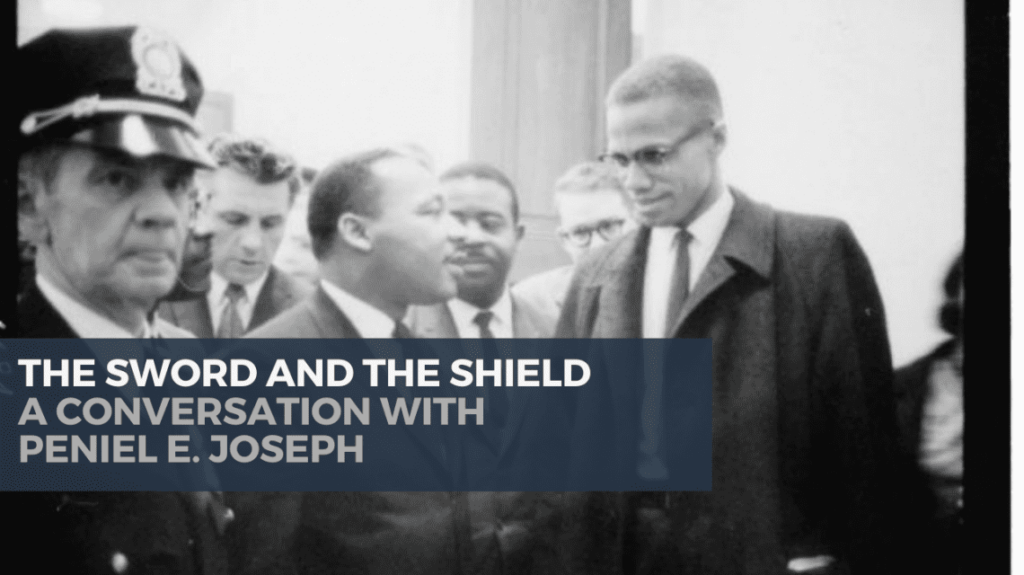
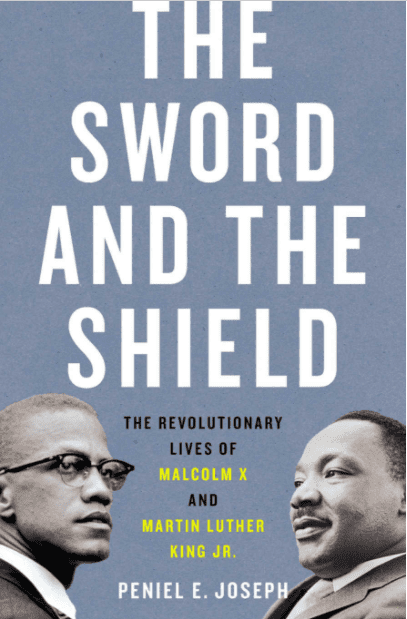
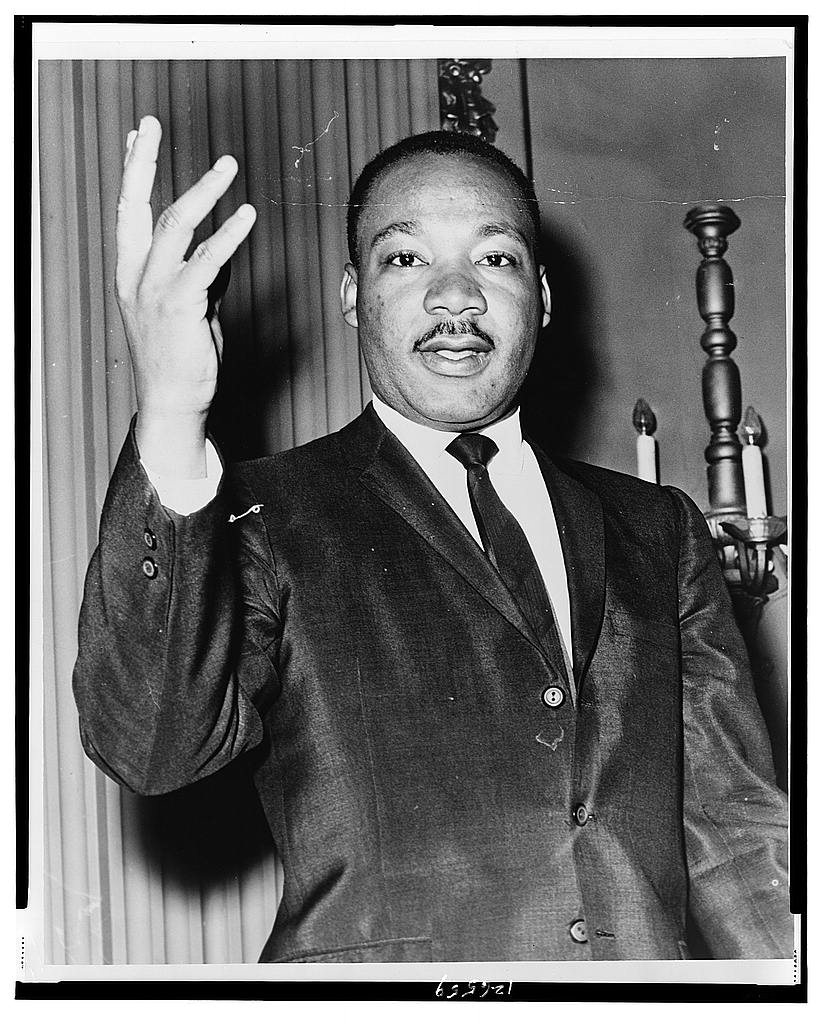
In this conversation, Dr. Peniel Joseph discusses his new book, The Sword and the Shield: The Revolutionary Lives of Malcolm X and Martin Luther King Jr. This dual biography of Malcolm X and Martin Luther King upends longstanding preconceptions to transform our understanding of the twentieth century’s most iconic African American leaders. This is part II of the conversation. Part I can be seen here. The Not Even Past Conversations Series was born out of the extraordinary circumstances of the COVID-19 pandemic. It takes the form of an interview held informally (usually at home) over Zoom with leading scholars and teachers at the University of Texas at Austin and beyond. The following is a lightly edited transcript of a conversation between Adam Clulow and Peniel Joseph.
AC: You talk about the suffocating mythology that sometimes surrounds Dr King and Malcolm X. One of the parts of your book that’s so striking is your discussion of the ‘I Have a Dream’ speech. Can you talk about this moment and that speech?
Is that the case immediately? The speech has a huge impact and it’s very widely publicized and reported but I get the sense that very quickly people are focusing in on those parts that we all know and the rest of the speech is elided. Is that the case, that this understanding comes into being very quickly? Or is there a moment when the speech as a whole is considered?
PJ: I think the speech gets a Janus-faced treatment. The Black press treats it in a very holistic way. The white press is going to focus on ‘I Have a Dream’. John F. Kennedy says ‘I Have a Dream’ as soon as he meets King. It’s important to remember that the Black press, the Chicago Defender, the Pittsburgh Courier the New York Amsterdam News, Los Angeles Herald Dispatch, this is how most of the 16, 17, 18 million Black people got their news. You know, Black people were rarely written about in say The New York Times. King is an exception. Most of the time Black people were written about in major newspapers was for having committed some kind of crime. So the Black press really gets what he’s trying to say. And even the march on Washington, the Black press gives it its full title. It’s the March on Washington for Jobs and Freedom. So that economic aspect is really there for the Black press. But I would say that the mythologizing starts, yes, early and often when we think about the mainstream.
AC: So you talk about this kind of “children’s bedtime story” version of Civil Rights that is sometimes told. And it’s often told as a singularly American story. What really struck me in the book is the global dimensions of this story. You talk about Dr King and Malcolm X bestriding the global age of decolonization. They meet with Ben Bellah, the first President of Algeria and both travel across the world. Malcolm X travels repeatedly and is welcomed, you say, as America’s Black Prime Minister. So is Dr King. Can you say more about these figures as global icons in a much wider process of decolonization?
PJ: Yes, definitely. They’re both hugely impacted by this global age of decolonization. There’s been great work on Black internationalism done by Penny Von Eschen and Brenda Gayle Plummer and Thomas Borstelmann, Mary Dudziak, and Gerald Horne, whose whole career has focused on Black Internationalism with dozens of books. When we think about Malcolm and Martin, both of them are global figures. They converge at the intersection of anticolonialism and human rights, both of them.

Malcolm, I would argue, is even more interested in the global stage because in a lot of ways he’s able to get more global support than he is domestically. I think King is interested in the global stage but as his domestic reputation swells, he really utilizes global support to impact the domestic struggle. Whereas Malcolm is really trying to utilize the world stage to push for anti-racism and the defeat of white supremacy in, for example, the United Nations, and also to have coalitions in the Organization of African Unity that will censor the United States for its mistreatment of African-Americans. In a very specific, granular way they both in the 1950s take trips overseas. So King goes to Ghana in 1957 and is able to witness Prime Minister Kwame Nkrumah. When we think about Nkrumah he is such an important figure. He’s really the post-war avatar of Pan Africanism as a nation state building project on the continent of Africa. He makes mistakes. But symbolically, he is this unbelievably important figure. Malcolm X meets him in Harlem. Martin meets him in Ghana. Malcolm later meets him in Ghana.
So King gets to Africa first. In 1957. King spends a month in India in 1959. The India trip is crucial. King’s India trip and seeing all that poverty and the caste system in India makes King understand that he has been put on Earth not just to defeat racism and white supremacy, but actually to defeat poverty globally. These are massive ambitions that most humans will never have, He really believes it. That’s what’s so extraordinary and exciting about studying these figures. Malcolm visits the Middle East in 1959, spends five weeks there, visits Saudi Arabia, visits Khartoum, Egypt, all these different places. He meets up with Anwar El Sadat, the vice president of Egypt, the future president, Egypt.
Malcolm starts making critical alliances with Middle Eastern and African diplomats in the 1950s. Malcolm had such good alliances, that one of the little known facts I talk about in the book, is that Malcolm X has an office at the United Nations. He’s got it through the connections with African and Middle Eastern diplomats. So Malcolm goes in and out of the UN all the time with a briefcase. And he’s an extraordinary figure in this sense.
So as the 60s progressed, you see Dr. King with Ben Bella. King becomes this figure for anticolonial activists who especially are interested in human rights, but especially interested in also pressuring the United States to recognize their activism as something that’s good and virtuous, even as the United States has this ultimate contradiction of not just Jim Crow segregation, but really utilizing state violence against Black people.
In 1964, Malcolm goes overseas for about 25 weeks. He goes to the Hajj pilgrimage in Mecca. He goes to Nigeria. He goes to Tanzania. He goes to Ghana. Malcolm is in Ethiopia. He’s in Cairo. He’s in London. And Birmingham. And Smethwick. And Oxford. He’s in Paris. So what Malcolm is trying to do is, one, he really becomes a statesman who is giving the global audience, the world audience, a firsthand account of his experiences as a Black man and as a Black person in America.
He’s telling Africans about the depth and breadth of racism and white supremacy. He’s repudiating the State Department’s notion that things are getting better. Malcolm is actually even harsher globally than King is. By 1964 when King travels overseas, he travels to Scandinavia to accept the Nobel Peace Prize. So in a way, King is always giving, until he’s coming out against the Vietnam War, etc, he’s giving a more optimistic vision.
Malcolm finds some optimism in the fact that anticolonialism has worked and he wants help. Malcolm meet with Fidel Castro in Harlem September of 1960, and he’s telling Fidel that your struggle is our struggle and our struggle is your struggle. Malcolm is telling that to Kwame Nkrumah, Julius Nyerere in Tanzania. What’s so interesting about Malcolm is that so many African revolutionaries respect Malcolm. He is willing to speak truth to power. So the global component is really important for both of them. I would say that Malcolm really tries to cultivate that global component even more than King. And I think it’s out of necessity.
But it’s also because Malcolm is this revolutionary Pan Africanist and also a global Islamic figure. You know, I make an argument that he’s always Muslim, both within the Nation of Islam and then when he becomes an Orthodox Muslim. So just because he’s in a different sect doesn’t mean that he doesn’t believe he’s a Muslim.
They are secular, but these are two faith leaders. They bring this real morality to what they’re doing. And it’s not a cheap morality that we have in our society today about who’s sleeping with whom. It’s the morality of: does human life matter? Should we protect children? Should we protect communities? Should we not torture people? At any time? Any place? Should we be, and this is where King’s very important here, a society that is nonviolent but we are not morally equivocating about that nonviolence.

King believes in nonviolence. Whether it’s white sheriffs who are attacking Black people or it is people in Vietnam who are considered the enemy. The United States is dropping napalm. And again, these are crimes. These are crimes against humanity that the United States is committing. No matter what we do, we can never take back these acts. Right. And so King is saying that, right. And that’s when King, I argue, April 4th, 1967 becomes a revolutionary because there’s no turning back after that. There’s no handshakes with President Johnson and President Johnson doesn’t come to his funeral.
AC: Malcolm X and Dr King exist in a global moment of decolonization. Do you see a parallel between that moment and what’s happening now with Black Lives Matter? Because one thing that’s been so striking is the way these protests have gone global in a way that could not have been predicted two years ago. Do you see parallels between the years you discuss in the book and the global Dimensions of Black Lives Matter which have has swept across the world in unprecedented and unpredictable ways and galvanized people in many different countries?
PJ: Absolutely. I think there’s parallels and I think we’re at another crossroads. I think the parallels are, again, also between the global north and the global south, because as we’ve seen, the underdevelopment of the global south and really the exploitation of the global south has continued with a different kind of colonization. And that colonization is a kind of economic colonization. Right. Because of these unfair distributions of wealth created by globalization. Globalization, that in and of itself is not a bad thing, just like gentrification. But we have made sure that the distributions or the supply chains of power and privilege versus the supply chains of misery and greed are distributed along racial and economic lines, ethnicity lines, different lines based on identity and geography.
So in a way, even as indigenous groups got rights of political self-determination – probably our biggest global example after King and Malcolm’s time is going to be Nelson Mandela in South Africa. Yes, the ANC absolutely got political power in South Africa, but without connected economic justice and equality. The segregation, the economic impoverishment has actually increased even though now we have Black billionaires and African billionaires in South Africa, too. So the whole world is absolutely in the throes of a rebellion against this inequality that is organized around anti-black racism, but it’s organized around intersectional injustice based on your race, class, gender, sexuality, how you identify.
So we’re seeing this. And I think that King and Malcolm actually anticipated this crisis, and that’s why they were interested in thinking of human and civil rights as a Human Rights movement, this bigger movement that was going to guarantee redistribution of wealth and guarantee citizenship for, yes, Black people, but for all people.
AC: We’re going to return to Dr King in a second but you can say more about how Malcolm X changes and evolves? He’s often presented in a very limited way that does not encompass the complexity of the individual, but also just how much he changed across this period. Although you cover their whole lives, the book really focuses on a relatively compressed space of time and he travels a remarkable road in this period.
So let’s talk about the last two chapters of the book, the Radical King and the Revolutionary King. And so we talked about the ‘I Have a Dream’ speech. Let’s talk about the Riverside speech, in 1967. This is an extraordinary speech that is very different from popular understandings of Dr. King. It’s stunning in its repudiation of US involvement in Vietnam. You write in the last years of his life that Dr King was transformed “into a revolutionary dissident vilified in quarters that once feted him.” Do you think he anticipated the strength of this backlash?
PJ: I would say he didn’t anticipate how big the backlash would be because I think that he thought what would protect him was the mainstream accolades that he had gotten before. So he was a Nobel Prize winner, was somebody who had been a leader of a social movement, who was on par with Presidents of the United States. And people knew that King was a serious, sober person politically. He wasn’t prone to making wild eyed statements. And when you read the speech, the speech is very sober. I mean, it’s very critical. But it’s not even his most critical speech against the war. That’s going to start really at the end of that month, because he’s going to do a speech on April 4th, April 15th. He’s at the spring mobilization, which is the largest anti-war demonstration up until that time. 400,000. Two years later is going to be marching with over a million. That’s in Central Park with Benjamin Spock. Harry Belafonte.
But then April 30th is when he does the speech at Ebenezer Baptist Church, where Stokely Carmichael is in the front row. He says he’s not going to study war no more. It’s a much more stinging indictment. And Stokely leads the standing ovation for that speech. So the Riverside speech, I mean, I think one of the things he talks about when he says America is the greatest purveyor of violence in the world is very, very important, because I think that speech is very similar to what Malcolm X is saying when he says the chickens have come home to roost.
And one of the things that King starts to channel, I argue in the book after Malcolm’s assassination, is really Malcolm’s framing of structural racism and white supremacy and imperialism and racial violence and this idea that the United States being a deployer of that kind of violence is always going to have some kind of karmic payback. For Malcolm, he was talking about the Kennedy assassination, for King the reason why he breaks with Lyndon Johnson. He’s saying, look: we’re immorally killing all these people in Vietnam, and the Great Society is failing now. In a television interview in 1966, he says, your money goes where your heart goes. And the president’s heart and the country’s heart is in Vietnam. And he was right. I mean, all that money, we know retrospectively, we should have poured that into urban cities and poured that into rural areas and anti-poverty and employment and guaranteed basic income. We could have given everybody health care and income and not murdered all those people. So, again, what’s interesting about King is he takes that weight on for himself. So he feels the weight of the US’s morally reprehensible actions in a way, I think that elected leaders should because that would prevent you from doing it. So King feels that enormous psychic weight.
And he feels that about poverty. He feels that about violence. And so he becomes this very clarifying figure. But he starts to use nonviolence as a political sword in the way that Malcolm X had talked about. And King starts speaking truth to power, saying Congress, the halls of Congress are running wild with racism. In 1967 before the American Psychological Association, he’s saying the roots of urban rebellions are white supremacy, and white racism is producing chaos. And the media says that there would be peace if Black people stopped rebelling. And King says it’s the white people who are producing the chaos.
This is King. One of the most interesting symmetries between Malcolm and Martin is the fact that Malcolm X, who I argue is Black America’s prosecuting attorney, was always charging white America with a series of crimes. We have the videotape of King talking to poor Black people in Marks, Mississippi. There’s a point where Andy Young says King is in tears listening. This is terrible. Marks, Mississippi. King says the way you are living right here in America, it’s a crime. That’s what King says.

So we go from Malcolm saying this is a crime. He’s that revolutionary. King’s our good guy. Right? So he’s the bad guy. And King is saying this is a crime. And King is talking about white people getting access to land through the Homestead Act. And Black people not getting their reparations, their 40 acres and a mule. And yet people are telling Black people to pull themselves up by their bootstraps. And so he says, we’re coming to Washington to get that check. Right. So this is extraordinary what happens in terms of the symmetry between both of these individuals. Both while they’re living but then certainly during the last three years of King’s life.
AC: So a final question. Before becoming a university professor, I taught high school history. And the question I have is, how should we teach about these two figures in a way that does more justice to their lives.
PJ: I think we should teach about them together. So this is really a dual biography. Whenever you tell students about one, you tell them about the other. It’s pretty simple to do because they live parallel lives. Malcolm’s born in 1925. King in 1929. Malcolm’s killed in 1965. King in 1968. So there’s not a lot of mental shuffling you have to do. And so I think you show students the way in which they interpret race and democracy differently based on the life experiences that they have. So you look at King: Morehouse College, had his father in his life. Malcolm: father was killed, trauma, foster home. While he’s in college, Malcolm is in prison. While King is in seminary, Malcolm’s in prison and they both come out and they’re activists, both men of faith. They become faith leaders. But then you look at how, how and why both of them imbibe this revolutionary moment in different ways. And then why do they start to converge? How and why they converge.
AC: Thank you for sharing your thoughts on two remarkable lives and a remarkable book.
Part I in this series is available here.

PENIEL JOSEPH holds a joint professorship appointment at the LBJ School of Public Affairs and the History Department in the College of Liberal Arts at The University of Texas at Austin. He is also the founding director of the LBJ School’s Center for the Study of Race and Democracy. His career focus has been on “Black Power Studies,” which encompasses interdisciplinary fields such as Africana studies, law and society, women’s and ethnic studies, and political science. His newest book, The Sword and the Shield: The Revolutionary Lives of Malcolm X and Martin Luther King Jr., was published in March 2020 and is available now.
More from Dr. Joseph on Not Even Past:
Consider reading as well:
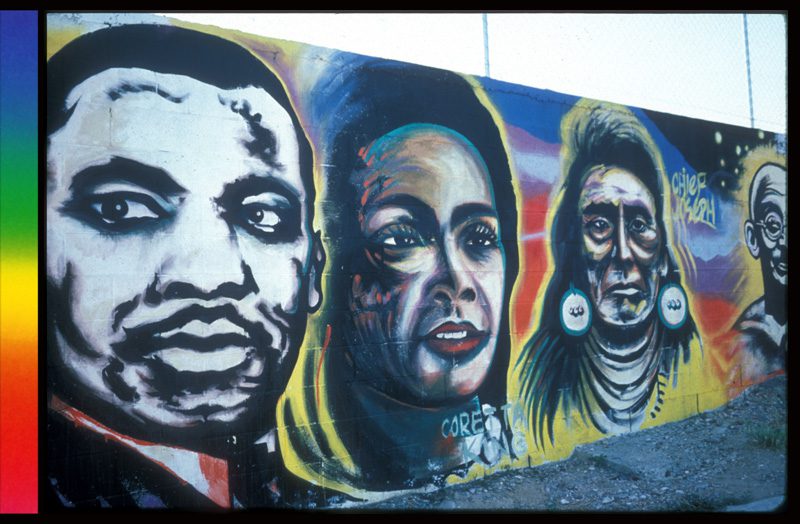
Featured Image Credit: MalcolmX and MLK, Jr., mural, E. W. alley view, N. of Manchester Ave. towards Cimarron, Los Angeles, California, 2010. (Vergara, Camilo J. Vergara Photograph Collection. Library of Congress Prints and Photographs Division.

This is Part I of a conversation with Dr. Peniel Joseph. In this conversation, Dr Joseph discusses his new book, The Sword and the Shield: The Revolutionary Lives of Malcolm X and Martin Luther King Jr. This dual biography of Malcolm X and Martin Luther King upends longstanding preconceptions to transform our understanding of the twentieth century’s most iconic African American leaders. The Not Even Past Conversations Series was born out of the extraordinary circumstances of the COVID-19 pandemic. It takes the form of an interview held informally (usually at home) over Zoom with leading scholars and teachers at the University of Texas at Austin and beyond. The following is a lightly edited transcript of a conversation between Adam Clulow and Peniel Joseph.
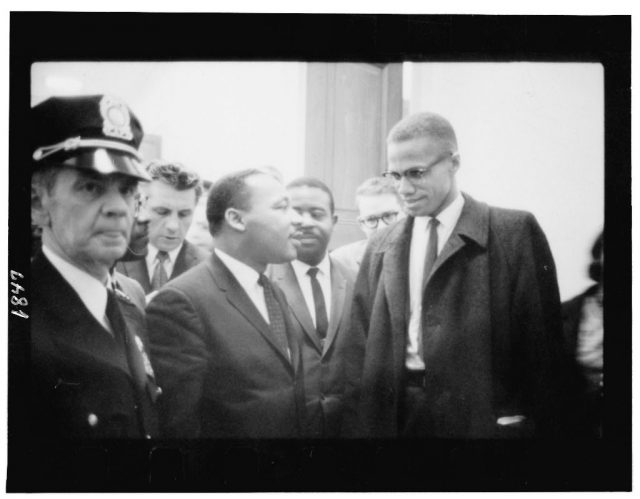
AC: Thank you so much for joining me today. You start the book with a meeting that takes place on March 26, 1964, between Malcolm X and Dr. Martin Luther King Jr. Remarkably, and as you write, this is the only time they actually met. Can you tell us about this meeting and how it came about? And the bigger question that runs through the whole book is how should we characterize their relationship? You use a few different terms. You talk about them as political partners, kindred spirits, and alter egos. How should we understand this meeting and their relationship more generally?
And do you think at that moment in March 1964, they’re aware of this partnership? They’re clearly thinking about each other. They’re reading each other’s writing. They’re listening to each other’s speeches now. They’re intertwined in all sorts of fascinating and productive ways but at this moment of meeting, is there an awareness of this partnership or do you think that lies ahead?
PJ: I think there’s an awareness. I think King is very careful until Malcolm X’s assassination. King utilizes Malcolm for leverage in the political mainstream. Malcolm X represents for white Americans, including elected officials the alternative to King. So if you think King is too militant, King is too radical. Then you’ve got Malcolm X to deal with, someone who is the boldest critic of white supremacy of his generation. And so I think that Malcolm and King realize what the other is doing for them.
But because King is so mainstream, Malcolm is the person who’s more willing to be seen with King. And that makes sense, right? Because when you think about King, it’s almost like when you think about a corporation that’s too big to fail. Now Malcolm, as we see by 1963, becomes this international figure as well. Starting in 1959 but especially in 1963-64, he’s traveling overseas. He spends 25 weeks in Africa, the Middle East. The famous Oxford Union debate. So he’s really becoming more of a global figure.
But the person who is a global leader, who’s really been given the imprimatur of the world, of mainstream politics, is the Nobel Prize winner. For these reasons, King is less interested in a formal partnership with Malcolm X. And Malcolm would be more interested because King has more to lose. But by the time Malcolm is assassinated and as we see with Watts in a lot of ways what’s going to happen to King, is that he loses his alter ego. Yes. Stokely Carmichael and King. But King loses that Malcolm X figure. And King is going to be forced to become further radicalized. And I argue really, in the later chapters, for the radical King, the revolutionary King.

AC: You talk about these two intertwined but different notions of radical black citizenship and radical black dignity that stand at the center of the book. Can you explain in more detail what you mean?
In this book, you argue for a more expansive understanding of these two remarkable figures. In particular, you talk about rescuing them from the suffocating mythology that surrounds them. I was so struck by was this phrase, how conventional images do no justice to these complex and changing figures. Does this apply equally to both of them or is the mythology more restrictive for Malcolm X or Dr King?
PJ: You know, I think it restricts both of them. So for Malcolm, this idea of being this black warrior really takes away from who he is. We’re not allowed to see the vulnerability, the sense of humor, the fear at times that he has, the shortcomings. Ossie Davis, the late Ossie Davis, an extraordinary actor and activist, has this great eulogy for Malcolm X, saying he was our living Black manhood, our shining Black prince. And there’s positives there, positives to have Malcolm as this kind of role model. But there’s negatives as well when he becomes somebody that’s impenetrable. Any figure, every leader has faults and flaws, man or woman, because they are human beings like the rest of us. So, Malcolm, when we take him out of that mythology, one, we see what a truly extraordinary figure he was. Because, and I say this in the book, Malcolm experiences racial trauma at a very early age. His father is murdered. His mother is institutionalized. His father is murdered by Black Legion white supremacists. He has this wayward youth that he admits in his autobiography, committing crimes, working odd jobs. He’s arrested for crimes he did commit and given a rather harsh sentence and spends 76 months in jail. And then he really becomes this person who is this intellectual, who is this political leader, this deep thinker, and then this great organizer. And so I think when you label Malcolm as just a warrior, you lose something. I think it hurts Black men because of this idea that Black men don’t have the full range of emotions. You know, it hurts you there.

Two. You’re unable to see what a truly, extraordinarily supple mind and diplomat Malcolm is, because he transforms from a prosecuting attorney into a statesman by 64. What’s so interesting is in Europe and the Middle East and Africa – even though Malcolm speaks at Harvard, at Yale – they see that intellect and embrace him more eagerly than Americans. Right. That’s why he’s at Oxford Union. And they see this brilliant man. Even when people disagree. Because the thing about brilliance and ideas, as you know, is that, of course, we’re not going to all agree on everything. The extraordinary nature of ideas is that we can disagree, hopefully civilly. Right? Well, we learn from each other in those disagreements. Right. And so Malcolm speaks at Middle Eastern universities, African universities, European universities. And they’re interested in him not only because he’s a political activist, but because of his brilliant mind. So he suffers in the standard mythology.
And then King suffers in ways at times on a bigger scale, because King is still a larger, more global figure. When you think about the holiday, when you think about the annual celebrations, when you think about it, King is virtually the only Black American figure accorded this monument in Washington. I mean, you know, we haven’t done that for other Black figures. You know, Harriet Tubman. Sojourner Truth. There’s people that we could pick. Ida B. Wells just won a Pulitzer Prize posthumously from Columbia University for her journalism against lynching in the late 19th, early 20th century. So we have these truly extraordinary figures. But King is the exceptional one. The two most well-known Black figures in American history are King and now Barack Obama. And when we think of King’s suffocating mythology, we don’t want to talk about how much of a revolutionary Dr. King was. We don’t want to say that Dr. King was interested in social democracy, that Dr. King had a criticism against capitalism, that Dr. King remained nonviolent, but the reason Dr. King was assassinated is because Dr. King was using nonviolence to coerce the country into doing things it doesn’t want to do, namely Black citizenship and dignity.

And so King is this anti imperialist, anti-war revolutionary and King becomes a fire breather. What’s so extraordinary is how you can be that radical. And he’s not cursing. He’s not threatening violence. And he’s trying to use the moral force of the witness. Right. John Lewis does the same thing. Congressman John Lewis, when you’re saying you’re going to reveal to the world the opponent you’re up against is using immoral tactics just through your witness. And if the police commit acts of violence, we’re going to roll ourselves up into a ball and let the world watch and the world will decide. Is this the land of the free and the home of the brave? That’s who Martin Luther King Jr becomes.
And the interesting thing about Malcolm and Martin is Malcolm had criticized the march on Washington as the Farce on Washington because he said they didn’t paralyze the city. By 67, 68, as early as 65, Dr. King says that’s the next step. We’re going to use nonviolence to paralyze cities in his essay Beyond Los Angeles. So the two start to have a meeting of the minds. Even though Malcolm is no longer alive by February 21st, 1965. So it’s truly extraordinary.
Part 2 of this conversation with Dr. Peniel Joseph is available here. The banner image comes from Malcolm X and MLK, Jr., mural, E. W. alley view, N. of Manchester Ave. towards Cimarron, Los Angeles, California, 2010. https://www.loc.gov/item/2015647507/

PENIEL JOSEPH holds a joint professorship appointment at the LBJ School of Public Affairs and the History Department in the College of Liberal Arts at The University of Texas at Austin. He is also the founding director of the LBJ School’s Center for the Study of Race and Democracy. His career focus has been on “Black Power Studies,” which encompasses interdisciplinary fields such as Africana studies, law and society, women’s and ethnic studies, and political science. His newest book, The Sword and the Shield: The Revolutionary Lives of Malcolm X and Martin Luther King Jr., was published in March 2020 and is available now.
More from Dr. Joseph on Not Even Past
Consider also reading:

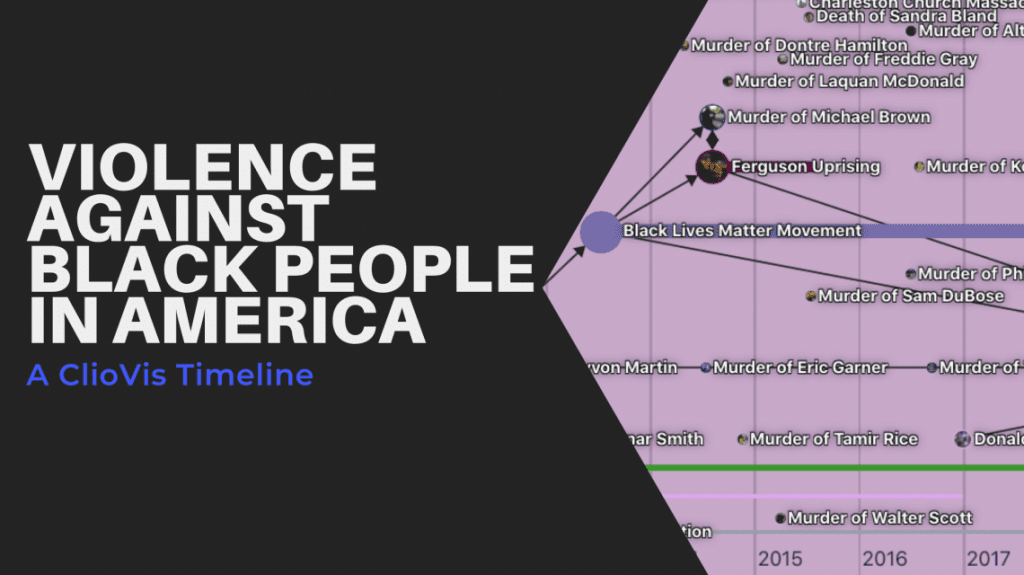
The brutal killing of George Floyd by police in Minneapolis this summer marked a key event in the history of violence against Black Americans. But it was just one of many acts of violence that have been committed in American history. In order to put Floyd’s killing into a larger historical context, our Digital History intern, Haley Price, created four ClioVis timelines to help herself and others learn more about such violence. Alina Scott, a graduate student in the History Department at the University of Texas at Austin and Dr. William Jones, a recent Ph.D. from Rice University, also worked on the timelines, adding relevant scholarship to many of the events to assist readers who want to learn more. Below, Haley, Alina, and Will introduce the timeline by telling us how the timelines were compiled, what they learned in making them, and how they think the timelines can serve as a resource for others. While the timelines are not comprehensive, they provide viewers with a sense of the historical forces at play across time and illustrate how the murder of George Floyd in the summer of 2020 fits into a larger pattern of historical violence.
As readers will see, there are four timelines. We originally started making one timeline. But, as the number of events grew, we decided to break the larger timeline into three separate timelines. You now see an “Overview” timeline that includes 153 events. We then divided the overview timeline into three thematic timelines: “Slavery in America,” “Jim Crow to Civil Rights,” and “Police and Civilian Brutality.”
Introduction
By Haley Price
The purpose of these timelines is to visualize the history of Black Americans and to connect the 2020 Black Lives Matter protests to their historical context. Even as a History and Humanities major, this part of US history was still very new to me. I had learned about “Jim Crow Laws,” “The Great Migration, and “The March on Washington” in my entry-level U.S. history classes, but they were often tacked onto the ends of units, a footnote in a whitewashed version of our past. Black history is not given its rightful space in the American history curriculum. It is no wonder many Americans feel unprepared to fully understand the June 2020 protests.
Making this timeline was a way for me to educate myself, but much more importantly, I hope it will be a helpful resource for others to do the same. If you take one look at this timeline and feel overwhelmed, I encourage you to push past that feeling. Pick one event that you recognize and start there. See what caused that event and then look at its impact. Take things slowly, learn a little bit at a time, and then share with a loved one who wants to learn, too.
What I Did:
As I added events and eras to the timeline, I filled in their dates and wrote descriptions, added images, connections to other events, and more. I predominantly used information from websites like history.com, blackpast.org, and recent news articles. These sites fall into the category of popular history, so they are accessible to all kinds of learners. I was encouraged to find so much information through simple web searches because that means that viewers who want to go beyond the timeline will be able to do the same.
To Use ClioVis timelines:
View “Overview: Context for the 2020 BLM Protests” in full screen here .
I. Slavery in America
View “I. Slavery in America” in full screen here.
What I Did:
By Dr. William Jones
I edited the timeline for content, grammar, and punctuation, focusing on the years before 1860. I also added academic sources that both substantiate the descriptions of the events and point viewers to additional reading. In choosing representative scholarship, I attempted to stick to academic sources that are comprehensive narratives published recently or considered classics. I found that describing the events themselves and finding sources for them was less difficult than deciding what should be included on the timeline. I always felt an internal tug between comprehensiveness, legibility, and simplicity.
A wide geographic perspective is often crucial for understanding the colonial era because all the European colonies in North America were part of larger empires, which included colonies in the Caribbean and South America. Yet I was also afraid of adding too many events to the timeline and making it illegible. For some events, I decided to include geographically broad connections in the descriptions rather than enter them onto the timeline. For instance, the authors of the South Carolina Slave Code of 1691 based that code on Jamaica’s code of 1684, which itself was based on Barbados’s code from 1661; this information (and sources to substantiate it) is only available on the timeline in the description of the South Carolina code. In other instances, I did not mention how historical developments outside the United States influenced a specific event on the timeline, but viewers who consult the readings will find that information. For instance, the nineteenth-century Atlantic slave trade in the Spanish Empire, sugar production in Cuba, and Great Britain’s attempts to police the slave trade on the west African coast are all background elements of the Amistad case, but none of that appears on the timeline. Finally, I felt like I needed to include some events (the Haitian Revolution, in particular) that occurred beyond the geographic boundaries of the United States because they influenced a great deal of the history of slavery and race.
II. Jim Crow to Civil Rights
View “II. Jim Crow to Civil Rights” in full screen here.
What I Did:
By Alina Scott
“My role in the project was to edit the period after 1860 for content and source material to ensure that Black voices and scholarship were included in the dialogue. The Black radical tradition and the movement for Black lives have a rich legacy of cultural, political, and historical contributions so incorporating novels, critiques, and histories by Black authors was not difficult. I also wanted to incorporate sources that are accessible to an audience outside academia by including e-books, podcasts, and documentaries available online.
As noted above, we divided the “Overview” timeline into three sections for the sake of user readability, though the timelines are best read together. A key goal of the project is to show the continuity of antiblackness from the highest levels of government to state leaders and local organizations. The project also shows the continuous resistance and resilience of Black people to systemic oppression.”
III. Police and Civilian Brutality
View “III. Police and Civilian Brutality” in full screen here.
“While revising, I was struck by the way the timeline highlights protest, legislation, and presidential power as key themes. While it includes a large number of important individuals, organizations, and events, the timelines is incomplete. Overall, the timelines do a tremendous job highlighting key dates in Civil Rights activism and legislation even if it was not possible to include all historical actors and events. They make an excellent tool for teaching and learning about the political genealogy of the historic moment we are currently in. The movement for Black Lives is bigger than politics and legislation and we encourage others to make their own timelines. For instance, how might this timeline overlap with another on Black life, joy, and healing practices? Or a timeline centering Black Women and their role as intellectuals, in community building, religious life, and organizing? Or a timeline on Black Internationalism, international BLM movements, or coalition-building in the African Diaspora? There is potential, with a tool like ClioVis, to digitally show the many ways Black people have advocated for our lives and liberated ourselves in a way that is historically accurate, representative, and educational.
We hope you find thatthe timelines a useful building block for teaching and learning history.”
If you would like to know more about using these and other timelines or use ClioVis in your classroom, contact admin@cliovis.org.
Visit ClioVis.org for more information on how to create an account, view tutorials, and other sample projects.
You Might Also Like:
Bby Laurie Green
100 years ago, Congress approved the 19th Amendment, which prohibited the denial or limitation of voting rights “on account of sex.”
The agonizing, fourteen-month struggle by suffragists to get three-quarters of the states to ratify the Amendment, especially its dramatic culmination in the Tennessee statehouse, has garnered much attention. But it may come as a surprise that Texas, a state that has become notorious nationwide for passing some of the most restrictive voting legislation, ratified the Amendment in just 14 days.

To be sure, Texas’s speedy ratification of the 19th Amendment represents a beacon for women’s political power in the U.S., but a critical assessment of the process it took to win it tells us far more about today’s political atmosphere and cautions us to compare the marketing of voting rights laws with their actual implications.
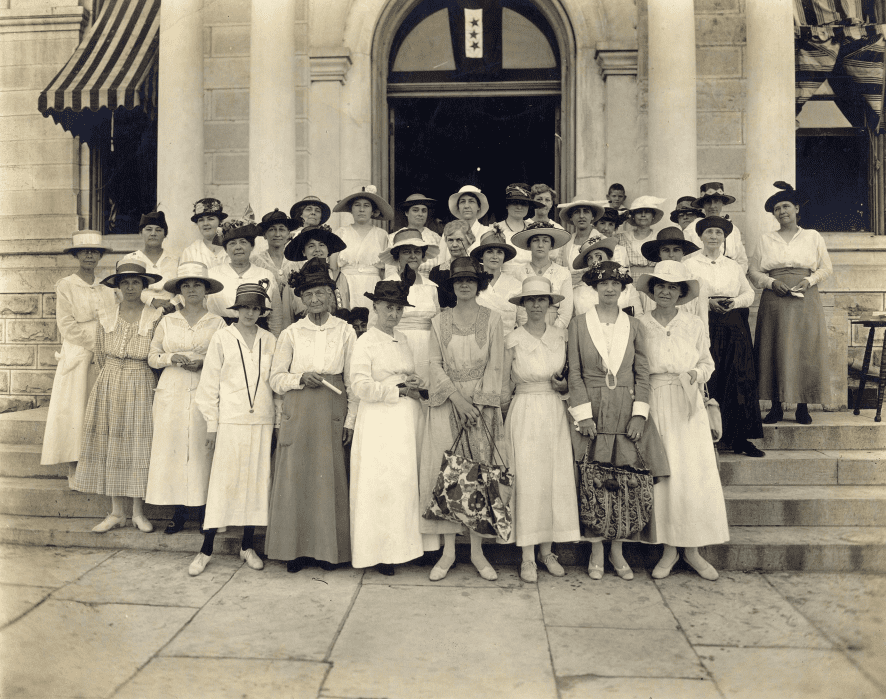
In a one-party state like Texas, the primaries were the elections that mattered, and 1918 marked the first time women could participate — thanks, in part, to campaigning by thousands of members of the all-white Texas Equal Suffrage Association (TESA).
Not all women got the chance to vote, however. Despite efforts by Black activists, including suffragists, Texas’s all-white primary system trumped women’s newly won right nearly everywhere in the state. Even still, the support from TESA secured the election of a pro-suffrage governor, William Hobby, and convinced him to introduce an equal suffrage amendment to the Texas constitution.
Like today, however, reactions to heightened immigration from Mexico – largely by those fleeing the violence of the Mexican Revolution – influenced Texas’s equal suffrage movement. Believing the specter of adding Mexican-born women to voter rolls would alienate legislators who would otherwise back women’s suffrage, Governor Hobby proposed a two-part amendment that would extend full suffrage to women but reverse a policy allowing foreign-born residents to vote if they had petitioned for naturalization.
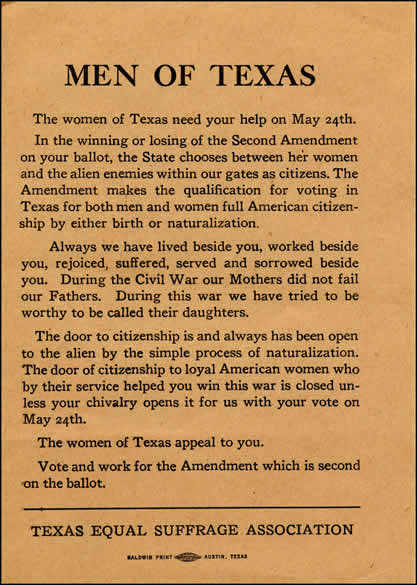
Tasked with getting voters to approve the amendment on May 24, 1919, TESA adhered to advice from national women’s suffrage leaders willing to alienate Mexican American and African American suffragists for another state win. “In the winning or losing of the Second Amendment on your ballot,” read a TESA leaflet addressed to the Men of Texas, “the State chooses between her women and the alien enemies within our gates as citizens.”

While this tactic won the allegiance of many Texans, it lost them the election — not a total surprise because immigrant men on a pathway to citizenship still retained the right to vote.
Just eleven days later, Congress approved the 19th Amendment to the U.S. Constitution, prohibiting the denial of voting rights on the basis of only sex. It took Hobby just two weeks to call a special session to approve the federal amendment’s simple language.
By 1921, Mexican-born women awaiting naturalization had lost their right to vote. In 1923, a restructured all-white primary law closed out even Black women who had managed to register earlier.
And again, on this 100th anniversary of Congress’s approval of women’s suffrage, voting rights are imperiled in Texas, this time by measures espoused as necessary to end voter fraud: the voter identification law already in place, threatened purges of voting rolls to eliminate non-citizens, and bills that nearly passed in this legislative session that would have classified registration mistakes as felonies.
In practice, these measures have targeted the same kinds of groups excluded from voting a century ago, such as the African American and immigrant women unable to reap the benefits of the 19th Amendment.

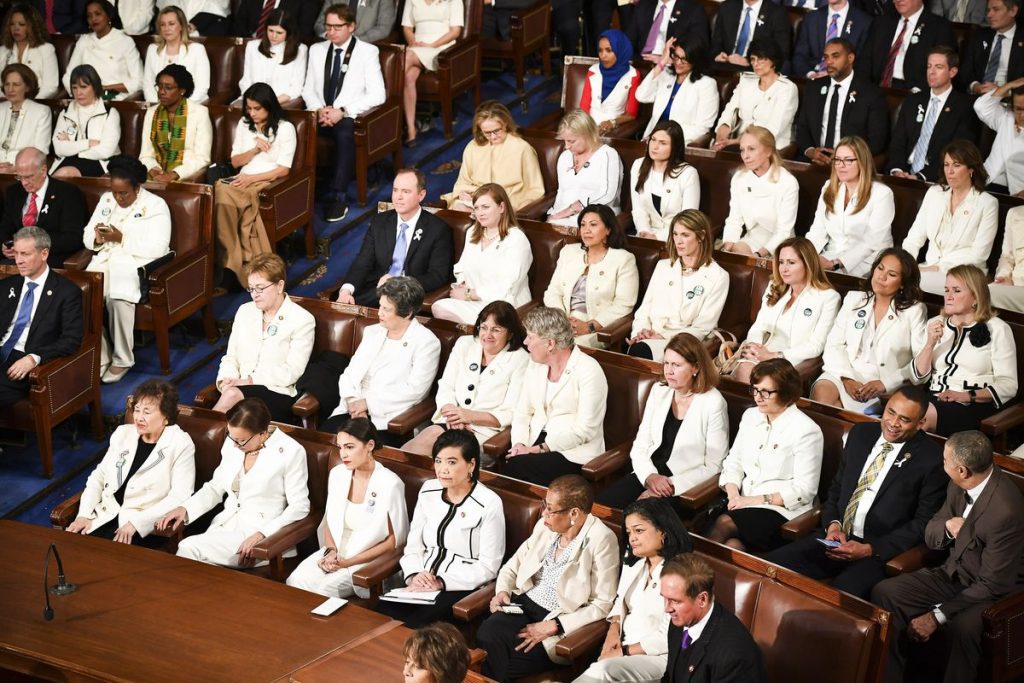
Photos of congresswomen wearing white at the 2019 State of the Union address illustrate how that history of injustices may have inspired women to figure so prominently in movements for truly universal voting rights. Those sworn in for the first time this year include many who could not have joined major suffrage organizations in 1919. But as crucial as it has been and will be to gain further political power for women by voting them into office, we can’t isolate that from burning voting rights issues today, in which Texas, like then, is a leader in voting restriction.
Laurie B. Green is an associate professor of history and a faculty affiliate in the Center for Women’s and Gender Studies at The University of Texas at Austin. Versions of this op-ed have been featured in The Houston Chronicle, San Antonio Express News, Abilene Reporter News, Amarillo Globe News, and The El Paso Times.
More by Laurie Green:
Women’s March, Like Many Before It, Struggles for Unity
The Media Matters: Reflections on the Fiftieth Anniversary of the Discovery of Hunger in the U.S.
You might also like:
Great Books on Women’s History: United States
Remembering the Tex-Son Strike: Legacies of Latina-led Labor Activism in San Antonio, Texas
The views and opinions expressed in this article or video are those of the individual author(s) or presenter(s) and do not necessarily reflect the policy or views of the editors at Not Even Past, the UT Department of History, the University of Texas at Austin, or the UT System Board of Regents. Not Even Past is an online public history magazine rather than a peer-reviewed academic journal. While we make efforts to ensure that factual information in articles was obtained from reliable sources, Not Even Past is not responsible for any errors or omissions.
Windswept litter and flaming logs on asphalt. Backlit figures swaying to handmade percussive instruments and bongos. High school seniors from Colegio Nacional huddled for warmth on the sidewalk, resting foreheads on shoulders for brief shut eye. A neighboring group of teens hoisted Argentine flags that read Movimiento Estudiantil Liberación. They danced and chanted, their makeshift bonfire illuminating passionate faces, streaked with glittering green paint. Tens of thousands filled the park, mostly young and female. Their necks adorned with green handkerchiefs, an aesthetic marker of political and ethical community.
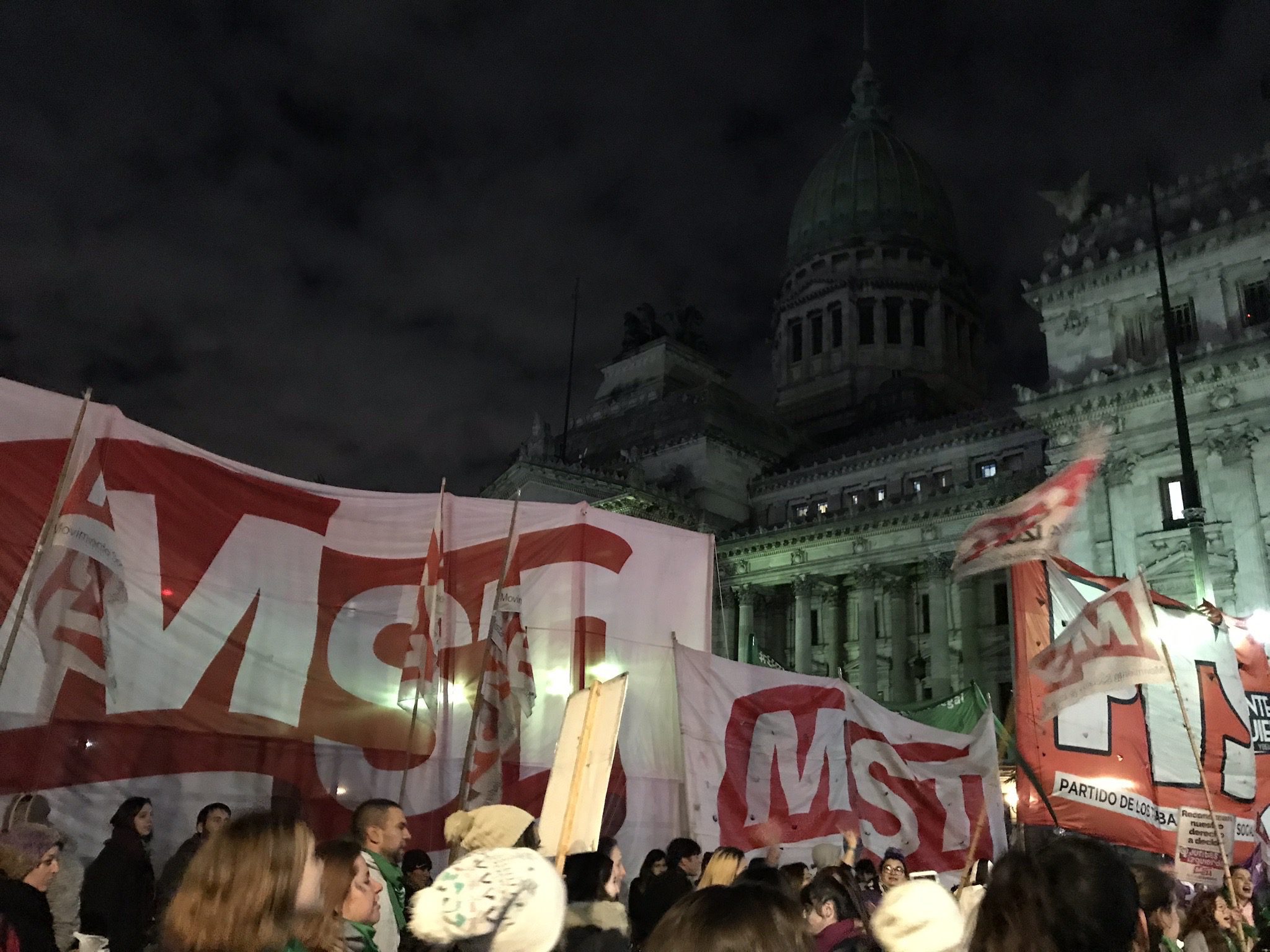
It was June 13, 2018 at around 10:30 pm when my mother and I joined the lively demonstration taking place outside of Argentina’s Congressional palace. After seeing intriguing images of the protest on the news, we were eager to witness the spectacle with our own eyes. We entered Plaza del Congreso just as the sun receded behind the neoclassical citadel in which the House of Deputies deliberated. Argentina’s lower house of Congress was voting on a bill that would decriminalize abortion in the first fourteen weeks of pregnancy. As political elites quarreled in their palace, a discussion that would last nearly twenty hours, protestors flooded the plaza outside to noisily advocate for the bill. Empty tour buses from countless distant provinces lined up along the avenues north of the blocked-off parameter. Inside the square, a cacophony of voices, symbols, and bodies deluged the space. Signs, banners, canopies, and tents exhibited slogans and logos of Tendencia Guevarista, Juventud Radical, Frente Popular Darío Santillán… and innumerable other left-wing political organizations.
A loquacious group of teen artists sat on checkered blankets exhibiting sketches, magnets, and stickers for sale. My mother paid a blond boy with a nose-ring ten pesos for a magnet, which she handed to me, “un regalo – a present.” In bright red letters on a green background, it read “¡CUIDADO! EL MACHISMO MATA” (Careful! The patriarchy kills.) More than anything, I wanted a green handkerchief like everyone else, but no one seemed to know where they came from.
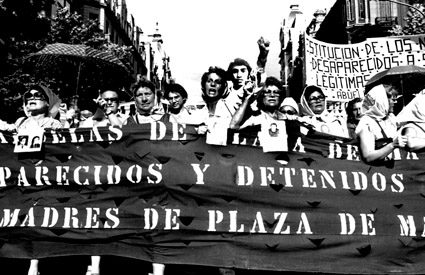
As a historian, I was impressed with the visual symbolism inherent in the handkerchiefs. I was immediately reminded of the photographs many of us have seen of elderly Argentine women defying a murderous military dictatorship. Las Madres de la Plaza de Mayo were middle-aged and elderly women who lost children and husbands to the military junta that ruled Argentina between 1976 and 1983. At great personal risk, these women met at the presidential palace every Thursday, beginning in 1977, to hold a vigil, wearing images of their missing kin on strings around their necks and plain white handkerchiefs on their heads.
It is reasonable to speculate that most of Las Madres de la Plaza de Mayo would not have considered themselves feminists, and it is even less likely they would have supported abortion rights. The historian Diane Taylor has pointed out that these women mobilized to defend their roles as mothers and wives, and they exploited traditional representations of femininity (purity and subservience to male family members) to mobilize shame. Even so, they remain national icons of feminine resistance in the public sphere.
Certainly, Las Madres paved the way for other female activist organizations, some of whom aligned themselves more directly with reproductive rights. For instance, Las Abuelas de la Plaza de Mayo consisted of women whose daughters or daughters-in-law were pregnant when detained by the military dictatorship. While searching for their missing grandchildren, this political group highlighted the military regime’s practice of kidnapping newborn infants for adoption into “loyal,” Catholic families. Margaret Atwood claims that this pro-natalist practice, with deep roots in Argentine history, was a fundamental inspiration for her novel The Handmaid’s Tale. Today, Las Abuelas continue to search for their grandchildren, many of whom are now in their late 30s or 40s and unaware of their biological heritage.

Las Abuelas de la Plaza de Mayo (via Wikipedia)
It goes without saying that today’s generation of activists in Buenos Aires operates in an entirely different historical context, with distinct political objectives. However, the symbolic implications of the pieces of cloth they wear on their bodies appear to acknowledge the role Las Madres and Abuelas played in legitimizing female activism. Now as then, Argentine women have shown they can provoke concrete political changes by assertively occupying public spaces.
As I think back to that Wednesday, I still remember wading through the sea of green, dazed and impressed with the demonstration unfolding. The closer to the palace we moved, the more boisterous and frenetic the crowd became. About fifty feet from the limestone and marble building, it became difficult to move. Here, banners rose fifteen feet into the air, most of them advertising Trosky-ist political parties, such as Movimiento Al Socialismo or Movimiento Socialista de los Trabajadores. The clamorous singing and drumming left my ears ringing after we painstakingly made our way out of the mosh pit. It was a rowdy rock concert with no central performer to orient the crowd and no security team to direct flows of human traffic. An overstimulation of sound, color, and corporal energy contrasted conspicuously with public displays of exhaustion nearby: teenagers sleeping in truck beds, on blankets, and against the iron fence circulating the square. A village of silent camping tents at the periphery of it all.
I spent only an hour or so at the demonstration, a small fraction of the time that most participants sacrificed to stand in the brisk winter night. The next afternoon, the Argentine Chamber of Deputies voted to decriminalize abortion by a narrow margin. This was an unprecedented victory for reproductive rights in a dominantly Catholic society and region of the world. The bill would have made Argentina just the third Latin American nation (after Cuba and Uruguay) to decriminalize abortions, and analysts speculated as to the effects this would have on reproductive rights transnationally. Unfortunately, the victory in the House of Deputies subsequently galvanized a counter mobilization of pro-life Catholics all over the nation. Even Argentine-born Pope Francis spoke out to condemn the legislation, and the country’s Senate ultimately defeated the bill in August. All the same, the bill’s narrow margin to victory and the movement’s prominent visibility were remarkable for a conservative country on a continent where abortion rights are the exception. In any case, the extraordinary June demonstrations deserve to be remembered for their historical and social significance in the larger trajectory of the Argentine feminist movement, rather than the legislative defeat that followed.
For more on gender in Argentina, see Diana Taylor, Disappearing Acts: Spectacles of Gender and Nationalism in Argentina’s “Dirty War,” (Durham: Duke University Press, 1997).
You May Also Like:
UT Gender Symposium: Women’s Bodies and Political Agendas
Women and Social Movements in the United States, 1600-2000

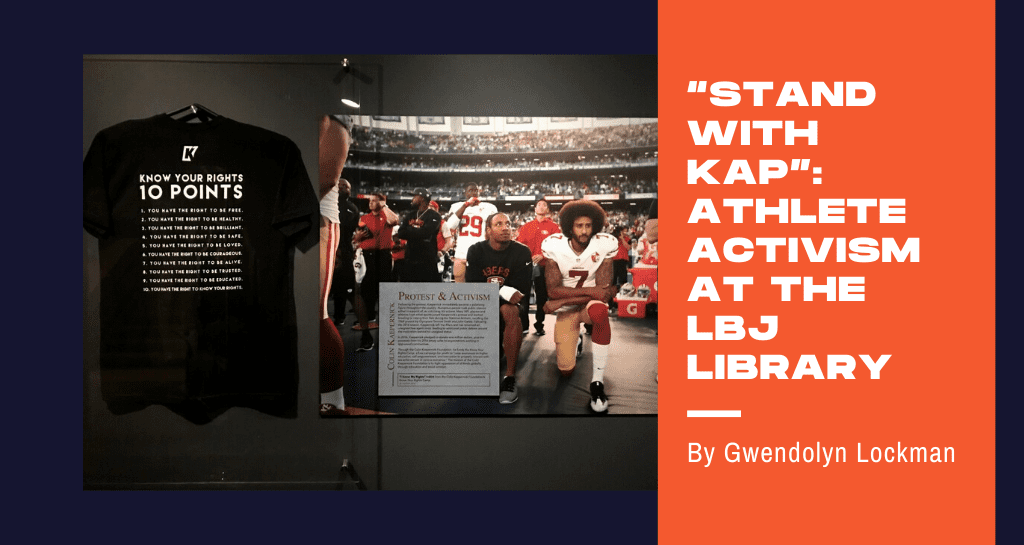
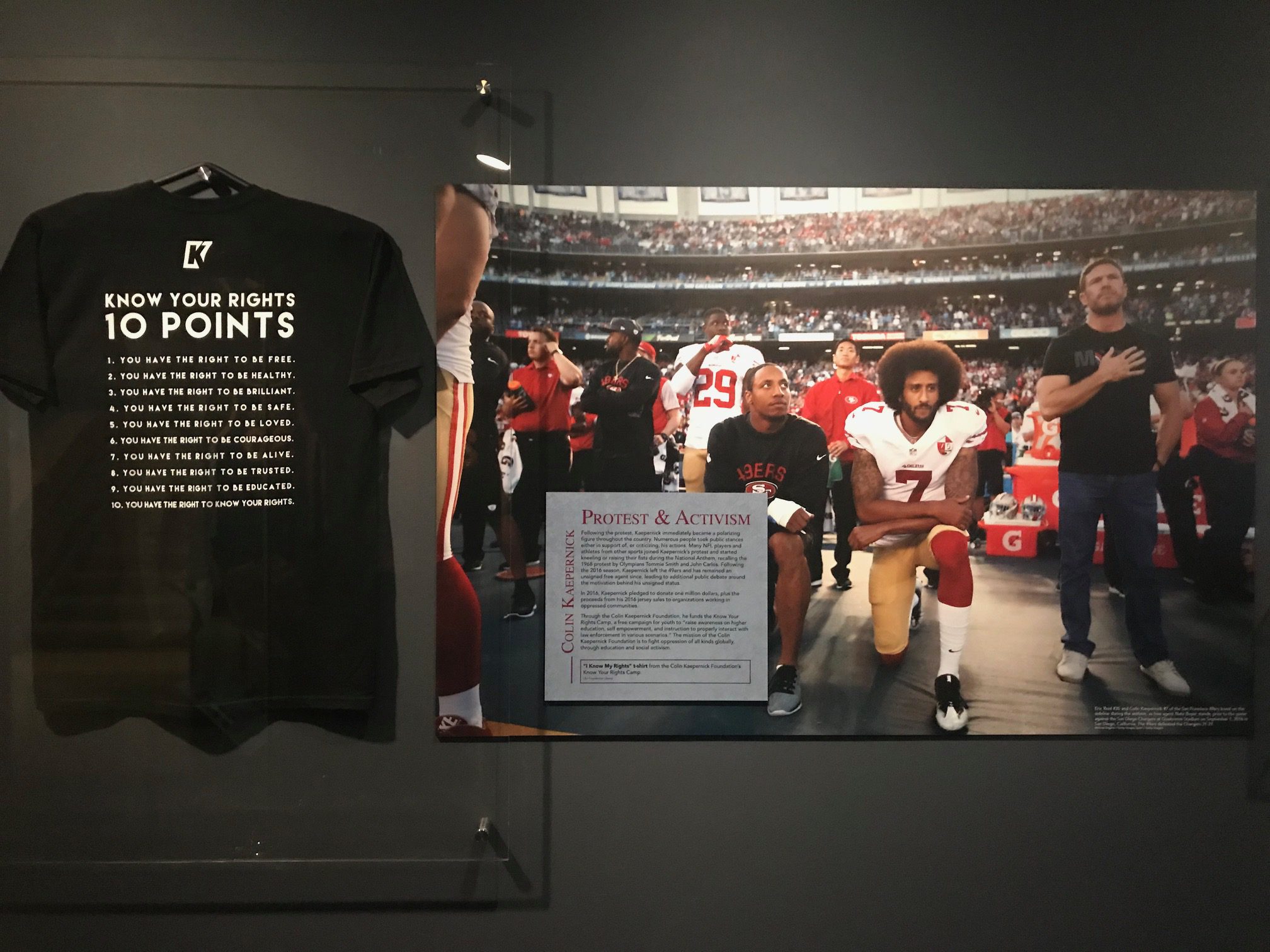
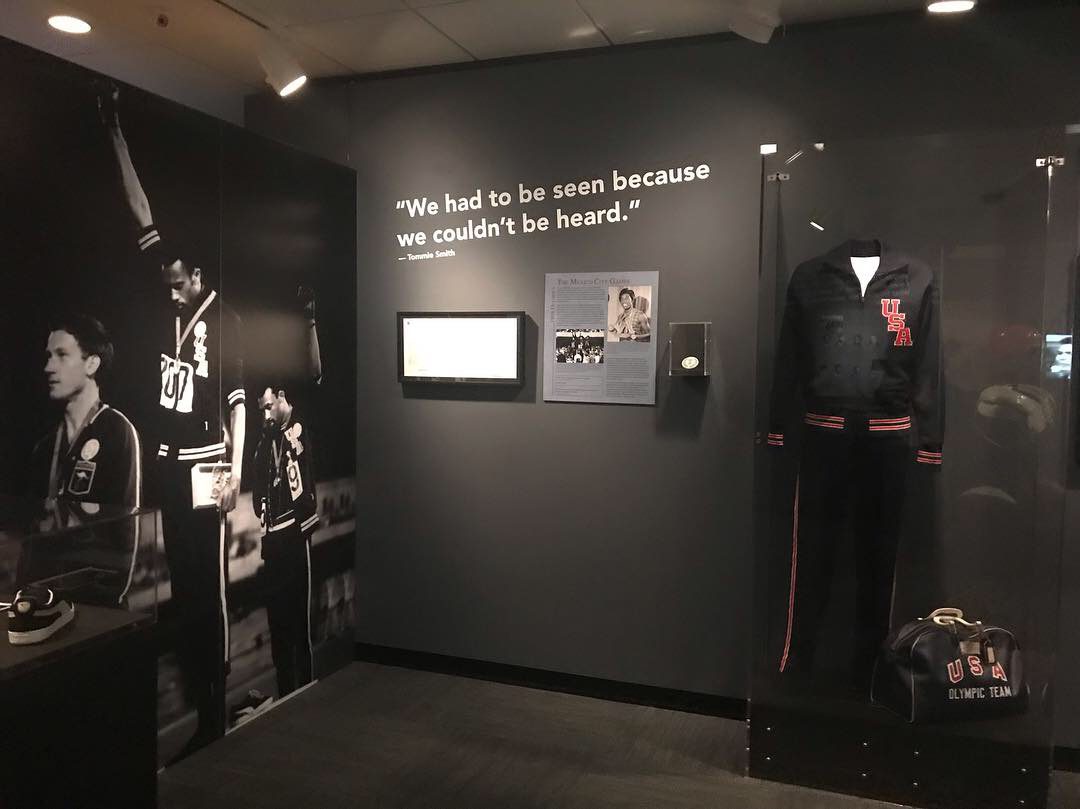
The Lyndon B Johnson Presidential Library opened “Get in the Game,” a timely exhibit on the intersection of social justice and sports, on April 21, 2018. In 2014, a new wave of athlete activism began in the United States. That year, NBA teams donned “I Can’t Breathe” shirts during warm ups to protest the police brutality against Eric Garner. In the summer of 2016, the WNBA joined the conversation with the “Change Starts with Us—Justice & Accountability” and #BlackLivesMatter, #Dallas5, #__ demonstrations by the Minnesota Lynx and New York Liberty. The current moment is most defined, of course, by Colin Kaepernick’s national anthem protests that began in the 2016 NFL preseason. “Get in the Game” charts a legacy of barrier-breaking and justice-seeking athletes from the late 19th century to the present with an emphasis on the current relationship between athlete activism and American politics.
The exhibit is remarkably comprehensive, especially for a small-scale and brief installation (the exhibit closes January 13, 2019). Visitors will find a wide selection of sports represented—horse racing, football, baseball, basketball, track and field, boxing, tennis, golf, and fencing—and attention to gender, race, media, player salaries, and social justice. Guests should be keen to linger in the center room of the exhibition, where curatorial care and intentionality is reflected in an exceedingly well communicated examination of Jackie Robinson’s post-baseball activism and the 1968 Olympic Project for Human Rights.

While most Americans are familiar with Jackie Robinson as a figure and the brief details of his early career with the Brooklyn Dodgers, few popular versions of his story reflect on the later years of his baseball career and after he retired. It is not popularly discussed that Robinson was among the crowd at the March on Washington for Jobs and Freedom in 1963, nor that he campaigned for Richard Nixon.
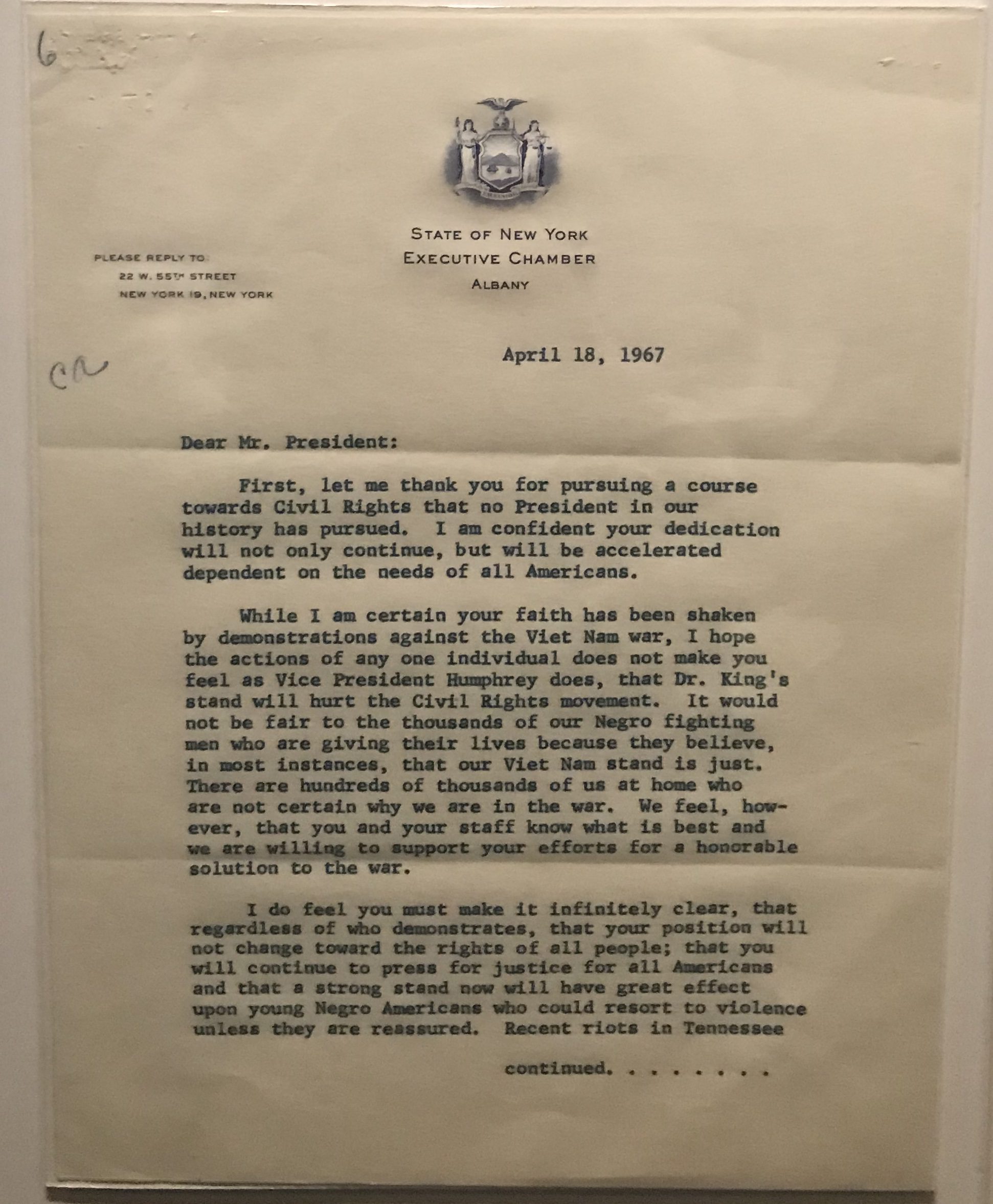
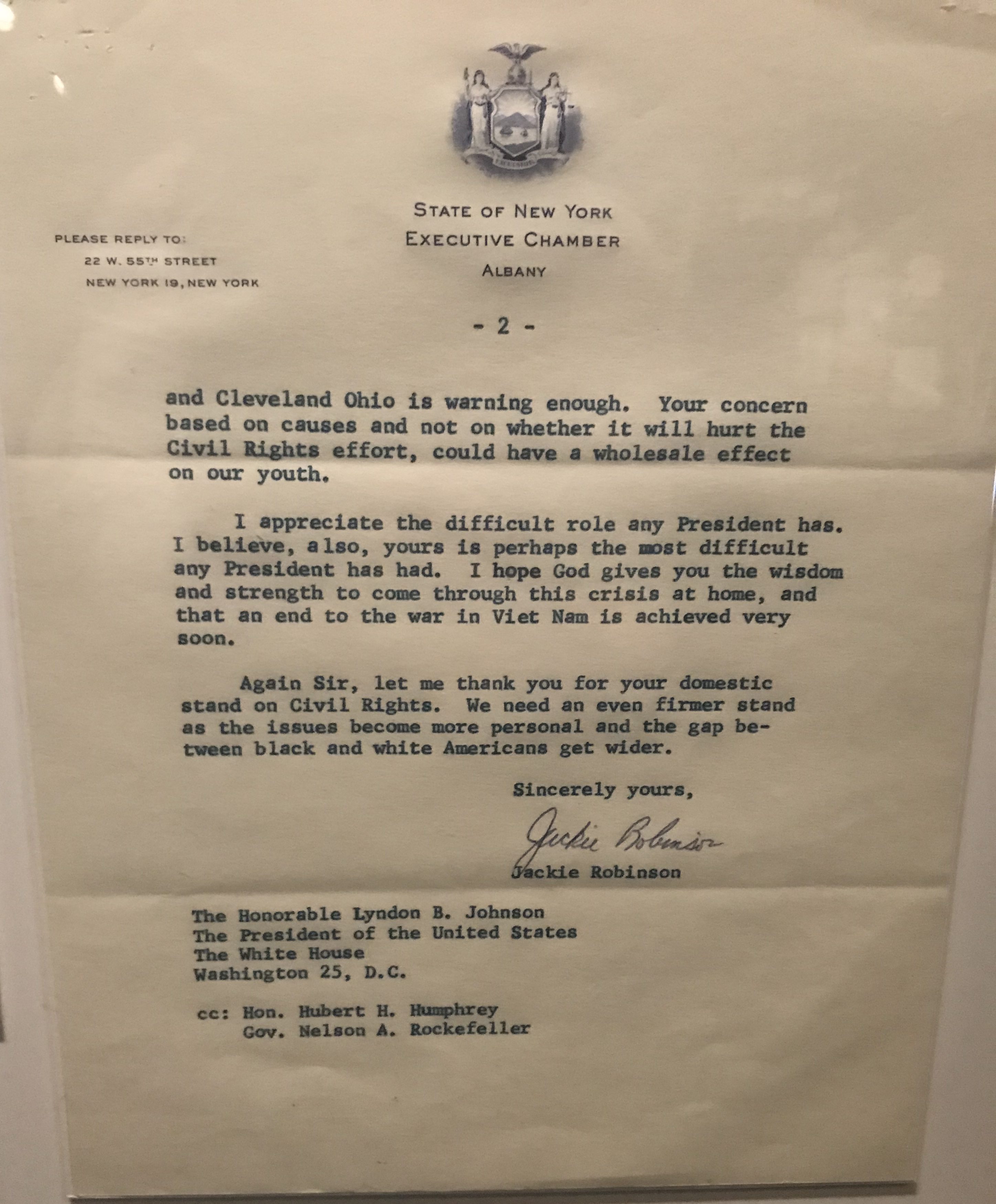
Robinson committed much of his time in retirement to activism, working with the NAACP, encouraging other black athletes, and communicating with several politicians. “Get in the Game” features letters and telegrams from Robinson to Presidents Eisenhower, Kennedy, Johnson, and Nixon. The letters show Robinson’s concern that Civil Rights remain a presidential priority throughout changes in regimes, as well as his concerns about the morality and risks regarding the Vietnam War.
Robinson implored Eisenhower to do more for African Americans, writing, “I was sitting in the audience at the Summit Meeting of Negro Leaders yesterday when you said we must have patience. On hearing you say this, I felt like standing up and saying, “Oh no! Not again!” I respectfully remind you sir, that we have been the most patient of all people. When you said we must have self-respect, I wondered how we could have self-respect and remain patient considering the treatment accorded us through the years.”
Robinson also engaged Presidents regarding black liberation in Africa and Dr. King’s anti-war stance. He wrote to President Kennedy, “With the new emerging African nations, Negro Americans must assert themselves more, not for what we can get as individuals, but for the good of the Negro masses. I thank you for what you have done so far, but it is not how much has been done but how much more there is to do. I would like to be patient Mr. President, but patience has caused us years in our struggle for human dignity.”
When Dr. King protested the Vietnam war in 1967, Robinson wrote to President Johnson, “I do feel you must make it infinitely clear, that regardless of who demonstrates, that your position will not change toward the rights of all people; that you will continue to press for justice for all Americans and that a strong stand now will have great effect upon young Negro Americans who could resort to violence unless they are reassured.”
Another strength of the exhibition is the number of items on loan or gifted from the Dr. Harry Edwards Archives at the San Jose State University Institute for the Study of Sport, Society and Social Change. Dr. Edwards led the Olympic Project for Human Rights (OPHR), the group that organized the boycott of the 1968 Mexico City Olympic Games, and continues to work with athletes, including Colin Kaepernick. The exhibition focuses not only on Tommie Smith and John Carlos’s iconic anthem protest and its 50th anniversary, but also the support, solidarity, and demands of the OPHR.
Mere days before his assassination, Dr. King met with Dr. Edwards and endorsed the athletes’ “courage and determination to make it clear that they will not participate in the 1968 Olympics until something is done about these terrible evils and injustices.” Five members of the Harvard Rowing team, due to compete in the Games, appeared with Dr. Edwards to officially state, “It is their criticisms of society which we here support.” Black students at Harvard Law also stated that they supported the athletes’ “willingness to sacrifice the fruits of your labor for the achievement of the goals of Black Americans.”
Though the International Olympic Committee (IOC) met one of the demands of the OPHR, that South Africa and Rhodesia be uninvited to the games, and the boycott was called off, Lew Alcindor (Kareem Abdul-Jabbar) and other basketball players maintained their stance and did not compete at the games.
Even for those athletes who did compete, the spirit of the OPHR continued, breeding both solidarity and backlash. An OPHR button is included in the exhibition, like the ones worn by Smith, Carlos, and the Australian runner Peter Norman who won the silver medal alongside Smith’s gold and Carlos’s bronze. Displayed adjacent to the button is a State Department memo concerned with what to do about the demands from the IOC to remove Smith and Carlos from the Olympic Village, though the athletes ended up leaving on their own, returning to backlash from the press and the public.
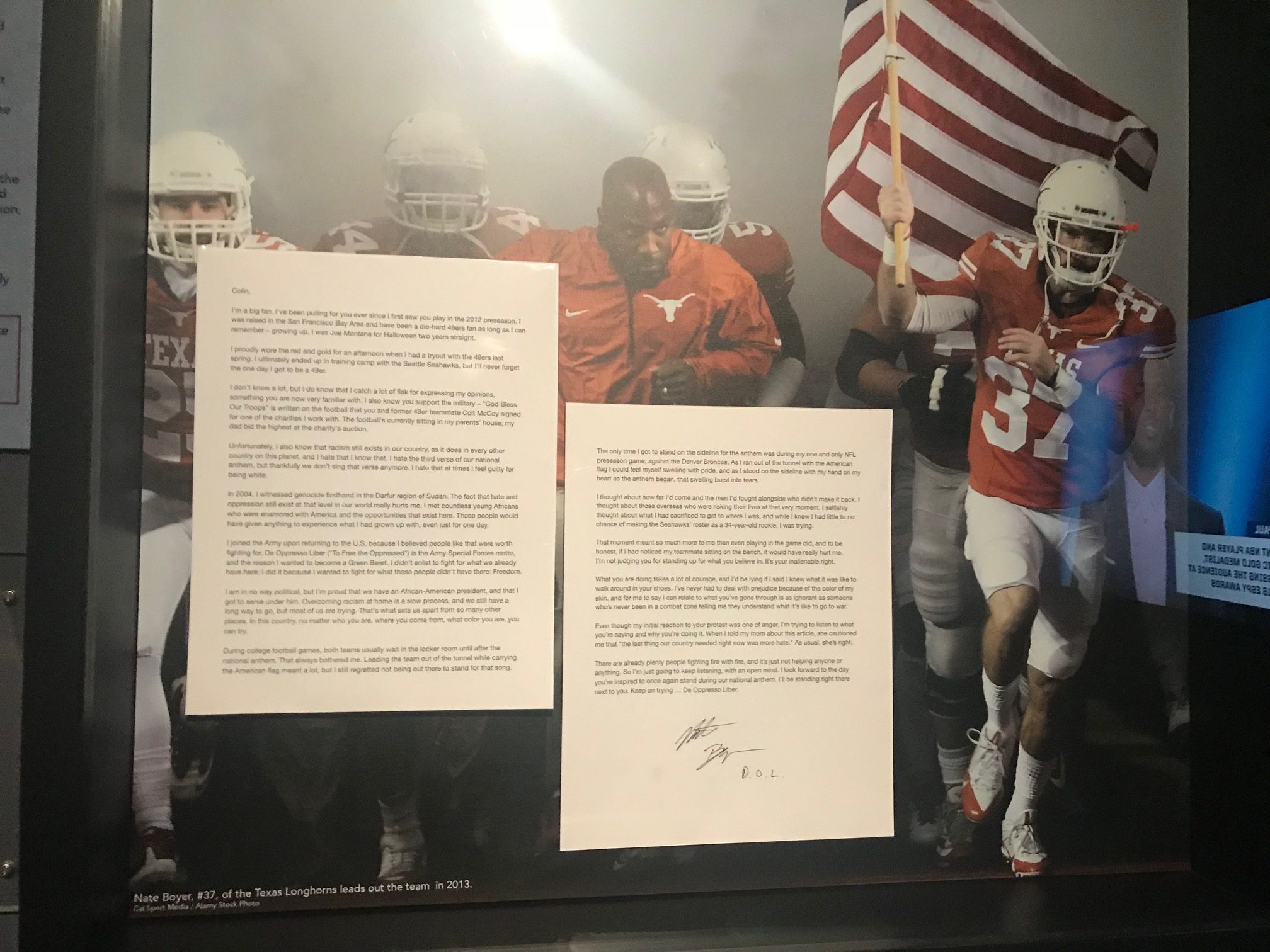
The exhibition closes with Kaepernick and notes his connection to the 1968 Olympics. A unique strength of the materials is the inclusion of University of Texas at Austin alumnus Nate Boyer, who worked with Kaepernick to attempt to bridge the divide between his protest and American servicemen and women and their families.
A notable curatorial decision that mutes the political nature of the exhibit and fails to connect Jackie Robinson, the 1968 games, and Colin Kaepernick, is the omission of Jackie Robinson’s autobiography I Never Had it Made (1972). This is a common missed connection in the anthem protest legacy. Calling upon Frederick Douglass’s 1852 speech, “What to a Slave is the Fourth of July?”, the introduction to Robinson’s book recalls game one of the 1947 World Series, Robinson’s rookie year. He writes, “The band struck up the national anthem. The flag billowed in the wind. it [sic] should have been a glorious moment for me as the stirring words of the national anthem poured from the stands. Perhaps it was, but then again perhaps the anthem could be called the theme song for a drama called The Noble Experiment . . . As I write this twenty years later, I cannot stand and sing the anthem. I cannot salute the flag; I know that I am a black man in a white world. In 1972, in 1947, at my birth in 1919, I know that I never had it made.”
Though the decision to omit the autobiography is an easily defendable one—the focus on Robinson is his breaking the color barrier and his correspondence with Presidents—it stands out because of the inclusion of other athletes’ autobiographies and provocative statements. Perhaps more accessible due to the museum’s possession of an inscribed copy owned by LBJ, Bill Russell’s book Go Up For Glory (1966) is included, along with details of his delivery of Muhammad Ali’s refusal to serve in the military.
As visitors exit “Get in the Game,” the last item they see is the block quote, “If there is no struggle there is no progress,” from Frederick Douglass. Knowing what we do about Robinson, Smith and Carlos, and Kaepernick, it is also worth considering a quote from Douglass’s “Fourth of July” speech:
“The Fourth [of] July is yours, not mine. You may rejoice. I must mourn. To drag a man in fetters into the grand illuminated temple of liberty, and call upon him to join you in joyous anthems, were inhuman mockery and sacrilegious irony.”
More like this:
Unsportsmanlike Conduct: College Football and the Politics of Rape
Muhammad Ali Helped Make Black Power into a Global Brand
Remembering Willie ‘El Diablo’ Wells and Baseball’s Negro Leagues
One has to only look at a few headlines to see that many view black women organizers as important figures in combating today’s most pressing problems. Articles urging mainstream America to “support black women” or “trust black women” such as the founders of the Black Lives Matter Movement are popular. Publications, such as Time, laud black women’s political leadership—particularly when they mount a challenge to the status quo such as Stacey Abrams’ victory in the Georgia Democratic Governor primary. At the core of these sentiments is the recognition that black women have developed and sustained a liberal democratic politics that is conscious of and responsive to the interconnected effects of racism, capitalism, and sexism and that their approach can offer insight into current socio-political issues. The media often frames these and other women’s efforts as a manifestation of the current political moment divorced from the longer tradition of black women agitators and organizers to which they belong. Many of the black women making headlines today for their work in advancing civil rights and social justice ideals draw from these earlier traditions, including from the Black Power Movement of the 1960s and 70s.
Although often thought of as civil rights’ “evil twin,” in the words of historian Peniel Joseph, Black Power was a diverse and diffuse collection of organizations, activists, and ideas. This movement spanned the political spectrum, states and continents, and stretched into both the grassroots and national arenas. Despite these variations, activists across the globe were united in support of the central pillars of Black Power—black community control, black self-determination, and black self-defense—broadly defined. In the latter half of the twentieth century, a bevy of organizations ranging from the Black Panther Party to the All-African People’s Party supported and advanced these principles.
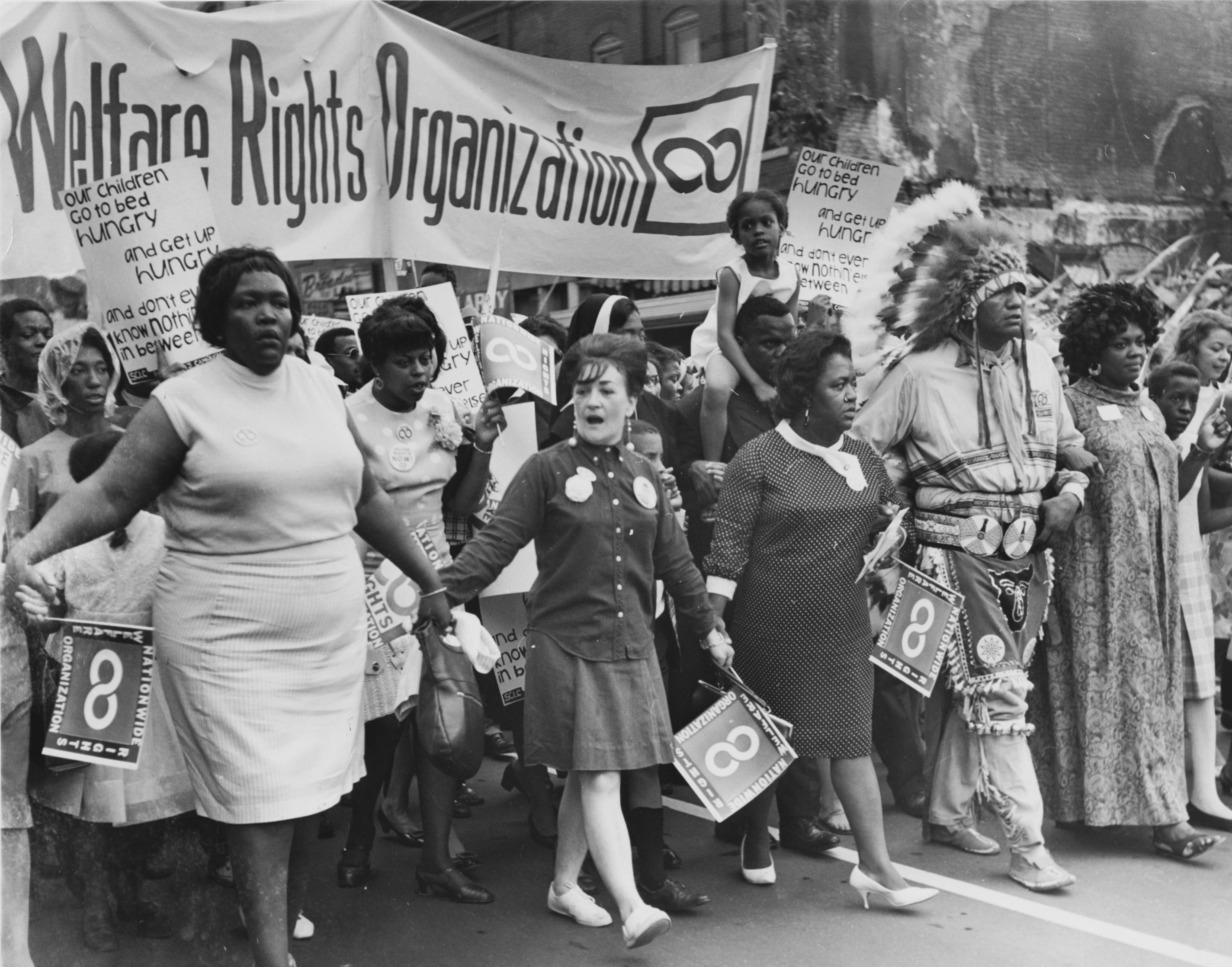
Black women were at the epicenter of this movement. Some joined national organizations and served in both rank-and-file and leadership roles. Others found a way to enact ideals like community control and self-determination through local neighborhood or welfare rights organizations. Whatever avenue they chose, female Black Power activists were not only vital to the infrastructure of the movement, they also advanced gender-specific interpretations of its governing axioms. Complicating common assumptions about their marginalization in the movement, black women activists fought for more inclusive understandings of Black Power, ultimately causing many organizations to adopt a more radical critique of racism, sexism, and capitalism.
Women in the Black Panther Party exemplified this gender-conscious ethos. Huey Newton and Bobby Seale founded the party in October 1966 in Oakland, California in response to rampant police brutality. However, the Black Panther Party quickly became a collective with a more expansive vision that included defending the black community, developing community programs to increase self-sufficiency, and fostering political education—albeit with a masculinist framing. Women joined the group a year after its founding, participating in all aspects of its programming and endorsing its principles. The first female member, Tarika Lewis, participated in political education classes, attended rallies, and was an artist for the party newspaper, The Black Panther. As the party developed, other women including Ericka Huggins and Elaine Brown joined the group. By the 1970s, Huggins edited the newspaper and Brown ran the party. Indeed, women became Panthers in droves, eventually comprising about two-thirds of the rank-and-file across forty chapters. As they organized, they challenged their male counterparts to rethink their commitment to patriarchal ideas of leadership, activism, and revolution, openly debating sexism within the movement and developing artwork and articles that framed black women as the consummate political actors. Their efforts worked. The Black Panther Party, often thought to be an exemplar of Black Power sexism, adopted more egalitarian polices toward women in both name and practice.
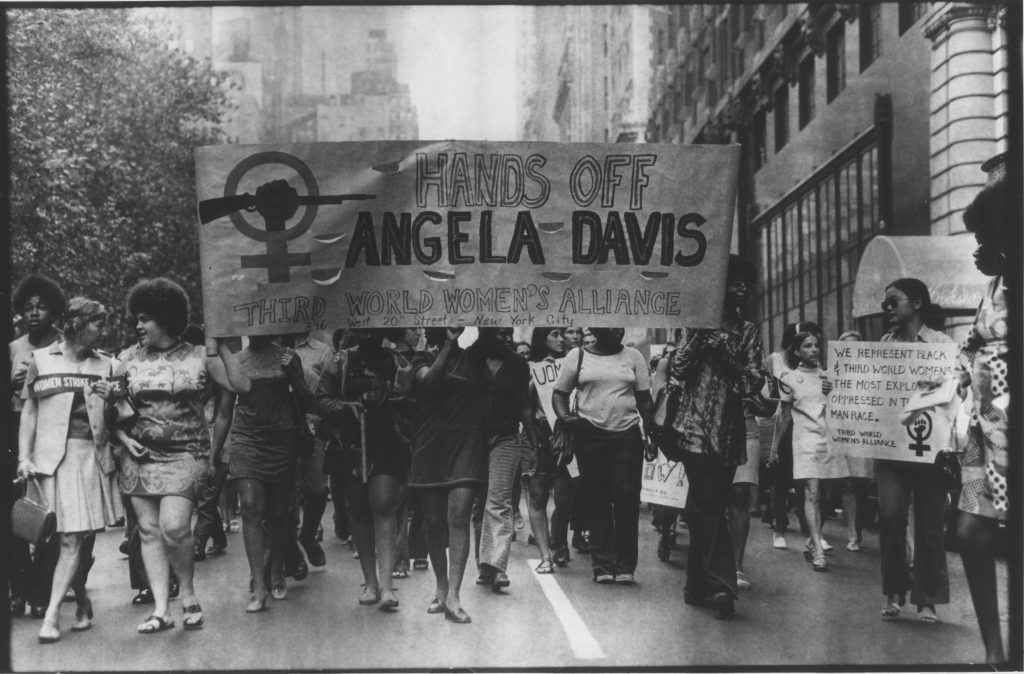
Other women, such as members of the Third World Women’s Alliance (TWWA), chose to engender and re-gender Black Power through what historian Stephen Ward calls, “Black Power feminist” groups. This organization originated as a women’s caucus within the Student Non-Violent Coordinating Committee (SNCC), which, by the late 1960s, advocated for globally-minded, anti-imperialist politics expressed through Black Power principles and positions. As it developed it became a collective of “black and other third world women” fighting “all forms of racist, sexist, and economic exploitation.” Through their newspaper, Triple Jeopardy, members developed an ideological platform and activist agenda that interpreted Black Power principles through this global, gender-specific, and intersectional lens. Articles about anatomy and reproductive rights fostered gender-specific understandings of self-determination; images of black and brown women arming themselves supported a capacious understanding of self-defense. These publications, as well as their collaborations with other Black Power era groups, helped produce more nuanced understandings of Black Power. Their multi-faceted approach to liberation also laid the groundwork for what we now call intersectionality.
Female Black Power organizers’ diverse organizing efforts are visible in activism today. The grassroots networks that progressive candidates like Abrams used to win the primary, as well as her endorsement of universal pre-K and affordable housing, build on the efforts of women such as Huggins and Brown, who dedicated much of their lives to developing capacious forms of community control. More radical organizers, such as the three women founders of the Black Lives Matter movement, carry on TWWA-like traditions of global anti-imperialist solidarity, intersectionality, and black self-determination through self-definition.
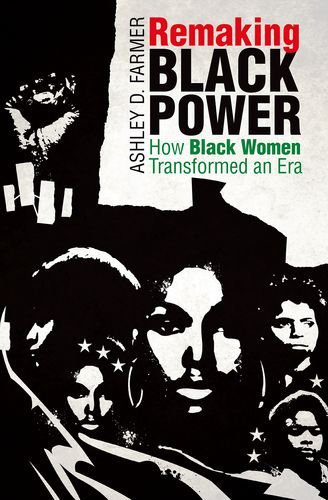
My new book, Remaking Black Power: How Black Women Transformed an Era, examines these and other women activists in order to better understand black activism past and present. It centers on black women’s ideas and organizing in order to foreground how they might help us rethink the historical and historic uses of Black Power in addressing all facets of oppression. Understanding the historical activism of black women organizers can reveal new sites of theoretical and organizational possibilities and shine light on the ways that we might move toward different and more equitable worlds today.
![]()
Ashley D. Farmer, Remaking Black Power: How Black Women Transformed an Era
“Online roundtable on Ashley Farmer’s Remaking Black Power,” in Black Perspectives, the blog of the African American Intellectual History Society, April 13, 2018.
For more on black women and Black Power, Prof. Farmer recommends these.
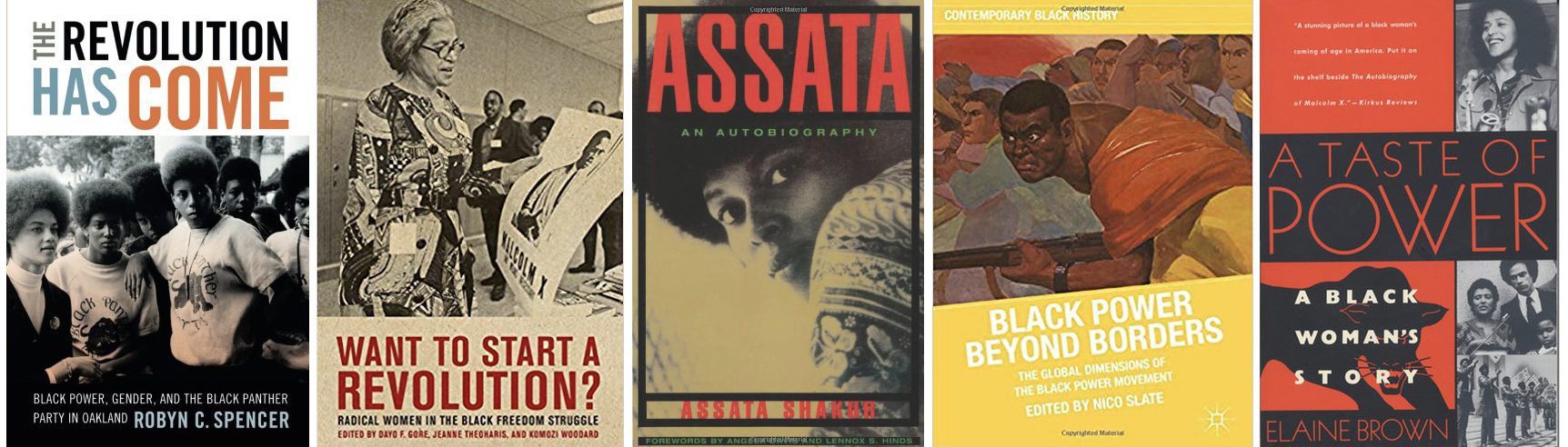
Robyn C. Spencer, The Revolution Has Come: Black Power, Gender, and the Black Panther Party in Oakland (2016).
A great book for anyone looking to learn more about the gender politics of the Black Panther Party.
Dayo F. Gore, Jeanne Theoharis, Komozi Woodard, Want to Start a Revolution? Radical Women in the Black Freedom Struggle (2009).
A strong collection of essays that explore black power and black radicalism from its origins to its apex.
Assata Shakur, Assata: An Autobiography (1988, 2001)
The life story of Assata Shakur, her journey into activism, membership in the Black Panther party, and her arrest and her current exile in Cuba.
Elaine Brown, A Taste of Power: A Black Women’s Story (1993).
A great autobiography that describes Brown’s journey to becoming a leading Black Power activist and leader of the Black Panther Party
Nico Slate ed. Black Power Beyond Borders: the Global Dimensions of the Black Power Movement (2012)
A collection of essays that speak to the global scope and reach of U.S-centered ideas of Black Power.
![]()
Featured image photo credit: Black Panthers at a rally in Oakland, Calif., in 1969, from the documentary “The Black Panthers: Vanguard of the Revolution.” (Photo: Pirkle Jones and Ruth Marion-Baruch).
Originally posted on Process History on September 5, 2017.
Near the end of the spring semester, my department asked me to teach a summer session of U.S. History since 1865. I had a short time to think about what I’d teach and how I’d teach it. For me, it was important for students to “do” the work of historians. This meant more than reading primary sources, though. In addition to this, students would engage with “essential questions” that are key for understanding the United States’ recent past. Moreover, in lieu of assigning a traditional textbook, which might not fully align with these essential questions, I decided that my students would read, analyze, and critique articles from the Journal of American History.
My first preparatory task was to frame the course around the essential questions. I wanted to create questions around a broad range of potential student interests. I chose four topics: 1) America’s role in the world; 2) economics and labor; 3) women and gender; and 4) comparative civil rights. These topics covered some of the important themes of post-Civil War U.S. History.
The questions I crafted (see Figure #1: The Course’s Essential Questions) were beneficial on several levels. Initially, they helped me with one of the most daunting challenges of syllabus creation—picking and choosing content to cover. These essential questions narrowed what I would focus on; lectures and in-class activities would always have to answer (at least) one of these questions. On top of this, I used the four questions to pick articles from the Journal of American History. From a content standpoint, these articles would provide additional detail that my lectures and in-class activities might not be able to cover in depth.
Selecting academic articles for an introductory survey can be tricky. I had to think about whether students would have enough prior knowledge to truly engage with the secondary source. At the same time, I needed to be cognizant of whether the article covered a fair amount of time, which might then help students understand important historical concepts, like change over time and contingency. Moreover, if I could, I wanted the articles to be useful for answering more than one of the course’s essential questions.
I ultimately chose fifteen articles from the Journal of American History to help students answer the course’s four essential questions. (See Figure #2: Academic Articles for a complete list.) Erika Lee’s “Enforcing the Borders,” for example, helped students compare and contrast a wide-range of racialized lived experiences from the Chinese Exclusion Act through the 1924 Immigration Act. Her article complemented lecture material on and primary sources about the history of white supremacy. Julia Mickenberg’s “Suffragettes and Soviets,” on the other hand, highlighted the interconnections between domestic and global events. Mickenberg’s article proved useful for students interested in women’s and gender history as well as those fascinated by the events of the First World War. Jacquelyn Dowd Hall’s classic, “The Long Civil Rights Movement,” was one of my students’ favorite articles. Hall famously critiqued the “classical” phase of the Civil Rights Movements in her article. Yet, for the purposes of my course, Hall’s article also helped students better understand the history of African Americans, the intersection of race and gender, and racialized economics. Hall’s seminal article, then, could assist students with three of the course’s four essential questions.
Students who are used to reading textbooks, however, can find reading academic articles challenging. To have them gain the skills necessary to successfully engage with these academic articles, I devoted a fair amount of in-class time to reading, interpreting, and analyzing these sources. I viewed my role as an encouraging coach who kept his approach to the analysis of academic articles straightforward and accessible. For the first three articles assigned in the class, I had students (re)read the introduction and the conclusion with a partner or in small groups. I asked students to underline and annotate where the historian(s) articulated their argument. Sometimes this meant that students had to mark several parts of the introduction and conclusion, trying to make sense of complex arguments which had multiple supporting parts. At first, this was a tough task for students, consuming upwards of 20 minutes of a 75-minute class. However, as we spent more time on this skill, students slowly gained more confidence. I was able to go around the room to work with small groups of students, focusing them on specific parts of introductions and conclusions. After a couple sessions, I asked students to paraphrase arguments in their own words. Students’ confidence grew the more they worked with one part of “doing” history—understanding historical arguments. Over time, what had taken 20 or 25 minutes soon dwindled to 12 or 15.
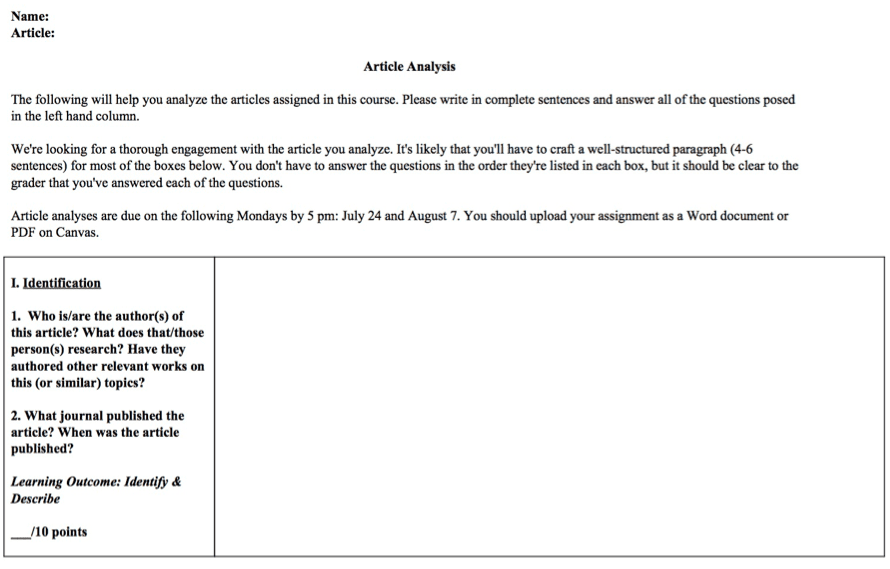
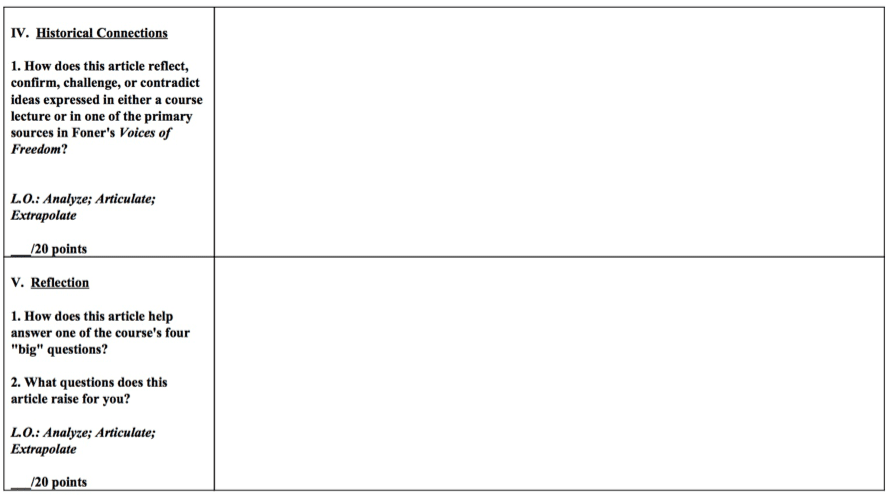
Students were required to write an analysis for two of the academic articles they read. To ensure further success, students were provided a fair amount of scaffolding on these assignments. To assist with article analyses, I created a reading grid that asked students to: research the historian/scholar; note and critique the sources used in the article; make historical connections to lectures and/or primary sources; and reflect on how the source could answer one of the course’s essential questions. I had detailed questions for each box of the reading grid, providing a fair amount of guidance for students to understand what they should be looking for when analyzing an article. Figure #3:The Reading Grid displays the course’s emphasis on scaffolding the analysis of academic articles.
By the end of the term, I could see that the focus on teaching with and analyzing academic articles worked on several levels. The most important, in my opinion, was how students improved from their first to their second article analysis. They had a much more nuanced understanding of historical argumentation in their second analyses. In addition, students wrote more critically about the historians’ source bases and felt more comfortable critiquing “master narratives” they had learned in high school. For those afraid of using academic articles in their surveys, I want to offer a simple reassurance: students never shied away from this hard work. My provisional course instructor survey scores indicate that students recognized article analyses as a core part of their learning. I already have a strong sense of which articles students enjoyed, but I hope my course instructor surveys include constructive criticism about the articles students viewed as least helpful for answering the course’s essential questions.
There were other outcomes to using academic articles. Many of the articles I selected emphasized U.S. History in a transnational perspective. As a result, students had to think about the United States as a place which influences—and is influenced by—others parts of the world. By carefully selecting articles, I also made it so I did not have to assign a traditional textbook. Lectures, primary sources, and the articles covered enough material for students to understand the American experience and to walk away with their own informed interpretation of the nation’s history.
As an educator now weeks removed from the course I taught, I see an even greater purpose to teaching with academic articles. As we navigate a period of deep political division, one that is fraught with fear for many, teaching with academic articles has the possibility to instill crucial civic skills in our students. By respectfully challenging those who came before them, each scholar I assigned demonstrated that disagreement is a core part of the democratic experience. Using academic articles instead of a textbook allowed my students to see that disagreement does not need to be hateful or vitriolic. Instead, it can be a productive way to move forward, pushing in the direction of the “more perfect Union” enshrined in the Constitution.
Figure 1: The Course’s Essential Questions
| America’s role in the world | Determine how the United States’ foreign policy changed and/or remained consistent from the Spanish-American War through the Cold War. How did the U.S. confront the challenges it faced around the globe? Are there core tenets (or beliefs) that have guided American foreign policy? If so, what are they? If not, how do foreign policy conflicts differ from each other? |
| Economics and labor | Evaluate the ways the American economy has changed over the past 150 years. How did “big business” alter the landscape of U.S. industry? Why did Progressive Era and New Deal reformers pass the reforms they did? Have Americans found a way to balance economic growth and workers’ rights in the post-World War II period? |
| Women and gender | Analyze the political and economic fight for women’s equality. To what extent has the role and status of women changed over the past 150 years? What have been landmark victories for women’s rights? Why have various political factions opposed women’s and feminist groups? Is there work left to be done? |
| Comparative civil rights | The continued fight for equality has, in many ways, defined the American experience. Compare and contrast the struggle for civil rights that two of the following segments of the population experienced: 1) African Americans; 2) women; 3) Mexican Americans; 4) Asian Americans; and/or 5) LGBTQ individuals. Are there commonalities that you see in the political rhetoric and tactics of these two groups? How would you describe the unique challenges these segments of the population faced? What are the arguments, agendas, challenges, etc. that have made coalitions difficult to form, both within and between different rights movements? |
| Author | Article title | Year of publication | Essential question(s) answered |
| Erika Lee | Enforcing the Borders: Chinese Exclusion along the U.S. Borders with Canada and Mexico, 1882-1924 | 2002 | America’s role in the world & comparative civil rights |
| Richard White | Information, Markets, and Corruption: Transcontinental Railroads in the Gilded Age | 2003 | Economics and labor |
| Jürgen Martschukat | “The Art of Killing by Electricity”: The Sublime and the Electric Chair | 2002 | Economics and labor & comparative civil rights |
| Julia L. Mickenberg | Suffragettes and Soviets: American Feminists and the Specter of Revolutionary Russia | 2014 | America’s role in the world; women and gender; & comparative civil rights |
| Lisa McGirr | The Passion of Sacco and Vanzetti: A Global History | 2007 | America’s role in the world; economics and labor; & comparative civil rights |
| Julia C. Ott | “The Free and Open People’s Market”: Political Ideology and Retail Brokerage at the New York Stock Exchange, 1913–1933 | 2009 | Economics and labor |
| Rachel Louise Moran | Consuming Relief: Food Stamps and the New Welfare of the New Deal | 2011 | Economics and labor & women and gender |
| James J. Weingartner | Americans, Germans, and War Crimes: Converging Narratives from “the Good War” | 2008 | America’s role in the world & comparative civil rights |
| Thomas A. Guglielmo | Fighting for Caucasian Rights: Mexicans, Mexican Americans, and the Transnational Struggle for Civil Rights in World War II Texas | 2006 | America’s role in the world; economics and labor; & comparative civil rights |
| Elaine Tyler May | Security against Democracy: The Legacy of the Cold War at Home | 2011 | America’s role in the world; economics and labor; women and gender; & comparative civil rights |
| Nancy Bernkopf Tucker | Taiwan Expendable? Nixon and Kissinger Go to China | 2005 | America’s role in the world & comparative civil rights |
| Jacquelyn Dowd Hall | The Long Civil Rights Movement and the Political Uses of the Past | 2005 | Economics and labor; women and gender; & comparative civil rights |
| Michael B. Katz et al. | The New African American Inequality | 2005 | Economics and labor & comparative civil rights |
| Kevin J. Mumford | The Trouble with Gay Rights: Race and the Politics of Sexual Orientation in Philadelphia, 1969-1982 | 2011 | Women and gender & comparative civil rights |
| Michael H. Hunt | In the Wake of September 11: The Clash of What? | 2002 | America’s role in the world |
Figure 3: The Reading Grid (PDF)
Also by Christopher Babits on Not Even Past:
Finding Hitler (in all the Wrong Places?)
The Rise of Liberal Religion by Matthew Hedstrom (2013)
Encountering America: Humanistic Psychology, Sixties Culture, and the Shaping of the Modern Self by Jessica Grogan (2012)
Another perspective on the Texas Textbook Controversy
You may also like:
A collection of articles by faculty and graduate students on teaching US survey courses
Teaching Assistants in the Department of History share stories on learning to teach
History Professor Jeremi Suri experiments with teaching US history survey courses digitally
All content © 2010-present NOT EVEN PAST and the authors, unless otherwise noted
Sign up to receive our MONTHLY NEWSLETTER