• New
  • Features
  • Reviews
  • Texas
  • Teaching
  • Digital
  • Watch & Listen
  • Authors
  • About

The past is never dead. It's not even past

Not Even Past

Crimes against Nature: Squatters, Poachers, Thieves, and the Hidden History of American Conservation, by Karl Jacoby (2003)

by Henry Wiencek

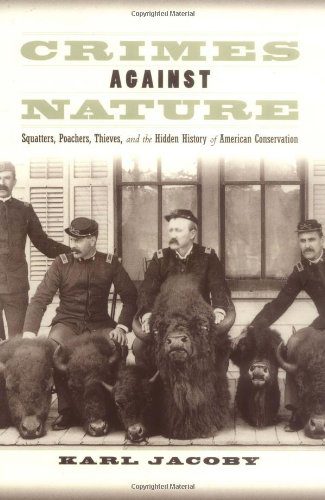
51-7Ixuoe7LWho actually lived in The Adirondacks, Yosemite, and The Grand Canyon before they became national parks? This is the simple, but compelling, question Karl Jacoby asks in Crimes against Nature: Squatters, Poachers, Thieves, and the Hidden History of American Conservation. When we think about preserving nature, Jacoby argues, Americans tend to assume an easy dichotomy between The Evil Poacher vs. The Righteous Park Ranger. But Crimes against Nature tells a deeper history of the rural communities who relied on these lands before their “preservation” and introduces some moral complexity into the story of America’s national parks.

Jacoby’s narrative starts with the legal, cultural and environmental changes taking place during the Progressive Era. As America became increasingly urbanized, many social reformers and politicians feared a dystopian future in which crowded, industrial cities replaced nature entirely. Teddy Roosevelt often spoke about the dangers of “over-civilization” as fewer and fewer Americans encountered the great outdoors. Starting in the late 19th-century, The federal government responded to these anxieties with the establishment of national parks that would protect “wilderness” from human development. These preserved park lands, officials reasoned, would encourage people to “get back to nature” and escape the pollution, disease, and social disorder of urban slums.
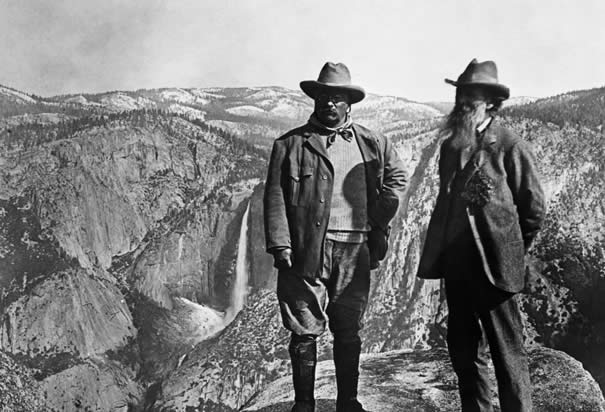
Teddy Roosevelt and naturalist John Muir pose at Yosemite National Park, 1906 (Library of Congress)

Teddy Roosevelt and naturalist John Muir pose at Yosemite National Park, 1906 (Library of Congress)

But the conservationist impulse to protect “wilderness” from the encroachment of human society, Jacoby points out, wholly disregarded the rural communities that had been living there for generations. Overnight, settlers and residents became outlaws and “squatters” residing on government owned land. The hunting and fishing which had sustained those communities was suddenly “poaching,” a crime that could result in fines or banishment. At the time of the Adirondacks’ preservation, 16,000 settlers lived within what became “preserved” and “uninhabited” land. Even the Grand Canyon at one time provided trails and access to natural resources for local Native American populations.
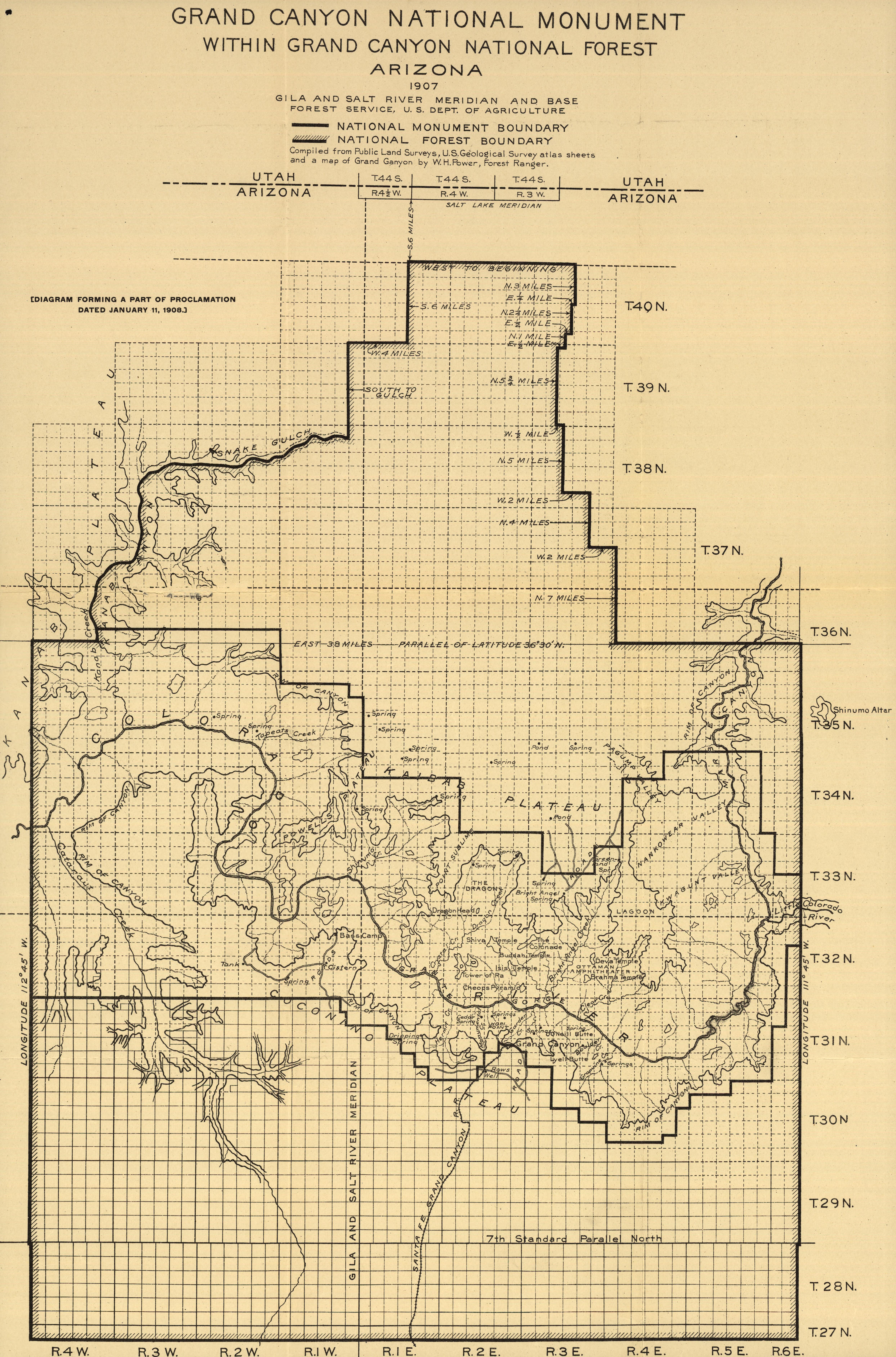
Map of Grand Canyon National Monument prepared by the National Forest Service, 1907 (Library of Congress)

Map of Grand Canyon National Monument prepared by the National Forest Service, 1907 (Library of Congress)

In order to enforce these new sets of rules, federal and state governments mobilized a bureaucracy of Forest Police to prevent squatting and poaching. Officials set new legal boundaries around “conserved” areas and organized forestland into grids of property ownership. Jacoby argues these efforts to define and protect “preserved” zones oversimplified complex ecological systems and produced unintended consequences. When officials at Yellowstone began hunting predators such as coyotes and mountain lions to maintain animal populations, the number of elk soared, throwing off the park’s delicate ecological balance. Despite the conservationist impulse to preserve nature as it is, park managers were really creating “nature” as it ought to be.
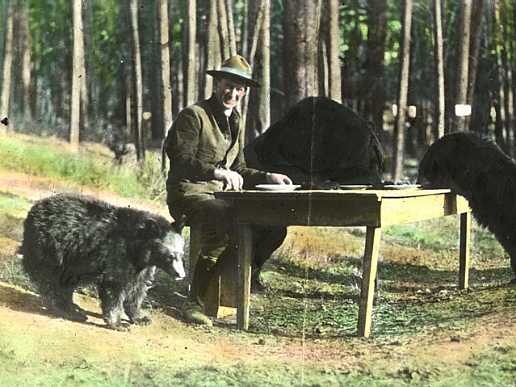
Horace M. Albright, Superintendent of Yellowstone National Park, with bears from the park, 1922 (National Park Service)

Horace M. Albright, Superintendent of Yellowstone National Park, with bears from the park, 1922 (National Park Service)

Crimes against Nature also details a variety of confrontations that ensued between park officials and the local communities who refused to leave. Setting fires, hunting or even making violent threats all represented forms of resistance against the incursions of the state on rural lands. Although many conservationists regarded these rural populations as fascinating vestiges of a pre-modern world, that nostalgia co-existed with a fierce contempt for their “primitive” modes of subsistence. Conservationists and Forest Police railed against the “irrationality” and wastefulness of rural hunting habits and worried that such behavior would undermine the rule of law.
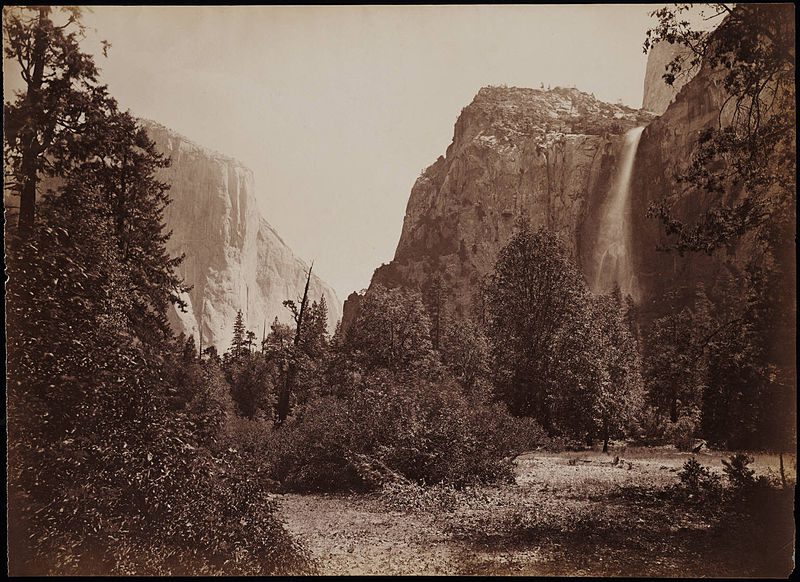
"View of Tutocanula Pass, Yosemite, California," by photographer Carleton E. Watkins, 1878-1881 (Beinecke Rare Book & Manuscript Library, Yale University)

“View of Tutocanula Pass, Yosemite, California,” by photographer Carleton E. Watkins, 1878-1881 (Beinecke Rare Book & Manuscript Library, Yale University)

Jacoby concludes that both sides actually embodied distinct, but complementary, American ideals. While conservationists sought to prevent illicit behavior and maintain the rule of law, settlers regarded themselves as rugged individualists pursuing self-sufficiency. In contrast to the simplified narrative of conservation vs. poaching, Jacoby sees a morally complex story unfolding in the wilderness.

bugburnt


Read more on the history of national parks and preservation:

Neel Baumgartner on Big Bend’s “scenic beauty”

Erika Bsumek on Lady Bird Johnson’s beautification project

And watch Blake Scott and Andres Lombana-Bermudez’s short documentary on the history of tourism in the Panamanian jungle
 

Hearing the Roaring Twenties: The New Archive (No. 12)

by Henry Wiencek

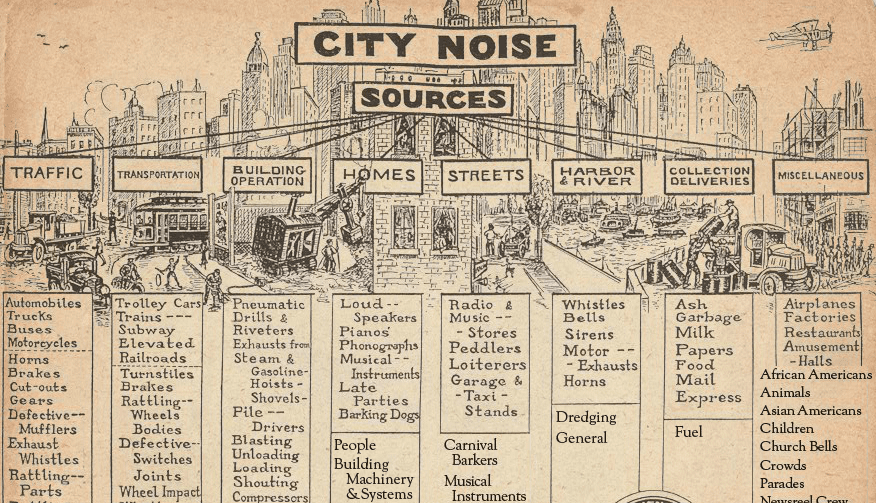
Ultimately, the task of any historian is to piece together the experience of another time—to understand what it was like being on the streets of Paris in 1789. Photographs, primary documents and personal recollections offer important glimpses, but one digital history site specifically wants to understand how it sounded. “The Roaring Twenties”—a collaboration between Emily Thompson of Princeton University and Scott Mahoy of the University of Southern California—compiles audio files and written noise complaints from 1920s New York City to capture the utter cacophony its residents experienced. Arranged by sound type, geography and timeline, this database is a new type of documentary and experiential history—recreating what the Roaring Twenties sounded like.

A screenshot of the "Sounds" section (The Roaring Twenties)

A screenshot of the “Sounds” section (The Roaring Twenties)

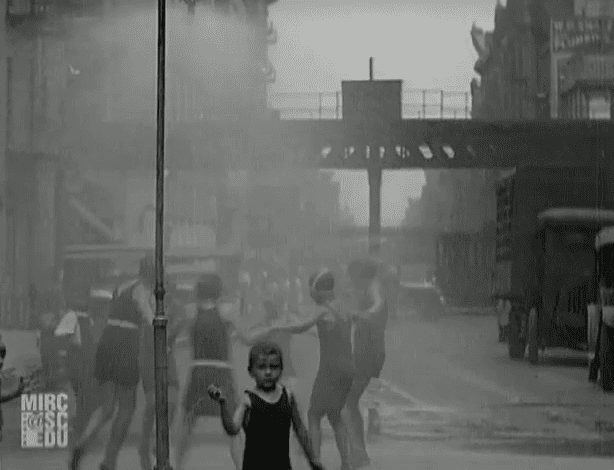
The variety of noises that 1920s New Yorkers endured is astonishing. Click on any of the listings in the “Sound” section and you’ll get the brief history of a particular sound: its source, its location, its formal noise complaint (if such documentation existed) and, in many entries, a contemporary piece of footage capturing the actual noise. It is remarkable to visit the utterly different sonic world these videos capture. While many of the auditory sensations caught on film would be familiar to present day residents—sirens, construction and honking cars—actually hearing (and seeing) them feels like entering a parallel universe. For the individuals seen on camera, all that rattling, whistling and yelling would have been the ordinary context for daily life; yet to us, it is exotic and bizarre.

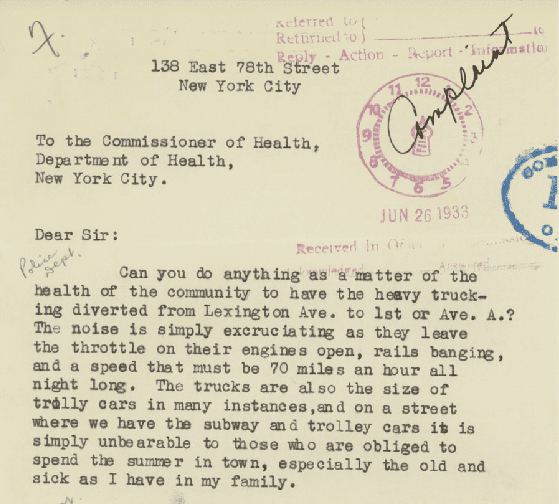
A formal complaint Louise P. Jenkins of Manhattan filed with the New York Commissioner of Health in 1933 regarding the sounds of fire engines (The Roaring Twenties/NYC Dept. of Records/Municipal Archives)

Screenshot of the formal complaint Louise P. Jenkins filed with the New York Commissioner of Health in 1933 regarding the sounds of trucks in her Manhattan neighborhood (The Roaring Twenties/NYC Dept. of Records, Municipal Archives)

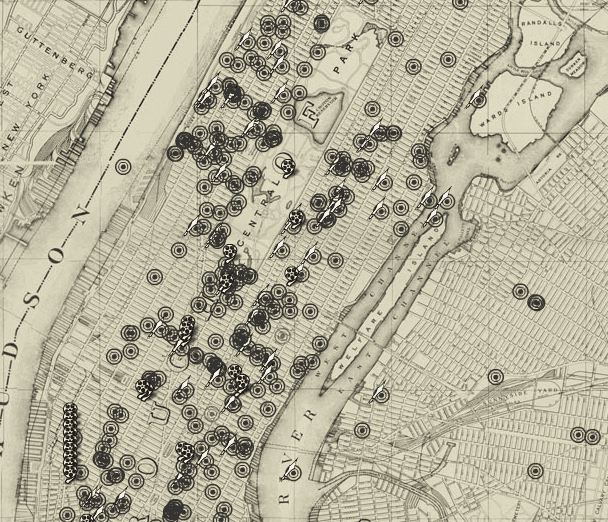
In order to provide a spatial context for this historical soundscape, the “Space” section arranges each sound entry onto a map of the city. Manhattan has the highest concentration, but you can find yelling newspaper vendors, saxophone playing neighbors and noisy radios in every borough. Many of these sounds reflect the unique cultural and ethnic character of New York’s neighborhoods: there is a Kung Fu demonstration on Chinatown’s Mott Street; an “Ol’ Clo'” Jewish peddler looking for clothing to buy on the Lower East Side; and ferry boat whistles along the Battery promenade. They also reveal an industrial city at work. Gotham echoed with dynamite blasting, steel factory operations, riveting, and boring machines.

Screenshot of the "Space" section, which arranges different sounds onto a map of New York City (The Roaring Twenties)

Screenshot of the “Space” section, which arranges different sounds onto a map of New York City (The Roaring Twenties)

But look closer and you’ll discover many sounds that will complicate our assumptions about what a “modern” industrial city sounded like. In 1930, Mr. W.C. Mansfield filed a noise complaint about an Upper West Side horse stable. That same year saw multiple complaints for rooster crowing in upper Manhattan as well as several sites in the Bronx. And in 1932, Mr. Arthur Campe of Brooklyn informed the city about one Mr. Johnson’s “noisy chickens.” New York did not just contain a diversity of sounds, but also a diversity of economies and lifestyles—both industrial and pre-industrial. Even as the jackhammering of factories and construction projects rang through the air, the neighing of horses and crowing of roosters were present as well.

Screenshot from the video "Fire Engines, and Children at Play" (The Roaring Twenties/NYC Dept. of Records, Municipal Archives)

Screenshot from the video “Fire Engines, and Children at Play,” circa 1928-30 (The Roaring Twenties/NYC Dept. of Records, Municipal Archives)

Books can elegantly describe trends like industrial growth and urbanization, but “The Roaring Twenties” goes deeper by uncovering the sonic minutiae that accompanied them: a noisy bakery on Ogden Avenue in the Bronx; dairy wagons bothering J. J. Cohen each day in upper Manhattan; or the early morning racket created by live poultry aboard the NY Central Railroad cars along Riverside Drive. And these sounds are not just pieces of trivia. They exhibit people, machines and animals projecting their unique way of life into the sonic atmosphere. This compelling and very addictive site captures New York City at its noisiest, most contested and loudest.

bugburnt

Catch up with the latest New Archives:

The Civil War, as seen by the artists of Harper’s Weekly

And an economic, demographic and oceanic history of the trans-Atlantic slave trade

Reagan on War: A Reappraisal of the Weinberger Doctrine, 1980-1984, by Gail E. S. Yoshitani (2012)

by Simon Miles

Few presidents have left as complicated and politically charged a legacy as Ronald Reagan. Hailed as a pioneer of conservatism by some and reviled as an enemy of the middle class and a supporter of dictators by others, Reagan’s legacy has largely been shaped by debate between partisan pundits. Gradually, however, a limited body of more moderate of “Reagan revisionism” has begun to emerge. Historians and political scientists, writing with the benefit of temporal distance from events and increased access to sources have begun to produce more nuanced accounts of the 51uDzi5S1DLReagan administration – especially in the realm of foreign policy – that acknowledge the administration’s shortcomings and its successes.

Gail Yoshitani’s Reagan on War is one such book. Yoshitani, a professor of history at the US Military Academy at West Point, offers an in-depth look at the Reagan administration’s development of a strategic doctrine for the use of force based on extensive archival research. She demonstrates how a doctrine for the use of force emerged, but also how the Reagan administration, and the president in particular, chose to either adhere to or eschew these doctrines depending on Reagan’s goals Throughout Reagan on War, Yoshitani asks two important questions. First, what role did Reagan personally play in shaping his administration’s foreign policy? Second, to what extent did Reagan’s advisors, neoconservative and otherwise, influence the administration’s foreign policy?

Yoshitani’s account of US foreign policy during the early 1980s places Reagan at the center of events. As president, Yoshitani argues, Reagan set the course for US Cold War strategy. His perception of American resources as infinite and his determination to rebuild not only US military and economic strength, but also the country’s morale, guided policy during the 1980s. Reagan firmly believed that the solution to America’s “Vietnam syndrome” was strong presidential leadership (which he felt had been particularly lacking during the preceding Carter administration) and “peace through strength.” Yoshitani is clear, however, that Reagan’s advisors were responsible for developing policies to achieve these goals.

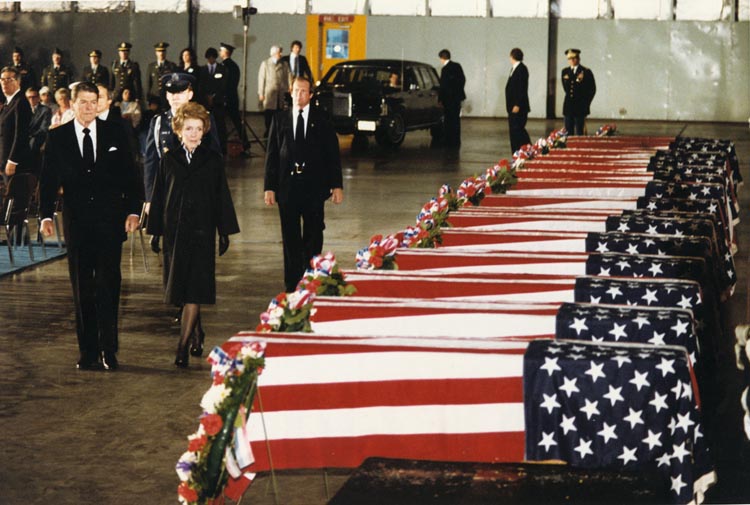
President Ronald Reagan and First Lady Nancy Reagan view the caskets of the 17 US victims of the 1983 attack against the US Embassy in Beirut (The Reagan Library)

President Ronald Reagan and First Lady Nancy Reagan view the caskets of the 17 US victims of the 1983 attack against the US Embassy in Beirut (The Reagan Library)

The key question faced by the Reagan administration in Yoshitani’s analysis was not only how to deal with the Soviet Union, but also when the United States should use military force overseas in the aftermath of Vietnam. Reagan’s advisors had differing policy prescriptions for this dilemma and Yoshitani examines the various doctrines proposed by Director of Central Intelligence William Casey, the Pentagon (in particular Chairman of the Joint Chiefs of Staff General John Vessey), Secretary of State George Shultz, and finally Secretary of Defense Caspar Weinberger. Casey’s approach to the use of force centered on proxy forces, usually the militaries of right-wing governments in Latin America, to repel communism. Proxy forces would bear the brunt of combat and create a permissive context for any future American military involvement, if desired, by cultivating a local perceived ally that the United States could support. Vessey and his Pentagon colleagues favored direct and decisive US engagement with limited, realistic goals, such as the removal of Palestinian Liberation Organization fighters from Lebanon. Shultz saw the military as a tool to be deployed in support of diplomacy. Deploying troops was a clear sign of resolve, he argued, but should be done sparingly to ensure that the Soviet Union would not feel compelled to become involved to counterbalance American involvement around the world. Weinberger, synthesizing these approaches, outlined six litmus tests for US policy-makers to govern the use of force: necessity to US or allied national interest; wholehearted commitment; defined political and military objectives; correlation between objectives and forces committed; public support; and the absence of a non-military alternative. Though Reagan did not always adhere to the Weinberger Doctrine, Yoshitani argues, it formed the heuristic framework in which the administration considered the use of force.

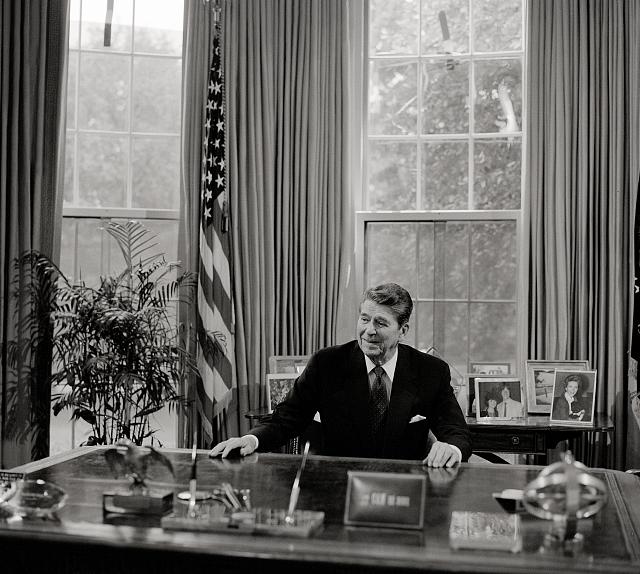
President Ronald Reagan at his desk in the Oval Office (Library of Congress)

President Ronald Reagan at his desk in the Oval Office (Library of Congress)

Yoshitani makes a valuable contribution to the historiography of Reagan’s foreign policy by exploring Reagan as an individual, his advisors, and their approach to policy-making and the Cold War. The 1980s are already fertile ground for historians, with ample material accessible at the Ronald Reagan Presidential Library, the National Archives and Records Administration, and in smaller repositories such as the Hoover Institution Archives. This valuable and insightful book will be of considerable interest to students of the Cold War.

More on the presidency of Ronald Reagan:

Joseph Parrott’s review of The Rebellion of Ronald Reagan: A History of the End of the Cold War

Dolph Briscoe’s review of The Age of Reagan: A History

Jonathan Hunt looks back on the 1986 Reykjavík Summit between Reagan and Mikhail Gorbachev


Persuasion, Propaganda, and Radio Free Europe: The New Archive (No. 9)

By Charley S. Binkow

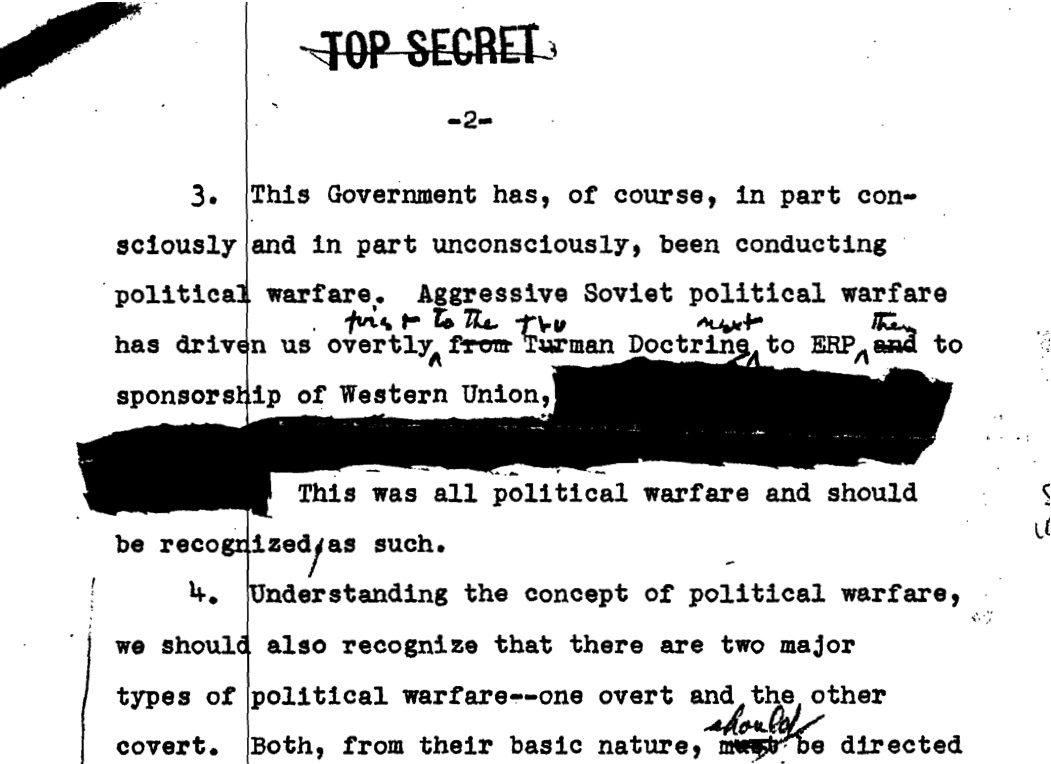
How does a nation fight a war of ideas?  When the battlefield is popular opinion, how does a state arm itself?  In 1949, the United States found its answer.  Their weapon: the airwaves.  The CIA launched Radio Free Europe in 1949 with the hopes of encouraging Eastern Europeans to defect from the Soviet bloc and weaken their countries from the inside.  The Digital Radio Free Europe and Radio Liberty archive gives us a declassified, thorough, and incredibly interesting view of the radio’s peak years between 1949 and 1972.

Kennan

“George F. Kennan on Organizing Political Warfare,” April 30, 1948 (Wilson Center Digital Archive)

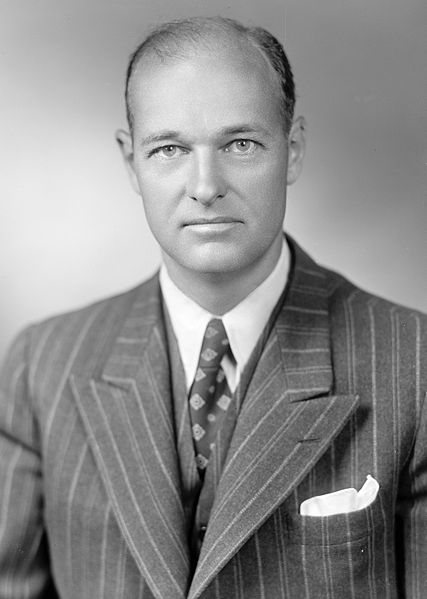
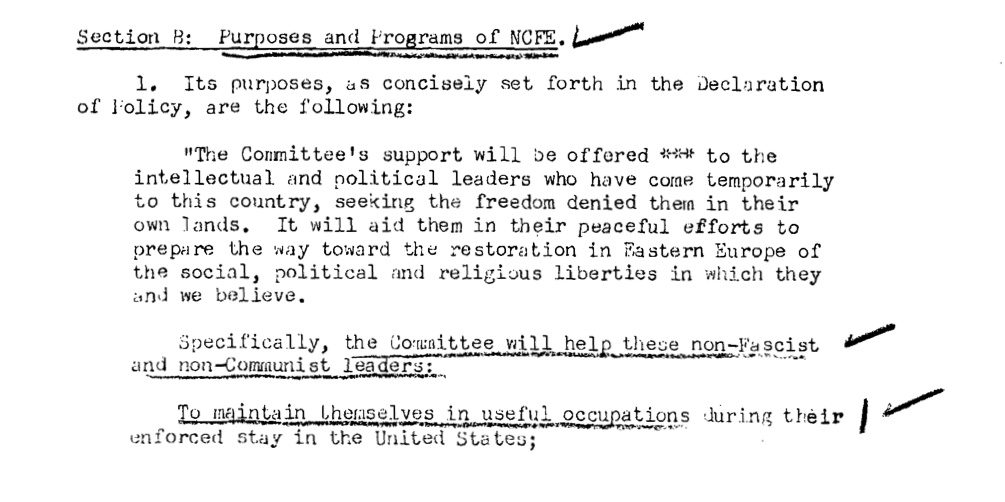
The RFE/RL collection of documents is among the many fascinating collections posted by the Wilson Center on its website: “Digital Archive: International History Declassified.”  It is a treasure trove of information. Memorandums, reports, and letters, all declassified by the Central Intelligence Agency, giving us an unseen history of the station.  You can see the beginnings of the program, when George Kennan (one of the architects of containment policy) stressed the need to inspire “continuing popular resistance within the countries of the Soviet World,” to its founding mission statement to “engage in efforts by radio, press and other means to keep alive among their fellow citizens in Europe the ideals of individual and national freedom.” The documents give us insight into uncertainties about the program as well.  Several statesmen had doubts, like Richard Arens, who claimed RFE was harboring Marxists and broadcasting socialist propaganda.  West Germany, where RFE was based, also felt a lack of control over the station and a sense of being used by the U.S.

George F. Kennan, 1947 (Wikimedia Commons)

George F. Kennan, 1947 (Wikimedia Commons)

My favorite part of the collection is its extensive collection of papers concerning the Hungarian Revolution of 1956.  RFE played an important role in the uprising, at least from the Hungarians’ point of view.  However, after the uprising failed, and public outcry blamed the United States and RFE for its inaction, the CIA tried its best to back peddle and “down play” the situation as much as possible.  Especially fascinating are the policy reviews after the Hungarian revolution (notably its concerns with Poland and Czechoslovakia).

Mission

“Understanding Between Office of Policy Coordination and National Committee
for Free Europe,” October 04, 1949, a document outlining the mission of the Free Europe Committee (Wilson Center Digital Archive)

This archive is easily navigable and well worth searching.  The Wilson Center also has a plethora of other digital archives, including documents on China, North Korea, Cuba, Brazil, and South Africa, as well as other archives on the Cold War in Europe and around the globe. But its collection on Radio Free Europe is an excellent place to start.

If you’re further interested in the Hungarian Revolution, you should also check out the Open Society Archives’ collection, which we featured here last week.

The Fish that Ate the Whale: The Life and Times of America’s Banana King, by Rich Cohen (2012)

by Kody Jackson

The best stories teach us without our knowing.  The best way to illustrate this, of course, is with a story.  When I was in elementary school, I had to memorize the prefixes of the metric system: kilo-, hecto-, deca-, base, deci-, centi-, milli-.  And I could never get it right!  It always went something like this: Kilo…Hecto…something else…pass…deci…I forget…umm.  All I ever wanted was to go back to feet and inches.  And so it went, until our fifth grade teacher introduced us to the magical phrase, King Henry died by drinking chocolate milk.  My teacher’s little jingle changed everything: King Henry made that infernal metric system memorable.  It was a wonderful lesson on the power of a story, one that has stuck with me to this day.

I would like to think Rich Cohen had a similar experience in his fifth grade classroom, one where he too learned how to defeat the evil metric system, but I cannot be sure.  All I know is that he holds story in the same esteem in his The Fish that Ate the Whale: The Life and Times of America’s Banana King. In the first couple pages, Cohen introduces his readers to his compelling protagonist, Samuel Zemurray, a poor Jewish immigrant to the United States who later came to embody the American Dream.

41lHqhh606L

The book’s first glimpse of Zemurray shows him working hard in his uncle’s Alabama grocery store, sweeping and cleaning, stacking and shelving, and always looking for an opportunity to succeed.  His real break comes when a banana peddler arrives in town.  Fascinated by the sight, Zemurray sets out to involve himself in the trade.  He begins selling freckled bananas, the ones thought too ripe for long-distance transport.  He finds a partner; they invest in a company.  They purchase banana ships.  Zemurray takes sole control, buys banana land in Honduras, and profits enormously.  The story reaches its climax when Zemurray ascends to the presidency of the United Fruit Company, one of the United States’ most dominant and successful monopolies of the late nineteenth century.  Even from this perch, Zemurray still embodies the underdog, fighting to maintain his banana empire, championing the noble cause of Zionism, and struggling to be accepted by mainstream America.  The story ends as a triumph that, while acknowledging certain mistakes, largely celebrating the life of Zemurray.  He was a self-made man, a shrewd banana tycoon, and, most importantly to Cohen, a Jew who succeeded in a hostile and prejudiced world.

Cohen’s story, on the whole, proves successful.  As a reader, one becomes so engrossed by Zemurray and his work ethic that one almost does not notice the technical descriptions of banana planting, the history lesson on U.S. trust-busting, or the explanations of Central American politics.  These chapters pass like clouds on a windy day, quickly and without much notice.  Thus, in terms of story, Cohen presents his readers with a tour de force.

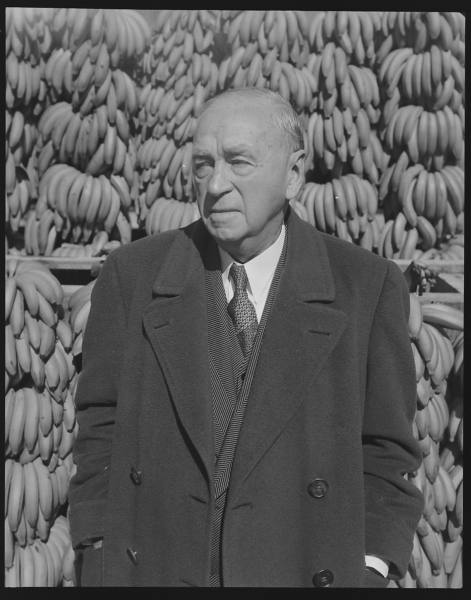
Samuel Zemurray, a Russian who rose to become a fruit magnate (Image courtesy of Peter Ubel)

Samuel Zemurray, the Russian immigrant who rose to become a giant in the American fruit industry (Image courtesy of Peter Ubel)

Stories, however, are never without their faults.  To accommodate his narrative structure, Cohen simplifies and whitewashes the actions of Zemurray and his fellow banana titans.  Rarely do abuse and corruption come up; even when they do, they are largely minimized.  In sum, Cohen tells a story of business decisions and individual effort, not exploitation and collective sacrifice.  Cohen falls most grievously into this trap when writing about Zemurray’s involvement in a Honduran coup.  With colorful mercenaries and crafty strategy, it starts to look more like a Wild West adventure than a violation of sovereignty.  Cohen gets so caught up in the romance that he forgets the other side of the story.  To neglect the Central American experience is like telling the Illiad without mentioning Priam’s grief or recounting the Crusades without mentioning the experiences of Muslims (or Byzantines, for that matter).  A more circumspect tale might have noted that triumphs for U.S. business, at least in this age, often played out as tragedies for a foreign people.

While The Fish that Ate the Whale oversimplifies the complex and glorifies the morally questionable, readers should evaluate it for what it truly is, a wonderful story.  Its quick pace and well-crafted characters make it exciting to read.  More than that, Cohen makes the history memorable, which is no small feat.  As such, it provides a great introduction to Central American history and a jumping off point for future research into the area.

You may also like:

Felipe Cruz’s review of Banana Cultures: Agriculture, Consumption & Environmental Change in Honduras and the United States


Sixteen Months in a Leaky Boat

by Kristie Flannery

A few weeks ago José Salvador Alvarenga drifted onto a small island in the South Pacific Ocean in a worn-out, 24-foot long, fiberglass boat, wearing nothing but a tattered pair of underpants. With the aid of a Spanish interpreter, Alvarenga explained to surprised locals that he had been lost at sea for at least sixteen months after his fishing boat was pushed out to sea off the coast of Mexico. He said that he stayed alive by catching and eating raw fish, turtles, and birds.

Media outlets around the world have rushed to tell Alvarenga’s amazing story of survival, but from the beginning they have doubted the veracity of the fishermen’s version of events. Underlying the media’s skepticism is the belief that it is simply not possible for a human to survive for so long at sea without food and fresh water.

Jose-Salvador-Alvarenga

Jose Salvador Alvarenga, who spent 13 months on a remote Pacific island, after being rescued. (Image courtesy of Mashable)

One Fox News article asked, “Was it all a mirage?” The Sydney Morning Herald described Alvarenga’s story as “a tale of ocean survival that smells a bit fishy.” Searching for holes in Alvarenga’s story, a number of reports pointed out that Alvarenga was rather plump for someone who had been through such an ordeal (Doctors later confirmed that his paradoxically bloated appearance is consistent with a state of long term starvation).

One Fox News article asked, “Was it all a mirage?” The Sydney Morning Herald described Alvarenga’s story as “a tale of ocean survival that smells a bit fishy.” Searching for holes in Alvarenga’s story, a number of reports pointed out that Alvarenga was rather plump for someone who had been through such an ordeal (Doctors later confirmed that his paradoxically bloated appearance is consistent with a state of long term starvation).

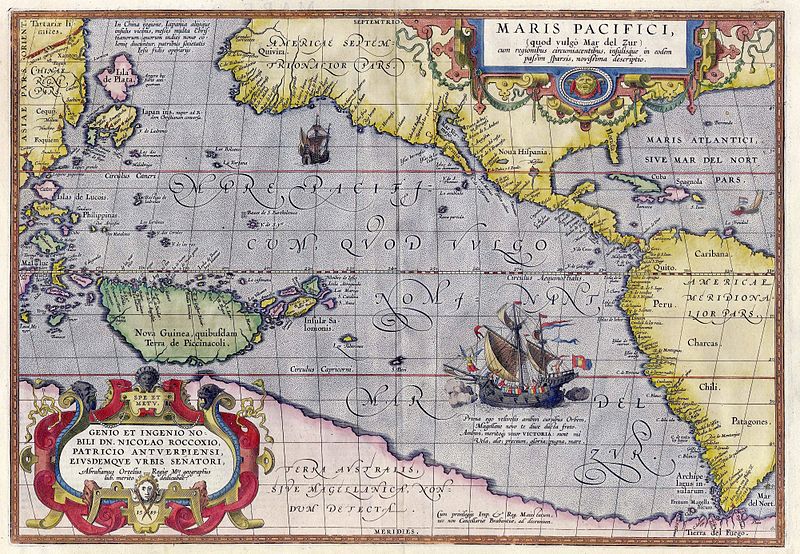
Could Alvarenga really have drifted for 8000 miles from Mexico to the Ebon atoll in the Marshall Islands? If we look into the history of the great Pacific Ocean, we find several stories of survival that suggest Alvarenga is telling the truth.

In his famous history of The Manila Galleon, William Lytle Schurz talked about the survivors of one of these large Spanish treasure ships that was lost crossing the Pacific from Mexico in 1693. Two men made it all the way to the Philippines in conditions similar to what Alvarenga endured (thanks to Steph Mawson for this reference). The Galleon‘s

fate was eventually learned from two men picked up long after near the town of Binangonan de Lampon. In the boat in which they had managed to reach the Philippines was the corpse of a dead companion. One of the two survivors had gone stark mad from his sufferings. Before the burning galleon had foundered six men put off from her side in an open boat and headed westward. After three weeks their food gave out and two of the starving men slid over the gunwales into the sea. Those who were left then ate their jackboots and their belts to stave of starvation. At last it was decided to draw lots as to which of the four should be eaten by the rest. One of the three preferred to starve rather than to turn cannibal. It was only the last two who survived these horrible experiences, one without his reason, the other broken by his sufferings and long under the shadow of the Church for having partaken of human flesh.

800px-Ortelius_-_Maris_Pacifici_1589

Maris Pacifici by Abraham Ortelius (1589), the first printed map of the Pacific and the Americas. (Image courtesy of Helmink Antique Maps)

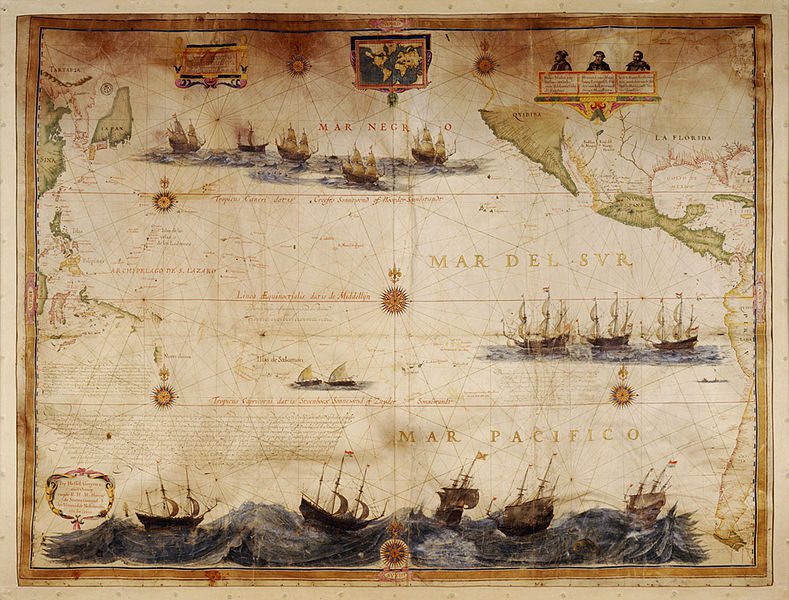
789px-Hessel_Gerritsz_-_Mar_del_Sur

Early 17th century map of the Pacific. (Image courtesy of Bibliothèque Nationale de France)

Perhaps the most famous Pacific castaway is the British Naval Captain William Bligh. In 1789, Bligh and eighteen of his men were forced to disembark from Bligh’s ship The Bounty and climb into a 25-foot long launch boat; a tiny vessel intended for carrying people and supplies from ship to shore. The mutineers surely believed that their deposed Captain and his supporters faced a certain death. Yet over the next forty-seven days, Bligh used a quadrant and a pocket watch to navigate the very crowded launch from near Tonga to the Dutch settlement at West Timor, a 4350 mile journey.

Amazingly, only one man died on this voyage. Greg Denning’s history of the mutiny Mr Bligh’s Bad Language: Passion, Power and Theatre on the Bounty wrote that:

“From [Bligh’s] careful record of every item consumed … the total food each man had in forty-eight days was this: seven pounds bread, one pound salt pork, one pint rum, five ounces wine, two and one-quarter coconuts, one banana, one pint coconut milk, one and one-quarter raw seabirds, four ounces fish … A sailor’s ordinary food allowance has been calculated at about 4,450 calories a day. On the figures I have given here a nutritionist estimates that the launch people were reduced to 345 calories a day. This would mean a possible daily energy deficit of 4,105 calories and a total weight loss of 56 pounds.

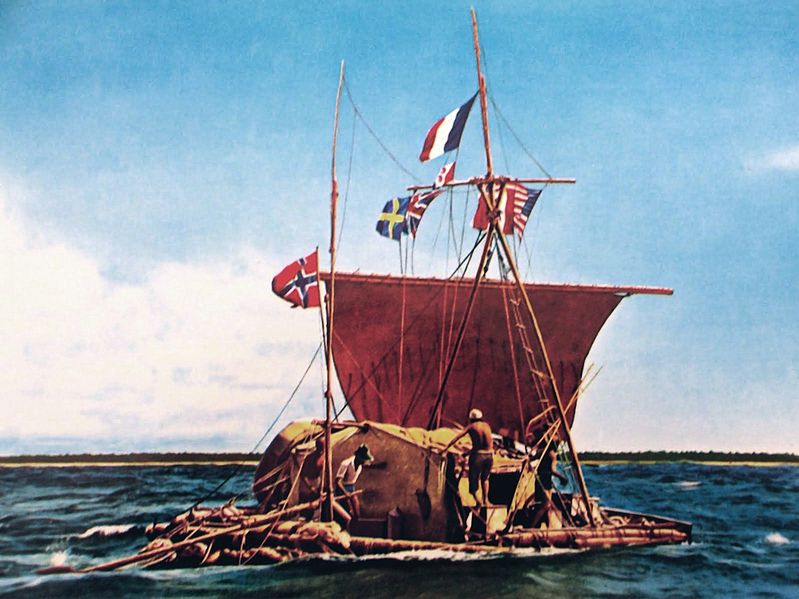
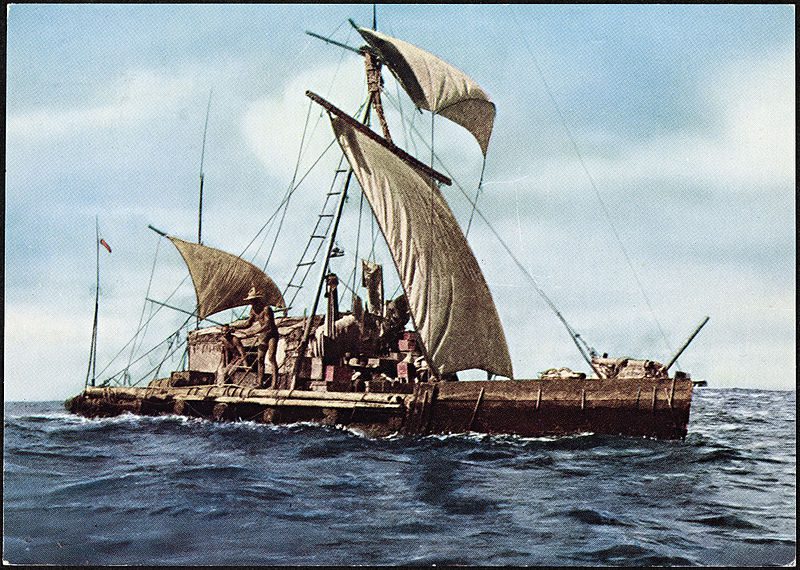
In 1947, the intrepid Norwegian anthropologist Thor Heyerdhal and five other men crossed the Pacific Ocean from Peru to Polynesia in a small, balsa-wood raft named “Kon Tiki” that Heyerdhal built with his own hands. The boat was a replica of a pre-Inca raft, and the purpose of this dangerous exhibition was to prove Heyerdhal’s theory that it was the South Americans who first discovered and populated Polynesia thousands of years ago using similar vessels.

799px-Kon-Tiki

Kon-Tiki raft, circa 1947 (Image courtesy of Wikimedia Commons

800px-Expedition_Kon-Tiki_1947._Across_the_Pacific._(8765728430)

A Kon-Tiki expedition across the Pacific, 1947 (Image courtesy of Wikimedia Commons)

Although the Kon Tiki’s voyage doesn’t exactly prove Heyerdhal’s origins theory, (which for most scholars doesn’t hold water), the fact that six men completed a 101-day long, 4300-mile voyage on a 40 square-foot raft was at the time, and continues to be, a pretty exciting feat. The raft didn’t have oars and couldn’t really be steered in any direction. Although the Kon Tiki was equipped with US army supplied food, the crew reported a rich supply of fish (and sharks!) in the warm-water currents that carried them to Polynesia. If you are interested in Heyerdhal’s adventure, the story of the Kon Tiki is told in Joachim Rønning and Espen Sandberg’s 2012 film, which is currently available on Netflix.

After reading this piece, you might agree that Alvarenga deserves an apology from the news outlets around the world who rushed to accuse the fisherman of fabricating his story. We historians of the Pacific world know that the history of this largest ocean is punctuated by amazing stories of survival that should be celebrated.

Further Reading:

Digitized version of William Bligh’s log book


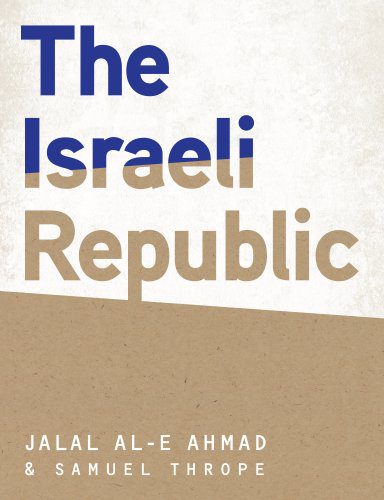
The Israeli Republic, by Jalal Al-e Ahmad (2014)

by Lior Sternfeld

In 1963 Jalal Al-e Ahmad, accompanied by his wife, the renowned Iranian novelist, Simin Daneshvar, traveled to Israel as an official guest of the country. He later wrote a travelogue about the journey, published in Iran under the title, Safr beh vilayet esrail (Journey to the Land of Israel). Two years earlier the author had gained his leftist internationalist credentials when he published one of the most important Third World manifestos, known as “Gharbzadegi” (Plague from the West). Al-e Ahmad is perceived to have laid the intellectual and ideological foundations of the 1979 revolution in Iran; both the leader of the Iranian revolution, Ayatollah Ruhollah Khomeini and Iran’s current Supreme Leader considered Al-e Ahmad to be an influence and role model. This article reviews the most recent translation of Al-e Ahmad’s travelogue, and will be useful to anyone wants to know more about modern Iran.

519goVFs4MLTranslator Samuel Thrope’s introduction allows the reader to understand the profound complexity that characterized Al-e Ahmad throughout his career. Thrope provides excellent biographical and historical contextualization of the text. He also confronts one of the profound dilemmas confronting Al-e Ahmad’s reader. The use of Vilayet in the title can be translated in two different ways. One is charged with religious meaning as “Guardianship of Israel,” while the second carries the more prosaic meaning of Territory. As the travelogue itself makes clear, Al-e Ahmad himself was divided about Israel’s role in that land.

Like a large section of the Iranian left, Al-e Ahmad viewed Israel as part of the Third World. Al-e Ahmad juxtaposes East versus West and draws the borders of the East from “Tel Aviv to Tokyo,” acknowledging Israel’s ability to create an indigenous culture (unlike in Iran, as he analyzed in Gharbzadegi), that did not blindly mimic other cultures but was based on the ancient Hebraic Jewish culture. Al-e Ahmad was especially impressed with the revival of the Hebrew language. His admiration for almost everything he saw in Israel, did not prevent him from arguing that the Palestinians, and by extension the East in general and the Arabs and Muslims in particular, paid the price for the sins committed by Europeans in the Holocaust.

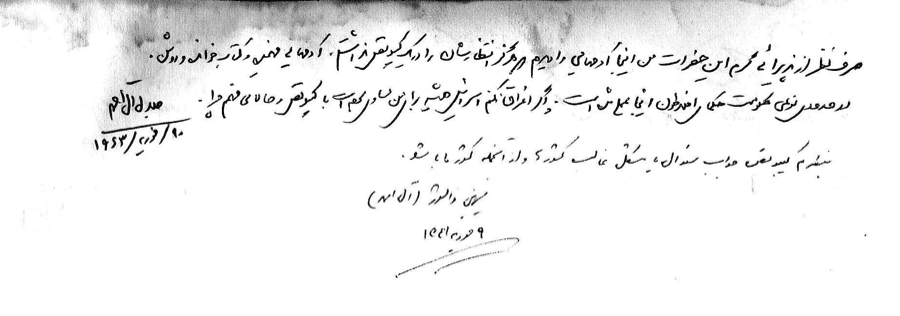
israelAl-e Ahmad and Daneshvar spent some time in the north Israel kibbutz “Ayelet Ha’Shahar,” which allowed the couple to get a first hand experience of kibbutz life. They saw a play, hung out with kibbutz members, and immersed themselves in conversations about China, the USSR, and Cuba over glasses of beer. Just before leaving, Al-e Ahmad wrote in the kibbutz guest book: “not only were they hospitable, but I met people here that I never expected to meet. Learned people, understanding and open-minded. In a sense, they are implementing Plato. Honestly speaking, I always identified Israel with the Kibbutz, and now I understand why.” Simin Daneshvar added: “as I see it the Kibbutz is the answer to the problem of all the countries, including our own.

This text opens a window to the mindset of the Iranian left. Al-e Ahmad’s praise of Israel articulates his (and other Iranians’) dispute with the Arabs, his harsh criticism of Arab governments, and refutes Arab ideas about Iran’s inferiority.

800px-PikiWiki_Israel_3290_Picking_Cotton

Cotton fields of a kibbutz in Shamir, Israel, circa 1958 (Image courtesy of Wikimedia Commons)

The last chapter of the travelogue shifts tone and criticizes Israel for abandoning its Third World position and becoming a colonial power in its own right.  The origin of the chapter is the subject of some controversy. Some believe that it was written in 1968 after the 1967 war and just before Al-e Ahmad’s death (in 1969), and reflects his own and the Iranian left’s disillusion with Israel. During the 1967 war, when Israel occupied the Sinai Peninsula, the West Bank, and the Golan Heights and then imposed military control over the entire population of non-citizen Palestinians., it became impossible for observers like Al-e Ahmad to view it as a nation that had taken part in a postcolonial struggle. The other explanation is that after his death, this chapter was written by his brother, Shams Al-e Ahmad, in order to get it approved in the radical revolutionary circles, for publication in Iran in 1984. Thrope adds some useful comments about this controversy as well. Thrope’s suggests that it was Jalal Al-e Ahmad himself who wrote this chapter, and that the voice expressed there is one of a literary character (a friend who wrote a letter to Al-e Ahmad). By presenting this fictional dialogue, Al-e Ahmad contemplates his ambiguous stand towards Israel and Zionism, or as Thrope writes: “Could Zionism really serve as a model for the remedy that Iran required? Just as importantly, as a Muslim, an Easterner, and an intellectual opposed to the Shah’s policies, which included close relationship with Israel, how should he relate to the Jewish State’s existence in the heart of the Muslim Middle East?” In this chapter, Al-e Ahmad not only criticized Israel as a colonial power, he harshly criticized the European intellectual left and singled it out for what he sees as double standards. While they vehemently fought against the colonization of Algiers and were outspoken in their criticism of the colonial project as a whole, they could live peacefully with the colonization of the territories gained by Israel in 1967. Al-e Ahmad blames Jean-Paul Sartre and Claude Lanzmann for leading this dreadful trend. He also blames the military regimes of the Arab countries for their incompetence in facing the changing reality of Israeli policy, and the “Petrodollar Empires” of the Persian Gulf for myopic political and economic goals in only caring about the oil industry.

daneshvar11

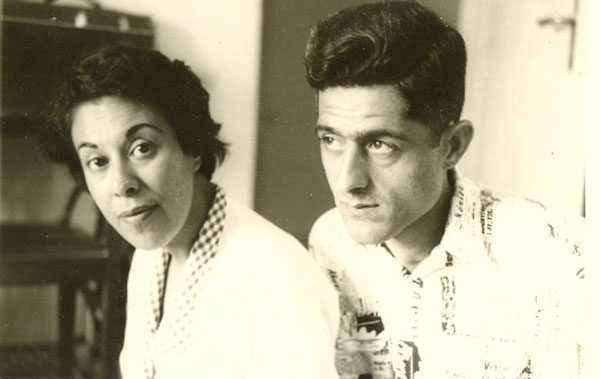
Jalal Al-e Ahmad (r) with his wife, writer and intellectual Simin Daneshvar (l), in an undated photograph (probably from the early 1960s).

This book recounts a fascinating journey undertaken by an Iranian intellectual to an Israel that existed primarily in the author’s mind. The kind of utopia Al-e Ahmad saw would strike many Israelis as odd. Yet, I am sure that every reader would find this book (and its excellent translation) to be a window on the prerevolutionary Iranian left at a time when it was possible for an Iranian intellectual to embrace certain aspects of Israeli society; to get a glimpse of the history of the Israel-Iran relations and the greater Middle East too.

bugburnt


Listen to an interview with translator Samuel Thrope on 15 Minute History

Image of kibbutz guest book reproduced with the kind assistance of archivist Noa Herman at the archive of Kibbutz Ayelet Ha’Shahar.


Sound Maps: The New Archive (No. 6)

By Henry Wiencek

In the study of history, it’s easy to fall back on national identities: “Irish music,” an “English accent,” “American Exceptionalism” are just a few examples. But a closer examination of the local cultures—music, dialects, history—that exist within nations demonstrates how misleading those generalizations can be. Just look through one of the British Library’s “Sound Maps” and you’ll be convinced. This remarkable site takes many of the library’s 50,000 recordings of music, regional accents, and oral histories and arranges them geographically on Google Maps. The project is at once global and local—each sound map is an aural window into a unique part of the world. You can hear birds chirping in Algarve, Portugal, a folksinger perform in Carlistrane, Ireland, or the local dialect in Morton, Mississippi.

US_AccentsOne of the most fascinating—and addictive—features on the site is “Your Accents,” a global map of the world’s seemingly endless variety of dialects. The map features recordings of people from across the globe reading the same English phrases, allowing listeners to discern how each locality articulates “scone,” “garage” and “schedule” among other richly pronounceable words. The most immediate differences are apparent along national lines, as English, Indian, American, and various other accents contour the words in unique ways. But the map goes even deeper—revealing the astonishing regional differences that exist within those nations. Although people from Brighton and Leeds ostensibly share an “English” accent, the sonic differences between them are vast.

Holocaust

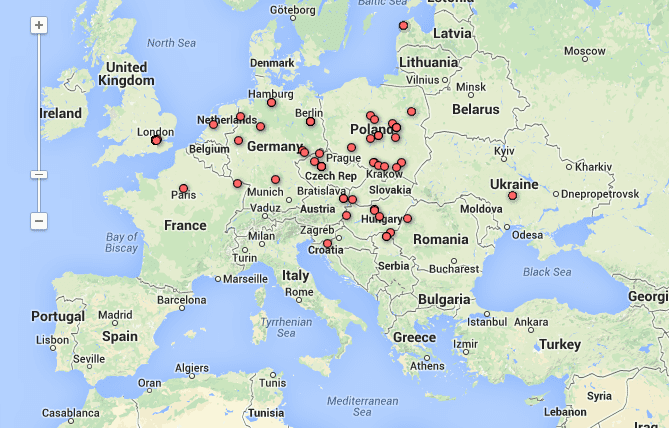
Other sound maps use the same technology to tell far more sobering stories. “Jewish Survivors of the Holocaust” archives oral histories of that traumatic epoch. Again using Google Maps, the page arranges survival stories based on geographic origins: individuals from France, England, Germany, Poland and even Azerbaijan are all represented. These unique and deeply affecting histories underscore the striking heterogeneity of the Holocaust’s victims and survivors. They were rich and poor; came from big cities and small towns; and identified as religiously devout and irreligious. By mapping their oral histories, the British Library visually captures that geographic and experiential diversity.  And by letting them speak, reinforces the kinds of variations that get flattened out or even erased when reading text on a page.

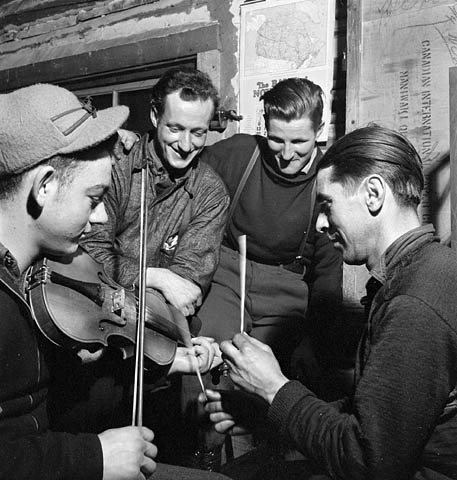
lumbermen_violin_and_sticks_1943The British Library’s “Sound Maps” is an invaluable tool for anyone interested in hearing what the world sounds like. Cultural historians and preservationists will take particular interest in the collections of music and dialects—time capsules of old folkways quietly vanishing in a globalizing world. Readers may note the site’s emphasis on English speaking regions, especially the UK, but the geographic breadth of its collection remains deeply impressive. These maps do not just capture the sounds of the world, they capture its most compelling minutiae: the small town pubs, the remote jungles, and the fascinating people.

Explore the latest finds in the NEW ARCHIVE:

Charley Binkow on iTunes’s salute to Black History Month

And Henry Wiencek finds a new way of looking at Emancipation

Photo Credits:

Screenshot from “Your Accents” sound map (Image courtesy of the British Library)

Screenshot from “Jewish Survivors Of The Holocaust” sound map (Image courtesy of the British Library)

Quebecois lumbermen making music with a violin and sticks, 1943 (Image courtesy of National Film Board of Canada)

Getz/Gilberto Fifty Years Later: A Retrospective

by Edward Shore

“I’m not a sociologist but it was a time when people in the States wanted to turn to something other than their troubles,” Brazilian singer Astrud Gilberto mused in 1996. “There was a feeling of dissatisfaction, possibly the hint of war to come, and people needed some romance, something dreamy for distraction.” This year marks the fiftieth anniversary of 1964’s Getz/Gilberto, the triumphant collaboration between North American jazz saxophonist Stanley Getz (1927-1991), Brazilian singer and guitarist João Gilberto (b. 1931), his then-wife, Astrud Gilberto (b. 1940), and their friend and compatriot, the composer Antonio Carlos “Tom” Jobim (1927-1994).

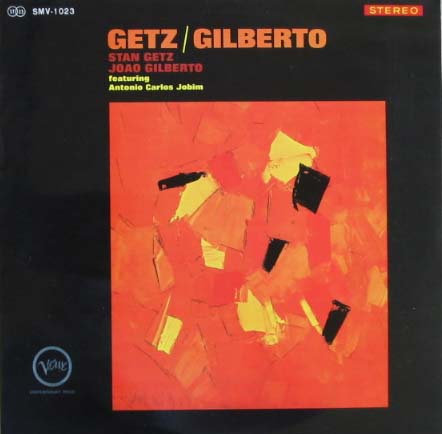
getz-gilberto_0Getz/Gilberto was not North America’s first encounter with bossa nova, the lyrical fusion of samba and cool jazz emanating from the smoky nightclubs, recording studios, and performance halls of Rio de Janeiro in the mid-1950s. Yet the eight-track LP was by far the most successful. Propelled by the genre-defining single, “The Girl From Ipanema,” Getz/Gilberto spent ninety-six weeks on the charts and won four Grammy awards, including Best Album of the Year in 1965. Other tracks, including “Para Machucar Meu Coração,” “Desafinado,” and “Corcovado/Quiet Nights of Quiet Stars,” also became jazz standards. “Americans are generally not very curious about the styles of other countries,” Astrud Gilberto insisted. “But our music was Brazilian music in a modern form. It was very pretty and it was exceptional for managing to infiltrate America’s musical culture.”

What explains Americans’ love affair with bossa nova in the winter of 1964? Part of the answer lies in the power of popular music to relieve a broken heart. Critics associated Getz/Gilberto’s cool, sophisticated sound with the Kennedy White House, where music, high fashion, and glamorous parties had been hallmarks of “Camelot” on Pennsylvania Avenue during the early 1960s. Perhaps audiences sought to recapture a bit of the mystique that had vanished when President Kennedy was slain in Dallas, Texas, only five months before the record’s release.

getz_gilberto_01For jazz critic Howard Mandel, Getz/Gilberto was like “another tonic for the assassination’s disruption, akin for adults to the salve upbeat the Beatles had provided for teenagers’ after their appearance on the Ed Sullivan Show in February 1964.” Gilberto’s hushed vocals and understated guitar, Jobim’s gentle piano, and Getz’s lush saxophone transported weary listeners to a sun soaked, tropical paradise light years removed from the turmoil confronting the United States in the winter of 1964.

Yet the Brazil of North American fantasy–languid, exotic, and serene–contrasted sharply with reality. By late 1963, the United States had declared Brazil a “trouble spot” in its hemispheric crusade against communism. Traditional elites and U.S. Cold Warriors opposed Brazilian President João “Jango” Goulart and his center-left agenda, which extended voting rights to illiterates, taxed foreign corporations, and introduced land reform. Meanwhile, peasant agitation in the Brazilian Northeast, the fulcrum of the global sugar trade, deepened the anxieties of U.S. policymakers who feared that Latin America’s largest economy might soon follow in Cuba’s footsteps. In March 1964, the Lyndon Johnson administration and the Brazilian military secretly began plotting Goulart’s overthrow.

002marchaWhile “The Girl from Ipanema” climbed to the top of the Billboard charts, U.S. warships penetrated Brazilian waters to support a military coup d’état on April 1, 1964, terminating the country’s brief flirtation with social reform. The United States had once again intervened in Latin America to preserve an illusion of tropical tranquility that existed only in the imaginations of ruling elites, intelligence agencies, and North American consumers. The military dictators who succeeded Jango and controlled Brazil for the next two decades understood the uses of music just as well and embraced bossa nova for its commercial appeal, apolitical subject matter, and potential to smooth over the nation’s deep-seated socio-political divisions.

Yet the marriage between bossa nova and the dictatorship was not to last. A younger generation of Brazilian artists, including Caetano Veloso, Gal Costa, Gilberto Gil, Rita Lee, and Tom Zé, fused elements of bossa nova with rock n’roll, psychedelia, experimental theatre, and Brazilian folk music into the colorful, exuberant countercultural movement known as Tropicália. Gone was the “tall, tan, young, and lovely” morena of Ipanema Beach. By 1968, the regime’s censors raced to cleanse Brazilian popular music of anti-establishment themes, even forcing Caetano Veloso and Gilberto Gil, two of the country’s most visible stars, into exile in the United Kingdom. The coup government ultimately turned its back on bossa nova, too. In 1969, the regime sacked Vinícius de Moraes from his post in the Foreign Ministry after the legendary composer, playwright, and original author of “The Girl from Ipanema” criticized the dictatorship’s restraints on artistic freedom.

getz_gilberto_02Popular interest in bossa nova continued to wane over the course of the 1970s. Outraged by U.S. sponsorship of the military regime, Brazilian musicians distanced themselves from a style that enjoyed intimate ties to the “giant from the North.” A blend of rock, samba, and jazz known as MPB, or “música popular brasileira,”eclipsed bossa nova as Brazil’s national sound. MPB artists like Chico Buarque, Jorge Ben, and Novos Baianos camouflaged criticisms of government repression, social injustice, and imperialism with irresistible melodies, appealing to a growing audience of middle-class youth. Meanwhile, in the slums and favelas of Rio de Janeiro, São Paulo, and Salvador, a young generation of Afro-Brazilians challenged the nation’s vaunted reputation as a “racial democracy,” while embracing cultural symbols of Black Power and the African Diaspora, including soul, funk, and reggae. Amid this rising tide of popular protest against the regime, bossa nova, with its dreamy, cool detachment, appeared painfully at odds with the struggles of ordinary Brazilians.

Still, the genre remains a major force in Brazilian pop culture and “world” music. The millions of tourists who visit Rio de Janeiro every year arrive at an airport named after Tom Jobim. Inevitably, more than a few vacationers board their flights home in “Girl from Ipanema” t-shirts purchased at the airport gift shop. Bossa nova also experienced a brief resurgence in the mid-1990s. Red Hot+Rio, a compilation album produced by the AIDS-awareness organization Red Hot in 1996, paid tribute to the musical career of Tom Jobim and featured covers by artists including Sting, Astrud Gilberto, and David Byrne. Today, pop stars like Marisa Monte, Celso Fonseca, and Uruguay’s Jorge Drexler refashion bossa nova sounds for contemporary audiences. And what about the song that made bossa nova an international sensation? “The Girl From Ipanema” currently ranks as the second-most-recorded pop song of all time, after the Beatles’ “Yesterday.” Amid the pageantry surrounding the upcoming FIFA World Cup and the 2016 Rio Olympic Games, look for “The Girl From Ipanema” to sway gently back into the spotlight.

Stan Getz and Astrud Gilberto perform “The Girl From Ipanema” in 1964:


bugburnt


Hear more Bossa Nova:


João Gilberto and Antonio Carlos Jobim in a 1992 live concert

Elis Regina and Tom Jobim performing “Aguas de Março” in 1974


Astrud Gilberto’s comments can be found in “Interview with Astrud Gilberto,” by Howard Mandel, Verve Records, Re-issue of Getz/Gilberto, 1996, liner notes.

Howard Mandel’s comments come from correspondence with the author, January 2014. A special thanks to him from the author.

Photo Credits:

1964 LP cover of Getz/Gilberto (Image courtesy of Verve Records)

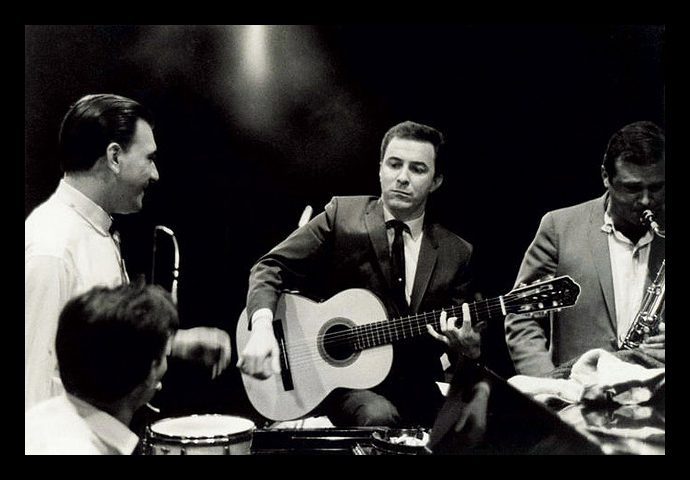
Creed Taylor, Antonio Carlos “Tom” Jobim, João Gilberto and Stan Getz recording together (Image courtesy of last.fm)

Brazilians marching against the country’s military dictatorship, 1964 (Image courtesy of Mount Holyoke College)

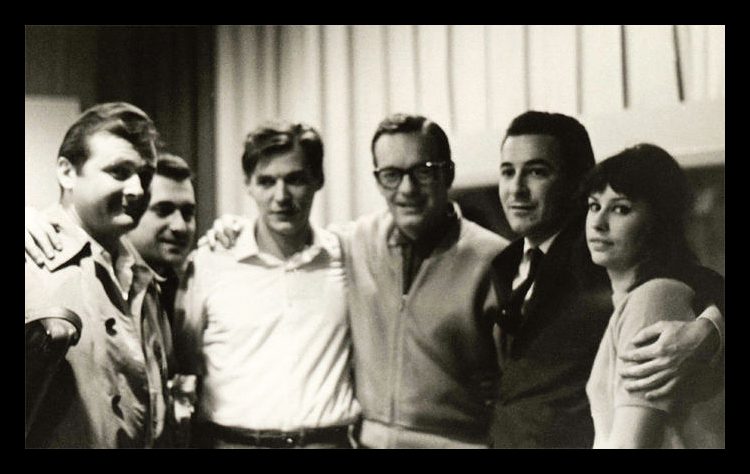
Musical team on Getz/Gilberto: (from left) Stan Getz, Milton Banana, Tom Creed Taylor, João Gilberto and Astrud Gilberto (Image courtesy of last.fm)

Images used under Fair Use Guidelines


The 1980 Moscow Olympics and my Family

by Andrew Straw

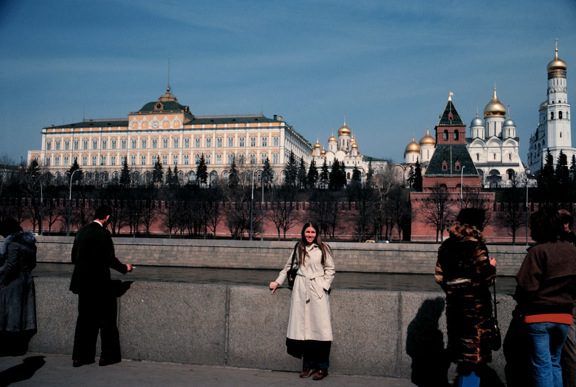
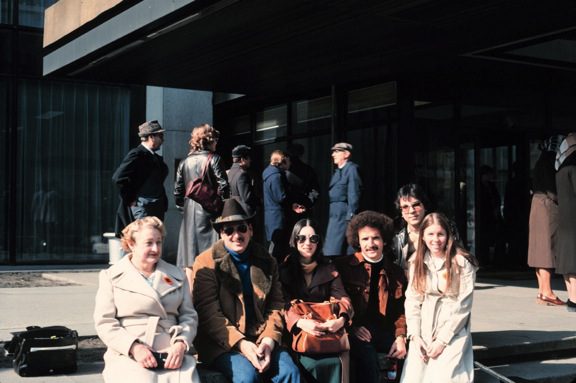
My mother, Rae Straw, and her friend Pam had an odd assignment in 1979 for two travel agents from Houston: selling the Soviet Union to American tourists.  For travel agents, such familiarization or “FAM” trips were a regular occurrence, but going to the Soviet Union during the preparations for the 1980 Moscow Olympics was a unique experience.  While Red Square, the red stars on Stalinist buildings, the Moscow Metro, and the Hermitage dazzled my mother, her biggest impression was the shear excitement of Soviet citizens at hosting the world.  In fact, despite Cold War tensions, since Khrushchev’s “Thaw” Soviets had enjoyed hosting foreigners at a number of international festivals.  American citizens and culture were literally transported to Moscow during the World Youth Festival in 1957, and the 1959 “American Exhibition” in Moscow attracted several million Soviet citizens who came to gaze at American consumerism.

Similar to the ongoing Sochi Winter Olympics, impressive preparations for the 1980 Moscow games were surrounded by domestic repressions, corruption, and strained international relations with the West.  Despite these similarities, there are obvious differences, particularly the Soviet invasion of Afghanistan and the subsequent American-led boycott of the Olympics.  However, most reporting (aside from The Daily Show’s Jason Jones) has missed another big difference between the atmosphere surrounding both events: the fact that American consumer goods no longer have the potential to transform the way Russians view their state in comparison to the rest of the world.

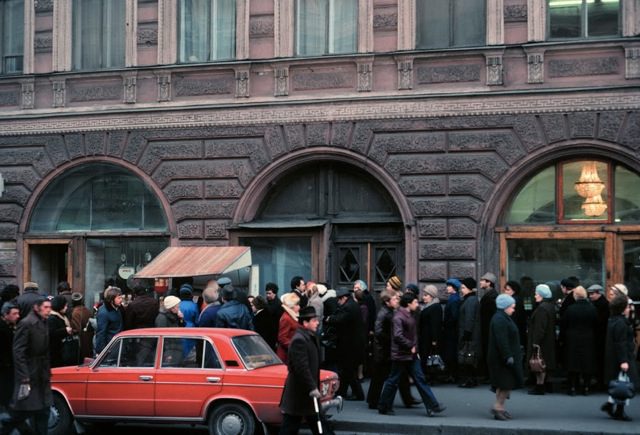
rae_kremlinThe irony of the 1980 boycott was that it nixed an influx of American products, people, and ideas into Moscow just at the time a younger and more liberal generation of Soviet politicians and “Baby Boomers” were rising through the ranks of the Soviet system and the growing middle class desired an increase in opportunities, freedoms, leisure activities, and consumer goods.  Even if most did not actively challenge the Soviet system, many wanted to experience Western culture and comforts. In this Cold War context, promoting American consumerism, music, high wages and a “life without queues” was the most attractive part of U.S. modernity. While there is no consensus on how crucial “soft power” was in deciding the outcome of the Cold War, many Americans understood the Soviet affinity for U.S. consumerism and pop-culture. Both U.S. government and businesses sponsored the post-Stalin “American invasion” that included Jazz radio programming, political propaganda, tours of musicians, student exchanges, and exhibits of American goods.

st_petersburg_streetEven though travelers such as my mother had little intention of converting communists to capitalists, they loaded suitcases with cigarettes, chewing gum, pens, and blue jeans.  Once in Moscow, my mother and her companions sold and bartered their Western-made goods a few blocks from the Rossiya Hotel in central Moscow.  But after my mother returned to the U.S., the boycott was announced and her work of selling the Olympic host to Americans and the chance for going back to the USSR ended.

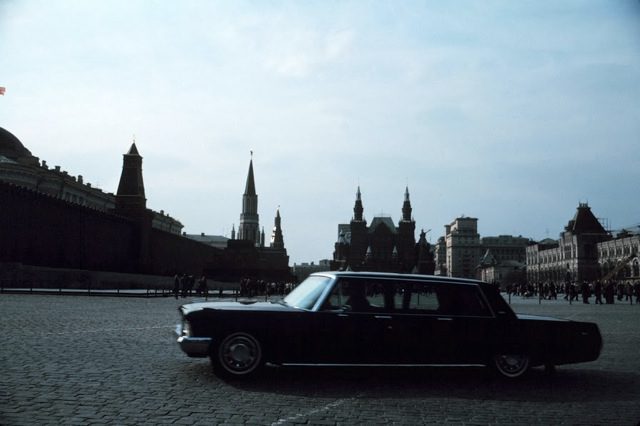
kremlin_limoMeanwhile, my future father-in-law, Nail Aminevich Izmaylov, was a driver with the Academy of Sciences Institute in Moscow, and through connections he got a job as a stand-by driver for foreign tourists at the Olympics.  While the American-led boycott was a huge disappointment for sports fans, he described the most depressing part as knowing that “business opportunities” for buying Western goods and then profiting on the black market would be limited.  Still, the games went on, and drivers prepared by keeping a “driver’s komplekt” of terrible Soviet cigarettes, damp matches, and a broken pen.  The idea was, once the chauffeured visitors tried one of these Soviet items, they would immediately offer their own or treat the driver to a shopping spree of Western goods in one of the stores where only foreigners were allowed to shop.

group_moscowThis dynamic of the event as an influx of superior consumer goods is absent in Sochi.  Instead, Bosco, the Russian designer brand with ties to the Kremlin, designed the high-quality team uniforms, which are available in shopping centers throughout the country.  In general, U.S. fashion and music have largely lost the subversive appeal as Putin’s “Sushi Years” have led to a continued consumerist bonanza that the majority of Russians have enjoyed to varying degrees.  In short, Putin has replaced the one-party communist state with a one-party consumerist state.

As my mother and father-in-law watched the Sochi opening ceremony, they reflected on the boycott and 1980 Moscow Olympics with both nostalgia and disappointment.  On the one hand, it was a period when adventurous visitors provided a profitable opportunity to savvy Soviets by transporting everyday Western goods into the Soviet Union.  On the other hand, the boycott and disappointment of not being able to show Americans around Moscow remains for both my mother and father-in-law.   While not shying away from acknowledging the current issues from Ukrainian protests to corruption to anti-LGBT laws, both were pleased that athletes and fans from across the world were participating in the games.

More reading on the Cold War and the Soviet Union:


Donald J. Raleigh, Soviet Baby Boomers: An Oral History of Russia’s Cold War Generation


Walter Hixon, Parting the Curtain: Propaganda, Culture, and the Cold War 1945-1961


Stephen Kotkin, Armageddon Averted: The Soviet Collapse, 1970-2000


Photo Credits:


Rae Straw standing alongside the Moscow River


A queue of Russians in St. Petersburg


A limo parked in Moscow’s Red Square


Rae Straw (far right) pictured with her tour group in Moscow


All images courtesy of Andrew Straw


« Previous Page
Next Page »

Recent Posts

  • The Radical Spanish Empire Roundtable – Introduction
  • All Eyes on the Petition: Reflections on The Radical Spanish Empire
  • Forgery, Invention, and the History of Skepticism in The Radical Spanish Empire
  • Iberian Subaltern Political Philosophies and The Radical Spanish Empire
  • Lawfare and the Legal Construction of Race in The Radical Spanish Empire
NOT EVEN PAST is produced by

The Department of History

The University of Texas at Austin

We are supported by the College of Liberal Arts
And our Readers

Donate
Contact

All content © 2010-present NOT EVEN PAST and the authors, unless otherwise noted

Sign up to receive our MONTHLY NEWSLETTER

  • New
  • Features
  • Reviews
  • Texas
  • Teaching
  • Digital
  • Watch & Listen
  • Authors
  • About